Information Retrieval · arXiv:2610.36763 v1 · submitted 27 Oct 2026 · 34 references
The Vocabulary Is Already Here: Adapting Pretrained Interpretable Features for Generative Recommendation
The paper says
“Generative recommendation (GR) predicts the next item through its semantic ID (SID). Existing methods commonly fit SID vocabularies to pretrained language model (PLM) representations of item descriptions, incurring additional training costs and making vocabulary coverage dependent on the fitting domains.”
more of the abstract
We observe that pretrained sparse autoencoders expose PLM features with human-interpretable semantic annotations, allowing feature indices to serve as a reusable SID vocabulary. However, reusing this vocabulary requires preserving item distinctions under compact token budgets and learning to favor target items over candidates with shared dominant features. It also requires extending feature interpretability from item content to retrieval decisions. To address these challenges, we propose API, a framework that Adapts the Pretrained Interpretable vocabulary for effective and explainable GR without additional vocabulary learning. Within API, Pretrained Interpretable IDs (PIDs) retain selected feature indices and relative activation strengths for item discrimination. With PIDs as supervision, the Semantic Prediction Adapter (SPA) learns user preferences from interaction histories through joint feature-index and strength prediction. SPA combines both predictions to score candidate items, with item-level supervision encouraging the observed next item to outrank its alternatives. API further explains candidate score differences through feature contributions paired with their pretrained semantic annotations. Extensive experiments show that API achieves competitive performance across backbones and decoding schemes, while preserving item distinctions under compact token budgets and enabling explainable retrieval.
from the abstract
Pith says
Machine review · deepseek-v4-flash · 28 Oct 2026 · what was read was not recorded · not checked by a person
It can be wrong. Challenge this review or reply to it.
Holds up, with conditions. Frozen SAE features as a GR vocabulary is a neat idea, but the theoretical ranking guarantee looks unverified and the practical gains are modest. This line is wrong
3 major objections · 6 minor
How often objections from reviews like this one are right: not yet measured
Not checked: figures, code, what the 34 references say.
The paper says, at §4.3, Proposition 4.2
The review did not quote this passage.
Pith says: Objection 1 of 3 · major
The paper states that the condition ε_u < Δ_q/4 (where ε_u is the SPA's strength prediction error and Δ_q the true strength separation) guarantees that the target item outranks a competitor sharing the same feature-index sequence. However, ε_u and Δ_q are never measured or reported on any dataset.
more of objection 1
The ablation study in Table 5 shows that adding strength prediction alone (without preference alignment) degrades NDCG@10 on all three datasets (e.g., Beauty: 0.02959 → 0.02833), which suggests that ε_u is often not smaller than Δ_q/4. The paper must empirically verify this condition or provide an alternative justification for when and why strength prediction helps. Without this, the theoretical support for strength-based item discrimination is substantially weakened, and the incremental benefit of retaining relative strengths in PIDs becomes questionable.
The paper says, at §4.1, Eq. (4)
The review did not quote this passage.
Pith says: Objection 2 of 3 · major
The selection priority formula π_{ij} = log(1+a_{ij}) log(1/ρ_j) is introduced as a heuristic without theoretical derivation or justification. While it is shown empirically to reduce collision rates, the paper does not discuss why this specific form (product of log strength and inverse prevalence) is chosen over alternatives (e.g., TF-IDF variants, additive combinations, or learned selection). The authors should provide a rationale or at least a brief ablation study comparing different formulations to support the design choice.
The paper says, at §4.1, Proposition 4.1
The review did not quote this passage.
Pith says: Objection 3 of 3 · major
The bound on the number of items sharing the same PID involves parameters Δ (minimum pairwise PLM distance) and ε (reconstruction error), which are not estimated or bounded from data. The paper should report approximate values of Δ and ε for typical items in the datasets to indicate whether the bound is informative. Without such calibration, the proposition remains abstract, and the claim that 'the strengths can distinguish items when Δ > 2ε+δ' is not connected to practice.
6 minor objections
The paper says, at §5.6, Figure 4
Pith says: minor objection 1 of 6
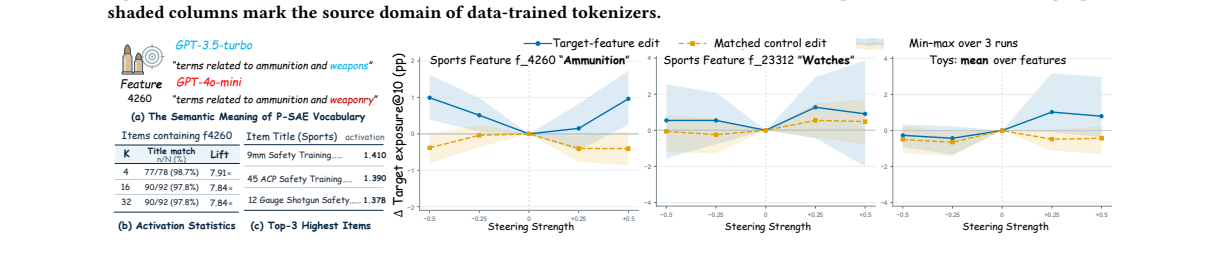
The steering experiment in Figure 4 (right panel) reports '∆ Target exposure@10 (pp)' on the y-axis, but the legend labels 'Target-feature edit', 'Matched control edit', and 'Min–max over 3 runs' are difficult to distinguish. Please use distinct line styles or markers for clarity.
The paper says, at §5.5, Figure 3
Pith says: minor objection 2 of 6
In the bar charts, the color coding for different methods is described only in the caption; it would be helpful to add a direct legend inside the figure for readability.
show 4 more
The paper says, at §3, Eq. (2)
Pith says: minor objection 3 of 6
The reconstruction formulation uses decoder columns d_j constrained to unit norm (in practice). The paper should state this explicitly in the main text, as it is used in Eq. (3) implicitly.
The paper says, at §B.1, proof of Proposition 4.1
Pith says: minor objection 4 of 6
The step where ∥u_{c_r}∥_2 ≤ 1 is used. This follows from the assumption that decoder columns are normalized; this assumption should be stated before the proof.
The paper says, at §5.1, Table 1
Pith says: minor objection 5 of 6
The baseline 'Ghost (2026)' is cited with reference [27], but the paper does not mention the Ghost method in related work; adding a brief description of how it compares would help the reader.
The paper says, at §2, 'Generative recommendation and item tokenization'
Pith says: minor objection 6 of 6
The paper cites 'text-to-text formulation [4]' but does not clearly distinguish between text-based SIDs and structured SIDs (like TIGER). A clarifying sentence would be useful.
What would settle it
On any held-out test set, compute for each pair of items that share the same top-K feature-index sequence (e.g., K=4): (1) the true strength separation Δ_q = D_H(q_i+, q_i-); (2) the SPA's strength prediction error for the target ε_u = D_H(q̂_u, q_i+). Report the fraction of such pairs satisfying ε_u < Δ_q/4. Also report the mean and standard deviation of ε_u and Δ_q. If the condition holds for fewer than, say, 80% of cases, then Proposition 4.2 provides little practical guarantee for the claimed discriminant ability of strength-based ranking.
from the skeptic's reading
How the review went
4 readings by deepseek-v4-flash · 28 Oct 2026
- Reader holds up, with conditions
- Skeptic agrees
- Editor wrote the verdict above
- Referee major revision: 3 major objections, 6 minor
Not run on this paper: the simulated authors' defence.
Pith did not check this review's objections against the paper.
The review in full
The review in brief, machine-written
The paper proposes API, which replaces the costly vocabulary-fitting step in generative recommendation by reusing pretrained SAE features as tokens. That's the core pitch, and it's an attractive one: if you already have a PLM–SAE pair, you get a shared, interpretable vocabulary for free. The authors do a solid job working through the engineering challenges—priority-based feature selection, strength retention, a prediction adapter—and the experiments are thorough. Across three Amazon subsets, two backbones, and both auto-regressive and parallel decoding, API is competitive with or slightly ahead of learned tokenizers. The interpretability and steering results are a bonus and feel genuine.
The soft spot, as the stress test flags, is Proposition 4.2. The condition εu < Δq/4 is never checked, and the ablation in Table 5 shows that strength prediction alone hurts NDCG on every dataset. That pattern suggests εu is often large relative to Δq, which would mean the theoretical ranking margin is unreliable in practice. The authors don't hide this—the ablation is there—but they don't address the gap between the theory and the evidence. The bound itself is correct given its assumptions, but the paper never verifies that those assumptions hold. This weakens the claim that the strength component is what makes the vocabulary reusable for ranking. The rest of the pipeline (preference alignment) seems to do the heavy lifting.
The paper also only tests one PLM–SAE pair (GPT-2-small + Bloom's SAE), so generality across different SAE scales or PLMs is unexplored. The performance lifts over strong baselines are in the 2–4% relative range—real but not transformative.
Who is this paper for? Researchers working on tokenization for generative recommendation, especially those interested in mechanistic interpretability as a source of vocabulary. The idea is worth discussing, but the theoretical piece needs more empirical grounding before I'd fully trust it.
I'd send this to review. The central idea is novel and the experiments are well-run, but the authors should be pushed to either measure εu and Δq, or drop the strong theoretical claim and present the strength prediction as a heuristic.
The strongest objection
The central claim that a frozen pretrained SAE feature dictionary can serve as a reusable vocabulary for generative recommendation relies in part on the ability to discriminate items that share the same feature indices via their relative activation strengths (PIDs). Proposition 4.2 (Appendix B.2) provides a theoretical ranking margin for such items: the target outranks a competitor if ε_u < Δ_q/4, where ε_u is the SPA's strength prediction error (Hellinger distance) and Δ_q is the true strength separation. However, the paper never measures ε_u or Δ_q on any test case. The ablation study (Table 5) shows that adding strength prediction alone (without preference alignment) reduces NDCG@10 on all three datasets (e.g., Sports: 0.01104 → 0.01055). This suggests that ε_u may be large relative to Δ_q for many items, because the strength signal by itself misranks items. Only when combined with the preference alignment loss (which does not depend on strength prediction) does the full SPA improve. The theoretical guarantee thus rests on an unverified inequality, and the empirical pattern indicates that strength-based discrimination may not be reliable as claimed. If the condition commonly fails, the proposition's relevance to the adaptation argument is weakened, and the incremental benefit of strength retention in PIDs becomes questionable—though the central vocabulary reuse claim may still hold via index-only + preference alignment alone.
The Pith reader identified the same weakest assumption: the inequality ε_u < Δ_q/4 is not empirically checked. My stress-test reinforces this by noting that the ablation in Table 5 provides indirect evidence that ε_u may be large (since strength prediction alone degrades performance). I propose a concrete, measurable test that would settle whether the theoretical condition holds in practice. The verdict remains CONDITIONAL because this concern aligns with the reader's existing condition requiring empirical checks of theoretical conditions. The central claim about vocabulary reuse itself is still supported by the overall competitive results, so no change to the verdict is warranted.
The referee's report
The central idea of reusing a pretrained interpretable feature dictionary as a directly usable vocabulary for generative recommendation is novel and could reduce the cost and domain dependency of current tokenization methods. If the approach holds, it opens a practical path from mechanistic interpretability to deployment in recommendation systems, offering built-in explainability. The empirical results across three domains and two decoding schemes demonstrate that the framework is competitive with learned tokenizers, which is an important proof of concept. The theoretical analysis of PID separability and ranking margins, while incomplete, provides a foundation for further study.
Pith's reading of the paper (a machine's summary, not the authors')
The paper shows that pretrained sparse autoencoder (SAE) feature dictionaries, originally designed for mechanistic interpretability of language models, can be directly reused as a vocabulary for generative recommendation without any additional training on recommendation data. By constructing compact item identifiers from selected feature indices and their relative activation strengths, and training a prediction adapter over user interaction histories, the API framework achieves recommendation accuracy competitive with learned tokenizers across three product domains. Crucially, this frozen vocabulary also enables interpretable retrieval: the model can decompose score differences into contributions from human-readable features such as 'ammunition' or 'LEGO', and local activation edits produce detectable shifts in recommendation exposure. If the central claim holds, generative recommendation can bypass costly and domain-specific vocabulary fitting and gain interpretability from existing mechanistic interpretability resources.
What carries the argument. The central machinery is a pair of components: (i) Pretrained Interpretable IDs (PIDs), which select for each item the top-K feature indices from a frozen P-SAE dictionary using a priority score that discounts features prevalent in the catalog, and retain the normalized log activation strengths of those features; (ii) the Semantic Prediction Adapter (SPA), which encodes user histories via the full candidate-pool activations, predicts the next item's feature indices and relative activation strengths, and scores candidates by combining sequence log-likelihood with Hellinger distance between predicted and candidate strength vectors. Item-level preference alignment via cross-entropy over the catalog guides training.
Core claim. The paper asserts that a frozen pretrained SAE feature dictionary constitutes a ready-made, reusable vocabulary for generative recommendation. Through the API framework, it demonstrates that selecting features by a priority that balances activation strength with catalog prevalence (PID) and predicting both feature indices and relative strengths from user histories (SPA) yields recommendation performance that matches or exceeds learned tokenizers such as RVQ and OPQ, while naturally providing interpretable feature-level explanations for retrieval decisions. The paper further provides a theoretical bound on item separability under compact token budgets and a condition under which relative strength information ensures correct ranking of items that share the same feature indices.
The premise it rests on. The paper assumes that the normalized log activation strengths of selected SAE features can be reliably predicted from user interaction histories by the learned adapter, and that the prediction error ε_u is less than one quarter of the strength separation Δ_q between items that share the same feature indices, a condition not empirically verified for typical items.
If the paper is right (Pith's inferences, not the authors')
Generative recommendation systems could eliminate the domain-specific vocabulary fitting step, reducing computational costs and simplifying cross-domain deployment.
The same frozen SAE vocabulary can be used across different item catalogs without retraining, enabling immediate transferability.
Retrieval explanations become naturally available as feature contributions paired with human-readable annotations, aiding debugging and user trust.
The approach provides a practical pathway from mechanistic interpretability research to deployed recommendation systems.
Feature steering experiments suggest potential for user-controlled adjustments to recommendation outputs via explicit feature edits.
If the relative strength prediction is accurate enough to distinguish items sharing dominant features, the method could generalize to domains with high item similarity where learned tokenizers struggle.
The reliance on a single pretrained SAE (GPT-2-small with a specific dictionary) raises the question of how performance depends on SAE quality and scale; future SAEs from larger models may improve both accuracy and interpretability.
The steering experiments suggest that feature-level control over recommendations is possible, which could be extended to user-specified preference adjustments or fairness interventions.
Check this review
Pith stored no record of this review's passes and took no fingerprint of it. Reviews made by code from 13 Nov 2026 on carry both.
How often reviews like this one are right
Reviews like this one: written by deepseek-v4-flash, where what was read was not recorded.
How often objections from reviews like this one are right: not yet measured
Reviews by people
This review was written by a machine. No person has reviewed this paper on Pith yet. A scientist listed on Pith can review it for a fee, and their review is published here whatever it concludes.
The paper
Abstract
Generative recommendation (GR) predicts the next item through its semantic ID (SID). Existing methods commonly fit SID vocabularies to pretrained language model (PLM) representations of item descriptions, incurring additional training costs and making vocabulary coverage dependent on the fitting domains. We observe that pretrained sparse autoencoders expose PLM features with human-interpretable semantic annotations, allowing feature indices to serve as a reusable SID vocabulary. However, reusing this vocabulary requires preserving item distinctions under compact token budgets and learning to favor target items over candidates with shared dominant features. It also requires extending feature interpretability from item content to retrieval decisions. To address these challenges, we propose API, a framework that Adapts the Pretrained Interpretable vocabulary for effective and explainable GR without additional vocabulary learning. Within API, Pretrained Interpretable IDs (PIDs) retain selected feature indices and relative activation strengths for item discrimination. With PIDs as supervision, the Semantic Prediction Adapter (SPA) learns user preferences from interaction histories through joint feature-index and strength prediction. SPA combines both predictions to score candidate items, with item-level supervision encouraging the observed next item to outrank its alternatives. API further explains candidate score differences through feature contributions paired with their pretrained semantic annotations. Extensive experiments show that API achieves competitive performance across backbones and decoding schemes, while preserving item distinctions under compact token budgets and enabling explainable retrieval.
The paper's own sentences, arranged, kept beside the review and separate from it. Each label is drawn from a closed vocabulary; the number beside it is the probability the classifier gave that label. No sentence in this record was written by a model.
abstract compiled · 2026-10-28
The authors' main claim, as the classifier picked it out 0.98
“Extensive experiments show that API achieves competitive performance across backbones and decoding schemes, while preserving item distinctions under compact token budgets and enabling explainable retrieval.”
How the main claim is stated: asserted 1.00
What the abstract itself states, as probabilities: claims first 0.07 · states limitation 0.23 · human participants 0.05 · controlled comparison 0.30 · randomized assignment 0.01 · states quantitative result 0.05 · compares with prior results 0.70 · mentions code or data availability 0.03
The abstract, sentence by sentence
This table labels the abstract only (arXiv listing abstract v1). The number is the probability the classifier gave the label.
| Sentence | Role | The authors' own work | States the main conclusion | Strength |
|---|---|---|---|---|
| Generative recommendation (GR) predicts the next item through its semantic ID (SID). | background 1.00 | 0.08 | 0.03 | asserted 1.00 |
| Existing methods commonly fit SID vocabularies to pretrained language model (PLM) representations of item descriptions, incurring additional training costs and making vocabulary coverage dependent on the fitting domains. | background 0.92 | 0.04 | 0.03 | asserted 1.00 |
| We observe that pretrained sparse autoencoders expose PLM features with human-interpretable semantic annotations, allowing feature indices to serve as a reusable SID vocabulary. | result 0.41 | 0.69 | 0.16 | asserted 0.99 |
| However, reusing this vocabulary requires preserving item distinctions under compact token budgets and learning to favor target items over candidates with shared dominant features. | gap 0.85 | 0.32 | 0.04 | asserted 0.97 |
| It also requires extending feature interpretability from item content to retrieval decisions. | gap 0.89 | 0.18 | 0.03 | asserted 0.98 |
| To address these challenges, we propose API, a framework that Adapts the Pretrained Interpretable vocabulary for effective and explainable GR without additional vocabulary learning. | contribution 0.98 | 0.76 | 0.21 | asserted 0.99 |
| Within API, Pretrained Interpretable IDs (PIDs) retain selected feature indices and relative activation strengths for item discrimination. | method 0.96 | 0.79 | 0.06 | asserted 1.00 |
| With PIDs as supervision, the Semantic Prediction Adapter (SPA) learns user preferences from interaction histories through joint feature-index and strength prediction. | method 0.99 | 0.83 | 0.05 | asserted 1.00 |
| SPA combines both predictions to score candidate items, with item-level supervision encouraging the observed next item to outrank its alternatives. | method 1.00 | 0.84 | 0.06 | asserted 1.00 |
| API further explains candidate score differences through feature contributions paired with their pretrained semantic annotations. | method 0.67 | 0.86 | 0.07 | asserted 1.00 |
| Extensive experiments show that API achieves competitive performance across backbones and decoding schemes, while preserving item distinctions under compact token budgets and enabling explainable retrieval. | result 1.00 | 0.96 | 0.85 | asserted 1.00 |
What kind of paper the classifier reports this is: method or tool 1.00 · evidence from observation or experiment 1.00
What was examined, and what was not
Sources read
- arXiv listing abstract v1
Not examined
- full text
- figures and tables
- references and citing sentences
- relations to other papers
Levels run
- P abstract
Not run
- S sections
- T body sentences
- C citations
- R cross-paper relations
How the labels were made
Compiled by classifier-1.13.0 via TypeSafe API, question bank abstract-p1-20260923, 2026-10-28: 1 request, 8,132 input tokens.
Every quoted sentence on this record is the authors'. Every label is from Pith's closed vocabulary, with the probability shown beside it. This record as JSON
Figures (8)



Showing 4 of the paper's 8 figures. Figures are the authors', reproduced from the paper.
References (34)
- [1] Trenton Bricken, Adly Templeton, Joshua Batson, Brian Chen, Adam Jermyn, Tom Conerly, Nick Turner, Cem Anil, Carson Denison, Amanda Askell, Robert Lasenby, Yifan Wu, Shauna Kravec, Nicholas Schiefer, Tim Maxwell, Nicholas Joseph, Zac Hatfield-Dodds, Alex Tamkin, Karina Nguyen,... on Pith
- [2] Dengzhao Fang, Jingtong Gao, Chengcheng Zhu, Yu Li, Xiangyu Zhao, and Yi Chang. 2025. HiD-VAE: Interpretable Generative Recommendation via Hierar- chical and Disentangled Semantic IDs. arXiv:2508.04618 [cs.IR] doi:10.48550/ arXiv.2508.04618 on PithPith's reviewarXivdoi:10.48550/arxiv.2508.04618
- [3] Leo Gao, Tom Dupré la Tour, Henk Tillman, Gabriel Goh, Rajan Troll, Alec Radford, Ilya Sutskever, Jan Leike, and Jeffrey Wu. 2025. Scaling and evaluat- ing sparse autoencoders. InThe Thirteenth International Conference on Learn- ing Representations. https://proceedings.iclr.cc... on Pith
- [4] Shijie Geng, Shuchang Liu, Zuohui Fu, Yingqiang Ge, and Yongfeng Zhang. 2022. Recommendation as Language Processing (RLP): A Unified Pretrain, Personalized Prompt & Predict Paradigm (P5). InProceedings of the 16th ACM Conference on Recommender Systems. https://arxiv.org/abs/2203.13366 on PithPith's reviewarXiv
- [5] Yupeng Hou, Jiacheng Li, Ashley Shin, Jinsung Jeon, Abhishek Santhanam, Wei Shao, Kaveh Hassani, Ning Yao, and Julian McAuley. 2025. Generating Long Semantic IDs in Parallel for Recommendation. InProceedings of the 31st ACM SIGKDD Conference on Knowledge Discovery and Data Min... on Pithdoi:10.1145/3711896.3736979
- [6] Yu Hou and Won-Yong Shin. 2026. Tokenize Once, Recommend Anywhere: Unified Item Tokenization for Multi-domain LLM-based Recommendation. In Proceedings of the AAAI Conference on Artificial Intelligence, Vol. 40. 14848–14855. doi:10.1609/aaai.v40i17.38505 on Pithdoi:10.1609/aaai.v40i17.38505
- [7] Robert Huben, Hoagy Cunningham, Logan Riggs Smith, Aidan Ewart, and Lee Sharkey. 2024. Sparse Autoencoders Find Highly Interpretable Features in Lan- guage Models. InThe Twelfth International Conference on Learning Representations. https://openreview.net/forum?id=F76bwRSLeK on Pith
- [8] Clark Mingxuan Ju, Liam Collins, Leonardo Neves, Bhuvesh Kumar, Louis Yufeng Wang, Tong Zhao, and Neil Shah. 2025. Generative Recommendation with Seman- tic IDs: A Practitioner’s Handbook. InProceedings of the 34th ACM International Conference on Information and Knowledge Mana... on Pithdoi:10.1145/3746252.3761612
- [9] Doyup Lee, Chiheon Kim, Saehoon Kim, Minsu Cho, and Wook-Shin Han. 2022. Autoregressive Image Generation using Residual Quantization. InProceedings of the IEEE/CVF Conference on Computer Vision and Pattern Recognition. 11513– 11522. doi:10.1109/CVPR52688.2022.01123 on Pithdoi:10.1109/cvpr52688.2022.01123
- [10] Tom Lieberum, Senthooran Rajamanoharan, Arthur Conmy, Lewis Smith, Nicolas Sonnerat, Vikrant Varma, Janos Kramar, Anca Dragan, Rohin Shah, and Neel Nanda. 2024. Gemma Scope: Open Sparse Autoencoders Everywhere All At Once on Gemma 2. InProceedings of the 7th BlackboxNLP Worksh... on Pithdoi:10.18653/v1/2024.blackboxnlp-1.19
- [11] Enze Liu, Bowen Zheng, Cheng Ling, Lantao Hu, Han Li, and Wayne Xin Zhao on Pith
- [12] Ruochen Liu, Hao Chen, Yuanchen Bei, Lijia Chen, Qijie Shen, Feiran Huang, Fakhri Karray, and Senzhang Wang. 2026. SetLLM: Set Large Language Model for Cold-Start Item Recommendation. InProceedings of the 32nd ACM SIGKDD Conference on Knowledge Discovery and Data Mining V. 2. ... on Pith
- [13] Ruochen Liu, Hao Chen, Yuanchen Bei, Qijie Shen, Fangwei Zhong, Senzhang Wang, and Jianxin Wang. 2024. Fine tuning out-of-vocabulary item recommenda- tion with user sequence imagination.Advances in Neural Information Processing Systems37 (2024), 8930–8955 on Pith
- [14] Ziluowen Luo, Senzhang Wang, Chaozhuo Li, Jun Yin, Hao Yan, Ming Cheng, Chenxu Wang, Songyang Liu, Litian Zhang, Qiwei Ye, et al . 2026. Distilling Agentic Systems: A Roadmap across Models, Artifacts, and Harnesses.arXiv preprint arXiv:2609.36630(2026) on PithPith's reviewarXiv
- [15] Ziluowen Luo, Jun Yin, Ruochen Liu, Ming Cheng, Shirui Pan, Chengqi Zhang, and Senzhang Wang. 2026. NICE: Scale-Stable Perturbations for Graph Neural Network Explanations via Noise Corruption.arXiv preprint arXiv:2608.16038 (2026) on PithPith's reviewarXiv
- [16] Ziluowen Luo, Jun Yin, Hao Yan, Ruochen Liu, Ming Cheng, and Senzhang Wang on Pith
- [17] Alec Radford, Jeffrey Wu, Rewon Child, David Luan, Dario Amodei, and Ilya Sutskever. 2019.Language Models are Unsupervised Multitask Learners. Technical Report. OpenAI. https://cdn.openai.com/better-language-models/language_ models_are_unsupervised_multitask_learners.pdf on Pith
- [18] Colin Raffel, Noam Shazeer, Adam Roberts, Katherine Lee, Sharan Narang, Michael Matena, Yanqi Zhou, Wei Li, and Peter J. Liu. 2020. Exploring the Limits of Transfer Learning with a Unified Text-to-Text Transformer.Journal of Machine Learning Research21, 140 (2020), 1–67. https... on Pith
- [19] Senthooran Rajamanoharan, Tom Lieberum, Nicolas Sonnerat, Arthur Conmy, Vikrant Varma, János Kramár, and Neel Nanda. 2024. Jumping Ahead: Improving Reconstruction Fidelity with JumpReLU Sparse Autoencoders.arXiv preprint arXiv:2407.14435(2024). arXiv:2407.14435 https://arxiv.o... on PithPith's reviewarXiv
- [20] Shashank Rajput, Nikhil Mehta, Anima Singh, Raghunandan Hulikal Keshavan, Trung Vu, Lukasz Heldt, Lichan Hong, Yi Tay, Vinh Tran, Jonah Samost, Maciej Trovato et al. Kula, Ed Chi, and Maheswaran Sathiamoorthy. 2023. Recommender Systems with Generative Retrieval. InAdvances in ... on Pithdoi:10.52202/075280-0452
show 14 more
- [21] Zihua Si, Zhongxiang Sun, Jiale Chen, Guozhang Chen, Xiaoxue Zang, Kai Zheng, Yang Song, Xiao Zhang, Jun Xu, and Kun Gai. 2024. Generative Retrieval with Semantic Tree-Structured Identifiers and Contrastive Learning. InProceedings of the 2024 Annual International ACM SIGIR Con... on Pithdoi:10.1145/3673791
- [22] Juntao Tan, Shuyuan Xu, Wenyue Hua, Yingqiang Ge, Zelong Li, and Yongfeng Zhang. 2024. IDGenRec: LLM-RecSys Alignment with Textual ID Learning. InProceedings of the 47th International ACM SIGIR Conference on Research and Development in Information Retrieval. 355–364. doi:10.11... on Pithdoi:10.1145/3626772.3657821
- [23] Adly Templeton, Tom Conerly, Jonathan Marcus, Jack Lindsey, Trenton Bricken, Brian Chen, Adam Pearce, Craig Citro, Emmanuel Ameisen, Andy Jones, Hoagy Cunningham, Nicholas L Turner, Callum McDougall, Monte MacDi- armid, C. Daniel Freeman, Theodore R. Sumers, Edward Rees, Joshu... on Pith
- [24] Wenjie Wang, Honghui Bao, Xinyu Lin, Jizhi Zhang, Yongqi Li, Fuli Feng, See- Kiong Ng, and Tat-Seng Chua. 2024. Learnable Item Tokenization for Generative Recommendation. InProceedings of the 33rd ACM International Conference on Information and Knowledge Management (CIKM ’24).... on Pithdoi:10.1145/3627673.3679569
- [25] Jiangnan Xia, Xuansheng Wu, Yu Yang, Xin Wang, and Ninghao Liu. 2026. SAERec: Constructing Fine-grained Interpretable Intents Priors via Sparse Autoencoders for Recommendation.arXiv preprint arXiv:2606.18897(2026). arXiv:2606.18897 https://arxiv.org/abs/2606.18897 on PithPith's reviewarXiv
- [26] Linting Xue, Noah Constant, Adam Roberts, Mihir Kale, Rami Al-Rfou, Aditya Siddhant, Aditya Barua, and Colin Raffel. 2021. mT5: A Massively Multilingual Pre-trained Text-to-Text Transformer. InProceedings of the 2021 Conference of the North American Chapter of the Association ... on Pith
- [27] Jun Yin, Bangguo Zhu, Peng Huo, Ruochen Liu, Hao Chen, Senzhang Wang, Shirui Pan, and Chengqi Zhang. 2026. Echoes in Filter Bubble: Diagnosing and Curing Popularity Bias in Generative Recommenders.arXiv preprint arXiv:2605.16825(2026) on PithPith's reviewarXiv
- [28] Yuanbo Zhao, Ruochen Liu, Senzhang Wang, Jun Yin, Yuxin Dong, Huan Gong, Hao Chen, Shirui Pan, and Chengqi Zhang. 2026. SimGR: Escaping the Pit- falls of Generative Decoding in LLM-based Recommendation.arXiv preprint arXiv:2602.07847(2026) on PithPith's reviewarXiv
- [29] Bowen Zheng, Yupeng Hou, Hongyu Lu, Yu Chen, Wayne Xin Zhao, Ming Chen, and Ji-Rong Wen. 2024. Adapting Large Language Models by Integrating Collaborative Semantics for Recommendation. In2024 IEEE 40th International Conference on Data Engineering (ICDE). 1435–1448. https://arx... on Pith
- [30] Bowen Zheng, Hongyu Lu, Yu Chen, Wayne Xin Zhao, and Ji-Rong Wen. 2026. Universal item tokenization for transferable generative recommendation. In Proceedings of the 49th International ACM SIGIR Conference on Research and Development in Information Retrieval. 2509–2520 on Pith
- [31] Jieming Zhu, Mengqun Jin, Qijiong Liu, Zexuan Qiu, Zhenhua Dong, and Xiu Li. 2024. CoST: Contrastive Quantization based Semantic Tokenization for Generative Recommendation. InProceedings of the 18th ACM Conference on Recommender Systems. Association for Computing Machinery. do... on Pith
- [498] doi:10.18653/v1/2021.naacl-main.41 on Pithdoi:10.18653/v1/2021.naacl-main.41
- [2025] Generative Recommender with End-to-End Learnable Item Tokenization. InProceedings of the 48th International ACM SIGIR Conference on Research and Development in Information Retrieval (SIGIR ’25). Association for Computing Machinery. doi:10.1145/3726302.3729989 on Pithdoi:10.1145/3726302.3729989
- [2026] One-Turn Knockout: Traceable and Editable Proxy Unlearning Under Asymmetric Access Constraints. InProceedings of the Thirty-Fifth International Joint Conference on Artificial Intelligence, IJCAI-26. 688–696. Main Track. doi:10. 24963/ijcai.2026/78 on Pith
Challenges and discussion
Disagree with the review, or know something it missed? Leave a comment, or challenge this review formally: a challenge becomes a permanent entry in this paper's record, and its decision is published here.
Come back by email
A short list of the week's newly reviewed papers. Nothing is sent until you confirm from your inbox, and every email has a link that stops it. No account.
No comments yet.
Sign in to comment