Machine Learning · arXiv:2608.16038 v2 · submitted 17 Aug 2026 · 213 references
NICE: Scale-Stable Perturbations for Graph Neural Network Explanations via Noise Corruption
The paper says
“Post-hoc Graph Neural Network (GNN) explainers commonly follow a Perturb-Query paradigm, inferring the importance of graph elements based on queried predictions to perturbed inputs.”
more of the abstract
However, such perturbations often introduce substantial distribution shift, undermining the reliability of the queried predictions used to derive explanations. While existing efforts mainly improve perturbed graphs or stabilize model predictions on them, we revisit the perturbation mechanism itself. We show that the widely used Element-wise Masking(EM) suppresses edge-induced messages toward zero, causing deterministic scale contraction that accumulates across message-passing layers, a phenomenon we term Scale Drift. Consequently, prediction changes under EM may conflate information corruption with deviations in propagation scale. As a scale-stable alternative to EM, we introduce Noise Corruption (NC), which perturbs each message through matched-norm random-direction corruption while preserving the expected squared message norm. Building on NC, we propose NICE, a Noise Corruption-based explanation framework, which learns a Stochastic Restoration Boundary (SRB) under NC-induced uncertainty, balancing target-prediction restoration against compactness. Furthermore, Boundary-Integrated Gradient (BIG) converts this boundary into edge attributions by accumulating each edge's contribution to reducing restoration risk along the restoration path. Experiments across multiple benchmarks demonstrate stronger explanation performance and model faithfulness while confirming that NC substantially reduces the Scale Drift induced by masking.
from the abstract
Pith says
Machine review · deepseek-v4-flash · 27 Aug 2026 · what was read was not recorded · not checked by a person
It can be wrong. Challenge this review or reply to it.
Holds up, with conditions. A genuinely new perturbation primitive for GNN explainability, with honest but incomplete theory; the scale-stability claim is proven at message level, not for the full computation. This line is wrong
3 major objections · 4 minor
How often objections from reviews like this one are right: not yet measured
Not checked: figures, code, what the 213 references say.
The paper says, at Proposition 3 and Eq. (9)
The review did not quote this passage.
Pith says: Objection 1 of 3 · major
Proposition 3 establishes only per-message expected squared-norm preservation, E[||Psi_NC,rho(m_e)||^2] = ||m_e||^2, but the quantity that determines the queried prediction is the full multi-layer GNN computation. At the next aggregation step, for a node with messages {m_e}, the expected squared norm of the NC-perturbed aggregate is sum_e ||m_e||^2 + 2 sum_{e<f} rho_e^{1/2} rho_f^{1/2} m_e^T m_f, whereas the clean aggregate norm is sum_e ||m_e||^2 + 2 sum_{e<f} m_e^T m_f.
more of objection 1
Therefore, when clean messages are aligned, NC contracts the aggregate norm even though every per-message norm is preserved in expectation. The paper's layer-wise scale proxy S^(l) in Eq. (2) averages per-message norms and cannot detect this contraction, so the claim that NC defines a scale-stable perturbation space for the queried GNN computation is not proven. The authors should either state the additional independence or orthogonality conditions under which aggregate-scale stability holds, or restrict the claim to per-message scale.
The paper says, at Theorem 1, Corollary 2, and Appendix B
The review did not quote this passage.
Pith says: Objection 2 of 3 · major
The proof of Theorem 1 explicitly holds incoming layer representations fixed, so it bounds the direct one-layer contraction. The accumulated drift claimed in Corollary 2 is not established for the actual perturbed trajectory: the assumption eta_e^(l) >= eta is stated for the clean messages m_e^(l), and after layer 1 the EM-perturbed representations change the messages at later layers in ways that the theorem does not control.
more of objection 2
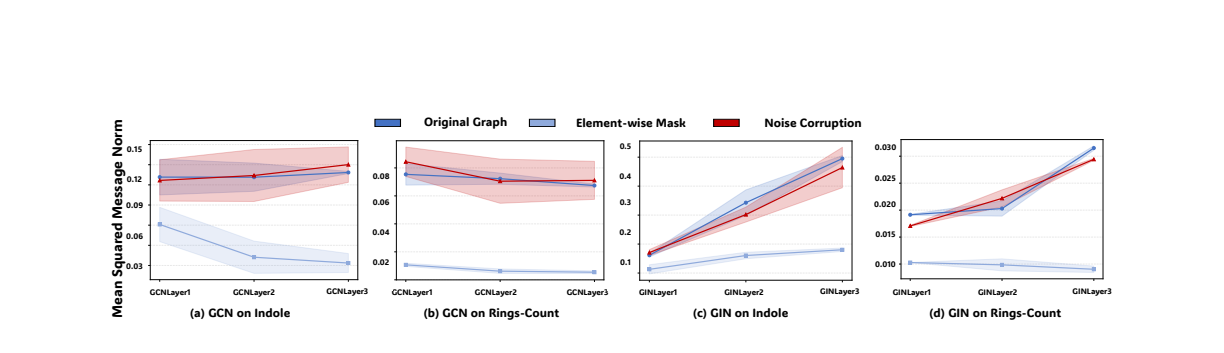
The corollary is conditional, so it is not incorrect, but the surrounding text and Figure 3(d) are used as evidence for depth-amplified drift. To support this, the authors should verify the condition eta_e^(l) >= eta along the EM-perturbed computation, or prove a bound under a stated assumption on the perturbed path, or explicitly label the corollary as a one-layer effect repeated under an idealized condition.
The paper says, at Appendix G, Table 9
The review did not quote this passage.
Pith says: Objection 3 of 3 · major
The appendix reports that under sparsity-matched random configurations, NC increases target-prediction degradation relative to EM on all four datasets (e.g., Mutag Imp. = -51.72%, Benzene -13.16%, Alkane -26.19%, Fluoride -72.73%). This directly undercuts the abstract's and introduction's phrasing that NC avoids the confounding of information corruption with propagation-scale deviations in queried predictions.
more of objection 3
The paper's later interpretation that NC controls representation-level shift but not prediction-level shift is reasonable, but this caveat must appear in the main text and the claims should be adjusted (e.g., 'per-message scale' rather than 'scale-stable perturbation space' for predictions).
4 minor objections
The paper says, at Table 1
Pith says: minor objection 1 of 4
No statistical significance tests are reported; the paper provides means and standard deviations over five seeds, but for several near-ties (e.g., Mutag Recall) a paired test or confidence intervals would strengthen the claim that NICE outperforms all baselines.
The paper says, at Experimental Setup / Appendix C
Pith says: minor objection 2 of 4
Table 6 lists B-XAIC row as '5,000' with '45000/5000' split, which conflicts with the text describing 40,000/5,000/5,000; this should be corrected.
show 2 more
The paper says, at Methodology
Pith says: minor objection 3 of 4
The hyperparameters beta and lambda_rest are introduced in Eqs. (12)-(13) but the main text does not discuss how they interact across datasets; the sensitivity analysis is confined to the appendix and one dataset.
The paper says, at Overall
Pith says: minor objection 4 of 4
The authors do not release code or trained models; given the breadth of the evaluation, a public implementation would help reproducibility.
What would settle it
Re-run the Figure 5 protocol on Benzene and Indole with the paper's 3-layer GIN. For each test graph, use the same ground-truth configuration (GT edges ρ=1, others ρ=0) and, for NC, draw 500 independent noise realizations. At each layer, compute the node-averaged expected squared norm of the aggregated node update, E[||Σ_{e∈N(i)} Ψ_NC,ρ_e(m_e^(l))||^2], and compare it with the clean aggregated norm at the same layer. If this aggregate-norm ratio deviates by more than 10% at any layer while the per-message S^(l) ratio remains near 1, then Proposition 3 does not transfer to the full computation, and the scale-stability claim should be restricted to message-level norms.
from the skeptic's reading
How the review went
4 readings by deepseek-v4-flash · 27 Aug 2026
- Reader holds up, with conditions
- Skeptic agrees
- Editor wrote the verdict above
- Referee major revision: 3 major objections, 4 minor
Not run on this paper: the simulated authors' defence.
Pith did not check this review's objections against the paper.
The review in full
The review in brief, machine-written
Ziluowen—read NICE. The core idea is real and I haven't seen it in the explainer literature: instead of multiplicative masking that shrinks messages toward zero, they corrupt each message by adding a random vector of the same norm, preserving expected squared norm. The scale-drift diagnosis of element-wise masking is correct as far as it goes, and the empirical setup (eight benchmarks, ground-truth annotations, oracle controls) is more careful than most. This paper deserves a serious referee.
What is new: the move from masking to matched-norm noise as a perturbation primitive, plus the restoration-boundary and integrated-gradient machinery. Theorem 1 and Proposition 3 are elementary but not wrong. I agree with the reader's conditional verdict: the central mechanism is sound, but it is over-claimed.
The main soft spot is exactly what the stress-test note says: the guarantee is per-message, not per-computation. Proposition 3 says E||Ψe||^2 = ||me||^2 for each edge. But the queried prediction depends on aggregated messages. Once you aggregate, E||Σe Ψe||^2 includes cross terms ρ_eρ_f me·mf, so aligned clean messages still suffer scale contraction. The paper's S^(l) proxy averages per-message norms and cannot see this. Theorem 1 holds incoming representations fixed, so Corollary 2's accumulated drift relies on an unproven assumption (ηe^(l) ≥ η at every layer). Figure 5 reports the same proxy. The appendix is honest about the consequence: under random configurations NC produces larger target-prediction degradation than EM on all four datasets. So the scale-stability claim is established at the message level, and the explanation-quality benefit is empirical, not theoretical.
Practical issues: no code release, no significance tests, and a couple of baseline citations look wrong (GNNExplainer and PGExplainer are attributed to surveys rather than the original papers). Those are fixable but need fixing before publication.
Who this is for: researchers working on perturbation-based GNN explainability. The paper is worth engaging, and I would send it to peer review. But I would press the authors to release code and seeds and to provide at least one analysis that tracks the full computation scale, not just per-message norms.
The strongest objection
Proposition 3 establishes E[||Ψ_NC(m_e)||^2] = ||m_e||^2 for each individual message, and Theorem 1 bounds the direct single-layer contraction of EM while holding incoming representations fixed. Neither result controls the quantity the central claim actually needs: the scale of the full multi-layer GNN computation that determines queried predictions. At the next aggregation step, node updates are sums of perturbed messages, and E[||Σ_e Ψ_e||^2] = Σ_e E[||Ψ_e||^2] + 2Σ_{e<f} E[Ψ_e·Ψ_f]. Under NC the cross terms vanish because the corruption directions are independent and conditionally zero-mean, whereas the clean aggregate retains Σ_{e<f} m_e·m_f. Thus, even when every per-message norm is preserved in expectation, the expected aggregate norm can contract whenever clean messages are mutually aligned. The paper's scale proxy S^(l) averages per-message norms and therefore cannot detect this contraction. Later ReLU and re-mixing layers introduce further dependencies. Similarly, Theorem 1's proof explicitly holds incoming representations fixed, so the proven contraction is the direct one-layer effect, not the accumulated trajectory invoked in Corollary 2; Corollary 2 assumes η_e^(l) ≥ η for every layer without showing this holds on the EM-perturbed path. Figure 5 is supportive but reports the same per-message S^(l), so it does not close the gap. Appendix G implicitly concedes the point: under random configurations, NC yields target-prediction degradation larger than EM on all four reported datasets. The Scale Drift and scale-stability claims are therefore established at the message level, not for the full GNN computation; the central explanatory benefit of NC remains empirically motivated rather than theoretically grounded.
The reader's weakest assumption is exactly the load-bearing point: per-message expected-norm preservation is not sufficient to keep the full multi-layer GNN computation in the original scale regime. My stress-test sharpens this into a concrete mechanism: even at a single aggregation step, the vanishing cross terms under NC can contract the expected norm of the summed messages, while the paper's S^(l) metric averages per-message norms and is blind to this effect. This is not an external dispute with the field's consensus; it is an internal gap between the proved statement and the claimed conclusion. The same gap affects the EM side: Theorem 1 holds incoming representations fixed, so the depth-amplified accumulation in Corollary 2 is not rigorously derived from it. The empirical Figure 5 uses the same per-message metric and thus cannot resolve the issue. Appendix G's admission that NC can increase target-prediction degradation under random configurations further supports restricting the claim. Because the paper still provides valuable empirical evidence and a plausible diagnosis, a conditional verdict remains appropriate; the condition should include a full-computation scale check rather than only per-message message norms.
The referee's report
If the claims hold, the paper contributes a useful new view: perturbation mechanisms themselves can introduce distribution shift independent of explanation-score quality. The empirical evaluation is broad — eight benchmarks, multiple baselines, oracle and random controlled configurations, hyperparameter sensitivity — and the authors honestly report in Appendix G that NC does not always reduce target-prediction degradation. The theoretical results (Theorem 1, Proposition 3) are mathematically correct but near-tautological; the main contribution is the empirical demonstration that NICE improves agreement with ground-truth explanations and fidelity. Because explanation quality is measured against external ground-truth annotations, the central explanation result is not circular.
Pith's reading of the paper (a machine's summary, not the authors')
The paper argues that the go-to perturbation in post-hoc GNN explainers, element-wise masking, changes predictions for two entangled reasons: it removes an edge's information and it contracts the scale of messages. It calls that accumulated contraction Scale Drift and shows it deepens with network depth, so masking-based attribution scores can be driven by scale collapse rather than by the importance of the removed content. The paper proposes Noise Corruption, which perturbs each message by mixing it with a random vector of the same norm, preserving the expected squared message size. On that scale-stable perturbation space, the paper builds NICE, which learns a compact stochastic restoration boundary and converts it into edge attributions with a path-integrated gradient. On eight molecular benchmarks, NICE improves average Recall by 8.67% and AUC-ROC by 7.57% over the strongest baseline, with the largest fidelity gains at small explanation budgets.
What carries the argument. The load-bearing object is the message-level perturbation operator acting on edge-induced messages $m_e^{(l)}$. Element-wise Masking uses $\Psi_{\mathrm{EM},\rho_e}^{(l)}(m_e^{(l)}) = \rho_e m_e^{(l)}$, and Noise Corruption uses $\Psi_{\mathrm{NC},\rho_e}^{(l)}(m_e^{(l)}) = \sqrt{\rho_e}\,m_e^{(l)} + \sqrt{1-\rho_e}\,\epsilon_e^{(l)}$ with $\epsilon_e^{(l)}$ uniform on the sphere of the same norm as $m_e^{(l)}$. The scale proxy is the mean squared message norm $S^{(l)}(G) = \mathbb{E}_e\|m_e^{(l)}\|_2^2$. Theorem 1 bounds the masking scale ratio in terms of the squared gate values weighted by each edge's scale share $\eta_e^{(l)}$, proving deterministic layer-wise contraction; Proposition 3 shows the NC restoration path preserves $\mathbb{E}_{\epsilon}\|\Psi_{\mathrm{NC},\rho_e}(m_e)\|_2^2 = \|m_e\|_2^2$. The framework machinery built on this is Stochastic Restoration Boundary Learning, which minimizes the mean-plus-variance target-prediction degradation $R_{y^*}(\rho) = \mathbb{E}[d_{y^*}(\rho,\epsilon)] + \beta\,\mathrm{Std}[d_{y^*}(\rho,\epsilon)]$ together with an $\ell^1$ compactness penalty, and Boundary-Integrated Gradient, which computes $s_e = -\rho_e^\star \int_0^1 \frac{\partial R_{y^*}}{\partial \rho_e}\big|_{\rho = t\rho^\star}\,dt$ along the linear restoration path from full corruption to the learned boundary.
Core claim. The central claim is that the usual way of instantiating a perturb-query explanation, element-wise masking of messages, does not merely remove the information carried by an edge: it also deterministically contracts the scale of that edge's message, and the contraction compounds across message-passing layers. Theorem 1 makes this precise: the layer-wise message scale under masking is bounded by $1 - \sum_e (1-\rho_e^2)\eta_e^{(l)}$ times the clean scale, where $\eta_e^{(l)}$ is edge $e$'s share of the total squared message norm, so any nonzero-scale message with $\rho_e<1$ shrinks the whole layer. Corollary 2 shows the cumulative log-scale drift grows at least linearly with depth. The paper's alternative, Noise Corruption, replaces the masked message $\rho_e m_e$ with $\sqrt{\rho_e}\,m_e + \sqrt{1-\rho_e}\,\epsilon_e$, where $\epsilon_e$ is uniformly drawn from the sphere of radius $\|m_e\|_2$; Proposition 3 shows this path preserves the expected squared norm for every gate $\rho_e$, so queried prediction changes are no longer contaminated by scale collapse. NICE then separates the two remaining tasks: Stochastic Restoration Boundary Learning finds a compact gate configuration whose target prediction is restored accurately and consistently under noise, and Boundary-Integrated Gradient accumulates each edge's contribution to lowering stochastic restoration risk along the path from fully corrupted to boundary, producing the final attribution scores.
The premise it rests on. The load-bearing premise is that keeping each corrupted message at the same expected squared size is enough to keep the whole multi-layer GNN computation in the original scale regime; nonlinear layers can still re-scale and re-mix messages, so later-layer message scales are not governed by the first-layer expectation guarantee of Proposition 3.
If the paper is right (Pith's inferences, not the authors')
Explanations produced by masking-based explainers mix information removal with scale collapse, so their edge rankings can be contaminated; the contamination grows at least linearly with network depth according to Corollary 2.
With Noise Corruption, the queried GNN stays in the original scale regime, so prediction changes used to derive scores reflect corrupted message content rather than shrunken message magnitude.
The compact restoration boundary learned by SRB, combined with BIG attribution, is what makes NICE faithful at small budgets; the reported Fidelity advantage is largest at the most aggressive Top-10% retention.
NICE's average Recall gain of 8.67% and AUC-ROC gain of 7.57% over the strongest baseline indicate that both coverage and ranking of ground-truth edges improve, not just threshold-dependent precision.
Because the scale gap deepens with depth, deeper GNN architectures give future explainers a stronger reason to adopt scale-stable perturbation instead of masking.
If Scale Drift is a real confound, a cheap diagnostic for existing explainers is to rescore their masks under a norm-preserving variant of the same mask: an edge whose importance came mainly from scale contraction should lose rank when scale is held fixed.
Noise Corruption is a generic perturbation primitive and could be dropped into other deletion-based uses of a frozen model, such as counterfactual search or input-influence estimation, wherever one wants to corrupt content without leaving the model's operating scale.
The scale-stability guarantee is only in expectation per message; a natural extension is a layer-wise scale monitor or renormalization step for NC, especially in GNNs with batch normalization or residual connections that can interact with noise variance.
Because NC is stochastic, explanation variance across forward passes becomes a measurable, first-class quantity; SRB's variance penalty suggests that any stochastic explainer should regularize the variance of the queried signal, not just its mean.
Check this review
Pith stored no record of this review's passes and took no fingerprint of it. Reviews made by code from 13 Nov 2026 on carry both.
How often reviews like this one are right
Reviews like this one: written by deepseek-v4-flash, where what was read was not recorded.
How often objections from reviews like this one are right: not yet measured
Reviews by people
This review was written by a machine. No person has reviewed this paper on Pith yet. A scientist listed on Pith can review it for a fee, and their review is published here whatever it concludes.
The paper
Abstract
Post-hoc Graph Neural Network (GNN) explainers commonly follow a Perturb-Query paradigm, inferring the importance of graph elements based on queried predictions to perturbed inputs. However, such perturbations often introduce substantial distribution shift, undermining the reliability of the queried predictions used to derive explanations. While existing efforts mainly improve perturbed graphs or stabilize model predictions on them, we revisit the perturbation mechanism itself. We show that the widely used Element-wise Masking(EM) suppresses edge-induced messages toward zero, causing deterministic scale contraction that accumulates across message-passing layers, a phenomenon we term Scale Drift. Consequently, prediction changes under EM may conflate information corruption with deviations in propagation scale. As a scale-stable alternative to EM, we introduce Noise Corruption (NC), which perturbs each message through matched-norm random-direction corruption while preserving the expected squared message norm. Building on NC, we propose NICE, a Noise Corruption-based explanation framework, which learns a Stochastic Restoration Boundary (SRB) under NC-induced uncertainty, balancing target-prediction restoration against compactness. Furthermore, Boundary-Integrated Gradient (BIG) converts this boundary into edge attributions by accumulating each edge's contribution to reducing restoration risk along the restoration path. Experiments across multiple benchmarks demonstrate stronger explanation performance and model faithfulness while confirming that NC substantially reduces the Scale Drift induced by masking.
The paper's own sentences, arranged, kept beside the review and separate from it. Each label is drawn from a closed vocabulary; the number beside it is the probability the classifier gave that label. No sentence in this record was written by a model.
abstract compiled · 2026-09-23
The authors' main claim, as the classifier picked it out 1.00
“Experiments across multiple benchmarks demonstrate stronger explanation performance and model faithfulness while confirming that NC substantially reduces the Scale Drift induced by masking.”
How the main claim is stated: asserted 1.00
What the abstract itself states, as probabilities: claims first 0.08 · states limitation 0.10 · human participants 0.03 · controlled comparison 0.63 · randomized assignment 0.02 · states quantitative result 0.05 · compares with prior results 0.87 · mentions code or data availability 0.02
The abstract, sentence by sentence
This table labels the abstract only (arXiv listing abstract v2). The number is the probability the classifier gave the label.
| Sentence | Role | The authors' own work | States the main conclusion | Strength |
|---|---|---|---|---|
| Post-hoc Graph Neural Network (GNN) explainers commonly follow a Perturb-Query paradigm, inferring the importance of graph elements based on queried predictions to perturbed inputs. | background 1.00 | 0.04 | 0.02 | asserted 1.00 |
| However, such perturbations often introduce substantial distribution shift, undermining the reliability of the queried predictions used to derive explanations. | background 0.78 | 0.09 | 0.04 | asserted 0.82 |
| While existing efforts mainly improve perturbed graphs or stabilize model predictions on them, we revisit the perturbation mechanism itself. | gap 0.76 | 0.14 | 0.05 | asserted 0.96 |
| We show that the widely used Element-wise Masking(EM) suppresses edge-induced messages toward zero, causing deterministic scale contraction that accumulates across message-passing layers, a phenomenon we term Scale Drift. | result 0.58 | 0.87 | 0.16 | asserted 1.00 |
| Consequently, prediction changes under EM may conflate information corruption with deviations in propagation scale. | interpretation 0.84 | 0.64 | 0.08 | hedged possibility 0.99 |
| As a scale-stable alternative to EM, we introduce Noise Corruption (NC), which perturbs each message through matched-norm random-direction corruption while preserving the expected squared message norm. | method 0.66 | 0.91 | 0.12 | asserted 1.00 |
| Building on NC, we propose NICE, a Noise Corruption-based explanation framework, which learns a Stochastic Restoration Boundary (SRB) under NC-induced uncertainty, balancing target-prediction restoration against compactness. | method 0.59 | 0.93 | 0.12 | asserted 0.99 |
| Furthermore, Boundary-Integrated Gradient (BIG) converts this boundary into edge attributions by accumulating each edge's contribution to reducing restoration risk along the restoration path. | method 0.91 | 0.90 | 0.06 | asserted 1.00 |
| Experiments across multiple benchmarks demonstrate stronger explanation performance and model faithfulness while confirming that NC substantially reduces the Scale Drift induced by masking. | result 1.00 | 0.96 | 0.75 | asserted 1.00 |
What kind of paper the classifier reports this is: method or tool 1.00 · evidence from observation or experiment 0.99
What was examined, and what was not
Sources read
- arXiv listing abstract v2
Not examined
- full text
- figures and tables
- references and citing sentences
- relations to other papers
Levels run
- P abstract
Not run
- S sections
- T body sentences
- C citations
- R cross-paper relations
How the labels were made
Compiled by classifier-1.13.0 via TypeSafe API, question bank abstract-p1-20260923, 2026-09-23: 1 request, 7,002 input tokens.
Every quoted sentence on this record is the authors'. Every label is from Pith's closed vocabulary, with the probability shown beside it. This record as JSON
Figures (9)




Showing 8 of the paper's 9 figures. Figures are the authors', reproduced from the paper.
References (213)
- [1] Bengio, Yoshua and LeCun, Yann , booktitle =. Scaling Learning Algorithms Towards on Pith
- [2] Hinton, Geoffrey E. and Osindero, Simon and Teh, Yee Whye , journal =. A Fast Learning Algorithm for Deep Belief Nets , volume = on Pith
- [3] Deep learning , author=. 2016 , publisher= on Pith
- [4] Laurens van der Maaten and Geoffrey Hinton , title =. Journal of Machine Learning Research , volume = on Pith
- [5] Shiwen Wu and Fei Sun and Wentao Zhang and Xu Xie and Bin Cui , title =. ACM Computing Surveys , volume = on Pith
- [6] Ling Yang and Jiayi Zheng and Heyuan Wang and Zhongyi Liu and Zhilin Huang and Shenda Hong and Wentao Zhang and Bin Cui , title =. IEEE Transactions on Knowledge and Data Engineering , volume = on Pith
- [7] Hao Yuan and Haiyang Yu and Shurui Gui and Shuiwang Ji , title =. IEEE Transactions on Pattern Analysis and Machine Intelligence , volume = on Pith
- [8] Antonio Longa and Steve Azzolin and Gabriele Santin and Giulia Cencetti and Pietro Lio and Bruno Lepri and Andrea Passerini , title =. ACM Computing Surveys , volume = on Pith
- [9] Tianxiang Zhao and Dongsheng Luo and Xiang Zhang and Suhang Wang , title =. ACM Transactions on Intelligent Systems and Technology , volume = on Pith
- [10] Thorben Funke and Megha Khosla and Mandeep Rathee and Avishek Anand , title =. IEEE Transactions on Knowledge and Data Engineering , volume = on Pith
- [11] Teague Sterling and John J. Irwin , title =. Proceedings of the International Conference on Neural Information Processing Systems , volume = on Pith
- [12] Neil Zeghidour and Alejandro Luebs and Ahmed Omran and Jan Skoglund and Marco Tagliasacchi , title =. IEEE/ACM Transactions on Audio, Speech, and Language Processing , volume = on Pith
- [13] Daria Reshetova and Yikun Bai and Xiugang Wu and Ayfer Özgür , title =. The Journal of Machine Learning Research , volume = on Pith
- [14] Enyan Dai and Suhang Wang , title =. ACM Transactions on Knowledge Discovery from Data , volume = on Pith
- [15] Alessio Ragno and Biagio La Rosa and Roberto Capobianco , title =. IEEE Transactions on Artificial Intelligence , volume = on Pith
- [16] Yong-Min Shin and Sun-Woo Kim and Won-Yong Shin , title =. IEEE Transactions on Pattern Analysis and Machine Intelligence , volume = on Pith
- [17] Xiangnan He and Kuan Deng and Xiang Wang and Yan Li and Yong-Dong Zhang and Meng Wang , title =. Proceedings of the International ACM SIGIR Conference on Research and Development in Information Retrieval , year = on Pith
- [18] Wenqi Fan and Yao Ma and Qing Li and Yuan He and Eric Zhao and Jiliang Tang and Dawei Yin , title =. Proceedings of The World Wide Web Conference , year = on Pith
- [19] Yang Liu and Xiang Ao and Zidi Qin and Jianfeng Chi and Jinghua Feng and Hao Yang and Qing He , title =. Proceedings of the Web Conference , year = on Pith
- [20] Kelong Mao and Xi Xiao and Jieming Zhu and Biao Lu and Ruiming Tang and Xiuqiang He , title =. Proceedings of the International ACM SIGIR Conference on Research and Development in Information Retrieval , year = on Pith
show 80 more
- [21] Xiangsheng Li and Maarten de Rijke and Yiqun Liu and Jiaxin Mao and Weizhi Ma and Min Zhang and Shaoping Ma , title =. Proceedings of the ACM International Conference on Information & Knowledge Management , year = on Pith
- [22] Ling Yang and Ye Tian and Minkai Xu and Zhongyi Liu and Shenda Hong and Wei Qu and Wentao Zhang and Bin CUI and Muhan Zhang and Jure Leskovec , title =. International Conference on Learning Representations , year = on Pith
- [23] Fang Wu and Siyuan Li and Xurui Jin and Yinghui Jiang and Dragomir Radev and Zhangming Niu and Stan Z. Li , title =. Proceedings of the International Conference on Machine Learning , year = on Pith
- [24] Zhiqiang Zhong and Yangqianzi Jiang and Davide Mottin , title =. Proceedings of the Learning on Graphs Conference , year = on Pith
- [25] Zhonghao Wang and Danyu Sun and Sheng Zhou and Haobo Wang and Jiapei Fan and Longtao Huang and Jiajun Bu , title =. Proceedings of the International Conference on Neural Information Processing Systems , year = on Pith
- [26] Thomas N. Kipf and Max Welling , title =. International Conference on Learning Representations , year = on Pith
- [27] Petar Veli. International Conference on Learning Representations , year = on Pith
- [28] Keyulu Xu and Weihua Hu and Jure Leskovec and Stefanie Jegelka , title =. International Conference on Learning Representations , year = on Pith
- [29] Zhenyu Hou and Xiao Liu and Yukuo Cen and Yuxiao Dong and Hongxia Yang and Chunjie Wang and Jie Tang , title =. Proceedings of the ACM SIGKDD Conference on Knowledge Discovery and Data Mining , year = on Pith
- [30] Benjamin Sanchez-Lengeling and Jennifer Wei and Brian Lee and Emily Reif and Peter Y. Wang and Wesley Wei Qian and Kevin McCloskey and Lucy Colwell and Alexander Wiltschko , title =. Proceedings of the International Conference on Neural Information Processing Systems , year = on Pith
- [31] Thomas N. Kipf and Max Welling , title =. Proceedings of the International Conference on Neural Information Processing Systems , year = on Pith
- [32] Yongduo Sui and Xiang Wang and Jiancan Wu and Min Lin and Xiangnan He and Tat-Seng Chua , title =. Proceedings of the ACM SIGKDD Conference on Knowledge Discovery and Data Mining , year = on Pith
- [33] Zhitao Ying and Jiaxuan You and Christopher Morris and Xiang Ren and Will Hamilton and Jure Leskovec , title =. Proceedings of the International Conference on Neural Information Processing Systems , year = on Pith
- [34] Weihua Hu and Matthias Fey and Marinka Zitnik and Yuxiao Dong and Hongyu Ren and Bowen Liu and Michele Catasta and Jure Leskovec , title =. Proceedings of the International Conference on Neural Information Processing Systems , year = on Pith
- [35] Jun Yin and Zhengxin Zeng and Mingzheng Li and Hao Yan and Chaozhuo Li and Weihao Han and Jianjin Zhang and Ruochen Liu and Hao Sun and Weiwei Deng and Feng Sun and Qi Zhang and Shirui Pan and Senzhang Wang , title =. Proceedings of the ACM on Web Conference , year = on Pith
- [36] Shashank Rajput and Nikhil Mehta and Anima Singh and Raghunandan Hulikal Keshavan and Trung Vu and Lukasz Heldt and Lichan Hong and Yi Tay and Vinh Q. Tran and Jonah Samost and Maciej Kula and Ed H. Chi and Maheswaran Sathiamoorthy , title =. Proceedings of the International C... on Pith
- [37] Xiaoqi Wang and Han Wei Shen , title =. International Conference on Learning Representations , year = on Pith
- [38] Jonathan Ho and Ajay Jain and Pieter Abbeel , title =. Proceedings of the International Conference on Neural Information Processing Systems , year = on Pith
- [39] Eric Jang and Shixiang Gu and Ben Poole , title =. International Conference on Learning Representations , year = on Pith
- [40] Yuning You and Tianlong Chen and Yongduo Sui and Ting Chen and Zhangyang Wang and Yang Shen , title =. Proceedings of the International Conference on Neural Information Processing Systems , year = on Pith
- [41] Shantanu Thakoor and Corentin Tallec and Mohammad Gheshlaghi Azar and Mehdi Azabou and Eva L. Dyer and Rémi Munos and Petar Veličković and Michal Valko , title =. International Conference on Learning Representations , year = on Pith
- [42] Fan-Yun Sun and Jordan Hoffmann and Vikas Verma and Jian Tang , title =. International Conference on Learning Representations , year = on Pith
- [43] Yijun Tian and Chuxu Zhang and Zhichun Guo and Xiangliang Zhang and Nitesh V. Chawla , title =. NeurIPS 2022 New Frontiers in Graph Learning Workshop , year = on Pith
- [44] Jihong Wang and Minnan Luo and Jundong Li and Yun Lin and Yushun Dong and Jin Song Dong and Qinghua Zheng , title =. Proceedings of the ACM SIGKDD Conference on Knowledge Discovery and Data Mining , year = on Pith
- [45] Chaofan Chen and Oscar Li and Chaofan Tao and Alina Jade Barnett and Jonathan Su and Cynthia Rudin , title =. Proceedings of the International Conference on Neural Information Processing Systems , year = on Pith
- [46] Zhijie Zhu and Lei Fan and Maurice Pagnucco and Yang Song , title =. Proceedings of the IEEE/CVF Conference on Computer Vision and Pattern Recognition , year = on Pith
- [47] Aaron van den Oord and Oriol Vinyals and Koray Kavukcuoglu , title =. Proceedings of the International Conference on Neural Information Processing Systems , year = on Pith
- [48] Chris J. Maddison and Andriy Mnih and Yee Whye Teh , title =. International Conference on Learning Representations , year = on Pith
- [49] Kaiming He and Haoqi Fan and Yuxin Wu and Saining Xie and Ross Girshick , title =. IEEE/CVF Conference on Computer Vision and Pattern Recognition , year = on Pith
- [50] Phillip E Pope and Soheil Kolouri and Mohammad Rostami and Charles E Martin and and Heiko Hoffmann , title =. IEEE/CVF Conference on Computer Vision and Pattern Recognition , year = on Pith
- [51] Zaixi Zhang and Qi Liu and Hao Wang and Chengqiang Lu and Cheekong Lee , title =. AAAI Conference on Artificial Intelligence , year = on Pith
- [52] Kenza Amara and Zhitao Ying and Zitao Zhang and Zhichao Han and Yang Zhao and Yinan Shan and Ulrik Brandes and Sebastian Schemm and Ce Zhang , title =. Learning on Graphs Conference , year = on Pith
- [53] Semi-supervised classification with graph convolutional networks , author=. arXiv preprint arXiv:1609.02907 , year= on PithPith's reviewarXiv
- [54] H2-fdetector: A gnn-based fraud detector with homophilic and heterophilic connections , author=. Proceedings of the ACM web conference 2022 , pages= on Pith
- [55] On explainability of graph neural networks via subgraph explorations , author=. International conference on machine learning , pages=. 2021 , organization= on Pith
- [56] Machine learning for integrating data in biology and medicine: Principles, practice, and opportunities , author=. Information Fusion , volume=. 2019 , publisher= on Pith
- [57] Modeling polypharmacy side effects with graph convolutional networks , author=. Bioinformatics , volume=. 2018 , publisher= on Pith
- [58] Graph neural networks for automated de novo drug design , author=. Drug Discovery Today , volume=. 2021 , publisher= on Pith
- [59] Graph attention networks , author=. arXiv preprint arXiv:1710.10903 , year= on PithPith's reviewarXiv
- [60] Inductive representation learning on large graphs , author=. Advances in neural information processing systems , volume= on Pith
- [61] A survey on the explainability of supervised machine learning , author=. Journal of Artificial Intelligence Research , volume= on Pith
- [62] Counterfactual explanations without opening the black box: Automated decisions and the GDPR , author=. Harv. JL & Tech. , volume=. 2017 , publisher= on Pith
- [63] Dyrep: Learning representations over dynamic graphs , author=. International conference on learning representations , year= on Pith
- [64] Human-centered explainable ai (xai): From algorithms to user experiences , author=. arXiv preprint arXiv:2110.10790 , year= on PithPith's reviewarXiv
- [65] Comparison of descriptor spaces for chemical compound retrieval and classification , author=. Knowledge and Information Systems , volume=. 2008 , publisher= on Pith
- [66] Advanced Methods for Knowledge Discovery from Complex Data , author=. Link-based Classification , volume=. 2005 , publisher= on Pith
- [67] MoleculeNet: a benchmark for molecular machine learning , author=. Chemical science , volume=. 2018 , publisher= on Pith
- [68] Understanding attention and generalization in graph neural networks , author=. Advances in neural information processing systems , volume= on Pith
- [69] Explainability in graph neural networks: A taxonomic survey , author=. IEEE Transactions on Pattern Analysis and Machine Intelligence , year= on Pith
- [70] A Bayesian approach to in silico blood-brain barrier penetration modeling , author=. Journal of chemical information and modeling , volume=. 2012 , publisher= on Pith
- [71] AqSolDB, a curated reference set of aqueous solubility and 2D descriptors for a diverse set of compounds , author=. Scientific data , volume=. 2019 , publisher= on Pith
- [72] Benchmark data sets for graph kernels , author= on Pith
- [73] os and A. R enyi, On random graphs I , author=. Publ. Math. Debrecen , volume= on Pith
- [74] Delaney, John S. , title =. Journal of Chemical Information and Computer Sciences , volume =. 2004 , doi = on Pith
- [75] Higher-order explanations of graph neural networks via relevant walks , author=. IEEE transactions on pattern analysis and machine intelligence , volume=. 2021 , publisher= on Pith
- [76] DEGREE: Decomposition Based Explanation for Graph Neural Networks , author=. International Conference on Learning Representations , year= on Pith
- [77] Cooperative Explanations of Graph Neural Networks , author=. Proceedings of the Sixteenth ACM International Conference on Web Search and Data Mining , pages= on Pith
- [78] On pixel-wise explanations for non-linear classifier decisions by layer-wise relevance propagation , author=. PloS one , volume=. 2015 , publisher= on Pith
- [79] Explainability methods for graph convolutional neural networks , author=. Proceedings of the IEEE/CVF conference on computer vision and pattern recognition , pages= on Pith
- [80] Explainability techniques for graph convolutional networks , author=. arXiv preprint arXiv:1905.13686 , year= on PithPith's reviewarXiv
- [81] Gnnexplainer: Generating explanations for graph neural networks , author=. Advances in neural information processing systems , volume= on Pith
- [82] Parameterized explainer for graph neural network , author=. Advances in neural information processing systems , volume= on Pith
- [83] Interpreting graph neural networks for nlp with differentiable edge masking , author=. International Conference on Learning Representations , year= on Pith
- [84] On explainability of graph neural networks via subgraph explorations , author=. International Conference on Machine Learning , pages=. 2021 , organization= on Pith
- [85] PaGE-Link: Path-based Graph Neural Network Explanation for Heterogeneous Link Prediction , author=. arXiv preprint arXiv:2302.12465 , year= on PithPith's reviewarXiv
- [86] Z orro: Valid, sparse, and stable explanations in graph neural networks , author=. IEEE Transactions on Knowledge and Data Engineering , year= on Pith
- [87] GStarX: Explaining Graph Neural Networks with Structure-Aware Cooperative Games , author=. Advances in Neural Information Processing Systems , year= on Pith
- [88] A value for n-person games , author=. 1953 , publisher= on Pith
- [89] Associated consistency, value and graphs , author=. International Journal of Game Theory , volume=. 2020 , publisher= on Pith
- [90] The concrete distribution: A continuous relaxation of discrete random variables , author=. arXiv preprint arXiv:1611.00712 , year= on PithPith's reviewarXiv
- [91] Categorical reparameterization with gumbel-softmax , author=. arXiv preprint arXiv:1611.01144 , year= on PithPith's reviewarXiv
- [92] Graphlime: Local interpretable model explanations for graph neural networks , author=. IEEE Transactions on Knowledge and Data Engineering , year= on Pith
- [93] Relex: A model-agnostic relational model explainer , author=. Proceedings of the 2021 AAAI/ACM Conference on AI, Ethics, and Society , pages= on Pith
- [94] Pgm-explainer: Probabilistic graphical model explanations for graph neural networks , author=. Advances in neural information processing systems , volume= on Pith
- [95] Distill n’Explain: explaining graph neural networks using simple surrogates , author=. International Conference on Artificial Intelligence and Statistics , pages=. 2023 , organization= on Pith
- [96] Simplifying graph convolutional networks , author=. International conference on machine learning , pages=. 2019 , organization= on Pith
- [97] Graphsvx: Shapley value explanations for graph neural networks , author=. Machine Learning and Knowledge Discovery in Databases. Research Track: European Conference, ECML PKDD 2021, Bilbao, Spain, September 13--17, 2021, Proceedings, Part II 21 , pages=. 2021 , organization= on Pith
- [98] Xgnn: Towards model-level explanations of graph neural networks , author=. Proceedings of the 26th ACM SIGKDD International Conference on Knowledge Discovery & Data Mining , pages= on Pith
- [99] Reinforcement learning enhanced explainer for graph neural networks , author=. Advances in Neural Information Processing Systems , volume= on Pith
- [100] Generative causal explanations for graph neural networks , author=. International Conference on Machine Learning , pages=. 2021 , organization= on Pith
The first 100 of 213 references are listed here. All of them are in this paper's citation record.
Cited by 1 Pith paper
Reviewed papers on Pith that cite this one. The full citation record
How the literature uses it
What this paper does with the arXiv papers it cites
What it cites · 3 sentences without a confident label
Uses the method or tool of 1 paper
-
To assess whether explanations remain faithful to the target model, we further report the widely used Fidelity [ref] .
GCExplainer: Human-in-the-Loop Concept-based Explanations for Graph Neural Networks · Experimental Setup · 0.94
Uses data or values from 1 paper
-
Additionally include seven tasks from the more challenging B-XAIC benchmark, namely Indole, PAINS, Rings-Count and Rings-Max [ref] .
B-XAIC Dataset: Benchmarking Explainable AI for Graph Neural Networks Using Chemical Data · Experimental Setup · 0.97
Cites as background 1 paper
-
Graph Neural Networks (GNNs) have achieved remarkable success across a wide range of graph learning tasks [ref] .
Semi-Supervised Classification with Graph Convolutional Networks · Introduction · 0.99
Challenges and discussion
Disagree with the review, or know something it missed? Leave a comment, or challenge this review formally: a challenge becomes a permanent entry in this paper's record, and its decision is published here.
Come back by email
A short list of the week's newly reviewed papers. Nothing is sent until you confirm from your inbox, and every email has a link that stops it. No account.
No comments yet.
Sign in to comment