Chemical Physics · arXiv:2610.38145 v2 · submitted 28 Oct 2026
El Agente Quntur: Agentic Active-Space Selection for CASSCF
The paper says
“Multireference calculations require time-consuming expert decisions about active spaces, state identity, and convergence. This study asks whether agents can make these decisions reliably.”
more of the abstract
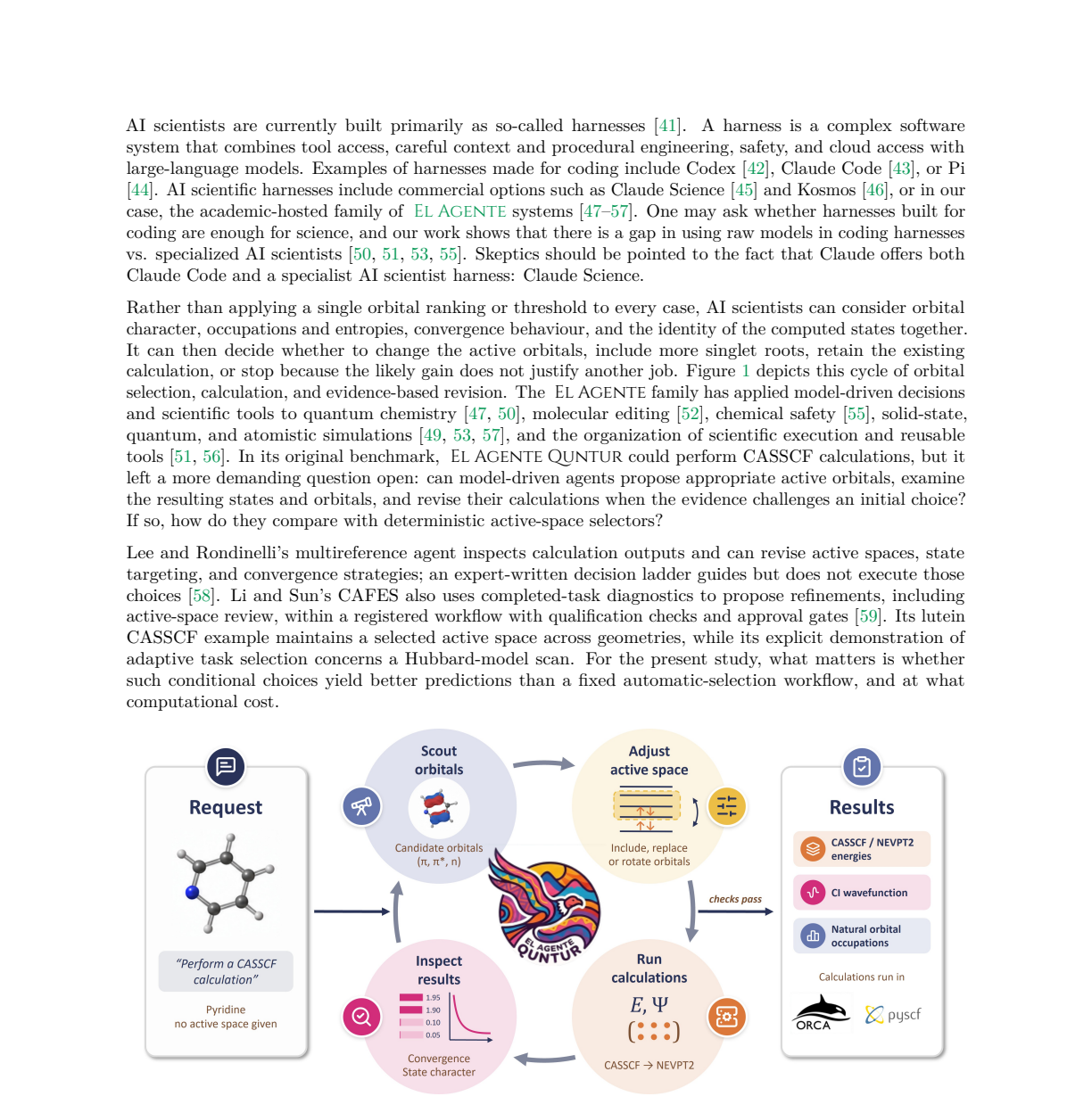
Using the El Agente Quntur multi-agent harness with GPT-5.6 Sol and GPT-5.6 Terra as its language models, agents study 32 fixed-geometry singlet excitations, detect missing active orbitals, compare excited states, and revise state assignments as calculations progress. Prompts specify equal-weight two-singlet state-averaged complete active space self-consistent field (CASSCF) calculations followed by strongly contracted second-order N-electron valence state perturbation theory (NEVPT2) with def2-TZVPD; agents choose and refine the active spaces. Excitation energies are evaluated against published complete active space second-order perturbation theory (CASPT2) reference values at matching geometries. Agentic execution reduces mean absolute error by 48% relative to six deterministic Active Space Finder protocols. Computational traces vary substantially across runs in selection strategies and cost, even for the same molecule. These results underscore the advantage of agentic active space selection over fixed workflows, yet leave room to improve efficiency through runtime-aware decision-making, reduced inter-agent communication overhead and redundancy, more systematic checks of state identity, and clearer stopping criteria.
from the abstract
Pith says
Machine review · deepseek-v4-flash · 31 Oct 2026 · of version 1 of the paper; version 2 is newer · what was read was not recorded · not checked by a person
It can be wrong. Challenge this review or reply to it.
Holds up, with conditions. A real head-to-head of an agentic active-space workflow against six ASF variants, with honest bookkeeping of its own state-assignment failures; the headline 48% number survives a state-validated re-scoring, but the paper should have done that arithmetic itself. This line is wrong
4 major objections · 7 minor
How often objections from reviews like this one are right: not yet measured
Not checked: figures, code, what the references say.
The paper says, at §3.1, Table 1 note, Fig. 3 caption, Abstract
The review did not quote this passage.
A classifier read this sentence of the paper as acknowledging the concern (probability 0.62):
“The numerical match does not validate the target state; correlated ordering of both states remains untested.”
Pith says: Objection 1 of 4 · major
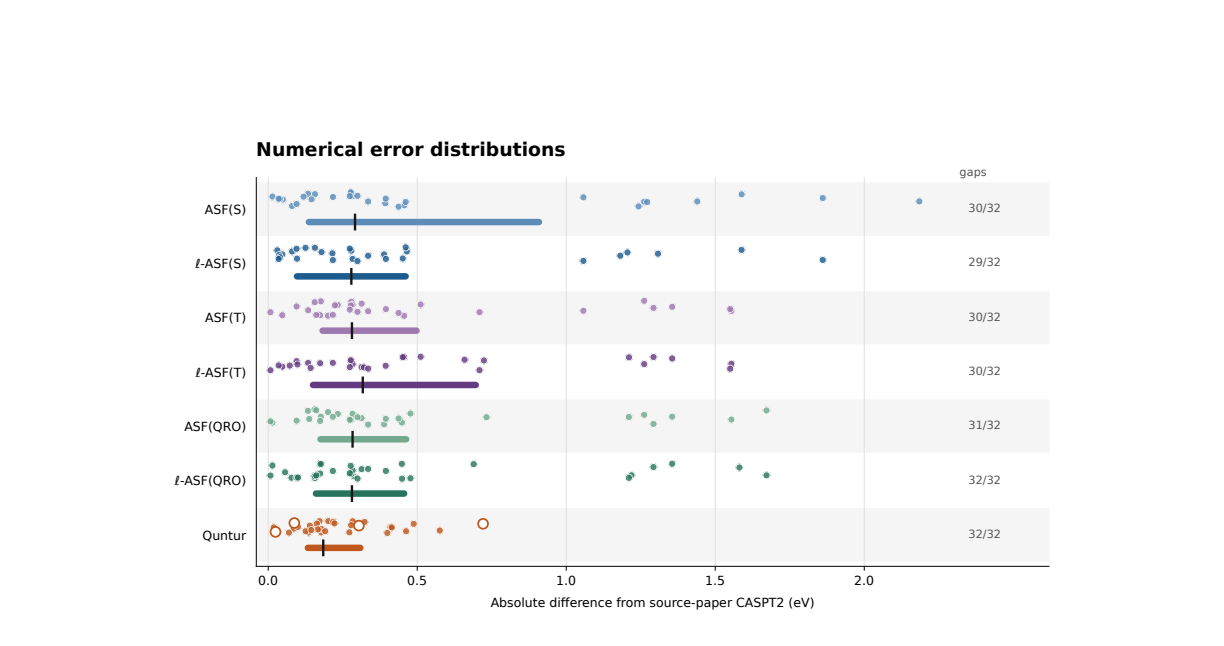
The 48% headline is a numerical-agreement statistic, and the manuscript says so twice (Table 1 note; Fig. 3 caption, 'The plot measures numerical agreement, not state-validated accuracy'). What is missing is the sensitivity analysis, and the Abstract sentences reporting the 48% carry no such qualification.
more of objection 1
The manuscript itself lists the cases where the reported gap is not the prompted calculation: 005, 019, 023, 025 (root character differs), 012 (unresolved assignment), and 006, 014, 029 (different final state average, or separately optimized state pairs), that is, seven of 32. Recomputing from Table S1: excluding 005/019/023/025 gives a Quntur MAE of 0.233 eV and raises l-ASF(QRO) to 0.490 eV; additionally excluding 006/014/029 gives 0.238 eV; re-scoring furan (023) against the 6.06 eV Rydberg value the manuscript itself quotes in the Fig. 6 caption moves the aggregate by roughly +0.008 eV. The claim therefore appears to survive its own caveats, but a reader cannot establish that from the present text. Please add a state-validated or exclusion-based MAE column to Table 1 with per-case flags, and qualify the abstract sentence accordingly. Note also that cyclopropene (005) carries the largest Quntur error (0.721 eV) and that its CAS(2,3) omits the occupied sigma orbital the reference transition requires, so the §3.1 statement that Quntur has no error above 1 eV is partly a property of the small space, not only of root identity.
The paper says, at §3.1, Table 1, §3.3, Table 2
The review did not quote this passage.
Pith says: Objection 2 of 4 · major
No uncertainty is attached to the 0.239 versus 0.459 eV comparison, and the supporting evidence in §3.1 cuts both ways: Quntur has the smaller error in 16 of 32 cases and l-ASF(QRO) in the other 16 (medians 0.185 versus 0.281 eV), and the mean difference is carried almost entirely by tail suppression, six l-ASF(QRO) errors above 1 eV against none for Quntur.
more of objection 2
With 32 cases, one run per case, and a repeatability study restricted to two molecules (§3.3, Table 2), please report a paired bootstrap or permutation interval on the MAE difference over cases, a distributional statistic such as the fraction of cases with absolute error above 0.5 eV, and a sentence stating what four runs on two molecules can and cannot say about benchmark-level variance. The tail behaviour is the substantively interesting result and deserves to be stated as such; '48%' as printed invites a precision the design does not support.
The paper says, at SI A.3, §2.2, Abstract
The review did not quote this passage.
Pith says: Objection 3 of 4 · major
The six ASF MAEs in Table 1 are recomputed against references the authors independently transcribed ('our reference column'), and SI A.3 concedes that 'our revised references can change miss counts relative to the ASF publication', with row-level classifications following the authors' own reference column.
more of objection 3
The Abstract nevertheless presents the comparison as being against 'the state-of-the-art Active Space Finder protocol'. Please give the ASF paper's own published aggregate MAE for the relevant variants alongside the recomputed values, and state explicitly whether the 48% changes if the ASF authors' reference column is used instead. If the recomputation amounts to a correction of the ASF paper, that should be presented as a result in its own right; if it is not a correction, the headline rests partly on re-referencing the baseline. This is the one place where the central number could move materially, and it is a one-table addition.
The paper says, at §4.2, §4.4, Table 2
The review did not quote this passage.
Pith says: Objection 4 of 4 · major
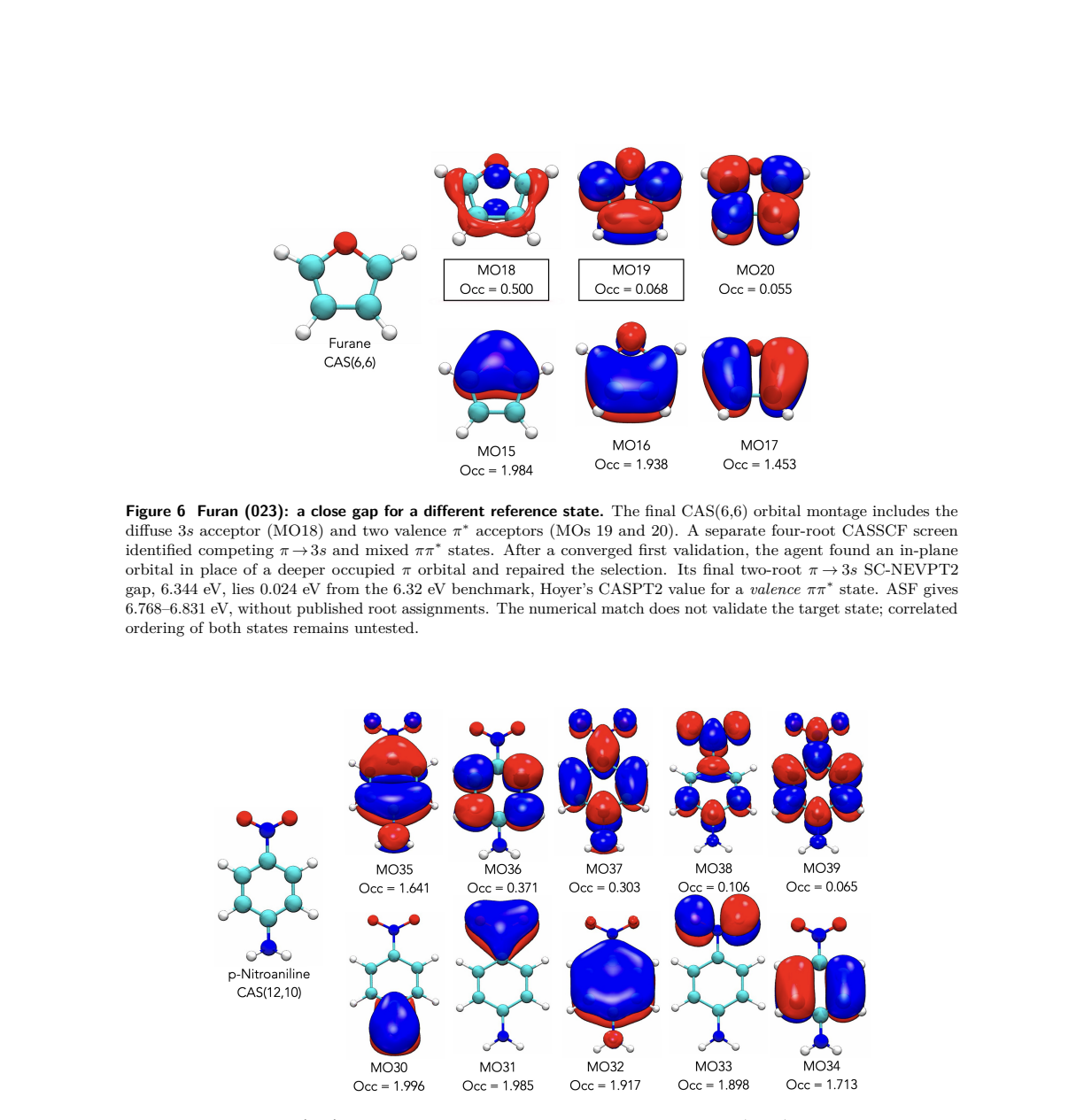
The four independent p-nitroaniline runs use CAS(12,10) built by three different routes and one CAS(14,11), yet all four land at 4.943-4.948 eV against a 4.62 eV reference, a 0.32 eV offset that is far larger than the spread across spaces and larger than the 0.11 eV advantage over l-ASF(QRO) at 5.069 eV.
more of objection 4
This is a useful finding the manuscript does not draw out: for this molecule the residual error is not active-space-controlled, so what §4.2 presents as the flagship demonstration of multi-agent critical review changed the route and the cost but not the error beyond what any of the four spaces delivered. Something similar applies in §4.4 to furan, where 0.024 eV agreement is coincidence with a different state. Please add a short decomposition: for how many of the 32 cases is the residual error plausibly attributable to the active space rather than to SC-NEVPT2 versus CASPT2, the basis, or reference selection? Without it, the causal reading of 'agentic active-space selection' carries more weight than the data support.
7 minor objections
The paper says, at Abstract
Pith says: minor objection 1 of 7
The Abstract calls l-ASF(QRO) 'the state-of-the-art Active Space Finder protocol', whereas §3.1 correctly describes it as a specific variant with lowered threshold and quasi-restricted starting orbitals, the best of six fixed protocols. Since the variant is selected on performance, say so in the Abstract ('the best-performing of six ASF configurations') rather than implying a single canonical protocol.
The paper says, at §2.1, Abstract, §5
Pith says: minor objection 2 of 7
§2.1 declines any ablation over base models ('a rabbit hole that scientific publications should avoid'), which is a defensible scoping decision, but the Abstract and §5 then generalise to 'agentic active space selection over fixed workflows' as a class. Either narrow the general claim to El Agente Quntur with this specific model pair, or add a small ablation on a subset of cases, given that §4.3 already shows route sensitivity to model-driven choices.
show 5 more
The paper says, at §2.3, SI A.5, data repository
Pith says: minor objection 3 of 7
The root-character labels drive the paper's most important caveats, and the deposit is described as containing 'LLM-assisted audit reports' while §2.3 describes a 'scientific audit' without specifying the agent. Please state explicitly whether the assignments for 005, 012, 019, 023, and 025 were adjudicated by a human, and if not, what independent check was applied. A single sentence would make the paper's central self-criticism auditable.
The paper says, at Fig. 3, §3.2
Pith says: minor objection 4 of 7
The Fig. 3 caption marks four hollow Quntur circles (005, 019, 023, 025), but §3.2 also lists pyrrole (012) as retaining an unresolved assignment. Harmonise the marker set and the note so the count of qualified cases the reader carries away matches the audit.
The paper says, at Reference [20], §2.2, SI A.3
Pith says: minor objection 5 of 7
Both the benchmark and the six baseline protocols derive from Shirazi et al., which is listed as an arXiv preprint (version 2). Please state whether a peer-reviewed version now exists, since the entire comparison rests on that source and its failure accounting.
The paper says, at §4.6, Table 3
Pith says: minor objection 6 of 7
The manuscript is honest that the ASF paper supplies no comparable per-case resource accounting (discussion after Table 3). Even so, a rough per-case comparison, for example ORCA jobs and wall-clock per case here against the single selection pass ASF performs, would let readers judge practical significance. If such a comparison is impossible, say so in one sentence rather than leaving the cost asymmetry qualitative.
The paper says, at Table 1, Table S1
Pith says: minor objection 7 of 7
The Table S1 marker system flags only root-character mismatches ('a'). Please extend it to flag the cases that did not follow the prompted protocol (006 fixed-orbital CASCI fallback, 014 six-root average, 029 separately optimized state pairs), so that the per-case table and the Table 1 note are consistent with each other.
What would settle it
Publish a sensitivity ladder recomputing Quntur's MAE from Table S1: (i) exclude wrong-root cases 005, 019, 023, 025; (ii) re-score 023 against Hoyer's separate 6.06 eV Rydberg reference; (iii) additionally exclude protocol-deviation cases 006, 014, 029; (iv) worst case, assign the paper's own 1.0 eV miss threshold to all seven flagged entries while retaining all 32 rows, and report the resulting margins next to the 48% figure. If (i)-(iii) stay near 0.24 eV as the table check indicates, the central claim stands and the abstract should state the range rather than a single percentage. As a secondary audit, search the deposited traces' web queries and retrieved snippets for all 32 sessions to confirm that no retrieved page contained the reference values or ASF gap tables before final-answer selection, since the propanamide trajectory consulted the ASF preprint (Table S3 row 11).
from the skeptic's reading
How the review went
4 readings by deepseek-v4-flash · 31 Oct 2026
- Reader holds up, with conditions
- Skeptic partly agrees
- Editor wrote the verdict above
- Referee major revision: 4 major objections, 7 minor
Not run on this paper: the simulated authors' defence.
Pith did not check this review's objections against the paper.
The review in full
The review in brief, machine-written
The thing worth knowing: this is a genuine apples-to-apples benchmark, not a demo. Same 32 fixed geometries as Shirazi et al., same two-root SA-CASSCF/SC-NEVPT2 protocol, six published ASF variants against the El Agente Quntur harness, references independently retranscribed from Schreiber and Hoyer rather than copied from the ASF table (Section 2.3). They also deposit the traces, prompts, inputs, and outputs. That is more than most agentic-chemistry papers give you, and it means the claims are checkable. The comparison is also fair on the failure convention: ℓ-ASF(QRO) returned a gap on all 32, so the 0.459 eV has no failure penalty baked in and the 0.239 eV is not flattered by one.
The candor is real and it cuts against them, which is how you can tell. They flag cases 005, 019, 023, 025 as wrong-root, 012 as a mislabeled Rydberg, and 006, 014, 029 as protocol deviations, and they say plainly that numerical agreement is not state-validated accuracy [b137, b163]. So I did the arithmetic they should have done. Drop the four wrong-root entries and Quntur's MAE falls to about 0.233 eV, because the biggest Quntur error (cyclopropene, 0.721 eV) is itself a wrong-root case. Re-score furan against Hoyer's 6.06 eV Rydberg value and you land around 0.24 eV. The margin survives. That is good news for the paper and it should be a table, not something a referee has to reconstruct from Table S1.
Second soft spot, worth more than the state-identity one: the aggregate win is a tail effect, not across-the-board superiority. Quntur is better on 16 cases, ℓ-ASF(QRO) on 16; medians 0.185 vs 0.281. What carries the mean is that Quntur has no error above 1 eV and ℓ-ASF(QRO) has six. That is a real and arguably more interesting claim than 48%, and the paper undersells it by leading with the mean.
Third, cost. 764M tokens, 2,276 minutes outside ORCA against 585 minutes of ORCA. They say they cannot compare because ASF publishes no per-case accounting [b268]. Fair, but it leaves "advantage" doing a lot of work in the abstract.
Minor: no model ablation, defended as a rabbit hole. Defensible, but it does mean a reader cannot separate harness from model. Reproducibility rests on two molecules, though the 0.001–0.005 eV spread is reassuring.
Who should read it: anyone working on automated active-space selection or on agentic scientific workflows with quantitative claims. Send it out. A referee should push hard on the state-validated rescoring table and on whether the tail effect is the honest framing.
The strongest objection
The central claim is the 0.239 versus 0.459 eV MAE comparison (48% reduction) on 32 fixed-geometry singlet excitations. Its load-bearing precondition is that numerical agreement with the geometry-matched CASPT2 reference is a state-valid accuracy measure. The paper itself establishes that this precondition holds only partially: Table 1's note and the Fig. 3 caption assign audited wrong-root entries 005, 019, 023, and 025, and state explicitly that 'the other Quntur roots are not thereby independently established as the intended S1' (b137); case 012 (pyrrole) adds a fifth mismatch, a Rydberg-like root reported under a valence label with its relation to the comparator unresolved (b568); and cases 006, 014, and 029 deviate from the prescribed two-root protocol while entering the MAE unpenalized, with 014's six-root average explicitly 'not method-equivalent to the benchmark protocol' (A.5.14). The abstract's 48% therefore rests on a metric the paper cannot validate state-by-state, and the sensitivity is acknowledged but never quantified. A first-pass quantification from Table S1 indicates the concern is not decisive: the four wrong-root entries contribute 1.137 eV of the 7.646 eV total, and excluding them lowers Quntur's MAE to about 0.233 eV because the largest Quntur error (cyclopropene, 0.721 eV) is itself a wrong-root case; re-scoring furan-023 against Hoyer's separate Rydberg reference of 6.06 eV (the paper quotes this column), or also excluding the three protocol-deviation cases, leaves roughly 0.24 eV, preserving a margin of about 48% against 0.459 eV. Only an arbitrary 1.0 eV penalty on each of the seven flagged entries erodes the margin to about 12%, a convention with no textual basis because all seven Quntur calculations converged and the ASF failure penalty applies only to failed jobs.
The reader conditionalized the verdict on quantifying whether state-validated accuracy would change the MAE comparison. Performing that quantification from the paper's own Table S1 is what the stress test should do, and the result is that the condition is dischargeable. The reader identified the right weak spot (hence partial agreement), but the arithmetic shows that weak spot does not carry the result: Quntur's 32 errors sum to 7.646 eV (0.239 eV MAE) and l-ASF(QRO)'s to 14.703 eV (0.459 eV MAE), both verified from Table S1. The four flagged wrong-root entries sum to 1.137 eV, and cyclopropene, the largest Quntur error at 0.721 eV, is among them, so excluding the flagged entries slightly improves Quntur's MAE to about 0.233 eV; re-scoring furan against its matched 6.06 eV Rydberg reference, or also excluding the three protocol-deviation cases (006, 014, 029), leaves the MAE near 0.24 eV, a margin of roughly 48% over the best ASF variant. Even the harshest defensible re-scoring convention leaves the comparison positive. Credit is due where the paper independently supports its numbers: the ASF and reference columns were retranscribed rather than copied, the trajectories and input/output files are deposited, and the four-run repeats agree to under 0.005 eV, so the remaining question was never whether the gaps were computed but what they measure. The honest residual concern is precision and generalization, not direction: the 28 unflagged roots are not proven to be the intended S1 states, and the audits document outcome-aware decisions (case 024's post-hoc threshold relaxation, b555; case 025's state relabeling toward a closer number, b566) that make the benchmark MAE a plausible optimistic bound on out-of-sample accuracy. Those facts support the reader's CONDITIONAL rather than a clean ACCEPT, but they do not overturn the paper's central 32-case comparison. I therefore recommend UNCHANGED: the verdict stands, with the sensitivity ladder as the concrete check that would settle the remaining doubt.
The referee's report
If the claim holds, this is a useful and timely result: it would be the first controlled evidence that agentic revision of active spaces beats a deterministic selector on a third-party benchmark, and the paper's evidentiary practice is well above the norm for this literature. The benchmark is external (Shirazi et al.) rather than author-curated, the failure convention is matched to the prior work, and the baseline is the best-performing of six ASF configurations, which is the conservative choice. The deposit of prompts, traces, calculation files, and audit reports is a genuine contribution, as is the resource accounting in Table 3 and Table S2, which almost no comparable agent paper provides. The self-audit is unusually candid: four wrong-root cases, three protocol deviations, and one unresolved assignment are disclosed rather than buried. Recomputing Table S1, the headline survives the paper's own caveats (see Major 1), which strengthens rather than weakens the case.
Pith's reading of the paper (a machine's summary, not the authors')
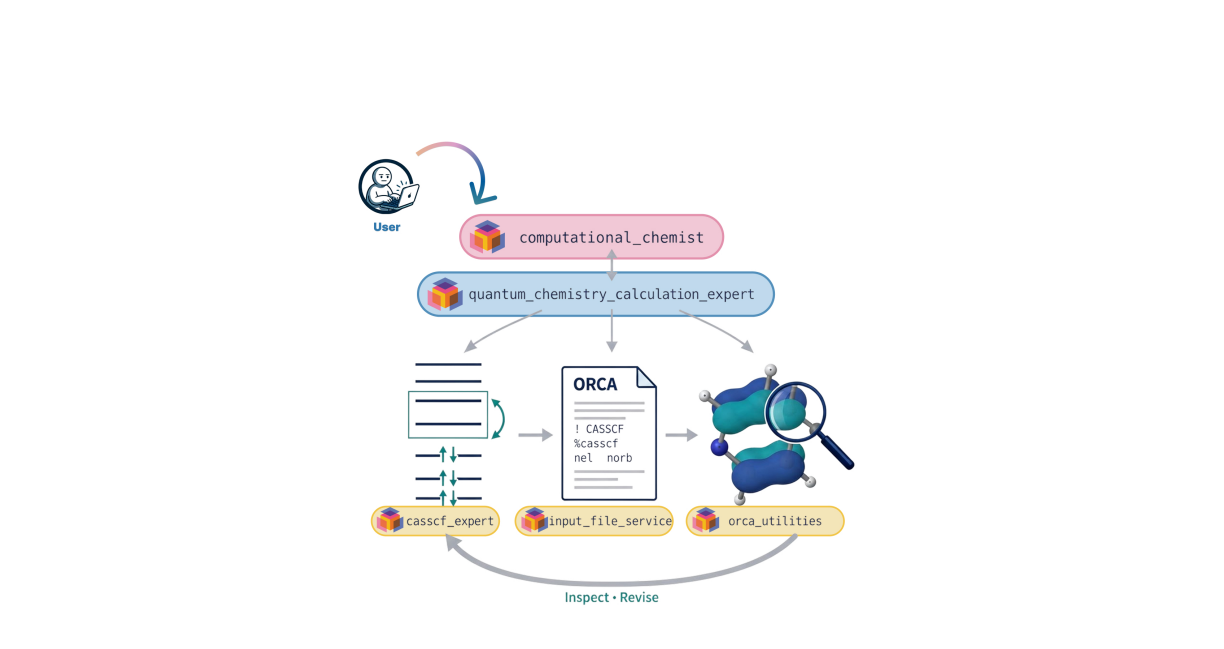
The paper asks whether a multi-agent language-model system can take over the part of multireference quantum chemistry that is normally human judgement: deciding which orbitals and electrons belong in a CASSCF active space, checking whether the finished calculation actually described the intended excited state, and revising when it did not. The test bed is 32 fixed-geometry singlet excitations drawn from a published benchmark that already scores six deterministic active-space selectors against geometry-matched CASPT2 references, so the agents enter an existing comparison rather than a bespoke demonstration. The authors report a mean absolute error of 0.239 eV for the gaps the agents returned, against 0.459 eV for the best of the six fixed protocols, a 48% reduction, with a numerical gap produced for all 32 cases and no error above 1 eV where the best fixed protocol had six. The interesting claim is as much about mechanism as about the average: the recorded trajectories show agents discarding a converged calculation because its intended lone pairs had escaped the active space, adding a matched perturbative check that reversed a CASSCF state ordering, and withdrawing an orbital selection that a projection score had provisionally approved. The authors state plainly that the metric tracks numerical proximity, not validated accuracy, and that the model and tool effort behind the result was large and uneven.
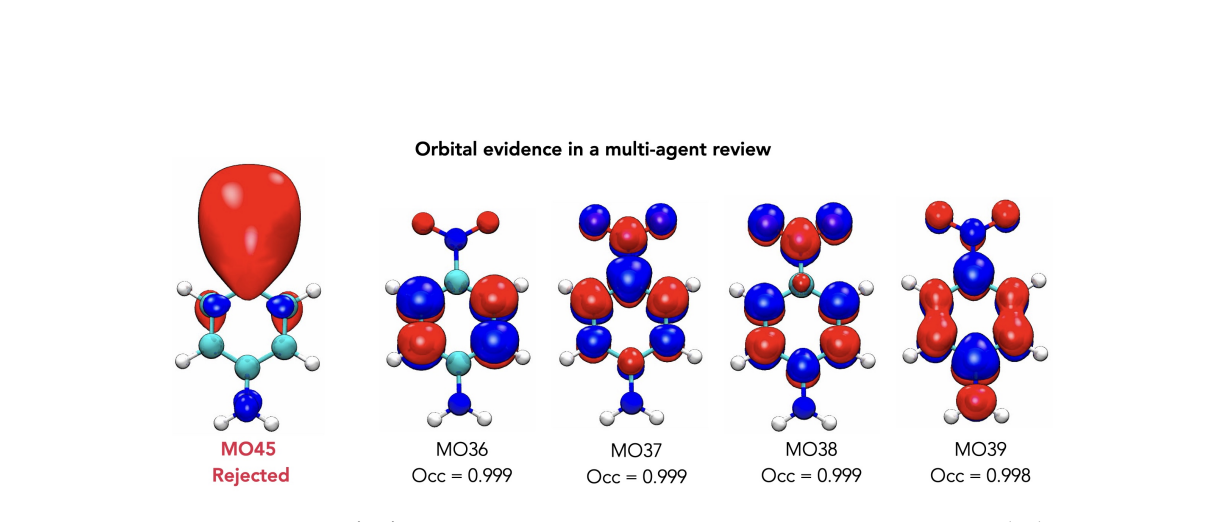
What carries the argument. The load-bearing structure is a division of labour among specialist agents plus an evidence-driven revision loop. One agent proposes and revises active spaces and state-averaging schemes; an input service turns that advice into executable ORCA or PySCF inputs and can send unresolved chemical questions back; a coordinating calculation expert runs staged jobs and requests diagnostics; a planning chemist decides what to report or test next. The evidence the loop consumes is orbital plots, occupations, atom and orbital populations, configuration weights, convergence and stationarity checks, and the ordering of roots across basis changes. That loop is what allows a converged but chemically wrong result to be caught: in one case the intended in-plane lone pairs left the active space during a normally terminating two-root optimization, and the reported number came instead from a four-root common-orbital fallback that kept them. Around this sits the scoring apparatus: independently re-transcribed geometry-matched CASPT2 references, the six fixed protocols' own printed gaps transcribed from their source, and a failure convention imported from the fixed-protocol study so that a failed job and an uncertain agent result are not silently treated the same way.
Core claim. The central claim is that letting a hierarchical multi-agent system plan, run, inspect and then revise active-space choices produces excitation energies that agree better with published CASPT2 values than any of six fixed automatic selection protocols applied uniformly. On the 32 entries the reported mean absolute error is 0.239 eV, versus 0.459 eV for the strongest fixed variant, and the comparison does not lean on the convention that penalises failed fixed-protocol jobs, because both approaches returned a gap on every entry. The improvement is not a steady per-case edge: the agents are closer on 16 cases and the best fixed protocol on 16, with median absolute errors of 0.185 and 0.281 eV, so the aggregate gap comes mainly from the tail, where the fixed protocol has six errors above 1 eV and the agents have none. The paper's own audit separates this numerical result from state identity: in four cases the computed root differs in character from the transition the reference value describes, and in three further cases the state average or the orbital optimization departed from the prescribed protocol, none of which receives a penalty in the reported error. The authors therefore present the result as evidence that agentic revision beats a fixed workflow on numerical agreement, with state-validated accuracy named as an open requirement rather than a settled one.
The premise it rests on. The load-bearing premise is that the absolute difference between a reported excitation gap and one published reference number is a fair accuracy score even when the two numbers can describe different electronic transitions or slightly different averaging protocols.
If the paper is right (Pith's inferences, not the authors')
If the result holds, active-space selection stops being a fixed input-preparation rule and becomes a tested hypothesis, with the standard workflow extended by inspection and revision steps rather than replaced.
Because the agents report a gap on all 32 entries and never exceed 1 eV of error while the best fixed protocol has six such misses, workflows built on fixed selection thresholds carry a tail risk that an inspection loop can catch before reporting.
The revision loop demonstrably changes scientific conclusions, not just numbers: in one case CASSCF put one state lower while matched perturbative corrections reversed the order, and the corrected ordering was adopted.
Repeated runs of the same prompt on the same geometry give gaps that agree to within 0.005 eV while using between 5 and 20 submitted jobs, so reproducibility of the answer and reproducibility of the procedure come apart.
Cost is a first-order design constraint: 219 quantum chemistry jobs, roughly 9.8 hours of compute inside those jobs against 37.9 hours of activity outside them, and hundreds of millions of tokens across the 32 sessions, with a sizable share of search activity spent on program syntax rather than chemistry.
The natural next experiment, which the paper's own case notes make cheap, is to re-score both arms under a state-validated criterion and see how much of the 48% survives; my reading is that the headline number is sensitive to this and that the authors' frank separation of numerical agreement from validated accuracy is the right place to push.
The four runs per molecule suggest that the variance between trajectories is mostly procedural rather than chemical: identical starting hypotheses, identical final spaces, near-identical gaps, but job counts and wall-clock times differing by factors of three to eight. If so, most of the token cost is spent paying for software mechanics rather than for chemistry, and constraining the mechanics shou
Benchmarks with one reference number per molecule may systematically penalise exactly the behaviour this system is built for. When an agent explores competing states and finds a different one that happens to sit near the tabulated value, the score rewards it for the wrong reason; when it correctly identifies a state the benchmark did not tabulate, the score punishes it. Multi-reference-per-molecul
The audited trajectories, with their accept and reject decisions and the evidence behind each, are a plausible training set for a much smaller specialist model; the paper gestures at this, and the cost profile makes it the obvious route from a demonstration to something usable at scale.
Check this review
Pith stored no record of this review's passes and took no fingerprint of it. Reviews made by code from 13 Nov 2026 on carry both.
How often reviews like this one are right
Reviews like this one: written by deepseek-v4-flash, where what was read was not recorded.
How often objections from reviews like this one are right: not yet measured
Reviews by people
This review was written by a machine. No person has reviewed this paper on Pith yet. A scientist listed on Pith can review it for a fee, and their review is published here whatever it concludes.
The paper
Abstract
Multireference calculations require time-consuming expert decisions about active spaces, state identity, and convergence. This study asks whether agents can make these decisions reliably. Using the El Agente Quntur multi-agent harness with GPT-5.6 Sol and GPT-5.6 Terra as its language models, agents study 32 fixed-geometry singlet excitations, detect missing active orbitals, compare excited states, and revise state assignments as calculations progress. Prompts specify equal-weight two-singlet state-averaged complete active space self-consistent field (CASSCF) calculations followed by strongly contracted second-order N-electron valence state perturbation theory (NEVPT2) with def2-TZVPD; agents choose and refine the active spaces. Excitation energies are evaluated against published complete active space second-order perturbation theory (CASPT2) reference values at matching geometries. Agentic execution reduces mean absolute error by 48% relative to six deterministic Active Space Finder protocols. Computational traces vary substantially across runs in selection strategies and cost, even for the same molecule. These results underscore the advantage of agentic active space selection over fixed workflows, yet leave room to improve efficiency through runtime-aware decision-making, reduced inter-agent communication overhead and redundancy, more systematic checks of state identity, and clearer stopping criteria.
The paper's own sentences, arranged, kept beside the review and separate from it. Each label is drawn from a closed vocabulary; the number beside it is the probability the classifier gave that label. No sentence in this record was written by a model.
abstract compiled · 2026-10-30
The authors' main claim, as the classifier picked it out 0.92
“Our results underscore the advantage of agentic active space selection over fixed workflows, yet leave room to improve efficiency through runtime-aware decision-making, reduced inter-agent communication overhead and redundancy, more systematic checks of state identity, and clearer stopping criteria.”
How the main claim is stated: asserted 0.69
What the abstract itself states, as probabilities: claims first 0.06 · states limitation 0.97 · human participants 0.05 · controlled comparison 0.93 · randomized assignment 0.02 · states quantitative result 0.98 · compares with prior results 0.98 · mentions code or data availability 0.03
The abstract, sentence by sentence
This table labels the abstract only (arXiv listing abstract v1). The number is the probability the classifier gave the label.
| Sentence | Role | The authors' own work | States the main conclusion | Strength |
|---|---|---|---|---|
| Multireference calculations often require substantial human expertise and time to choose and refine an active space for the electronic states or chemical process of interest. | background 1.00 | 0.05 | 0.02 | asserted 0.99 |
| This involves selecting which orbitals to include, verifying that the calculation describes the intended excited state, and deciding whether the results have converged. | background 1.00 | 0.06 | 0.02 | asserted 0.98 |
| Here, we ask whether scientific agentic systems (harnesses) can make these decisions reliably. | gap 0.57 | 0.18 | 0.03 | hedged possibility 0.36 |
| We use the El Agente Quntur multi-agent harness, with GPT-5.6 Sol and GPT-5.6 Terra as the underlying LLM components, to explore 32 diverse singlet excitations at fixed molecular geometries. | method 0.90 | 0.93 | 0.03 | asserted 0.88 |
| The agents planned and executed calculations, choosing and refining active spaces under prompts that specified equal-weight two-singlet state-averaged CASSCF followed by strongly contracted NEVPT2 with def2-TZVPD. | method 0.99 | 0.94 | 0.04 | asserted 0.99 |
| We evaluate excitation energies against published CASPT2 reference values at matching geometries and compare performance with six deterministic Active Space Finder protocols. | method 0.98 | 0.93 | 0.04 | asserted 0.79 |
| Within the El Agente Quntur system, agents detect missing active orbitals, compare candidate excited states, and revise state assignments as calculations progress. | method 0.96 | 0.86 | 0.05 | asserted 1.00 |
| Agentic execution reduced mean absolute error by 48\% relative to the state-of-the-art Active Space Finder protocol. | result 1.00 | 0.95 | 0.49 | asserted 1.00 |
| We note that computational traces vary substantially across runs in both active space selection strategies and cost, even for the same molecule. | result 0.58 | 0.92 | 0.04 | asserted 0.99 |
| Our results underscore the advantage of agentic active space selection over fixed workflows, yet leave room to improve efficiency through runtime-aware decision-making, reduced inter-agent communication overhead and redundancy, more systematic checks of state identity, and clearer stopping criteria. | future work 0.69 | 0.80 | 0.74 | asserted 0.69 |
What kind of paper the classifier reports this is: method or tool 0.74 · evidence from simulation or computation 0.99
What was examined, and what was not
Sources read
- arXiv listing abstract v1
Not examined
- full text
- figures and tables
- references and citing sentences
- relations to other papers
Levels run
- P abstract
Not run
- S sections
- T body sentences
- C citations
- R cross-paper relations
How the labels were made
Compiled by classifier-1.13.0 via TypeSafe API, question bank abstract-p1-20260923, 2026-10-30: 1 request, 7,667 input tokens.
Every quoted sentence on this record is the authors'. Every label is from Pith's closed vocabulary, with the probability shown beside it. This record as JSON
Figures (10)
Showing 5 of the paper's 10 figures. Figures are the authors', reproduced from the paper.
Challenges and discussion
Disagree with the review, or know something it missed? Leave a comment, or challenge this review formally: a challenge becomes a permanent entry in this paper's record, and its decision is published here.
Come back by email
A short list of the week's newly reviewed papers. Nothing is sent until you confirm from your inbox, and every email has a link that stops it. No account.
No comments yet.
Sign in to comment