Robotics · arXiv:2610.38405 v1 · submitted 28 Oct 2026 · 25 references
SpaceAct: Benchmarking 3D Spatial and Temporal Reasoning via Closed-Loop Action and Active Perception
The paper says
“To solve problems in 3D space rather than merely describe images, multimodal large language models (MLLMs) need 3D spatiotemporal reasoning: reconstructing 3D geometry from occluded 2D views, anticipating physical dynamics, and executing precise, closed-loop actions.”
more of the abstract
Prior studies test passive VQA on static images or symbolic planning, requiring no execution or supplying privileged coordinates while ignoring collision, statics, and timing. We introduce SpaceAct, an interactive benchmark evaluating 3D spatiotemporal reasoning via closed-loop physical action and active perception, with SAPA, a Spatiotemporal Active-Probing Agent framework. Built on interlocking bricks and mechanical puzzles, it has 108 verified instances across 36 task families in six categories, without privileged coordinates, and diagnostic modes (+plan, +state, no-camera, blind, L7 levers). In brick-bridging or aperture-threading, models rotate the camera to resolve occlusion, read in-scene rulers, output 6-DoF poses under swept-collision and statics checks, and self-correct via split-screen rollback feedback (dynamic tasks freeze time during deliberation and give five strobe frames). Across 10 frontier MLLMs on the 44 hardest instances, scores span 4.8-79.1 (seven solve at most 27.3% of 6-DoF tasks); for the top three, a reference plan (+plan) closes 44% of the gap while leaving collisions at 5.2 per episode, whereas adding exact 3D state (+state) closes 90% and cuts collisions to 0.5; for four others, +plan lifts the mean score from 10.9 to 35.3 and +state to 81.8; and 46% of failures are collision or observation loops. SpaceAct and SAPA advance evaluation to closed-loop physical interaction, showing that even with a valid plan, MLLMs remain bottlenecked by 3D visual grounding and action refinement, while offering a testbed for active multi-view exploration and explicit 3D grounding.
from the abstract
Pith says
Machine review · deepseek-v4-flash · 30 Oct 2026 · what was read was not recorded · not checked by a person
It can be wrong. Challenge this review or reply to it.
Holds up, with conditions. A genuinely new closed-loop 3D benchmark with honest, paired diagnostics; the 'grounding, not planning' conclusion is probably right, but the 44%/90% split is a bundled measurement, not a clean causal decomposition. This line is wrong
2 major objections · 4 minor
How often objections from reviews like this one are right: not yet measured
Not checked: figures, code, what the 25 references say.
The paper says, at §6.4, Figure 3, Eq. (3)
The review did not quote this passage.
Pith says: Objection 1 of 2 · major
The nested diagnostic's central inference — that the +plan→+state gap measures 3D visual grounding — is only as strong as the completeness of the reference plan. Figure 3 defines +plan as adding a plan with 'turns and regions; distances are left to the model,' so converting region-level directions into metric displacements is work that remains after +plan and is removed by +state.
more of objection 1
Under the paper's own definitions this conversion is assigned to E_ctrl ('mapping the plan to action vectors'), not to P_plan, and the abstract and conclusion use the careful joint phrasing '3D visual grounding and closed-loop action refinement,' which the data do support. However, Section 6.4 goes further: 'most of the remaining gap and nearly all collisions trace to 3D visual grounding (𝒢vis)' and the takeaway '3D visual grounding is the binding constraint' are not established by the design, because the reference plans are generated by the same in-house solvers that define A⋆ in Eq. (4) and plan granularity is not independently calibrated across the eight diagnostic families. The paper does disclose mixed pair-level plan effects (10 up, 8 down for the top three; 29 up, 19 down overall, Section 7), and that disclosure is to its credit, but it does not resolve whether plan phrasing leaks metric information in some families and is too coarse in others. I recommend either calibrating plan quality (for example, showing that a perfect metric executor can complete every reference plan, or varying plan granularity and showing that the 44%/90% split is stable), reporting per-instance top-3 plan effects, or consistently attributing the residual to G_vis together with E_ctrl rather than to G_vis alone.
The paper says, at §6.4, Figure 3
The review did not quote this passage.
Pith says: Objection 2 of 2 · major
The +state condition bundles several distinct interventions: it removes the need to estimate pose from pixels, the need to remember pose across turns, and the need to reconstruct coarse layout from vision (coarse layout is supplied as text). The paper never isolates working-memory load, so the +plan→+state gap conflates visual grounding with state tracking.
more of objection 2
This conflation is tolerable for the abstract-level claim, which names grounding jointly with closed-loop action refinement, but two consequences should be addressed: first, the phrase '3D visual grounding is the binding constraint' overstates what the manipulation can separate; second, a reader cannot tell how much of the sevenfold episode shortening under +state comes from removing perceptual search versus removing the burden of maintaining a metric belief. A control that separates memory (for example, exact pose supplied every k turns, or a variant that removes the persistent note while keeping images) would tighten the attribution; short of that, the paper should state explicitly that the diagnosed bottleneck is the joint pixels-to-remembered-metric-state-to-action loop rather than visual grounding in isolation.
4 minor objections
The paper says, at Eq. (4)
Pith says: minor objection 1 of 4
The constants 0.88 and 0.92 in Eq. (4) appear without explanation; they look like multiplicative discounts and should be described, since the tiered score is the primary metric and readers will otherwise treat them as arbitrary.
The paper says, at §3.5, §6.4
Pith says: minor objection 2 of 4
The gap-closure percentages (44%, 90%, 83%) recompute cleanly as (S_cond − S_main)/(100 − S_main), but this definition is never stated; adding it once near Eq. (4) would remove ambiguity.
show 2 more
The paper says, at §5
Pith says: minor objection 3 of 4
Because abandoned Claude Opus 5.5 runs are scored as zero in the main matrix, the reported 79.1 is a lower bound on that model's achieved score; the handling is disclosed, but a sentence noting the direction of the bias would help readers interpret the top-tier gap.
The paper says, at §6.4
Pith says: minor objection 4 of 4
The claim that +plan helps 'mainly on discrete search' is documented for the four further models (P4 and D8 account for about 90% of their gain) but is not broken down per instance for the top three; a small per-instance table for the 22 top-3 pairs would let readers verify the claim directly.
What would settle it
Run a +plan_full condition on the same eight shared L5 instances with the top-3 models, adding to the current +plan prompt the exact metric waypoints or action-level steps from the reference solver (positions and orientations at each stage), while still withholding current pose and leaving imagery unchanged. If +plan_full closes most of the +plan→+state gap (score near 90 or collisions dropping substantially below 5.2), then the original +plan left real planning/action-selection work undone and the attribution to 𝒢vis/ℰctrl is not established; if +plan_full stays at the +plan level, the conclusion survives this test.
from the skeptic's reading
How the review went
4 readings by deepseek-v4-flash · 30 Oct 2026
- Reader holds up, with conditions
- Skeptic agrees
- Editor wrote the verdict above
- Referee major revision: 2 major objections, 4 minor
Not run on this paper: the simulated authors' defence.
Pith did not check this review's objections against the paper.
The review in full
The review in brief, machine-written
You should know two things. First, the benchmark is the real thing: models must emit continuous 6-DoF commands checked by swept collision and rigid-body statics, with no motion planner and no privileged coordinates, while actively moving the camera and reading in-scene rulers, with the clock frozen during deliberation and strobe frames for dynamic tasks. That is a genuine step past CubeBench, SpatialAct, and SpatialWorld (discrete or semantic actions) and past VABench (which delegates collision checking and trajectory generation to a fixed execution layer). Second, the headline claim—that planning is not the binding constraint, metric grounding is—is probably right in qualitative terms, but the 44%/90% split is a bundled measurement, not a clean causal decomposition.
Credit where it is due. The paper's strongest asset is its honesty: abandoned Claude runs are dropped from paired diagnostics rather than counted against a condition, the mixed pair-level plan effects (29 up, 19 down) and the single-run main matrix are disclosed, and the authors state they cannot rule out memorization. Instance verification is done by deterministic reference solvers, with the statics solver calibrated against StableLego (99.85% agreement with a Gurobi reference). The headline conclusion is also supported by converging interventions beyond the plan/state nesting: blind input raises collisions ninefold, locking the camera hurts occlusion-heavy tasks, and the perceptual L7 levers (+occ, +blueprint, +rot) cause the steepest score drops. That multi-pronged evidence is what makes the conclusion believable.
Soft spots, in order of real weight. First, the stress-test concern about +plan only half lands. The plan gives turns and regions and leaves distances to the model; choosing the distance from a ruler is exactly the grounding capability the paper is isolating, not leftover planning. What is true is that the +plan to +state gap bundles grounding with pose memory and with coarse layout supplied as text, and that the plan and the A* reference come from the same in-house solver, so plan granularity is never independently calibrated. Read 44%/90% as an ordering—state helps far more than a plan—not as a decomposition into named sub-capabilities. The paper's own note that the plan mostly helps discrete search (P4, D8) and that mechanism families stall for design/planning reasons already warns you the split is family-dependent. Second, no code or dataset release appears anywhere in the text; for a benchmark paper that is the single most important thing for referees to demand. Third, the diagnostic sample is small: 8 families and 22 top-3 paired episodes, with seed variance measured on only 4 families.
Who this is for: anyone evaluating embodied MLLMs or building visuomotor grounding benchmarks. It deserves a serious referee. The fixes are tractable: release the simulator and instances, soften the attribution to match the bundled measurement, and add a +state-without-layout condition plus metric-level plans. I would send it out.
The strongest objection
The paper's central inference is the nested diagnostic: +plan is taken to bypass 𝒫plan, so the residual +plan→+state gap is attributed to 𝒢vis and ℰctrl (Section 6.4, Eq. 3, Figure 3). But Figure 3 defines +plan as adding a reference high-level plan with 'turns and regions; distances are left to the model.' A region-level plan that omits distances and exact waypoints does not fully determine the action sequence; converting turn-and-region directions into metric moves is itself planning or action selection. The reference plans are also generated by the same in-house solvers that define A⋆ in Eq. (4), so there is no independent calibration of plan granularity across the eight diagnostic families. Adding exact 3D state every turn simultaneously removes the need to estimate pose, the need to remember it, and possibly the need to reconstruct coarse layout from vision, since +state also includes coarse layout as text. The 44%/90% split therefore bundles visual grounding with pose memory and with whatever planning remains after an incomplete plan. This is load-bearing because the headline causal claim—that with a valid plan the bottleneck is grounding, not planning—collapses if the plan condition leaves substantial planning work undone. The paper discloses mixed pair-level plan effects (29 up, 19 down; Section 7) and planning-like stalls in mechanism synthesis (Section 6.6), but neither disclosure resolves whether +plan truly bypasses 𝒫plan.
SpaceAct's central claim is causal: once a correct plan is supplied, the remaining score gap is dominated by metric 3D visual grounding and closed-loop control rather than planning. The supporting evidence is the nested +plan/+state diagnostic on eight L5 instances across seven models, plus L7 levers, blind, and no-camera ablations. The load-bearing requirement is that +plan actually bypasses 𝒫plan. That requirement is insecure: Figure 3 says the plan supplies turns and regions while distances are left to the model, so the model must still perform distance estimation and action-level selection; the +plan→+state gap may therefore measure more than pure visual grounding. This is the same assumption the reader flagged as weakest, phrased more sharply: the reference plan is not shown to be complete enough to remove planning. The proposed +plan_full experiment would settle it by supplying exact reference waypoints without privileged current state: if models then approach +state performance, the original plan was not a true planning bypass; if they do not, the grounding/control attribution survives. I do not see a reason to move the verdict: the benchmark design is internally consistent, the deterministic verification and paired comparisons are real evidence, and the paper openly reports endpoint failures, pair-level plan variance, memorization limits, and mechanism stalls. The concern is a condition on the causal claim rather than a demonstrated falsification, so the conditional verdict stands unchanged.
The referee's report
If the results hold, SpaceAct is a substantial contribution to embodied MLLM evaluation: it removes three shortcuts that the authors correctly identify in prior benchmarks (privileged coordinates, motion-planner-free execution, and static worlds), and it ships strengths that I want to credit explicitly: deterministic per-instance verification with shortcut filtering, an execution protocol with no motion planner, paired diagnostic runs with disclosed exclusion rules for abandoned episodes, disclosed sensitivity of the failure-signature thresholds (26%–62% loop share), seed robustness on four families, and a per-turn trajectory analysis that is claimed to be fully reproducible. The central measurement — that +plan closes 44% of the gap while +state closes 90% and cuts collisions from 5.2 to 0.5 — is an empirical comparison against external interventions (ground-truth state injection, image removal), not a derivation equivalent to its input, and the arithmetic checks out. The bottleneck claim is important for the field because it redirects attention from high-level planning toward metric grounding and closed-loop control in embodied MLLM systems.
Pith's reading of the paper (a machine's summary, not the authors')
SpaceAct is an interactive benchmark that makes multimodal large language models solve physical 3D puzzles — bridging a gorge with interlocking bricks, threading rings through wires, unlinking interlocking hearts — by actively moving a camera, reading in-scene rulers, and issuing continuous 6-DoF actions checked for collision and static stability, with no privileged coordinates. The paper's central claim is that current frontier MLLMs fail at the closed loop from raw pixels to precise 3D action, and that the failure is not a planning failure. In paired diagnostic runs, giving the three strongest models a correct high-level plan closes only 44% of the score gap and leaves collisions unchanged at 5.2 per episode, while adding exact 3D state every turn closes 90%, reaches 100% success on the diagnostic set, and cuts collisions to 0.5 — and 46% of unsolved episodes end in collision or observation loops. If the paper is right, the bottleneck for vision-language models acting in the physical world sits in metric visual grounding and closed-loop correction, which redirects where the field should spend its effort.
What carries the argument. The load-bearing mechanism is the diagnostic decomposition of the per-turn policy into four operators, written $\pi = \mathcal{E}_{\text{ctrl}} \circ \mathcal{P}_{\text{plan}} \circ \langle \mathcal{G}_{\text{vis}}, \mathcal{I}_{\text{phys}} \rangle$ (Eq. 3): metric 3D grounding $\mathcal{G}_{\text{vis}}$ (inverting the perspective projection against in-scene rulers), physical identification $\mathcal{I}_{\text{phys}}$ (reading velocities, periods, and hidden parameters from strobe frames and probes), multi-step planning $\mathcal{P}_{\text{plan}}$, and frame-aware control $\mathcal{E}_{\text{ctrl}}$ (mapping the plan to action vectors and correcting from rollback views). The nested diagnostic conditions +plan and +state replace $\mathcal{P}_{\text{plan}}$ alone, then $\mathcal{P}_{\text{plan}}$ plus $\mathcal{G}_{\text{vis}}$, with ground truth in otherwise identical paired episodes, so the score gap between the two conditions is attributed to grounding plus control. The execution layer does the rest: every action is swept in fine substeps (at most 0.05 stud or 0.5°) with no motion planner, under swept-collision checks and a rigid-body statics solver calibrated against a reference optimizer; the simulation clock freezes while the model deliberates, and dynamic tasks render five same-view strobe frames at 0.25-second intervals; and first-violation truncation returns a split-screen rollback image pairing the contact moment with the last valid state.
Core claim. The paper makes three connected claims. First, it claims to measure something prior benchmarks do not: 3D spatiotemporal reasoning exercised through closed-loop physical action, where success depends on reading metric coordinates from visual scales, satisfying continuous swept-collision and statics constraints, and acting in a world that evolves in time. Second, on the 44 hardest instances it reports steep stratification across ten frontier MLLMs (scores 4.8–79.1), with the metric-geometry categories — continuous 6-DoF manipulation and multi-view perception — the hardest, and no instance solved by all ten models. Third, and most centrally, it claims that the binding constraint is visual grounding, not planning: a reference plan closes 44% of the remaining score gap for the three strongest models while collisions stay at 5.2 per episode, whereas plan plus exact 3D state closes 90%, reaches 100% success on the diagnostic set, shortens episodes about sevenfold, and cuts collisions to 0.5; the same ordering holds for four weaker models (10.9 → 35.3 with the plan, → 81.8 with the plan and state). The paper reads this as evidence that, once a plan is known, most of the remaining gap and nearly all collisions trace to the coupling of metric visual grounding with frame-aware control and rollback correction.
The premise it rests on. The load-bearing premise is that the hand-written reference plans supplied in the +plan condition are equally usable across all task families — they specify turns and regions while leaving distances to the model — so that the score gap between the plan and the plan-plus-state conditions measures true visual grounding rather than an artifact of how the plans happen to be phrased.
If the paper is right (Pith's inferences, not the authors')
For MLLMs used as embodied planners, further planning ability will not fix tasks like these: with a correct plan in hand, the strongest models still collide as often as without one, so the next measurable gain must come from metric grounding and closed-loop correction.
Benchmarks that supply privileged coordinates or delegate collision checking and trajectory generation to a fixed execution layer test a different capability than SpaceAct, since removing those shortcuts is what exposes the grounding bottleneck.
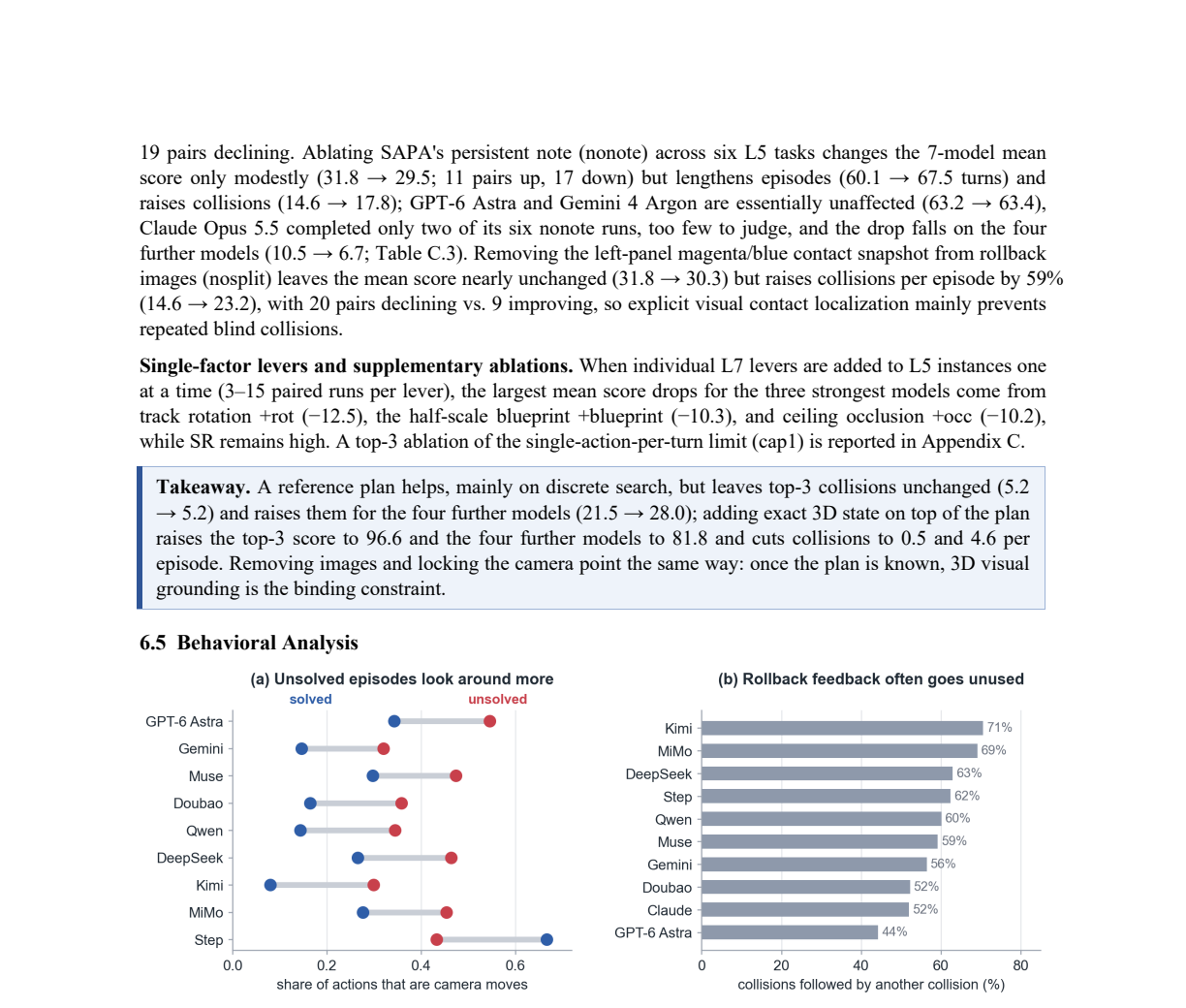
The failure statistics give concrete design targets: 44%–71% of collisions are followed by another collision on the next turn, so split-screen contact feedback is not yet being converted into metric corrections by current models.
Because the +state condition solves every diagnostic instance in about 5.3 turns with 0.5 collisions, the benchmark shows that the tasks themselves are tractable when grounding is supplied, separating agent capability from task difficulty.
Failures split by task type: collision and observation loops dominate unsolved 6-DoF manipulation episodes (60%), while mechanism-synthesis tasks mostly stall without loops, pointing to design and planning difficulty there rather than local grounding.
My inference: the +state gain bundles metric grounding together with state tracking and working memory, because supplying the exact pose every turn also removes the need to remember it; a variant that injects state every K turns would separate memory capacity from perceptual grounding, which the paper's data do not yet do.
My inference: the 44% closure is a property of the reference plans as phrased (turns and regions, distances left to the model); plans rewritten to embed metric hints would likely close more of the gap, so the plan-versus-grounding split is partly a statement about plan format, not only about model capability.
My inference: the blind-condition result — 77.8% success where collision feedback acts as a tactile probe — suggests a testable policy that deliberately probes by collision to map obstacle boundaries could serve as a cheap fallback for grounding-poor models.
My inference: the benchmark's simulator-internal checks make it usable as synthetic training data; fine-tuning a model on SpaceAct rollbacks with an explicit depth or coordinate head is a direct, falsifiable test of whether the grounding bottleneck can be trained away.
Check this review
Pith stored no record of this review's passes and took no fingerprint of it. Reviews made by code from 13 Nov 2026 on carry both.
How often reviews like this one are right
Reviews like this one: written by deepseek-v4-flash, where what was read was not recorded.
How often objections from reviews like this one are right: not yet measured
Reviews by people
This review was written by a machine. No person has reviewed this paper on Pith yet. A scientist listed on Pith can review it for a fee, and their review is published here whatever it concludes.
The paper
Abstract
To solve problems in 3D space rather than merely describe images, multimodal large language models (MLLMs) need 3D spatiotemporal reasoning: reconstructing 3D geometry from occluded 2D views, anticipating physical dynamics, and executing precise, closed-loop actions. Prior studies test passive VQA on static images or symbolic planning, requiring no execution or supplying privileged coordinates while ignoring collision, statics, and timing. We introduce SpaceAct, an interactive benchmark evaluating 3D spatiotemporal reasoning via closed-loop physical action and active perception, with SAPA, a Spatiotemporal Active-Probing Agent framework. Built on interlocking bricks and mechanical puzzles, it has 108 verified instances across 36 task families in six categories, without privileged coordinates, and diagnostic modes (+plan, +state, no-camera, blind, L7 levers). In brick-bridging or aperture-threading, models rotate the camera to resolve occlusion, read in-scene rulers, output 6-DoF poses under swept-collision and statics checks, and self-correct via split-screen rollback feedback (dynamic tasks freeze time during deliberation and give five strobe frames). Across 10 frontier MLLMs on the 44 hardest instances, scores span 4.8-79.1 (seven solve at most 27.3% of 6-DoF tasks); for the top three, a reference plan (+plan) closes 44% of the gap while leaving collisions at 5.2 per episode, whereas adding exact 3D state (+state) closes 90% and cuts collisions to 0.5; for four others, +plan lifts the mean score from 10.9 to 35.3 and +state to 81.8; and 46% of failures are collision or observation loops. SpaceAct and SAPA advance evaluation to closed-loop physical interaction, showing that even with a valid plan, MLLMs remain bottlenecked by 3D visual grounding and action refinement, while offering a testbed for active multi-view exploration and explicit 3D grounding.
The paper's own sentences, arranged, kept beside the review and separate from it. Each label is drawn from a closed vocabulary; the number beside it is the probability the classifier gave that label. No sentence in this record was written by a model.
abstract compiled · 2026-10-30
The authors' main claim, as the classifier picked it out 1.00
“SpaceAct and SAPA advance evaluation to closed-loop physical interaction, showing that even with a valid plan, MLLMs remain bottlenecked by 3D visual grounding and action refinement, while offering a testbed for active multi-view exploration and explicit 3D grounding.”
How the main claim is stated: asserted 1.00
What the abstract itself states, as probabilities: claims first 0.15 · states limitation 0.71 · human participants 0.04 · controlled comparison 0.66 · randomized assignment 0.02 · states quantitative result 0.99 · compares with prior results 0.88 · mentions code or data availability 0.07
The abstract, sentence by sentence
This table labels the abstract only (arXiv listing abstract v1). The number is the probability the classifier gave the label.
| Sentence | Role | The authors' own work | States the main conclusion | Strength |
|---|---|---|---|---|
| To solve problems in 3D space rather than merely describe images, multimodal large language models (MLLMs) need 3D spatiotemporal reasoning: reconstructing 3D geometry from occluded 2D views, anticipating physical dynamics, and executing precise, closed-loop actions. | background 0.97 | 0.08 | 0.05 | asserted 0.99 |
| Prior studies test passive VQA on static images or symbolic planning, requiring no execution or supplying privileged coordinates while ignoring collision, statics, and timing. | gap 0.91 | 0.03 | 0.02 | asserted 1.00 |
| We introduce SpaceAct, an interactive benchmark evaluating 3D spatiotemporal reasoning via closed-loop physical action and active perception, with SAPA, a Spatiotemporal Active-Probing Agent framework. | contribution 1.00 | 0.91 | 0.06 | asserted 0.99 |
| Built on interlocking bricks and mechanical puzzles, it has 108 verified instances across 36 task families in six categories, without privileged coordinates, and diagnostic modes (+plan, +state, no-camera, blind, L7 levers). | method 0.86 | 0.91 | 0.03 | asserted 1.00 |
| In brick-bridging or aperture-threading, models rotate the camera to resolve occlusion, read in-scene rulers, output 6-DoF poses under swept-collision and statics checks, and self-correct via split-screen rollback feedback (dynamic tasks freeze time during deliberation and give five strobe frames). | method 1.00 | 0.77 | 0.04 | asserted 0.98 |
| Across 10 frontier MLLMs on the 44 hardest instances, scores span 4.8-79.1 (seven solve at most 27.3% of 6-DoF tasks); for the top three, a reference plan (+plan) closes 44% of the gap while leaving collisions at 5.2 per episode, whereas adding exact 3D state (+state) closes 90% and cuts collisions to 0.5; for four others, +plan lifts the mean score from 10.9 to 35.3 and +state to 81.8; and 46% of failures are collision or observation loops. | result 1.00 | 0.96 | 0.24 | asserted 1.00 |
| SpaceAct and SAPA advance evaluation to closed-loop physical interaction, showing that even with a valid plan, MLLMs remain bottlenecked by 3D visual grounding and action refinement, while offering a testbed for active multi-view exploration and explicit 3D grounding. | interpretation 0.92 | 0.88 | 0.90 | asserted 1.00 |
What kind of paper the classifier reports this is: dataset or benchmark 1.00 · evidence from observation or experiment 0.95
What was examined, and what was not
Sources read
- arXiv listing abstract v1
Not examined
- full text
- figures and tables
- references and citing sentences
- relations to other papers
Levels run
- P abstract
Not run
- S sections
- T body sentences
- C citations
- R cross-paper relations
How the labels were made
Compiled by classifier-1.13.0 via TypeSafe API, question bank abstract-p1-20260923, 2026-10-30: 1 request, 6,255 input tokens.
Every quoted sentence on this record is the authors'. Every label is from Pith's closed vocabulary, with the probability shown beside it. This record as JSON
Figures (10)




Figures are the authors', reproduced from the paper.
References (25)
- [1] Bakhtin, A., et al. (2019). PHYRE: A new benchmark for physical reasoning. In NeurIPS on Pith
- [2] Bear, D. M., et al. (2021). Physion: Evaluating physical prediction from vision in humans and machines. In NeurIPS Datasets and Benchmarks Track on Pith
- [3] Chen, B., et al. (2024). SpatialVLM: Endowing vision-language models with spatial reasoning capabilities. In CVPR on Pith
- [4] Cheng, A.-C., et al. (2024). SpatialRGPT: Grounded spatial reasoning in vision-language models. In NeurIPS on Pith
- [5] Fu, X., et al. (2024). BLINK: Multimodal large language models can see but not perceive. In ECCV. 22 on Pith
- [6] Gao, H., et al. (2026b). SpatialWorld: Benchmarking interactive spatial reasoning of multimodal agents in real-world tasks. arXiv preprint arXiv:2606.09669. Gurobi Optimization, LLC (2025). Gurobi Optimizer Reference Manual on PithPith's reviewarXiv
- [7] Huang, W., et al. (2022). Inner Monologue: Embodied reasoning through planning with language models. In CoRL on Pith
- [8] Jia, M., et al. (2026). OmniSpatial: Towards comprehensive spatial reasoning benchmark for vision language models. In ICLR on Pith
- [9] Kulits, P., Xu, Y., Jones, R. K., Schmid, C., and Wu, J. (2026). BrickBench: Evaluating agentic brick design. arXiv preprint arXiv:2610.12452 on PithPith's reviewarXiv
- [10] Li, S., Wu, K., Zhang, C., and Zhu, Y. (2024). I-PHYRE: Interactive physical reasoning. In ICLR on Pith
- [11] Liu, R., Deng, K., Wang, Z., and Liu, C. (2024). StableLego: Stability analysis of block stacking assembly. IEEE Robotics and Automation Letters on Pith
- [12] Liu, T., et al. (2026). SpatialAct: Probing spatial reasoning-to-action capabilities of VLM agents in 3D scenes. arXiv preprint arXiv:2605.31148 on PithPith's reviewarXiv
- [13] Liu, X., et al. (2025). VisualAgentBench: Towards large multimodal models as visual foundation agents. In ICLR on Pith
- [14] Mayer, J., et al. (2025). iVISPAR: An interactive visual-spatial reasoning benchmark for VLMs. In EMNLP on Pith
- [15] Paglieri, D., et al. (2025). BALROG: Benchmarking agentic LLM and VLM reasoning on games. In ICLR on Pith
- [16] Shinn, N., et al. (2023). Reflexion: Language agents with verbal reinforcement learning. In NeurIPS on Pith
- [17] Shridhar, M., et al. (2021). ALFWorld: Aligning text and embodied environments for interactive learning. In ICLR on Pith
- [18] Tang, K., et al. (2026). LEGO-Puzzles: How good are MLLMs at multi-step spatial reasoning? In ECCV on Pith
- [19] Wang, S., et al. (2026). SpatialViz-Bench: A cognitively-grounded benchmark for diagnosing spatial visualization in MLLMs. In ICLR on Pith
- [20] Wu, H., et al. (2026). SpatialScore: Towards comprehensive evaluation for spatial intelligence. In CVPR on Pith
show 5 more
- [21] Xia, T., et al. (2026). BuildArena: A physics-aligned interactive benchmark of LLMs for engineering construction. In ICML on Pith
- [22] Xu, X., et al. (2026). DeepPHY: Benchmarking agentic VLMs on physical reasoning. In AAAI on Pith
- [23] Yao, S., et al. (2023). ReAct: Synergizing reasoning and acting in language models. In ICLR on Pith
- [24] Yi, K., et al. (2020). CLEVRER: Collision events for video representation and reasoning. In ICLR on Pith
- [25] Zhang, Z., Jin, J., Wang, Y., Zhang, Z., Diao, H., Wang, L., and Lu, H. (2026b). VABench: Measuring embodied spatial intelligence through visual demonstrations, active perception, and metric control. arXiv preprint arXiv:2609.19554. 23 Appendix A Task Family Catalog and Verifi... on PithPith's reviewarXiv
Cited by 1 Pith paper
Reviewed papers on Pith that cite this one. The full citation record
- VLAN: Vision-Language Accessible Navigation cs.AI · Nov 2026
Challenges and discussion
Disagree with the review, or know something it missed? Leave a comment, or challenge this review formally: a challenge becomes a permanent entry in this paper's record, and its decision is published here.
Come back by email
A short list of the week's newly reviewed papers. Nothing is sent until you confirm from your inbox, and every email has a link that stops it. No account.
No comments yet.
Sign in to comment