Quantum Physics · arXiv:2610.40592 v3 · submitted 29 Oct 2026
Toric codes all the way down: decoupling translation-invariant topological CSS codes in higher dimensions
The paper says
“Topological Calderbank-Shor-Steane (CSS) codes in more than two spatial dimensions offer features useful for fault-tolerant quantum computation, such as transversal non-Clifford gates and single-shot decoding, but a systematic understanding of them is still lacking.”
more of the abstract
One approach is to decouple a code: map it to a stack of higher-form toric codes by a finite-depth local CSS-preserving Clifford circuit, possibly after adding ancillas. For translation-invariant p-ary CSS codes, where p is prime (p = 2 for qubits), we require the circuit to commute with the translations of a superlattice. In two dimensions, such a decoupling exists once these translations act trivially on every anyon type. In higher dimensions, excitations are sorted by their dimension into superselection layers, which can remain glued together even when translations act trivially on each layer. We show that this gluing is the only remaining obstruction: a code can be decoupled on a superlattice exactly when, after coarse-graining to it, translations act trivially on every layer and the gluing vanishes. Moreover, for a code with finitely many excitation types in each layer and m nonzero layers, once translations act trivially on every layer, further coarse-graining by a factor of pm−1 in every direction removes the aforementioned gluing. Physically, the same criterion determines when the code encodes the maximal number of logical qudits on a finite torus. Finally, we give an explicit algorithm that constructs the decoupling as a circuit of SUM (qudit CNOT) and SWAP gates.
from the abstract
Pith says
Machine review · deepseek-v4-flash · 30 Oct 2026 · of version 1 of the paper; version 3 is newer · what was read was not recorded · not checked by a person
It can be wrong. Challenge this review or reply to it.
Holds up. A rigorous, general decoupling criterion for translation-invariant topological CSS codes, with a constructive circuit and machine-checked proof; the central argument holds up, with minor citation and scope caveats. This line is wrong
4 minor
How often objections from reviews like this one are right: not yet measured
Not checked: figures, code, what the references say.
4 minor objections
The paper says, at References [15] and [23]
Pith says: minor objection 1 of 4
References [15] and [23] both assign the identifier arXiv:2608.09913 to different papers (Song's profile framework and the authors' two-dimensional decoupling result); one of the two identifiers is wrong and should be corrected, since readers cannot otherwise locate the cited two-dimensional result.
The paper says, at Figure 1
Pith says: minor objection 2 of 4
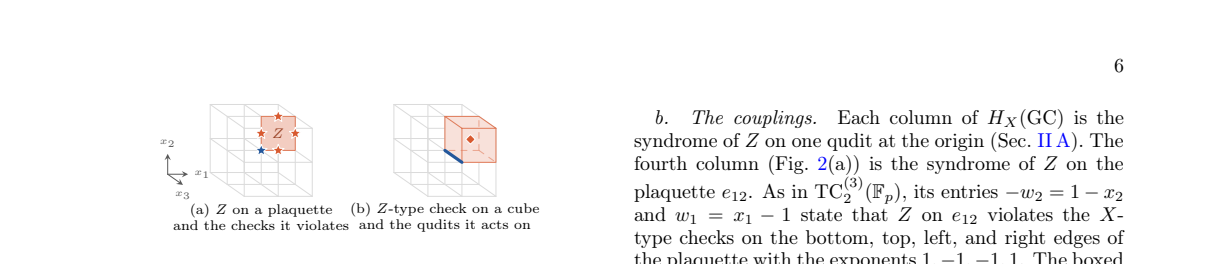
Figure 1 distinguishes TC^(3)_1 from TC^(3)_2 by color (blue versus orange) and by star and diamond markers; please confirm that the distinction survives greyscale printing, or add distinct shapes and a note in the caption.
show 2 more
The paper says, at Data availability
Pith says: minor objection 3 of 4
The data availability statement claims a Lean 4 proof of Theorem 1, Propositions 1 and 2, Corollaries 1 and 2, and Lemmas 1-13; pinning the Lean version and Mathlib commit is good practice, and the repository should map each formalized statement to the paper's numbering so that the claim can be audited by readers.
The paper says, at Algorithm 1 (Section IVC)
Pith says: minor objection 4 of 4
Algorithm 1's 'cannot be decoupled' output relies on Theorem 1 together with Lemma 7 (profile invariance under circuits and ancillas); a pointer in the text would make explicit that this conclusion is covered by the criterion rather than by the algorithm's coarse-graining heuristics.
What would settle it
Independent verification worth running: instantiate Lemma 9 for the glued code with D=3 and superlattice Z×pZ×Z, using the gluing class δ2(GC) with plaquette values (−1,0,0), and confirm that the restricted values on the three unit 2-cells vanish, equivalently that p times the f12 component is zero in F_p. This directly tests the gluing-removal step on which the p^{m−1} coarse-graining and hence the sufficient direction of Theorem 1 rest.
from the skeptic's reading
How the review went
4 readings by deepseek-v4-flash · 30 Oct 2026
- Reader holds up
- Skeptic agrees
- Editor wrote the verdict above
- Referee minor revision: 4 minor
Not run on this paper: the simulated authors' defence.
Pith did not check this review's objections against the paper.
The review in full
The review in brief, machine-written
Bottom line: this is a real advance. It takes a previously case-by-case question—when is a higher-dimensional translation-invariant CSS code locally equivalent to a stack of toric codes—and answers it with an iff condition on the superselection profile: decoupling on a superlattice exists exactly when the profile is toric-stack, meaning translations act trivially on every layer and the inter-layer gluing vanishes. The new content is substantial: arbitrary spatial dimension D, prime p, multiple layers, the pm−1 coarse-graining bound, an explicit SUM/SWAP decoupling circuit, and the torus logical-qudit count. The proof is constructive and detailed, and the appendices are real mathematics, not a sketch. I looked for circularity or hidden fitting, and found none: the multiplicities tj come from the layers themselves, and the criterion is not built into the definition of the profile.
The formal evidence is unusually strong. The paper ships a Lean 4 formalization of Theorem 1, the main propositions and corollaries, and Lemmas 1–13 against a public Mathlib commit, plus an open-source Python implementation that checks the commuting square and the returned circuit. I treat that as genuine independent confirmation. The scope boundaries are stated honestly: prime p, finite-dimensional layers (which excludes fracton models), possible ancillas, non-minimal circuit depth, and composite qudit dimensions needing extra invariants. These are assumptions, not gaps.
Soft spots are minor. The profile-and-gluing framework leans on Song's preprint [15], which is version 1 and not yet a journal article; the paper redefines enough that the argument is essentially self-contained, but a referee should check that citation carefully. Second, Refs. [15] and [23] carry the same arXiv identifier 2608.09915. One of them is wrong. It does not affect any proof, but it will confuse readers and should be fixed. Third, Proposition 1's polynomial bound is dense and the authors say it is far from practical; the coarse-graining index is not bounded. That is an honest limitation, not a flaw.
This paper is for people working on translation-invariant stabilizer codes, higher-dimensional toric and color codes, phase classification, and finite-torus logical encodings. The math, data, and formalization all look solid, and the citation issue is mechanical. I recommend sending it to peer review.
The strongest objection
I cannot identify a load-bearing concern. Theorem 1's "only if" direction is exactly Lemma 7 plus the toric-stack profile computation; its "if" direction is the constructive chain Lemma 10 through Lemma 12, with Lemma 10 the only non-obvious step and it is proved in Appendix C4 by absorbing homotopy errors into free summands and stabilizing via the generalized Schanuel lemma. The gluing-removal statements (Lemmas 2 and 9) are proved in Appendix B and match the glued-code example in Section V. The scope boundaries — prime p, finite-dimensional layers, possible ancillas, and non-minimized circuit depth — are stated by the authors in Sections IID and VI, so they are assumptions, not gaps. The Lean 4 formalization of the main theorem and the linked Python implementation provide independent support. The only issue I found is the duplicate arXiv identifier shared by Refs. [15] and [23], which does not affect any proof.
The strongest claim is Theorem 1, and both directions must survive scrutiny. Necessity is handled by Lemma 7, including the subtle case of |0> ancillas, which changes M_X by a free summand that the τ≥1 truncation removes. Sufficiency is the riskier direction because a derived-category isomorphism of profiles must be promoted to an actual circuit. Lemma 4 reduces the profile to a bounded finite-free complex C_code, so the profile isomorphism gives a quasi-isomorphism C_stack→C_code; Appendix C4 turns this into a stable isomorphism of check cokernels, Lemma 11 lifts it to invertible U and V, and Lemma 12 factors U into SUM and SWAP layers. The only algebraic step that could hide an assumption, Lemma 10, is proved in Appendix C4 with explicit absorption of homotopy errors and Schanuel-style stabilization, using standard homological algebra and a published Swan reference. The gluing-removal mechanism (Lemmas 1, 2, 9, Proposition 2) is self-contained, and the glued-code example confirms the restriction computation. The scope restrictions the reader identified — prime p, finite-dimensional layers, possible ancillas, and non-minimized circuit depth — are stated by the authors in Sections IID and VI, so they do not undercut the theorem as scoped. The claimed Lean 4 formalization of the main theorem and the Python implementation are additional independent evidence. I therefore find no load-bearing concern and see no reason to change the reader's ACCEPT verdict.
The referee's report
The central claim is that inter-layer gluing is the only obstruction to decoupling once translations act trivially on every layer, and that this obstruction is always removable by p-ary coarse-graining. The criterion is parameter-free and no quantity is fitted; t_j is determined as dim E^j_X, and decouplability is not built into the definition of the profile, so the circularity concern does not land: necessity is Lemma 7 plus the toric-stack profile computation, and sufficiency is the constructive chain of Lemmas 10-12. The claim that gluing obstructs decoupling is demonstrated concretely with the glued code, whose profile the paper computes independently in Appendix A5. If correct, the result is a substantial advance: it extends the two-dimensional anyon-preservation criterion to all dimensions, where the layer-wise argument fails, and it yields explicit circuits rather than existence statements. The computational content is unusually strong: an open-source Python implementation that verifies its outputs, and a reported Lean 4 formalization of Theorem 1, both propositions, both corollaries, and Lemmas 1-13 against a pinned Mathlib commit (I did not audit the repositories).
Pith's reading of the paper (a machine's summary, not the authors')
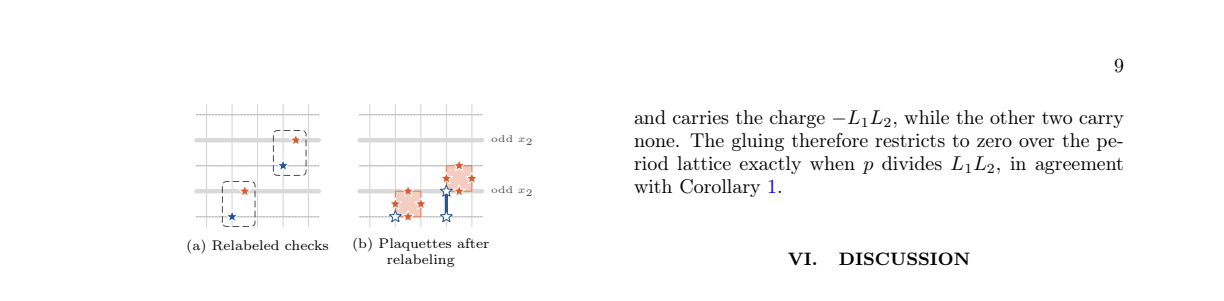
This paper proves exactly when a translation-invariant topological CSS code on a $D$-dimensional lattice can be untangled into a stack of higher-form toric codes by a finite-depth, translation-respecting circuit, and it gives algorithms that build the circuit. In two dimensions the only obstacle was already known: translations can permute anyon types, and coarse-graining to a superlattice that preserves them removes the obstacle. The new result is that in higher dimensions, where excitations come in pointlike, looplike, and higher-dimensional layers, a second obstruction — the gluing between layers — is the only thing left, and further coarse-graining always removes it: a code with $m$ nonzero layers needs at most a factor of $p^{m-1}$ in every direction. The same criterion tells exactly when a finite torus carries the maximal number of logical qudits, and the decoupling circuit, made of SUM and SWAP gates, transfers toric-code decoders and logical gates back to the code. A concrete three-dimensional example, the glued code, shows the obstruction is genuine: a loop excitation carries a pointlike charge equal to the signed area it projects, so layers cannot be separated without coarse-graining.
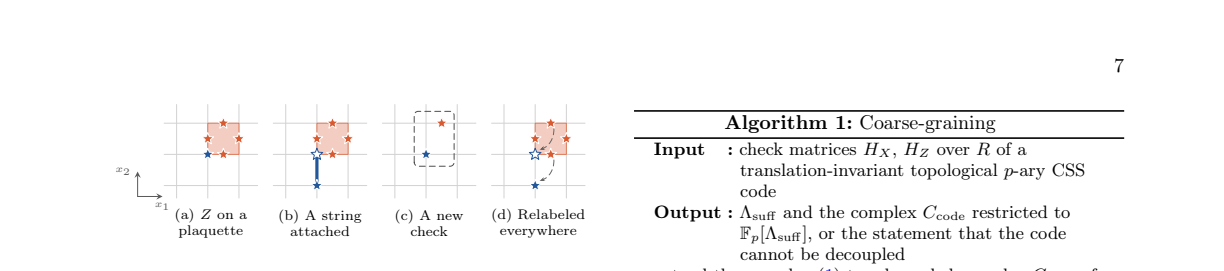
What carries the argument. The load-bearing object is the superselection profile $E_X = \tau^{\geq 1} \mathrm{RHom}_R(M_X, R)$ of the code module $M_X = R^q/\operatorname{im} H_X^\dagger$, whose cohomology layers $E_X^j = \operatorname{Ext}_R^j(M_X, R)$ classify $(j-1)$-dimensional excitations and their translation action. Truncation triangles assemble the layers into the profile, and their connecting morphisms $\delta_j$, equivalently classes $\kappa_{ji} \in \operatorname{Ext}_R^{j-i+1}(E_X^j, E_X^i)$, are the inter-layer gluing: they describe how a $(j-1)$-dimensional excitation carries an $(i-1)$-dimensional one. Lemma 1 turns such a class into a concrete table of values on unit cells, which is what makes the glued code's area-dependent charge visible, and Lemma 2 shows that coarse-graining by $p$ in every direction annihilates every positive-degree gluing class, peeling off one layer. On the constructive side, the decoupling is a commuting square $d^0_{\mathrm{stack}} U = V d^0_{\mathrm{code}}$ of invertible matrices over the Laurent polynomial ring $R = \mathbb{F}_p[x_1^{\pm 1}, \dots, x_D^{\pm 1}]$; the proof lifts a stable isomorphism of the check cokernels to invertible $U$ and $V$ and factors $U$ into layers of SUM gates and one block SWAP. Algorithms 1 and 2 turn this into a sufficient superlattice and an explicit circuit, with polynomial cost in the dense size of the input once the dimension is fixed.
Core claim. The paper's central claim (Theorem 1) is a sharp criterion: a translation-invariant topological $p$-ary CSS code on $\mathbb{Z}^D$, with $p$ prime, can be decoupled on a superlattice $\Lambda$ — mapped to a stack $\bigoplus_j \mathrm{TC}_j^{(D)}(\mathbb{F}_p)^{\oplus t_j}$ by a finite-depth local CSS-preserving Clifford circuit of SUM and SWAP gates, possibly after adding ancillas — if and only if its superselection profile over $\mathbb{F}_p[\Lambda]$ is that of a toric-code stack, $E_X|_{\mathbb{F}_p[\Lambda]} \simeq \bigoplus_j \mathbb{F}_p[-j]^{\oplus t_j}$. The profile sorts excitations by dimension into layers $E_X^j = \operatorname{Ext}_R^j(M_X, R)$, and the criterion has exactly two parts: translations in $\Lambda$ must act trivially on every layer, and the inter-layer gluing classes $\delta_j$ must vanish. The constructive engine is the coarse-graining lemma (Lemma 2): every class in $\operatorname{Ext}_R^n(A,B)$ with $n>0$ restricts to zero over $\mathbb{F}_p[p\Lambda_{\mathrm{triv}}]$, so coarse-graining by a factor of $p$ in every direction detaches one glued layer at a time, and $m$ nonzero layers need at most a factor of $p^{m-1}$. The authors exhibit the glued code, a three-dimensional code whose layers match two toric codes while a loop carries the signed projected area it encloses as a pointlike charge; this nonzero gluing blocks decoupling on the original lattice, and they show one direction of coarse-graining removes it. Under the same criterion, a finite torus with period lattice $L$ encodes the maximal $\sum_j \binom{D}{j} t_j$ logical qudits exactly when the code can be decoupled on $L$ (Corollary 1).
The premise it rests on. The load-bearing premise is that every superselection layer has finitely many excitation types over $\mathbb{F}_p$ and that the qudit dimension $p$ is prime, which the authors impose explicitly to define the trivially-acting superlattice; fracton models such as the cubic code and the X-cube model are outside the theorem, and the paper notes that composite qudit dimensions need invariants beyond the profile.
If the paper is right (Pith's inferences, not the authors')
Every translation-invariant topological $p$-ary CSS code with finitely many excitation types per layer and $m$ nonzero layers can be reduced to a stack of higher-form toric codes after coarse-graining by at most $p^{m-1}$ in every direction, so the gluing obstruction is always removable.
A finite torus holds the maximal $\sum_j \binom{D}{j} t_j$ logical qudits exactly when the code decouples on its period lattice; otherwise a nontrivial translation action or a nonzero gluing class lowers the count, which is the mechanism behind topological frustration in codes such as the gross code.
Because the decoupling is an explicit local circuit, single-shot decoding and toric-code decoders should transfer: the paper expects that $Z$-type errors in this class admit single-shot decoding exactly when $E_X^1 = 0$, with both error types requiring $D \geq 4$.
Constant-depth logical gates of any code in this class, non-Clifford ones included, correspond to constant-depth gates of its toric-code stack, so cup-product constructions of non-Clifford gates on toric stacks give candidate gates for codes that lack them.
For three-dimensional codes, which have at most two nonzero layers, the minimal coarse-graining is fully classified: none, a factor $p$ along one direction, or along two directions, depending on whether the single gluing class's plaquette values vanish, are dependent, or are independent.
The coarse-graining lemma is a standalone algebraic fact — every positive-degree extension between modules annihilated by the augmentation ideal dies under $p$-scaling of the lattice — so the same ungluing mechanism should govern other translation-invariant commuting-projector models with finite layer types, not only CSS codes.
The hardest part of applying the criterion is computing the profile; once the layers and gluing classes are known, both the superlattice and the circuit are produced algorithmically, so the criterion doubles as a triage test for whether toric-stack decoders and logical gates apply to a candidate code.
The authors leave open whether ancillas can always be avoided and whether the smallest decoupling superlattice is reachable when $D \geq 4$ and three or more layers coexist; searching for codes whose minimal coarse-graining is actually forced by higher-layer gluings would show when the $p^{m-1}$ bound is tight, a question the paper explicitly does not settle.
The paper's own caveats bound what the criterion delivers in practice: the polynomial cost bound is worst-case and described as far from practical, the coarse-graining step enlarges the lattice by an index the bound does not control, and ancillas are adjoined without proof they are ever avoidable — so the result is a provable existence-and-construction theorem, not yet an economical decoder compil
Check this review
Pith stored no record of this review's passes and took no fingerprint of it. Reviews made by code from 13 Nov 2026 on carry both.
How often reviews like this one are right
Reviews like this one: written by deepseek-v4-flash, where what was read was not recorded.
How often objections from reviews like this one are right: not yet measured
Reviews by people
This review was written by a machine. No person has reviewed this paper on Pith yet. A scientist listed on Pith can review it for a fee, and their review is published here whatever it concludes.
The paper
Abstract
Topological Calderbank-Shor-Steane (CSS) codes in more than two spatial dimensions offer features useful for fault-tolerant quantum computation, such as transversal non-Clifford gates and single-shot decoding, but a systematic understanding of them is still lacking. One approach is to decouple a code: map it to a stack of higher-form toric codes by a finite-depth local CSS-preserving Clifford circuit, possibly after adding ancillas. For translation-invariant p-ary CSS codes, where p is prime (p = 2 for qubits), we require the circuit to commute with the translations of a superlattice. In two dimensions, such a decoupling exists once these translations act trivially on every anyon type. In higher dimensions, excitations are sorted by their dimension into superselection layers, which can remain glued together even when translations act trivially on each layer. We show that this gluing is the only remaining obstruction: a code can be decoupled on a superlattice exactly when, after coarse-graining to it, translations act trivially on every layer and the gluing vanishes. Moreover, for a code with finitely many excitation types in each layer and m nonzero layers, once translations act trivially on every layer, further coarse-graining by a factor of pm−1 in every direction removes the aforementioned gluing. Physically, the same criterion determines when the code encodes the maximal number of logical qudits on a finite torus. Finally, we give an explicit algorithm that constructs the decoupling as a circuit of SUM (qudit CNOT) and SWAP gates.
The paper's own sentences, arranged, kept beside the review and separate from it. Each label is drawn from a closed vocabulary; the number beside it is the probability the classifier gave that label. No sentence in this record was written by a model.
abstract compiled · 2026-10-30
The authors' main claim, as the classifier picked it out 1.00
“We show that this gluing is the only remaining obstruction: a code can be decoupled on a superlattice exactly when, after coarse-graining to it, translations act trivially on every layer and the gluing vanishes.”
How the main claim is stated: asserted 1.00
What the abstract itself states, as probabilities: claims first 0.07 · states limitation 0.43 · human participants 0.01 · controlled comparison 0.02 · randomized assignment 0.01 · states quantitative result 0.63 · compares with prior results 0.59 · mentions code or data availability 0.03
The abstract, sentence by sentence
This table labels the abstract only (arXiv listing abstract v1). The number is the probability the classifier gave the label.
| Sentence | Role | The authors' own work | States the main conclusion | Strength |
|---|---|---|---|---|
| Topological Calderbank-Shor-Steane (CSS) codes in more than two spatial dimensions offer features useful for fault-tolerant quantum computation, such as transversal non-Clifford gates and single-shot decoding, but a systematic understanding of them is still lacking. | background 0.52 | 0.06 | 0.03 | asserted 0.97 |
| One approach is to decouple a code: map it to a stack of higher-form toric codes by a finite-depth local CSS-preserving Clifford circuit, possibly after adding ancillas. | method 0.62 | 0.10 | 0.05 | hedged possibility 0.67 |
| For translation-invariant $p$-ary CSS codes, where $p$ is prime ($p=2$ for qubits), we require the circuit to commute with the translations of a superlattice. | method 0.68 | 0.19 | 0.02 | asserted 0.98 |
| In two dimensions, such a decoupling exists once these translations act trivially on every anyon type. | background 0.92 | 0.14 | 0.05 | asserted 0.99 |
| In higher dimensions, excitations are sorted by their dimension into superselection layers, which can remain glued together even when translations act trivially on each layer. | result 0.48 | 0.43 | 0.07 | asserted 0.80 |
| We show that this gluing is the only remaining obstruction: a code can be decoupled on a superlattice exactly when, after coarse-graining to it, translations act trivially on every layer and the gluing vanishes. | result 0.95 | 0.93 | 0.85 | asserted 1.00 |
| Moreover, for a code with finitely many excitation types in each layer and $m$ nonzero layers, once translations act trivially on every layer, further coarse-graining by a factor of $p^{m-1}$ in every direction removes the aforementioned gluing. | result 0.92 | 0.89 | 0.18 | asserted 1.00 |
| Physically, the same criterion determines when the code encodes the maximal number of logical qudits on a finite torus. | interpretation 0.94 | 0.77 | 0.09 | asserted 1.00 |
| Finally, we give an explicit algorithm that constructs the decoupling as a circuit of SUM (qudit CNOT) and SWAP gates. | contribution 0.82 | 0.95 | 0.07 | asserted 1.00 |
What kind of paper the classifier reports this is: theoretical result 0.99 · evidence from proof or derivation 1.00
What was examined, and what was not
Sources read
- arXiv listing abstract v1
Not examined
- full text
- figures and tables
- references and citing sentences
- relations to other papers
Levels run
- P abstract
Not run
- S sections
- T body sentences
- C citations
- R cross-paper relations
How the labels were made
Compiled by classifier-1.13.0 via TypeSafe API, question bank abstract-p1-20260923, 2026-10-30: 1 request, 7,205 input tokens.
Every quoted sentence on this record is the authors'. Every label is from Pith's closed vocabulary, with the probability shown beside it. This record as JSON
Figures (4)

Figures are the authors', reproduced from the paper.
Challenges and discussion
Disagree with the review, or know something it missed? Leave a comment, or challenge this review formally: a challenge becomes a permanent entry in this paper's record, and its decision is published here.
Come back by email
A short list of the week's newly reviewed papers. Nothing is sent until you confirm from your inbox, and every email has a link that stops it. No account.
No comments yet.
Sign in to comment