Computational Geometry · arXiv:2611.00777 v1 · submitted 31 Oct 2026 · 45 references
From Static Models to Editable CAD: A Design-Intent-Aware Framework for Reverse Parametrization
The paper says
“Neutral CAD formats such as STEP typically preserve geometry but not feature histories or parameter dependencies. Thus, they are inherently limited for iterative design that requires modifications, a critical limitation for design optimization that relies on iterative processes.”
more of the abstract
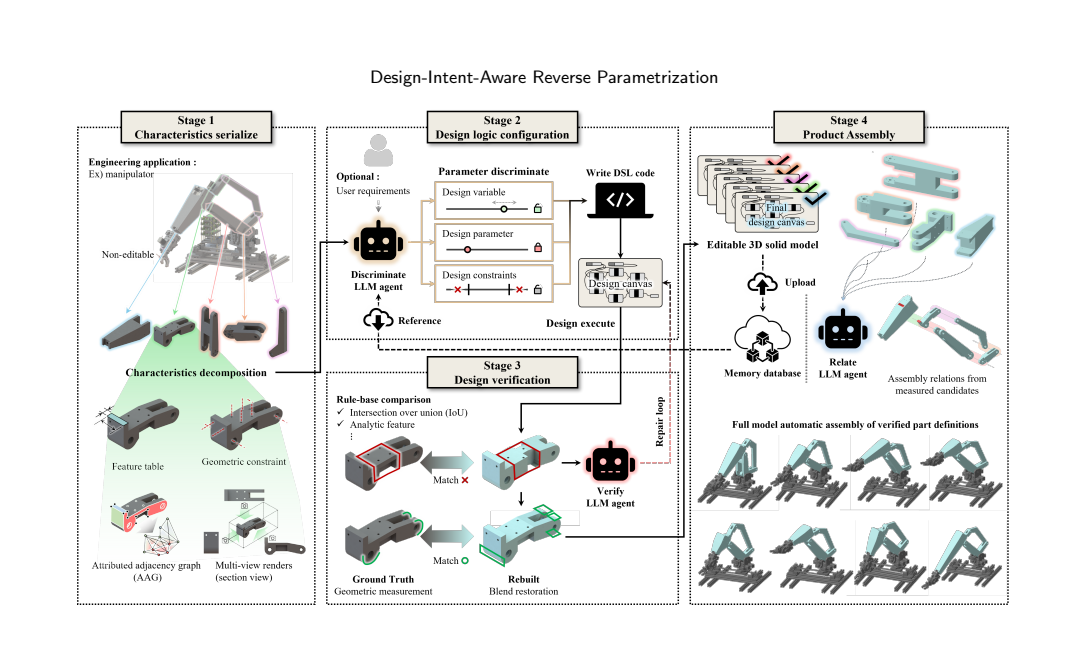
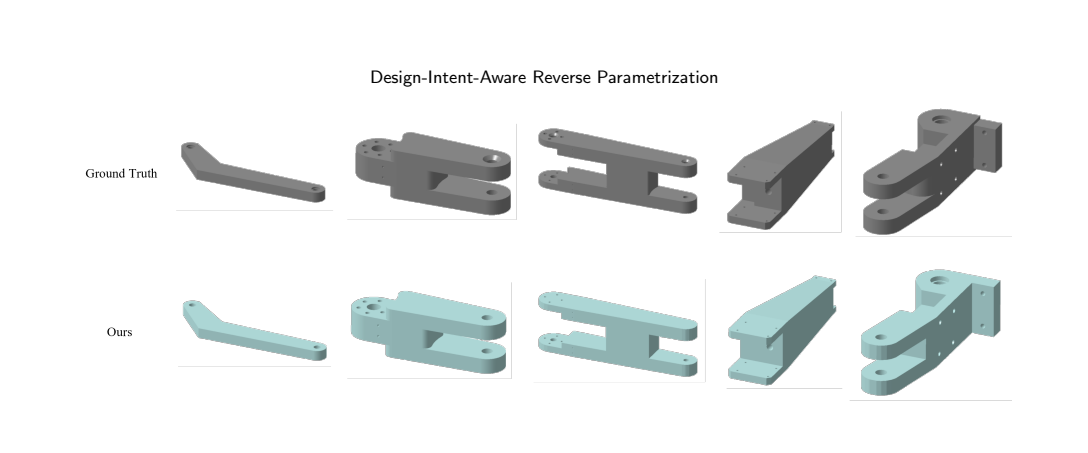
This study presents a design-intent-aware reverse-parametrization framework that converts history-free STEP parts into editable Grasshopper definitions and represents their assembly relations. Without task-specific training, the framework combines kernel-measured features, geometric relations, a compressed attributed adjacency graph, and multiview renderings. An LLM assigns dimensions independent, fixed, or dependent roles, confirms candidate joints, and interprets verification reports. Kernel- and rule-based modules perform measurement, parameter binding, geometry construction, and verification. Evaluation distinguishes default-shape preservation, design-intent reflection, and edit validity, with the latter examined through assembly-level editing examples involving checks for geometry regeneration, joint alignment, interference, and mechanism closure. As an example, five components of a mechanical mechanism were used, and across 25 runs, the mean global and analytic-feature-region intersection over unions (IoUs) were 0.984 and 0.983, respectively; all runs passed the combined shape-preservation criterion. In a separate request experiment, the requested dimension was selected as an independent variable in 19 of 20 runs. Product-level examples show coordinated changes in part geometry and assembly design while preserving assembly relations and avoiding inter-part interference. These results demonstrate editable reconstruction of history-free CAD models under the evaluated geometric and assembly constraints, indicating potential for subsequent design optimization.
from the abstract
Pith says
Machine review · deepseek-v4-flash · 3 Nov 2026 · what was read was not recorded · not checked by a person
It can be wrong. Challenge this review or reply to it.
Holds up, with conditions. Role-separation LLM-plus-kernel pipeline with credible shape fidelity and a genuinely useful editability definition, but the paper never reports its own editValid conjunct — the joint claim is unquantified. This line is wrong
3 major objections · 4 minor
How often objections from reviews like this one are right: not yet measured
Not checked: figures, code, what the 45 references say.
The paper says, at Sec. 4.3; Eq. (9)
The review did not quote this passage.
Pith says: Objection 1 of 3 · major
The paper's operational definition makes edit validity jointly necessary for an editable counterpart (Section 3.1, b81), and Eq. (9) defines VALID_RESULT = MATCH_0 AND editValid. However, no experiment reports editValid(G) from Eq. (7): Section 4.3 and Table 3 quantify only MATCH_0, and the table note confirms that "the combined criterion follows Eq.
more of objection 1
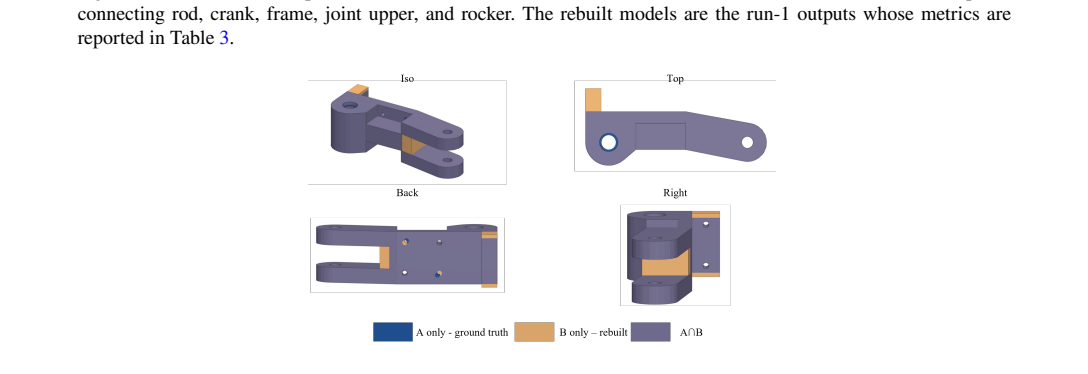
(2)", so the abstract's "all runs passed" statement refers to the shape-preservation criterion only. The reader cannot tell how many of the 25 runs satisfied Eq. (9), how many corner or interior samples from Section 3.5.2 failed, how much the released ranges shrank after single-axis trimming, or how many product-level sliders were locked in the Section 4.5 sweep. This is not merely a presentation gap: Section 3.5.2 states that corner and interior failures are recorded but not converted into constraints or range adjustments, so a run containing a tested-but-invalid configuration would still count among the headline passes. The continuous-versus-sampled gap is itself disclosed (Section 3.5.2; b614); what is missing is the outcome of the sample-based check that the authors themselves defined in Eq. (7). Please report per-run editValid results (and the product-level analogue from Eq. 5), or explicitly narrow the central claim (b8) to condition (i) plus qualitative assembly checks.
The paper says, at Sec. 4.4
The review did not quote this passage.
Pith says: Objection 2 of 3 · major
Condition (ii), design-intent reflection, is evaluated without any external reference. Tables 4 and 5 report the structure and run-to-run consistency of LLM role assignments, but consistency is a stability measure, not a correctness measure, and the paper itself notes that similarity alone does not establish stability of target selection (Section 4.4.1, b532).
more of objection 2
Because the natural-language rationales are explicitly described as supporting auditability rather than providing evidence (Section 3.3), no part of the evaluation checks that the inferred independent/fixed/dependent roles correspond to a human designer's intent for these parts. The request experiment (Table 6) is the strongest evidence, but Section 4.4.3 states that responsiveness is measured at the discrimination stage only and that actual variable connection and achievement of the requested change require separate execution-based verification, which is not reported with per-request outcomes. A concrete remedy would be expert-annotated role assignments for the five parts, or a comparison with a prior reverse-parametrization method, which would also give the Jaccard figures (Table 4) a base rate against which to be interpreted.
The paper says, at Sec. 4.1.1; Table 3 note
The review did not quote this passage.
A classifier read this sentence of the paper as acknowledging the concern (probability 0.83):
“However, generalizability beyond the evaluated components and assembly remains to be established, particularly for irregular and free-form geometries such as topology-optimized shapes.”
Pith says: Objection 3 of 3 · major
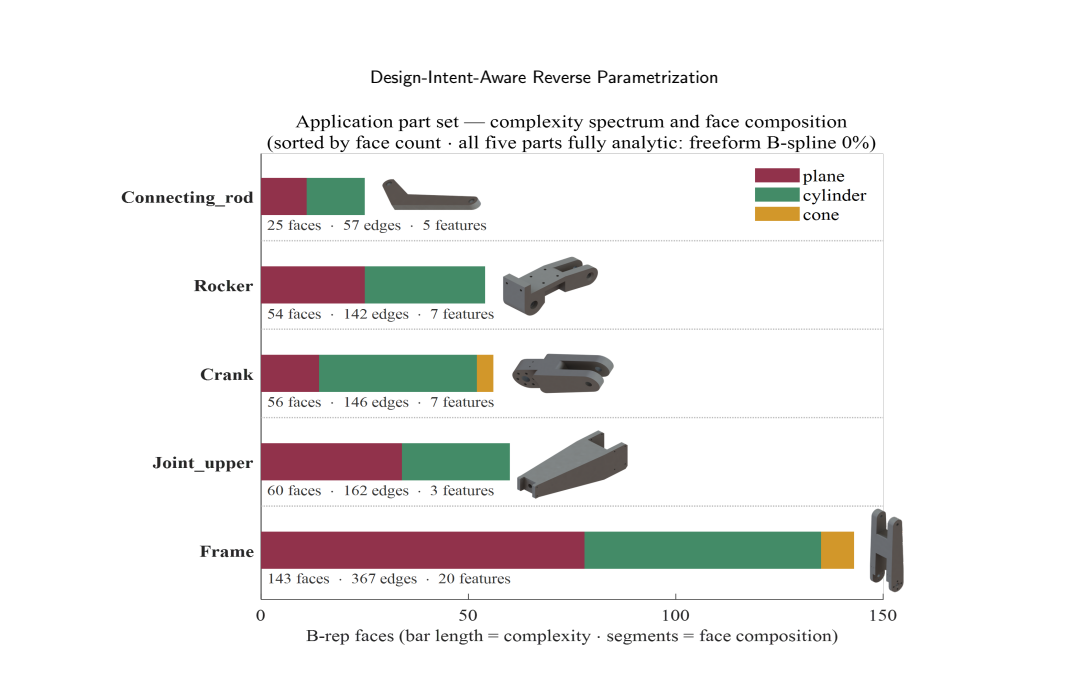
Because all five evaluation parts are fully analytic (Section 4.1.1, b461), the multi-metric shape criterion of Eq. (2) is partly degenerate on this corpus: as the Table 3 note states, no irregular body regions exist, so the r_org condition is vacuous and IoU_af coincides with IoU_vox for every part.
more of objection 3
The reported analytic-feature IoU of 0.983 therefore carries no information beyond the global grid IoU, and the effective active checks reduce to essentially one IoU threshold (0.80) together with the breach-ratio and missing-hole counts, all satisfied with a wide margin. The authors acknowledge the analytic-only scope (b464, b613), so this is a scope-of-evidence concern rather than an internal inconsistency; nevertheless, the headline "analytic-feature-region fidelity" should be presented with this degeneracy stated, and at least one part containing non-analytic or irregular regions would materially strengthen the claimed verification of condition (i).
4 minor objections
The paper says, at Sec. 4.1.3
Pith says: minor objection 1 of 4
Several thresholds used in the product-level checks are not specified: tau_cap in Eq. (3), tau_d in Eq. (5), the hotspot fraction beta in Section 3.5.1, and the measurement-tolerance factor kappa_m in Eq. (8). Without these values the assembly-level experiments cannot be reproduced or compared.
The paper says, at Sec. 4.5
Pith says: minor objection 2 of 4
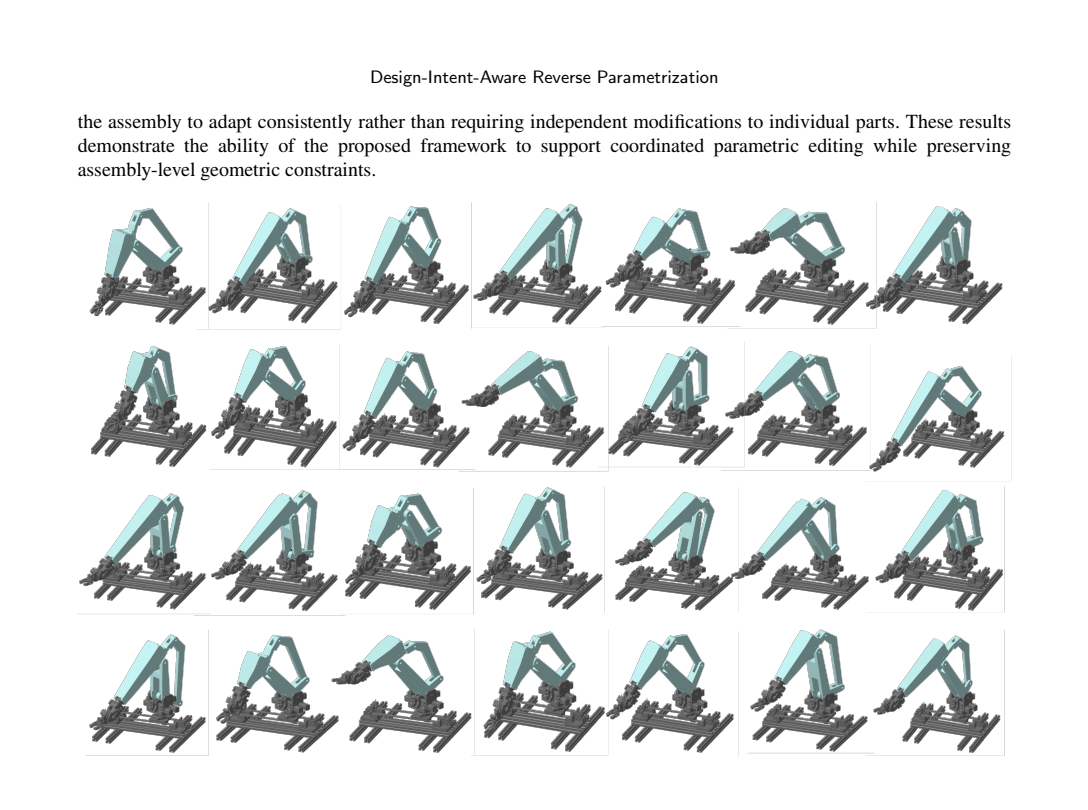
The assembly-level sweep is performed on the base geometry without fillets (Section 4.2.3), but the Section 4.5 results paragraph reports successful regeneration without restating this exclusion; please recall it there so the 28 illustrated configurations are not over-interpreted.
show 2 more
The paper says, at Abstract
Pith says: minor objection 3 of 4
The abstract and several passages contain missing spaces between words (for example, "modifications,acriticallimitation"); the production PDF or text encoding should be checked for a line-breaking or extraction problem.
The paper says, at Replication of results
Pith says: minor objection 4 of 4
The code and data are available only "on reasonable request," and the LLM component (Claude Sonnet 4.6) is proprietary and seedless; given the paper's emphasis on reproducible kernel measurement, releasing the serialization code, prompt templates, and per-run logs would substantially strengthen the artifact.
What would settle it
Re-run the five parts (5 runs each) and report per-run VALID_RESULT of Eq. (9) with its components: MATCH_0 (Eq. 2) and editValid (Eq. 7) over T, giving valid-sample counts for single-axis, corner, and interior probes, and final released slider ranges versus declared ranges. At the product level, report per-slider sweep outcomes, bisection refinement counts, and locked-slider reasons on the merged canvas. If all 25 runs yield editValid=1 and every product-level slider reaches its declared bounds without failure, the joint claim is substantiated and only the acknowledged continuous-space gap remains. If any run fails corner or interior probes, the scoped claim ('under the evaluated constraints') must be revised, since the implemented loop records such failures without converting them into constraints or range adjustments.
from the skeptic's reading
How the review went
4 readings by deepseek-v4-flash · 3 Nov 2026
- Reader holds up, with conditions
- Skeptic partly agrees
- Editor wrote the verdict above
- Referee major revision: 3 major objections, 4 minor
Not run on this paper: the simulated authors' defence.
Pith did not check this review's objections against the paper.
The review in full
The review in brief, machine-written
Two things to know. First, the architecture is the real contribution: the LLM only assigns independent/fixed/dependent roles to kernel-measured dimensions and confirms candidate joints; every coordinate and geometric value comes from OpenCASCADE, and code emission is rule-based. That is the right division of labor for LLM-based CAD, and it makes the reported shape fidelity non-circular. Second, the paper defines success as a conjunction it never actually reports. An editable counterpart requires default-shape preservation AND design-intent reflection AND edit validity (Eq. 9, VALID_RESULT = MATCH_0 ∧ editValid), but every quantitative headline — 25/25 passes, global IoU 0.984, feature IoU 0.983 — concerns MATCH_0 only. No section reports how many runs attained editValid=1, how many corner or interior samples failed, how much slider ranges shrank after single-axis trimming, or how many product-level sliders were locked. Section 3.5.2 explicitly says corner/interior failures are recorded but not converted into constraints, so a tested-but-invalid configuration is compatible with every number in the paper. The continuous-versus-sampled gap is disclosed (their b614); the missing conjunct is not. This reads like the edit-validity results were computed but dropped between methods and results, and it is fixable — but as published, the joint claim in Section 3.1 is unquantified.
Credit where due. The three-condition operational definition is genuinely useful; most reconstruction work stops at geometric similarity without asking whether the parameters can actually be edited. The request experiment (requested dimension selected as independent in 19/20 runs) shows the discrimination responds to intent rather than being a fixed lookup. Default-shape fidelity is checked against the external STEP source, and the paper is unusually explicit about scope: five fully analytic parts from one robot-arm design.
The remaining soft spots are proportionate. Design-intent evaluation has no external baseline — no expert judgment, no prior-method comparison — and run-to-run Jaccard for outside-graph selections (0.49–0.64) shows real variation in exactly the dimensions that matter most. Product-level editing is qualitative: 28 illustrated configurations, no quantitative per-slider success counts. Code and data are withheld on request, which is the wrong call for a paper whose key missing numbers a reader would want to verify.
Who this is for: anyone building LLM-plus-CAD pipelines or reverse-parametrization systems; the architecture and the editability definition are worth borrowing. Send it to a serious referee — the gaps are reporting gaps plus missing baselines, not a broken core.
The strongest objection
Section 3.1 makes joint satisfaction definitional: the paper states (b81) that an editable counterpart requires default-shape preservation, intent reflection, and edit validity, and that 'if any of these conditions is not satisfied, the resulting model cannot be reliably used'; Eq. (9) then defines VALID_RESULT = MATCH_0 ∧ editValid as 'technically verified.' Yet every quantitative headline — 25/25 combined-criterion passes, mean global IoU 0.984, analytic-feature IoU 0.983 — concerns MATCH_0 (condition i) only. Condition (iii) outcomes are never reported: Section 3.5.2 defines editValid(G) over the retained sample set T (six-step single-axis sweeps, up to 80 corner probes, 20 LHS interior samples), but no section reports how many of the 25 runs attained editValid=1, how many corner or interior samples failed, how much released ranges shrank after single-axis trimming, or how many product-level sliders were locked in the Section 4.5 sweep. This matters because Section 3.5.2 explicitly says corner/interior failures are recorded but not converted into constraints or range adjustments; a failed corner is therefore compatible with the reported pipeline, and the reader cannot know whether any run's released editing space contains a tested-but-invalid configuration. The deeper continuous-versus-sampled gap is acknowledged by the authors (b614; Section 3.5.2 on Boolean nonmonotonicity), so that part is disclosed. What remains unresolved is upstream: the paper's own operational definition requires the editValid conjunct, yet that conjunct has no reported outcome. The scoped conclusion (b8) is honest but underdetermined by the reported data.
The paper is unusually careful: it separates LLM judgment from deterministic kernel work, defines three independently necessary conditions in Section 3.1, discloses that Eq. (7)'s editValid is sample-based (Section 3.5.2), and scopes its conclusion (b8) to 'under the evaluated geometric and assembly constraints.' The reader's CONDITIONAL verdict is right; I reach it by an adjacent route. The reader's weakest assumption is the continuous-versus-sampled gap; that gap is real but fully acknowledged (b358, b614), and a scoped conclusion can arguably live with it. The unresolved issue is more elementary: the joint-satisfaction criterion that the paper itself makes definitional (b81, Eq. 9) is never reported as an outcome. The headline figures — mean global IoU 0.984, analytic-feature IoU 0.983, 25/25 combined-criterion passes — all instantiate MATCH_0 (condition i). Condition (ii) is reported as selection statistics with no ground truth; condition (iii) only procedurally: Section 4.2.3 describes the sweep, Section 4.5 shows 28 illustrative configurations, but no run-level editValid pass/fail, no interior-sample validity ratios, no corner-failure counts, and no range-shrinkage or slider-lock summaries appear. Section 3.5.2 even specifies that corner/interior failures are recorded but not converted into constraints, so a failing corner is consistent with the pipeline as described; whether this occurred in any run is unknowable from the paper. Also relevant: Table 3's note that r_org is vacuous (all faces analytic) means the combined criterion reduces essentially to an IoU threshold of 0.80 taken as the max of Boolean and grid estimates after center alignment — a wide goal, so MATCH_0 alone is not a demanding bar. Credit is due where the paper earns it: the role-separation architecture, the acceptance gates of Eq. (8), the honest Eq. (7) wording, and the explicit limitation statements (b272, b389, b465, b514, b532, b613) are genuine support for a narrow claim. The missing edit-validity reporting is a data-presentation gap, not a structural flaw, but it is the load-bearing gap for the joint claim as defined. The condition on acceptance should be: report per-run VALID_RESULT components including sampled edit-validity outcomes and product-level sweep results, and ideally release the artifacts (currently 'available on reasonable request').
The referee's report
The framework architecture is a genuine strength: grounding all numerical values in kernel measurements and prohibiting LLM-emitted coordinates addresses the parameter-provenance problem that plagues end-to-end LLM CAD generation; the delta-following acceptance gate (Eq. 8) is a concrete, verifiable check that a promoted slider actually controls the intended dimension; and the request experiment (Table 6) is a controlled behavioral test of intent responsiveness (1/20 without request versus 19/20 with request). Default-shape fidelity is credible: IoU values are computed against the external STEP source with both Boolean and grid estimators, both values are reported, and metrics were stable across runs. The paper is also explicit about several limitations (sample-based edit validity, analytic-only benchmark, self-referential intent evaluation). If the missing edit-validity reporting is supplied, this would be a solid advance over prior CSG recovery and CAD command-sequence methods for the reusable-CAD literature.
Pith's reading of the paper (a machine's summary, not the authors')
The paper sets out to show that a STEP part with no modeling history—STEP being the neutral CAD exchange format that stores boundary geometry but not how the model was built—can be rebuilt as a genuinely editable parametric model rather than a static copy. Editability is defined operationally by three jointly necessary conditions: the default shape must match the source, the dimensions a designer would want to change must be exposed as independent controls while the rest are fixed or linked, and the model must stay geometrically valid when those controls move. The framework splits the work by role: a large language model judges design intent from a serialized description of the part, while a geometric kernel performs every measurement, construction, and verification, so no unmeasured number can enter the model. On five robotic-arm parts the rebuilt definitions matched the source at a mean global IoU of 0.984, and coordinated edits across the six-part assembly preserved joint closure and avoided interference. If the approach holds, history-free geometry from scans, legacy files, or neutral data exchange could enter iterative design and optimization without manual remodeling.
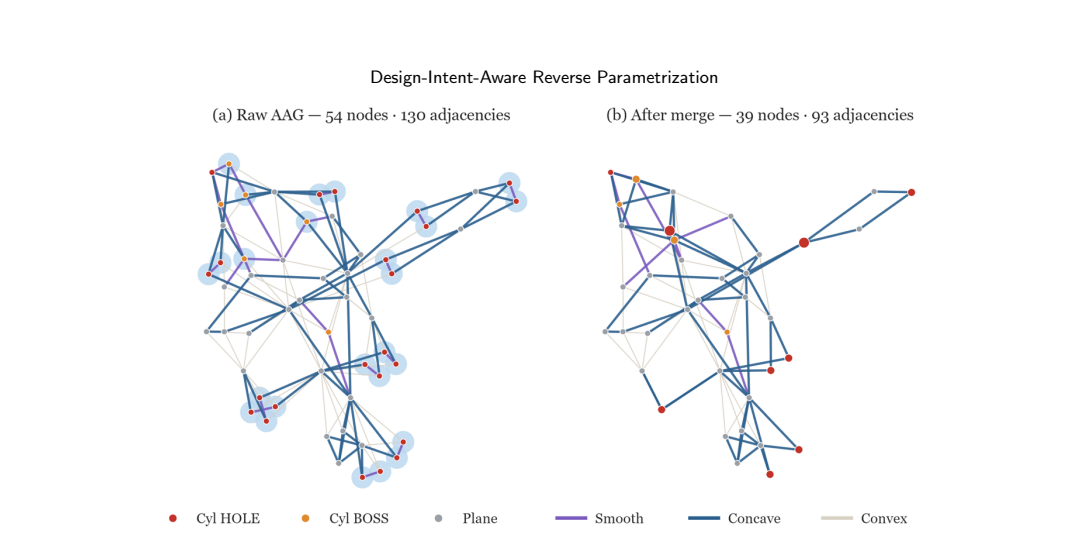
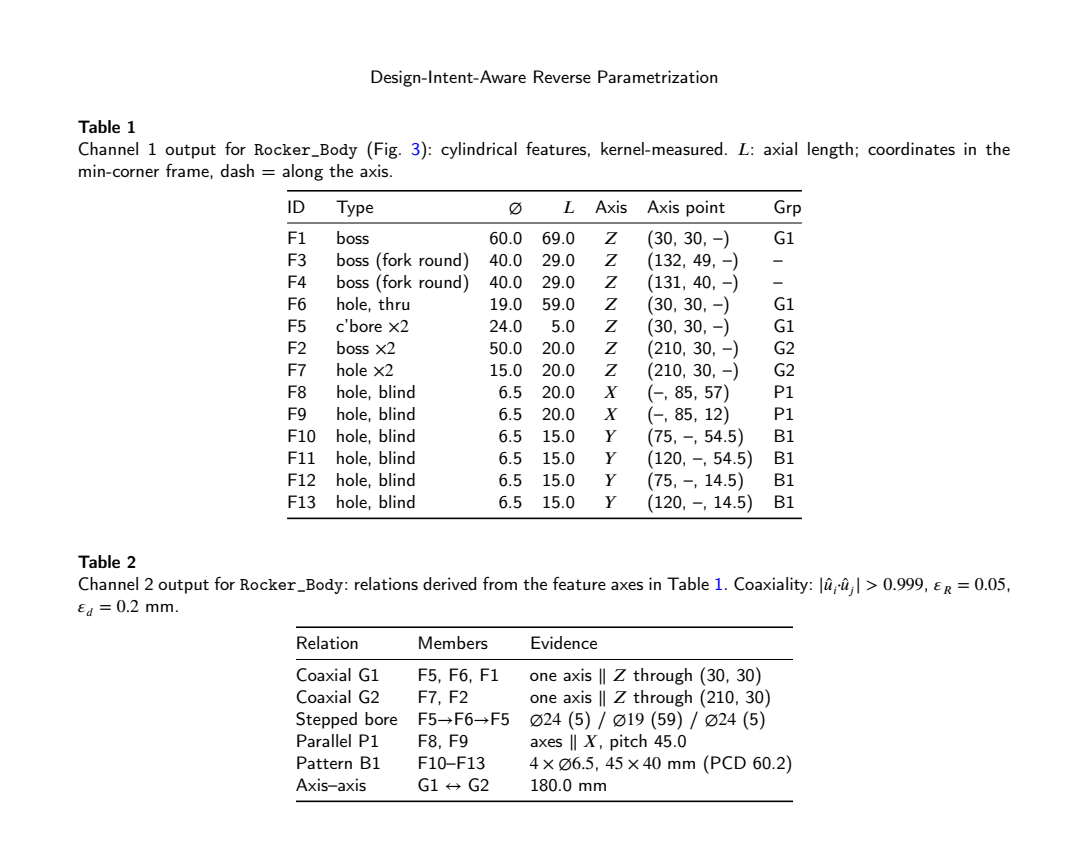
What carries the argument. The carrying mechanism is role separation plus a four-channel serialization. The geometric kernel parses the input B-rep and serializes it into a feature table of kernel-measured dimensions, a channel of geometric relations (coaxial groups, bolt-circle patterns, symmetry), a compressed attributed adjacency graph (a face-adjacency graph with smooth/convex/concave edge labels), and multiview renderings. The LLM consumes this text and returns only role assignments—which dimensions are OPENED, FIXED, or MIRROR($t$), which kernel-measured joint candidates are real, and what the verification report means—while a rule-based emitter and kernel modules handle all measurement, parameter binding, geometry construction, and checking. Edit validity is engineered through kernel-derived clamps (the relations INSIDE, WALL, NEIGHBOR, DEPTH, OVERLAP) injected into the canvas, an acceptance gate for promoted variables, and a sampling loop over single-axis sweeps, corner configurations, and Latin-hypercube interior points. At the product level, measured seat links make slot widths follow seated-part thickness through a Jacobian of face positions, and every user-facing slider is trimmed to the last value at which the rebuilt assembly still closes and passes interference and bolted-joint checks.
Core claim. The central claim is that an editable counterpart of a history-free boundary representation (B-rep) can be constructed and verified, with editability defined as the joint satisfaction of three conditions. Default-shape preservation requires the Grasshopper definition $G$—Grasshopper being the visual parametric modeling environment of Rhinoceros 3D—at its default slider values $\theta_0$ to reproduce the source solid under a combined criterion of global $\mathrm{IoU}_{3\mathrm{D}}$, analytic-feature-region IoU, boundary-breach and volume ratios, and a missing-hole count. Design-intent reflection requires each candidate dimension to receive an OPENED, FIXED, or MIRROR($t$) role from an LLM, with cross-part couplings realized as shared sliders or measured links. Edit validity requires every tested configuration in the declared editing space to yield a single, closed, kernel-valid solid, and at the product level to keep the mechanism closable, joints intact, and inter-part penetration below tolerance. On the evaluation set, all 25 runs passed the shape-preservation criterion with mean global IoU 0.984 and analytic-feature IoU 0.983, the requested dimension became an independent variable in 19 of 20 request runs, and the claim is explicitly scoped to the sampled configurations actually tested.
The premise it rests on. The load-bearing premise is that checking a finite set of slider configurations—six-step single-axis sweeps, up to 80 corner combinations, and 20 interior samples—certifies the whole declared editing space, even though Eq. (7) asserts only that no failures occurred among those tests and the paper concedes that untested combinations could still fail.
If the paper is right (Pith's inferences, not the authors')
History-free STEP from scans, legacy designs, or neutral data exchange could enter iterative design and optimization loops without manual remodeling, because the output is an executable Grasshopper model whose default geometry is verified against the source.
Design intent becomes inspectable: every dimension carries an OPENED, FIXED, or MIRROR role with a natural-language rationale, so a designer can audit why a dimension is editable, locked, or linked before trusting the model.
Across parts, coordinated editing is preserved: shared sliders and measured seat links make a change to a seated part's thickness propagate to its receiving slot, and each slider is clamped to the last value at which the product still closes, avoids interference, and keeps its bolted joints.
Because the pipeline is training-free and grounds every number in kernel measurements, the same geometry can be re-parameterized differently when a user request changes which dimension is driving, which is what the 19-of-20 request result demonstrates.
The natural stress test is the discreteness of the edit-validity certificate: the framework records corner and interior failures but does not convert them into new constraints, so an obvious strengthening is an adaptive loop that turns each newly found failure into another clamp until the sampled and declared editing spaces agree.
Since intent discrimination leans on an LLM's pretrained engineering conventions, parts whose function is defined by manufacturing process—castings, molded housings, weldments—may need domain-specific precedent memory; the paper's case-based retrieval mechanism is the place to test this.
The measured seat links are linearized and not relinearized during editing, so very large coordinated edits could drift from the intended clearance; a testable extension is to recompute the face-position Jacobian after each edit or bound the linearization error.
All evaluation parts are purely analytic surfaces, which implies the next hurdle is free-form and topology-optimized geometry; a concrete follow-on benchmark would feed STEP derived from topology optimization through the pipeline, exactly the case the paper names as future work.
Check this review
Pith stored no record of this review's passes and took no fingerprint of it. Reviews made by code from 13 Nov 2026 on carry both.
How often reviews like this one are right
Reviews like this one: written by deepseek-v4-flash, where what was read was not recorded.
How often objections from reviews like this one are right: not yet measured
Reviews by people
This review was written by a machine. No person has reviewed this paper on Pith yet. A scientist listed on Pith can review it for a fee, and their review is published here whatever it concludes.
The paper
Abstract
Neutral CAD formats such as STEP typically preserve geometry but not feature histories or parameter dependencies. Thus, they are inherently limited for iterative design that requires modifications, a critical limitation for design optimization that relies on iterative processes. This study presents a design-intent-aware reverse-parametrization framework that converts history-free STEP parts into editable Grasshopper definitions and represents their assembly relations. Without task-specific training, the framework combines kernel-measured features, geometric relations, a compressed attributed adjacency graph, and multiview renderings. An LLM assigns dimensions independent, fixed, or dependent roles, confirms candidate joints, and interprets verification reports. Kernel- and rule-based modules perform measurement, parameter binding, geometry construction, and verification. Evaluation distinguishes default-shape preservation, design-intent reflection, and edit validity, with the latter examined through assembly-level editing examples involving checks for geometry regeneration, joint alignment, interference, and mechanism closure. As an example, five components of a mechanical mechanism were used, and across 25 runs, the mean global and analytic-feature-region intersection over unions (IoUs) were 0.984 and 0.983, respectively; all runs passed the combined shape-preservation criterion. In a separate request experiment, the requested dimension was selected as an independent variable in 19 of 20 runs. Product-level examples show coordinated changes in part geometry and assembly design while preserving assembly relations and avoiding inter-part interference. These results demonstrate editable reconstruction of history-free CAD models under the evaluated geometric and assembly constraints, indicating potential for subsequent design optimization.
The paper's own sentences, arranged, kept beside the review and separate from it. Each label is drawn from a closed vocabulary; the number beside it is the probability the classifier gave that label. No sentence in this record was written by a model.
abstract compiled · 2026-11-03
The authors' main claim, as the classifier picked it out 1.00
“These results demonstrate editable reconstruction of history-free CAD models under the evaluated geometric and assembly constraints, indicating potential for subsequent design optimization.”
How the main claim is stated: asserted 0.67
What the abstract itself states, as probabilities: claims first 0.05 · states limitation 0.32 · human participants 0.04 · controlled comparison 0.08 · randomized assignment 0.02 · states quantitative result 0.99 · compares with prior results 0.09 · mentions code or data availability 0.04
The abstract, sentence by sentence
This table labels the abstract only (arXiv listing abstract v1). The number is the probability the classifier gave the label.
| Sentence | Role | The authors' own work | States the main conclusion | Strength |
|---|---|---|---|---|
| Neutral CAD formats such as STEP typically preserve geometry but not feature histories or parameter dependencies. | background 1.00 | 0.05 | 0.02 | asserted 1.00 |
| Thus, they are inherently limited for iterative design that requires modifications, a critical limitation for design optimization that relies on iterative processes. | background 0.89 | 0.06 | 0.03 | asserted 1.00 |
| This study presents a design-intent-aware reverse-parametrization framework that converts history-free STEP parts into editable Grasshopper definitions and represents their assembly relations. | contribution 1.00 | 0.93 | 0.16 | asserted 1.00 |
| Without task-specific training, the framework combines kernel-measured features, geometric relations, a compressed attributed adjacency graph, and multiview renderings. | method 1.00 | 0.76 | 0.03 | asserted 1.00 |
| An LLM assigns dimensions independent, fixed, or dependent roles, confirms candidate joints, and interprets verification reports. | method 0.99 | 0.70 | 0.04 | asserted 1.00 |
| Kernel- and rule-based modules perform measurement, parameter binding, geometry construction, and verification. | method 1.00 | 0.68 | 0.03 | asserted 1.00 |
| Evaluation distinguishes default-shape preservation, design-intent reflection, and edit validity, with the latter examined through assembly-level editing examples involving checks for geometry regeneration, joint alignment, interference, and mechanism closure. | method 0.93 | 0.92 | 0.06 | asserted 0.84 |
| As an example, five components of a mechanical mechanism were used, and across 25 runs, the mean global and analytic-feature-region intersection over unions (IoUs) were 0.984 and 0.983, respectively; all runs passed the combined shape-preservation criterion. | result 1.00 | 0.96 | 0.06 | asserted 1.00 |
| In a separate request experiment, the requested dimension was selected as an independent variable in 19 of 20 runs. | result 1.00 | 0.94 | 0.03 | asserted 1.00 |
| Product-level examples show coordinated changes in part geometry and assembly design while preserving assembly relations and avoiding inter-part interference. | result 1.00 | 0.90 | 0.10 | asserted 1.00 |
| These results demonstrate editable reconstruction of history-free CAD models under the evaluated geometric and assembly constraints, indicating potential for subsequent design optimization. | interpretation 0.99 | 0.90 | 0.89 | asserted 0.67 |
What kind of paper the classifier reports this is: method or tool 1.00 · evidence from observation or experiment 0.95
What was examined, and what was not
Sources read
- arXiv listing abstract v1
Not examined
- full text
- figures and tables
- references and citing sentences
- relations to other papers
Levels run
- P abstract
Not run
- S sections
- T body sentences
- C citations
- R cross-paper relations
How the labels were made
Compiled by classifier-1.13.0 via TypeSafe API, question bank abstract-p1-20260923, 2026-11-03: 1 request, 8,233 input tokens.
Every quoted sentence on this record is the authors'. Every label is from Pith's closed vocabulary, with the probability shown beside it. This record as JSON
Figures (7)
Figures are the authors', reproduced from the paper.
References (45)
- [1] Aamodt, A., Plaza, E., 1994. Case-based reasoning: Foundational issues, methodological variations, and system approaches. AI communications 7, 39–59 on Pith
- [2] Anantha, R., Kramer, G.A., Crawford, R.H., 1996. Assembly modelling by geometric constraint satisfaction. Computer-Aided Design 28, 707–722 on Pith
- [3] Badagabettu, A., Yarlagadda, S.S., Farimani, A.B., 2024. Query2cad: Generating cad models using natural language queries. arXiv preprint arXiv:2406.00144 on PithPith's reviewarXiv
- [4] Benkő, P., Martin, R.R., Várady, T., 2001. Algorithms for reverse engineering boundary representation models. Computer-Aided Design 33, 839–851 on Pith
- [5] Camba, J.D., Contero, M., Company, P., 2016. Parametric cad modeling: An analysis of strategies for design reusability. Computer-aided design 74, 18–31 on Pith
- [6] Casey,E.,Zhang, T.,Ishida,S.,Thompson, J.R.,Khasahmadi,A.,Lambourne, J.G.,Jayaraman,P.K.,Willis, K.D.,2025. Aligning constraint generation with design intent in parametric cad, in: 2025 IEEE/CVF International Conference on Computer Vision (ICCV), IEEE. pp. 8613– 8622 on Pith
- [7] Dong, X., Li, C., Zheng, P., Han, C., Jing, J., Shen, H., Song, Y., Yang, Z., 2025. Histcad: A constraint-aware parametric history-based cad representation, dataset, and benchmark with industrial complexity. arXiv preprint arXiv:2602.19171 on PithPith's reviewarXiv
- [8] Dong, Y., Zou, S., Li, S., Deng, N., Zhou, H., Yang, X., Cai, P., Wen, L., Cai, X., Shi, B., 2026. Assemcad: Production-ready cad assembly generation from natural language. arXiv preprint arXiv:2607.05123 on PithPith's reviewarXiv
- [9] Du, T., Inala, J.P., Pu, Y., Spielberg, A., Schulz, A., Rus, D., Solar-Lezama, A., Matusik, W., 2018. Inversecsg: Automatic conversion of 3d models to csg trees. ACM Transactions on Graphics (TOG) 37, 1–16 on Pith
- [10] Guo, H., Liu, S., Pan, H., Liu, Y., Tong, X., Guo, B., 2022. Complexgen: Cad reconstruction by b-rep chain complex generation. ACM Transactions on Graphics (TOG) 41, 1–18 on Pith
- [11] Jayaraman,P.K.,Lambourne,J.G.,Desai,N.,Willis,K.D.,Sanghi,A.,Morris,N.J.,2022. Solidgen:Anautoregressivemodelfordirectb-rep synthesis. arXiv preprint arXiv:2203.13944 on PithPith's reviewarXiv
- [12] Jones, B., Hildreth, D., Chen, D., Baran, I., Kim, V.G., Schulz, A., 2021. Automate: A dataset and learning approach for automatic mating of cad assemblies. ACM Transactions on Graphics (TOG) 40, 1–18 on Pith
- [13] Joshi, S., Chang, T.C., 1988. Graph-based heuristics for recognition of machined features from a 3d solid model. Computer-aided design 20, 58–66 on Pith
- [14] Kania, K., Zieba, M., Kajdanowicz, T., 2020. Ucsg-net-unsupervised discovering of constructive solid geometry tree. Advances in neural information processing systems 33, 8776–8786 on Pith
- [15] Khan, M.S., Dupont, E., Ali, S.A., Cherenkova, K., Kacem, A., Aouada, D., 2024a. Cad-signet: Cad language inference from point clouds using layer-wise sketch instance guided attention, in: 2024 IEEE/CVF Conference on Computer Vision and Pattern Recognition (CVPR), IEEE. pp. 4713–4722 on Pith
- [16] Khan, M.S., Sinha, S., Sheikh, T.U., Stricker, D., Ali, S.A., Afzal, M.Z., 2024b. Text2cad: Generating sequential cad designs from beginner- to-expert level text prompts. Advances in Neural Information Processing Systems 37, 7552–7579 on Pith
- [17] Kim, J., Pratt, M.J., Iyer, R.G., Sriram, R.D., 2008. Standardized data exchange of cad models with design intent. Computer-Aided Design 40, 760–777 on Pith
- [18] Koch,S.,Matveev,A.,Jiang,Z.,Williams,F.,Artemov,A.,Burnaev,E.,Alexa,M.,Zorin,D.,Panozzo,D.,2019. Abc:Abigcadmodeldataset for geometric deep learning, in: 2019 IEEE/CVF conference on computer vision and pattern Recognition (CVPR), Ieee. pp. 9593–9603 on Pith
- [19] Lee,M.,Zhang,D.,Jambon,C.,Kim,Y.M.,2025a. Brepdiff:Single-stageb-repdiffusionmodel,in:ProceedingsoftheSpecialInterestGroup on Computer Graphics and Interactive Techniques Conference Conference Papers, pp. 1–11 on Pith
- [20] Lee, S., Yang, S., Kang, N., 2025b. Multi-objective generative design framework and realization for quasi-serial manipulator: Considering kinematic and dynamic performance. Engineering Applications of Artificial Intelligence 161, 112142 on Pith
show 25 more
- [21] Li,X.,Sun,Y.,Sha,Z.,2025. Llm4cad:Multimodallargelanguagemodelsforthree-dimensionalcomputer-aideddesigngeneration. Journal of Computing and Information Science in Engineering 25, 021005 on Pith
- [22] Liang, J., He, F., Fan, R., Chu, Y., Yan, X., 2025. Cadcl: Reconstruct parametric cad models from b-rep via contrastive learning. Journal of Computational Design and Engineering 12, 176–184 on Pith
- [23] Liu, Y., Dutt, N.S., Li, C., Mitra, N.J., 2025. B-repler: Language-guided editing of cad models. arXiv preprint arXiv:2508.10201 on PithPith's reviewarXiv
- [24] Liu,Y.,Obukhov,A.,Wegner,J.D.,Schindler,K.,2024. Point2cad:Reverseengineeringcadmodelsfrom3dpointclouds,in:2024IEEE/CVF Conference on Computer Vision and Pattern Recognition (CVPR), IEEE. pp. 3763–3772 on Pith
- [25] Makatura, L., Foshey, M., Wang, B., Hähnlein, F., Ma, P., Deng, B., Tjandrasuwita, M., Spielberg, A., Owens, C., Chen, P.Y., et al., 2024. How can large language models help humans in design and manufacturing? part 1: Elements of the llm-enabled computational design and manufa... on Pith
- [26] Mallis, D., Karadeniz, A.S., Cavada, S., Rukhovich, D., Foteinopoulou, N., Cherenkova, K., Kacem, A., Aouada, D., 2025. Cad-assistant: Tool-augmented vllms as generic cad task solvers, in: 2025 IEEE/CVF International Conference on Computer Vision (ICCV), IEEE. pp. 7284–7294 on Pith
- [27] Otey, J., Company, P., Contero, M., Camba, J.D., 2018. Revisiting the design intent concept in the context of mechanical cad education. Computer-aided design and applications 15, 47–60 on Pith
- [28] Pratt,M.J.,Anderson,B.D.,Ranger,T.,2005.Towardsthestandardizedexchangeofparameterizedfeature-basedcadmodels.Computer-Aided Design 37, 1251–1265 on Pith
- [29] Ren, D., Zheng, J., Cai, J., Li, J., Zhang, J., 2022. Extrudenet: Unsupervised inverse sketch-and-extrude for shape parsing, in: European Conference on Computer Vision, Springer. pp. 482–498. Y. Lee et al.:Preprint submitted to ElsevierPage 30 of 31 Design-Intent-Aware Reverse... on Pith
- [30] Rukhovich, D., Dupont, E., Mallis, D., Cherenkova, K., Kacem, A., Aouada, D., 2025. Cad-recode: Reverse engineering cad code from point clouds, in: 2025 IEEE/CVF International Conference on Computer Vision (ICCV), IEEE. pp. 9801–9811 on Pith
- [31] Schönemann, P.H., 1966. A generalized solution of the orthogonal procrustes problem. Psychometrika 31, 1–10 on Pith
- [32] Sharma, G., Goyal, R., Liu, D., Kalogerakis, E., Maji, S., 2018. Csgnet: Neural shape parser for constructive solid geometry, in: Proceedings of the IEEE conference on computer vision and pattern recognition, pp. 5515–5523 on Pith
- [33] Sharma, G., Liu, D., Maji, S., Kalogerakis, E., Chaudhuri, S., Měch, R., 2020. Parsenet: A parametric surface fitting network for 3d point clouds, in: European conference on computer vision, Springer. pp. 261–276 on Pith
- [34] Uy, M.A., Chang, Y.Y., Sung, M., Goel, P., Lambourne, J.G., Birdal, T., Guibas, L.J., 2022. Point2cyl: Reverse engineering 3d objects from pointcloudstoextrusioncylinders,in:ProceedingsoftheIEEE/CVFconferenceoncomputervisionandpatternrecognition,pp.11850–11860 on Pith
- [35] Willis, K.D., Jayaraman, P.K., Chu, H., Tian, Y., Li, Y., Grandi, D., Sanghi, A., Tran, L., Lambourne, J.G., Solar-Lezama, A., et al., 2022. Joinable:Learningbottom-upassemblyofparametriccadjoints,in:2022IEEE/CVFConferenceonComputerVisionandPatternRecognition (CVPR), IEEE. pp.... on Pith
- [36] Willis, K.D., Pu, Y., Luo, J., Chu, H., Du, T., Lambourne, J.G., Solar-Lezama, A., Matusik, W., 2021. Fusion 360 gallery: A dataset and environment for programmatic cad construction from human design sequences. ACM Transactions on Graphics (TOG) 40, 1–24 on Pith
- [37] Wu,R.,Xiao,C.,Zheng,C.,2021. Deepcad:Adeepgenerativenetworkforcomputer-aideddesignmodels,in:2021IEEE/CVFInternational Conference on Computer Vision (ICCV), IEEE. pp. 6752–6762 on Pith
- [38] Xu,J.,Wang,C.,Zhao,Z.,Liu,W.,Ma,Y.,Gao,S.,2024a. Cad-mllm:Unifyingmultimodality-conditionedcadgenerationwithmllm. arXiv preprint arXiv:2411.04954 on PithPith's reviewarXiv
- [39] Xu,X.,Lambourne,J.,Jayaraman,P.,Wang,Z.,Willis,K.,Furukawa,Y.,2024b. Brepgen:Ab-repgenerativediffusionmodelwithstructured latent geometry. ACM Transactions on Graphics (TOG) 43, 1–14 on Pith
- [40] Xu, X., Willis, K.D., Lambourne, J.G., Cheng, C.Y., Jayaraman, P.K., Furukawa, Y., 2022. Skexgen: Autoregressive generation of cad construction sequences with disentangled codebooks. arXiv preprint arXiv:2207.04632 on PithPith's reviewarXiv
- [41] Yu,F.,Chen,Q.,Tanveer,M.,MahdaviAmiri,A.,Zhang,H.,2023.D 2csg:Unsupervisedlearningofcompactcsgtreeswithdualcomplements and dropouts. Advances in Neural Information Processing Systems 36, 22807–22819 on Pith
- [42] Yu,F.,Chen,Z.,Li,M.,Sanghi,A.,Shayani,H.,Mahdavi-Amiri,A.,Zhang,H.,2022. Capri-net:Learningcompactcadshapeswithadaptive primitive assembly, in: 2022 IEEE/CVF Conference on Computer Vision and Pattern Recognition (CVPR), IEEE. pp. 11758–11768 on Pith
- [43] Yuan, H., Bousseau, A., Pan, H., Zhang, Q., Mitra, N.J., Li, C., 2024. Diffcsg: Differentiable csg via rasterization, in: SIGGRAPH Asia 2024 Conference Papers, pp. 1–10 on Pith
- [44] Yuan,Y.,Sun,S.,Liu,Q.,Bian,J.,2025. Cad-editor:Alocate-then-infillframeworkwithautomatedtrainingdatasynthesisfortext-basedcad editing. arXiv preprint arXiv:2502.03997 on PithPith's reviewarXiv
- [45] Zhang, C., Polette, A., Pinquié, R., Carasi, G., De Charnace, H., Pernot, J.P., 2025. ecad-net: Editable parametric cad models reconstruction from dumb b-rep models using deep neural networks. Computer-Aided Design 178, 103806. Y. Lee et al.:Preprint submitted to ElsevierPage 31 of 31 on Pith
Cited by 2 Pith papers
Reviewed papers on Pith that cite this one. The full citation record
Challenges and discussion
Disagree with the review, or know something it missed? Leave a comment, or challenge this review formally: a challenge becomes a permanent entry in this paper's record, and its decision is published here.
Come back by email
A short list of the week's newly reviewed papers. Nothing is sent until you confirm from your inbox, and every email has a link that stops it. No account.
No comments yet.
Sign in to comment