Machine Learning · arXiv:2611.02102 v3 · submitted 1 Nov 2026
NorthCUA Technical Report: Turbocharging Computer-Use Agents through Experience at Scale
The paper says
“Scaling computer-use agents from individual actions to complex software work requires experience that connects decisions to complete outcomes. We present NorthCUA, an integrated system for turbocharging computer-use agents through experience at scale.”
more of the abstract
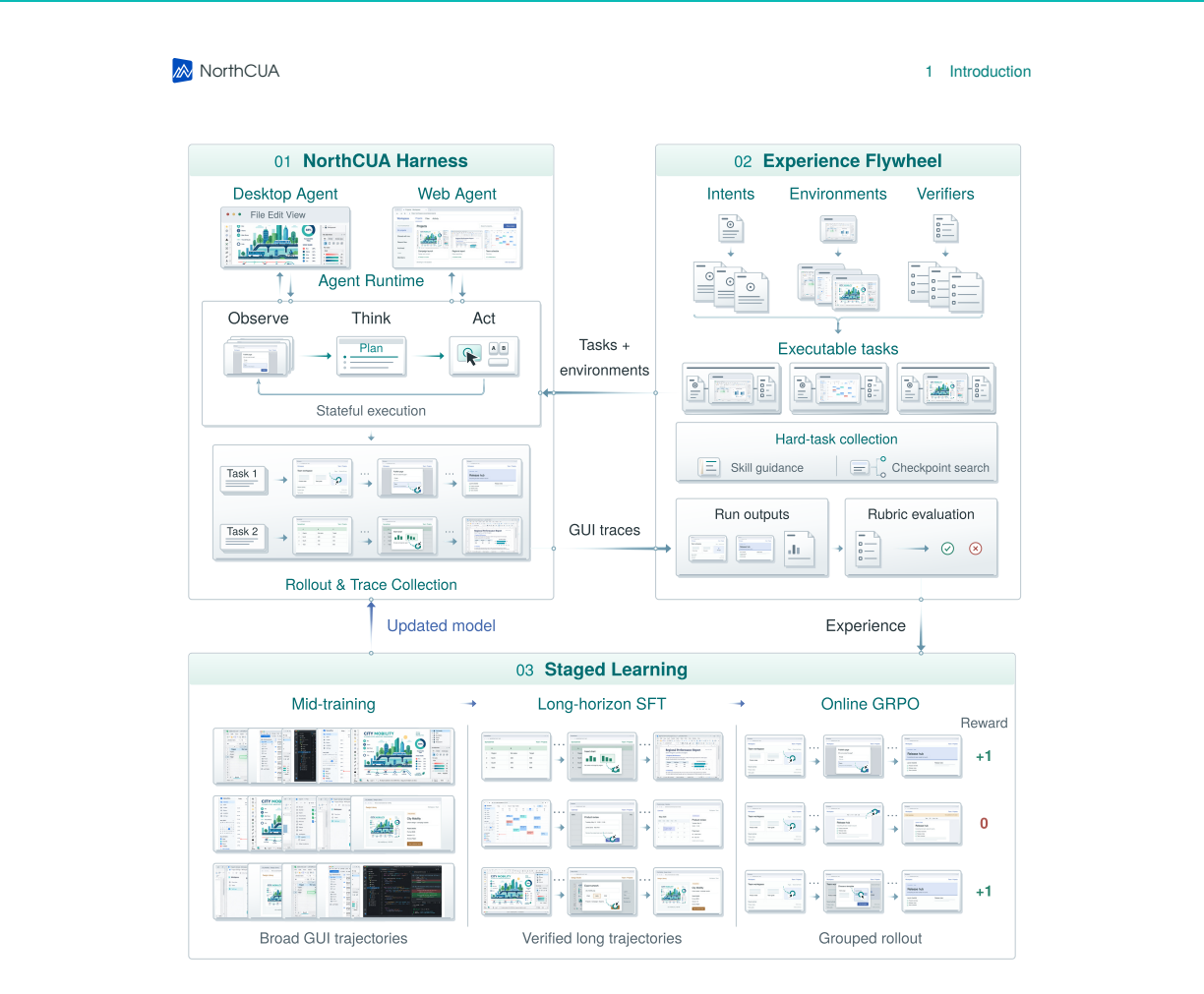
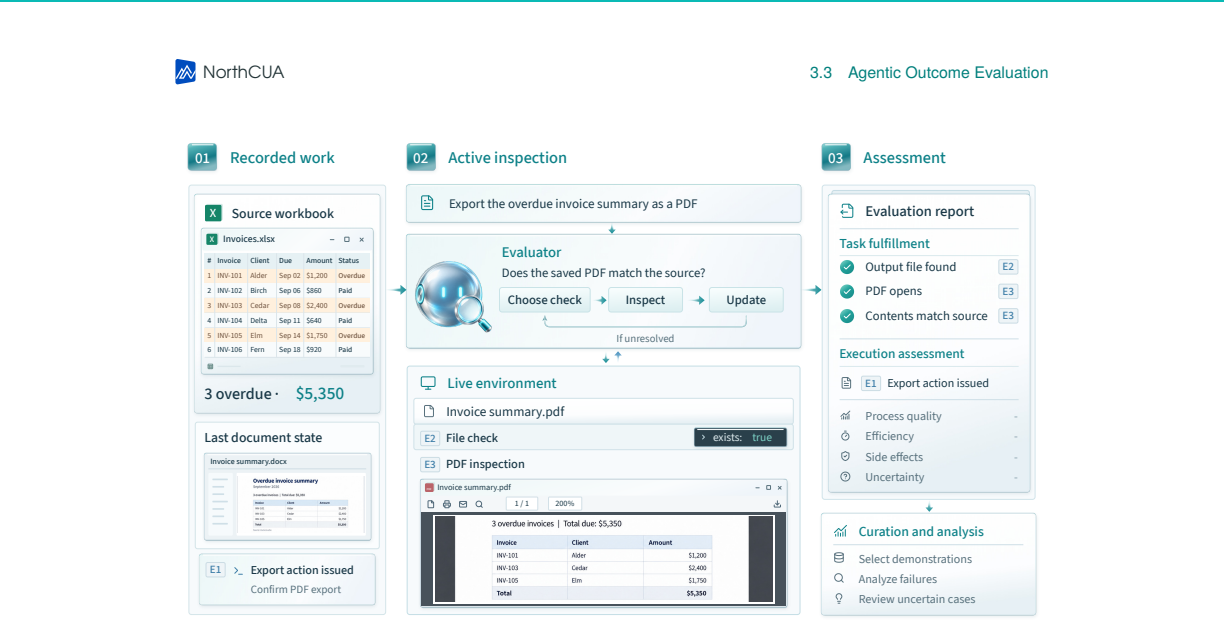
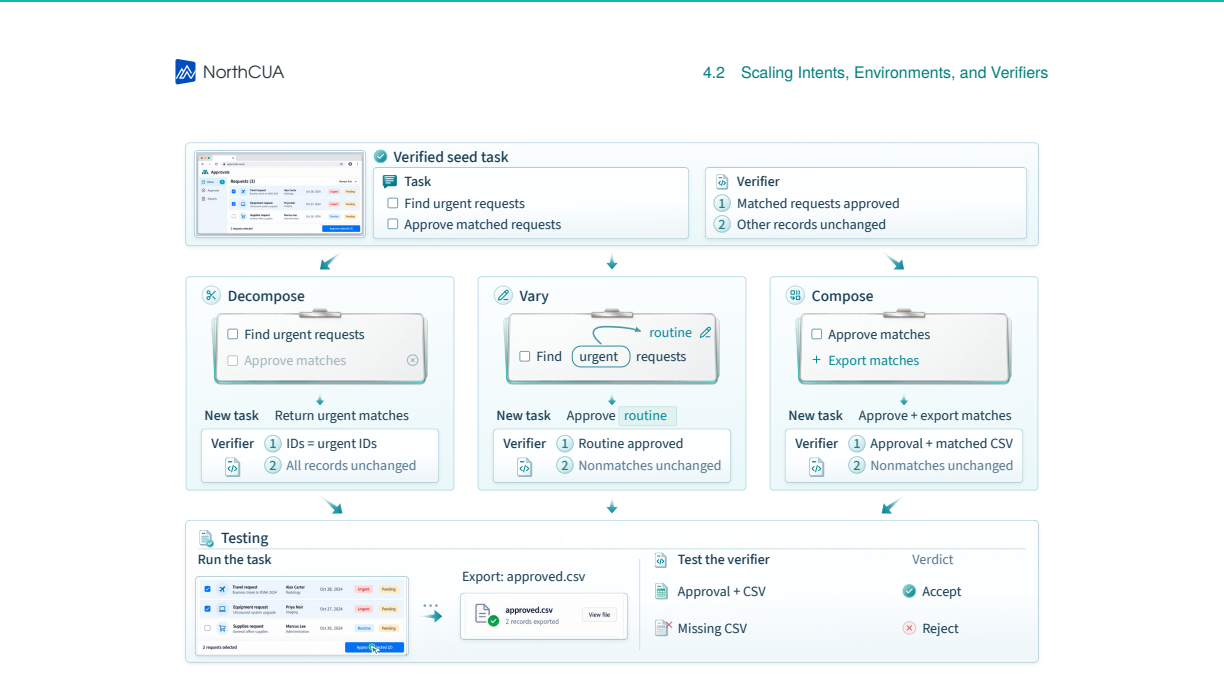
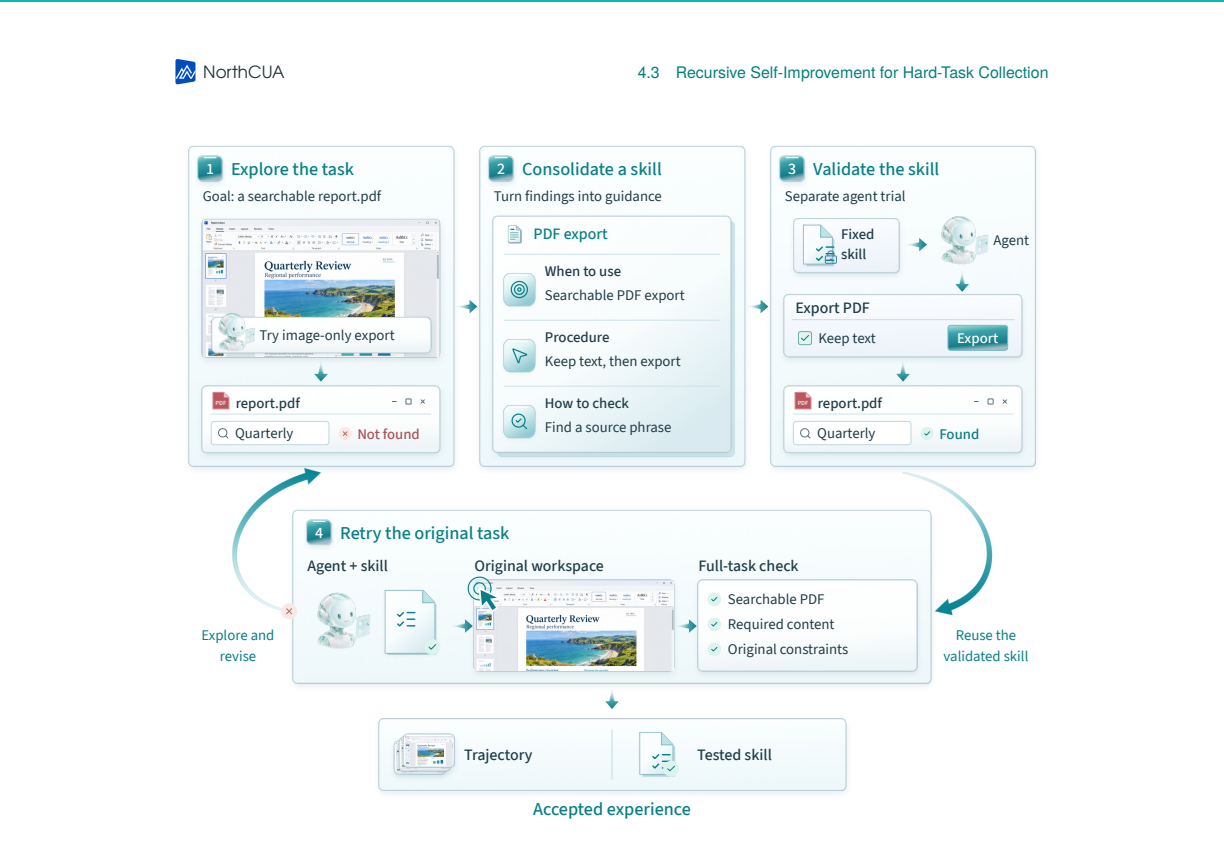
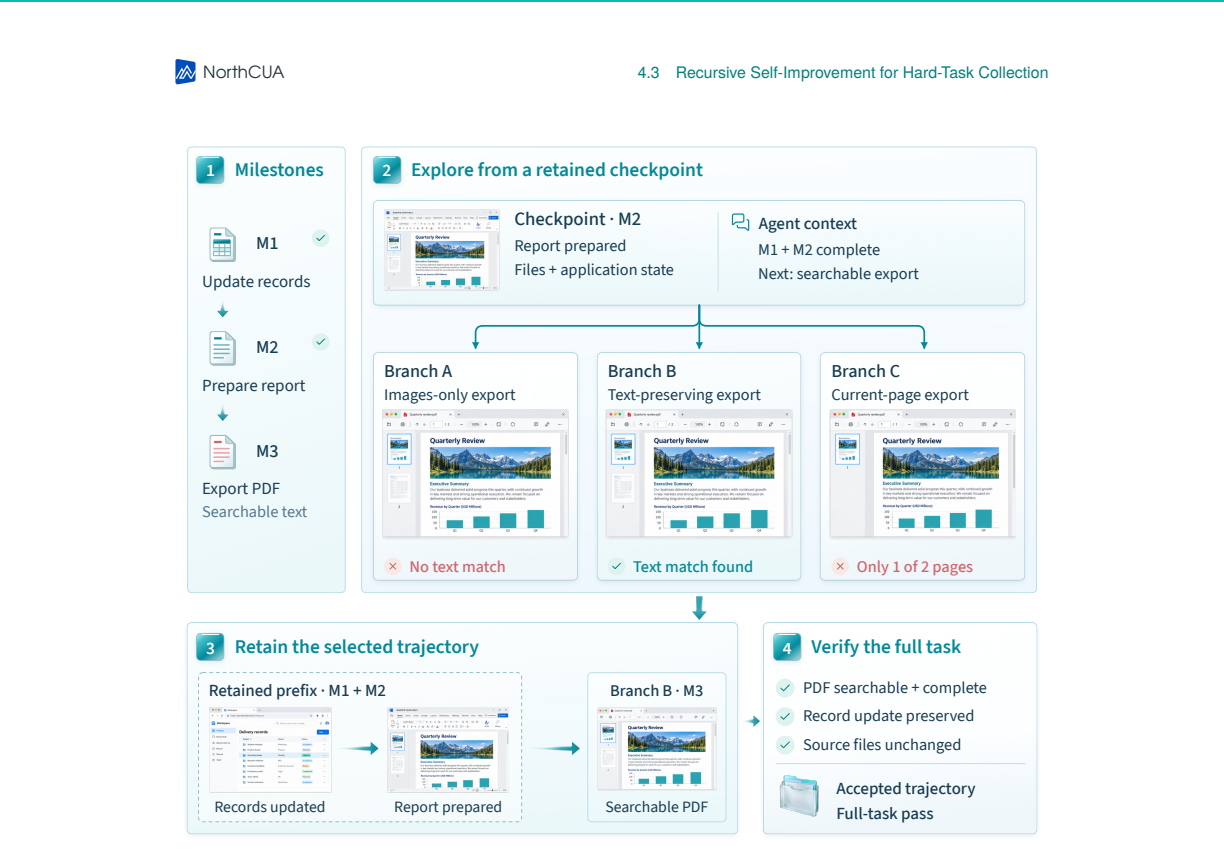
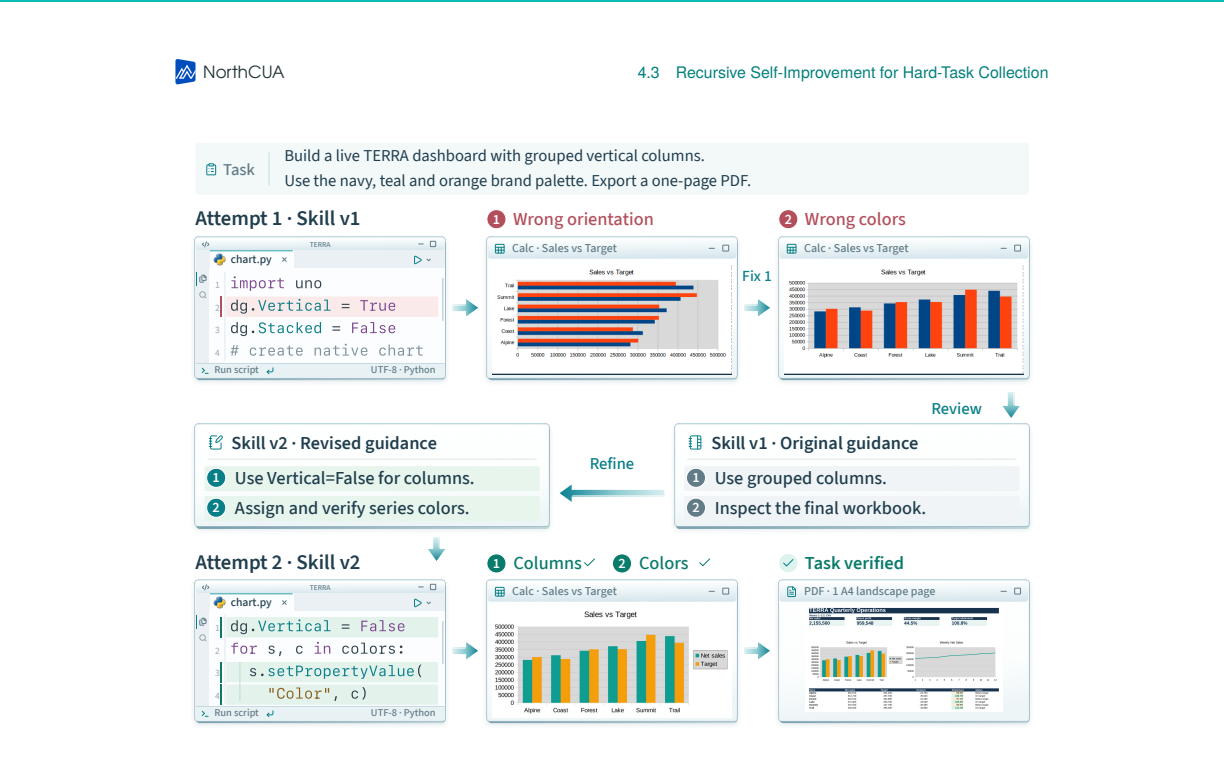
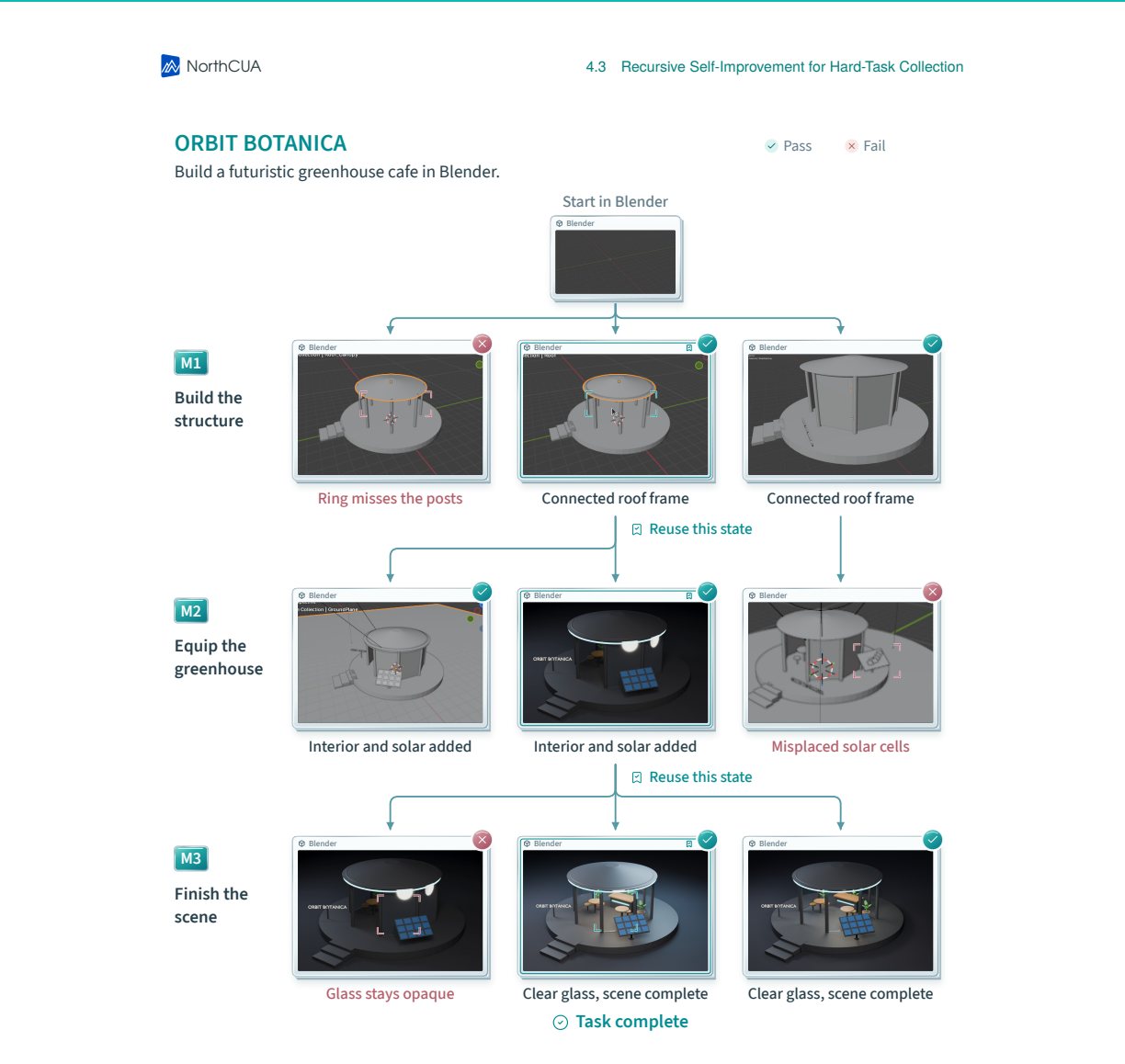
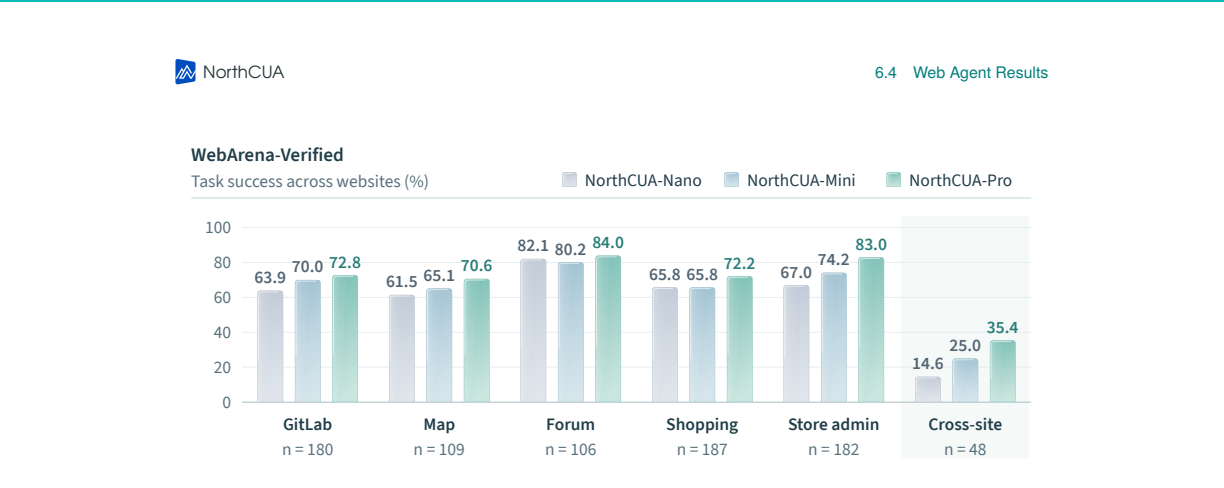
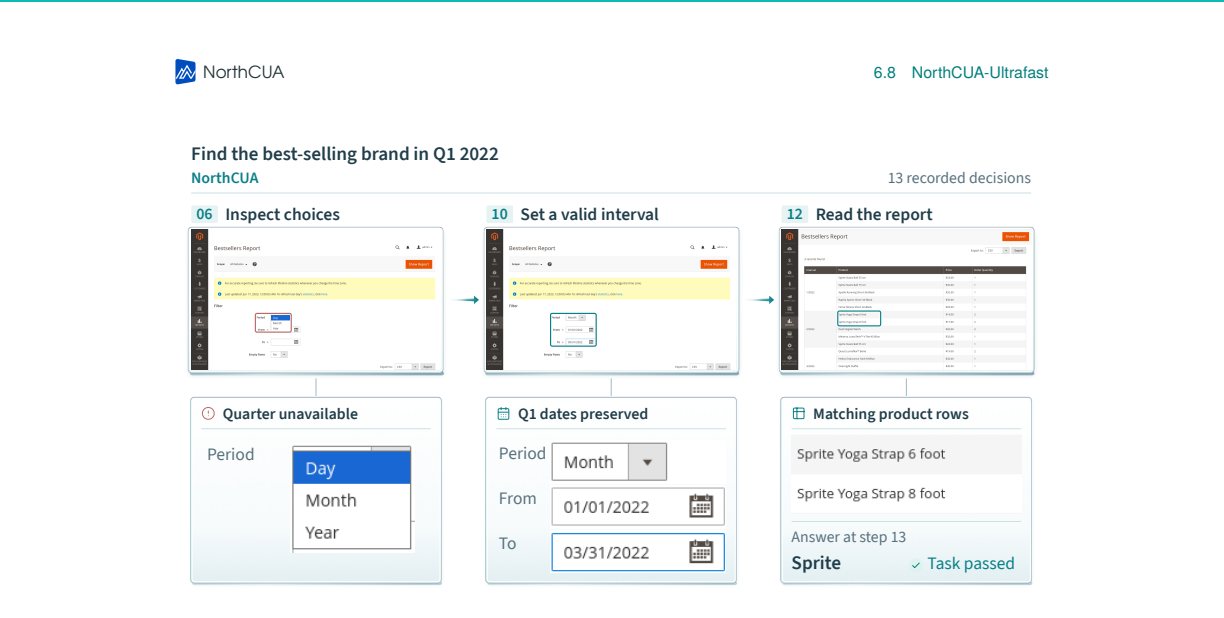
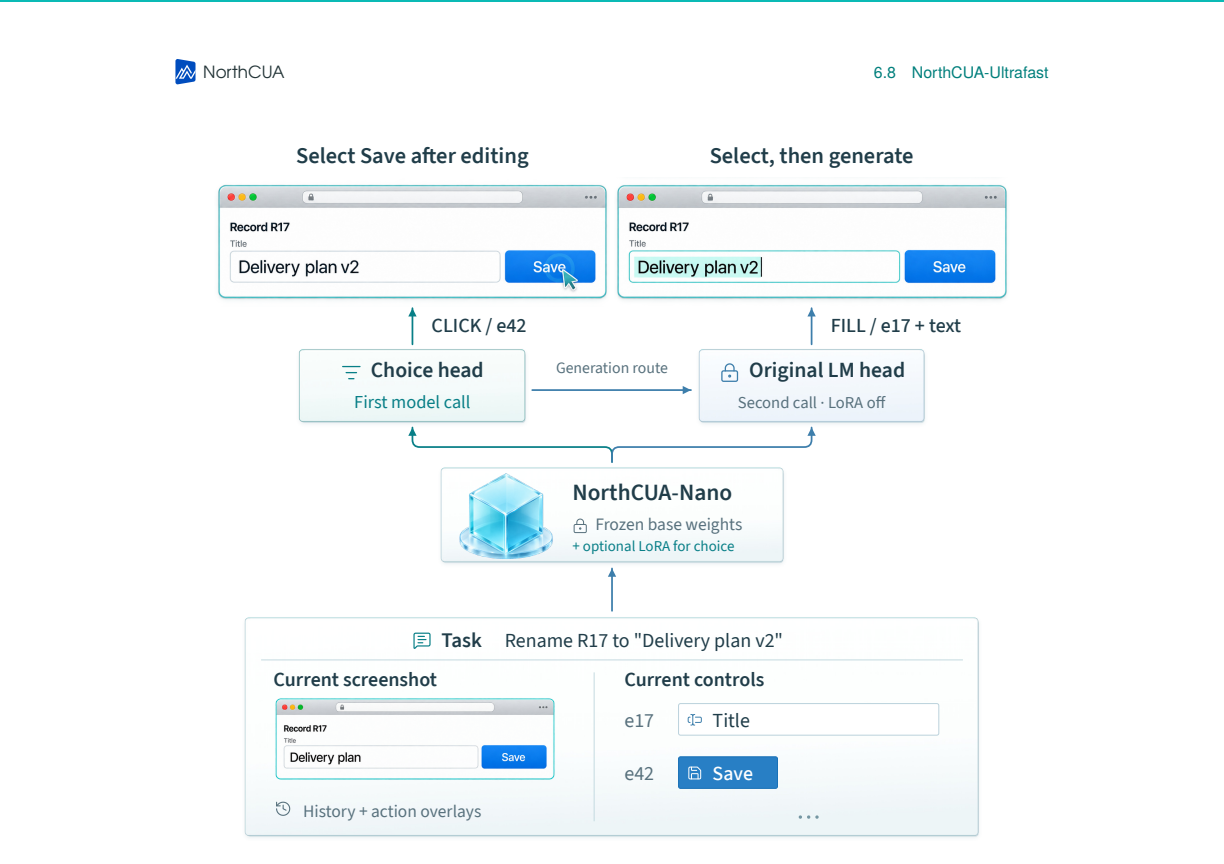
Its Experience Flywheel supplies diverse executable tasks to the NorthCUA Harness, which sustains long interactions, records decisions, and checks task outcomes. The Flywheel uses these records to curate verified trajectories. For unsolved tasks, recursive self-improvement evolves reusable skills and preserves verified milestones so later attempts build on earlier progress. Staged Learning combines this experience with grounding data from the Flywheel to develop GUI competence through mid-training and long-horizon supervised fine-tuning. The policy then learns from fresh attempts in the same Harness through joint desktop-web reinforcement learning, closing the loop between experience production and policy improvement. The resulting Nano, Mini, and Pro family achieves state-of-the-art results among open-source models across GUI grounding, desktop execution, and Web interaction under the reported evaluation settings. For more responsive Web workflows, NorthCUA-Ultrafast pairs direct action selection with open-ended generation on pre-RL Nano, offering a measured quality-latency tradeoff. Together, these advances establish NorthCUA as a high-performing model family and a reusable foundation for agents that carry complex software work from intent to completion.
from the abstract
Pith says
Machine review · deepseek-v4-flash · 4 Nov 2026 · of version 2 of the paper; version 3 is newer · what was read was not recorded · not checked by a person
It can be wrong. Challenge this review or reply to it.
Holds up, with conditions. A detailed, internally consistent systems report with released models and checkable benchmark claims — but the headline SOTA numbers rest on a training/eval disjointness assumption the paper never states or tests. This line is wrong
3 major objections · 6 minor
How often objections from reviews like this one are right: not yet measured
Not checked: figures, code, what the references say.
The paper says, at Sections 4.1.1, 4.2.2, 5.1; Tables 6, 8, 10
The review did not quote this passage.
Pith says: Objection 1 of 3 · major
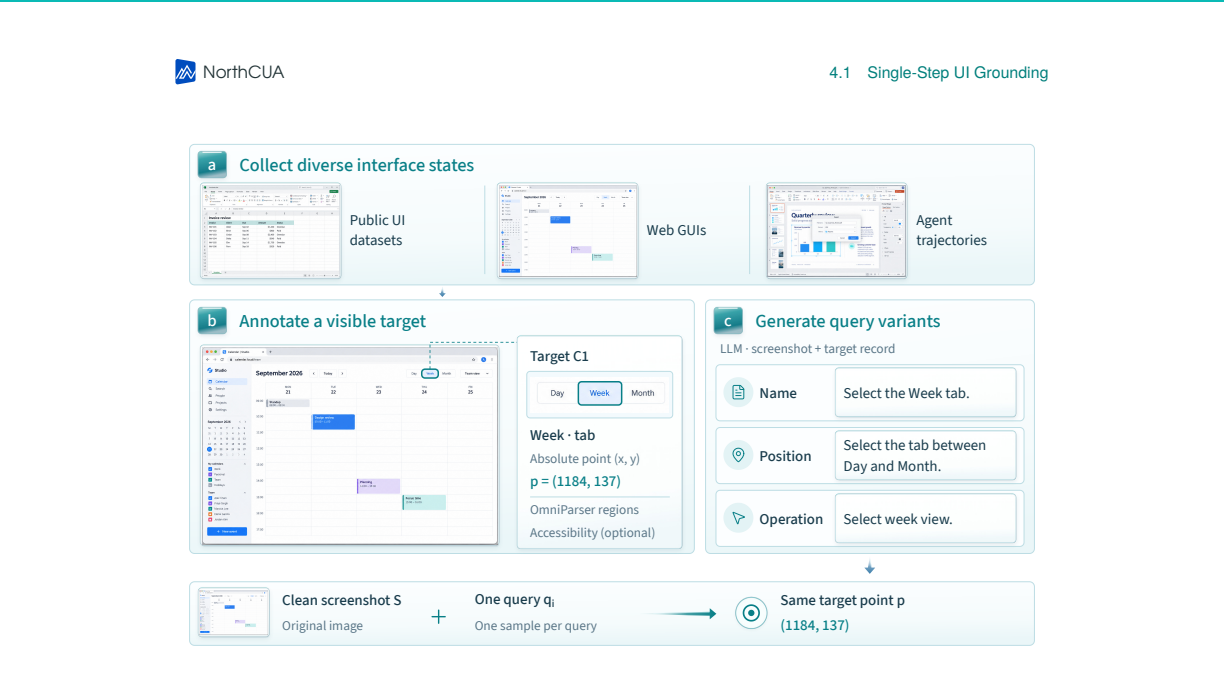
The central empirical claim, open-source state-of-the-art on OSWorld-Verified (88.6%) and WebArena-Verified (73.9%), is only meaningful if the training corpora are disjoint from the evaluation tasks, and the paper never states or audits such a guarantee. The construction routes make overlap concrete: Section 4.1.1 builds the grounding pool from 'public UI datasets, web-collected GUI screenshots, and screenshots from agent trajectories,' which …
more of objection 1
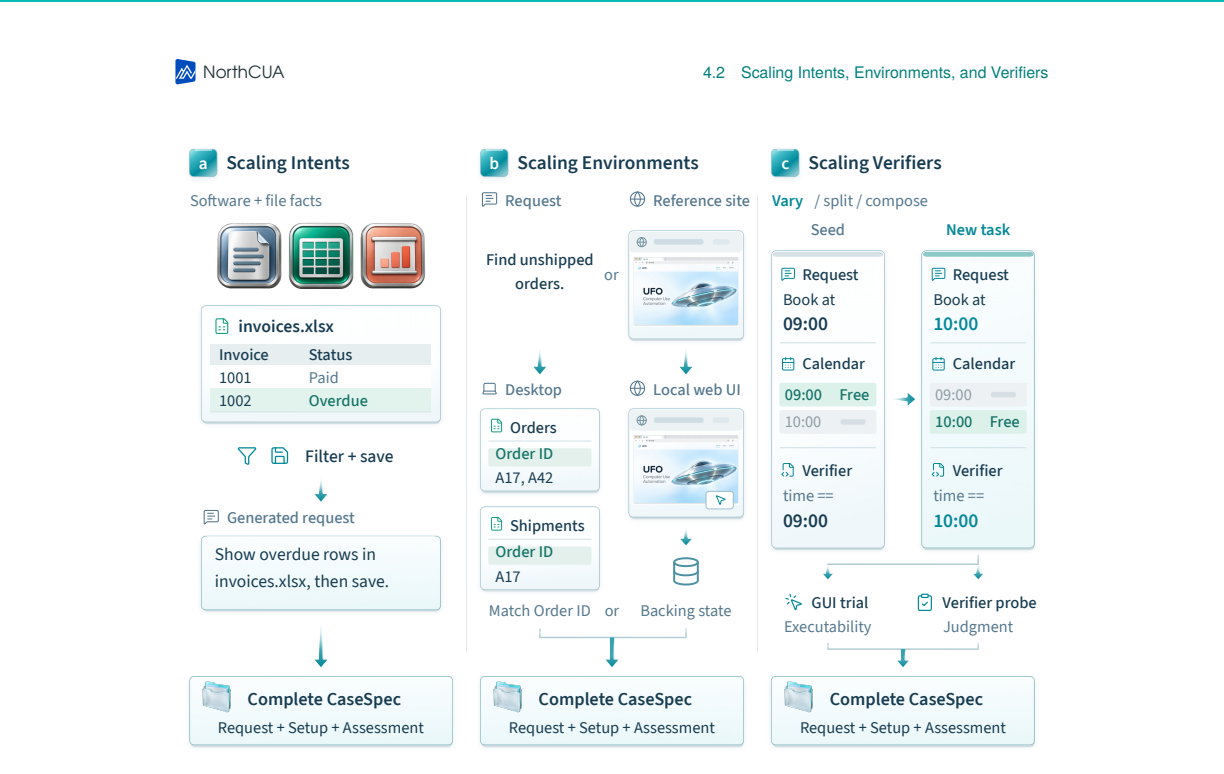
… are exactly the artifact types of ScreenSpot-Pro, OSWorld-G, and OSWorld; Section 4.2.2 reconstructs 'selected workflows from public reference URLs' into local environments, the same construction route underlying WebArena's cloned sites; and Section 4.2.3 admits 'Task datasets' as seeds for verifier scaling without stating that the evaluation benchmarks' tasks were excluded. Section 5.1's coverage list (store administration, form filling, LibreOffice/GIMP/Inkscape/Blender/VS Code) coincides with the WebArena and OSWorld task families. Because the headline margins over the closest competitors (1.0 point on OSWorld-Verified; 2.3 points on WebArena-Verified) correspond to single-digit task counts, the paper should (i) state explicitly that the evaluation tasks, screenshots, sites, and verifiers were excluded from the grounding pool, the mid-training corpus, the SFT cohort, and the RL task pool; (ii) report a quantitative contamination audit (image similarity and URL/domain/n-gram overlap) against each evaluation set; and (iii) if Appendix D's 'source-grouped splits' already document such exclusions, cite the relevant appendix material directly in Section 6.1.
The paper says, at Section 6.1; Tables 6-7
The review did not quote this passage.
Pith says: Objection 2 of 3 · major
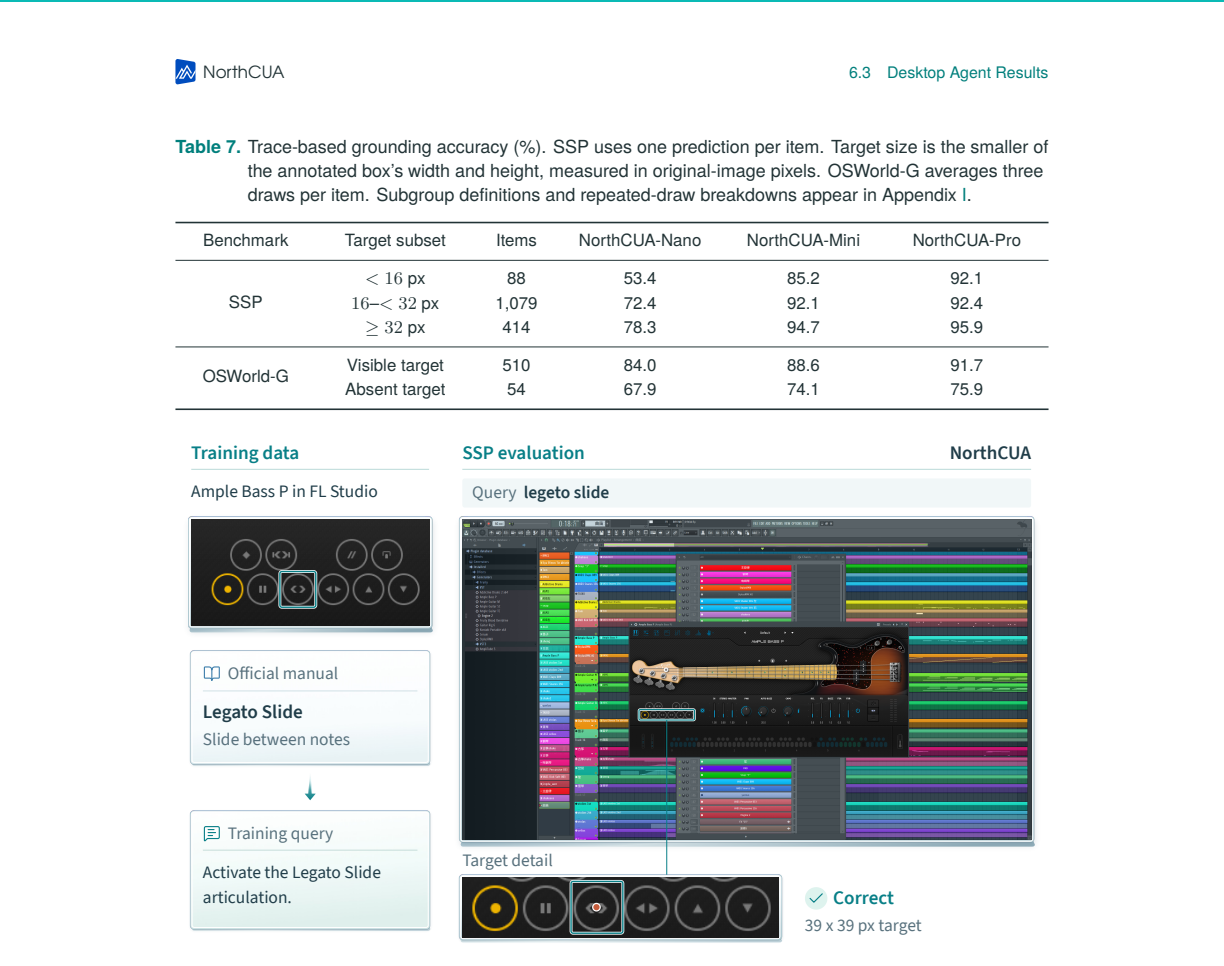
The OSWorld-G headline number uses 'best-complete-run accuracy' for the NorthCUA models while compared models are reported as single values. Pro's three runs span 89.4-91.0, and the item-weighted mean computed from Table 7 is approximately 90.2, versus the reported 91.0. Because Pro's claimed lead over Claude Opus 5.5 (89.9) rests on this choice, the comparison is asymmetric: report the three-run mean as the headline with standard deviations, keep best-of-k as supplementary, or apply the same best-of-k protocol to every compared model.
The paper says, at Sections 3.3 and 5.1 (Table 2)
The review did not quote this passage.
Pith says: Objection 3 of 3 · major
The agent-as-a-judge evaluator selects the over-100,000-trajectory mid-training corpus and adjudicates all tasks lacking executable verifiers, but no human-agreement rate, precision/recall on a labeled sample, or confidence calibration is reported; the paper only records 'judgment uncertainty' as a reporting dimension. The impact on the headline benchmark numbers is indirect because the SFT cohort and the RL rewards both require scripted task verifiers, but the flywheel recipe itself, and its reproducibility by other groups, depends on the judge's accuracy at scale.
more of objection 3
Report a sampled human-agreement study over the rubric dimensions used for curation (task fulfillment, process quality, efficiency, side effects), with disagreement rates and the disposition of uncertain verdicts.
6 minor objections
The paper says, at Abstract and Figure 1
Pith says: minor objection 1 of 6
The phrase 'state-of-the-art results among open-source models' should be scoped, since on OSWorld 2.0 binary completion Pro (30.6%) is below Claude Opus 5 (31.4%) and Claude Fable 5.1 (41.7%) in the same 108-task block; Section 6.3 reports this honestly, but the abstract's blanket wording invites over-reading.
The paper says, at Section 6.5, Figure 28
Pith says: minor objection 2 of 6
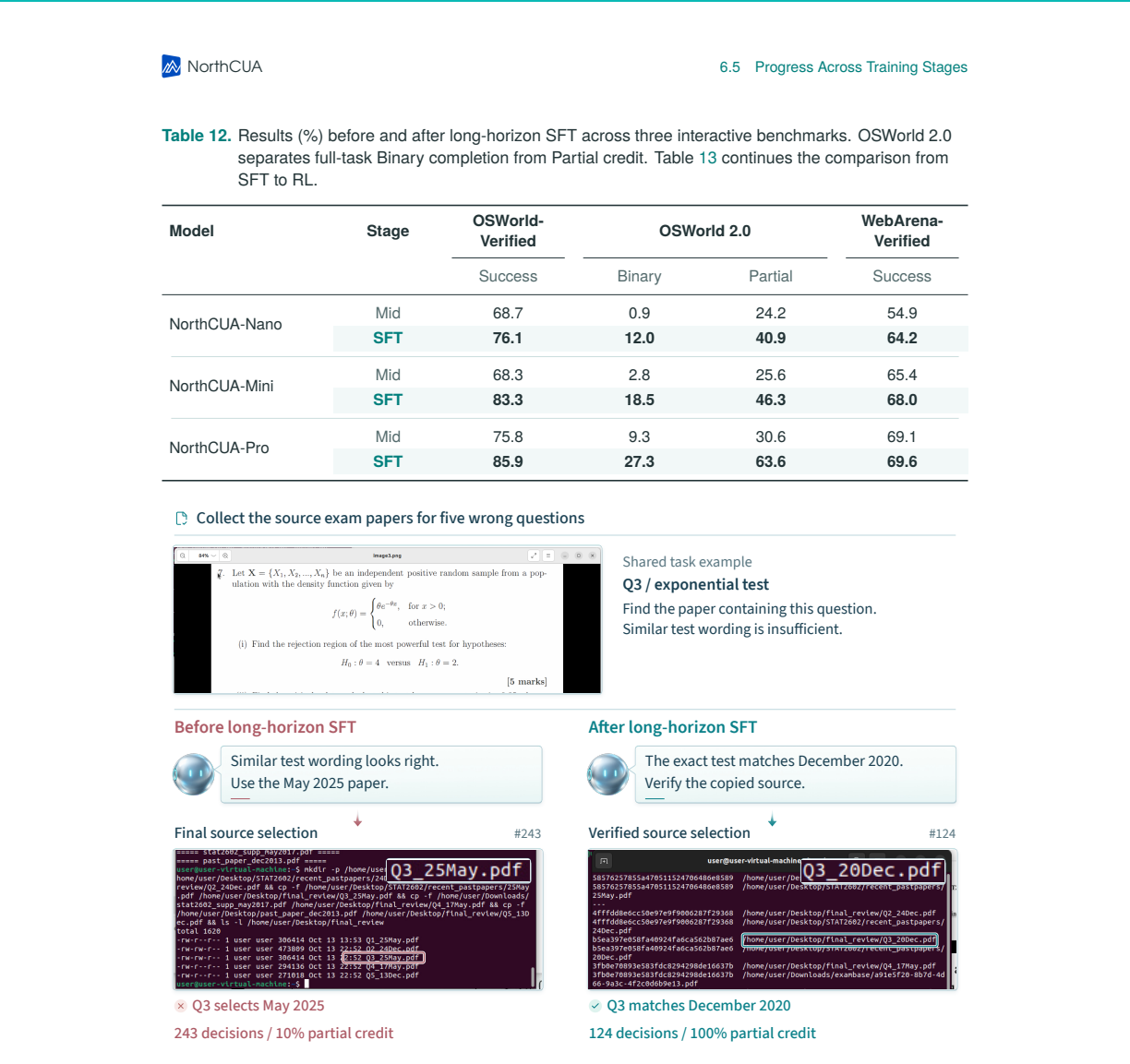
The before/after case study is presented as evidence of the SFT effect, but the caption discloses that the two runs use 'different dataset revisions and OCR settings'; this confound should be acknowledged in the body text or the claim restricted.
show 4 more
The paper says, at Sections 6.2 and 4.1.2
Pith says: minor objection 3 of 6
The prose attributes SSP gains on icon targets to documentation-grounded query generation, but no ablation isolates the documentation route; state its share of the grounding pool or report a controlled comparison.
The paper says, at Sections 6.3-6.4 (Tables 8, 10)
Pith says: minor objection 4 of 6
With margins of 1.0 point over Qwen-CUA-Max and 2.3 points over Kimi-K3/GPT-6 Astra, the paper should state explicitly whether each cited baseline used the same step budget, task list, and scoring function, and identify which tasks separate the top two models.
The paper says, at Section 6.1
Pith says: minor objection 5 of 6
The 100-step budget for OSWorld-Verified is above the original OSWorld's 15-step limit; if OSWorld-Verified's official protocol permits 100 steps, cite the relevant statement, since baseline comparability depends on matching budgets.
The paper says, at Throughout
Pith says: minor objection 6 of 6
Ligature artifacts render throughout as 'office', 'efficient', 'difficult', and 'sufficient'; replace these with standard ASCII sequences in the camera-ready version.
What would settle it
Have the authors (or an independent auditor with data access) run a disjointness audit: (i) compute image similarity (perceptual hash plus an embedding-based retriever, at near-duplicate/derived-image threshold) between every screenshot in the Section 4.1.1 grounding pool and every mid-training trajectory frame against the 1,581 ScreenSpot-Pro images, the 564 OSWorld-G screenshots, and the OSWorld-Verified/WebArena-Verified task states; (ii) match the public reference URLs and site templates ingested by the Section 4.2.2 reconstruction pipeline against the WebArena and OSWorld source sites; (iii) report the overlap counts and, if nonzero, re-evaluate on a checkpoint trained with the overlapping samples excluded, showing how the headline numbers (OSWorld-Verified 88.6, WebArena-Verified 73.9, OSWorld-G 91.0, SSP 93.3) shift.
from the skeptic's reading
How the review went
4 readings by deepseek-v4-flash · 4 Nov 2026
- Reader holds up, with conditions
- Skeptic partly agrees
- Editor wrote the verdict above
- Referee major revision: 3 major objections, 6 minor
Not run on this paper: the simulated authors' defence.
Pith did not check this review's objections against the paper.
The review in full
The review in brief, machine-written
Two things to know. First, this is the most detailed open technical report on computer-use agent training I have read: 123 pages covering the full pipeline — harness, experience flywheel, staged learning, recursive self-improvement — with all three model sizes and harness code released. Second, the headline numbers are checkable but their interpretation is contingent: Pro's 88.6 on OSWorld-Verified and 73.9 on WebArena-Verified beat trillion-parameter systems, yet the paper never establishes that training corpora are disjoint from the evaluation domains, and the overlap mechanisms are concrete.
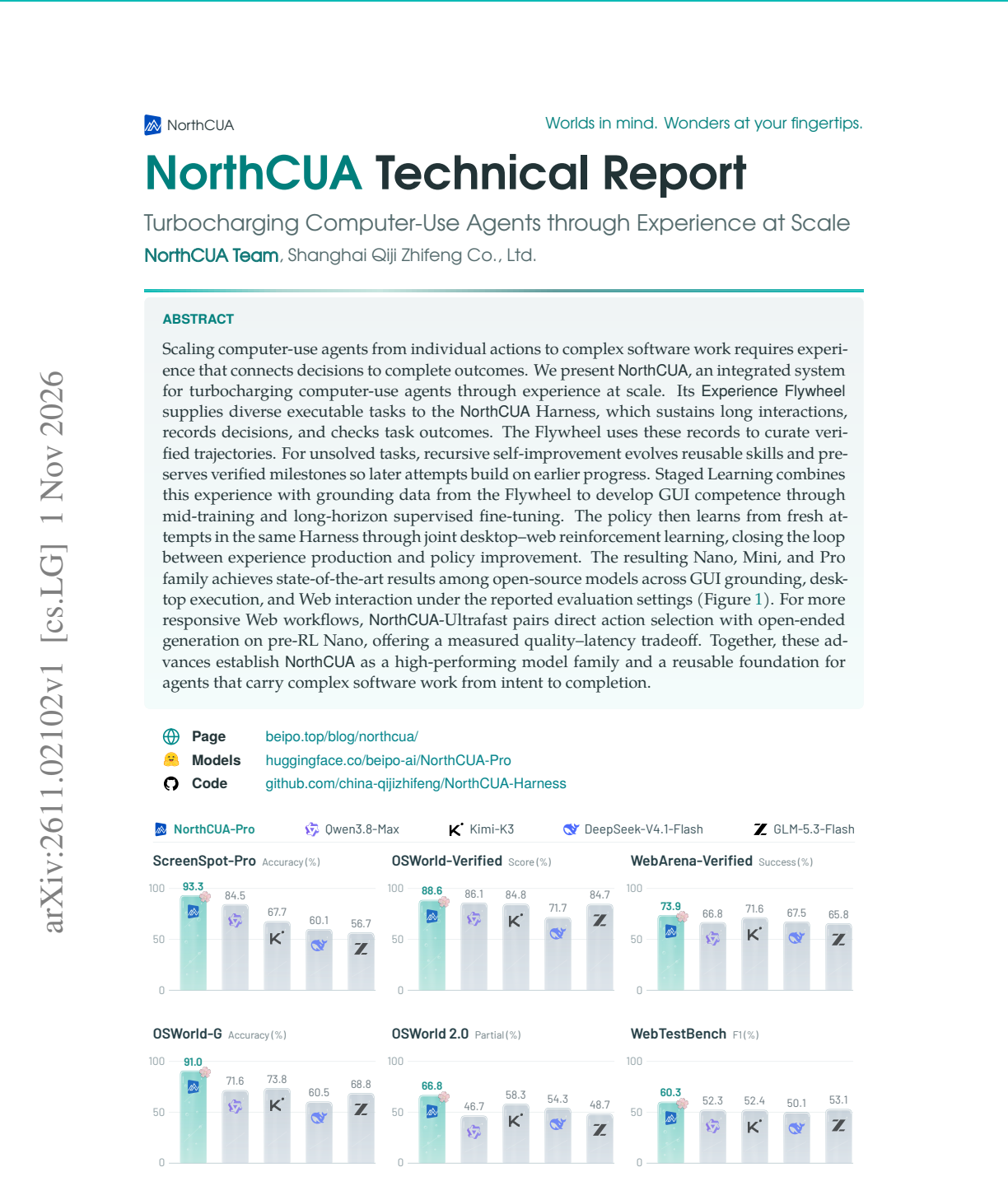
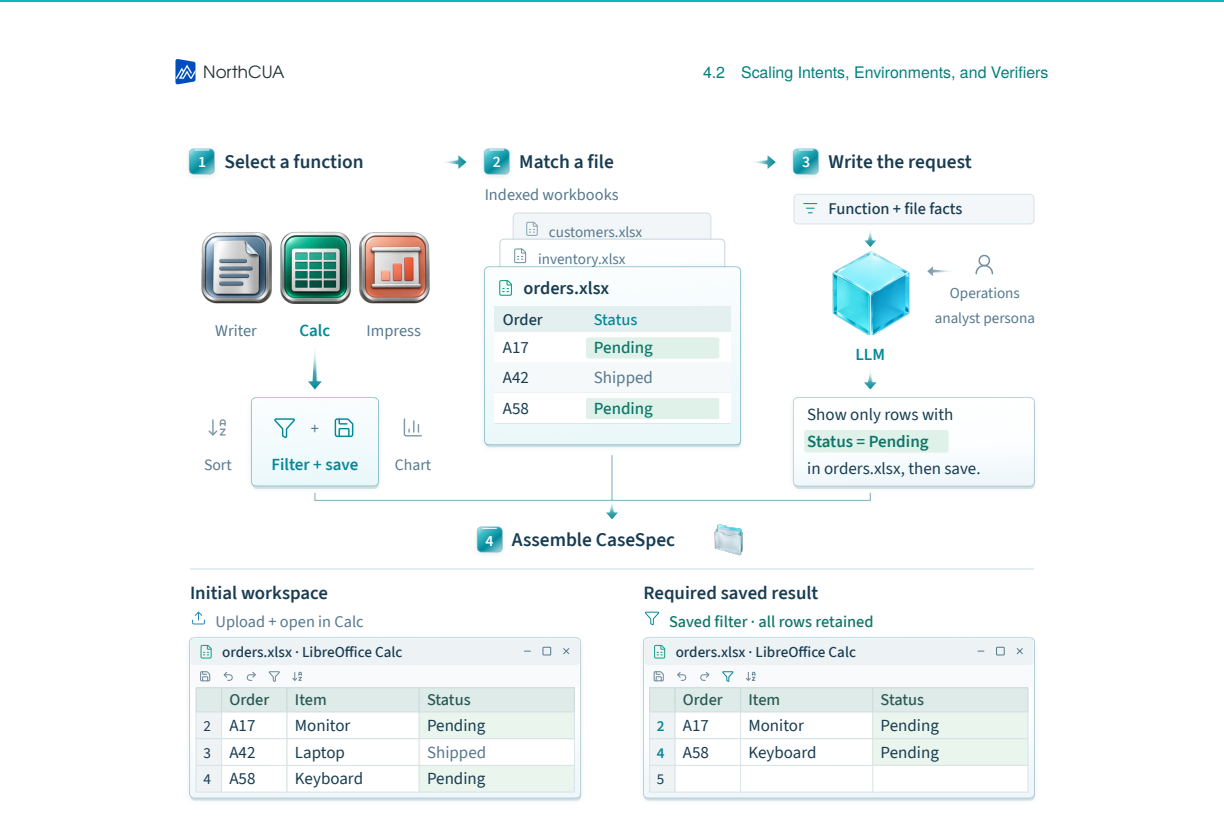
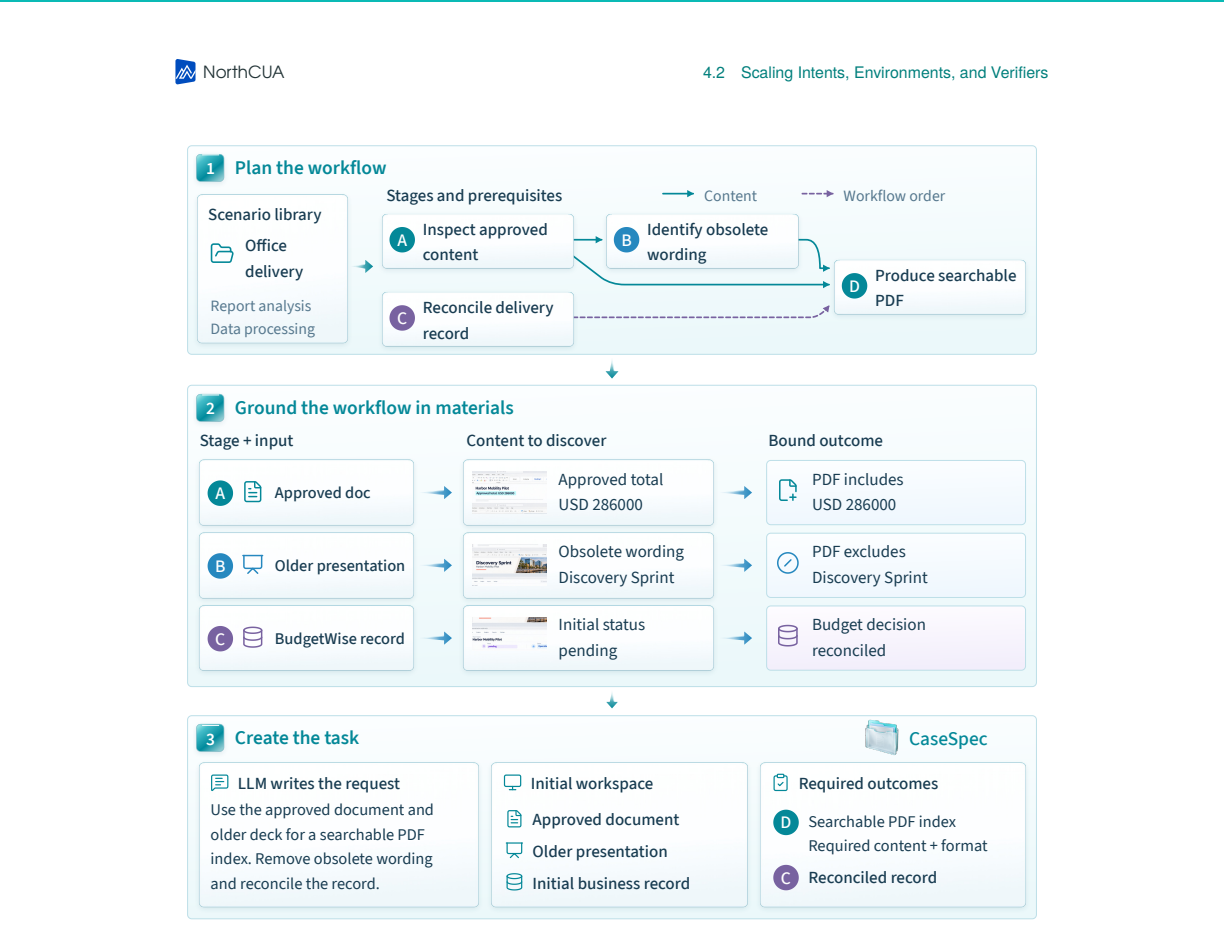
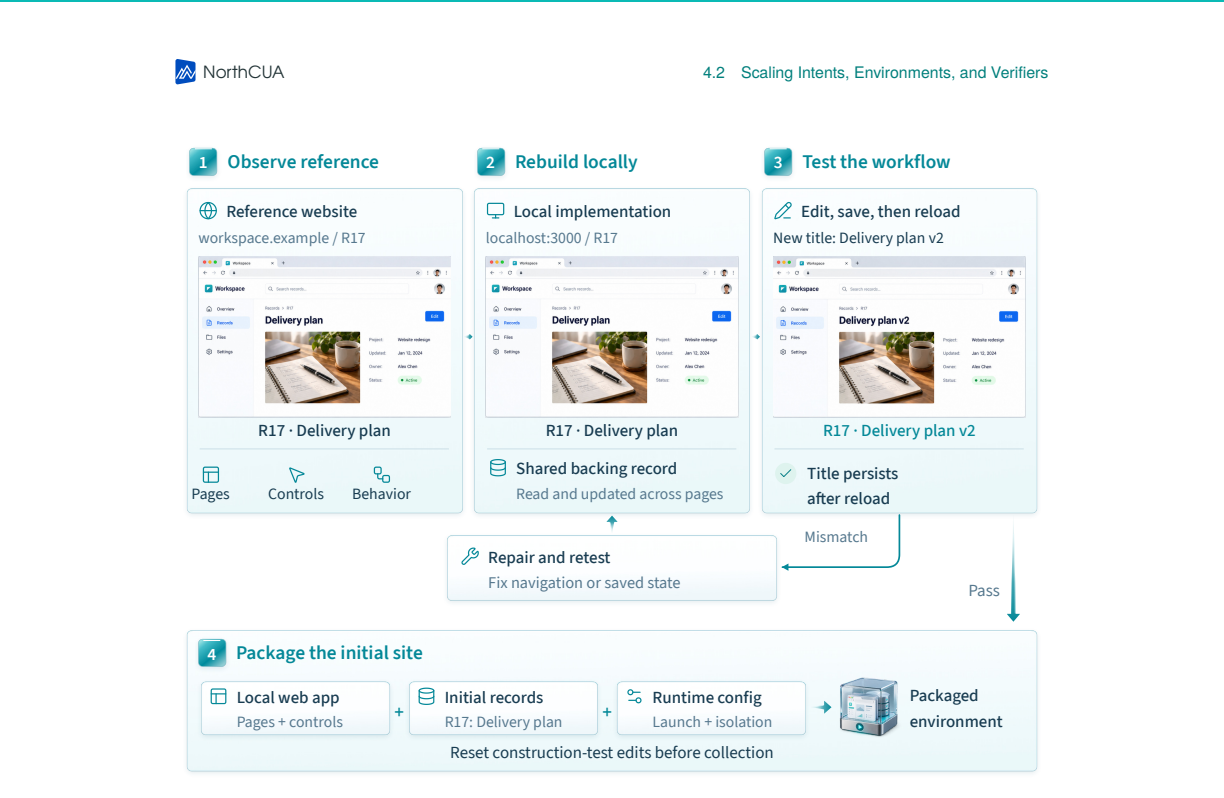
What is genuinely new is the integration. The flywheel's three construction routes (intents, environments, verifiers), the RSI pair (skill-guided exploration with independent skill validation; milestone-guided checkpoint search that preserves verified states), and the context-preserving RL adapter that splits long trajectories at context boundaries while keeping attempt-level reward credit and trajectory-mean normalization (Eq. 1) are described with an engineering detail I rarely see in this literature. The paper is also transparent about protocol: the 361-task OSWorld-Verified setting with the eight Google Drive tasks excluded, all 812 WebArena-Verified tasks, all 108 OSWorld 2.0 tasks, all 1,581 ScreenSpot-Pro items, and explicit markers for self-evaluated baselines. Stage-wise gains in Table 12 are internally consistent with the final numbers, and since the models are released, the benchmark measurements are independently reproducible.
The soft spot is real, and it is the one the stress test flags. The grounding pool includes web-collected screenshots and screenshots from agent trajectories (4.1.1); the environment route reconstructs reference websites from public URLs (4.2.2), the same route WebArena uses; and the mid-training coverage list (5.1) — store administration, form filling, office operations, LibreOffice/GIMP/Blender — maps almost one-to-one onto the evaluation task families. No contamination check appears: no URL exclusions, no image-similarity audit, no n-gram overlap. The 'under the reported evaluation settings' hedge covers protocol, not data disjointness, and training data is not released, so the question cannot be audited externally. None of this makes the pipeline implausible; it makes the clean-SOTA reading premature. A revision should demand an explicit exclusion list plus an overlap analysis.
Two minor issues. The OSWorld-G headline 91.0 is the best of three draws, disclosed in the text but easy to miss. And the agent-as-a-judge evaluator that curates the 100,000+ trajectory corpus has no reported human agreement rate; 'judgment uncertainty' is recorded as a dimension but never quantified, which matters because that judge sits upstream of essentially the whole training signal. I could not audit Sections 6.6-6.8 or the appendices, so the RL ablation and latency study remain unverified here.
Who it is for: anyone building or evaluating computer-use agents. It deserves a serious referee; the right outcome is revision requiring the disjointness work, not rejection. I would gladly discuss the RSI and RL-adapter sections with a reading group; the rest is reference material.
The strongest objection
The central claim is empirical: the flywheel recipe produces state-of-the-art open-source numbers on six benchmarks. That claim holds only if the training corpora are effectively disjoint from the evaluation tasks, and the paper never establishes or even discusses this. The leakage mechanisms are concrete. Section 4.1.1 builds the grounding pool from "public UI datasets, web-collected GUI screenshots, and screenshots from agent trajectories, including real Linux desktop interaction"; ScreenSpot-Pro and OSWorld-G images are public benchmark artifacts of exactly this type, and trajectory screenshots would come from whatever tasks the harness ran. Section 4.2.2 reconstructs "selected workflows from public reference URLs" into local environments, which is the same construction route WebArena uses for its cloned sites. Section 5.1 lists mid-training coverage that mirrors the eval domains: "store administration, form filling," human-verification flows, and LibreOffice/GIMP/Inkscape/Blender/VS Code operations, which are the core OSWorld and WebArena task families. If any WebArena task pages, OSWorld task environments, or their screenshots entered the grounding pool or environment pool, the reported 88.6% OSWorld-Verified and 73.9% WebArena-Verified inflate directly; even domain-level overlap would transfer evaluation-specific skills. No contamination analysis (n-gram overlap, image-similarity audit, URL/domain exclusion, or date cutoff) appears in Section 6, and the training data is not released, so the claim cannot be externally audited. The paper's "under the reported evaluation settings" hedge addresses protocol, not data disjointness. This is a correctness risk in the empirical claim, not a disagreement with consensus.
The reader's verdict is CONDITIONAL, and my pass does not move it. The contamination concern the reader placed first is indeed the most load-bearing issue: the central claim is a set of benchmark numbers, and the paper's own pipeline (Sections 4.1.1, 4.2.2, 5.1) provides concrete, non-hypothetical routes by which evaluation-domain screenshots, sites, or workflows could enter the grounding pool, the mid-training trajectory corpus, or the reconstructed environment pool. The absence of any disjointness statement, contamination analysis, or released training data makes the headline numbers unauditable on exactly the axis that would most directly inflate them. I verified the internal consistency of the reported numbers before settling on this concern: Table 12 stage transitions are monotone and consistent with final checkpoints (e.g., Pro OSWorld-Verified 75.8 Mid, 85.9 SFT, 88.6 RL), the Figure 27 website-group breakdowns re-aggregate to the stated WebArena totals, and Table 6/8/9/10/11 match Figure 1. The OSWorld-G best-of-three-run reporting is a real quality issue but not load-bearing for the open-source SOTA claim, since even the worst run (89.4%) exceeds the strongest open-source baseline (Nex-N2.5-Pro 87.4%). I depart from the reader on the agent-as-a-judge premise: an inaccurate judge degrades the training signal and would make the benchmark numbers harder to achieve, not easier, so it threatens the story's robustness and reproducibility rather than the validity of the headline measurements. My concrete test is a single audit with two probes (image-similarity and URL/site overlap) that the authors can run since the training data is private; its result would either confirm the numbers are clean or quantify the inflation.
The referee's report
If the reported numbers are correct, this is a substantial systems contribution. The paper ships open weights for all three model sizes, harness code, and clearly marked protocol disclosures; it distinguishes its own evaluations of other providers' models from published scores; the stage-wise ablations (Table 12) indicate that the experience-production pipeline, not model scale alone, drives the gains; and the evaluation is on external benchmarks (ScreenSpot-Pro, OSWorld, WebArena, WebTestBench) rather than self-built tests. A 397B open-weights model outperforming much larger general and CUA-tuned models on OSWorld-Verified and WebArena-Verified, with Mini (35B) close behind, would be a useful result for the field, and the honest reporting of gaps (OSWorld 2.0 versus Claude Fable 5.1; weak cross-site WebArena performance) adds credibility. The main threats to the central empirical claim are the absence of a stated or audited training/evaluation disjointness guarantee and an asymmetric OSWorld-G reporting rule; both are testable and fixable within the manuscript's scope.
Pith's reading of the paper (a machine's summary, not the authors')
The paper claims that computer-use agents improve most when the production of training experience and the learning from it are co-designed as one closed loop: tasks are manufactured, executed, outcome-checked, and converted into policy updates, after which the updated policy returns to the same harness to produce fresh experience. The resulting Nano (9B), Mini (35B), and Pro (397B) models are reported to reach state-of-the-art scores among open-source systems on GUI grounding (93.3% on ScreenSpot-Pro), desktop execution (88.6% on OSWorld-Verified), and web interaction (73.9% on WebArena-Verified), under the paper's stated evaluation settings. A sympathetic reader would care because the claim implies that a 397B open-weights model can outperform much larger, trillion-parameter systems on the reported suites, and because the stage-wise gains at every model size indicate that the experience-production pipeline, not parameter count alone, is what drives the improvement.
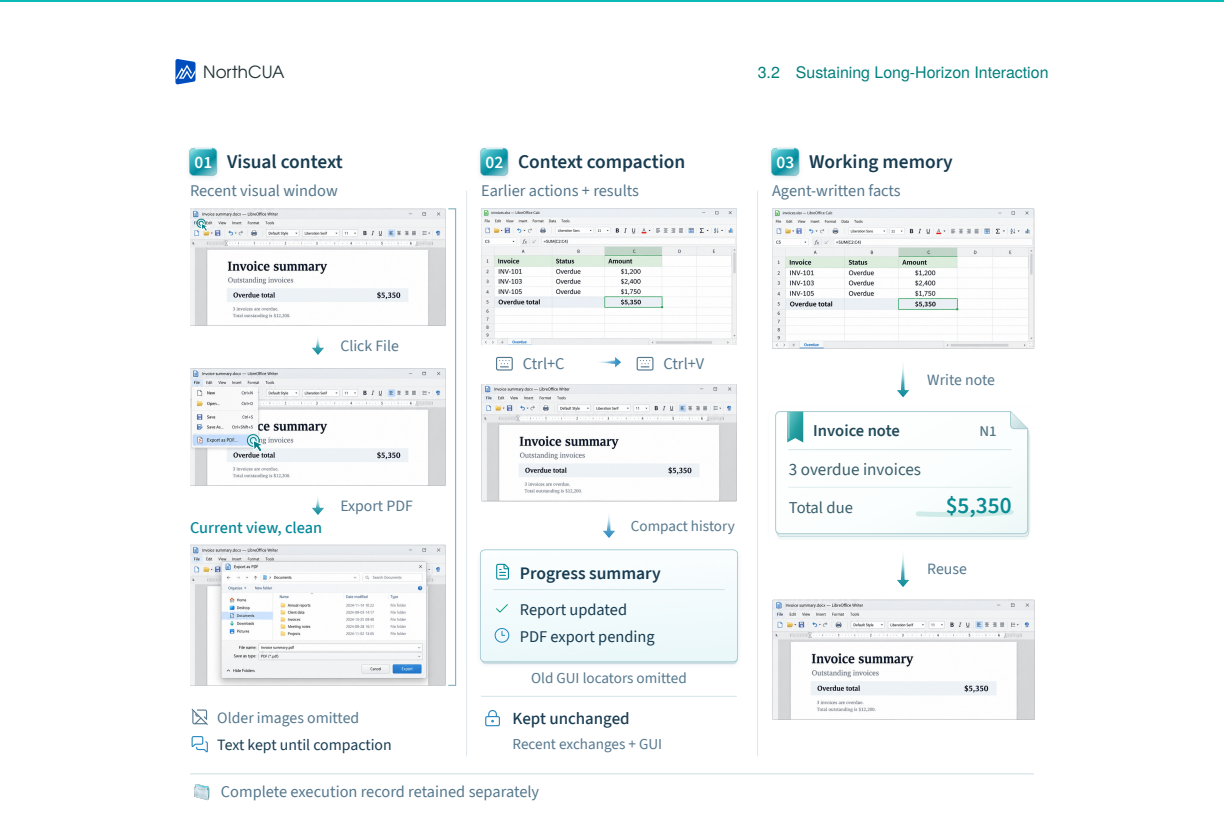
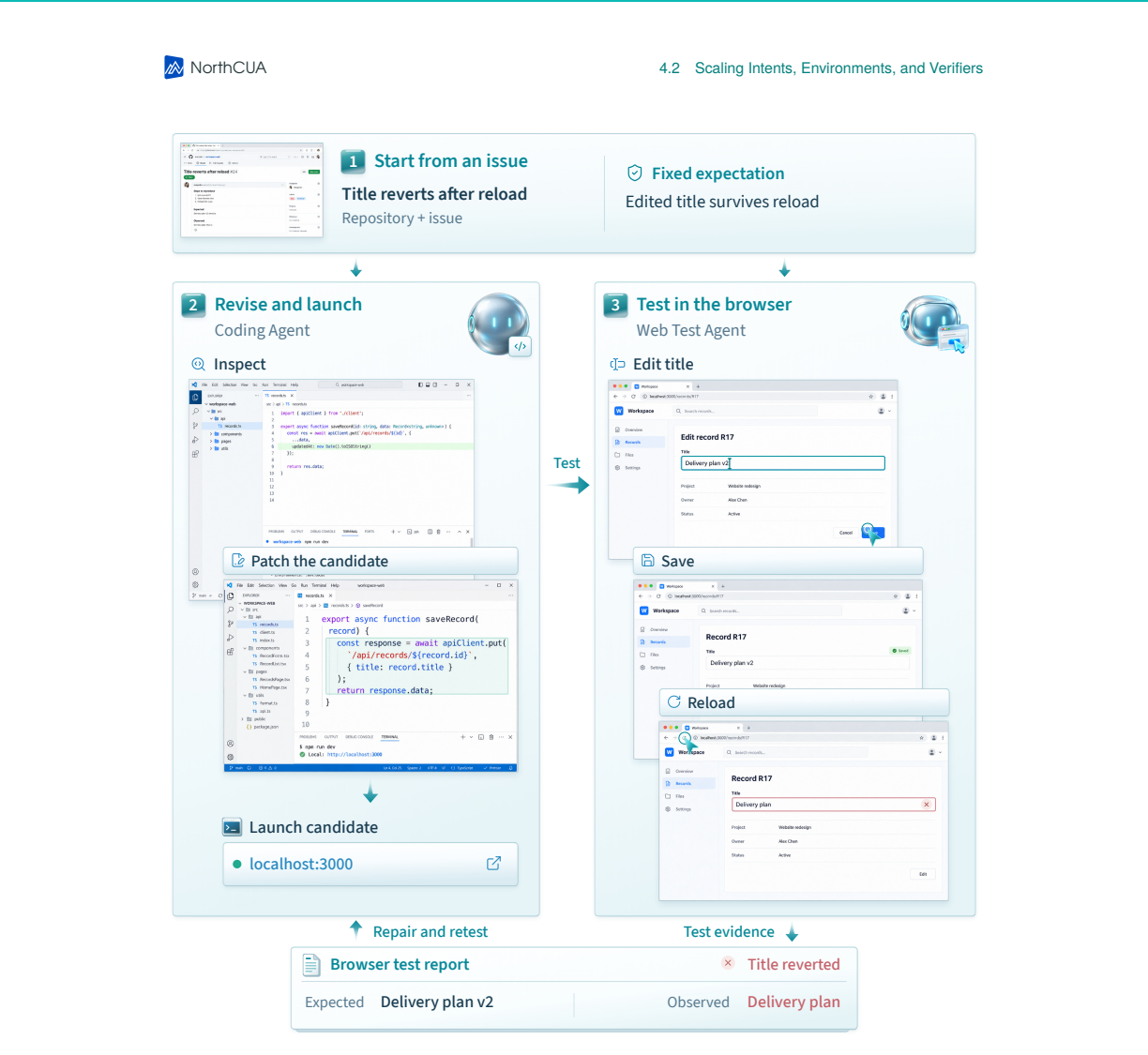
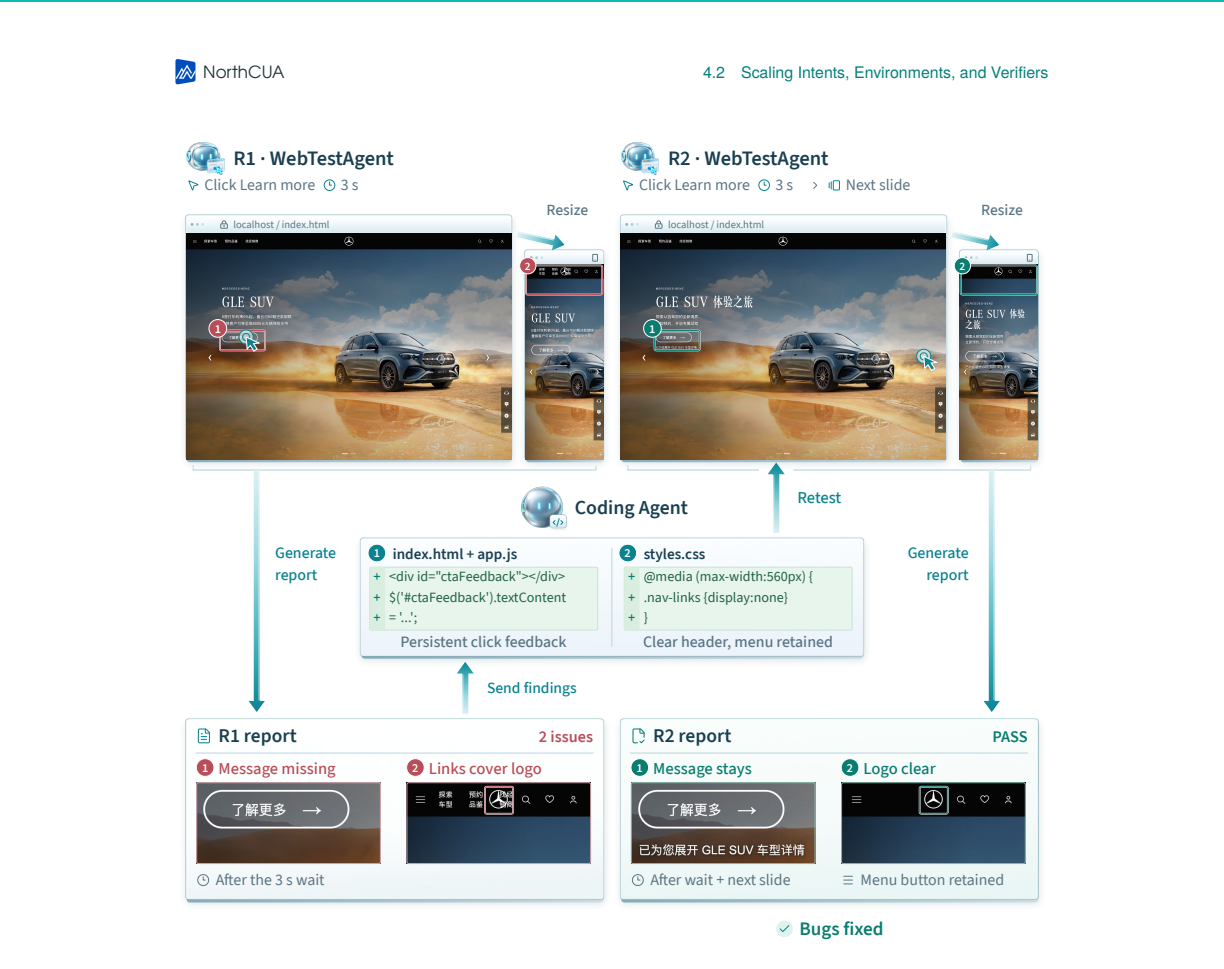
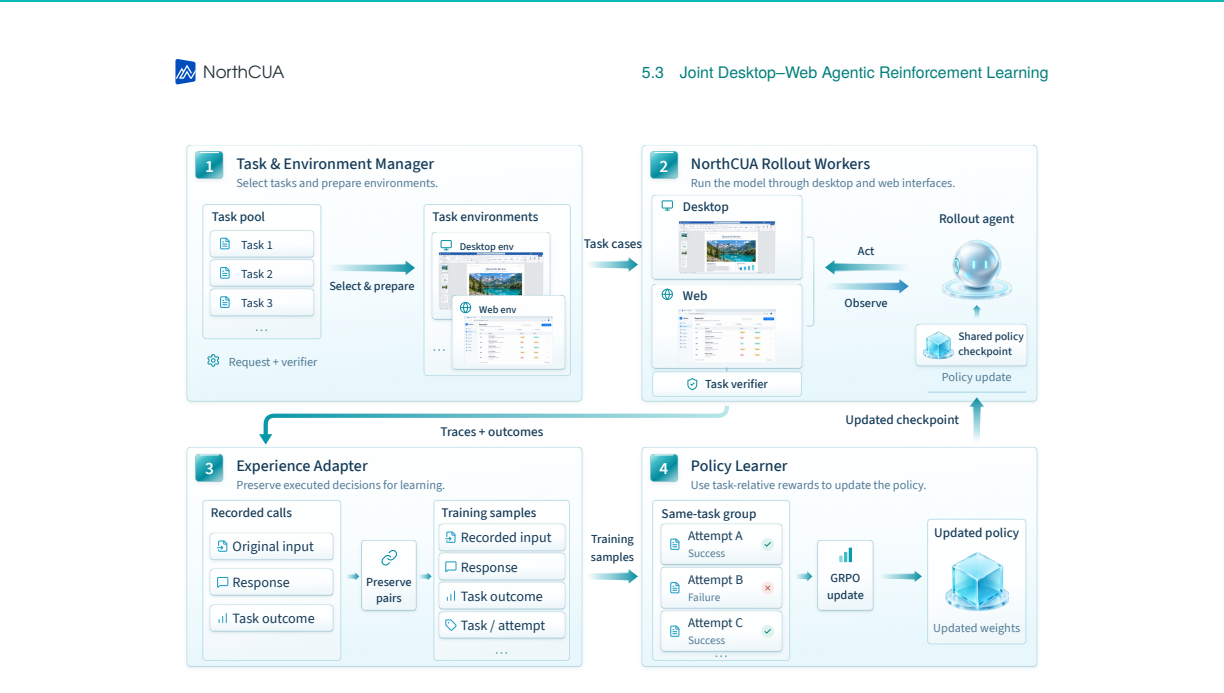
What carries the argument. The load-bearing object is the closed experience loop formed by three components working through one shared interface. The NorthCUA Harness is a full-lifecycle runtime that executes desktop and web tasks, sustains long-horizon decisions through a bounded visual window, task-preserving context compaction, and a note tool, and judges outcomes with an agent-as-a-judge evaluator that inspects recorded work and the live workspace. The Experience Flywheel constructs executable tasks from three routes (Scaling Intents, Scaling Environments, Scaling Verifiers), curates verified trajectories, and adds recursive self-improvement — skill-guided exploration and milestone-guided checkpoint search — to collect demonstrations for hard tasks that ordinary rollouts leave unsolved. Staged Learning converts the corpus into policy updates through mid-training, verified long-horizon SFT, and joint desktop–web GRPO whose task-group rewards come from executable verifiers. The identity that carries the argument is the return path: an updated policy re-enters the same Harness, so collection and learning share one CaseSpec task contract and one outcome interface and can compound over rounds.
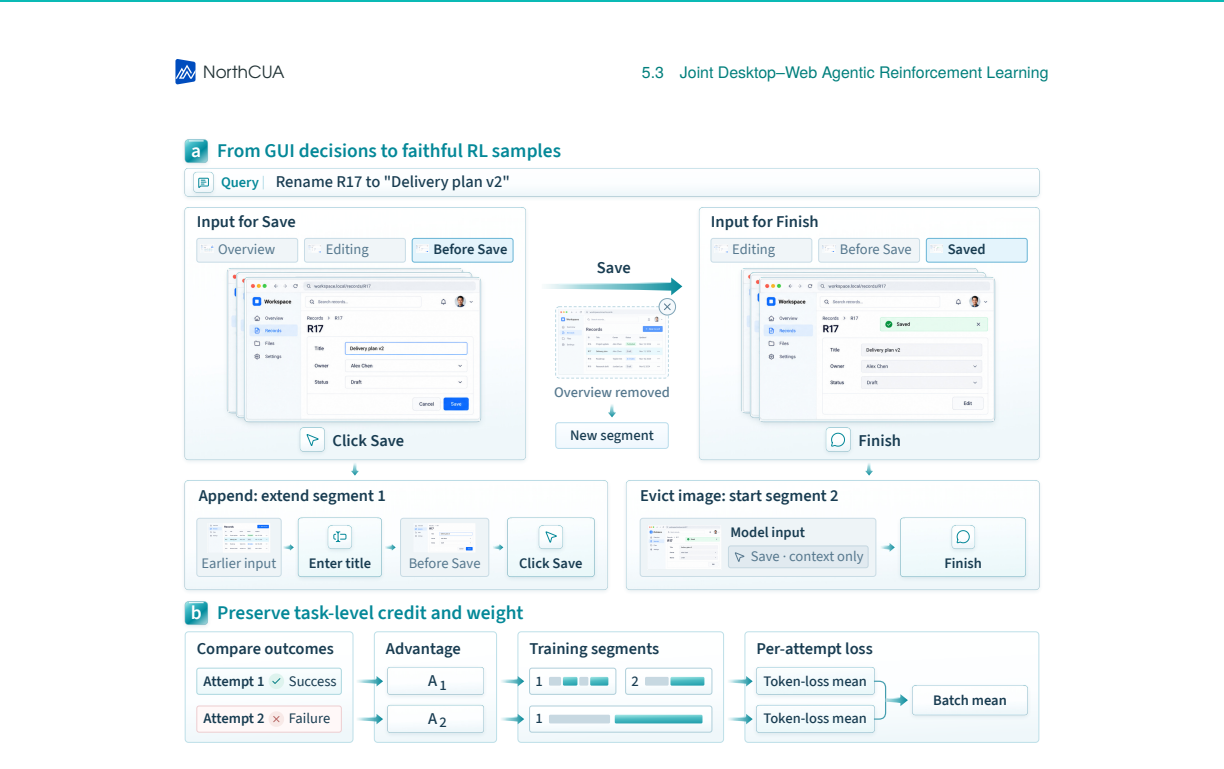
Core claim. The central claim is that sustained software work can be learned from experience that is manufactured, verified, and recycled at scale. The paper reports a three-stage recipe — broad GUI mid-training on over four million interaction steps, verified long-horizon supervised fine-tuning on roughly 3,000 complete workflows, and joint desktop–web reinforcement learning with GRPO over verifier-scored attempts — and states that each stage produces measurable gains at every model size, with the largest desktop jump coming from the long-horizon SFT transition. Its headline results are that NorthCUA-Pro reaches 93.3% on ScreenSpot-Pro, 91.0% on OSWorld-G, 88.6% on OSWorld-Verified (the highest score among the compared systems), 73.9% on WebArena-Verified, and 60.3% F1 on WebTestBench, exceeding trillion-parameter references including Qwen3.8-Max and Kimi-K3 on the reported settings. The paper also frames the loop as reusable: the same harness interfaces that collect demonstrations collect the policy's own fresh attempts, so experience production and policy improvement share one execution and outcome interface and can compound across rounds.
The premise it rests on. The headline scores stand only if the training corpora — web-collected GUI screenshots, reconstructed local websites, and the 100,000-trajectory pool — never overlap the WebArena and OSWorld evaluation tasks, a disjointness the paper never states; they also presume the agent-as-a-judge evaluator's verdicts, which select the training trajectories, are accurate at scale, a premise the paper records as an uncertainty dimension but does not quantify against human labels.
If the paper is right (Pith's inferences, not the authors')
A 397B open-weights model can beat trillion-parameter systems on the reported grounding, desktop, and web suites, so the recipe offers an open alternative to closed large models for computer-use work.
Because every model size gains at each training stage, the experience-construction and curation choices, not parameter count alone, determine benchmark improvement.
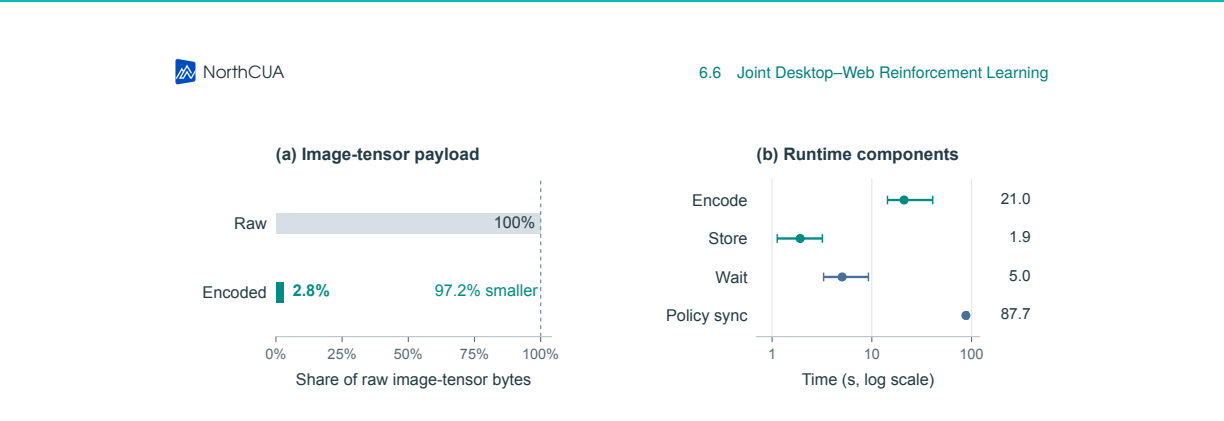
One shared policy can be trained jointly on desktop and web tasks; the context-preserving sample construction (decision-time inputs, attempt-level reward credit) keeps long multimodal rollouts usable as reinforcement-learning data.
The same harness used for demonstration collection can be reused for online RL and for future rounds of collection, making the system a compoundable foundation rather than a one-shot training run.
NorthCUA-Ultrafast shows the pre-RL checkpoint can be adapted for direct action selection, completing matched successful WebArena-Verified tasks 2.3× faster on average at a measured quality–latency tradeoff.
If the flywheel is the active ingredient, a testable prediction follows: ablating the judge-selected trajectory pool or the recursive self-improvement branches (skill guidance, milestone checkpoints) should erode the reported SFT-to-RL gains more than shrinking model size would.
Because the pipeline pools web-collected screenshots, reconstructs public reference websites into local testbeds, and covers exactly the workflow types WebArena and OSWorld test, a near-duplicate audit between the training pools and the evaluation suites would settle whether the margins survive contamination checks.
The agent-as-a-judge evaluator selects the 100,000-trajectory corpus, so a held-out judge-versus-human agreement study would convert the recorded 'judgment uncertainty' dimension into a quantity that predicts curation quality; the paper does not report such a number.
Check this review
Pith stored no record of this review's passes and took no fingerprint of it. Reviews made by code from 13 Nov 2026 on carry both.
How often reviews like this one are right
Reviews like this one: written by deepseek-v4-flash, where what was read was not recorded.
How often objections from reviews like this one are right: not yet measured
Reviews by people
This review was written by a machine. No person has reviewed this paper on Pith yet. A scientist listed on Pith can review it for a fee, and their review is published here whatever it concludes.
How Pith checks papers · The full audit of this paper · Review history (2 versions)
The paper
Abstract
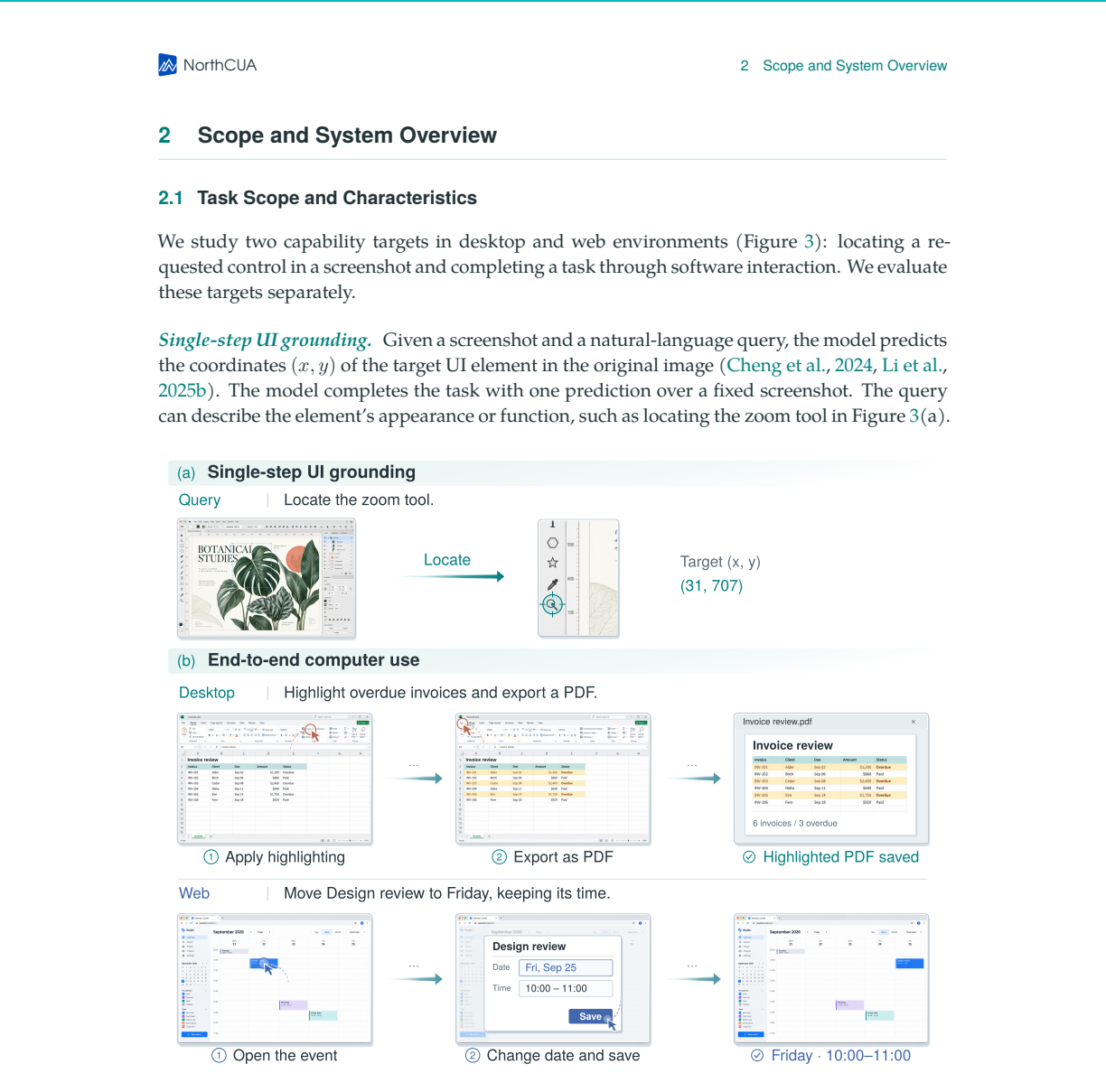
Scaling computer-use agents from individual actions to complex software work requires experience that connects decisions to complete outcomes. We present NorthCUA, an integrated system for turbocharging computer-use agents through experience at scale. Its Experience Flywheel supplies diverse executable tasks to the NorthCUA Harness, which sustains long interactions, records decisions, and checks task outcomes. The Flywheel uses these records to curate verified trajectories. For unsolved tasks, recursive self-improvement evolves reusable skills and preserves verified milestones so later attempts build on earlier progress. Staged Learning combines this experience with grounding data from the Flywheel to develop GUI competence through mid-training and long-horizon supervised fine-tuning. The policy then learns from fresh attempts in the same Harness through joint desktop-web reinforcement learning, closing the loop between experience production and policy improvement. The resulting Nano, Mini, and Pro family achieves state-of-the-art results among open-source models across GUI grounding, desktop execution, and Web interaction under the reported evaluation settings. For more responsive Web workflows, NorthCUA-Ultrafast pairs direct action selection with open-ended generation on pre-RL Nano, offering a measured quality-latency tradeoff. Together, these advances establish NorthCUA as a high-performing model family and a reusable foundation for agents that carry complex software work from intent to completion.
The paper's own sentences, arranged, kept beside the review and separate from it. Each label is drawn from a closed vocabulary; the number beside it is the probability the classifier gave that label. No sentence in this record was written by a model.
abstract compiled · 2026-11-03
The authors' main claim, as the classifier picked it out 0.98
“Together, these advances establish NorthCUA as a high-performing model family and a reusable foundation for agents that carry complex software work from intent to completion.”
How the main claim is stated: asserted 1.00
What the abstract itself states, as probabilities: claims first 0.05 · states limitation 0.43 · human participants 0.06 · controlled comparison 0.12 · randomized assignment 0.01 · states quantitative result 0.06 · compares with prior results 0.75 · mentions code or data availability 0.07
The abstract, sentence by sentence
This table labels the abstract only (arXiv listing abstract v1). The number is the probability the classifier gave the label.
| Sentence | Role | The authors' own work | States the main conclusion | Strength |
|---|---|---|---|---|
| Scaling computer-use agents from individual actions to complex software work requires experience that connects decisions to complete outcomes. | background 0.91 | 0.08 | 0.05 | asserted 1.00 |
| We present NorthCUA, an integrated system for turbocharging computer-use agents through experience at scale. | contribution 1.00 | 0.86 | 0.10 | asserted 1.00 |
| Its Experience Flywheel supplies diverse executable tasks to the NorthCUA Harness, which sustains long interactions, records decisions, and checks task outcomes. | method 0.97 | 0.76 | 0.04 | asserted 1.00 |
| The Flywheel uses these records to curate verified trajectories. | method 0.99 | 0.76 | 0.03 | asserted 1.00 |
| For unsolved tasks, recursive self-improvement evolves reusable skills and preserves verified milestones so later attempts build on earlier progress. | method 0.98 | 0.76 | 0.05 | asserted 1.00 |
| Staged Learning combines this experience with grounding data from the Flywheel to develop GUI competence through mid-training and long-horizon supervised fine-tuning. | method 0.99 | 0.80 | 0.04 | asserted 1.00 |
| The policy then learns from fresh attempts in the same Harness through joint desktop-web reinforcement learning, closing the loop between experience production and policy improvement. | method 0.99 | 0.85 | 0.06 | asserted 1.00 |
| The resulting Nano, Mini, and Pro family achieves state-of-the-art results among open-source models across GUI grounding, desktop execution, and Web interaction under the reported evaluation settings. | result 1.00 | 0.94 | 0.43 | asserted 1.00 |
| For more responsive Web workflows, NorthCUA-Ultrafast pairs direct action selection with open-ended generation on pre-RL Nano, offering a measured quality-latency tradeoff. | method 0.61 | 0.88 | 0.04 | asserted 0.98 |
| Together, these advances establish NorthCUA as a high-performing model family and a reusable foundation for agents that carry complex software work from intent to completion. | interpretation 0.96 | 0.79 | 0.85 | asserted 1.00 |
What kind of paper the classifier reports this is: method or tool 1.00 · evidence from observation or experiment 0.93
What was examined, and what was not
Sources read
- arXiv listing abstract v1
Not examined
- full text
- figures and tables
- references and citing sentences
- relations to other papers
Levels run
- P abstract
Not run
- S sections
- T body sentences
- C citations
- R cross-paper relations
How the labels were made
Compiled by classifier-1.13.0 via TypeSafe API, question bank abstract-p1-20260923, 2026-11-03: 1 request, 7,510 input tokens.
Every quoted sentence on this record is the authors'. Every label is from Pith's closed vocabulary, with the probability shown beside it. This record as JSON
Figures (43)









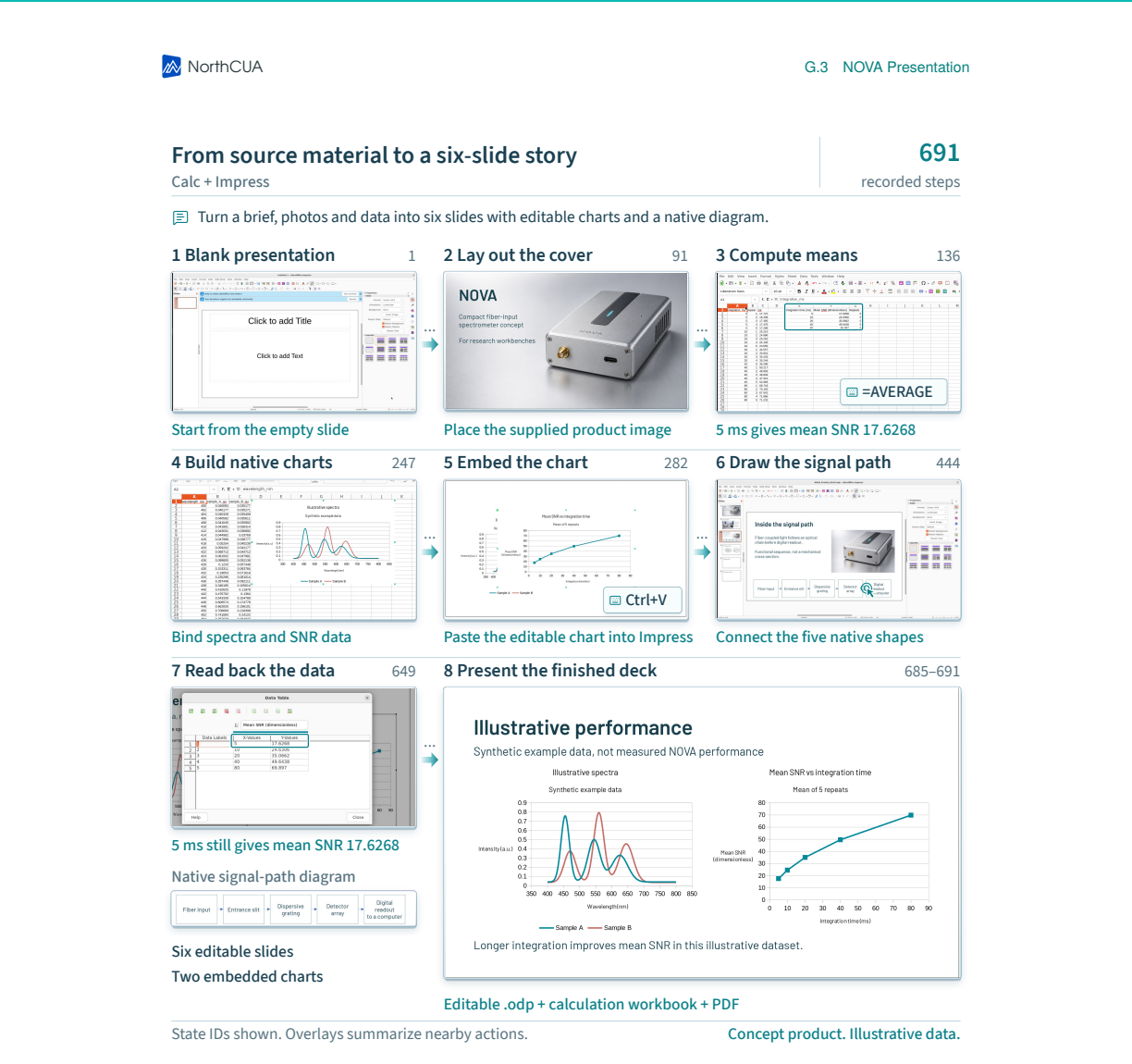
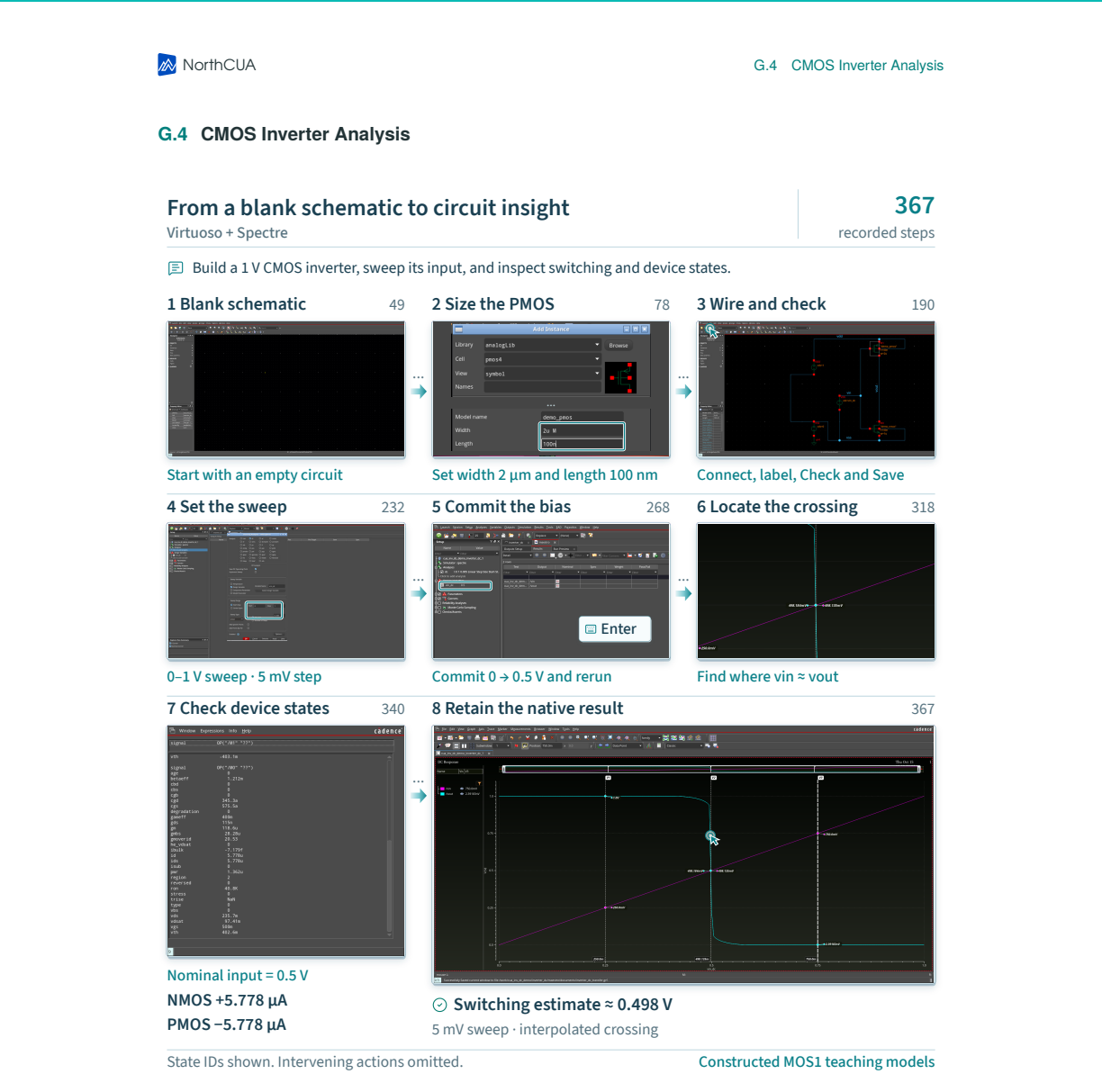

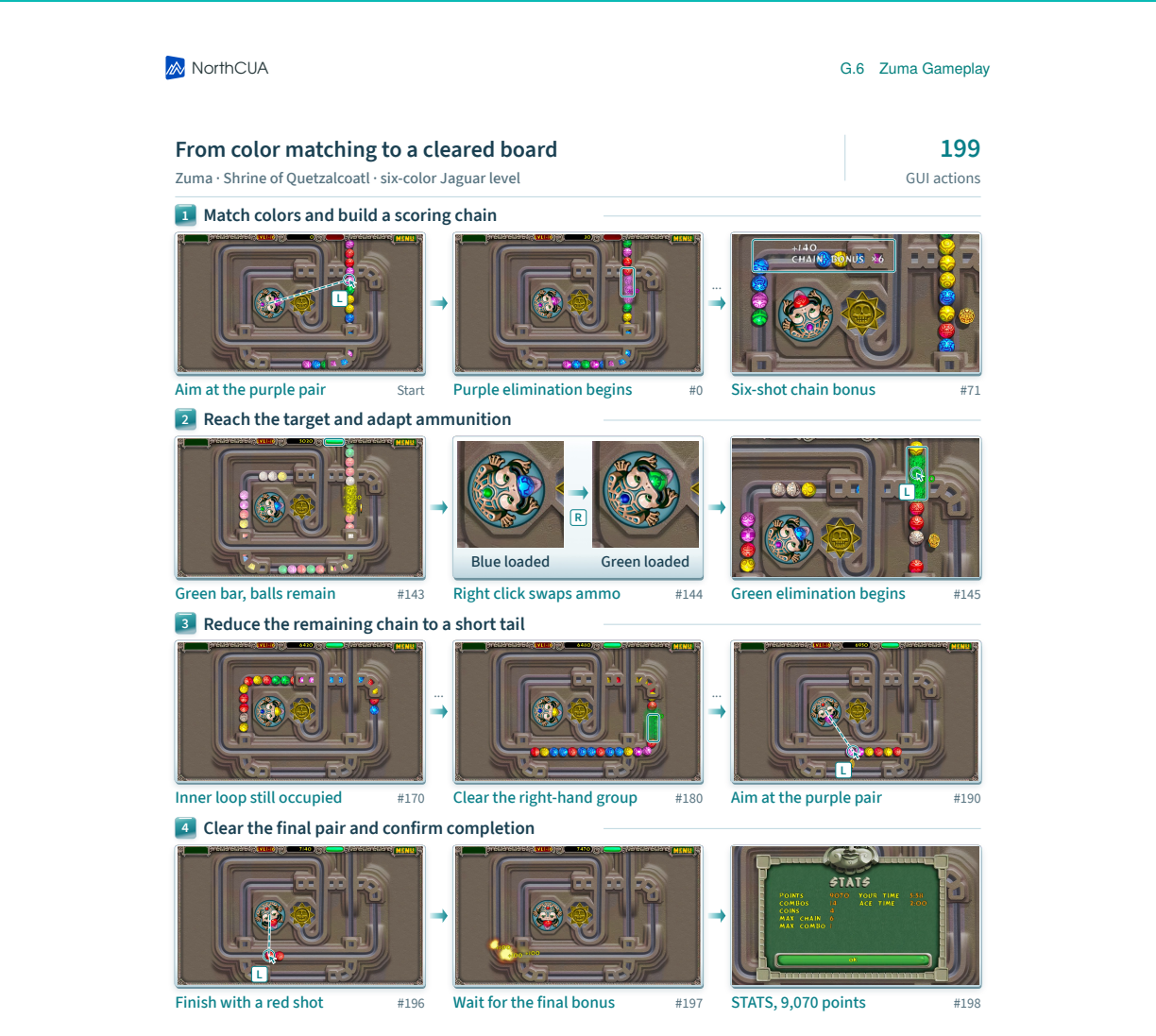

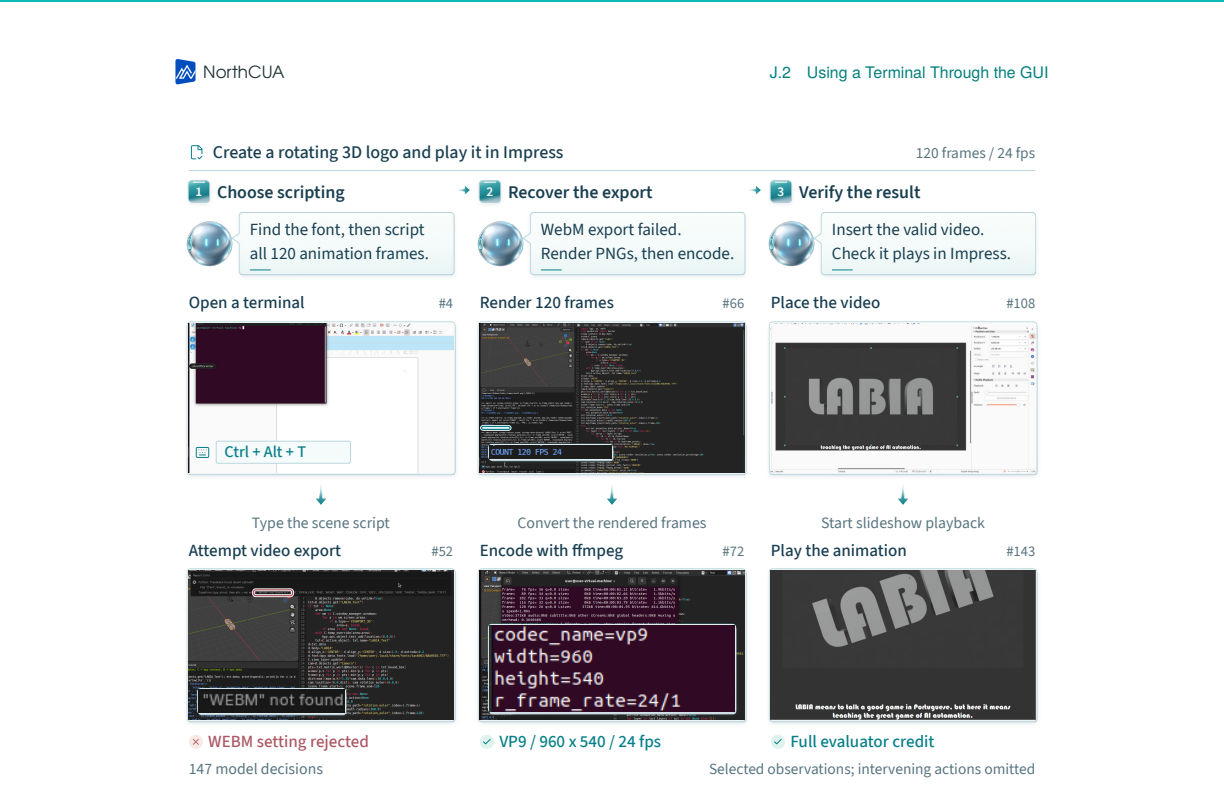
Figures are the authors', reproduced from the paper.
Challenges and discussion
Disagree with the review, or know something it missed? Leave a comment, or challenge this review formally: a challenge becomes a permanent entry in this paper's record, and its decision is published here.
Come back by email
A short list of the week's newly reviewed papers. Nothing is sent until you confirm from your inbox, and every email has a link that stops it. No account.
No comments yet.
Sign in to comment