Machine Learning · arXiv:2611.02230 v1 · submitted 1 Nov 2026 · 32 references
Who Should Score the Cache? Mid-Depth Layers Are the Best Judges of KV-Cache Eviction
The paper says
“Key-value (KV) cache eviction methods rank tokens by attention scores, and each layer scores its own cache. To our knowledge, no eviction method asks which layer should score.”
more of the abstract
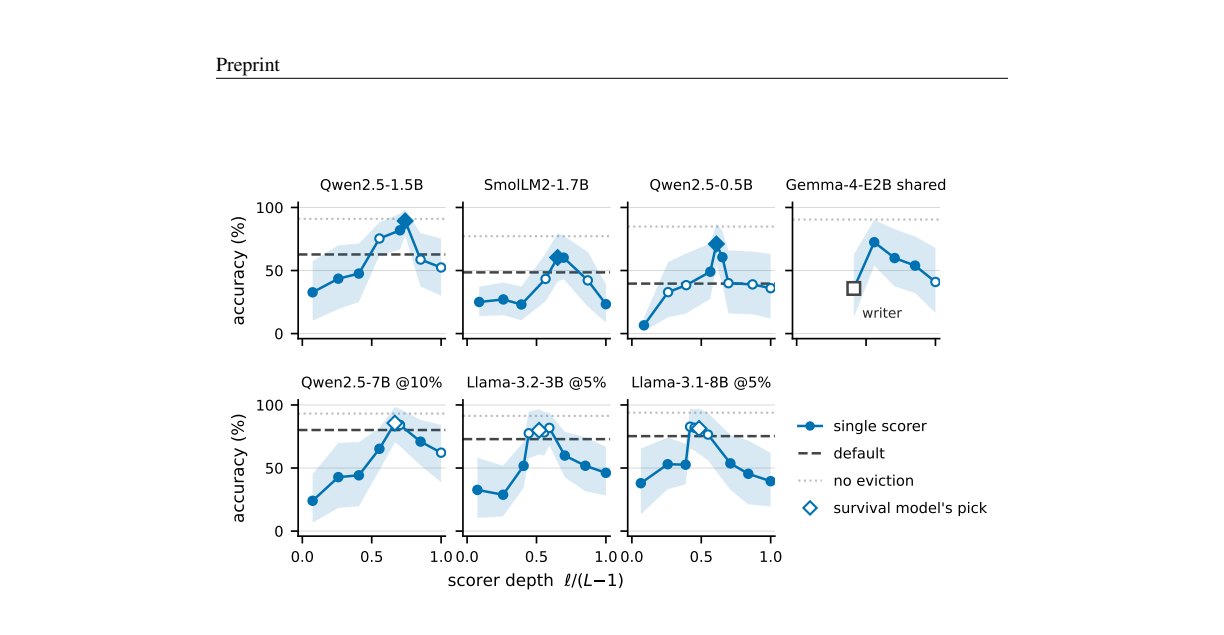
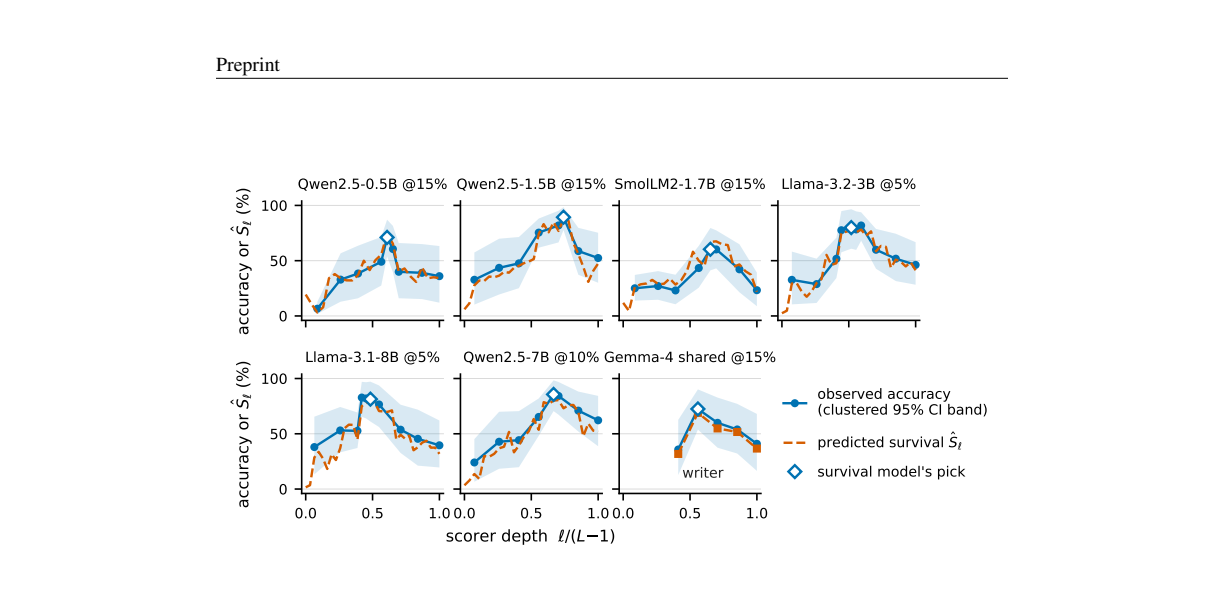
We find, across twenty-one models, that the depth of the scoring layer governs eviction quality. On the eighteen models with per-layer caches, spanning 0.5B to 109B, long-context retrieval accuracy collapses at shallow layers, peaks between 0.4 and 0.75 of depth, and degrades at the last layer. The curve arises because a layer judges tokens well only once it has used the question to find the answer, which takes several layers. Modeling eviction as a top-k cut, we compute answer survival probability from prefill attention and reproduce the measured curves. This approach selects the scoring layer using calibration prompts with known answers, and the selected layer is the best layer measured on most models and never significantly below it. It improves on the own-layer default on sixteen of the eighteen models, with significant gains on seven, all at 14B or below, while on larger models the default is already close to the best mid-depth layer. Scoring every cache from the selected layer while keeping one set of tokens for all heads also beats per-head SnapKV by 18 to 43 points on five models up to 14B under tight budgets. This gain carries over to financial filings at 32K context, all at the same memory budget, with no extra forward pass. The same curve explains a penalty in shared-cache models, where several layers read one cache and the layer that writes it scores by default. On Gemma-4-E2B the writer is shallow and loses 28 points to a mid-depth reader at a 10% budget. We also find that in open-book question answering (LongBench) no mid-depth layer beats the own-layer default.
from the abstract
Pith says
Machine review · deepseek-v4-flash · 3 Nov 2026 · what was read was not recorded · not checked by a person
It can be wrong. Challenge this review or reply to it.
Holds up, with conditions. A genuinely useful measured result—scoring-layer depth matters for eviction—but the universal "depth governs" claim is only established under question-window scoring; worth a serious referee, not a desk reject. This line is wrong
2 major objections · 6 minor
How often objections from reviews like this one are right: not yet measured
Not checked: figures, code, what the 32 references say.
The paper says, at Abstract; §1; §3; §5.1
The review did not quote this passage.
Pith says: Objection 1 of 2 · major
The headline claim that 'the depth of the scoring layer governs eviction quality' is broader than the evidence. All depth sweeps (Figures 1 and 2, Table 2) use the question-window scoring convention defined in Section 3; the kvpress-window comparison in Table 1 tests only the survival model's single pick per model, not a full depth sweep; and Section 3 states that numbers are never compared across the two windows.
more of objection 1
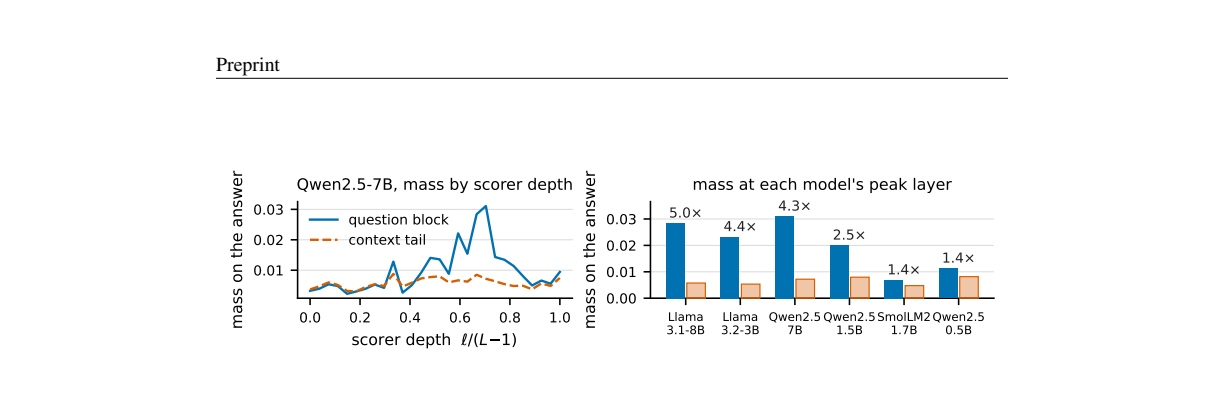
Section 5.1's own control shows the depth signal is question-driven: without the question, the reader-writer attention-mass gap on Gemma-4 shrinks by a factor of 6.5, and the per-model question/context-tail ratios drop to 1.4 to 5.0. The paper discloses the window convention in Section 3 and the question-visibility limitation in Section 7, but the abstract and title state the universal claim without this scope condition. I ask the authors to restate the universal depth-curve claim as conditional on question-visible scoring, or preferably to run a depth sweep under the kvpress window on at least two models (for example Qwen2.5-1.5B and Llama-3.1-8B) to show whether the curve shape transfers to the second scoring convention. This is a scope correction rather than a contradiction, but it is load-bearing because the unqualified claim is the paper's central advertised finding.
The paper says, at §3; §A.1; Abstract
The review did not quote this passage.
Pith says: Objection 2 of 2 · major
The binding budgets at which every headline margin is reported appear to be selected on a subset of the evaluation set. Section A.1 states that 'the scan uses the first ten evaluation prompts per task,' and the main results use 25 prompts per task (n = 200) from the same pool; if the ten scan prompts are the first ten of those 25, the budget is chosen with knowledge of 40% of the evaluation data per task.
more of objection 2
This does not bias the fixed-budget comparison among scorers, and the multi-budget evidence in Table A4 (Qwen2.5-1.5B at 5 to 50%) shows the qualitative conclusions are robust. However, the magnitude claims in the abstract ('+18 to +43pp', '+26.6pp', 'loses 28 points') are conditional on budgets chosen partly from the evaluation set, and the protocol also selects budgets where the default demonstrably loses on those very prompts. Please state explicitly whether the scan prompts are disjoint from the n = 200 evaluation prompts; if they are not, verify the headline margins at a budget selected without access to evaluation prompts.
6 minor objections
The paper says, at Abstract; Table 1; Table A4
Pith says: minor objection 1 of 6
The abstract's 'beats per-head SnapKV by 18 to 43 points on five models up to 14B' is verifiable only by combining Table 1 (four distinct models across five columns, with Qwen2.5-1.5B at two budgets) with Table A4 (which adds Qwen2.5-0.5B). A cross-reference in the Table 1 caption would make the count checkable at a glance.
The paper says, at §4.1
Pith says: minor objection 2 of 6
The GemFilter head-to-head uses question-window scoring ('L20 under the question window, as in Figure 1') while the surrounding Table 1 uses the kvpress window. The text states this, but an explicit sentence that the GemFilter comparison is not comparable with the Table 1 columns would prevent a reader from treating the 89.3% versus 36.5% as part of the SnapKV comparison.
show 4 more
The paper says, at §A.10; Table 1
Pith says: minor objection 3 of 6
The third of the four Table 1 combination-over-SnapKV comparisons (Qwen2.5-14B @5%) has p = 0.055 under the exact sign-flip test while its cluster bootstrap CI excludes zero. The p-value is disclosed, but the main text counts this column among the 'clustered-significant' gains; a footnote noting that this margin is marginal under the exact test in isolation, with the joint test giving p = 0.008, would sharpen the reporting.
The paper says, at §3
Pith says: minor objection 4 of 6
The sentence 'The same scorer at the same budget shifts by several points between the two windows' justifies never comparing across windows; a single quantified example would make the caution concrete and would also help readers interpret the size of the Table 1 gains.
The paper says, at Abstract; §6; §7
Pith says: minor objection 5 of 6
The abstract says the curve 'explains' the shared-cache penalty, while Section 7 correctly states that the writer-depth explanation rests on one sibling pair. 'Is consistent with' or 'predicts' would be the proportionate wording until the deeper-writer experiment suggested in Section 7 is run.
The paper says, at §3; §A.10
Pith says: minor objection 6 of 6
With 'No multiple-comparison correction is applied,' the 18-model pick-versus-best-other claims in Table A2 should be read descriptively: across 18 models and 7 to 10 measured layers per model, some 'within noise' and 'significant' margins are expected by chance. The joint sign-flip test on the six primary comparisons is reassuring; a sentence acknowledging the descriptive status of the per-model comparisons in Section A.10 would complete the picture.
What would settle it
Run the full scorer-depth sweep (all seven grid layers plus the survival model's pick) on Qwen2.5-1.5B and Llama-3.1-8B using the kvpress scoring window (last 64 prefilled tokens, 5-token smoothing, per-head sets) at the binding budgets of Table 1. If the mid-depth peak and the picked layer's advantage persist within one grid step, the concern is resolved; if the curve flattens or the best layer leaves the 0.4-0.75 depth band, the universal depth-curve claim must be restricted to the question-window convention.
from the skeptic's reading
How the review went
4 readings by deepseek-v4-flash · 3 Nov 2026
- Reader holds up, with conditions
- Skeptic agrees
- Editor wrote the verdict above
- Referee major revision: 2 major objections, 6 minor
Not run on this paper: the simulated authors' defence.
Pith did not check this review's objections against the paper.
The review in full
The review in brief, machine-written
Short version: this is a real result with good evidence, and a serious editor should send it out. The question of which layer should score the cache is genuinely unasked in the prior eviction literature, and the paper answers it with unusually careful measurements: depth sweeps on eighteen per-layer models across labs and scales, a parameter-free survival model computed from prefill attention on calibration prompts the evaluation never uses, a heads-versus-depth control, a masking-versus-deletion equivalence check, clustered bootstrap intervals, exact sign-flip tests, and honest negative results on LongBench and on models from 32B up. The survival model is a genuine predictor rather than a fit: its picks are best or tied on all eighteen per-layer models, and it reproduces the shared-cache reader ranking on Gemma-4-E2B within a few points. The shared-cache penalty story is also compelling, and the sibling-pair control against Gemma-4-E4B is a sensible natural experiment, even though the authors correctly say it rests on one pair.
The main soft spot is scope of the central claim. Every depth curve uses the question-window scoring convention; the kvpress-window comparison in Table 1 tests only one mid-depth pick, not a full depth sweep, and the paper itself says it never compares numbers across the two windows. The survival model is built under the same convention. So "depth governs eviction quality at every scale we test" is established for question-window scoring, not for attention-scoring conventions generally. The authors' own no-question control shows why this matters: without the question, layers are nearly equally blind to the answer. I would not call this fatal, because the window choice is disclosed, but the abstract and introduction should either run a second full sweep under a different window or restate the law as conditional on the scoring convention.
The second soft spot is the practical headline. The 18 to 43 point gains over SnapKV are measured at per-model binding budgets chosen with knowledge of the default's behavior, on an eight-task pool. All of that is disclosed, and the gains persist over the full thirteen-task pool but shrink by 3 to 6 points. So the practical claim is real but budget- and task-pool-dependent; readers should not extrapolate the headline number to arbitrary settings.
Minor: I did not see a public code repository. The reproducibility statement is unusually detailed, but a compute-heavy empirical claim like this would benefit from a shipped implementation.
Who this is for: people working on KV-cache compression and efficient LLM inference. If that is your group, bring it to the reading group. My recommendation: accept for peer review, and ask the authors to tighten the window-dependence before publication.
The strongest objection
The paper's central claim ('the depth of the scoring layer governs eviction quality at every scale we test', [b15]) rests on depth sweeps that all use the question-block scoring window defined in Section 3. Section 5.1's own control shows the depth signal is question-driven: without the question, layers are nearly equally blind to the answer. That suggests the curve is a property of question-visible scoring, not of layer depth per se. The Table 1 comparison against SnapKV uses the kvpress window (last 64 prefilled tokens) but only tests one mid-depth pick, not a full depth sweep, and the paper states it never compares numbers across the two windows. The survival model (Equation 1) is computed under the same question-window convention, so its predictive success does not independently establish a window-independent law. This is a scope condition the paper discloses rather than a contradiction, but it is the least secured step in the universal claim: if a full depth sweep under the kvpress window flattened, the abstract's 'depth governs' would need to be restated as 'depth governs under question-window scoring.' A reader should not treat the 18-model universal curve as covering arbitrary attention-scoring conventions without that check.
The reader's weakest assumption identified question-window attention mass on the answer and question visibility during prefill as the load-bearing step; the stress-test agrees and sharpens it into a scoring-convention scope condition. The paper's internal evidence is strong: a parameter-free survival model that matches the measured depth curves, calibration-stable picks on the significant models, a no-question control that moves in the predicted direction, a shared-cache prediction that reproduces five reader accuracies, exact sign-flip checks on the primary comparisons, and disclosed negative results on LongBench, large models, and alternate task pools. No internal inconsistency or correctness red flag was found. The practical headline gains are conditional on binding budgets and question-visible prefill, exactly as the paper states. The remaining unsecured step is narrow: the universal depth claim has not been shown under a second standard scoring window, because the kvpress comparison tests a single selected layer rather than a full depth curve. That keeps the verdict at CONDITIONAL but does not move it further.
The referee's report
If the results hold, the paper identifies a previously unreported degree of freedom in KV-cache eviction, namely the scoring layer, with a large practical effect at tight budgets, and supplies both a mechanistic explanation and a constant-free predictor that transfers to another task family. The strengths are substantial: evaluation breadth (21 models across scales and release dates), the discipline of never comparing numbers across the two scoring windows (Section 3), and an unusually transparent statistical and reproducibility apparatus. Every number is generated by a script from shared JSON files, one statistics implementation is used throughout, masked eviction is verified equivalent to physical deletion, and cluster bootstraps are checked with exact sign-flip tests that attain the minimum possible p-value (0.008) on the joint test. The survival model is a genuine predictor rather than a fit: it has no adjustable constants, is computed on calibration prompts disjoint from evaluation, and transfers to DocFinQA.
Pith's reading of the paper (a machine's summary, not the authors')
Every KV-cache eviction method ranks cached tokens by attention scores, and every existing method lets each layer score its own cache. This paper asks a question nobody had varied: which layer should do the scoring, and finds the answer is almost always a mid-depth layer. Across twenty-one models, retrieval accuracy collapses when a shallow layer scores the eviction, peaks between 40% and 75% of network depth, and degrades again at the last layer. The paper explains the curve with a parameter-free survival model that computes, from the uncompressed model's prefill attention and known answer spans, the probability that a gold answer survives the scorer's top-$k$ cut; the model reproduces the measured curves and picks a layer that is the best measured on most models. On small and mid-size models the chosen scorer with one shared token set beats per-head SnapKV by 18 to 43 points under tight memory budgets, and the gain carries to financial-document extraction at 32K context.
What carries the argument. The load-bearing object is the survival model, Equation (1), which treats eviction as a ranking problem: layer $\ell$ is a good scorer when it ranks the tokens the answer needs above the $k$-th place of its top-$k$ cut. For a prompt, the model reconstructs the set $K_\ell$ of tokens layer $\ell$ would keep — including the always-kept sink and recency tokens — and counts a gold answer as surviving if some occurrence of it lies entirely inside $K_\ell$, matching the all-or-nothing credit of the recall metric. Averaged over gold answers and prompts, this gives $\hat{S}_\ell$, a prediction computed entirely from the uncompressed model's prefill attention and the locations of known answer spans, with no adjustable constants and no generation. The survival score does two jobs: it reproduces the measured depth curves, including the reader ranking on a shared cache, and it selects the scoring layer. The mechanism behind the curve is that attention on the answer, driven by question tokens, builds with depth and peaks at mid-depth; without the question, layers are nearly equally blind to the answer, so the whole predictive story depends on question visibility during prefill. The paper tests the alternative explanation that the curve merely reflects where retrieval heads sit, and finds that mid-depth heads carry the signal but a single mid-depth layer collects them without a head search.
Core claim. The paper's central discovery is a universal depth curve: when a single layer scores every cache's eviction, long-context retrieval accuracy is a function of that layer's depth — a cliff at shallow layers, a peak between 0.4 and 0.75 of depth, and a decline at the last layer — on all eighteen per-layer models tested, from 0.5B to 109B parameters, with the same shape on shared-cache architectures. The mechanism offered is that a layer becomes a good judge only once its attention has used the question to locate the answer, a job that takes several layers; removing the question flattens the depth signal almost completely. Modeling eviction as a top-$k$ cut, the paper computes the probability that each gold answer survives the scorer's kept set — Equation (1), an all-or-nothing survival probability with no adjustable constants, built from prefill attention of the uncompressed model and known answer spans on 25 calibration prompts per task — and shows this survival score tracks the measured accuracy curves (Spearman 0.90–1.00) and selects a layer that is the best measured on fourteen of the eighteen models and never significantly worse on the other four. The same survival score computed from each reader's attention reproduces the reader ranking on a shared cache. The applied claim is that scoring every cache from the selected mid-depth layer with a single kept set for all heads beats per-head SnapKV by 18 to 43 points on five models up to 14B under tight budgets, ties on two Llama models, and transfers to financial-filing extraction at 32K context without an extra forward pass; from 32B up the default is already close to the best mid-depth layer. The paper also documents where the gain ends: on open-book question answering (LongBench), no mid-depth layer beats the own-layer default, and the survival model, built for exact-match answers, does not predict that outcome.
The premise it rests on. The predictive story rests on treating question-window attention mass on the gold answer, measured on 25 calibration prompts per task with known answer spans from the uncompressed model, as the proxy for eviction quality on unseen prompts; the paper itself shows the signal collapses when the question is removed, and the measured gains also depend on the chosen binding budget at which each model is compared.
If the paper is right (Pith's inferences, not the authors')
Scoring-layer depth becomes a tunable, measurable decision: an eviction method can keep its scoring rule and gain accuracy simply by scoring from a selected mid-depth layer rather than each cache's own layer — the default loses to the best mid-depth scorer on all seven primary models and never significantly beats it anywhere.
Layer selection is cheap and automatic: the survival model uses only the uncompressed model's prefill attention and known answer spans on 25 calibration prompts per task, so the layer can be chosen once per model without a sweep over layers and with under 1% added prefill time.
A single kept set for all heads plus mid-depth scoring is a ready improvement to SnapKV-style methods at tight budgets on models up to 14B: gains of +18 to +43 points, recovering 83 to 99% of uncompressed accuracy where SnapKV keeps 37 to 63%.
Shared-cache architectures carry a hidden cost when the writer is shallow: on Gemma-4-E2B the default writer needs roughly twice a mid-depth reader's budget, and scoring by a deeper reader or by rank consensus over the readers recovers most of the gap.
The boundary of the effect is documented: from 32B up the own-layer default already sits near the best mid-depth layer, and on open-book QA no mid-depth layer beats the default — so the practical advice is strongest for small and mid-size models on exact-answer retrieval.
The RULER-selected layer transfers to real documents: on financial-filing extraction at 32K it beats the default by 8 to 12 points, and the combined method beats per-head SnapKV by 14 to 16 points there, all at the same memory budget with no extra forward pass.
Beyond eviction, the same depth logic likely constrains any scheme that borrows one layer's attention to decide what other layers keep — prefill token pruning, cross-layer compression, and training-time sparse schedules that fix a preceding layer as selector — and the survival model offers those settings a ready selection rule, since it needs only prefill attention and a notion of the span that mu
Because the best scorer differs by task family, which the paper states explicitly, a per-prefix selector that recognizes the task family could beat any single fixed layer; the survival model is cheap enough to evaluate on several families at once.
The question-dependence of the signal implies that prefix caches, where the question arrives after the cache is built, cannot use this rule directly; a testable extension would be ranking tokens by context-tail attention combined with a learned question prior, since the paper shows context alone flattens the curve.
The writer-depth explanation rests on one sibling pair; the paper itself proposes training the same model with a deeper writer as the decisive test, and the survival model makes that test quantitative — it predicts the shared-cache penalty shrinks to near zero when the writer sits at mid-depth.
Check this review
Pith stored no record of this review's passes and took no fingerprint of it. Reviews made by code from 13 Nov 2026 on carry both.
How often reviews like this one are right
Reviews like this one: written by deepseek-v4-flash, where what was read was not recorded.
How often objections from reviews like this one are right: not yet measured
Reviews by people
This review was written by a machine. No person has reviewed this paper on Pith yet. A scientist listed on Pith can review it for a fee, and their review is published here whatever it concludes.
The paper
Abstract
Key-value (KV) cache eviction methods rank tokens by attention scores, and each layer scores its own cache. To our knowledge, no eviction method asks which layer should score. We find, across twenty-one models, that the depth of the scoring layer governs eviction quality. On the eighteen models with per-layer caches, spanning 0.5B to 109B, long-context retrieval accuracy collapses at shallow layers, peaks between 0.4 and 0.75 of depth, and degrades at the last layer. The curve arises because a layer judges tokens well only once it has used the question to find the answer, which takes several layers. Modeling eviction as a top-k cut, we compute answer survival probability from prefill attention and reproduce the measured curves. This approach selects the scoring layer using calibration prompts with known answers, and the selected layer is the best layer measured on most models and never significantly below it. It improves on the own-layer default on sixteen of the eighteen models, with significant gains on seven, all at 14B or below, while on larger models the default is already close to the best mid-depth layer. Scoring every cache from the selected layer while keeping one set of tokens for all heads also beats per-head SnapKV by 18 to 43 points on five models up to 14B under tight budgets. This gain carries over to financial filings at 32K context, all at the same memory budget, with no extra forward pass. The same curve explains a penalty in shared-cache models, where several layers read one cache and the layer that writes it scores by default. On Gemma-4-E2B the writer is shallow and loses 28 points to a mid-depth reader at a 10% budget. We also find that in open-book question answering (LongBench) no mid-depth layer beats the own-layer default.
The paper's own sentences, arranged, kept beside the review and separate from it. Each label is drawn from a closed vocabulary; the number beside it is the probability the classifier gave that label. No sentence in this record was written by a model.
abstract compiled · 2026-11-03
The authors' main claim, as the classifier picked it out 0.86
“We find, across twenty-one models, that the depth of the scoring layer governs eviction quality.”
How the main claim is stated: asserted 1.00
What the abstract itself states, as probabilities: claims first 0.66 · states limitation 0.92 · human participants 0.03 · controlled comparison 0.96 · randomized assignment 0.02 · states quantitative result 0.99 · compares with prior results 0.96 · mentions code or data availability 0.03
The abstract, sentence by sentence
This table labels the abstract only (arXiv listing abstract v1). The number is the probability the classifier gave the label.
| Sentence | Role | The authors' own work | States the main conclusion | Strength |
|---|---|---|---|---|
| Key-value (KV) cache eviction methods rank tokens by attention scores, and each layer scores its own cache. | background 1.00 | 0.07 | 0.02 | asserted 1.00 |
| To our knowledge, no eviction method asks which layer should score. | gap 1.00 | 0.09 | 0.03 | asserted 0.91 |
| We find, across twenty-one models, that the depth of the scoring layer governs eviction quality. | result 0.99 | 0.96 | 0.59 | asserted 1.00 |
| On the eighteen models with per-layer caches, spanning 0.5B to 109B, long-context retrieval accuracy collapses at shallow layers, peaks between 0.4 and 0.75 of depth, and degrades at the last layer. | result 1.00 | 0.95 | 0.49 | asserted 1.00 |
| The curve arises because a layer judges tokens well only once it has used the question to find the answer, which takes several layers. | interpretation 1.00 | 0.76 | 0.10 | asserted 0.98 |
| Modeling eviction as a top-$k$ cut, we compute answer survival probability from prefill attention and reproduce the measured curves. | method 0.80 | 0.94 | 0.05 | asserted 1.00 |
| This approach selects the scoring layer using calibration prompts with known answers, and the selected layer is the best layer measured on most models and never significantly below it. | method 0.60 | 0.95 | 0.21 | asserted 1.00 |
| It improves on the own-layer default on sixteen of the eighteen models, with significant gains on seven, all at 14B or below, while on larger models the default is already close to the best mid-depth layer. | result 0.99 | 0.96 | 0.13 | asserted 1.00 |
| Scoring every cache from the selected layer while keeping one set of tokens for all heads also beats per-head SnapKV by 18 to 43 points on five models up to 14B under tight budgets. | result 0.99 | 0.94 | 0.11 | asserted 1.00 |
| This gain carries over to financial filings at 32K context, all at the same memory budget, with no extra forward pass. | result 1.00 | 0.92 | 0.06 | asserted 1.00 |
| The same curve explains a penalty in shared-cache models, where several layers read one cache and the layer that writes it scores by default. | interpretation 0.61 | 0.82 | 0.08 | asserted 0.99 |
| On Gemma-4-E2B the writer is shallow and loses 28 points to a mid-depth reader at a 10% budget. | result 1.00 | 0.94 | 0.05 | asserted 1.00 |
| We also find that in open-book question answering (LongBench) no mid-depth layer beats the own-layer default. | result 0.80 | 0.95 | 0.04 | asserted 1.00 |
What kind of paper the classifier reports this is: method or tool 0.55 · evidence from observation or experiment 1.00
What was examined, and what was not
Sources read
- arXiv listing abstract v1
Not examined
- full text
- figures and tables
- references and citing sentences
- relations to other papers
Levels run
- P abstract
Not run
- S sections
- T body sentences
- C citations
- R cross-paper relations
How the labels were made
Compiled by classifier-1.13.0 via TypeSafe API, question bank abstract-p1-20260923, 2026-11-03: 1 request, 9,606 input tokens.
Every quoted sentence on this record is the authors'. Every label is from Pith's closed vocabulary, with the probability shown beside it. This record as JSON
Figures (3)
Figures are the authors', reproduced from the paper.
References (32)
- [2] arXiv:2308.14508. William Brandon, Mayank Mishra, Aniruddha Nrusimha, Rameswar Panda, and Jonathan Ragan- Kelley. Reducing Transformer key-value cache size with cross-layer attention. InAdvances in Neural Information Processing Systems (NeurIPS), on PithPith's reviewarXiv
- [3] arXiv:2405.12981. 9 Preprint Zefan Cai, Yichi Zhang, Bofei Gao, Yuliang Liu, Yucheng Li, Tianyu Liu, Keming Lu, Wayne Xiong, Yue Dong, Junjie Hu, and Wen Xiao. PyramidKV: Dynamic KV cache compression based on pyramidal information funneling.arXiv preprint arXiv:2406.02069, on PithPith's reviewarXiv
- [4] Chi-Chih Chang, Wei-Cheng Lin, Chien-Yu Lin, Hung-Yueh Chiang, Yash Akhauri, Xilai Dai, Huiqiang Jiang, Yucheng Li, Luis Ceze, Kai-Chiang Wu, and Mohamed S. Abdelfattah. xKV: Cross-layer KV-cache compression via aligned singular vector extraction.arXiv preprint arXiv:2503.18893, on PithPith's reviewarXiv
- [6] arXiv:2407.11550. Qichen Fu, Minsik Cho, Thomas Merth, Sachin Mehta, Mohammad Rastegari, and Mahyar Najibi. LazyLLM: Dynamic token pruning for efficient long context LLM inference.arXiv preprint arXiv:2407.14057, on PithPith's reviewarXiv
- [7] arXiv:2410.19258. Yizhao Gao, Jianyu Wei, Qihao Zhang, Yu Cheng, Shimao Chen, Zhengju Tang, Zihan Jiang, Yifan Song, Hailin Zhang, Liang Zhao, Bo Yang, Gang Wang, Shijie Cao, and Fuli Luo. HySparse: A hybrid sparse attention architecture with oracle token selection and KV cach... on PitharXiv
- [8] arXiv:2310.01801. Gemma Team. Gemma 3n: Efficient on-device architectures. Google developer documentation, https://ai.google.dev/gemma/docs/gemma-3n, on PithPith's reviewarXiv
- [9] No standalone technical re- port; architecture documented in the official developer guide. Gemma Team. Gemma 4 technical report.arXiv preprint arXiv:2607.02770, on PithPith's reviewarXiv
- [11] Inbasekaran S. Page-EntroKV: Hardware-aligned, entropy-weighted KV-cache eviction under grouped-query attention.arXiv preprint arXiv:2610.03135, on PithPith's reviewarXiv
- [12] Dongwon Jo, Jiwon Song, Yulhwa Kim, and Jae-Joon Kim. FastKV: Decoupling of context reduc- tion and KV cache compression for prefill-decoding acceleration. InFindings of the Association for Computational Linguistics: ACL 2026, on Pith
- [13] arXiv:2502.01068. Jang-Hyun Kim, Jinuk Kim, Sangwoo Kwon, Jae W. Lee, Sangdoo Yun, and Hyun Oh Song. KVzip: Query-agnostic KV cache compression with context reconstruction. InAdvances in Neural Infor- mation Processing Systems (NeurIPS), on PithPith's reviewarXiv
- [14] arXiv:2505.23416. Sravanth Kodavanti and Manjunath Arveti. MOSAIC: Multi-objective search for allocating infer- ence cache across LLM decoder layers.arXiv preprint arXiv:2610.25431, on PitharXiv
- [15] arXiv:2406.19707. 10 Preprint Yuhong Li, Yingbing Huang, Bowen Yang, Bharat Venkitesh, Acyr Locatelli, Hanchen Ye, Tianle Cai, Patrick Lewis, and Deming Chen. SnapKV: LLM knows what you are looking for be- fore generation. InAdvances in Neural Information Processing Systems (NeurIPS), on PithPith's reviewarXiv
- [16] arXiv:2404.14469. Zichang Liu, Aditya Desai, Fangshuo Liao, Weitao Wang, Victor Xie, Zhaozhuo Xu, Anastasios Kyrillidis, and Anshumali Shrivastava. Scissorhands: Exploiting the persistence of importance hypothesis for LLM KV cache compression at test time. InAdvances in Neural... on PithPith's reviewarXiv
- [18] arXiv:2401.06104. Ziran Qin, Yuchen Cao, Mingbao Lin, Wen Hu, Shixuan Fan, Ke Cheng, Weiyao Lin, and Jianguo Li. CAKE: Cascading and adaptive KV cache eviction with layer preferences. InInternational Conference on Learning Representations (ICLR), on PithPith's reviewarXiv
- [19] arXiv:2503.12491. Varshini Reddy, Rik Koncel-Kedziorski, Viet Dac Lai, Michael Krumdick, Charles Lovering, and Chris Tanner. DocFinQA: A long-context financial reasoning dataset. InAnnual Meeting of the Association for Computational Linguistics (ACL), on PitharXiv
- [20] arXiv:2401.06915. Yiqun Shen, Song Yuan, Zhengze Zhang, Xiaoliang Wang, Daxin Jiang, and Nguyen Cam-Tu. LA Va: Layer-wise KV cache eviction with dynamic budget allocation. InFindings of the As- sociation for Computational Linguistics: EMNLP 2025, on PitharXiv
- [21] arXiv:2509.09754. Jack Shi and Jerry Gu. Trust the mass: Forced weights in KV-cache eviction.arXiv preprint arXiv:2608.25230, on PithPith's reviewarXiv
- [22] Zhenmei Shi, Yifei Ming, Xuan-Phi Nguyen, Yingyu Liang, and Shafiq Joty. Discovering the gems in early layers: Accelerating long-context LLMs with 1000x input token reduction. InFindings of the Association for Computational Linguistics: ACL 2026, on Pith
- [23] arXiv:2409.17422. Yutao Sun, Li Dong, Yi Zhu, Shaohan Huang, Wenhui Wang, Shuming Ma, Quanlu Zhang, Jianyong Wang, and Furu Wei. You only cache once: Decoder-decoder architectures for language models. InAdvances in Neural Information Processing Systems (NeurIPS), on PithPith's reviewarXiv
- [24] arXiv:2405.05254. Yuyao Sun, Tao Deng, Shuang Li, Deqing Wang, Hao Geng, and Minjun Yu. Learning to predict middle-layer attention in MLLMs for visual token pruning.arXiv preprint arXiv:2608.06411, on PithPith's reviewarXiv
show 12 more
- [25] arXiv:2407.15891. Rei Taniguchi, Yuyang Dong, Makoto Onizuka, and Chuan Xiao. Adaptive layer selection for layer-wise token pruning in LLM inference. InFindings of the Association for Computational Linguistics: ACL 2026, on PithPith's reviewarXiv
- [26] arXiv:2601.07667. Guangtao Wang, Shubhangi Upasani, Chen Wu, Darshan Gandhi, Jonathan Li, Changran Hu, Bo Li, and Urmish Thakker. LLMs know what to drop: Self-attention guided KV cache eviction for efficient long-context inference.arXiv preprint arXiv:2503.08879, 2025a. Yixuan... on PithPith's reviewarXiv
- [27] arXiv:2405.10637. Wenhao Wu, Yizhong Wang, Guangxuan Xiao, Hao Peng, and Yao Fu. Retrieval head mechanisti- cally explains long-context factuality. InInternational Conference on Learning Representations (ICLR), on PithPith's reviewarXiv
- [28] arXiv:2404.15574. Guangxuan Xiao, Yuandong Tian, Beidi Chen, Song Han, and Mike Lewis. Efficient streaming language models with attention sinks. InInternational Conference on Learning Representations (ICLR), on PithPith's reviewarXiv
- [29] arXiv:2309.17453. Guangxuan Xiao, Jiaming Tang, Jingwei Zuo, Junxian Guo, Shang Yang, Haotian Tang, Yao Fu, and Song Han. DuoAttention: Efficient long-context LLM inference with retrieval and streaming heads. InInternational Conference on Learning Representations (ICLR), on PithPith's reviewarXiv
- [30] arXiv:2410.10819. Dongjie Xu, Kai Qian, Julius, Weijie Shi, Yuxuan Sun, Minghua Tang, Fenglei Jin, Hanchi Dong, and Jiajie Xu. RippleKV: Cross-layer KV cache allocation via perturbation propagation.arXiv preprint arXiv:2608.08684, on PithPith's reviewarXiv
- [31] arXiv:2410.05076. Wen Zan, Jiaqi Zhang, Jianchao Tan, Hong Liu, Cunguang Wang, Xiang Li, Duyue Ma, Guanyu Wu, Yifan Lu, Fengcun Li, Yerui Sun, Peng Pei, Yuchen Xie, and Xunliang Cai. LongCat sparse attention: Taming the lightning via streaming-aware hierarchical cross-layer in... on PithPith's reviewarXiv
- [32] arXiv:2306.14048. A SUPPORTING COMPARISONS This appendix records the two choices made for each model, its budget (Section A.1) and its scoring layer (Section A.2), and then the comparisons the main text cites (Section A.3 to Section A.10). A.1 BINDING BUDGETS Table A1 shows th... on PithPith's reviewarXiv
- [2023] arXiv:2305.17118. Daming Luo, Christy Liang, and Junyu Xuan. How query visibility changes KV-cache compression rankings: A matched-budget audit.arXiv preprint arXiv:2607.11942, on PithPith's reviewarXiv
- [2024] arXiv:2403.09054. Yushi Bai, Xin Lv, Jiajie Zhang, Hongchang Lyu, Jiankai Tang, Zhidian Huang, Zhengxiao Du, Xiao Liu, Aohan Zeng, Lei Hou, Yuxiao Dong, Jie Tang, and Juanzi Li. LongBench: A bilingual, multitask benchmark for long context understanding. InAnnual Meeting of the... on PithPith's reviewarXiv
- [2025] Alessio Devoto, Maximilian Jeblick, and Simon J´egou. Expected attention: KV cache compression by estimating attention from future queries distribution.arXiv preprint arXiv:2510.00636, on PitharXiv
- [2026] Cheng-Ping Hsieh, Simeng Sun, Samuel Kriman, Shantanu Acharya, Dima Rekesh, Fei Jia, Yang Zhang, and Boris Ginsburg. RULER: What’s the real context size of your long-context language models?arXiv preprint arXiv:2404.06654, on PithPith's reviewarXiv
Challenges and discussion
Disagree with the review, or know something it missed? Leave a comment, or challenge this review formally: a challenge becomes a permanent entry in this paper's record, and its decision is published here.
Come back by email
A short list of the week's newly reviewed papers. Nothing is sent until you confirm from your inbox, and every email has a link that stops it. No account.
No comments yet.
Sign in to comment