Quantum Physics · arXiv:2611.03329 v1 · submitted 2 Nov 2026 · 84 references
Agentic Pipelines for Mapping Topological Codes to Quantum Hardware
The paper says
“Mapping a prescribed many-body Hamiltonian to a particular quantum hardware is generally an approximate process, resulting in both intended and unwanted quantum dynamics.”
more of the abstract
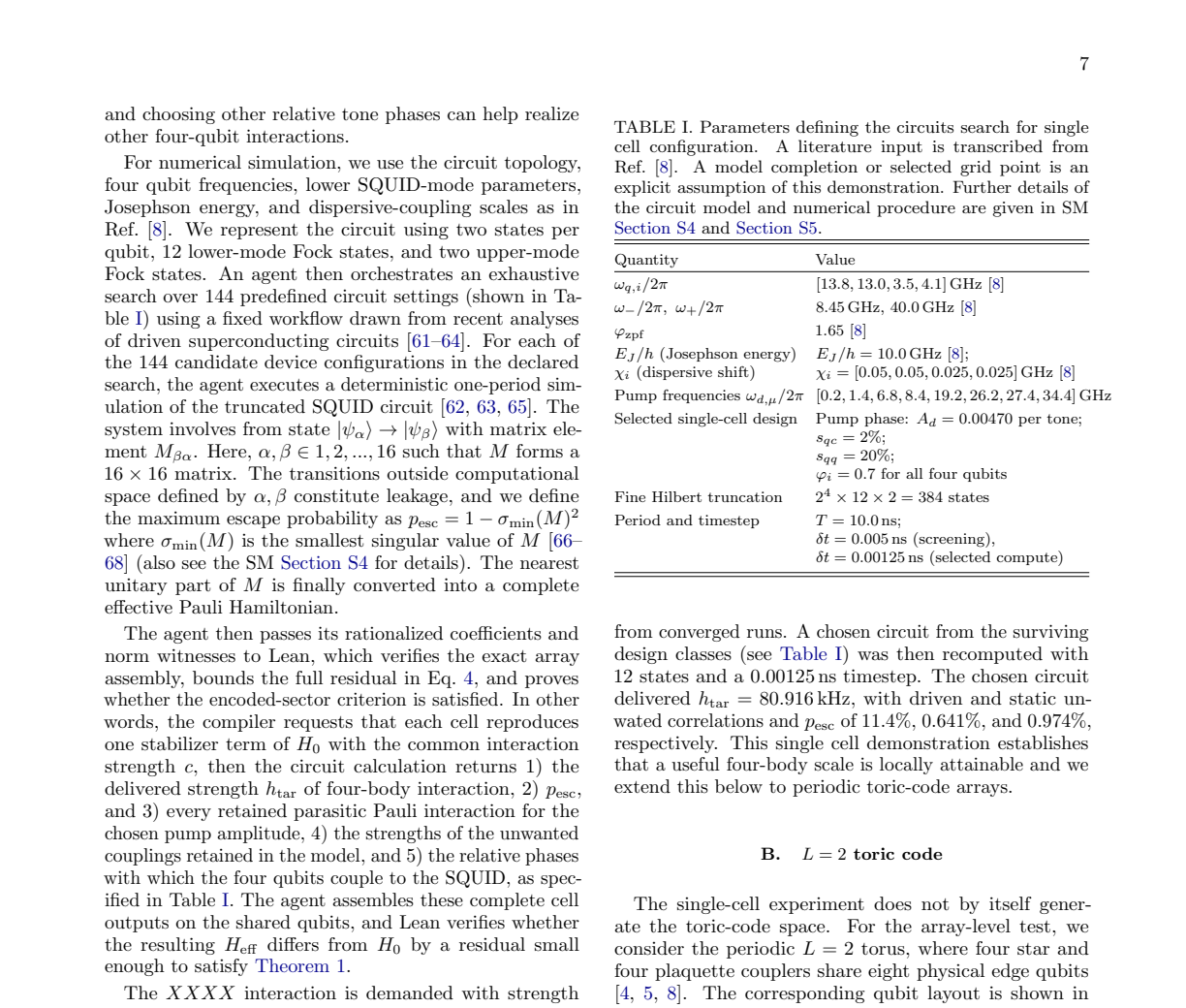
We introduce an AI-agent-assisted workflow that uses Lean to establish whether an effective device Hamiltonian retains the intended low-energy subspace of the target many-body Hamiltonian. We demonstrate this approach with topological quantum error correction (QEC), providing, to our knowledge, the first Lean-verified pipeline connecting a code space to low-energy states of a device model. Starting from qubits and parity checks, the pipeline constructs the ideal Hamiltonian whose lowest energy states form the intended code space, and determines the excitation gap that protects that code space. It then tests if the device retains the required number of isolated low-energy states and quantifies how closely their subspace matches the intended code space. We compare three bounds on unwanted energy shifts obtained by: summing the interaction strengths, grouping the anticommuting Pauli interactions, and diagonalizing the Hamiltonian. Pauli grouping yields a bound that is tighter than the conventional sum and closer to the diagonalization result, avoiding overly conservative compensation requirements. The workflow also identifies the strongest unwanted interactions and the qubits they affect, providing specific targets for improving device couplings and controls. We demonstrate our framework using an eight-qubit toric-code array on a superconducting device, where the same driven device generates both the required four-qubit interactions as well as unwanted dynamics. An AI agent identifies viable device parameters within a prescribed leakage budget, and Lean verifies four isolated low-energy states close to the ideal code space. Our workflow supports predictive hardware engineering for analog implementations of QEC codes.
from the abstract
Pith says
Machine review · deepseek-v4-flash · 3 Nov 2026 · what was read was not recorded · not checked by a person
It can be wrong. Challenge this review or reply to it.
Holds up, with conditions. A careful agentic-verification paper: the math is sound and honestly attributed, the Lean certificate is real but scoped to the declared two-cell model, and the missing files plus the model-to-device gap are what a referee should push on. This line is wrong
3 major objections · 5 minor
How often objections from reviews like this one are right: not yet measured
Not checked: figures, code, what the 84 references say.
The paper says, at Abstract; §V.B; SM S6.2 and S8
The review did not quote this passage.
A classifier read this sentence of the paper as acknowledging the concern (probability 0.80):
“The certificate is uniform over this guard and conditional on the connected-size-two model.”
Pith says: Objection 1 of 3 · major
The abstract states that 'Lean verifies four isolated low-energy states close to the ideal code space,' but the verified statement (SM S9, Eq. S35) is a theorem about the declared connected-size-two effective model H^(2)_eff, not about the full driven circuit Hamiltonian.
more of objection 1
Three-cell and higher connected processes and cross-cell virtual SQUID-mode excitations are excluded by an off-resonance expectation rather than by a bound (§V.B; SM S6.2), and Fock-truncation effects beyond the compared cutoffs enter only through the guard η (SM S8). The available margin, gcode/2 − r ≈ 187.2 kHz, is roughly an order of magnitude above the individual connected-pair correction norms (Table S3, up to 15.4 kHz), so the excluded next order is not automatically negligible. The authors acknowledge this boundary in SM S8 and S10, and the conclusion's phrase 'a declared circuit Hamiltonian' is appropriately scoped; the abstract and the Fig. 1c caption should carry the same qualifier wherever the verification is described as applying to the device.
The paper says, at §IV, after Eq. (5); SM S8, Eq. (S34)
The review did not quote this passage.
A classifier read this sentence of the paper as acknowledging the concern (probability 0.76):
“The extension of a residual bound by the numerical allowance assumes that the discrepancy is no larger than that allowance; its justification and limitations are described in Sec. S8.”
Pith says: Objection 2 of 3 · major
The main text says that 'r = rcert + η is a rigorous upper bound on the total mismatch.' This is exact for rcert, which is certified through the Cholesky-defect identity of SM S3.2 (Eq. S18), but not for η: Eq.
more of objection 2
(S34) assembles η = 2.2847 kHz from three finite-Fock, timestep, and rationalization comparisons that SM S8 describes as 'specified convergence tests, not an interval proof over every cutoff.' The eigenvalue-counting and projector conclusions of Theorem 1 therefore inherit the status of η, and the Lean-verified inequality 2r < gcode is an exact-arithmetic statement about 2(rcert + η) < gcode with η imported as a declared allowance. The main text should separate the exact, Lean-verified portion of the bound from the allowance portion so that the rigorous certificate's boundary is visible without consulting the SM.
The paper says, at SM S4, Eq. (S25); §V.A
The review did not quote this passage.
Pith says: Objection 3 of 3 · major
The reduction from the one-period propagator to Heff separates the nonunitary leakage component: M is the compression of U(T) onto the 16-dimensional dressed manifold, pesc = 1 − σmin(M)² is reported as a budget, and the polar unitary Q = AB† supplies the coherent part from which the effective Hamiltonian is extracted.
more of objection 3
Leakage therefore never enters R, and Theorem 1 has no mechanism to account for it; the certified four-state sector is that of the projected unitary dynamics, not of the open device. This matters concretely because the selected single cell has pesc = 0.974%, only 0.026 percentage points below the declared 1% ceiling (§V.A, Eq. S30). The authors acknowledge that the 1% cutoff is 'a declared engineering budget, not a universal fault-tolerance threshold,' but the main text should state explicitly that the certificate covers only the unitary part of the compressed dynamics.
5 minor objections
The paper says, at §I, §II, §III, §V
Pith says: minor objection 1 of 5
Typos: 'perfomring' (end of §I), 'if the the code space' (§II), 'anticommuntation-group' (§III), 'unwated' and 'anticommunitng' (§V.A, §V.B).
The paper says, at Fig. 2d caption
Pith says: minor objection 2 of 5
The caption's 'evaluating bounds in Eq. 7 and Eq. 2' appears to intend Eq. 8, the anticommuting-group bound of Theorem 2; Eq. 2 defines H0(L) and is not a residual bound.
show 3 more
The paper says, at Reference [39]
Pith says: minor objection 3 of 5
The entry 'An introduction to topological quantum codes, arXiv preprint arXiv:1311.0277 (2013)' omits the author names; this is a well-known review and should be cited completely.
The paper says, at §V.B and SM S6.1
Pith says: minor objection 4 of 5
Since c is set, after the search, to the minimum delivered check strength (SM S6.1, Eq. S31), the demonstrated certificate validates a target tuned to the simulated device; the paper notes that c can be user-specified, but the 'predictive hardware engineering' claim would be more strongly supported by a run with c fixed a priori.
The paper says, at §VI Conclusion
Pith says: minor objection 5 of 5
'Implementing a L = 2 toric code on a device with driven-SQUID couplers' reads as a fabricated-device statement; since the demonstration uses simulated circuit data (as the paper later acknowledges), the sentence should say 'on a simulated device model.'
What would settle it
At the selected L=2 operating point, compute the connected three-cell corrections C_jkl = H_jkl - sum_i H_i - sum_pairs C_jk for all connected triples, using the same solver but without projecting the shared SQUID modes to vacuum, at the fine Fock resolution and timestep. Reassemble R' = R^(2) + sum C_jkl, rerun the exact dense witness and the Lean certificate, and test whether 2(r' + eta') < gcode still holds and whether the low band still contains exactly four states. If the three-cell/cross-cell addition pushes the certified residual above gcode/2 - r, the headline certificate does not cover the simulated eight-qubit array; if it remains below with margin, the model-boundary concern is quantitatively retired.
from the skeptic's reading
How the review went
4 readings by deepseek-v4-flash · 3 Nov 2026
- Reader holds up, with conditions
- Skeptic agrees
- Editor wrote the verdict above
- Referee minor revision: 3 major objections, 5 minor
Not run on this paper: the simulated authors' defence.
Pith did not check this review's objections against the paper.
The review in full
The review in brief, machine-written
Two things to know up front. The math and verification discipline are genuinely solid: Theorem 1 is a standard finite-dimensional perturbation bound, correctly labeled as not new; Theorem 2 is the known anticommuting-Pauli identity, re-derived cleanly and applied to a new setting (residual certification for QEC device Hamiltonians); and the exact-rational Lean checking is the right way to turn a floating-point residual inventory into a certificate. And the certificate is exactly as scoped as the authors say it is—it is a theorem about the connected-size-two effective model, and the link from that model to the simulated eight-qubit array is the one load-bearing claim that is argued rather than bounded.
What is actually new is the assembly. The individual ingredients are published, and the authors say so. The pipeline—code specification to declared circuit model to Lean-checked spectral certificate to residual anatomy—is a reusable template, and the anticommuting grouping bound is a real practical gain over coefficient-sum bounds: 476.8 kHz fails, 248.6 kHz passes, 144.3 kHz for the dense witness. That comparison alone justifies the paper. The residual breakdown (dominant ZZ at 27.841 kHz, two-qubit aggregate mass at 170.75 kHz) makes it a genuinely useful hardware diagnostic.
Soft spots, in proportion. First, the Lean files and numerical ledger are promised, not available. For a paper whose entire claim is verification, that is a real gap; nobody can currently re-run the central artifact. Second, the certificate does not reach the device: three-cell and higher processes and cross-cell SQUID-mode excitations sit outside the bound, supported only by an off-resonance argument. The authors state this plainly (SM S8: conditional on the connected-size-two model; SM S10: Lean does not establish the accuracy of the physical model), so this is not an inconsistency—it is the declared boundary, and the referee's job is to judge whether the physical argument is adequate. The roughly 187 kHz margin is comfortable at order two but does not by itself make order three negligible. Third, the numerical guard eta = 2.2847 kHz comes from convergence tests the authors explicitly describe as not interval proofs, so the rigor of the headline bound stops at an estimate. All three are disclosed, which is more than most papers in this genre manage.
I checked the numbers I can check: r = 142 + 2.2847 = 144.285 kHz, gcode/2 = 331.483 kHz, and the bound hierarchy is internally consistent. Choosing c as the minimum delivered check strength is conservative, not self-serving; nothing is fitted to force the certificate.
This paper deserves a serious referee. The honest scoping and the verification discipline put it above the usual agentic-formalization output. The referee should demand the Lean files and press hard on the model-to-device step. If those hold up, this is a useful template for the field.
The strongest objection
The central numerical statement (SM S9, Eq. S35) is a theorem about H^(2)_eff, the effective Hamiltonian built from isolated cells plus connected two-cell corrections and projected onto the dressed four-qubit manifold. It is not a theorem about the full driven circuit Hamiltonian. Three places where this matters are acknowledged by the authors but remain unenclosed. First, three-cell and higher connected processes and cross-cell virtual SQUID-mode excitations are excluded on an off-resonance expectation, not by a bound (Section V.B; SM S8). Second, the guard eta = 2.2847 kHz is assembled from finite-Fock, timestep, and rationalization comparisons that the authors explicitly describe as specified convergence tests, not interval proofs over every cutoff (SM S8). Third, the passage from the one-period propagator to Heff uses a polar/unitary extraction that separates out the nonunitary leakage component, so leakage enters only as a declared budget (pesc) rather than as part of R (SM S4). Theorem 1 has no mechanism to reach across these gaps: it bounds perturbations of H0 within the space on which R is defined, and the machine-checked eigenvalue counting and projector bound apply to that space. The margin available before the certificate fails is gcode/2 - r approximately 187.2 kHz, while the connected-pair corrections already contribute norms up to about 15 kHz, so the next order is not automatically negligible relative to that margin. The authors state the boundary themselves (SM S8: 'conditional on the connected-size-two model'; SM S10: 'Lean does not establish the accuracy of the physical model'), so this is not an internal inconsistency; it is the load-bearing unproved link between the certified model and the simulated device claim.
The reader's weakest assumption identifies exactly the point on which the central claim rests: the certificate is conditional on the connected-size-two circuit model, and the numerical guard is not an interval proof over truncation. I agree with that assessment. Within the declared model, the mathematics is sound: Theorem 1 is a standard perturbation bound correctly stated and proved in SM S2, Theorem 2 is a correct anticommuting-Paul identity proved in SM S3, and the reported numbers are internally consistent. The exact rational verification strategy for the dense witness is credible, and the paper's disclosure of the model boundary and the non-rigorous character of the convergence guard is unusually explicit. The remaining issue is not formal correctness but scope: the four certified low-energy states are low-energy states of H^(2)_eff, and the assertion that this object captures the relevant low-energy sector of the simulated eight-qubit driven-SQUID array is supported by physical argument and convergence checks, not by a bound. Because the authors themselves frame the result as conditional on the declared model, the reader's CONDITIONAL verdict is appropriate, and my stress-test does not move it.
The referee's report
If the claims hold, the paper's main contribution is a reusable, machine-checked template connecting a code-space specification to a declared device model, including, to the authors' knowledge, the first application of anticommuting-Pauli grouping to QEC device residuals. The formal verification is a genuine strength: Theorem 1 is proved self-contained in SM S2, Theorem 2 is algebraically verified and Lean-checked, and the dense-matrix witness (SM S3.2) avoids trusting floating-point factorizations via an exact rational defect check. The paper is also commendably explicit about its trust boundary: SM S8 states that η is an allowance from specified convergence tests rather than an interval proof, and SM S10 states that Lean does not certify the physical model or a fabricated device. The residual anatomy (Fig. 2d,e) provides concrete, actionable diagnostics for hardware improvement. The main reservation is the scope of the headline claim, a framing issue rather than a mathematical error; the in-text mathematics checks out.
Pith's reading of the paper (a machine's summary, not the authors')
This paper tries to establish a practical answer to a hard question: when a quantum device is driven to emulate a topological error-correcting code, how can you be sure the device actually realizes the code's protected subspace? It builds an end-to-end, AI-agent-orchestrated workflow that constructs the ideal toric-code Hamiltonian from qubits and parity checks, simulates a candidate superconducting circuit, and uses the Lean proof assistant to verify the mathematical conditions under which the simulated device provably retains the code's four low-energy states. Applied to an eight-qubit $L = 2$ toric-code array with driven SQUID couplers, the pipeline verifies a residual bound of $r = 144.285$ kHz against an ideal gap of $g_{\mathrm{code}} = 662.966$ kHz, certifying exactly four eigenvalues below half the gap and a proved distance of at most 0.279 from the ideal code space (direct diagonalization finds 0.054). The demonstration hinges on a residual-norm bound that groups anticommuting Pauli interactions, giving a certificate tighter than the conventional coefficient-sum bound and close to exact diagonalization, so designs are not rejected or over-compensated merely because the naive bound is loose. If it works, the payoff is predictive hardware engineering: search device parameters, get a machine-checked yes or no on whether the encoded sector survives.
What carries the argument. The load-bearing object is the residual operator $R = H_{\mathrm{eff}} - U H_0 U^\dagger$, everything the device does beyond the rotated ideal code Hamiltonian. Three pieces carry the argument. Theorem 1 (finite encoded-sector criterion), a standard spectral-perturbation estimate formalized in Lean, converts a norm bound $r$ on $R$ into a certificate of exactly $m$ eigenvalues below $g_{\mathrm{code}}/2$, spectral separation at least $g_{\mathrm{code}} - 2r$, and projector distance $\lVert P_{\mathrm{low}} - U P_0 U^\dagger \rVert \leq r/(g_{\mathrm{code}} - r)$. Theorem 2 (commutation-aware Pauli bound) is the piece that makes the certificate pass: the residual's Pauli channels are partitioned into groups of pairwise anticommuting operators, and because anticommuting channels cannot reinforce one another on any common state, each group's norm is exactly the quadrature sum $\sqrt{\sum_a r_a^2}$; Lean verifies that the partition covers every one of the 8,561 channels and that every claimed anticommutator vanishes. The tightest route builds the full $256 \times 256$ residual matrix and proves $r_{\mathrm{cert}}^2 I - R^2 \succeq 0$ by exact rational verification of a proposed factorization, so the floating-point eigensolver is never trusted.
Core claim. The central claim is that analog compilation of a topological QEC code can be certified end to end, to the authors' knowledge for the first time: the pipeline starts from the cell-complex data of the $L = 2$ toric code, writes down the stabilizer Hamiltonian whose four-dimensional ground space is the code space with gap $g_{\mathrm{code}} = 4c$, simulates the declared driven dc-SQUID device at a chosen parameter setting, and expands the effective Hamiltonian into 8,561 residual Pauli channels compared with the eight requested checks. It then applies a formalized spectral criterion (Theorem 1): if a rigorous bound $r$ on the residual satisfies $2r < g_{\mathrm{code}}$, the device has exactly four eigenvalues below $g_{\mathrm{code}}/2$, a separation of at least $g_{\mathrm{code}} - 2r$ from the rest, and a low-energy subspace within operator distance $r/(g_{\mathrm{code}} - r)$ of the rotated ideal code space. Theorem 1 is itself a standard perturbation fact; the contribution is its Lean formalization together with the tighter residual bound that makes it applicable: the conventional coefficient-sum bound of 476.8 kHz fails, the anticommuting-Pauli bound of 248.6 kHz passes, and an exact dense-matrix witness with a numerical guard gives the certified 144.285 kHz, with Lean checking $2 \times 144.285 < 662.966$ kHz. The paper thus establishes, conditional on the declared connected-size-two circuit model, that the simulated array retains exactly four isolated low-energy states close to the toric-code space, and identifies the dominant unwanted coupling (a 27.841 kHz ZZ interaction on qubits 1 and 3) as a concrete hardware target.
The premise it rests on. The load-bearing premise is that the declared circuit model (connected effects of at most two couplers, with three-cell and higher processes and cross-cell virtual SQUID-mode excitations excluded as off-resonant, and a 2.285 kHz numerical guard built from three specified convergence tests rather than an interval proof) captures the interactions that determine the device's true low-energy sector; if those omitted processes contribute more than the roughly 374 kHz margin, the four certified states need not be the sector of the real device.
If the paper is right (Pith's inferences, not the authors')
Any declared circuit model for any code family (surface codes, color codes) can be fed to the same pipeline: build $H_0$, simulate the device, resolve the residual into Pauli channels, and receive a machine-checked verdict on whether the isolated low-energy sector survives.
Because the Theorem 2 bound is evaluated from the Pauli inventory without forming the $2^n \times 2^n$ matrix, the verified route stays practical as arrays grow whenever a bounded-degree model is retained, where the dense witness would cost $O(b\,4^n)$ bits.
The same certificate can act as a post-fabrication acceptance test: experimental spectroscopy or Hamiltonian-learning data replace the simulated coefficients and the Lean proofs are reapplied unchanged.
The residual anatomy turns the workflow into a hardware diagnostic, naming the couplings to suppress (here a 27.841 kHz ZZ term on qubits 1 and 3 and several one-qubit Y fields) rather than calling for a single global compensation.
Device settings that satisfy the spectral criterion under the anticommuting bound would be rejected or over-tuned if judged by the coefficient-sum bound alone, so the new bound changes which pump and coupler settings count as workable.
A natural stress test the paper's own boundary suggests: computing the three-cell connected correction at the selected point would show how much of the 374.397 kHz certified margin is consumed by exactly the terms the model excludes, turning the declared truncation assumption into a measured quantity.
Because the anticommuting-group bound works directly from the Pauli inventory with no dense matrix, the same Theorem 2 machinery could certify other analog simulators (Rydberg arrays, flux-qubit lattices) wherever residual interactions admit a Pauli expansion and the coefficient-sum bound is known to be loose.
The distance between the proved subspace bound (0.279) and the numerically observed value (0.054) suggests a structure-sensitive refinement of Theorem 1 (exploiting symmetries, locality, or stabilizer commutation) could certify larger arrays or tighter leakage budgets from the same residual evidence.
A further extension the authors leave implicit is to treat agreement across competing circuit models as the acceptance criterion: run the same workflow with and without the three-cell terms and only trust a design whose certificate holds under both.
Check this review
Pith stored no record of this review's passes and took no fingerprint of it. Reviews made by code from 13 Nov 2026 on carry both.
How often reviews like this one are right
Reviews like this one: written by deepseek-v4-flash, where what was read was not recorded.
How often objections from reviews like this one are right: not yet measured
Reviews by people
This review was written by a machine. No person has reviewed this paper on Pith yet. A scientist listed on Pith can review it for a fee, and their review is published here whatever it concludes.
The paper
Abstract
Mapping a prescribed many-body Hamiltonian to a particular quantum hardware is generally an approximate process, resulting in both intended and unwanted quantum dynamics. We introduce an AI-agent-assisted workflow that uses Lean to establish whether an effective device Hamiltonian retains the intended low-energy subspace of the target many-body Hamiltonian. We demonstrate this approach with topological quantum error correction (QEC), providing, to our knowledge, the first Lean-verified pipeline connecting a code space to low-energy states of a device model. Starting from qubits and parity checks, the pipeline constructs the ideal Hamiltonian whose lowest energy states form the intended code space, and determines the excitation gap that protects that code space. It then tests if the device retains the required number of isolated low-energy states and quantifies how closely their subspace matches the intended code space. We compare three bounds on unwanted energy shifts obtained by: summing the interaction strengths, grouping the anticommuting Pauli interactions, and diagonalizing the Hamiltonian. Pauli grouping yields a bound that is tighter than the conventional sum and closer to the diagonalization result, avoiding overly conservative compensation requirements. The workflow also identifies the strongest unwanted interactions and the qubits they affect, providing specific targets for improving device couplings and controls. We demonstrate our framework using an eight-qubit toric-code array on a superconducting device, where the same driven device generates both the required four-qubit interactions as well as unwanted dynamics. An AI agent identifies viable device parameters within a prescribed leakage budget, and Lean verifies four isolated low-energy states close to the ideal code space. Our workflow supports predictive hardware engineering for analog implementations of QEC codes.
The paper's own sentences, arranged, kept beside the review and separate from it. Each label is drawn from a closed vocabulary; the number beside it is the probability the classifier gave that label. No sentence in this record was written by a model.
abstract compiled · 2026-11-04
The authors' main claim, as the classifier picked it out 0.82
“Our workflow supports predictive hardware engineering for analog implementations of QEC codes.”
How the main claim is stated: asserted 0.91
What the abstract itself states, as probabilities: claims first 0.91 · states limitation 0.38 · human participants 0.02 · controlled comparison 0.18 · randomized assignment 0.01 · states quantitative result 0.53 · compares with prior results 0.67 · mentions code or data availability 0.04
The abstract, sentence by sentence
This table labels the abstract only (arXiv listing abstract v1). The number is the probability the classifier gave the label.
| Sentence | Role | The authors' own work | States the main conclusion | Strength |
|---|---|---|---|---|
| Mapping a prescribed many-body Hamiltonian to a particular quantum hardware is generally an approximate process, resulting in both intended and unwanted quantum dynamics. | background 1.00 | 0.06 | 0.03 | asserted 0.98 |
| We introduce an AI-agent-assisted workflow that uses Lean to establish whether an effective device Hamiltonian retains the intended low-energy subspace of the target many-body Hamiltonian. | contribution 0.78 | 0.93 | 0.14 | asserted 1.00 |
| We demonstrate this approach with topological quantum error correction (QEC), providing, to our knowledge, the first Lean-verified pipeline connecting a code space to low-energy states of a device model. | contribution 0.94 | 0.96 | 0.39 | asserted 1.00 |
| Starting from qubits and parity checks, the pipeline constructs the ideal Hamiltonian whose lowest energy states form the intended code space, and determines the excitation gap that protects that code space. | method 1.00 | 0.89 | 0.07 | asserted 1.00 |
| It then tests if the device retains the required number of isolated low-energy states and quantifies how closely their subspace matches the intended code space. | method 1.00 | 0.91 | 0.06 | asserted 1.00 |
| We compare three bounds on unwanted energy shifts obtained by: summing the interaction strengths, grouping the anticommuting Pauli interactions, and diagonalizing the Hamiltonian. | method 0.98 | 0.94 | 0.05 | asserted 0.97 |
| Pauli grouping yields a bound that is tighter than the conventional sum and closer to the diagonalization result, avoiding overly conservative compensation requirements. | result 0.90 | 0.92 | 0.15 | asserted 1.00 |
| The workflow also identifies the strongest unwanted interactions and the qubits they affect, providing specific targets for improving device couplings and controls. | contribution 0.42 | 0.92 | 0.09 | asserted 1.00 |
| We demonstrate our framework using an eight-qubit toric-code array on a superconducting device, where the same driven device generates both the required four-qubit interactions as well as unwanted dynamics. | method 0.64 | 0.95 | 0.07 | asserted 1.00 |
| An AI agent identifies viable device parameters within a prescribed leakage budget, and Lean verifies four isolated low-energy states close to the ideal code space. | result 0.81 | 0.96 | 0.21 | asserted 1.00 |
| Our workflow supports predictive hardware engineering for analog implementations of QEC codes. | interpretation 0.96 | 0.64 | 0.46 | asserted 0.91 |
What kind of paper the classifier reports this is: method or tool 1.00 · evidence from simulation or computation 0.51
What was examined, and what was not
Sources read
- arXiv listing abstract v1
Not examined
- full text
- figures and tables
- references and citing sentences
- relations to other papers
Levels run
- P abstract
Not run
- S sections
- T body sentences
- C citations
- R cross-paper relations
How the labels were made
Compiled by classifier-1.13.0 via TypeSafe API, question bank abstract-p1-20260923, 2026-11-04: 1 request, 8,316 input tokens.
Every quoted sentence on this record is the authors'. Every label is from Pith's closed vocabulary, with the probability shown beside it. This record as JSON
Figures (2)
Showing 1 of the paper's 2 figures. Figures are the authors', reproduced from the paper.
References (84)
- [1] I. M. Georgescu, S. Ashhab, and F. Nori, Quantum simu- lation, Rev. Mod. Phys.86, 153 (2014) on Pith
- [2] A. J. Daley, I. Bloch, C. Kokail, S. Flannigan, N. Pearson, M. Troyer, and P. Zoller, Practical quantum advantage in quantum simulation, Nature607, 667 (2022) on Pith
- [3] E. Altmanet al., Quantum simulators: Architectures and opportunities, PRX Quantum2, 017003 (2021) on Pith
- [4] A. Y. Kitaev, Fault-tolerant quantum computation by anyons, Annals of Physics303, 2 (2003) on Pith
- [5] E. Dennis, A. Kitaev, A. Landahl, and J. Preskill, Topolog- ical quantum memory, Journal of Mathematical Physics 43, 4452 (2002) on Pith
- [6] K. J. Satzinger, Y.-J. Liu, A. Smith,et al., Realizing topo- logically ordered states on a quantum processor, Science 374, 1237 (2021) on Pith
- [7] G. Semeghini, H. Levine, A. Keesling,et al., Probing topo- logical spin liquids on a programmable quantum simulator, Science374, 1242 (2021) on Pith
- [8] M. Sameti, A. Potoˇ cnik, D. E. Browne, A. Wallraff, and M. J. Hartmann, Superconducting quantum simulator for topological order and the toric code, Physical Review A 95, 042330 (2017) on Pith
- [9] S. Wilkinson and M. J. Hartmann, Superconducting quan- tum many-body circuits for quantum simulation and com- puting, Applied Physics Letters116, 230501 (2020) on Pith
- [10] T. Menke, F. H¨ ase, S. Gustavsson, A. J. Kerman, W. D. Oliver, and A. Aspuru-Guzik, Automated design of super- conducting circuits and its application to 4-local couplers, npj Quantum Information7, 49 (2021) on Pith
- [12] D. Hangleiter, M. Kliesch, M. Schwarz, and J. Eisert, Direct certification of a class of quantum simulations, Quantum Science and Technology2, 015004 (2017) on Pith
- [13] R. Shaffer, E. Megidish, J. Broz, W.-T. Chen, and H. H¨ affner, Practical verification protocols for analog quantum simulators, npj Quantum Information7, 46 (2021) on Pith
- [14] D. Nigg, M. M¨ uller, E. A. Martinez, P. Schindler, M. Hen- nrich, T. Monz, M. A. Martin-Delgado, and R. Blatt, Quantum computations on a topologically encoded qubit, Science345, 302 (2014) on Pith
- [15] D. Bluvstein, A. A. Geim, S. H. Li, S. J. Evered, J. P. Bonilla Ataides, G. Baranes, A. Gu, T. Manovitz, M. Xu, M. Kalinowski, S. Majidy, C. Kokail, N. Maskara, E. C. Trapp, L. M. Stewart, S. Hollerith, H. Zhou, M. J. Gullans, S. F. Yelin, M. Greiner, V. Vuleti´ c, M. Cain, an... on Pith
- [16] Google Quantum AI and Collaborators, Quantum error correction below the surface code threshold, Nature638, 920 (2025) on Pith
- [17] H.-N. Dai, B. Yang, A. Reingruber, H. Sun, X.-F. Xu, Y.-A. Chen, Z.-S. Yuan, and J.-W. Pan, Four-body ring- exchange interactions and anyonic statistics within a min- imal toric-code Hamiltonian, Nature Physics13, 1195 (2017) on Pith
- [18] R. Verresen, M. D. Lukin, and A. Vishwanath, Prediction of toric code topological order from Rydberg blockade, Physical Review X11, 031005 (2021) on Pith
- [19] A. R. Calderbank and P. W. Shor, Good quantum error- correcting codes exist, Physical Review A54, 1098 (1996) on Pith
- [20] A. M. Steane, Error correcting quantum codes, Proceed- ings of the Royal Society A452, 2551 (1996) on Pith
- [21] M. F. Gely and G. A. Steele, QuCAT: Quantum circuit analyzer tool in Python, New Journal of Physics22, 013025 (2020) on Pith
show 64 more
- [23] E. Bairey, I. Arad, and N. H. Lindner, Learning a local hamiltonian from local measurements, Physical Review Letters122, 020504 (2019) on Pith
- [24] B. Breen, M. Del Tredici, J. McCarran, J. Aspuru Mi- jares, W. W. Yin, K. Sulimany, J. M. Taylor, F. H. L. Koppens, and D. Englund, Ax-Prover: A deep reasoning agentic framework for theorem proving in mathematics and quantum physics (2025), arXiv:2510.12787 [cs.AI] on PithPith's reviewarXiv
- [25] Y. Ren, J. Li, and Y. Qi, MerLean: An agentic framework for autoformalization in quantum computation (2026), arXiv:2602.16554 [cs.LO] on PitharXiv
- [26] S. Lu, R. Deng, D. Zhu, and Z. Ji, Long-horizon auto- formalization of a core theorem underlying MIP* = RE (2026), arXiv:2609.19814 [quant-ph] on PithPith's reviewarXiv
- [27] A. Meiburg, L. A. Lessa, and R. R. Soldati, A formaliza- tion of the generalized quantum Stein’s lemma in Lean (2025), arXiv:2510.08672 [quant-ph] on PitharXiv
- [28] K. Kasauraet al., Lean-Quantum: Toward AI- assisted formalization of quantum information (2026), arXiv:2607.05492 [quant-ph] on PithPith's reviewarXiv
- [29] C. Zhu, Z. Tang, G. Zhen, Y. Cao, Y. Zhao, R. Chen, X. Zhao, L. Zhang, and X. Wang, Lean-QIT: Towards a formal infrastructure for quantum information theory (2026), arXiv:2607.09632 [quant-ph] on PithPith's reviewarXiv
- [30] L. Zhang, Y. Zhao, H. Yao, and X. Wang, Building Shor’s algorithm in Lean: An agentic formalization of quantum attacks on RSA-2048 and P-256 (2026), arXiv:2607.14082 [quant-ph] on PithPith's reviewarXiv
- [31] U. Kol, M. Ben-Shahar, K. Sulimany, and D. Englund, A machine-verified proof of a quantum-optimization conjec- ture (2026), arXiv:2606.29687 [quant-ph] on PithPith's reviewarXiv
- [32] M. Ehatamm, Y. Lee, X. Wu, and R. Tao, End-to- end formalization of quantum error correction (2026), arXiv:2605.16523 [quant-ph]. 11 on PithPith's reviewarXiv
- [33] W. W. Yin, J. M. Taylor, D. R. Englund, and F. H. L. Koppens, AxQM: A textbook-scale benchmark for formal proof synthesis in a library of finite-dimensional quantum mechanics (2026), arXiv:2609.05157 [quant-ph] on PithPith's reviewarXiv
- [34] L. Li, F. An, F. Zahariev, Z. X. Chong, A. Sabry, and M. S. Gordon, A verified compiler for quantum simulation (2025), arXiv:2509.18583 [cs.PL] on PitharXiv
- [35] A. Gu, A. H. Kemeny, S. F. Yelin, and M. D. Lukin, Discovering state-of-the-art quantum circuits with large language models (2026), arXiv:2610.22367 [quant-ph] on PithPith's reviewarXiv
- [36] A. F. Izmaylov, T.-C. Yen, R. A. Lang, and V. Vertelet- skyi, Unitary partitioning approach to the measurement problem in the variational quantum eigensolver method, Journal of Chemical Theory and Computation16, 190 (2020) on Pith
- [37] A. Ralli, P. J. Love, A. Tranter, and P. V. Coveney, Imple- mentation of measurement reduction for the variational quantum eigensolver, Physical Review Research3, 033195 (2021) on Pith
- [38] B. M. Terhal, Quantum error correction for quantum memories, Reviews of Modern Physics87, 307 (2015) on Pith
- [39] An introduction to topological quantum codes, arXiv preprint arXiv:1311.0277 (2013) on PithPith's reviewarXiv
- [40] X. Yang, R. Buechele, and N. Trivedi, Detection of anyon braiding through pump–probe spectroscopy, Proceedings of the National Academy of Sciences122, e2511917122 (2025) on Pith
- [41] A. Arora, E. M. Been, W. Munizzi, J. Wang, T. L. Patti, A. Chou, and P. Narang, Multi-purpose quan- tum laboratories from superconducting circuits (2026), arXiv:2608.17020 [quant-ph] on PithPith's reviewarXiv
- [42] T. Menke, W. P. Banner, T. R. Bergamaschi, A. Di Paolo, A. Veps¨ al¨ ainen, S. J. Weber, R. Winik, A. Melville, B. M. Niedzielski, D. Rosenberg, K. Serniak, M. E. Schwartz, J. L. Yoder, A. Aspuru-Guzik, S. Gustavsson, J. A. Grover, C. F. Hirjibehedin, A. J. Kerman, and W. D. O... on Pith
- [43] S. Puri, C. K. Andersen, A. L. Grimsmo, and A. Blais, Quantum annealing with all-to-all connected nonlinear oscillators, Nature Communications8, 15785 (2017) on Pith
- [44] R. Miyazaki and T. Yamamoto, Four-body coupler for superconducting qubits based on Josephson parametric oscillators, Physical Review A111, 062612 (2025) on Pith
- [45] L. de Moura and S. Ullrich, The Lean 4 theorem prover and programming language, inAutomated Deduction – CADE 28(Springer, 2021) pp. 625–635 on Pith
- [46] N. MacCallum and B. Fioca, Codex prompting guide, OpenAI Cookbook (2026), accessed 13 October 2026 on Pith
- [47] OpenAI, GPT-5: Model documentation, OpenAI API Documentation, accessed 13 October 2026 on Pith
- [48] Anthropic, Claude Opus 5: Model documentation, Claude Platform Documentation, accessed 13 October 2026 on Pith
- [49] R. Bhatia,Matrix Analysis, Graduate Texts in Mathe- matics, Vol. 169 (Springer, New York, 1997) on Pith
- [50] C. Davis and W. M. Kahan, The rotation of eigenvec- tors by a perturbation. iii, SIAM Journal on Numerical Analysis7, 1 (1970) on Pith
- [51] S. Bravyi, M. B. Hastings, and S. Michalakis, Topologi- cal quantum order: Stability under local perturbations, Journal of Mathematical Physics51, 093512 (2010) on Pith
- [52] E. Knill and R. Laflamme, Theory of quantum error- correcting codes, Physical Review A55, 900 (1997) on Pith
- [53] A. M. Childs, Y. Su, M. C. Tran, N. Wiebe, and S. Zhu, Theory of trotter error with commutator scaling, Physical Review X11, 011020 (2021) on Pith
- [54] I. Loaiza, A. Marefat Khah, N. Wiebe, and A. F. Izmaylov, Reducing molecular electronic hamiltonian simulation cost for linear combination of unitaries approaches, Quantum Science and Technology8, 035019 (2023) on Pith
- [55] B. Fuller, M. C. Tran, D. Lykov,et al., Improved quan- tum computation using operator backpropagation, npj Quantum Information12, 51 (2026) on Pith
- [56] R. Sarkar and E. van den Berg, On sets of maximally commuting and anticommuting Pauli operators, Research in the Mathematical Sciences8, 14 (2021) on Pith
- [57] S. M. Rump, Verification of positive definiteness, BIT Numerical Mathematics46, 433 (2006) on Pith
- [58] H. Peyrl and P. A. Parrilo, Computing sum of squares de- compositions with rational coefficients, Theoretical Com- puter Science409, 269 (2008) on Pith
- [59] M. Dostert, D. de Laat, and P. Moustrou, Exact semidef- inite programming bounds for packing problems, SIAM Journal on Optimization31, 1433 (2021) on Pith
- [60] A. Blais, A. L. Grimsmo, S. M. Girvin, and A. Wallraff, Circuit quantum electrodynamics, Reviews of Modern Physics93, 025005 (2021) on Pith
- [61] T. Rajabzadeh, Z. Wang, N. Lee, T. Makihara, Y. Guo, and A. H. Safavi-Naeini, Analysis of arbitrary supercon- ducting quantum circuits accompanied by a Python pack- age: SQcircuit, Quantum7, 1118 (2023) on Pith
- [62] X. Xiao, J. Venkatraman, R. G. Cortinas, S. Chowdhury, and M. H. Devoret, Diagrammatic method to compute the effective hamiltonian of a driven nonlinear oscillator, Physical Review Applied24, 044026 (2025) on Pith
- [63] W. Dai, S. Hazra, D. K. Weiss, P. D. Kurilovich, T. Con- nolly, H. K. Babla, S. Singh, V. R. Joshi, A. Z. Ding, P. D. Parakh, J. Venkatraman, X. Xiao, L. Frunzio, and M. H. Devoret, Characterization of drive-induced unwanted state transitions in superconducting circuits, Physi... on Pith
- [64] Y. Lu, T. Zhao, A. Vallieres, K. C. Smith, D. Weiss, X. You, Y. Zhang, S. Ganjam, A. Maiti, J. W. O. Garmon, S. Mundhada, Z. Huang, I. Mondragon-Shem, S. M. Girvin, J. Koch, and R. J. Schoelkopf, System- atic construction of time-dependent hamiltonians for microwave-driven jos... on Pith
- [65] F. Petiziol, M. Sameti, S. Carretta, S. Wimberger, and F. Mintert, Quantum simulation of three-body interac- tions in weakly driven quantum systems, Physical Review Letters126, 250504 (2021) on Pith
- [66] C. J. Wood and J. M. Gambetta, Quantification and characterization of leakage errors, Physical Review A97, 032306 (2018) on Pith
- [67] A. D. Paolo, A. L. Grimsmo, P. Groszkowski, J. Koch, and A. Blais, Control and coherence time enhancement of the 0–π qubit, New Journal of Physics21, 043002 (2019) on Pith
- [68] J. D. Teske, P. Cerfontaine, and H. Bluhm, Qopt: an experiment-oriented software package for qubit simulation and quantum optimal control, Physical Review Applied 17, 034036 (2022) on Pith
- [69] M. Kumph, J. Raftery, A. Finck, J. Blair, A. Carniol, S. Carnevale, G. A. Keefe, V. Arena, S. Hall, D. McKay, and G. Stehlik, Demonstration of RIP gates in a quan- tum processor with negligible transverse coupling (2024), arXiv:2406.11770 [quant-ph]. 12 on PithPith's reviewarXiv
- [70] H. Zhang, C. Ding, D. K. Weiss, Z. Huang, Y. Ma, C. Guinn, S. Sussman, S. P. Chitta, D. Chen, A. A. Houck, J. Koch, and D. I. Schuster, Tunable inductive coupler for high-fidelity gates between fluxonium qubits, PRX Quantum5, 020326 (2024) on Pith
- [71] S. Shanto, A. Kuo, C. Miyamoto, H. Zhang, V. Maurya, E. Vlachos, M. Hecht, C. W. Shum, and E. Levenson-Falk, Squadds: A validated design database and simulation workflow for superconducting qubit design, Quantum8, 1465 (2024) on Pith
- [72] M. M¨ uhlhauser and K. P. Schmidt, Linked cluster expan- sions via hypergraph decompositions, Physical Review E 105, 064110 (2022) on Pith
- [73] A. M. Eriksson, L. J. Splitthoff, H. V. Upadhyay, P. Cam- pana, O. Lundstr¨ om, N. P. Narendiran, K. Helambe, L. Andersson, and S. Gasparinetti, QDesignOptimizer based on ANMod: An automated, physics-guided, multi- parameter design optimizer for superconducting quantum devices... on Pith
- [74] Y. Peng, J. Young, P. Liu, and X. Wu, SimuQ: A frame- work for programming quantum hamiltonian simulation with analog compilation, Proceedings of the ACM on Programming Languages8, 2425 (2024) on Pith
- [75] D. Hangleiter, I. Roth, J. Fuksa,et al., Robustly learning the hamiltonian dynamics of a superconducting quantum processor, Nature Communications15, 9595 (2024) on Pith
- [76] Y. Li, N. O’Dea, and V. Khemani, Perturbative stability and error-correction thresholds of quantum codes, PRX Quantum6, 010327 (2025) on Pith
- [77] J. Choi, H. Zhou, H. S. Knowles, R. Landig, S. Choi, and M. D. Lukin, Robust dynamic hamiltonian engineering of many-body spin systems, Physical Review X10, 031002 (2020) on Pith
- [78] M. T. P. Nguyen, M. Rimbach-Russ, and S. Bosco, Color it, code it, cancel it: k-local dynamical decoupling from classical additive codes, PRX Quantum7, 020338 (2026) on Pith
- [79] K. C. Young, M. Sarovar, and R. Blume-Kohout, Error suppression and error correction in adiabatic quantum computation: Techniques and challenges, Physical Review X3, 041013 (2013) on Pith
- [80] Y.-C. Zheng and T. A. Brun, Fault-tolerant holonomic quantum computation in surface codes, Physical Review A91, 022302 (2015) on Pith
- [81] T. Kato,Perturbation Theory for Linear Operators, 2nd ed., Classics in Mathematics (Springer, Berlin, Heidelberg, 1995) on Pith
- [82] C. B´ eny and O. Oreshkov, General conditions for approxi- mate quantum error correction and near-optimal recovery channels, Physical Review Letters104, 120501 (2010) on Pith
- [83] L. B. Nguyen, Y. Kim, A. Hashim, N. Goss, B. Marinelli, B. Bhandari, D. Das, R. K. Naik, J. M. Kreikebaum, A. N. Jordan, D. I. Santiago, and I. Siddiqi, Programmable Heisenberg interactions between Floquet qubits, Nature Physics20, 240 (2024) on Pith
- [84] C. Ding, M. Di Federico, M. Hatridge, A. Houck, S. Leger, J. Martinez, C. Miao, D. I. Schuster, L. Stefanazzi, C. Stoughton, S. Sussman, K. Treptow, S. Uemura, N. Wilcer, H. Zhang, C. Zhou, and G. Cancelo, Experi- mental advances with the QICK (Quantum Instrumenta- tion Contro... on Pith
- [85] E. Hyypp¨ a, A. Veps¨ al¨ ainen, M. Papiˇ c, C. F. Chan, S. Inel, A. Landra, W. Liu, J. Luus, F. Marxer, C. Ockeloen- Korppi, S. Orbell, B. Tarasinski, and J. Heinsoo, Reducing leakage of single-qubit gates for superconducting quantum processors using analytical control pulse ... on Pith
- [86] D. Hangleiter, I. Roth, J. Fuksa, J. Eisert, and P. Roushan, Robustly learning the Hamiltonian dynamics of a super- conducting quantum processor, Nature Communications 15, 9595 (2024). 13 Supplemental Material This Supplemental Material gives the mathematical proofs, circuit-r... on Pith
Challenges and discussion
Disagree with the review, or know something it missed? Leave a comment, or challenge this review formally: a challenge becomes a permanent entry in this paper's record, and its decision is published here.
Come back by email
A short list of the week's newly reviewed papers. Nothing is sent until you confirm from your inbox, and every email has a link that stops it. No account.
No comments yet.
Sign in to comment