Optimization and Control · arXiv:2611.04807 v1 · submitted 3 Nov 2026 · 48 references
Asymptotic Optimality of cμ-Rule for LLM Inference Scheduling under Memory Constraint
The paper says
“Large language model (LLM) inference, the process by which a pre-trained model receives an input prompt and generates output tokens sequentially, has become increasingly important with the widespread deployment of LLM-based applications.”
more of the abstract
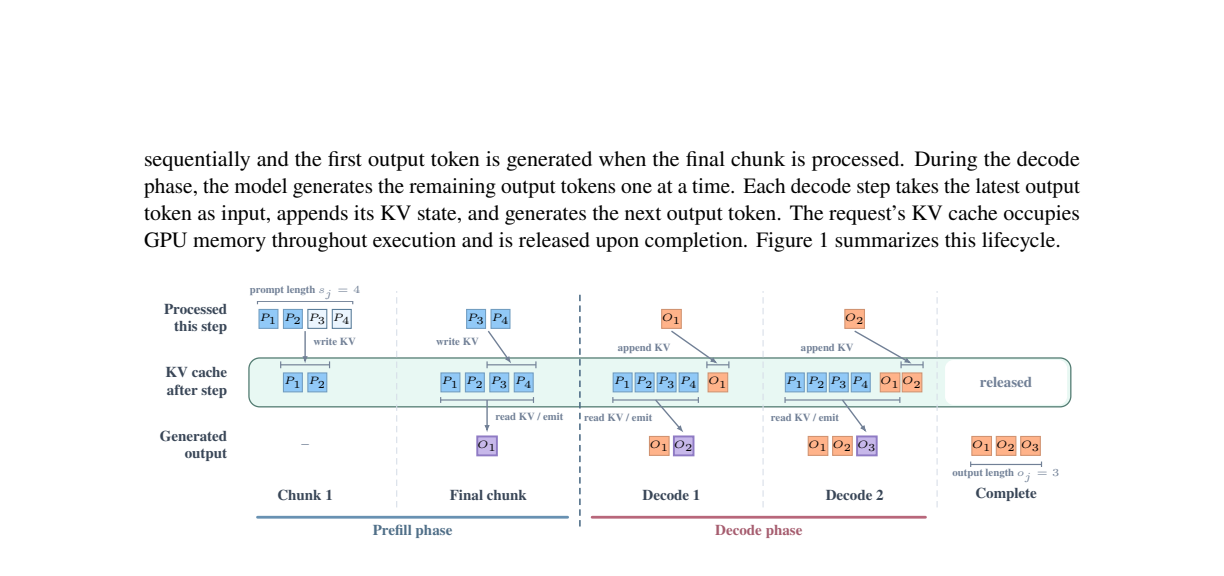
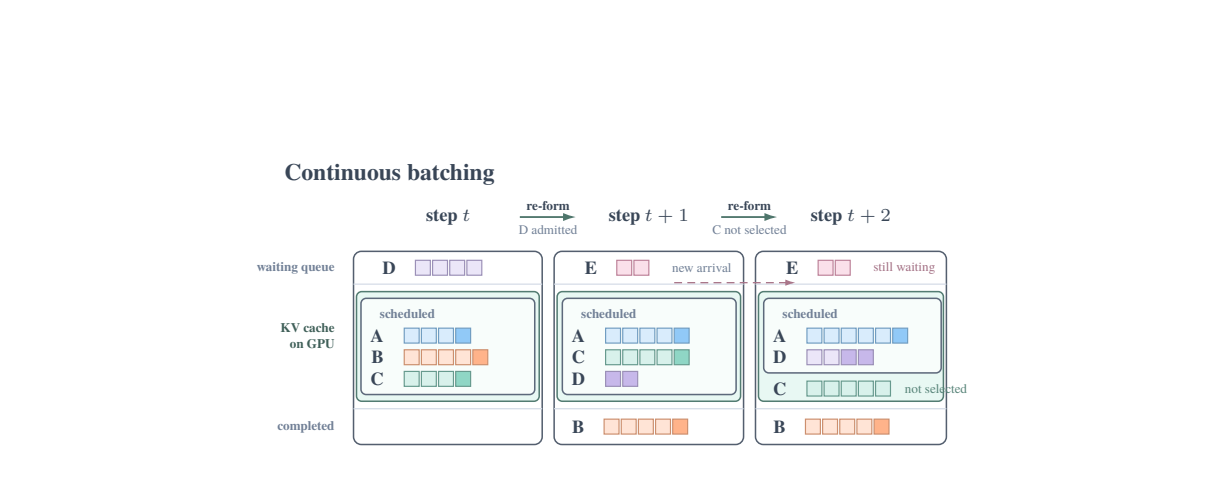
As inference workloads continue to scale, GPU memory has emerged as a critical bottleneck: the long input prompts and generation sequences common in agentic and reasoning workloads lead to substantial key-value (KV) cache usage. In this paper, we study the resulting online scheduling problem from a queueing perspective. Requests arrive stochastically with heterogeneous prompt and output lengths, undergo prefill and autoregressive decode, and compete for a finite KV-cache capacity. Unlike classical queueing models, the duration of a processing step depends on both prefill computation and KV-cache I/O, so service capacity is jointly determined by computation, memory access, and memory occupancy. We develop a fluid model that reduces the system to a multiclass single-server queue with effective service rates capturing computation, memory access, and memory capacity. This fluid analysis yields a cμ priority rule, where the effective service rate μ is jointly determined by computational speed, memory bandwidth, and memory capacity. We prove that this rule minimizes cumulative holding cost in the fluid model and, for a finite workload, also minimizes completion time and maximizes full-run output-token throughput. We then construct a feasible scheduling policy for the original finite system and prove that its scaled dynamics converge to the optimal fluid policy. Finally, experiments on a real LLM serving engine using an NVIDIA H800 show that practical implementations of the proposed priority rule substantially reduce average latency while maintaining high throughput relative to existing scheduling policies.
from the abstract
Pith says
Machine review · deepseek-v4-flash · 4 Nov 2026 · what was read was not recorded · not checked by a person
It can be wrong. Challenge this review or reply to it.
Holds up, with conditions. A serious queueing paper with complete proofs that cμ with memory-aware effective rates is optimal in a fluid model of LLM serving; the main open question is whether the linear step-time assumption covers the regime the optimal policy drives the hardware into. This line is wrong
3 major objections · 4 minor
How often objections from reviews like this one are right: not yet measured
Not checked: figures, code, what the 48 references say.
The paper says, at §2, Eq. (1); §4, Eq. (18)
The review did not quote this passage.
Pith says: Objection 1 of 3 · major
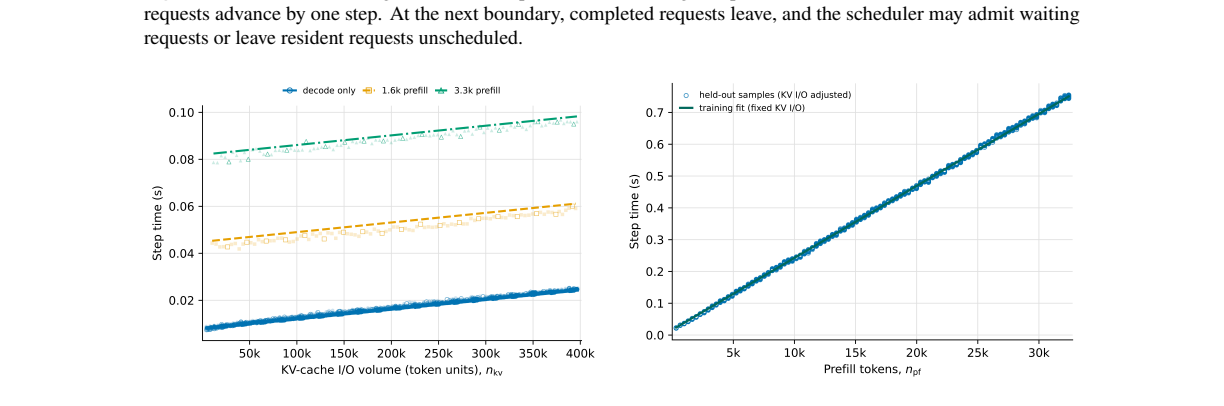
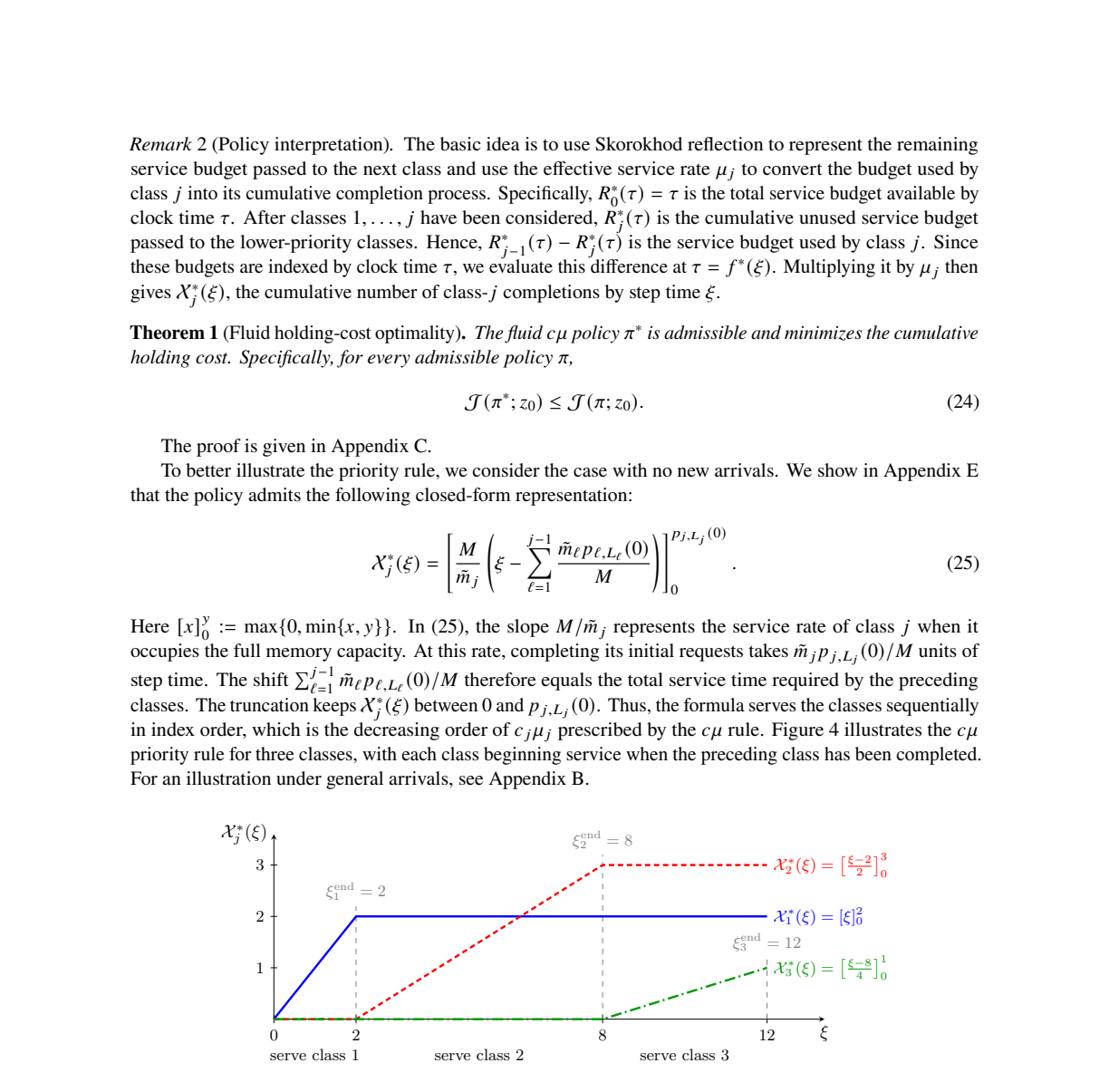
The exact linear step-time model in Eq. (1) is the load-bearing link between Theorems 1–3 and the H800 system. Table 1 reports an excellent overall fit, but the calibration strata are mixed-batch strata; the optimal fluid policy saturates the memory constraint and often serves a single class (Remark 2 and the no-arrival closed form (25)), and that regime is not shown to be covered by the fit.
more of objection 1
If real step time is nonlinear in KV-cache occupancy or batch composition in memory-saturated, single-class operation, the clock decomposition (16) and the effective service rate (18) fail, and the cμ ordering need not be the right ordering on the hardware. Please add a validation of Eq. (1) in the cμ operating regime, for example residual plots against KV-cache occupancy at capacity saturation, or explicitly restrict the optimality claims to the model rather than to the H800 system.
The paper says, at §5, Definition 5; Theorem 3
The review did not quote this passage.
Pith says: Objection 2 of 3 · major
The finite-scale policy and the prelimit model are fractional-request systems: Definition 5 allows y_rj(t) and ΔU_rj,L_j(t) to take noninteger values, and the abstract describes this as a policy for the original finite system. No rounding or integer-recovery argument is supplied, and because per-step admission counts are O(1), naive rounding errors could accumulate over O(r) steps and need not vanish in the fluid limit.
more of objection 2
Please either state clearly that Theorem 3 concerns the fractional prelimit model, or add an integerization argument that preserves the stated uniform convergence.
The paper says, at §6, Tables 3–4
The review did not quote this passage.
Pith says: Objection 3 of 3 · major
The experimental claim in the abstract, that practical implementations 'substantially reduce average latency' on a real engine, should be scoped to the assumptions stated in §6.2: known output lengths via exact-length replay, nonpreemptive service, and, for the production traces, a single run per policy.
more of objection 3
The authors acknowledge the exact-length assumption, but it is also the main route from Theorem 3 to practice, so the concluding sentence of the abstract should not suggest an unconditional production transfer; either add an experiment with predicted output lengths or restrict the claim explicitly.
4 minor objections
The paper says, at §6.2, WAIT-frac
Pith says: minor objection 1 of 4
The choice T_WAIT = 120 ms is described as ad hoc because the parameter formula in [4] does not apply under the paper's step-time model; please label WAIT-frac as a heuristic baseline rather than a faithful implementation of WAIT, so that the comparison in Tables 3–4 is not over-read.
The paper says, at §6.3–6.4
Pith says: minor objection 2 of 4
The phrase 'traffic intensity of approximately 0.95' is never defined; please specify how it is computed from the calibrated effective service rates and trace length distributions, since this determines the load used in every experiment.
show 2 more
The paper says, at Figure 3 and Table 1
Pith says: minor objection 3 of 4
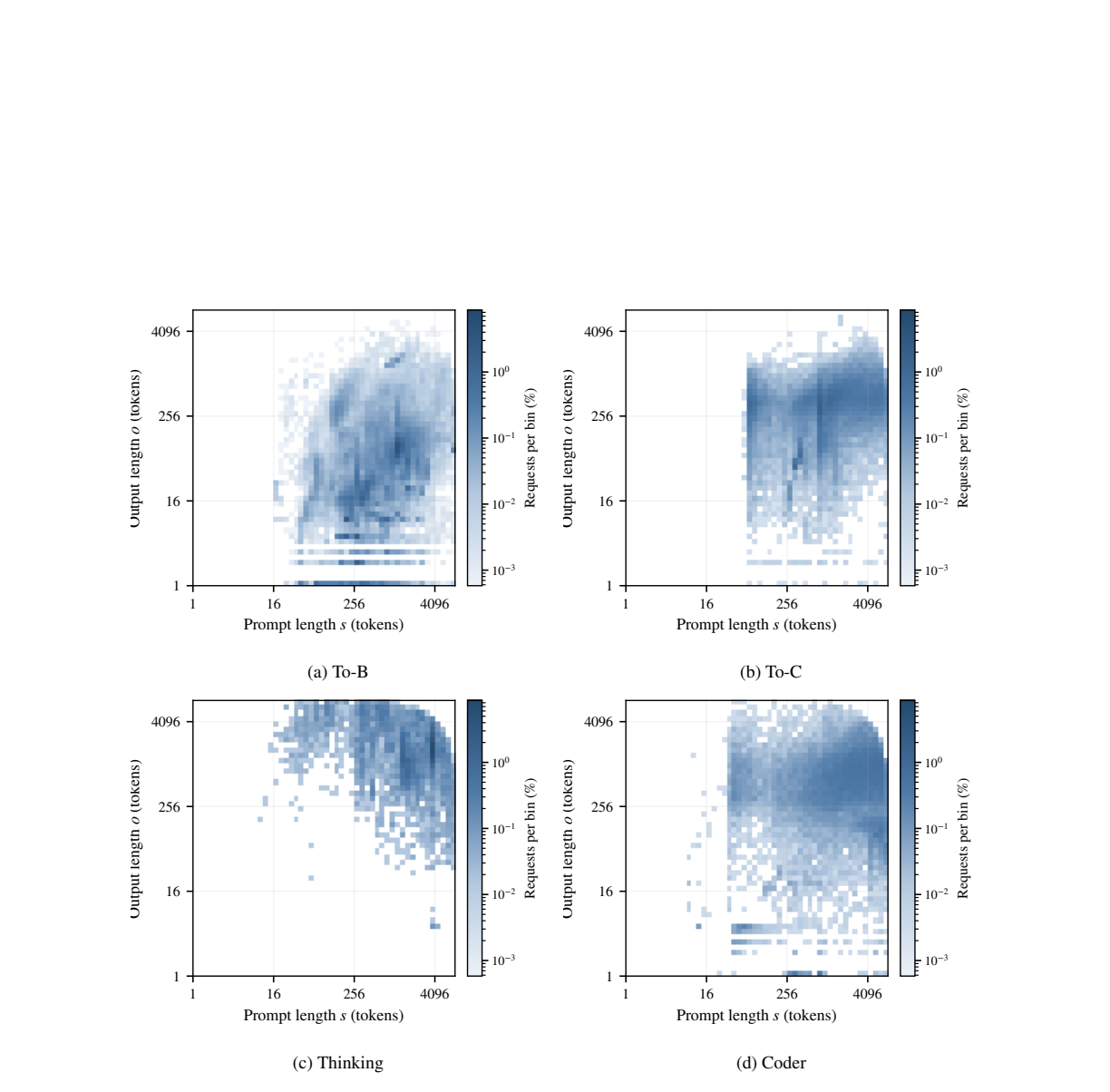
The calibration description is terse: please state the ranges of prefill tokens and KV-cache I/O volumes covered by the training and held-out strata, and whether memory saturation was included in the calibration data.
The paper says, at §6.4, Table 4
Pith says: minor objection 4 of 4
The production-trace results report one run per policy; please add a sentence indicating whether repetitions were infeasible for cost reasons, or report a small number of repetitions so the reader can assess run-to-run variability.
What would settle it
Re-run the H800 calibration with additional terms: step_time = a_pf n_pf + a_kv n_kv + b + β n_kv^2 + γ n_pf n_kv + δ·occupancy, stratified over the high-occupancy, single-class region that the cμ policy creates, and test whether β, γ, or δ are significantly nonzero and whether RMSE degrades on batches generated by the cμ policy. If nonlinearity is significant, compute μ_j from the fitted nonlinear clock and check whether the cμ priority order and the latency rankings in Tables 3–4 persist in a simulator; if the order changes, the real-system claim is not supported.
from the skeptic's reading
How the review went
4 readings by deepseek-v4-flash · 4 Nov 2026
- Reader holds up, with conditions
- Skeptic agrees
- Editor wrote the verdict above
- Referee major revision: 3 major objections, 4 minor
Not run on this paper: the simulated authors' defence.
Pith did not check this review's objections against the paper.
The review in full
The review in brief, machine-written
Read this one. It is a genuine queueing-theory paper, not another heuristic-plus-sweep. The new content is the reduction: under a linear GPU step-time model and a hard KV-cache capacity, the fluid limit collapses to a multiclass single-server queue with effective rate μj = (a_pf sj + (a_kv + b/M) m̃_j)^(-1), and the cμ ordering in that rate is optimal for holding cost and for completion time. The proofs in Appendices C, D, and G are real: workload lower bound via Skorokhod reflection, admissibility of the constructed policy, and tightness-plus-reflection to identify the fluid limit. I found no internal gap in the central derivation. The smoothed cμ-inspired prelimit policy is implementable and does not require arrival-rate knowledge, which is a real plus. The citation pattern is honest; the classical cμ antecedents are cited and the relation to WAIT and bin-packing work is discussed fairly.
The soft spots are proportionate. The load-bearing external assumption is Eq. (1), exact linearity of step time in prefill tokens, KV-cache I/O, and a fixed overhead. The effective rate (18), and hence every theorem, is an algebraic consequence of that linearity plus the differential memory constraint. The paper acknowledges the model is only approximately linear and reports R² ≈ 0.9999 on its calibration strata, which is good evidence. But the calibration strata may not cover the regime the optimal policy drives the system into—memory-saturated, often single-class batches—and if real step time is convex or occupancy-dependent there, the clock decomposition no longer holds and the optimal ordering may not be the right one on the H800. That is a domain mismatch, not a proof flaw. The experiments are honest but limited: exact output-length replay, nonpreemptive policies, one run per real trace, and a hand-set WAIT baseline parameter. The paper says these limitations in Section 7; they cap the strength of the empirical claims but do not undermine the math. The fluid-limit theorem is standard in structure, so the novelty is bounded, but the model and the effective-rate formula are new enough to matter for the LLM serving subfield.
This paper deserves a serious referee. I would send it to review rather than desk reject, and I would cite it if I work on serving-scheduling theory. The authors should be asked for artifact release and more experimental runs, and the referee should push on whether the linear step-time model holds in the saturated operating regime. Otherwise, the central argument holds up.
The strongest objection
The paper's theorems are internally coherent, but they are all conditional on the exact linear step-time model (1): step time = a_pf n_pf + a_kv n_kv + b. The effective service rate (18) and the reduction to a multiclass single-server queue follow algebraically from (1) together with the differential memory constraint m̃_j dX_j ≤ M dξ; if real step time is convex in n_kv or depends on occupancy and batch composition beyond these two linear terms, the clock decomposition (16) no longer holds and the cμ optimality results apply to a model the hardware does not realize. The paper acknowledges the model is only 'approximately linear' and reports R²≈0.9999 on its calibration strata, which is good evidence but does not cover the operating regime that the optimal policy drives the system into: memory-saturated, often single-class batches. The experiments also assume known output lengths (exact-length replay, nonpreemptive policies), acknowledged in the experiment section and deferred in [b367], so the unknown-length production transfer is a separate acknowledged limitation. The linearity assumption is thus the load-bearing external assumption: if it fails in the cμ operating region, the theoretically optimal ordering may not be the right one on the H800.
The reader's weakest_assumption correctly identifies Eq. (1) as the point where the chain from theorem to hardware is least secure. I checked the central derivation rather than the appendix line-by-line in full, and found no internal inconsistency: the state-space collapse in §3.4 is justified by the fixed memory capacity; the lower-bound proof via prefix workloads and Skorokhod reflection in Appendix C is standard and the algebra leading to (18) is correct; the smoothed policy in Definition 5 is admissible (Proposition 1) and the tightness/reflection argument in Appendix G identifies every subsequential limit with the deterministic cμ path. The stated theorems are therefore best read as theorems about the linear model, and the paper is careful to phrase Theorem 3 as convergence of scaled dynamics rather than as a cost-regret guarantee. The only step I would want settled before relying on the practical conclusion is the fidelity of (1) in exactly the regime the optimal policy produces. The high in-sample and held-out R² is real evidence, but the calibration strata were not chosen by the cμ policy, and nonlinearities from bandwidth saturation or prefill-decode interference typically appear precisely at high occupancy. A targeted calibration/test on cμ-generated batches would settle this. Because the reader's verdict is already CONDITIONAL and this concern does not reveal an internal error, no verdict change is needed; if the proposed calibration showed significant nonlinearity and a changed priority order, the real-system claim would need to be weakened.
The referee's report
The theoretical core is substantial and mostly self-contained: the fluid policy is constructed via Skorokhod reflection, its admissibility is verified, the holding-cost proof is a genuine lower-bound argument, and the convergence proof follows a tightness-plus-reflection structure. A notable strength is that μ_j is derived from the model parameters rather than fitted to the objective, and the finite-scale policy does not require arrival-rate knowledge. If the linear step-time model (1) is accurate in the operating regime reached by the cμ policy, the paper provides an elegant asymptotic optimality result for a memory-constrained LLM inference model. The experimental results support the proposed ordering as a practical heuristic, but they are conditional on exact output-length knowledge and on the calibrated linear step-time model; these conditions are acknowledged in the paper but should be carried into the paper's scope statements.
Pith's reading of the paper (a machine's summary, not the authors')
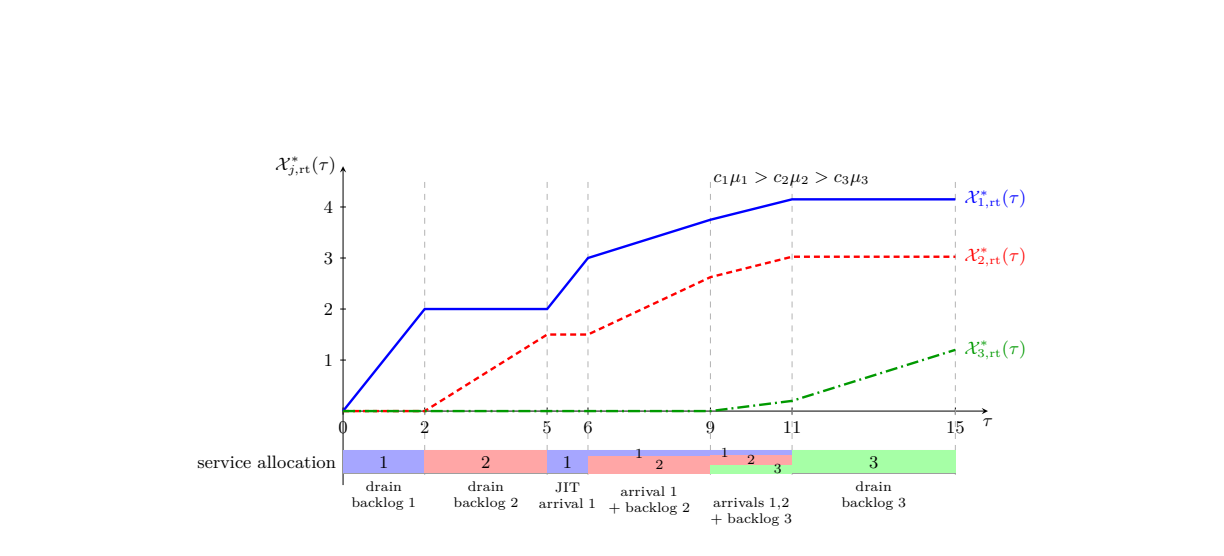
The paper argues that a classical queueing construction, the cμ priority rule, is the right way to schedule LLM inference on a single GPU when the key-value (KV) cache is the bottleneck. Requests with different prompt and output lengths arrive stochastically, pass through prefill and autoregressive decode, and compete for a fixed memory capacity. The authors show that under a fluid rescaling, where arrivals and processing speed up together while memory stays fixed, the system collapses to a multiclass single-server queue with a per-class effective service rate that folds in computation speed, memory bandwidth, and memory capacity. They prove that serving classes in decreasing order of c-sub-j times mu-sub-j minimizes cumulative holding cost in this fluid model, and also minimizes completion time and maximizes full-run output-token throughput for a finite workload. A smoothed, implementable version of the rule converges to the optimal fluid policy, and on a real H800 engine it cuts average latency versus the default scheduler while keeping throughput.
What carries the argument. The argument runs on three linked objects. First, the linear GPU step-time model $\Delta$ = a_pf times the number of prefill tokens plus a_kv times the KV-cache I/O volume plus b, calibrated on an NVIDIA H800, which turns each GPU step into a clock increment that depends on what is batched. Second, the fluid regime in which token-processing rates and arrival rates scale together while memory capacity M stays fixed; this forces every intermediate prefill and decode stage to collapse, because their scaled occupancy vanishes, leaving only the waiting queues and one cumulative completion process X_j per class. Third, the effective service rate μ_j, obtained by saturating the differential memory constraint m-tilde_j dX_j ≤ M dξ against the clock equation; substituting it makes the reduced model have the same service-effort representation as a classical single-server queue. The fluid cμ policy is then built by a Skorokhod reflection recursion on the cumulative service budget passed down the priority list, which is exactly what makes the optimality proof go through, while the prelimit counterpart is the smoothed cμ policy whose moving-average admissions wash out at fluid scale.
Core claim. The central claim is that the memory constraint and the linear step-time model together produce a clean effective service rate for each request class, mu_j = (a_pf s_j + (a_kv + b/M) m-tilde_j)^(-1), where a_pf is the per-token prefill compute cost, a_kv the per-token KV-cache I/O cost, b the fixed per-step overhead, M the KV-cache capacity in tokens, s_j the prompt length, and m-tilde_j the total KV-cache occupancy a class-j request generates over its lifetime. With this definition, the fluid limit of the memory-constrained inference system becomes algebraically identical to a classical multiclass single-server queue, so the classical cμ rule applies: prioritize classes by c_j μ_j, with c_j the holding-cost rate per waiting request. Theorem 1 establishes that this order minimizes cumulative holding cost among all admissible fluid policies, and Theorem 2 adds that for a finite workload it also minimizes the time to complete all requests, hence maximizes full-run output-token throughput. Theorem 3 constructs a feasible prelimit policy, a smoothed cμ rule that spreads admission plans over a short window to respect the memory constraint, and proves that its scaled dynamics converge uniformly on compacts in probability to the optimal fluid trajectory. The experiments then report that practical cμ and cμ-backfill implementations reduce average latency substantially relative to the default vLLM scheduler, WAIT-frac, MC-SF, and SVF on semi-synthetic and real production traces.
The premise it rests on. Everything rests on the linear step-time model (1) with coefficients scaling as in (2): if a real GPU's step time is not linear in KV-cache I/O volume and prefill token count, say because bandwidth saturation or interference among mixed batches adds curvature, then the clock identity f(ξ) = Σ_j (a_pf s_j + a_kv m-tilde_j) X_j(ξ) + bξ fails, the effective rate μ_j is no longer a constant per class, and the optimality theorems govern a model the hardware does not implement.
If the paper is right (Pith's inferences, not the authors')
Continuous-batching engines can adopt the rule by re-sorting waiting requests by $c_i \hat{\mu}_i$ with a future KV-feasibility check; the experiments show this near-free change cuts average latency sharply while holding output-token throughput roughly constant.
The smoothed policy is constructed without using the arrival rates $\lambda_j(\cdot)$, so the cμ ordering applies online when arrival rates are unknown or time-varying.
For a finite set of requests with known output lengths, the rule doubles as a completion-time minimizer, so the same priority order maximizes full-run output-token throughput.
Because the fluid regime fixes memory capacity $M$ while traffic grows, the optimality claim targets exactly the memory-bound operating point created by long-prompt, long-output workloads.
Extension I would test first: treat a multi-GPU cluster as a shared memory pool and rerun the reduction with $M$ the pool capacity and $\tilde{m}_j$ the peak concurrent occupancy per request; the paper lists multi-GPU serving as future work, and the cμ order surviving that step is not guaranteed by anything here.
The experiments assume each request's output length is known; ranking by $c_i \hat{\mu}_i$ computed from predicted lengths and sweeping prediction error would show how fast the latency gain erodes, a sensitivity the paper leaves open.
The effective-rate formula separates prefill compute cost from KV-memory cost, so the theory predicts the cμ rule's edge shrinks as $a_{\mathrm{pf}}/a_{\mathrm{kv}}$ falls (toward pure volume-based ordering) and grows as memory I/O dominates; a coefficient sweep in simulation would isolate where the gains come from.
Check this review
Pith stored no record of this review's passes and took no fingerprint of it. Reviews made by code from 13 Nov 2026 on carry both.
How often reviews like this one are right
Reviews like this one: written by deepseek-v4-flash, where what was read was not recorded.
How often objections from reviews like this one are right: not yet measured
Reviews by people
This review was written by a machine. No person has reviewed this paper on Pith yet. A scientist listed on Pith can review it for a fee, and their review is published here whatever it concludes.
The paper
Abstract
Large language model (LLM) inference, the process by which a pre-trained model receives an input prompt and generates output tokens sequentially, has become increasingly important with the widespread deployment of LLM-based applications. As inference workloads continue to scale, GPU memory has emerged as a critical bottleneck: the long input prompts and generation sequences common in agentic and reasoning workloads lead to substantial key-value (KV) cache usage. In this paper, we study the resulting online scheduling problem from a queueing perspective. Requests arrive stochastically with heterogeneous prompt and output lengths, undergo prefill and autoregressive decode, and compete for a finite KV-cache capacity. Unlike classical queueing models, the duration of a processing step depends on both prefill computation and KV-cache I/O, so service capacity is jointly determined by computation, memory access, and memory occupancy. We develop a fluid model that reduces the system to a multiclass single-server queue with effective service rates capturing computation, memory access, and memory capacity. This fluid analysis yields a cμ priority rule, where the effective service rate μ is jointly determined by computational speed, memory bandwidth, and memory capacity. We prove that this rule minimizes cumulative holding cost in the fluid model and, for a finite workload, also minimizes completion time and maximizes full-run output-token throughput. We then construct a feasible scheduling policy for the original finite system and prove that its scaled dynamics converge to the optimal fluid policy. Finally, experiments on a real LLM serving engine using an NVIDIA H800 show that practical implementations of the proposed priority rule substantially reduce average latency while maintaining high throughput relative to existing scheduling policies.
The paper's own sentences, arranged, kept beside the review and separate from it. Each label is drawn from a closed vocabulary; the number beside it is the probability the classifier gave that label. No sentence in this record was written by a model.
abstract compiled · 2026-11-04
The authors' main claim, as the classifier picked it out 0.88
“We prove that this rule minimizes cumulative holding cost in the fluid model and, for a finite workload, also minimizes completion time and maximizes full-run output-token throughput.”
How the main claim is stated: asserted 1.00
What the abstract itself states, as probabilities: claims first 0.05 · states limitation 0.14 · human participants 0.02 · controlled comparison 0.69 · randomized assignment 0.02 · states quantitative result 0.10 · compares with prior results 0.78 · mentions code or data availability 0.03
The abstract, sentence by sentence
This table labels the abstract only (arXiv listing abstract v1). The number is the probability the classifier gave the label.
| Sentence | Role | The authors' own work | States the main conclusion | Strength |
|---|---|---|---|---|
| Large language model (LLM) inference, the process by which a pre-trained model receives an input prompt and generates output tokens sequentially, has become increasingly important with the widespread deployment of LLM-based applications. | background 1.00 | 0.04 | 0.01 | asserted 0.99 |
| As inference workloads continue to scale, GPU memory has emerged as a critical bottleneck: the long input prompts and generation sequences common in agentic and reasoning workloads lead to substantial key-value (KV) cache usage. | background 1.00 | 0.09 | 0.01 | asserted 1.00 |
| In this paper, we study the resulting online scheduling problem from a queueing perspective. | contribution 0.89 | 0.75 | 0.02 | asserted 0.87 |
| Requests arrive stochastically with heterogeneous prompt and output lengths, undergo prefill and autoregressive decode, and compete for a finite KV-cache capacity. | background 0.98 | 0.16 | 0.02 | asserted 0.99 |
| Unlike classical queueing models, the duration of a processing step depends on both prefill computation and KV-cache I/O, so service capacity is jointly determined by computation, memory access, and memory occupancy. | background 0.87 | 0.44 | 0.02 | asserted 1.00 |
| We develop a fluid model that reduces the system to a multiclass single-server queue with effective service rates capturing computation, memory access, and memory capacity. | method 0.95 | 0.96 | 0.05 | asserted 1.00 |
| This fluid analysis yields a $c\mu$ priority rule, where the effective service rate $\mu$ is jointly determined by computational speed, memory bandwidth, and memory capacity. | result 0.60 | 0.94 | 0.32 | asserted 1.00 |
| We prove that this rule minimizes cumulative holding cost in the fluid model and, for a finite workload, also minimizes completion time and maximizes full-run output-token throughput. | result 0.99 | 0.96 | 0.67 | asserted 1.00 |
| We then construct a feasible scheduling policy for the original finite system and prove that its scaled dynamics converge to the optimal fluid policy. | contribution 0.42 | 0.97 | 0.15 | asserted 1.00 |
| Finally, experiments on a real LLM serving engine using an NVIDIA H800 show that practical implementations of the proposed priority rule substantially reduce average latency while maintaining high throughput relative to existing scheduling policies. | result 0.98 | 0.96 | 0.23 | asserted 1.00 |
What kind of paper the classifier reports this is: theoretical result 0.95 · evidence from proof or derivation 0.99
What was examined, and what was not
Sources read
- arXiv listing abstract v1
Not examined
- full text
- figures and tables
- references and citing sentences
- relations to other papers
Levels run
- P abstract
Not run
- S sections
- T body sentences
- C citations
- R cross-paper relations
How the labels were made
Compiled by classifier-1.13.0 via TypeSafe API, question bank abstract-p1-20260923, 2026-11-04: 1 request, 7,728 input tokens.
Every quoted sentence on this record is the authors'. Every label is from Pith's closed vocabulary, with the probability shown beside it. This record as JSON
Figures (8)
Figures are the authors', reproduced from the paper.
References (48)
- [1] Amey Agrawal, Nitin Kedia, Ashish Panwar, Jayashree Mohan, Nipun Kwatra, Bhargav Gulavani, Alexey Tumanov, and Ramachandran Ramjee. Taming Throughput-Latency tradeoff in LLM inference with Sarathi-Serve. In18th USENIX Symposium on Operating Systems Design and Implementation (O... on Pith
- [2] Eduardo Alvarez, Vishal Mehta, and Farshad Ghodsian. Inside nvidia rubin gpu architecture: Powering the era of agentic ai. NVIDIA Technical Blog, July 2026. URLhttps://developer.nvidia.c om/blog/inside-nvidia-rubin-gpu-architecture-powering-the-era-of-agentic-ai/ . Accessed: 2... on Pith
- [3] Ruicheng Ao, Jing Dong, Gan Luo, and David Simchi-Levi. Service-induced congestion in memory- constrained LLM serving, 2026. URLhttps://arxiv.org/abs/2606.15555. 23 on PithPith's reviewarXiv
- [4] Ruicheng Ao, Gan Luo, David Simchi-Levi, and Xinshang Wang. Optimizing LLM inference: Fluid- Guided online scheduling with memory constraints, 2026. URLhttps://arxiv.org/abs/2504.1 1320 on Pith
- [5] Patrick Billingsley.Convergence of Probability Measures. Wiley, 2 edition, 1999 on Pith
- [6] Maury Bramson. State space collapse with application to heavy traffic limits for multiclass queueing networks.Queueing Systems, 30(1–2):89–148, 1998. doi: 10.1023/A:1019160803783. URL https://doi.org/10.1023/A:1019160803783 on Pithdoi:10.1023/a:1019160803783
- [7] TomBrown,BenjaminMann,NickRyder,MelanieSubbiah, JaredDKaplan, PrafullaDhariwal, Arvind Neelakantan,PranavShyam,GirishSastry,AmandaAskell,etal. Languagemodelsarefew-shotlearners. Advances in neural information processing systems, 33:1877–1901, 2020 on Pith
- [8] Cagatay Buyukkoc, Pravin Varaiya, and Jean Walrand. The𝑐𝜇 rule revisited.Advances in Applied Probability, 17(1):237–238, 1985. doi: 10.2307/1427064. URLhttps://doi.org/10.2307/1427 064 on Pithdoi:10.2307/1427064
- [9] Zixi Chen, Yinyu Ye, and Zijie Zhou. Adaptively robust LLM inference optimization under prediction uncertainty, 2025. URLhttps://arxiv.org/abs/2508.14544 on PithPith's reviewarXiv
- [10] EG Coffman and Alexander L Stolyar. Bandwidth packing.Algorithmica, 29(1):70–88, 2001 on Pith
- [11] J. G. Dai, Tianze Deng, Yueying Li, and Tianyi Peng. Throughput-optimal scheduling algorithms for LLM inference and AI agents, 2026. URLhttps://arxiv.org/abs/2504.07347 on PithPith's reviewarXiv
- [12] YidingFeng,SiyuLiu,ZonghanYang,andYuhaoZhang. Generalnon-clairvoyantKV-Cachescheduling via regime-aware routing, 2026. URLhttps://arxiv.org/abs/2607.09248 on PithPith's reviewarXiv
- [13] Yiding Feng, Zonghan Yang, and Yuhao Zhang. Competitive non-clairvoyant KV-Cache scheduling for LLM inference, 2026. URLhttps://arxiv.org/abs/2601.22996 on PitharXiv
- [14] David Gamarnik. Stochastic bandwidth packing process: stability conditions via lyapunov function technique.Queueing systems, 48(3):339–363, 2004 on Pith
- [15] Javad Ghaderi, Yuan Zhong, and Rayadurgam Srikant. Asymptotic optimality of bestfit for stochastic bin packing.ACM SIGMETRICS Performance Evaluation Review, 42(2):64–66, 2014 on Pith
- [16] GilPress. ChatGPT users statistics. WhatsTheBigData, 2024. URLhttps://whatsthebigdata.co m/chatgpt-users/#google_vignette on Pith
- [17] GitHub. GitHub copilot.https://github.com/features/copilot, 2021 on Pith
- [18] Cindy Gordon. ChatGPT and Generative AI innovations are creating sustainability havoc. Forbes, 2024. URL https://www.forbes.com/sites/cindygordon/2024/03/12/chatgpt-and-generativ e-ai-innovations-are-creating-sustainability-havoc/ on Pith
- [19] Aaron Grattafiori et al. The Llama 3 herd of models.arXiv preprint arXiv:2407.21783, 2024. doi: 10.48550/arXiv.2407.21783. URLhttps://arxiv.org/abs/2407.21783 on PithPith's reviewarXivdoi:10.48550/arxiv.2407.21783
- [20] VarunGuptaandAnaRadovanovic. Lagrangian-basedonlinestochasticbinpacking.ACMSIGMETRICS Performance Evaluation Review, 43(1):467–468, 2015. 24 on Pith
show 28 more
- [21] Chenyu Huang, Zhengyang Tang, Shixi Hu, Ruoqing Jiang, Xin Zheng, Dongdong Ge, Benyou Wang, andZizhuoWang. Orlm: Acustomizableframeworkintraininglargemodelsforautomatedoptimization modeling.Operations Research, 2025 on Pith
- [22] Jean Jacod and Albert N. Shiryaev.Limit Theorems for Stochastic Processes. Springer, 2 edition, 2003. doi: 10.1007/978-3-662-05265-5 on Pithdoi:10.1007/978-3-662-05265-5
- [23] Patrick Jaillet, Jiashuo Jiang, Konstantina Mellou, Marco Molinaro, Chara Podimata, and Zijie Zhou. Online scheduling for LLM inference with KV cache constraints, 2025. URL https: //arxiv.org/abs/2502.07115 on PitharXiv
- [24] Li Kong, Qi Qi, Yinyu Ye, and Zijie Zhou. Geometry-aware online scheduling for LLM serving: From theoretical bound to system practice, 2026. URLhttps://arxiv.org/abs/2606.22327 on PithPith's reviewarXiv
- [25] Woosuk Kwon, Zhuohan Li, Siyuan Zhuang, Ying Sheng, Lianmin Zheng, Cody Hao Yu, Joseph E. Gonzalez, Hao Zhang, and Ion Stoica. Efficient memory management for large language model serving with PagedAttention. InProceedings of the 29th Symposium on Operating Systems Principles,... on Pithdoi:10.1145/3600006.3613165
- [26] RuihanLin, ZezhenDing, ZeanHan, andJihengZhang. Large-scaleLLMinferencewithheterogeneous workloads: Prefill–decode contention and asymptotically optimal control, 2026. URL https: //arxiv.org/abs/2602.02987 on PithPith's reviewarXiv
- [27] Siva Theja Maguluri, Rayadurgam Srikant, and Lei Ying. Stochastic models of load balancing and scheduling in cloud computing clusters. In2012 Proceedings IEEE Infocom, pages 702–710. IEEE, 2012 on Pith
- [28] Avishai Mandelbaum and Alexander L. Stolyar. Scheduling flexible servers with convex delay costs: Heavy-traffic optimality of the generalized𝑐𝜇-rule.Operations Research, 52(6):836–855, 2004. doi: 10.1287/opre.1040.0152. URLhttps://doi.org/10.1287/opre.1040.0152 on Pithdoi:10.1287/opre.1040.0152
- [29] Chengyi Nie, Nian Si, and Zijie Zhou. A queueing-theoretic framework for stability analysis of LLM inference with KV cache memory constraints. InProceedings of the 43rd International Conference on Machine Learning, 2026. URLhttps://arxiv.org/abs/2605.04595 on PithPith's reviewarXiv
- [30] OpenAI. ChatGPT.https://chat.openai.com, 2019 on Pith
- [31] OpenAI. GPT-4 technical report. arxiv 2303.08774.View in Article, 2(5), 2023 on PithPith's reviewarXiv
- [32] Reiner Pope, Sholto Douglas, Aakanksha Chowdhery, Jacob Devlin, James Bradbury, Jonathan Heek, Kefan Xiao, Shivani Agrawal, and Jeff Dean. Efficiently scaling transformer inference.Proceedings of Machine Learning and Systems, 5:606–624, 2023 on Pith
- [33] Walter Rudin.Principles of Mathematical Analysis. McGraw–Hill, 3 edition, 1976 on Pith
- [34] Aaditya Singh, Adam Fry, Adam Perelman, Adam Tart, Adi Ganesh, Ahmed El-Kishky, Aidan McLaughlin,AidenLow,AJOstrow,AkhilaAnanthram,etal. Openaigpt-5systemcard.arXivpreprint arXiv:2601.03267, 2025 on PithPith's reviewarXiv
- [35] Alexander L Stolyar. An infinite server system with general packing constraints.Operations Research, 61(5):1200–1217, 2013. 25 on Pith
- [36] AlexanderLStolyarandYuanZhong. Alarge-scaleservicesystemwithpackingconstraints: Minimizing the number of occupied servers.ACM SIGMETRICS Performance Evaluation Review, 41(1):41–52, 2013 on Pith
- [37] Alexander L Stolyar and Yuan Zhong. Asymptotic optimality of a greedy randomized algorithm in a large-scale service system with general packing constraints.Queueing Systems, 79(2):117–143, 2015 on Pith
- [38] Jan A. Van Mieghem. Dynamic scheduling with convex delay costs: The generalized𝑐𝜇 rule. The Annals of Applied Probability, 5(3):809–833, 1995. doi: 10.1214/aoap/1177004706. URL https://doi.org/10.1214/aoap/1177004706 on Pithdoi:10.1214/aoap/1177004706
- [39] Ashish Vaswani, Noam Shazeer, Niki Parmar, Jakob Uszkoreit, Llion Jones, Aidan N Gomez, Łukasz Kaiser, and Illia Polosukhin. Attention is all you need.Advances in neural information processing systems, 30, 2017 on Pith
- [40] Jiahao Wang, Jinbo Han, Xingda Wei, Sijie Shen, Dingyan Zhang, Chenguang Fang, Rong Chen, Wenyuan Yu, and Haibo Chen. KVCache cache in the wild: Characterizing and optimizing KVCache cache at a large cloud provider. In2025 USENIX Annual Technical Conference (USENIX ATC 25). US... on Pith
- [41] Meixuan Wang, Yinyu Ye, and Zijie Zhou. LLM serving optimization with variable prefill and decode lengths, 2025. URLhttps://arxiv.org/abs/2508.06133 on PithPith's reviewarXiv
- [42] Ward Whitt.Stochastic-Process Limits: An Introduction to Stochastic-Process Limits and Their Application to Queues. Springer, 2002 on Pith
- [43] Ward Whitt. Internet supplement to Stochastic-Process Limits: An Introduction to Stochastic-Process Limits and Their Application to Queues, 2002. URLhttps://www.columbia.edu/~ww2040/supp lement.html on Pith
- [44] RuthJ.Williams. Diffusionapproximationsforopenmulticlassqueueingnetworks: Sufficientconditions involvingstatespacecollapse.QueueingSystems,30(1–2):27–88,1998.doi: 10.1023/A:1019108819713. URLhttps://doi.org/10.1023/A:1019108819713 on Pithdoi:10.1023/a:1019108819713
- [45] Kuang Xu. Drift method: from stochastic networks to machine learning.URL: https://web. stanford. edu/kuangxu/papers/driftmethod. pdf. Last visited on, 3(09), 2023 on Pith
- [46] HeyuanYao,ChutongGao,YuanLyu,IzzyGrosof,andDavidSimchi-Levi. Multi-turnllmconversations undertheleast-recently-usedpolicy: Mean-fieldasymptoticsandhitratioapproximation.arXivpreprint arXiv:2609.02027, 2026 on PithPith's reviewarXiv
- [47] Gyeong-In Yu, Joo Seong Jeong, Geon-Woo Kim, Soojeong Kim, and Byung-Gon Chun. Orca: A distributed serving system for Transformer-Based generative models. In16th USENIX Symposium on Operating Systems Design and Implementation (OSDI 22), pages 521–538. USENIX Association, 2022.... on Pith
- [48] Noa Zychlinski, Carri W. Chan, and Jing Dong. Managing queues with different resource requirements. Operations Research, 71(4):1387–1413, 2023. doi: 10.1287/opre.2022.2284. URL https: //doi.org/10.1287/opre.2022.2284. 26 Appendices A Non-Anticipativity of Prelimit Policies Fix... on Pithdoi:10.1287/opre.2022.2284
Challenges and discussion
Disagree with the review, or know something it missed? Leave a comment, or challenge this review formally: a challenge becomes a permanent entry in this paper's record, and its decision is published here.
Come back by email
A short list of the week's newly reviewed papers. Nothing is sent until you confirm from your inbox, and every email has a link that stops it. No account.
No comments yet.
Sign in to comment