Chemical Physics · arXiv:2611.06237 v1 · submitted 4 Nov 2026 · 136 references
SO3LR Tauri: Generally Applicable Force Fields for Reactive (Bio)Molecular Simulations Covering the Periodic Table
The paper says
“Machine-learned force fields (MLFFs) aim to create a unified model that describes all major classes of (bio)molecules at quantum-mechanical accuracy.”
more of the abstract
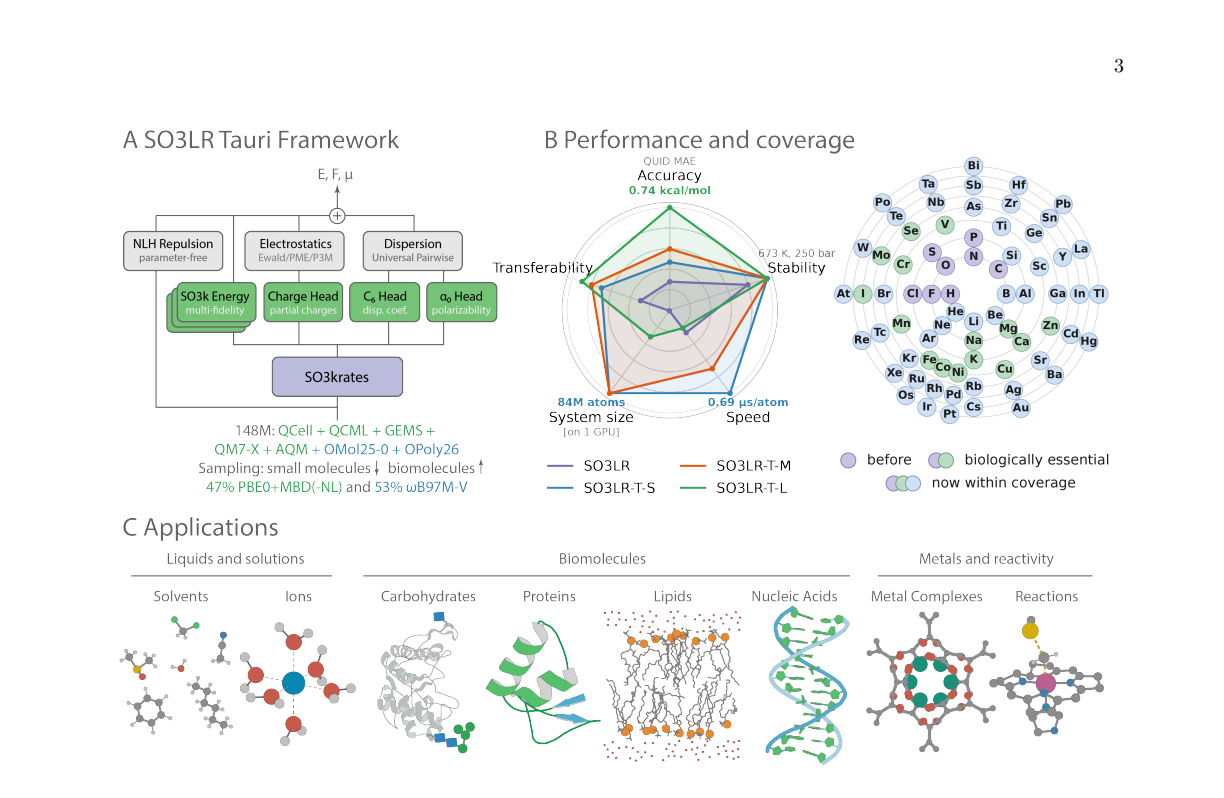
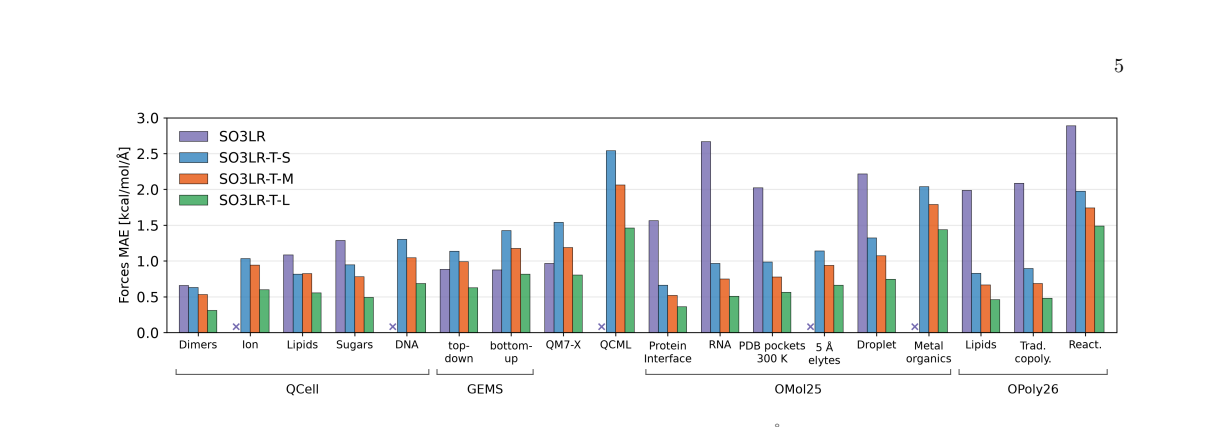
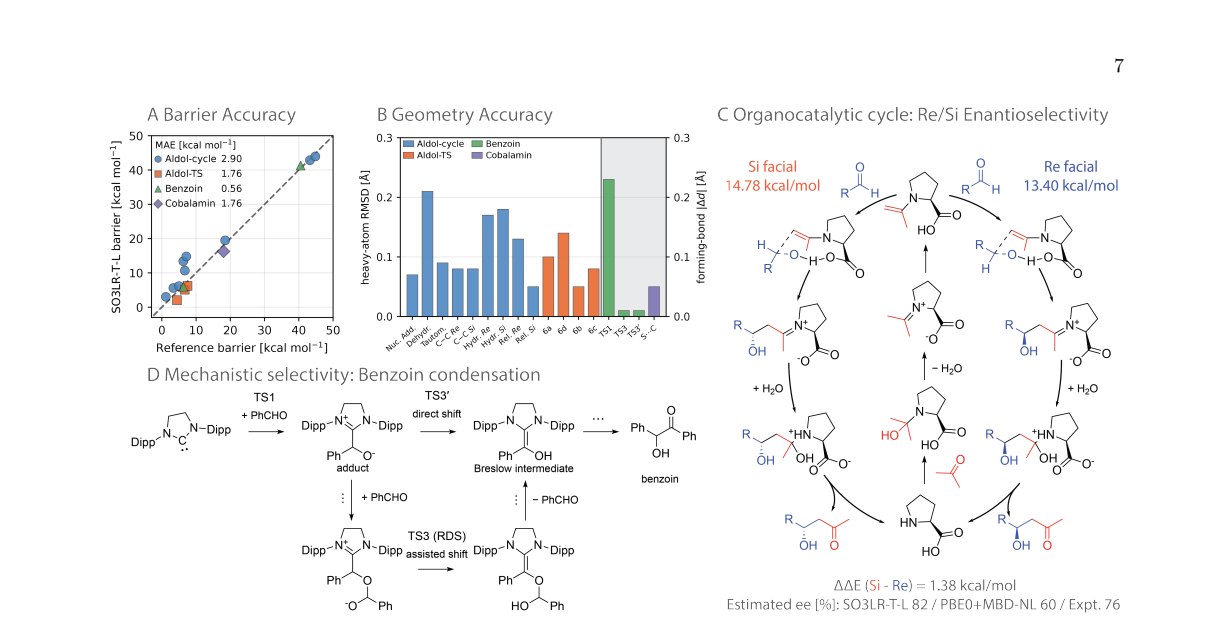
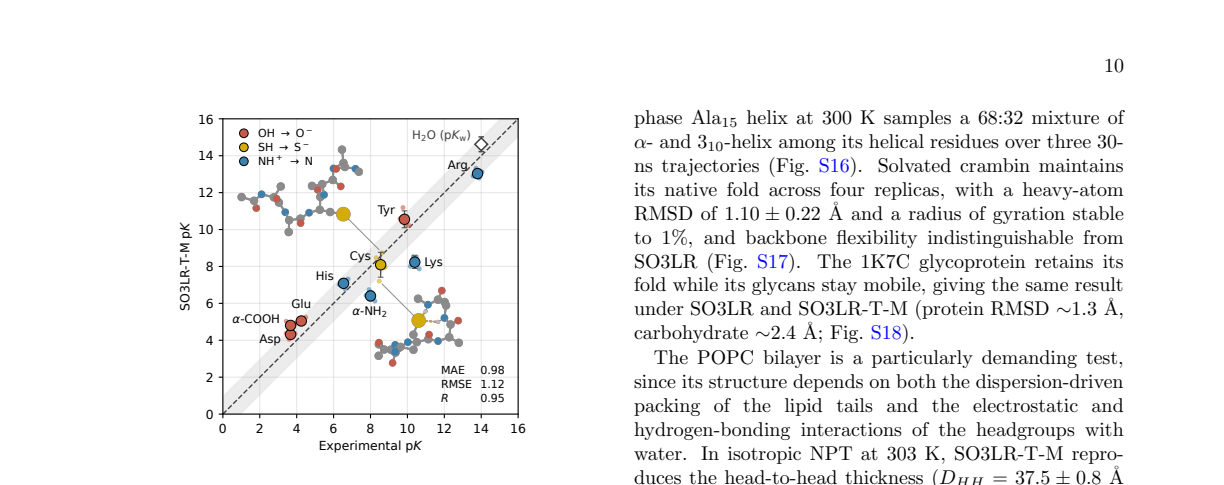
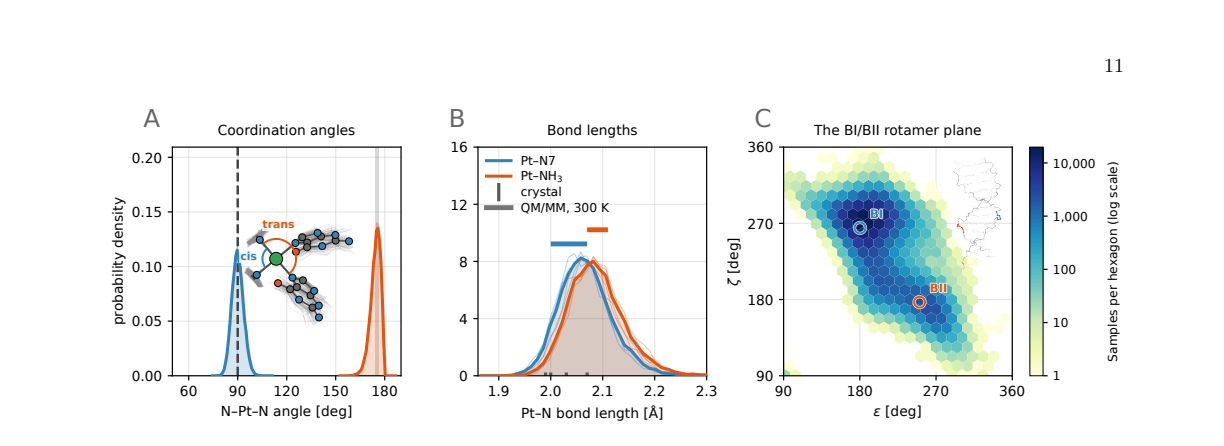
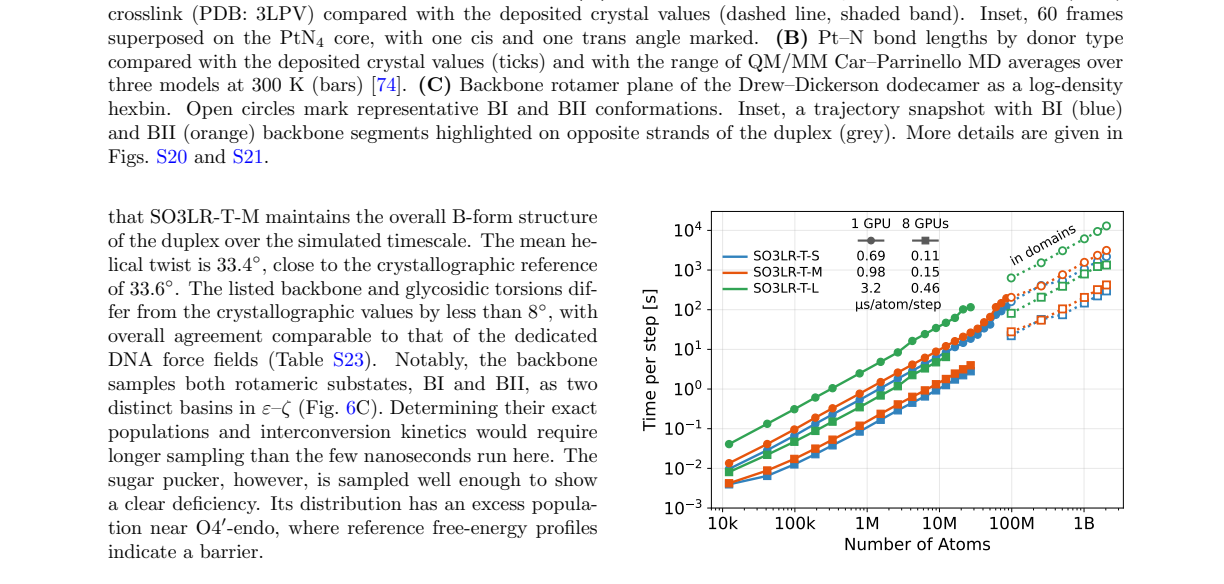
We present SO3LR Tauri, a family of MLFFs developed toward this goal, coupling a fast SO3krates network to explicit, physics-based interaction modules: pair-specific short-range repulsion, environment-dependent dispersion, and electrostatics, each improved beyond its original formulation. The models are trained on 148 million structures spanning 85 elements, drawn from several quantum-chemical datasets. Against coupled-cluster references, the models accurately reproduce nucleobase-pair and charged protein-ligand interactions, carbohydrate conformer ordering, and molecular dipoles. They also resolve the transition pathways of organic and enzymatic reactions. Dynamical simulations recover experimental densities of water and organic solvents, the hydration structure of mono- and divalent ions, the pKa values of amino-acid side chains, and the structure and dynamics of proteins, membranes, nucleic acids, glycoproteins, and metal-containing biomolecules, all without system-specific fitting. Released in three sizes, the models reach 0.7-3.2 μs/atom and scale to 27-84 million atoms on a single GPU. Much work remains to be done: achieving predictive accuracy for static and dynamic liquid properties, reaction barriers, coverage of chemical and conformational space, and the sampling and inference speed needed to describe biomolecular processes.
from the abstract
Pith says
Machine review · deepseek-v4-flash · 5 Nov 2026 · what was read was not recorded · not checked by a person
It can be wrong. Challenge this review or reply to it.
Holds up. A landmark ML force field for biomolecules, with impressive static accuracy and broad coverage, but the dynamic validation is weaker than claimed—the 47% liquid diffusion error attributed to nuclear quantum effects without testing is a real gap. This line is wrong
2 major objections · 5 minor
How often objections from reviews like this one are right: not yet measured
Not checked: figures, code, what the 136 references say.
The paper says, at §Liquid Properties, Fig. 4B
The review did not quote this passage.
Pith says: Objection 1 of 2 · major
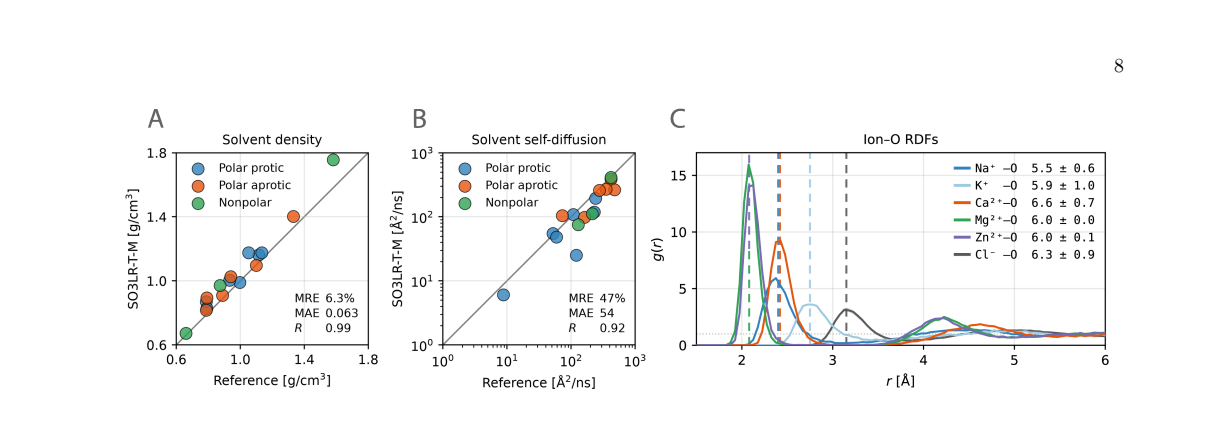
The 47% mean relative error in self-diffusion for the 16 neat solvents is the largest quantitative discrepancy in the dynamics benchmarks. The paper attributes this to nuclear quantum effects (NQE) with a brief statement that NQE 'may affect the self-diffusion coefficient strongly by up to a factor of two,' citing general references without any test specific to SO3LR-T-M.
more of objection 1
Since classical force fields (e.g., OPLS4) achieve 28% MRE without invoking NQE, the possibility that the model's intrinsic error dominates is real. The authors should either provide a quantitative estimate of the NQE contribution for this specific model (e.g., via a path-integral simulation on a subset, or by comparing to experimental isotope effects) or add a more cautious interpretation that acknowledges the unresolved error. This is load-bearing for the central claim that dynamics reach 'near-quantum-mechanical accuracy.'
The paper says, at §Water properties, Fig. S11
The review did not quote this passage.
Pith says: Objection 2 of 2 · major
The water oxygen–oxygen radial distribution function shows a first-peak height of 3.05 against an experimental 2.58. This over-structuring is consistent with suppressed diffusion (119 vs 230 Ų/ns). The authors attribute this to residual PBE0 bias corrected only by late-stage fine-tuning.
more of objection 2
The connection between structural over-structuring and the 47% diffusion error should be discussed quantitatively: what fraction of the diffusion error can be explained by the over-structured H-bond network alone, and how much remains for NQE? This would make the NQE discussion more concrete.
5 minor objections
The paper says, at §TOC graphic
Pith says: minor objection 1 of 5
The radar chart in Fig. 1B is visually appealing but the axes are not numerically labelled; consider adding values or at least defining the scale in the caption.
The paper says, at §Model Architecture
Pith says: minor objection 2 of 5
The sentence 'The neural network takes the atomic positions R, atomic numbers Z, total charge Q, and spin multiplicity S' could be clarified: are Q and S supplied as scalar inputs to the first layer or as global feature conditioning? A brief sentence on how they enter the backbone would help.
show 3 more
The paper says, at §Training data, Table S3
Pith says: minor objection 3 of 5
Table S3 reports sampling weights relative to OPoly26 but does not define the weight for OPoly26 itself. Clarify that OPoly26 has weight 1.0.
The paper says, at §Reactive chemistry
Pith says: minor objection 4 of 5
The sentence 'Only the aldol saddles were found blindly; benzoin and cobalamin were refined from published structures' (line after Fig. 3) is important for reproducibility. Consider moving it to the main text rather than the figure caption, and explicitly state whether the benzoin TS search was initialized from the published geometry or re-discovered de novo.
The paper says, at §Supplementary §S4.1
Pith says: minor objection 5 of 5
The IRC convergence tolerance is given as 'force tolerance 0.1 eV/Å' but the main text references energies in kcal/mol. For consistency, consider reporting in a single unit or providing conversion.
What would settle it
Perform classical MD and path-integral MD (PIMD) simulations of liquid water (900 molecules) using SO3LR-T-M at 300 K and 1 atm for 20 ns per replica (four replicas). Compute self-diffusion coefficients via the Einstein relation with Yeh–Hummer correction. Compare the classical and PIMD diffusion coefficients with the experimental value (230 Ų/ns). If the PIMD value agrees with experiment to within 20% while the classical value deviates by >40%, the NQE attribution is supported. If both deviate by >30%, the model has intrinsic dynamics errors. As a lightweight alternative, estimate the NQE contribution using a well-calibrated quantum water model (e.g., q-TIP4P/F) at the same thermodynamic point and subtract it from the SO3LR-T-M classical result; if the residual deviation exceeds 25%, the model error is dominant.
from the skeptic's reading
How the review went
4 readings by deepseek-v4-flash · 5 Nov 2026
- Reader holds up
- Skeptic partly agrees
- Editor wrote the verdict above
- Referee minor revision: 2 major objections, 5 minor
Not run on this paper: the simulated authors' defence.
Pith did not check this review's objections against the paper.
The review in full
The review in brief, machine-written
This is a serious engineering effort. The team has assembled 148M structures across 85 elements, trained through a multi-head scheme that mixes PBE0+MBD-NL and ωB97M-V, and released three model sizes with open code and data. The static benchmarks are genuinely strong: SAPT10k MAE of 0.45 kcal/mol, QUID 1.24, GlcMal conformer ordering with ρ=0.89, and dipoles that approach CCSD quality. The pKa calculations (MAE 0.98 pK units) and the demonstration of reactive saddle points—particularly the blind aldol cycle—are real steps forward. The coverage of metal-organic systems, even with higher errors, shows ambition that goes beyond the usual biomolecular scope.
The soft spot is where the paper will be used: dynamics. Liquid densities have a 6.3% MRE, and the 47% MRE in self-diffusion is handwaved to nuclear quantum effects (NQE) with a single citation but zero verification. The water oxygen-oxygen RDF peak is 3.05 versus experimental 2.58—over-structured, which directly suppresses diffusion. The stress test is fair: if the model's intrinsic error is driving the diffusion error, then the claim of near-QM accuracy for dynamics is misleading. The authors openly list this as unresolved (they say 'much work remains'), but the abstract and introduction pitch the model as recovering experimental densities and diffusion, which overstates what is actually shown. The reactivity study is also not entirely blind—only the aldol cycle was searched de novo; benzoin and cobalamin were seeded from published structures, which the authors honestly note.
This paper belongs in a good journal. It pushes the field forward on static properties and chemical coverage. But readers who care about dynamics should treat the transport numbers as a known limitation, not a solved problem. I'd recommend acceptance with a request to substantially tone down the dynamic claims, or to add explicit NQE simulations or model refinements.
The strongest objection
The paper's strongest dynamical validation claim rests on liquid water and organic solvent self-diffusion. The 47% mean relative error (MRE) in diffusion is attributed to nuclear quantum effects (NQE) with a brief statement that 'NQE may affect the self-diffusion coefficient strongly by up to a factor of two' (main text, Liquid Properties), citing general references rather than a quantitative test on this specific model. No simulation or analysis is provided to confirm that SO3LR-T-M's classical dynamics would become accurate if NQE were included. If the actual model error dominates (e.g., due to overstructured hydrogen-bond networks that suppress diffusion beyond NQE corrections), then the claim that the model recovers 'experimental densities and diffusion' for water and organic solvents—a central pillar for biomolecular applicability—would be misleading. Given that classical force fields for water (e.g., OPLS4) achieve 28% MRE in diffusion without invoking NQE, a 47% MRE that is hand-waved to NQE weakens the argument that the model provides near-quantum-mechanical accuracy for dynamics. This is the most load-bearing concern because if the model's dynamics are systematically unreliable, its use for protein folding, ligand binding, and transport phenomena—the intended applications—is severely limited, regardless of static benchmark performance.
The reader identified the omission of nuclear quantum effects as an unverified assumption, which overlaps with this concern. However, the reader's weakest assumption also flagged the multi-head training scheme and mixed reference data. I focus specifically on the liquid diffusion error attribution because it is the single most concrete, quantifiable, and impactful weakness that directly tests the central claim of 'near-quantum-mechanical accuracy' in dynamics. The paper's open code and data allow this test to be performed independently, and the concern does not require re-deriving theorems or questioning published results. The test is computationally feasible (~400 GPU-hours per approach) and would settle whether the dynamical limitation is fundamental or correctable by including NQE. I recommend UNCHANGED because the paper is transparent about limitations, and the concern does not invalidate the static benchmarks or the framework's general promise; it merely demands stronger evidence for the dynamical claim. The verdict remains ACCEPT but with a higher correctness risk noted if the test reveals intrinsic errors.
The referee's report
If the claimed accuracy holds, this work represents a major advance in the unification of biomolecular force fields. The combination of a fast equivariant backbone with physics-based long-range terms trained on diverse data covering 85 elements is novel in scope. The static benchmarks, especially the sub-1 kcal/mol interaction-energy errors on SAPT10k and QUID, and the correct stereoselectivity in the aldol reaction, are impressive. The demonstration that a single pretrained model can simultaneously describe proteins, nucleic acids, lipids, carbohydrates, ions, and reactive chemistry without reparametrization is a significant step toward the long-standing goal of a universal MLFF. However, the dynamical validation shows clear limitations (47% MRE in self-diffusion, over-structured water), and the attribution of these errors to nuclear quantum effects is asserted but not tested, which tempers the significance until these issues are resolved.
Pith's reading of the paper (a machine's summary, not the authors')
The paper presents SO3LR Tauri, a family of machine-learned force fields that aim to be a single, unified model for simulating all major classes of biomolecules—proteins, nucleic acids, lipids, carbohydrates—as well as reactive chemistry, at near-quantum-mechanical accuracy. The models combine a fast equivariant message-passing neural network (SO3krates) with explicit physics-based terms for short-range repulsion (pre-tabulated NLH potentials), electrostatics (particle-mesh Ewald), and dispersion (environment-dependent C6/C8/C10 via quantum Drude oscillators). Trained on 148 million structures spanning 85 elements from seven datasets at two DFT levels (PBE0+MBD-NL and ωB97M-V), the model reproduces static benchmarks (interaction energies, conformational energetics, dipoles), locates transition states for organic and enzymatic reactions, and recovers condensed-phase properties (densities, ion hydration, peptide pKa, protein/DNA/membrane structure) from unmodified molecular dynamics. The work is presented as a step toward a universal force field, with openly discussed limitations including liquid diffusion errors (47% MRE), water dynamics, and the need for nuclear quantum effects.
What carries the argument. The key machinery is the SO3LR Tauri architecture: a SO3krates equivariant message-passing neural network that predicts per-atom energies, partial charges, polarizability ratios, and C6 ratios, which parametrize three explicit physics-based terms. The short-range repulsion uses pre-tabulated, pair-specific screened Coulomb potentials (NLH) from dedicated DFT calculations, with no trainable parameters. Electrostatics uses damped pairwise Coulomb interactions with particle-mesh Ewald summation for periodic systems. Dispersion is modelled with environment-dependent atomic polarizabilities and C6 coefficients (from two learned ratios per atom), pairwise Casimir–Polder mixing, and higher-order C8/C10 via quantum Drude oscillator relations, with the leading C6 term also evaluated by PME. The network is trained on 148M structures from seven datasets at two DFT levels (PBE0+MBD-NL and ωB97M-V) using a multi-head scheme: separate heads per level of theory in early stages, then a single production head fine-tuned on both levels.
Core claim. The core claim is that SO3LR Tauri can serve as a single, pre-trained machine-learned force field that is generally applicable across the periodic table (elements 1–85) and across biomolecular classes, achieving near-DFT accuracy for static properties and recovering key condensed-phase observables from unmodified simulations, without any system-specific parametrization. The discovery is that a combination of a fast equivariant backbone (SO3krates) with separate physics-based modules for short-range repulsion (fixed pair-specific NLH potentials), electrostatics (PME), and environment-dependent dispersion (C6/C8/C10 with learned per-atom ratios) can be trained jointly on a diverse 148M-structure dataset to yield a model that transfers across chemical spaces and scales to tens of millions of atoms on a single GPU.
The premise it rests on. The mixed quantum-mechanical reference data (PBE0+MBD-NL for most fragments and ωB97M-V for OMol25 and OPoly26) are together sufficient to represent 'quantum-mechanical accuracy' for all simulated systems, and the multi-head training scheme does not introduce systematic errors that cancel in static benchmarks but amplify in dynamics such as liquid self-diffusion (47% mean relative error).
If the paper is right (Pith's inferences, not the authors')
If correct, a single pre-trained model can replace separate classical force fields for proteins, lipids, nucleic acids, carbohydrates, and water, eliminating cross-parameter inconsistencies and system-specific fitting.
The model's ability to locate transition states and predict reaction barriers (MAE 2.9 kcal/mol for an aldol cycle) suggests it could serve as a fast surrogate for DFT in enzyme mechanism studies and drug discovery.
Scaling to 84 million atoms on one GPU enables all-atom simulations of large biomolecular assemblies (e.g., organelles or viral capsids) with near-DFT accuracy, though the authors note nanosecond sampling remains a bottleneck.
The reported 47% mean relative error in liquid self-diffusion indicates that static benchmark accuracy does not guarantee correct dynamics, highlighting a key area for improvement in future general-purpose MLFFs.
The multi-head training scheme that combines data from two DFT levels could become a standard strategy for training foundation force fields on heterogeneous quantum-chemistry datasets, because it allows the backbone to learn a representation that captures physics common to both functionals.
The paper's explicit discussion of limitations—particularly liquid diffusion, water structuring, reaction barrier accuracy, and nuclear quantum effects—sets a constructive precedent and should guide benchmark design for the next generation of universal force fields.
The use of pre-tabulated NLH repulsion (rather than learning short-range repulsion from data) may be a generally applicable technique to improve stability in out-of-distribution configurations encountered in high-temperature, high-pressure, or generative-AI-proposed geometries.
Check this review
Pith stored no record of this review's passes and took no fingerprint of it. Reviews made by code from 13 Nov 2026 on carry both.
How often reviews like this one are right
Reviews like this one: written by deepseek-v4-flash, where what was read was not recorded.
How often objections from reviews like this one are right: not yet measured
Reviews by people
This review was written by a machine. No person has reviewed this paper on Pith yet. A scientist listed on Pith can review it for a fee, and their review is published here whatever it concludes.
The paper
Abstract
Machine-learned force fields (MLFFs) aim to create a unified model that describes all major classes of (bio)molecules at quantum-mechanical accuracy. We present SO3LR Tauri, a family of MLFFs developed toward this goal, coupling a fast SO3krates network to explicit, physics-based interaction modules: pair-specific short-range repulsion, environment-dependent dispersion, and electrostatics, each improved beyond its original formulation. The models are trained on 148 million structures spanning 85 elements, drawn from several quantum-chemical datasets. Against coupled-cluster references, the models accurately reproduce nucleobase-pair and charged protein-ligand interactions, carbohydrate conformer ordering, and molecular dipoles. They also resolve the transition pathways of organic and enzymatic reactions. Dynamical simulations recover experimental densities of water and organic solvents, the hydration structure of mono- and divalent ions, the pKa values of amino-acid side chains, and the structure and dynamics of proteins, membranes, nucleic acids, glycoproteins, and metal-containing biomolecules, all without system-specific fitting. Released in three sizes, the models reach 0.7-3.2 μs/atom and scale to 27-84 million atoms on a single GPU. Much work remains to be done: achieving predictive accuracy for static and dynamic liquid properties, reaction barriers, coverage of chemical and conformational space, and the sampling and inference speed needed to describe biomolecular processes.
The paper's own sentences, arranged, kept beside the review and separate from it. Each label is drawn from a closed vocabulary; the number beside it is the probability the classifier gave that label. No sentence in this record was written by a model.
abstract compiled · 2026-11-05
The authors' main claim, as the classifier picked it out 0.90
“Dynamical simulations recover experimental densities of water and organic solvents, the hydration structure of mono- and divalent ions, the pKa values of amino-acid side chains, and the structure and dynamics of proteins, membranes, nucleic acids, glycoproteins, and metal-containing biomolecules, all without system-specific fitting.”
How the main claim is stated: asserted 1.00
What the abstract itself states, as probabilities: claims first 0.06 · states limitation 0.97 · human participants 0.02 · controlled comparison 0.23 · randomized assignment 0.01 · states quantitative result 0.98 · compares with prior results 0.52 · mentions code or data availability 0.56
The abstract, sentence by sentence
This table labels the abstract only (arXiv listing abstract v1). The number is the probability the classifier gave the label.
| Sentence | Role | The authors' own work | States the main conclusion | Strength |
|---|---|---|---|---|
| Machine-learned force fields (MLFFs) aim to create a unified model that describes all major classes of (bio)molecules at quantum-mechanical accuracy. | background 1.00 | 0.06 | 0.08 | asserted 0.99 |
| We present SO3LR Tauri, a family of MLFFs developed toward this goal, coupling a fast SO3krates network to explicit, physics-based interaction modules: pair-specific short-range repulsion, environment-dependent dispersion, and electrostatics, each improved beyond its original formulation. | contribution 0.72 | 0.93 | 0.10 | asserted 1.00 |
| The models are trained on 148 million structures spanning 85 elements, drawn from several quantum-chemical datasets. | method 0.99 | 0.90 | 0.04 | asserted 1.00 |
| Against coupled-cluster references, the models accurately reproduce nucleobase-pair and charged protein-ligand interactions, carbohydrate conformer ordering, and molecular dipoles. | result 1.00 | 0.92 | 0.16 | asserted 1.00 |
| They also resolve the transition pathways of organic and enzymatic reactions. | result 1.00 | 0.90 | 0.11 | asserted 1.00 |
| Dynamical simulations recover experimental densities of water and organic solvents, the hydration structure of mono- and divalent ions, the pKa values of amino-acid side chains, and the structure and dynamics of proteins, membranes, nucleic acids, glycoproteins, and metal-containing biomolecules, all without system-specific fitting. | result 1.00 | 0.93 | 0.31 | asserted 1.00 |
| Released in three sizes, the models reach 0.7-3.2 $\mu$s/atom and scale to 27-84 million atoms on a single GPU. | result 0.84 | 0.91 | 0.07 | asserted 1.00 |
| Much work remains to be done: achieving predictive accuracy for static and dynamic liquid properties, reaction barriers, coverage of chemical and conformational space, and the sampling and inference speed needed to describe biomolecular processes. | future work 0.64 | 0.17 | 0.06 | asserted 0.96 |
What kind of paper the classifier reports this is: method or tool 1.00 · evidence from simulation or computation 1.00
What was examined, and what was not
Sources read
- arXiv listing abstract v1
Not examined
- full text
- figures and tables
- references and citing sentences
- relations to other papers
Levels run
- P abstract
Not run
- S sections
- T body sentences
- C citations
- R cross-paper relations
How the labels were made
Compiled by classifier-1.13.0 via TypeSafe API, question bank abstract-p1-20260923, 2026-11-05: 1 request, 6,489 input tokens.
Every quoted sentence on this record is the authors'. Every label is from Pith's closed vocabulary, with the probability shown beside it. This record as JSON
Figures (7)
Figures are the authors', reproduced from the paper.
References (136)
- [1] K. J. Chem. Inf. Model. , volume =. 2020 , publisher =. doi:10.1021/acs.jcim.9b01171 , url = on Pithdoi:10.1021/acs.jcim.9b01171
- [2] Gardner, John L A and Schulz, Hannes and H. Mach. Learn.: Sci. Technol. , volume =. 2026 , publisher =. doi:10.1088/2632-2153/ae8e2e , url = on Pithdoi:10.1088/2632-2153/ae8e2e
- [3] Frank, J. Thorben and Chmiela, Stefan and M. Nat. Mach. Intell. , volume =. 2026 , publisher =. doi:10.1038/s42256-026-01195-y , url = on Pithdoi:10.1038/s42256-026-01195-y
- [4] Kabylda, Adil and Frank, J. Thorben and Su. J. Am. Chem. Soc. , volume =. 2025 , doi = on Pith
- [5] Nordlund, Kai and Lehtola, Susi and Hobler, Gerhard , journal =. 2025 , publisher =. doi:10.1103/physreva.111.032818 , url = on Pithdoi:10.1103/physreva.111.032818
- [6] Unke, Oliver T. and St. Sci. Adv. , volume =. 2024 , publisher =. doi:10.1126/sciadv.adn4397 , url = on Pithdoi:10.1126/sciadv.adn4397
- [7] Hoja, Johannes and Medrano Sandonas, Leonardo and Ernst, Brian G. and Vazquez-Mayagoitia, Alvaro and DiStasio, Robert A. and Tkatchenko, Alexandre , journal =. 2021 , publisher =. doi:10.1038/s41597-021-00812-2 , url = on Pithdoi:10.1038/s41597-021-00812-2
- [8] Medrano Sandonas, Leonardo and Van Rompaey, Dries and Fallani, Alessio and Hilfiker, Mathias and Hahn, David and Perez-Benito, Laura and Verhoeven, Jonas and Tresadern, Gary and Kurt Wegner, Joerg and Ceulemans, Hugo and Tkatchenko, Alexandre , journal =. 2024 , publisher =. d... on Pithdoi:10.1038/s41597-024-03521-8
- [9] Eastman, Peter and Behara, Pavan Kumar and Dotson, David L. and Galvelis, Raimondas and Herr, John E. and Horton, Josh T. and Mao, Yuezhi and Chodera, John D. and Pritchard, Benjamin P. and Wang, Yuanqing and De Fabritiis, Gianni and Markland, Thomas E. , journal =. 2023 , pub... on Pithdoi:10.1038/s41597-022-01882-6
- [10] Donchev, Alexander G. and Taube, Andrew G. and Decolvenaere, Elizabeth and Hargus, Cory and McGibbon, Robert T. and Law, Ka-Hei and Gregersen, Brent A. and Li, Je-Luen and Palmo, Kim and Siva, Karthik and Bergdorf, Michael and Klepeis, John L. and Shaw, David E. , journal =. 2... on Pithdoi:10.1038/s41597-021-00833-x
- [11] Ganscha, Stefan and Unke, Oliver T. and Ahlin, Daniel and Maennel, Hartmut and Kashubin, Sergii and M. Sci. Data , volume =. 2025 , publisher =. doi:10.1038/s41597-025-04720-7 , url = on Pithdoi:10.1038/s41597-025-04720-7
- [12] Kabylda, Adil and Su. AI Sci. , volume =. 2026 , publisher =. doi:10.1088/3050-287x/ae5267 , url = on Pithdoi:10.1088/3050-287x/ae5267
- [13] Levine, Daniel S. and Shuaibi, Muhammed and Spotte-Smith, Evan Walter Clark and Taylor, Michael G. and Hasyim, Muhammad R. and Michel, Kyle and Batatia, Ilyes and Cs. arXiv preprint arXiv:2505.08762 , year =. doi:10.48550/arXiv.2505.08762 , url = on Pithdoi:10.48550/arxiv.2505.08762
- [14] Levine, Daniel S. and Liesen, Nicholas and Chua, Lauren and Diffenderfer, James and Ingolfsson, Helgi and Kroonblawd, Matthew P. and Kumar, Nitesh and Maiti, Amitesh and Mohottalalage, Supun S. and Shuaibi, Muhammed and Van Essen, Brian and Wood, Brandon M. and Zitnick, C. Law... on Pith
- [15] Barron, Jonathan T. , booktitle =. 2019 , url = on Pith
- [16] Frank, J. Thorben and Unke, Oliver T. and M. Nat. Commun. , volume =. 2024 , publisher =. doi:10.1038/s41467-024-50620-6 , url = on Pithdoi:10.1038/s41467-024-50620-6
- [17] Molecular dynamics simulation of an entire cell , author=. Front. Chem. , volume=. 2023 , publisher= on Pith
- [18] Th. J. Am. Chem. Soc. , volume =. 2026 , publisher =. doi:10.1021/jacs.6c00217 , url = on Pithdoi:10.1021/jacs.6c00217
- [19] Esders, Malte and Schnake, Thomas and Lederer, Jonas and Kabylda, Adil and Montavon, Gr. J. Chem. Theory Comput. , volume =. 2025 , publisher =. doi:10.1021/acs.jctc.4c01424 , url = on Pithdoi:10.1021/acs.jctc.4c01424
- [20] Cross learning between electronic structure theories for unifying molecular, surface, and inorganic crystal foundation force fields , author =. arXiv preprint arXiv:2510.25380 , year =. doi:10.48550/arXiv.2510.25380 , url = on Pithdoi:10.48550/arxiv.2510.25380
show 80 more
- [21] Hollingsworth, Scott A. and Dror, Ron O. , journal =. 2018 , publisher =. doi:10.1016/j.neuron.2018.08.011 , url = on Pithdoi:10.1016/j.neuron.2018.08.011
- [22] Unke, Oliver T. and Chmiela, Stefan and Sauceda, Huziel E. and Gastegger, Michael and Poltavsky, Igor and Sch. Chem. Rev. , volume =. 2021 , publisher =. doi:10.1021/acs.chemrev.0c01111 , url = on Pithdoi:10.1021/acs.chemrev.0c01111
- [23] Unke, Oliver T. and Chmiela, Stefan and Gastegger, Michael and Sch. Nat. Commun. , volume =. 2021 , publisher =. doi:10.1038/s41467-021-27504-0 , url = on Pithdoi:10.1038/s41467-021-27504-0
- [24] Anstine, Dylan M. and Zubatyuk, Roman and Isayev, Olexandr , journal =. 2025 , publisher =. doi:10.1039/d4sc08572h , url = on Pithdoi:10.1039/d4sc08572h
- [25] Marianski, Mateusz and Supady, Adriana and Ingram, Teresa and Schneider, Markus and Baldauf, Carsten , journal =. 2016 , publisher =. doi:10.1021/acs.jctc.6b00876 , url = on Pithdoi:10.1021/acs.jctc.6b00876
- [26] Jure. Phys. Chem. Chem. Phys. , volume =. 2006 , publisher =. doi:10.1039/b600027d , url = on Pithdoi:10.1039/b600027d
- [27] Rai, Brajesh K. and Sresht, Vishnu and Yang, Qingyi and Unwalla, Ray and Tu, Meihua and Mathiowetz, Alan M. and Bakken, Gregory A. , journal =. 2022 , publisher =. doi:10.1021/acs.jcim.1c01346 , url = on Pithdoi:10.1021/acs.jcim.1c01346
- [28] Baba, Hiromi and Urano, Ryo and Nagai, Tetsuro and Okazaki, Susumu , year =. J. Comput. Chem. , volume =. doi:10.1002/jcc.26975 , url = on Pithdoi:10.1002/jcc.26975
- [29] Das, K. P. and Ceglie, A. and Lindman, B. , year =. J. Phys. Chem. , volume =. doi:10.1021/j100295a058 , urldate = on Pithdoi:10.1021/j100295a058
- [30] Derlacki, Z. J. and Easteal, A. J. and Edge, A. V. J. and Woolf, L. A. and Roksandic, Z. , year =. J. Phys. Chem. , volume =. doi:10.1021/j100270a039 , urldate = on Pithdoi:10.1021/j100270a039
- [31] Easteal, Allan J. and Woolf, Lawrence A. , year =. J. Chem. Soc., Faraday Trans. 1 , volume =. doi:10.1039/f19858102821 , urldate = on Pithdoi:10.1039/f19858102821
- [32] Harris, Kenneth R. , year =. J. Chem. Soc., Faraday Trans. 1 , volume =. doi:10.1039/f19827802265 , urldate = on Pithdoi:10.1039/f19827802265
- [33] Holz, Manfred and Mao, Xi-an and Seiferling, Dieter and Sacco, Antonio , year =. J. Chem. Phys. , volume =. doi:10.1063/1.470863 , urldate = on Pithdoi:10.1063/1.470863
- [34] Holz, Manfred and Heil, Stefan R. and Sacco, Antonio , year =. Phys. Chem. Chem. Phys. , volume =. doi:10.1039/b005319h , urldate = on Pithdoi:10.1039/b005319h
- [35] Hurle, Robert L. and Easteal, Allan J. and Woolf, Lawrence A. , year =. J. Chem. Soc., Faraday Trans. 1 , volume =. doi:10.1039/f19858100769 , urldate = on Pithdoi:10.1039/f19858100769
- [36] Kida, Jun and Uedaira, Hisashi , year =. J. Magn. Reson. , volume =. doi:10.1016/0022-2364(77)90074-9 , urldate = on Pithdoi:10.1016/0022-2364(77)90074-9
- [37] Lemmon, Eric W. and Bell, Ian H. and Huber, Marcia L. and McLinden, Mark O. , editor =. 2025 , number =. doi:10.18434/T4D303 , note = on Pithdoi:10.18434/t4d303
- [38] McCall, David W. and Douglass, Dean C. and Anderson, Ernest W. , year =. J. Chem. Phys. , volume =. doi:10.1063/1.1730651 , urldate = on Pithdoi:10.1063/1.1730651
- [39] McCool, M. A. and Woolf, L. A. , year =. J. Chem. Soc., Faraday Trans. 1 , volume =. doi:10.1039/f19726801971 , urldate = on Pithdoi:10.1039/f19726801971
- [40] Prielmeier, F.X. and L. 1986 , journal =. doi:10.1080/00268978600101391 , urldate = on Pithdoi:10.1080/00268978600101391
- [41] Abraham, Mark James and Murtola, Teemu and Schulz, Roland and P. 2015 , journal =. doi:10.1016/j.softx.2015.06.001 , abstract = on Pithdoi:10.1016/j.softx.2015.06.001
- [42] Dodda, Leela S. and Vilseck, Jonah Z. and Tirado-Rives, Julian and Jorgensen, William L. , year =. J. Phys. Chem. B , volume =. doi:10.1021/acs.jpcb.7b00272 , urldate = on Pithdoi:10.1021/acs.jpcb.7b00272
- [43] Mart. 2009 , journal =. doi:10.1002/jcc.21224 , urldate = on Pithdoi:10.1002/jcc.21224
- [44] Yeh, In-Chul and Hummer, Gerhard , journal =. 2004 , publisher =. doi:10.1021/jp0477147 , url = on Pithdoi:10.1021/jp0477147
- [45] Li, Pengfei and Merz, Jr., Kenneth M. , journal =. 2016 , doi = on Pith
- [46] Drew, H R and Wing, R M and Takano, T and Broka, C and Tanaka, S and Itakura, K and Dickerson, R E , journal =. 1981 , doi = on Pith
- [47] Zgarbov. J. Chem. Theory Comput. , volume =. 2025 , doi = on Pith
- [48] Todd, Ryan C. and Lippard, Stephen J. , journal =. 2010 , doi = on Pith
- [49] Gkionis, Konstantinos and Mutter, Shaun T. and Platts, James A. , journal =. 2013 , doi = on Pith
- [50] Andrej Karpathy , title =. 2025 , publisher = on Pith
- [51] Galib, M. and Baer, M. D. and Skinner, L. B. and Mundy, C. J. and Huthwelker, T. and Schenter, G. K. and Benmore, C. J. and Govind, N. and Fulton, J. L. , journal =. 2017 , doi = on Pith
- [52] M. Inorg. Chem. , volume =. 2012 , doi = on Pith
- [53] Jalilehvand, Farideh and Sp. J. Am. Chem. Soc. , volume =. 2001 , doi = on Pith
- [54] Ohtaki, Hitoshi. and Radnai, Tamas. , journal =. 1993 , doi = on Pith
- [55] Helm, Lothar and Merbach, Andr. Chem. Rev. , volume =. 2005 , doi = on Pith
- [56] Wagner, W. and Pru. J. Phys. Chem. Ref. Data , volume =. 2002 , doi = on Pith
- [57] List, Benjamin and Lerner, Richard A. and Barbas, Carlos F. , title =. J. Am. Chem. Soc. , year =. doi:10.1021/ja994280y , url = on Pithdoi:10.1021/ja994280y
- [58] Breslow, Ronald , title =. J. Am. Chem. Soc. , year =. doi:10.1021/ja01547a064 , url = on Pithdoi:10.1021/ja01547a064
- [59] Matthews, Rowena G. , title =. Acc. Chem. Res. , year =. doi:10.1021/ar0000051 , url = on Pithdoi:10.1021/ar0000051
- [60] Loche, Philip and Huguenin-Dumittan, Kevin K. and Honarmand, Melika and Xu, Qianjun and Rumiantsev, Egor and How, Wei Bin and Langer, Marcel F. and Ceriotti, Michele , journal =. 2025 , publisher =. doi:10.1063/5.0251713 , pages = on Pithdoi:10.1063/5.0251713
- [61] Tian, Chuan and Kasavajhala, Koushik and Belfon, Kellon A. A. and Raguette, Lauren and Huang, He and Migues, Angela N. and Bickel, John and Wang, Yuzhang and Pincay, Jorge and Wu, Qin and Simmerling, Carlos , journal =. 2020 , publisher =. doi:10.1021/acs.jctc.9b00591 , url = on Pithdoi:10.1021/acs.jctc.9b00591
- [62] Huang, Jing and Rauscher, Sarah and Nawrocki, Grzegorz and Ran, Ting and Feig, Michael and de Groot, Bert L and Grubm. Nat. Methods , volume =. 2017 , publisher =. doi:10.1038/nmeth.4067 , url = on Pithdoi:10.1038/nmeth.4067
- [63] Jorgensen, William L. and Maxwell, David S. and Tirado-Rives, Julian , journal =. 1996 , publisher =. doi:10.1021/ja9621760 , url = on Pithdoi:10.1021/ja9621760
- [64] Foley, B. Lachele and Tessier, Matthew B. and Woods, Robert J. , journal =. 2012 , publisher =. doi:10.1002/wcms.89 , url = on Pithdoi:10.1002/wcms.89
- [65] Chem. Rev. , volume =. 2018 , publisher =. doi:10.1021/acs.chemrev.7b00427 , url = on Pithdoi:10.1021/acs.chemrev.7b00427
- [66] Jorgensen, William L. and Chandrasekhar, Jayaraman and Madura, Jeffry D. and Impey, Roger W. and Klein, Michael L. , journal =. 1983 , publisher =. doi:10.1063/1.445869 , url = on Pithdoi:10.1063/1.445869
- [67] Joung, In Suk and Cheatham, III, Thomas E. , journal =. 2008 , publisher =. doi:10.1021/jp8001614 , url = on Pithdoi:10.1021/jp8001614
- [68] Li, Pengfei and Merz, Jr., Kenneth M. , journal =. 2017 , doi = on Pith
- [69] Yoo, Jejoong and Aksimentiev, Aleksei , journal =. 2018 , publisher =. doi:10.1039/c7cp08185e , url = on Pithdoi:10.1039/c7cp08185e
- [70] Wennberg, Christian L. and Murtola, Teemu and Hess, Berk and Lindahl, Erik , journal =. 2013 , publisher =. doi:10.1021/ct400140n , url = on Pithdoi:10.1021/ct400140n
- [71] Honig, Barry and Nicholls, Anthony , journal =. 1995 , publisher =. doi:10.1126/science.7761829 , url = on Pithdoi:10.1126/science.7761829
- [72] Kov. J. Am. Chem. Soc. , volume =. 2025 , publisher =. doi:10.1021/jacs.4c07099 , url = on Pithdoi:10.1021/jacs.4c07099
- [73] Darden, Tom and York, Darrin and Pedersen, Lee , journal =. 1993 , publisher =. doi:10.1063/1.464397 , number = on Pithdoi:10.1063/1.464397
- [74] Unke, Oliver T. and Meuwly, Markus , journal =. 2019 , publisher =. doi:10.1021/acs.jctc.9b00181 , url = on Pithdoi:10.1021/acs.jctc.9b00181
- [75] Hirshfeld, F. L. , journal =. 1977 , publisher =. doi:10.1007/bf00549096 , number = on Pithdoi:10.1007/bf00549096
- [76] Bahmanyar, S. and Houk, K. N. and Martin, Harry J. and List, Benjamin , title =. J. Am. Chem. Soc. , year =. doi:10.1021/ja028812d , url = on Pithdoi:10.1021/ja028812d
- [77] Allemann, Christophe and Um, Joann M. and Houk, K.N. , title =. J. Mol. Catal. A: Chem. , year =. doi:10.1016/j.molcata.2010.03.020 , url = on Pithdoi:10.1016/j.molcata.2010.03.020
- [78] Huang, Gou-Tao and Hsieh, Ming-Hsiu and Yu, Jen-Shiang K. , title =. J. Org. Chem. , year =. doi:10.1021/acs.joc.1c02408 , url = on Pithdoi:10.1021/acs.joc.1c02408
- [79] Jensen, Kasper P. and Ryde, Ulf , title =. J. Am. Chem. Soc. , year =. doi:10.1021/ja034697a , url = on Pithdoi:10.1021/ja034697a
- [80] Kozlowski, Pawel M. and Kamachi, Takashi and Kumar, Manoj and Yoshizawa, Kazunari , title =. J. Biol. Inorg. Chem. , year =. doi:10.1007/s00775-012-0881-4 , url = on Pithdoi:10.1007/s00775-012-0881-4
- [81] Adamo, Carlo and Barone, Vincenzo , title =. J. Chem. Phys. , year =. doi:10.1063/1.478522 , url = on Pithdoi:10.1063/1.478522
- [82] Grimme, Stefan and Antony, Jens and Ehrlich, Stephan and Krieg, Helge , title =. J. Chem. Phys. , year =. doi:10.1063/1.3382344 , url = on Pithdoi:10.1063/1.3382344
- [83] Grimme, Stefan and Ehrlich, Stephan and Goerigk, Lars , title =. J. Comput. Chem. , year =. doi:10.1002/jcc.21759 , url = on Pithdoi:10.1002/jcc.21759
- [84] Weigend, Florian and Ahlrichs, Reinhart , title =. Phys. Chem. Chem. Phys. , year =. doi:10.1039/b508541a , url = on Pithdoi:10.1039/b508541a
- [85] Hermes, Eric D. and Sargsyan, Khachik and Najm, Habib N. and Z. J. Chem. Theory Comput. , volume =. 2022 , doi = on Pith
- [86] Henkelman, Graeme and Uberuaga, Blas P. and J. J. Chem. Phys. , volume =. 2000 , doi = on Pith
- [87] Gallegos, Miguel and Su on Pith
- [88] Fu, Xiang and Wu, Zhenghao and Wang, Wujie and Xie, Tian and Keten, Sinan and Gomez-Bombarelli, Rafael and Jaakkola, Tommi , journal =. 2023 , url = on Pith
- [89] Fuchs, Paul and Chen, Weilong and Thaler, Stephan and Zavadlav, Julija , journal =. 2025 , doi = on Pith
- [90] Barone, Vincenzo and Cossi, Maurizio , title =. J. Phys. Chem. A , year =. doi:10.1021/jp9716997 , url = on Pithdoi:10.1021/jp9716997
- [91] Ambrosetti, Alberto and Reilly, Anthony M. and DiStasio, Jr., Robert A. and Tkatchenko, Alexandre , title =. J. Chem. Phys. , year =. doi:10.1063/1.4865104 , url = on Pithdoi:10.1063/1.4865104
- [92] Hermann, Jan and Tkatchenko, Alexandre , title =. Phys. Rev. Lett. , year =. doi:10.1103/physrevlett.124.146401 , url = on Pithdoi:10.1103/physrevlett.124.146401
- [93] Blum, Volker and Gehrke, Ralf and Hanke, Felix and Havu, Paula and Havu, Ville and Ren, Xinguo and Reuter, Karsten and Scheffler, Matthias , title =. Comput. Phys. Commun. , year =. doi:10.1016/j.cpc.2009.06.022 , url = on Pithdoi:10.1016/j.cpc.2009.06.022
- [94] Neese, Frank , title =. WIREs Comput. Mol. Sci. , year =. doi:10.1002/wcms.1606 , url = on Pithdoi:10.1002/wcms.1606
- [95] Villot, Corentin and Lao, Ka Un , journal =. 2024 , doi = on Pith
- [96] Yang, Yang and Lao, Ka Un and Wilkins, David M. and Grisafi, Andrea and Ceriotti, Michele and DiStasio, Jr., Robert A. , journal =. 2019 , publisher =. doi:10.1038/s41597-019-0157-8 , url = on Pithdoi:10.1038/s41597-019-0157-8
- [97] Vandenhaute, Sander and Cools-Ceuppens, Maarten and DeKeyser, Simon and Verstraelen, Toon and Van Speybroeck, Veronique , title =. npj Comput. Mater. , volume =. 2023 , doi = on Pith
- [98] Kra. npj Comput. Mater. , volume =. 2026 , publisher =. doi:10.1038/s41524-025-01872-3 , url = on Pithdoi:10.1038/s41524-025-01872-3
- [99] Puleva, Mirela and Medrano Sandonas, Leonardo and L. Nat. Commun. , volume =. 2025 , publisher =. doi:10.1038/s41467-025-63587-9 , url = on Pithdoi:10.1038/s41467-025-63587-9
- [100] Khabibrakhmanov, Almaz and Fedorov, Dmitry V. and Tkatchenko, Alexandre , journal =. 2023 , publisher =. doi:10.1021/acs.jctc.3c00797 , url = on Pithdoi:10.1021/acs.jctc.3c00797
The first 100 of 136 references are listed here. All of them are in this paper's citation record.
Challenges and discussion
Disagree with the review, or know something it missed? Leave a comment, or challenge this review formally: a challenge becomes a permanent entry in this paper's record, and its decision is published here.
Come back by email
A short list of the week's newly reviewed papers. Nothing is sent until you confirm from your inbox, and every email has a link that stops it. No account.
No comments yet.
Sign in to comment