Machine Learning · arXiv:2611.06704 v2 · submitted 4 Nov 2026
Where It Breaks: Diagnosing Perception, Memory, and Decision Failures of a Vision-Language Agent in Pac-Man
The paper says
“Spatial agents must interpret observations, maintain consistent spatial memory and make decisions over long interactions. We use Pac-Man as a testbed to study the training challenges behind these capabilities in a Qwen3.5-9B-based agent.”
more of the abstract
Our research trajectory progresses from primitive-action RL on text-based mazes to visual inputs with an internal-state-assisted harness, then toward observation-driven memory and joint policy–harness improvement. The main analysis focuses on text-based maze RL; supplementary sections report visual-adaptation and harness experiments and discuss subsequent directions. Text-based maze RL requires curriculum and training-recipe design to overcome cold starts; normal-start clear rates on eight held-out mazes rise from 0% to a peak of 81.25%. In the second step, model adaptation and harness improvements raise the clear rate from 26.6% to 96.9% on one fixed map with three extra lives. These results highlight three development lessons: use curricula to address cold starts, establish visual grounding before language adaptation, and treat harness design as a determinant of agent performance. They provide practical guidance for subsequent VLM training and spatial-agent development.
from the abstract
Pith says
Machine review · deepseek-v4-flash · 5 Nov 2026 · of version 1 of the paper; version 2 is newer · what was read was not recorded · not checked by a person
It can be wrong. Challenge this review or reply to it.
Holds up, with conditions. A careful, honest measurement record of one VLM Pac-Man agent whose value is in the unit accounting; the only real soft spot is an abstract sentence about "held-out" mazes that the body already walks back. This line is wrong
3 major objections · 7 minor
How often objections from reviews like this one are right: not yet measured
Not checked: figures, code, what the references say.
The paper says, at Abstract; §4.1; Appendix G.4; Appendix M.1
The review did not quote this passage.
A classifier read this sentence of the paper as acknowledging the concern (probability 0.92):
“Complete per-training-slot map identities are not retained, so panel names alone cannot independently prove global train/validation separation.”
Pith says: Objection 1 of 3 · major
The manuscript contains both the stronger and the weaker reading of the T7 panel. §2 states that complete per-training-slot map identities are not retained, so panel names alone cannot independently prove global train/validation separation, and the Limitations also state that a complete historical per-slot map manifest is missing.
more of objection 1
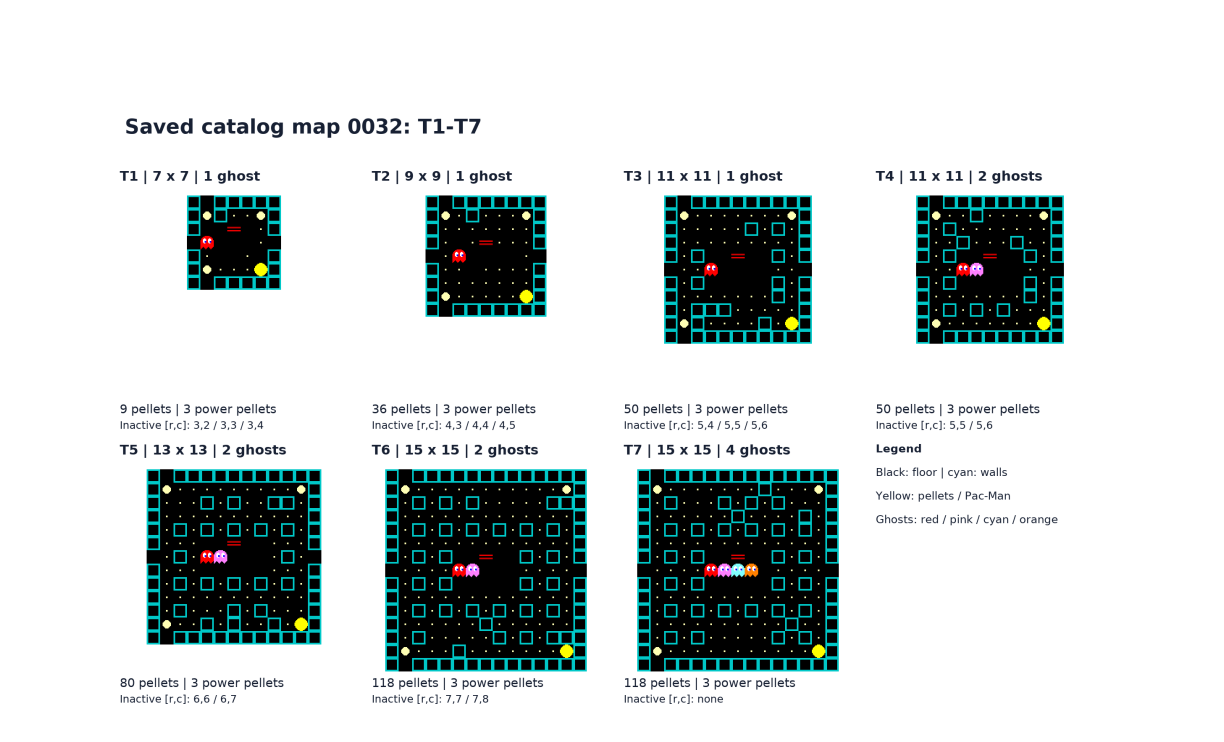
Yet the abstract says 'eight held-out mazes,' and G.4 says the 96 validation episodes 'use eight disjoint held-out tier-7 maps, identifiers 0032–0039.' Figure 3's catalog-level statement that training maps are 0000–0031 supports a catalog split but does not establish per-slot separation, especially because the paper says later replay and failure-state restarts are not described by those examples. The 0/96 at checkpoint 0 does not close the gap, because checkpoint 0 is pre-RL but pretrained and could score zero on familiar layouts. This is load-bearing for the 80.2% headline, though it does not invalidate the broader procedural conclusion. Please either release a per-slot map manifest or reconstruct the training map IDs, or relabel the panel consistently as a fixed documented validation panel and remove 'held-out' from the abstract and G.4.
The paper says, at Abstract; §4.1; §3.2; Figure 1; Appendix M.1
The review did not quote this passage.
Pith says: Objection 2 of 3 · major
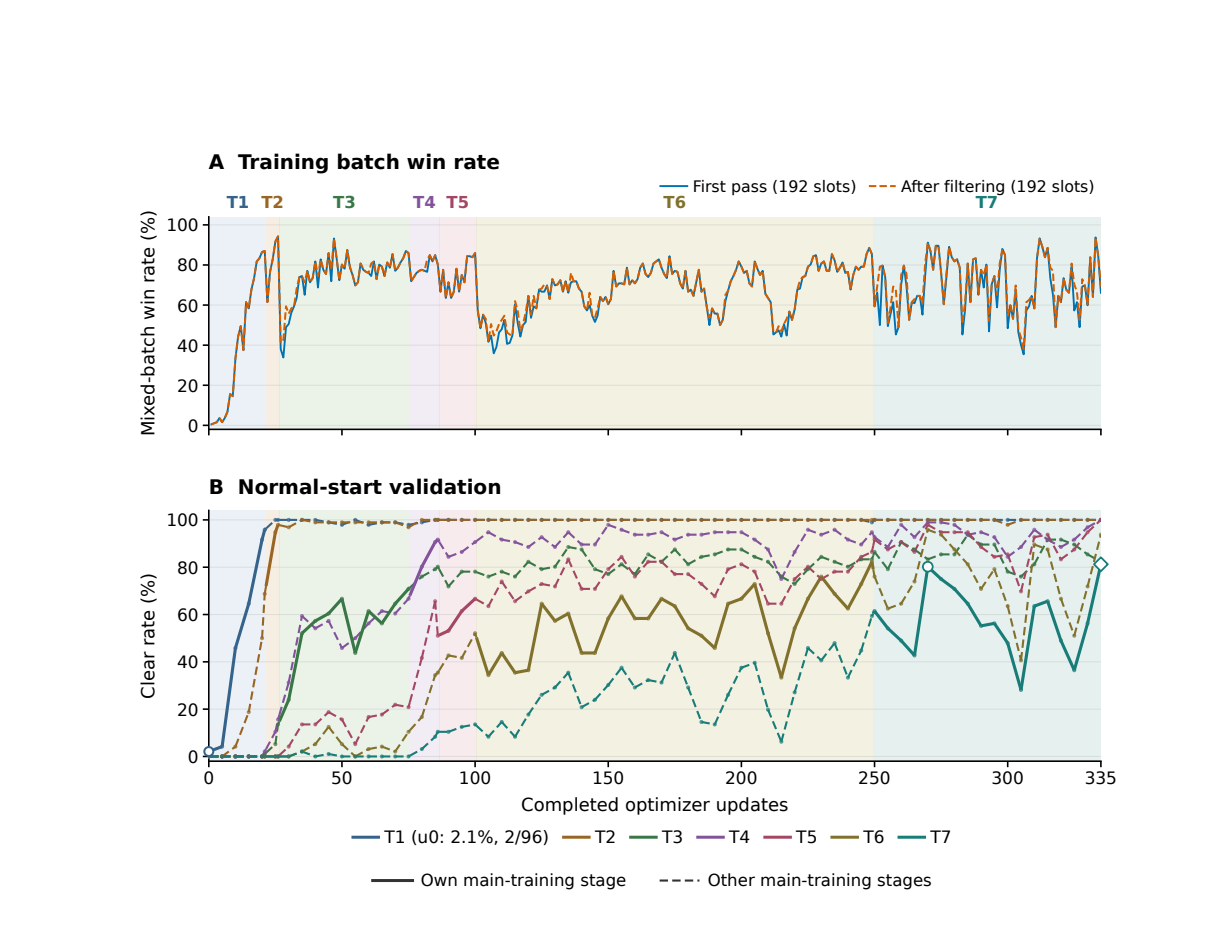
'Selected checkpoint 270' is never defined, and the manuscript uses 'selected' for at least two checkpoints. The abstract's 80.2% is 77/96 at 270, while Appendix M.1 calls 335 'selected as the best among nineteen post-resume complete validation checks' at 78/96 and says the same validation set is used for selection and reporting.
more of objection 2
Figure 1 adds a third denominator, calling 335 the highest final-stage count among 90 retained checks. A reader cannot tell whether 270 was pre-specified as the endpoint of the first continuation, selected on the panel, or chosen for another reason. If 270 is a pre-specified endpoint, call it that and reserve 'selected' for a stated selection rule; if it is selected on the panel, the 0-to-77 contrast is selection-biased and the abstract should say so. Please give the selection rule and reconcile the 90-check and 19-check denominators.
The paper says, at §4.1; Table 1; Appendix M.1
The review did not quote this passage.
Pith says: Objection 3 of 3 · major
The headline 80.2% is an aggregate over 96 attempts that are twelve samples on each of eight layouts, but the paper does not give the per-layout distribution for the 0/270 or 335/425 comparisons. The paper correctly says the 96 attempts are not 96 independent layouts, and Appendix M.1 says the later aggregate query records do not retain per-map win counts.
more of objection 3
For a paper whose central methodological point is the unit of evidence, the reader needs to know whether 77/96 is spread across the eight maps or driven by a subset. If the retained 192 endpoint rows contain layout identity, add the per-layout counts; if they do not, state explicitly in §4.1 and the abstract that the eight-layout distribution is unavailable and avoid language that implies a characterized eight-layout improvement.
7 minor objections
The paper says, at §3.2, equation for the normal-start completion estimate
Pith says: minor objection 1 of 7
The denominator is typeset as '18·12' in the extracted text; please write '(1/(8·12))' or '1/96' explicitly so it is not read as 216.
The paper says, at Figure 1 caption; Appendix M.1
Pith says: minor objection 2 of 7
Define the relation between '90 retained checks' and 'nineteen post-resume complete validation checks,' and state which set supports the 'highest' claim for checkpoint 335.
show 5 more
The paper says, at Abstract; §4.3
Pith says: minor objection 3 of 7
The claim that accurate static screenshot reading can coexist with interactive errors rests on 24 greedy exact outputs from one canonical map, compared with 18/20 full-map and 131/138 actor queries from three short windows; add 'in these panels' or 'on this 24-image bank from one map' to the abstract so the cross-panel rather than within-image comparison is explicit.
The paper says, at Abstract; §4.4 and Appendix G.3
Pith says: minor objection 4 of 7
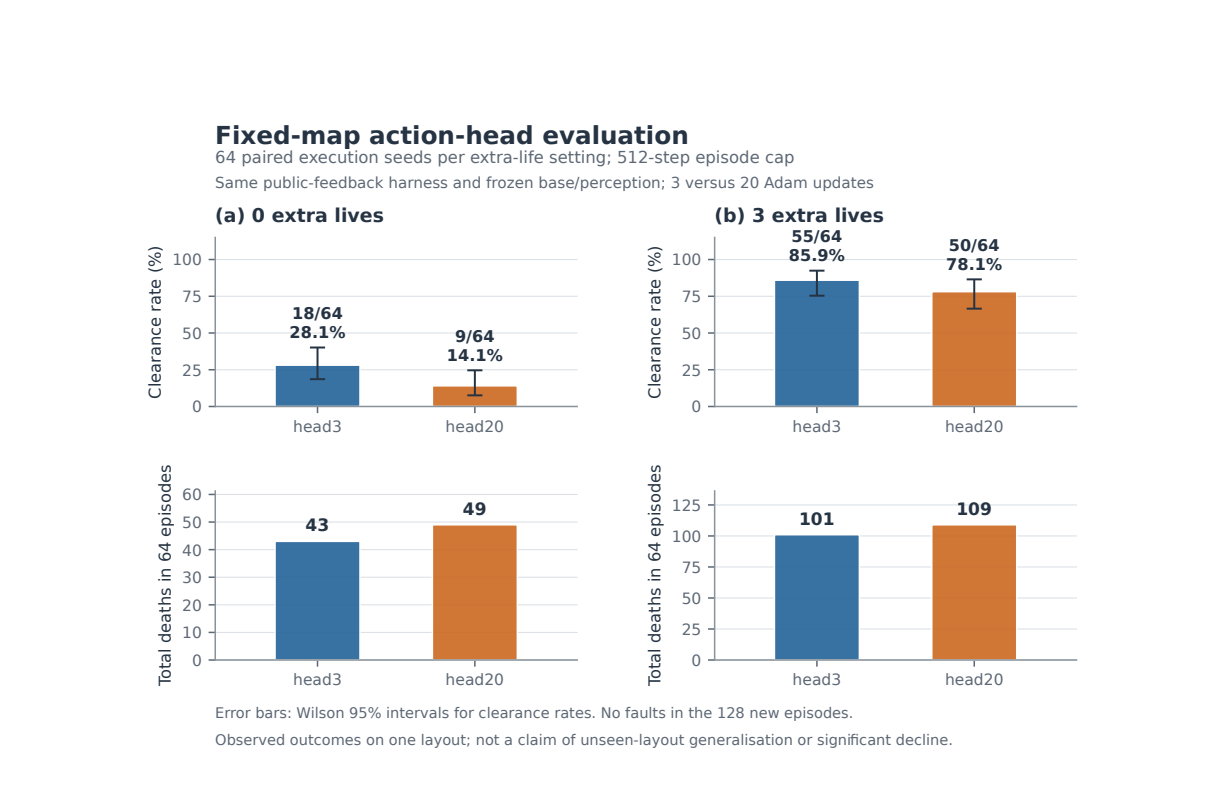
The action-head comparison is on one fixed map with 64 paired seeds, and both conservative bounds include zero; add that scope and the non-significant paired test to the abstract so 'can accompany worse action choices' is not read as a general or statistically significant decline.
The paper says, at Title; §P.5
Pith says: minor objection 5 of 7
'Memory' is supported by one traced overwrite in Figure 6 and bounded revised-memory checks, not by a full-episode memory ablation; the paper acknowledges this in §P.3, but the title and abstract should state that scope more explicitly, or use 'state maintenance' in the title.
The paper says, at Appendix M.1
Pith says: minor objection 6 of 7
The sentence 'Only 335 and 365 reach 80%' is true of the post-resume branch but reads as a global claim because checkpoint 270 is 77/96, also 80.2%, in the earlier branch; add 'in this post-resume branch.'
The paper says, at Appendix Q
Pith says: minor objection 7 of 7
The released package is an analysis archive, not a complete training or environment reproducer; state this in the main reproducibility sentence so readers do not overestimate what the companion makes runnable.
What would settle it
Enumerate the map identifiers retained in the T7 restart-bank audit of §M (updates 271-320: the 64-state bank plus the 520 sampled slots) and the "two training maps" behind the eleven restart states of Table 2, then intersect that set with the validation identifiers 0032-0039. This is a CPU-only join over records the paper says already exist, since §M reports that each bank "covers only two to five maps." An empty intersection confirms disjointness for the T7 restart sources and supports keeping "held-out" in the abstract. Any overlap would require restating 80.2% as within-catalog performance and removing "held-out" from both the abstract and §4.1.
from the skeptic's reading
How the review went
4 readings by deepseek-v4-flash · 5 Nov 2026
- Reader holds up, with conditions
- Skeptic agrees
- Editor wrote the verdict above
- Referee major revision: 3 major objections, 7 minor
Not run on this paper: the simulated authors' defence.
Pith did not check this review's objections against the paper.
The review in full
The review in brief, machine-written
I'd put this in front of students, and I'd send it out for review. It's a case study, not a method paper, and its contribution is bookkeeping discipline: it keeps perception, memory, and decision evidence in separate ledgers with separate denominators, and it refuses to pool them. That's rarer than it should be.
The concrete results are worth having. Static reading looks near-solved (24/24 greedy, 69/72 sampled, 37,797/37,800 cells) while three complete maps are wrong, which makes the point that a cell average hides a board-level misread. Closed-loop actor reading is 131/138 with the residual errors on ghosts, not on Pac-Man. The batch-333 audit is the best thing in the paper: a 192/192 all-win batch decomposed into eleven restart states on two source maps, with 96 of 132 restarts beginning with fifteen or fewer of 118 pellets left. Anyone who has read a training curve at face value should sit with that table. And the paired action-head comparison is exemplary restraint: they report the decline, ship exact Clopper-Pearson discordance bounds that include zero [b384], and decline to claim harm.
Credit also for the negative housekeeping. They throw out their own legacy 55.17% row as an unrecoverable denominator [b500], keep the stopped branch separate from the restored-from-330 branch [b116], and label the T7 panel as descriptive validation rather than generalization [b38]. That is what honest reporting of a messy development record looks like.
The soft spot is the one your skeptic flagged, and it holds. G.4 calls T7 maps 0032–0039 "eight disjoint held-out" maps while the training catalog is 0000–0031, which is a catalog-level split; §2 concedes that per-slot map identities were not retained [b38]; the abstract then says "eight held-out mazes." The body's reading is the defensible one, and the abstract should match it. The 0/96 baseline can't settle it, since checkpoint 0 precedes RL but not pretraining. But this touches one sentence, not the argument: the persistence finding is a repeated measure on the same panel, and the batch-333 concentration is internal to the training record. Secondary and acknowledged: the 0-to-270 contrast bundles curriculum and software changes so it identifies no technique, there is no training-seed replication, and the recipe is withheld pending employer approval. All stated by the authors; all proportionate to a single-system case study.
Recommendation: accept for review, but tell referees to check the arithmetic and the held-out wording, not to demand a new algorithm. I wouldn't cite the numbers myself; I would hand the paper to anyone writing an agent evaluation section.
The strongest objection
For the abstract's number to mean what it says - completion on "eight held-out mazes" rising "from 0% before this optimization to 80.2%" - the validation layouts must be disjoint from every map the policy trained on. The paper contains both the claim and the retraction. G.4 states the 96 validation episodes "use eight disjoint held-out tier-7 maps, identifiers 0032-0039," and the Figure 3 caption states "Training catalog maps are 0000-0031," which is a catalog-level split. But §2 states that "complete per-training-slot map identities are not retained, so panel names alone cannot independently prove global train/validation separation" (b38), and §M.1 notes the compact training exports carry tier labels rather than map and split fields. The abstract adopts the stronger of the two readings while the body keeps only the weaker one.
The 0/96 baseline cannot arbitrate this. Checkpoint 0 precedes RL in this run, so it could plausibly score 0/96 even on layouts the pretrained model had already encountered during training. The zero is therefore consistent with both a disjoint panel and an overlapping one, and cannot be used as independent evidence of separation.
The concern does not reach the central claim. The persistence finding (78/96 at 335, 60/96 at 425, with 17/96 at 375) is a repeated measure on the same panel, and the batch-333 concentration finding (96 of 132 restart attempts beginning with at most 15 of 118 pellets left, drawn from eleven states on two maps) is internal to the training record. Neither requires a clean held-out split. The paper also already relabels the panel as "descriptive validation" and states it is "not a new independent test." So what is at stake is the scope of one abstract sentence, not the structure of the argument.
I read this as a documented development record rather than an algorithmic contribution, and I checked the arithmetic before deciding where to push. The internal counts reconcile: 77/96 = 80.2%; Table 2's eleven states and 132 attempts sum correctly (4+4+3 states, 48+48+36 attempts); 24+72+10 = 106 matches the output count in Appendix J.1; the three sampled transcription errors correspond exactly to the three wrong cells in 37,797/37,800; the paired action-head discordances (5 improve and 14 regress; 8 and 13) net to the reported 18-to-9 and 55-to-50 changes; Table 1's stage deltas match the sentence about three panels higher, one unchanged and two lower; and Table 13's nineteen post-resume checks match the "best among nineteen" claim, with only 335 and 365 at or above 80%. The check-to-check swings (77/96 at 270, 27/96 at 305, 78/96 at 335, 17/96 at 375) are far too large to be binomial noise on eight layouts times twelve replicas, so they plausibly reflect real policy or serving changes, which is what the paper claims.
Credit where due: the manuscript is unusually disciplined about units - frames versus games, seeds versus layouts, faults versus deaths, first-pass versus filtered batches - and it ships a CPU-only paired-statistics reproduction for the 128 seed pairs. Its limitations are stated rather than hidden, which is why my concern is narrow.
I agree with the reader's choice of weakest assumption. G.4 and the Figure 3 caption assert the split, §2 withdraws independent verification of it, and the abstract uses the stronger form. I weight it as partial rather than decisive because the paper's own interpretation of the panel is already "descriptive validation," and because the central procedural claim - that one aggregate score cannot certify competence - is carried by same-panel repeated measures and by the training-start decomposition, neither of which depends on the split. That is also why I would not move the verdict: CONDITIONAL already encodes this gap, along with the bundled 0-to-270 interval, the absence of training-seed replication, and the withheld artifacts in Appendix Q. The concern narrows what the 80.2% sentence is entitled to say; it does not change the grade.
The referee's report
The paper deserves credit for unusually disciplined bookkeeping in this genre: denominators are stated per panel, repeated samples are distinguished from independent layouts, incompatible feedback and life-budget settings are not pooled, and the paired action-head comparison ships exact Clopper-Pearson discordance bounds that include zero alongside the observed p-values. The perception section also separates response validity from exact visible-state content and repeated decodes from independent images. These are real methodological strengths. The contribution is a diagnostic case study, not a new algorithm, and its reach is limited by one game, one model family, no training-seed replication, and partial artifact release, most of which the authors acknowledge.
Pith's reading of the paper (a machine's summary, not the authors')
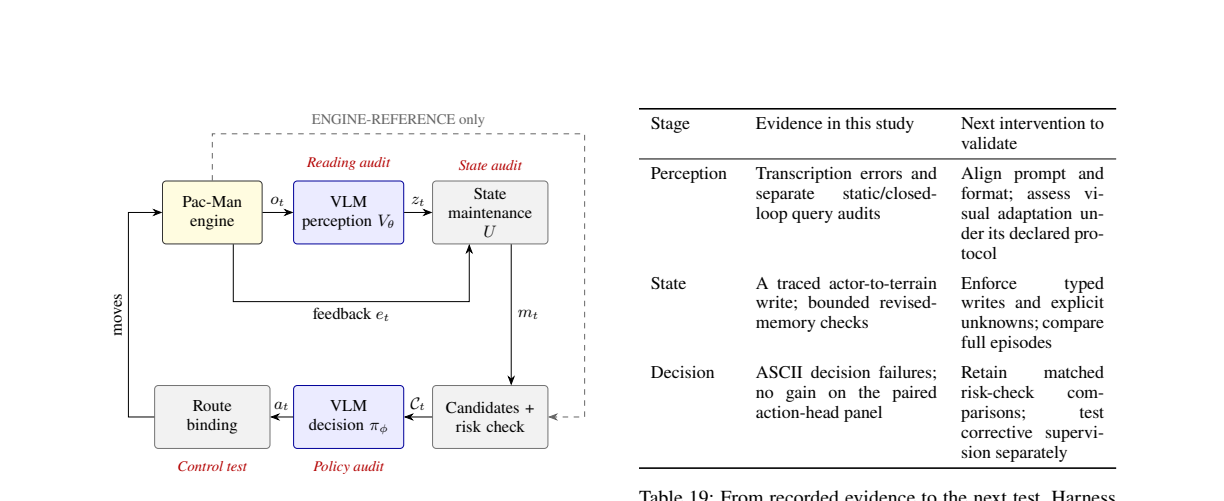
Training a model to play Pac-Man with four arrow keys looks like one problem. This paper argues it is at least three: reading the board off the screen, keeping track of state as the game moves, and choosing a direction whose consequences arrive many steps later. The authors work through the development records of a Qwen3.5-9B-based agent and present each stage failing on its own kind of evidence: near-perfect static screenshot transcription sitting alongside reading errors during play, a single misread cell overwriting a wall in maintained memory, a separate text-board policy whose validation clears fall from 59/96 to 37/96 as training continues, and a fixed-map action-head comparison in which three extra optimizer updates buy no measured gain. The headline training result is a rise from 0/96 to 77/96 clears on eight documented held-out mazes after policy optimization, but the same records show 78/96 at the peak and 60/96 at the last complete check, so a selected checkpoint is not a stable level of play. The claim is procedural rather than algorithmic: audit perception on the observations the policy actually consumes, say which start distribution a training win came from, and report more than one checkpoint before calling a number an improvement.
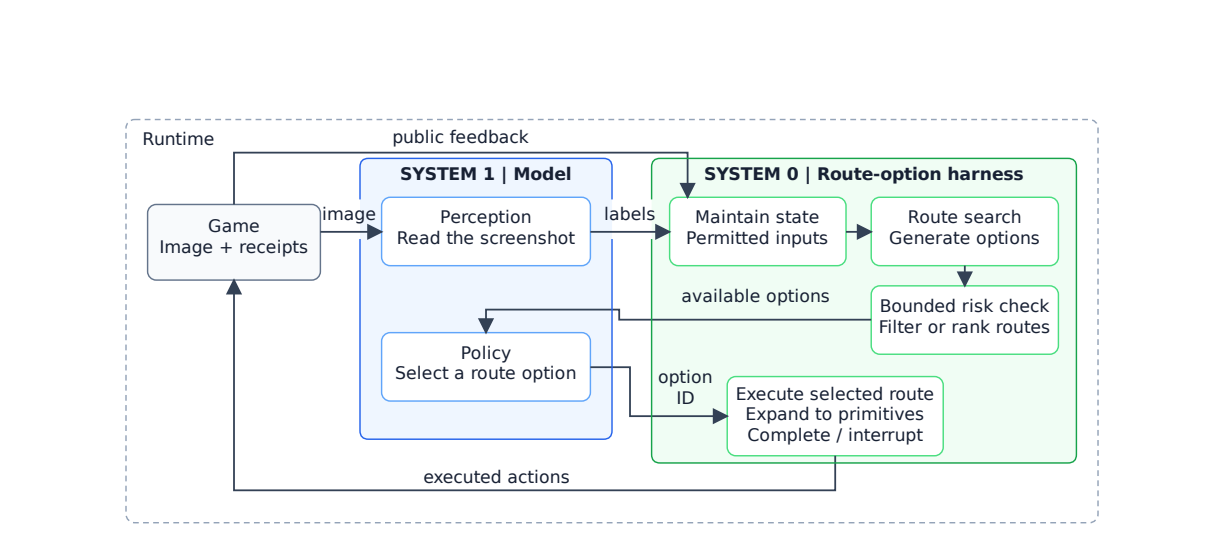
What carries the argument. The load-bearing device is a three-stage decomposition of the agent, written as $z_t = V_\theta(o_t)$ for reading the permitted observation, $m_t = U(m_{t-1}, z_t, e_t)$ for maintaining state from what the agent is allowed to see plus public feedback, and $a_t = \pi_\phi(o_t, m_t, C_t)$ for choosing among candidates. Alongside it sits an explicit information contract that separates what the policy may consume (screenshots plus typed public receipts, with engine coordinates, hidden maps and ghost internals reserved for scoring and audit) from what the diagnostic harness may know. The second device is a bookkeeping discipline for what a win means: mixed-start batches built from saved pre-death states are reported separately from normal-start validation, and the paper shows why that separation matters, since one batch cleared 192/192 first-pass episodes while 96 of its 132 final-stage restarts began with at most fifteen of 118 pellets remaining, against a normal-start panel where the same branch scored 54/96. Together these let the authors say which stage a number is about and which part of the task a training win actually exercised.
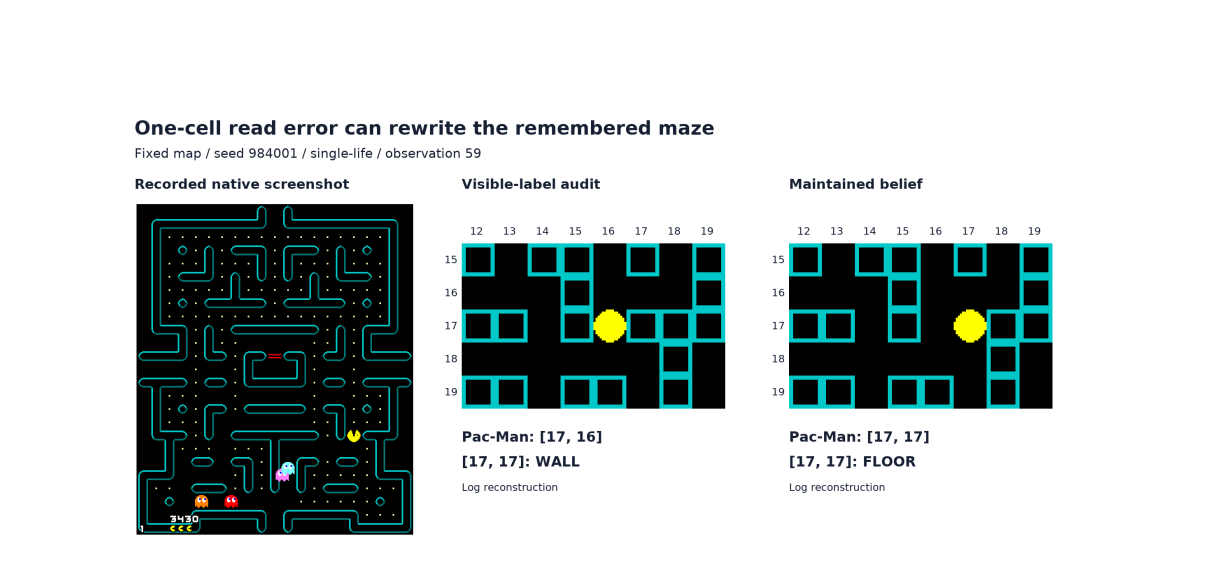
Core claim. The paper's central claim is that competence in a vision-language game agent decomposes into stages that must be measured separately, and that an aggregate completion score mixes them in a way that hides which stage is broken. The authors support this with retained records from one project rather than a new method. On the policy side, an ASCII primitive-action lineage rises from 0/96 to 77/96 normal-start clears at checkpoint 270 on eight documented held-out mazes with three extra lives and a 512-step cap, peaks at 78/96 at checkpoint 335, and is 60/96 at the last complete check at 425, so the reported endpoint and the retained trajectory answer different questions. On the perception side a frozen-reader audit transcribes 24/24 screenshots exactly under greedy decoding and 69/72 under sampling, yet closed-loop windows give 18/20 exact full-map queries and 131/138 exact visible-actor sets, and the map errors are of a specific kind: an occluded unknown cell is asserted as empty floor. On the decision side, a separate ASCII lineage drops from 59/96 to 37/96 validation clears later in training, with replayed regressions containing immediately lethal choices while an exit is open, and a paired fixed-map comparison of three versus twenty action-head updates shows 18/64 versus 9/64 clears at zero extra lives, an observed decline whose conservative paired interval still includes zero. The authors are careful that none of these isolated comparisons proves a general effect of reinforcement learning; what they do establish is that the three failure families are distinct and that a single score cannot distinguish them.
The premise it rests on. The eight fixed mazes used for every headline completion number are genuinely disjoint from training; the authors state that complete per-training-slot map identities were not retained, so the panel names alone cannot prove that separation, and if any of those layouts appeared in training the 0/96 to 77/96 rise measures familiarity with layouts rather than learned play.
If the paper is right (Pith's inferences, not the authors')
A reported completion rate means little without its start distribution: suffix wins from saved near-end states and wins from the initial game state measure different tasks and should be reported under different names.
Checkpoint selection and checkpoint retention need separate reporting, since the selected peak and the last complete check on the same panel differ substantially in these records.
Perception should be audited on the observations the policy actually consumes during interaction, because static transcription accuracy was near-perfect while in-play reading still produced board-level errors.
Where decision failures persist with pixels removed entirely, further perception work cannot repair them, and the next test should target available alternatives and the learning signal instead.
Board-level exactness, not average per-cell accuracy, is the right unit for a structured reading task, since a near-perfect cell average still concealed fully wrong maps.
The failure signature of an occluded cell written down as empty floor is the most transferable finding here: any agent that converts uncertain observations into definite assertions will propagate those assertions into its own state, and a rule that keeps unknown cells unknown is cheap to test in isolation.
The three-stage decomposition suggests a practical triage order for anyone debugging a similar agent: replay a failed episode with oracle substitutions at each stage and see which one restores behaviour, rather than retraining the whole stack and watching one number.
The gap between a 192/192 training batch and a 54/96 normal-start panel on the same branch is a clean illustration that concentrated restart states buy concentrated wins; this is measurable in advance, by counting distinct source games per batch rather than distinct state identifiers.
Because several of the reported comparisons come from different rounds with different feedback, life budgets and harness versions, an outside reader cannot reconstruct a single ranking of checkpoints from them; the paper's own recommendation of reserving a separate layout sample for reporting would settle what these records cannot.
Check this review
Pith stored no record of this review's passes and took no fingerprint of it. Reviews made by code from 13 Nov 2026 on carry both.
How often reviews like this one are right
Reviews like this one: written by deepseek-v4-flash, where what was read was not recorded.
How often objections from reviews like this one are right: not yet measured
Reviews by people
This review was written by a machine. No person has reviewed this paper on Pith yet. A scientist listed on Pith can review it for a fee, and their review is published here whatever it concludes.
The paper
Abstract
Spatial agents must interpret observations, maintain consistent spatial memory and make decisions over long interactions. We use Pac-Man as a testbed to study the training challenges behind these capabilities in a Qwen3.5-9B-based agent. Our research trajectory progresses from primitive-action RL on text-based mazes to visual inputs with an internal-state-assisted harness, then toward observation-driven memory and joint policy–harness improvement. The main analysis focuses on text-based maze RL; supplementary sections report visual-adaptation and harness experiments and discuss subsequent directions. Text-based maze RL requires curriculum and training-recipe design to overcome cold starts; normal-start clear rates on eight held-out mazes rise from 0% to a peak of 81.25%. In the second step, model adaptation and harness improvements raise the clear rate from 26.6% to 96.9% on one fixed map with three extra lives. These results highlight three development lessons: use curricula to address cold starts, establish visual grounding before language adaptation, and treat harness design as a determinant of agent performance. They provide practical guidance for subsequent VLM training and spatial-agent development.
The paper's own sentences, arranged, kept beside the review and separate from it. Each label is drawn from a closed vocabulary; the number beside it is the probability the classifier gave that label. No sentence in this record was written by a model.
abstract compiled · 2026-11-05
The authors' main claim, as the classifier picked it out 1.00
“Together, these findings motivate concrete checks for post-training: evaluate perception in use, distinguish training success from full-game validation, and examine decisions and later performance rather than relying on one selected score.”
How the main claim is stated: asserted 0.71
What the abstract itself states, as probabilities: claims first 0.03 · states limitation 0.74 · human participants 0.03 · controlled comparison 0.60 · randomized assignment 0.02 · states quantitative result 0.98 · compares with prior results 0.66 · mentions code or data availability 0.03
The abstract, sentence by sentence
This table labels the abstract only (arXiv listing abstract v1). The number is the probability the classifier gave the label.
| Sentence | Role | The authors' own work | States the main conclusion | Strength |
|---|---|---|---|---|
| Training an agent to play Pac-Man with only up, down, left and right actions raises a basic question: when performance is poor, what should be improved? | background 0.86 | 0.15 | 0.02 | asserted 0.48 |
| Difficulty can arise from reading the screen or from choosing actions over a long sequence. | background 0.97 | 0.09 | 0.04 | hedged possibility 0.89 |
| We examine these problems in a Qwen3.5-9B-based agent through separate perception checks and primitive-policy reinforcement-learning studies. | method 0.67 | 0.92 | 0.04 | asserted 0.94 |
| In the policy study, which uses textual boards to remove image transcription from the decision interface, completion on eight held-out mazes increased from 0% before this optimization to 80.2% at a selected checkpoint, with three extra lives. | result 1.00 | 0.96 | 0.09 | asserted 1.00 |
| The perception checks show that accurate static screenshot reading can coexist with errors during interaction. | result 0.99 | 0.93 | 0.12 | asserted 0.98 |
| A separate policy comparison also shows that further optimization can accompany worse action choices. | result 0.99 | 0.90 | 0.08 | asserted 0.97 |
| Together, these findings motivate concrete checks for post-training: evaluate perception in use, distinguish training success from full-game validation, and examine decisions and later performance rather than relying on one selected score. | future work 0.55 | 0.53 | 0.85 | asserted 0.71 |
| The study provides empirical lessons for improving future agent training and evaluation. | interpretation 0.43 | 0.55 | 0.10 | asserted 0.99 |
What kind of paper the classifier reports this is: empirical study 1.00 · evidence from observation or experiment 0.94
What was examined, and what was not
Sources read
- arXiv listing abstract v1
Not examined
- full text
- figures and tables
- references and citing sentences
- relations to other papers
Levels run
- P abstract
Not run
- S sections
- T body sentences
- C citations
- R cross-paper relations
How the labels were made
Compiled by classifier-1.13.0 via TypeSafe API, question bank abstract-p1-20260923, 2026-11-05: 1 request, 6,166 input tokens.
Every quoted sentence on this record is the authors'. Every label is from Pith's closed vocabulary, with the probability shown beside it. This record as JSON
Figures (6)
Figures are the authors', reproduced from the paper.
Challenges and discussion
Disagree with the review, or know something it missed? Leave a comment, or challenge this review formally: a challenge becomes a permanent entry in this paper's record, and its decision is published here.
Come back by email
A short list of the week's newly reviewed papers. Nothing is sent until you confirm from your inbox, and every email has a link that stops it. No account.
No comments yet.
Sign in to comment