Sound · arXiv:2611.06982 v1 · submitted 4 Nov 2026 · 41 references
Decode Before You Hear: Speculative Listening for Chunk-Interleaved Full-Duplex Speech Language Models
The paper says
“Chunk-interleaved full-duplex speech language models listen and speak in fixed time chunks, and each chunk must be processed before the next one arrives.”
more of the abstract
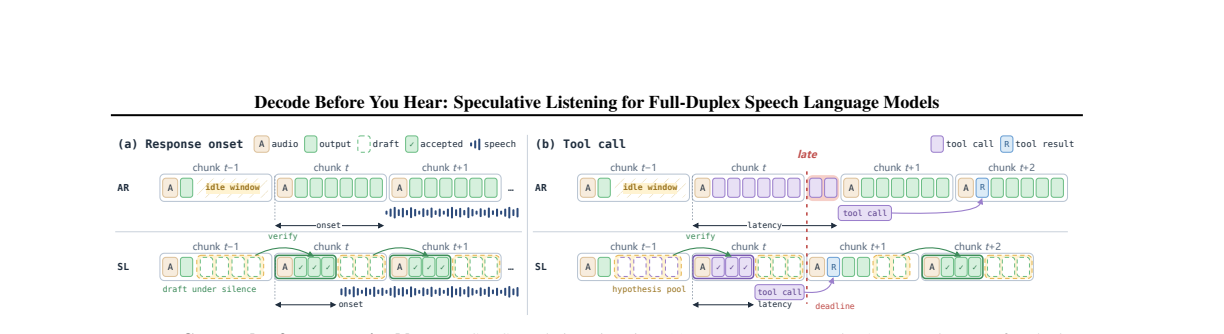
Their workload is asymmetric across chunks: listen chunks leave compute idle while awaiting audio, and speak and tool-call chunks require serial generation, which delays responses and tool calls. Using the idle compute for the next chunk requires decoding it before its audio arrives, under an assumed input. Taking silence as the assumed input and comparing the output with the output under real audio on four models, we observe two properties. First, the next audio chunk does not change the output in 95.3% of chunks. Second, 88% of changes begin at the first output token. Building on these properties, we propose Speculative Listening, a training-free, lossless framework for input-time self-speculative decoding. During idle time, the model drafts the next chunk under silence and, for changes at the first token, a second branch from the runner-up first token. It keeps all drafts in a cross-chunk hypothesis pool and verifies them when the audio arrives. On our eight-task benchmark TickTock-Bench, Speculative Listening speeds up speak chunks by 2.6-2.8x and tool-call chunks by up to 23.4x. On average, it reduces the decoding delay before a response starts by 73%, to 74-241 ms, close to the 200 ms gap between human turns, and the maximum lag behind real time by 94.4%.
from the abstract
Pith says
Machine review · deepseek-v4-flash · 6 Nov 2026 · what was read was not recorded · not checked by a person
It can be wrong. Challenge this review or reply to it.
Holds up. Speculative Listening is a clean, training-free method that exploits the surprising stability of chunk outputs under silence to cut latency dramatically; the empirical foundation holds up within the stated scope. This line is wrong
4 minor
How often objections from reviews like this one are right: not yet measured
Not checked: figures, code, what the 41 references say.
4 minor objections
The paper says, at Section 3.2 / Figure 3
Pith says: minor objection 1 of 4
The profiling methodology for the idle-window fraction (70–89%) is not described. Please briefly explain how these numbers were obtained (e.g., measure the GPU idle period between the end of forward passes and the start of the next chunk). This would help replicability and reassure readers that the idle window is a reliable compute budget.
The paper says, at Table 2 / Table 8
Pith says: minor objection 2 of 4
The #MAT metric is defined as 'output tokens per target forward pass over all chunks relative to AR'. The values in Table 8 are not normalized to 1.00 for AR (they are absolute counts). Clarify in the caption or main text whether the reported #MAT values are already relative to AR, or if they are raw counts. If raw counts, the normalized #MAT (as used in the abstract of Table 2) should be stated explicitly.
show 2 more
The paper says, at Section 5.4 / Figure 4a
Pith says: minor objection 3 of 4
Figure 4a shows a shaded bin for '9–32 tokens' with the note 'contains no chunks'. Either explain why this bin is empty (e.g., because the dataset used for this analysis does not produce chunks of that length) or remove the bin from the figure to avoid confusion.
The paper says, at Section A (Benchmark Details)
Pith says: minor objection 4 of 4
The lag accumulation formula is given but the chunk duration is not explicitly stated in the formula (it appears only in the description). Consider writing it as b_t = max(0, b_{t-1} + ℓ_t - D) where D is the chunk duration, for clarity.
What would settle it
If replication were desired, one could independently run the oracle probe of Section 3.2 on a new chunk-interleaved model (e.g., MiniCPM-o or a variant not tested) on the ticktock-Bench tasks. If the chunk-level acceptance rate of the silence draft drops below 60% across all speak chunks, the speedups would likely fall significantly, weakening the generalizability claim. Such a test would directly assess the load-bearing assumption.
from the skeptic's reading
How the review went
4 readings by deepseek-v4-flash · 6 Nov 2026
- Reader holds up
- Skeptic agrees
- Editor wrote the verdict above
- Referee minor revision: 4 minor
Not run on this paper: the simulated authors' defence.
Pith did not check this review's objections against the paper.
The review in full
The review in brief, machine-written
Speculative Listening does something genuinely new: it uses the idle compute between chunks to draft a response under silence, then verifies when the audio arrives. The key empirical finding—that 95.3% of chunks produce the same output under silence as under real audio, with mismatches concentrated at the first token—is well measured across four models. The speedups (2.6–2.8× on speak chunks, up to 23.4× on tool calls) are large and consistent enough that they would matter in a deployed system.
What I like most is the honesty. The authors explicitly state three limitations: the method is designed for low-concurrency, latency-sensitive deployments; they measured only the Thinker, not the Talker; and it only works on chunk-interleaved architectures. They also report per-model variation in the silence-match rate (Realtime-Venus drops to 37.9% during user speech) and show that speedups persist under temperature sampling and multi-session serving. The ablation study cleanly isolates the contribution of each component. For a training-free method, the empirical support is solid.
The soft spot is the load-bearing assumption: the silence-match rate. If future architectures or tasks yield lower match rates, the speedups will shrink. The paper's own data shows this variation already. But the authors test this honestly, and the method still helps even when acceptance is lower (Table 2 shows 2.4× for tool calls on Gander despite 34% acceptance on tool-call chunks). So the assumption is not fragile in practice, but it is the main empirical lever.
The benchmark TickTock-Bench is a useful contribution for the community. The paper is well written and the claims are within bounds.
Recommendation: accept for peer review. This is a solid piece of applied research with a clear contribution. I would bring it to our reading group.
The strongest objection
The paper's central claim that Speculative Listening yields large speedups on chunk-interleaved full-duplex models rests on the empirical observation that silence-draft outputs match real-audio outputs in 95.3% of chunks, with mismatches concentrated at the first token (Observations 1 and 2, Section 3.2). The reader correctly identifies this as the weakest assumption. However, the paper tests this observation across four diverse models on a new benchmark (760 sessions, 15,883 chunks), reports per-model and per-chunk-type variation (e.g., Realtime-Venus drops to 37.9% during user speech), and shows that the method remains effective even when acceptance varies (Table 2, Figure 4b). The ablation study (Table 4) further confirms the contribution of each component. The authors openly acknowledge three limitations (low-concurrency targeting, Thinker-only measurement, chunk-interleaved scope). No hidden assumption or internally inconsistent step was found. The paper's logic is coherent, and the evidence supports the stated speedups and latency reductions within the claimed scope.
The reader's verdict ACCEPT with MODERATE confidence is appropriate. The paper makes a well-motivated, training-free contribution to decoding latency in a specific architecture. The central empirical observations (95.3% match rate, 88% first-token divergence) are measured carefully across four models and openly reported with variation. The method builds on these observations via a clear self-speculative decoding framework, and the ablation study confirms that each component contributes. The benchmarks and metrics are well-defined, and limitations are honestly stated. No critical red flag or internally inconsistent step was identified. Therefore, the verdict should remain unchanged.
The referee's report
If the results hold, Speculative Listening offers a practical, hardware-agnostic improvement to an important class of streaming speech models. The speedups are large and consistent across four diverse models, and the method is training-free and lossless. The introduced benchmark TickTock-Bench fills a gap by providing a standardized evaluation environment for decoding in chunk-interleaved full-duplex systems. The paper is likely to influence both the design of future full-duplex speech systems and the broader practice of input-time speculative decoding.
Pith's reading of the paper (a machine's summary, not the authors')
Chunk-interleaved full-duplex speech language models leave GPU compute idle while waiting for the next audio chunk. This paper shows that during that idle window, the model can draft the upcoming chunk's output under a silence assumption, verify the draft in one forward pass when the real audio arrives, and correct it only where it diverges. On four models and a new eight-task benchmark, the method speeds up speak chunks by 2.6–2.8×, tool-call chunks by up to 23.4×, reduces the maximum lag behind real time by 94.4%, and shortens the decoding delay before a response starts to 74–241 ms—close to the 200 ms gap between human speakers. The framework is training-free, lossless, and works without a separate draft model.
What carries the argument. The key machinery is input-time self-speculative decoding: the target model drafts the next chunk's output under a silence hypothesis during the idle compute window, verifies the draft in a single forward pass once the real audio arrives, and uses a hypothesis pool (indexed by N-grams) plus a runner-up branch at the first token to cover mismatches. The verification step is identical to the verification in standard speculative decoding, making the framework lossless.
Core claim. The paper identifies two empirical properties of chunk outputs in chunk-interleaved full-duplex models: (1) the next audio chunk usually does not change the output—the output under silence matches the real-audio output token-for-token in 95.3% of chunks across four models; (2) when the output does change, 88% of the divergences begin at the first output token (the listen/speak decision). Building on these, Speculative Listening drafts the next chunk under silence during the idle window, maintains a cross-chunk hypothesis pool of drafts (including a runner-up branch for first-token divergences), and verifies the entire draft in the forward pass that processes the real audio. Post-audio computation then grows only with tokens that the draft got wrong. On TickTock-Bench, a benchmark of 760 sessions spanning speech reasoning, conversational dynamics, and agentic tool use, Speculative Listening achieves the stated speedups while preserving output quality.
The premise it rests on. The silence draft matches the real-audio output in 95.3% of chunks on average; the method's speedup depends on this acceptance rate being high, and it varies across models (e.g., Realtime-Venus drops to 37.9% during user speech) and may change for new architectures or tasks.
If the paper is right (Pith's inferences, not the authors')
Tool calls that previously took 1.8–2.6 s and missed the chunk deadline become ready within the chunk duration on average.
Response onset latency drops from 417–1089 ms to 74–241 ms, moving the model into the range of human turn-taking gaps (≈200 ms).
The maximum lag behind the incoming audio per session falls by 94.4% on average, preventing conversational staleness.
The method applies without retraining, fine-tuning, or a separate draft model, making it immediately usable on existing chunk-interleaved models.
The silence hypothesis exploits a feature of many current models: the model often decides to keep listening or speaks a response that does not depend on the exact acoustic details of the latest chunk. If future models produce outputs that are more sensitive to the incoming audio, the 95.3% acceptance rate may drop, reducing the speedup.
The approach is limited to chunk-interleaved architectures with idle windows. Parallel-stream models that decode at every audio frame (e.g., Moshi) require a different formulation, as the authors note.
At higher concurrency (multiple sessions per GPU), the idle window shrinks and the speedup decreases, but the method remains effective: on Streaming SLM with 4 concurrent sessions, speak-chunk speedup drops from 2.9× to 2.0×, and tool-call speedup from 22.7× to 10.5×.
Check this review
Pith stored no record of this review's passes and took no fingerprint of it. Reviews made by code from 13 Nov 2026 on carry both.
How often reviews like this one are right
Reviews like this one: written by deepseek-v4-flash, where what was read was not recorded.
How often objections from reviews like this one are right: not yet measured
Reviews by people
This review was written by a machine. No person has reviewed this paper on Pith yet. A scientist listed on Pith can review it for a fee, and their review is published here whatever it concludes.
The paper
Abstract
Chunk-interleaved full-duplex speech language models listen and speak in fixed time chunks, and each chunk must be processed before the next one arrives. Their workload is asymmetric across chunks: listen chunks leave compute idle while awaiting audio, and speak and tool-call chunks require serial generation, which delays responses and tool calls. Using the idle compute for the next chunk requires decoding it before its audio arrives, under an assumed input. Taking silence as the assumed input and comparing the output with the output under real audio on four models, we observe two properties. First, the next audio chunk does not change the output in 95.3% of chunks. Second, 88% of changes begin at the first output token. Building on these properties, we propose Speculative Listening, a training-free, lossless framework for input-time self-speculative decoding. During idle time, the model drafts the next chunk under silence and, for changes at the first token, a second branch from the runner-up first token. It keeps all drafts in a cross-chunk hypothesis pool and verifies them when the audio arrives. On our eight-task benchmark TickTock-Bench, Speculative Listening speeds up speak chunks by 2.6-2.8x and tool-call chunks by up to 23.4x. On average, it reduces the decoding delay before a response starts by 73%, to 74-241 ms, close to the 200 ms gap between human turns, and the maximum lag behind real time by 94.4%.
The paper's own sentences, arranged, kept beside the review and separate from it. Each label is drawn from a closed vocabulary; the number beside it is the probability the classifier gave that label. No sentence in this record was written by a model.
abstract compiled · 2026-11-06
The authors' main claim, as the classifier picked it out 0.54
“On average, it reduces the decoding delay before a response starts by 73%, to 74-241 ms, close to the 200 ms gap between human turns, and the maximum lag behind real time by 94.4%.”
How the main claim is stated: asserted 1.00
What the abstract itself states, as probabilities: claims first 0.05 · states limitation 0.63 · human participants 0.08 · controlled comparison 0.82 · randomized assignment 0.02 · states quantitative result 0.99 · compares with prior results 0.30 · mentions code or data availability 0.03
The abstract, sentence by sentence
This table labels the abstract only (arXiv listing abstract v1). The number is the probability the classifier gave the label.
| Sentence | Role | The authors' own work | States the main conclusion | Strength |
|---|---|---|---|---|
| Chunk-interleaved full-duplex speech language models listen and speak in fixed time chunks, and each chunk must be processed before the next one arrives. | background 1.00 | 0.07 | 0.02 | asserted 1.00 |
| Their workload is asymmetric across chunks: listen chunks leave compute idle while awaiting audio, and speak and tool-call chunks require serial generation, which delays responses and tool calls. | background 0.97 | 0.15 | 0.02 | asserted 1.00 |
| Using the idle compute for the next chunk requires decoding it before its audio arrives, under an assumed input. | background 0.58 | 0.11 | 0.05 | asserted 0.81 |
| Taking silence as the assumed input and comparing the output with the output under real audio on four models, we observe two properties. | method 0.76 | 0.94 | 0.03 | asserted 0.93 |
| First, the next audio chunk does not change the output in 95.3% of chunks. | result 1.00 | 0.95 | 0.10 | asserted 1.00 |
| Second, 88% of changes begin at the first output token. | result 1.00 | 0.96 | 0.05 | asserted 1.00 |
| Building on these properties, we propose Speculative Listening, a training-free, lossless framework for input-time self-speculative decoding. | contribution 0.95 | 0.87 | 0.29 | asserted 0.98 |
| During idle time, the model drafts the next chunk under silence and, for changes at the first token, a second branch from the runner-up first token. | method 0.99 | 0.76 | 0.05 | asserted 0.98 |
| It keeps all drafts in a cross-chunk hypothesis pool and verifies them when the audio arrives. | method 0.99 | 0.79 | 0.05 | asserted 0.99 |
| On our eight-task benchmark TickTock-Bench, Speculative Listening speeds up speak chunks by 2.6-2.8x and tool-call chunks by up to 23.4x. | result 1.00 | 0.95 | 0.43 | asserted 1.00 |
| On average, it reduces the decoding delay before a response starts by 73%, to 74-241 ms, close to the 200 ms gap between human turns, and the maximum lag behind real time by 94.4%. | result 1.00 | 0.95 | 0.44 | asserted 1.00 |
What kind of paper the classifier reports this is: method or tool 1.00 · evidence from observation or experiment 1.00
What was examined, and what was not
Sources read
- arXiv listing abstract v1
Not examined
- full text
- figures and tables
- references and citing sentences
- relations to other papers
Levels run
- P abstract
Not run
- S sections
- T body sentences
- C citations
- R cross-paper relations
How the labels were made
Compiled by classifier-1.13.0 via TypeSafe API, question bank abstract-p1-20260923, 2026-11-06: 1 request, 8,223 input tokens.
Every quoted sentence on this record is the authors'. Every label is from Pith's closed vocabulary, with the probability shown beside it. This record as JSON
Figures (6)



Figures are the authors', reproduced from the paper.
References (41)
- [1] Moshi: a speech-text foundation model for real-time dialogue , author=. 2024 , eprint= on Pith
- [2] Junbo Cui and Bokai Xu and Chongyi Wang and Tianyu Yu and Weiyue Sun and Yingjing Xu and Tianran Wang and Zhihui He and Wenshuo Ma and Tianchi Cai and Jiancheng Gui and Luoyuan Zhang and Xian Sun and Fuwei Huang and Moye Chen and Zhuo Lin and Hanyu Liu and Qingxin Gui and Qing... on PithPith's reviewarXiv
- [3] Interaction Models: A Scalable Approach to. Thinking Machines Lab: Connectionism , year = on Pith
- [4] Zhang, Xinrong and Chen, Yingfa and Hu, Shengding and Han, Xu and Xu, Zihang and Xu, Yuanwei and Zhao, Weilin and Sun, Maosong and Liu, Zhiyuan. Beyond the Turn-Based Game: Enabling Real-Time Conversations with Duplex Models. Proceedings of the 2024 Conference on Empirical Met... on Pithdoi:10.18653/v1/2024.emnlp-main.644
- [5] Zhang, Qinglin and Cheng, Luyao and Deng, Chong and Chen, Qian and Wang, Wen and Zheng, Siqi and Liu, Jiaqing and Yu, Hai and Tan, Chao-Hong and Du, Zhihao and Zhang, ShiLiang. O mni F latten: An End-to-end GPT Model for Seamless Voice Conversation. Proceedings of the 63rd Ann... on Pithdoi:10.18653/v1/2025.acl-long.709
- [6] Multimodal Duplex Interaction Agent , author=. 2026 , eprint= on Pith
- [7] Luoyuan Zhang and Bokai Xu and Junbo Cui and Weiyue Sun and Yingjing Xu and Hanyu Liu and Yuan Yao , year=. Liberating. 2606.07547 , archivePrefix= on PithPith's reviewarXiv
- [8] Lin, Guan-Ting and Lian, Jiachen and Li, Tingle and Wang, Qirui and Anumanchipalli, Gopala and Liu, Alexander H. and Lee, Hung-Yi , year=. doi:10.1109/asru65441.2025.11433838 , booktitle= on Pithdoi:10.1109/asru65441.2025.11433838
- [9] Wu, Donghang and Zhang, Haoyang and Chen, Chen and Zhang, Tianyu and Tian, Fei and Yang, Xuerui and Yu, Gang and Liu, Hexin and Hou, Nana and Hu, Yuchen and Chng, Eng Siong. Chronological Thinking in Full-Duplex Spoken Dialogue Language Models. Proceedings of the 27th Annual M... on Pithdoi:10.18653/v1/2026.sigdial-1.33
- [10] Fast Inference from Transformers via Speculative Decoding , author =. Proceedings of the 40th International Conference on Machine Learning , pages =. 2023 , editor = on Pith
- [11] Accelerating Large Language Model Decoding with Speculative Sampling , author=. 2023 , eprint= on Pith
- [12] Li, Yuhui and Wei, Fangyun and Zhang, Chao and Zhang, Hongyang , booktitle =. 2024 , editor = on Pith
- [13] Cai, Tianle and Li, Yuhong and Geng, Zhengyang and Peng, Hongwu and Lee, Jason D. and Chen, Deming and Dao, Tri , booktitle =. Medusa: Simple. 2024 , editor = on Pith
- [14] Prompt Lookup Decoding , author =. 2023 , month = on Pith
- [15] Luo, Xianzhen and Wang, Yixuan and Zhu, Qingfu and Zhang, Zhiming and Zhang, Xuanyu and Yang, Qing and Xu, Dongliang. Turning Trash into Treasure: Accelerating Inference of Large Language Models with Token Recycling. Proceedings of the 63rd Annual Meeting of the A ssociation f... on Pithdoi:10.18653/v1/2025.acl-long.338
- [16] Fu, Yichao and Bailis, Peter and Stoica, Ion and Zhang, Hao , booktitle =. Break the Sequential Dependency of. 2024 , editor = on Pith
- [17] Zhang, Jun and Wang, Jue and Li, Huan and Shou, Lidan and Chen, Ke and Chen, Gang and Mehrotra, Sharad. Draft & Verify: Lossless Large Language Model Acceleration via Self-Speculative Decoding. Proceedings of the 62nd Annual Meeting of the A ssociation for C omputational L ing... on Pithdoi:10.18653/v1/2024.acl-long.607
- [18] Liu, Fangcheng and Tang, Yehui and Liu, Zhenhua and Ni, Yunsheng and Tang, Duyu and Han, Kai and Wang, Yunhe , booktitle =. Kangaroo: Lossless Self-Speculative Decoding for Accelerating. doi:10.52202/079017-0381 , editor = on Pithdoi:10.52202/079017-0381
- [19] Xia, Heming and Yang, Zhe and Dong, Qingxiu and Wang, Peiyi and Li, Yongqi and Ge, Tao and Liu, Tianyu and Li, Wenjie and Sui, Zhifang. Unlocking Efficiency in Large Language Model Inference: A Comprehensive Survey of Speculative Decoding. Findings of the A ssociation for C om... on Pithdoi:10.18653/v1/2024.findings-acl.456
- [20] Shufan Li and Aditya Grover , year=. 2506.15556 , archivePrefix= on PitharXiv
show 21 more
- [21] Mai, Long and Liang, Junli. R elay S 2 S : Dual-Path Speculative Generation for Real-Time Dialogue. Findings of the A ssociation for C omputational L inguistics: EMNLP 2026. 2026. doi:10.18653/2026.findings-emnlp.1201 on Pithdoi:10.18653/2026.findings-emnlp.1201
- [22] Jiang, Tianyuan and Deng, Yongheng and Ren, Ju , booktitle=. Speak Early: Speculative speech generation for low-latency on Pith
- [23] Speculative Speculative Decoding , author=. The Fourteenth International Conference on Learning Representations , year= on Pith
- [24] Fast Transformer Decoding: One Write-Head is All You Need , author=. 2019 , eprint= on Pith
- [25] Kim, Sehoon and Mangalam, Karttikeya and Moon, Suhong and Malik, Jitendra and Mahoney, Michael and Gholami, Amir and Keutzer, Kurt , booktitle =. Speculative Decoding with Big Little Decoder , url =. doi:10.52202/075280-1705 , editor = on Pithdoi:10.52202/075280-1705
- [26] Levinson, Stephen C. and Torreira, Francisco , title =. Frontiers in Psychology , volume =. 2015 , doi = on Pith
- [27] Berant, Jonathan and Chou, Andrew and Frostig, Roy and Liang, Percy. Semantic Parsing on F reebase from Question-Answer Pairs. Proceedings of the 2013 Conference on Empirical Methods in Natural Language Processing. 2013 on Pith
- [28] Eliya Nachmani and Alon Levkovitch and Roy Hirsch and Julian Salazar and Chulayuth Asawaroengchai and Soroosh Mariooryad and Ehud Rivlin and RJ Skerry-Ryan and Michelle Tadmor Ramanovich , booktitle=. Spoken Question Answering and Speech Continuation Using Spectrogram-Powered.... on Pith
- [29] Joshi, Mandar and Choi, Eunsol and Weld, Daniel and Zettlemoyer, Luke. T rivia QA : A Large Scale Distantly Supervised Challenge Dataset for Reading Comprehension. Proceedings of the 55th Annual Meeting of the A ssociation for C omputational L inguistics (Volume 1: Long Papers... on Pithdoi:10.18653/v1/p17-1147
- [30] Yiming Chen and Xianghu Yue and Chen Zhang and Xiaoxue Gao and Robby T. Tan and Haizhou Li , year=. 2410.17196 , archivePrefix= on PithPith's reviewarXiv
- [31] Tianpeng Li and Jun Liu and Tao Zhang and Yuanbo Fang and Da Pan and Mingrui Wang and Zheng Liang and Zehuan Li and Mingan Lin and Guosheng Dong and Jianhua Xu and Haoze Sun and Zenan Zhou and Weipeng Chen , year=. 2502.17239 , archivePrefix= on PithPith's reviewarXiv
- [32] Big Bench Audio , author= on Pith
- [33] Lin, Guan-Ting and Kuan, Shih-Yun Shan and Wang, Qirui and Lian, Jiachen and Li, Tingle and Watanabe, Shinji and Lee, Hung-Yi , year=. doi:10.1109/icassp55912.2026.11463576 , booktitle= on Pithdoi:10.1109/icassp55912.2026.11463576
- [34] Guan-Ting Lin and Chen Chen and Zhehuai Chen and. 2026 , eprint= on Pith
- [35] Yingda Shen and Yuxiang Wang and Kunyu Feng and Qinke Ni and Jiaqi Li and Minghao Hsu and Junan Zhang and Dekun Chen and Yutong Bian and Zhizheng Wu , year=. 2610.11299 , archivePrefix= on PithPith's reviewarXiv
- [36] Beyond the Imitation Game: Quantifying and extrapolating the capabilities of language models , author=. arXiv preprint arXiv:2206.04615 , year= on PithPith's reviewarXiv
- [37] Suzgun, Mirac and Scales, Nathan and Sch. Challenging BIG -Bench Tasks and Whether Chain-of-Thought Can Solve Them. Findings of the A ssociation for C omputational L inguistics: ACL 2023. 2023. doi:10.18653/v1/2023.findings-acl.824 on Pithdoi:10.18653/v1/2023.findings-acl.824
- [38] Li, Jiaqi and Wang, Chaoren and Tian, Xiaohai and Chen, Mingjie and Liang, Xinyu and Li, Xu and Lin, Yufan and Qiu, Junwen and Zhang, Jun and Lu, Lu and Wu, Zhizheng. F lexi SLM : A Spoken Language Model with Dynamic and Controllable Frame Rates. Proceedings of the 2026 Confer... on Pithdoi:10.18653/2026.emnlp-main.497
- [39] Yuxiang Wang and Shengbo Cai and Zhixian Zhao and Yingda Shen and Yuancheng Wang and Xueyao Zhang and Liqiang Zhang and Teddy Sun and Steve Yves and Zhizheng Wu , year=. 2610.23804 , archivePrefix= on PithPith's reviewarXiv
- [40] Yuxiang Wang and Kunyu Feng and Yuancheng Wang and Zihang Liu and Shengbo Cai and Qinke Ni and Wan Lin and Tao Feng and Yingda Shen and Ming-Hao Hsu and Zhixian Zhao and Liqiang Zhang and Teddy Sun and Steve Yves and Zhizheng Wu , year=. 2610.01560 , archivePrefix= on PithPith's reviewarXiv
- [41] Spoken Language Models that Think Aloud , author=. 2026 , eprint= on Pith
Cited by 1 Pith paper
Reviewed papers on Pith that cite this one. The full citation record
Challenges and discussion
Disagree with the review, or know something it missed? Leave a comment, or challenge this review formally: a challenge becomes a permanent entry in this paper's record, and its decision is published here.
Come back by email
A short list of the week's newly reviewed papers. Nothing is sent until you confirm from your inbox, and every email has a link that stops it. No account.
No comments yet.
Sign in to comment