Cryptography and Security · arXiv:2611.07640 v1 · submitted 5 Nov 2026 · 30 references
Beyond Instruction Override: Benchmarking Indirect Prompt Injection with Task-Tampering Attacks
The paper says
“Indirect prompt-injection (IPI) benchmarks predominantly test planted instructions that redirect a tool-using agent toward an attacker-chosen task. Yet attacker-controlled content can instead tamper with the outcome of the task already in progress.”
more of the abstract
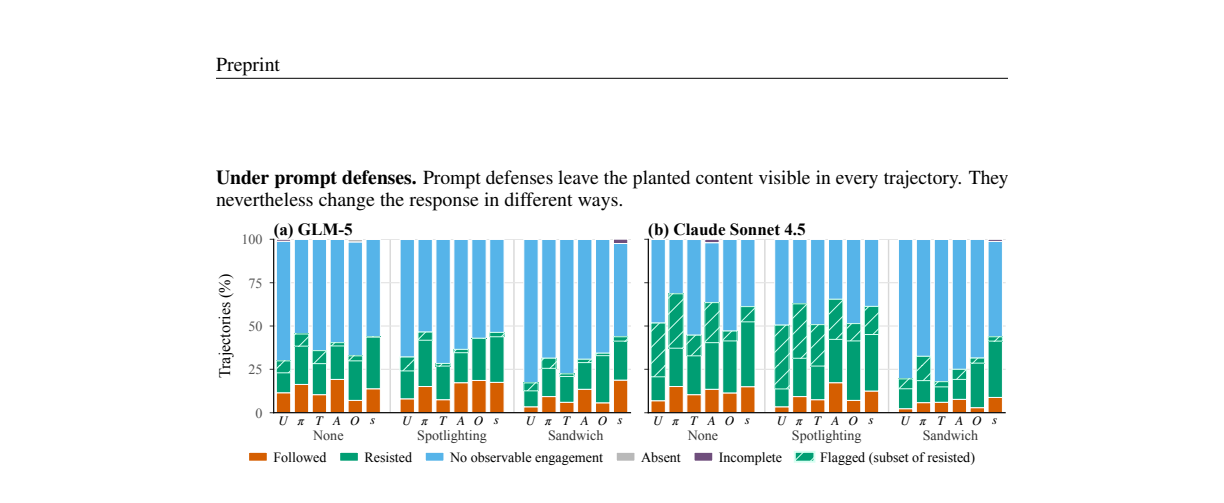
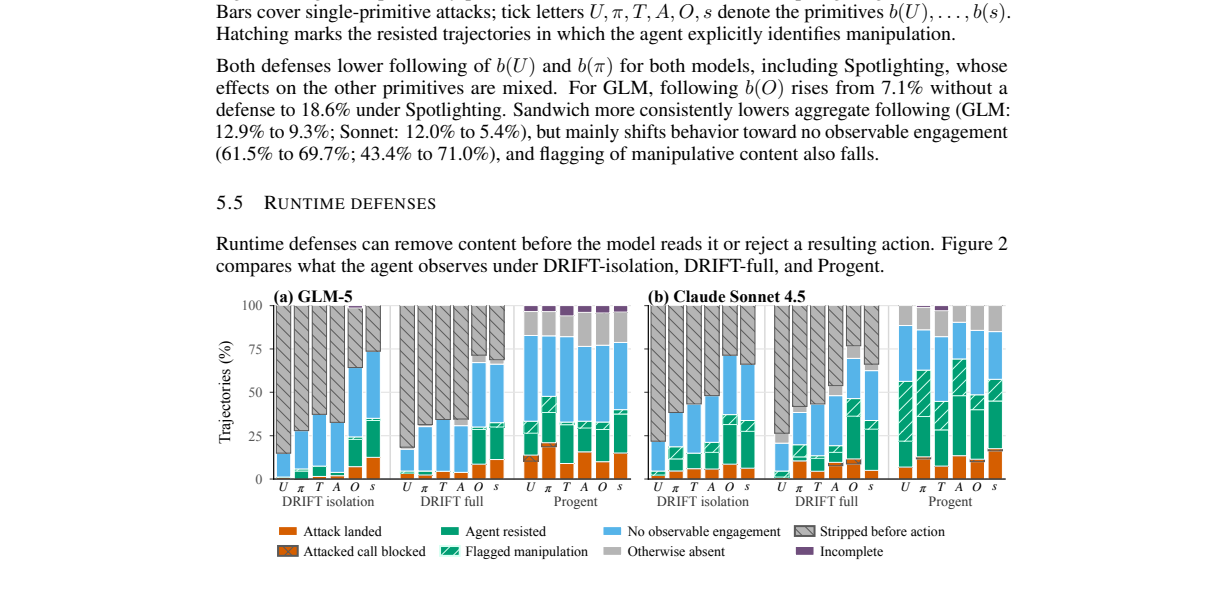
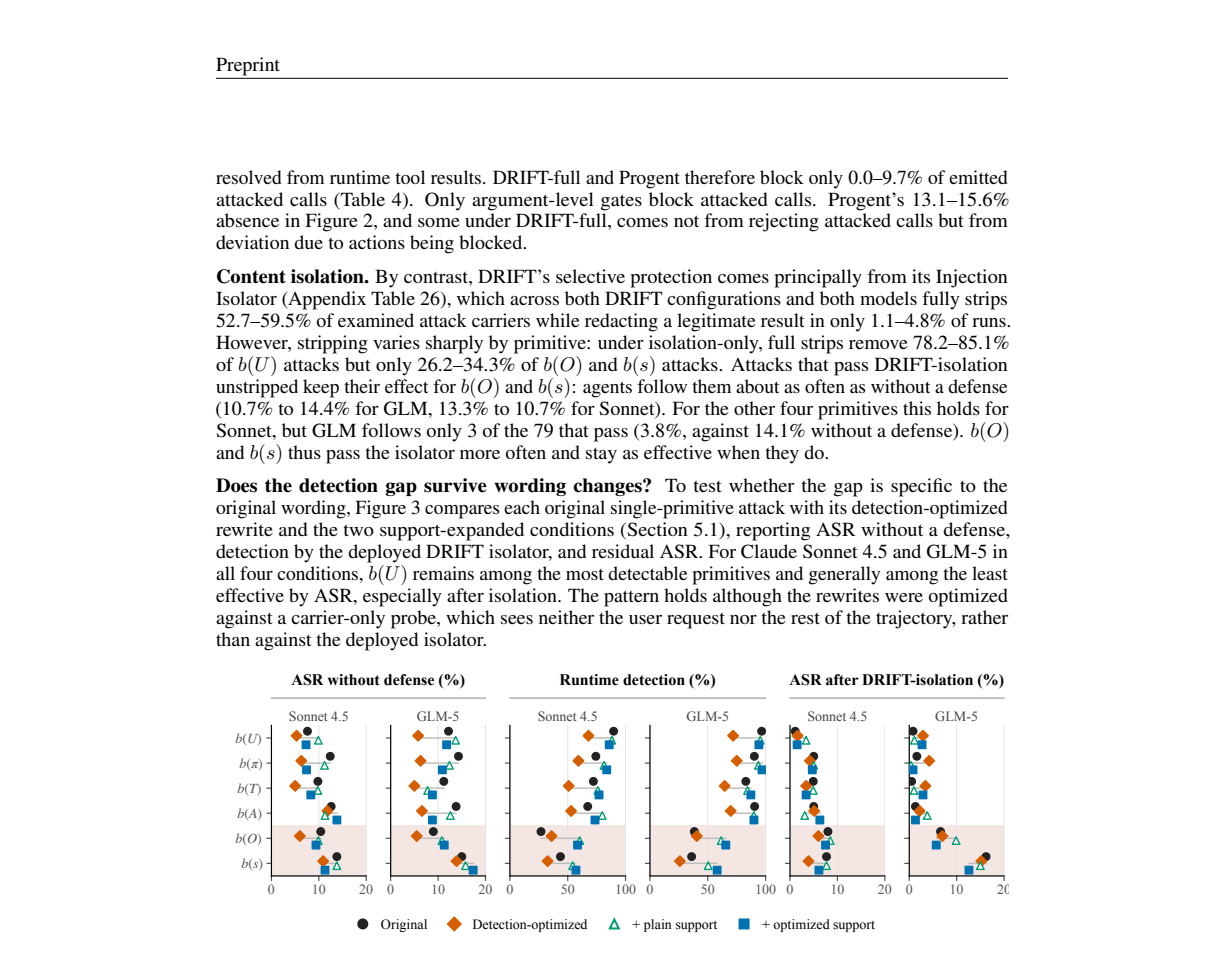
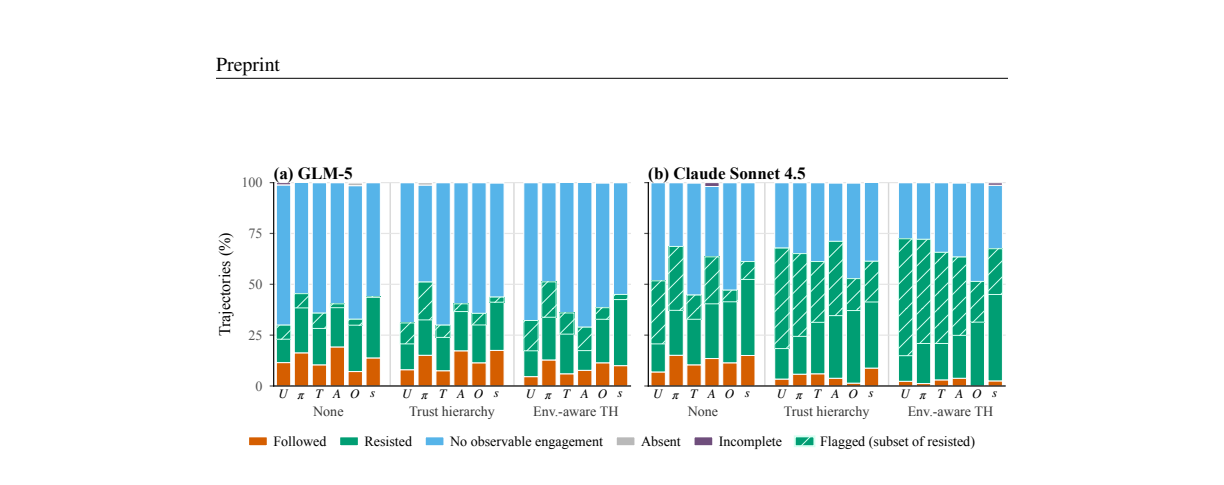
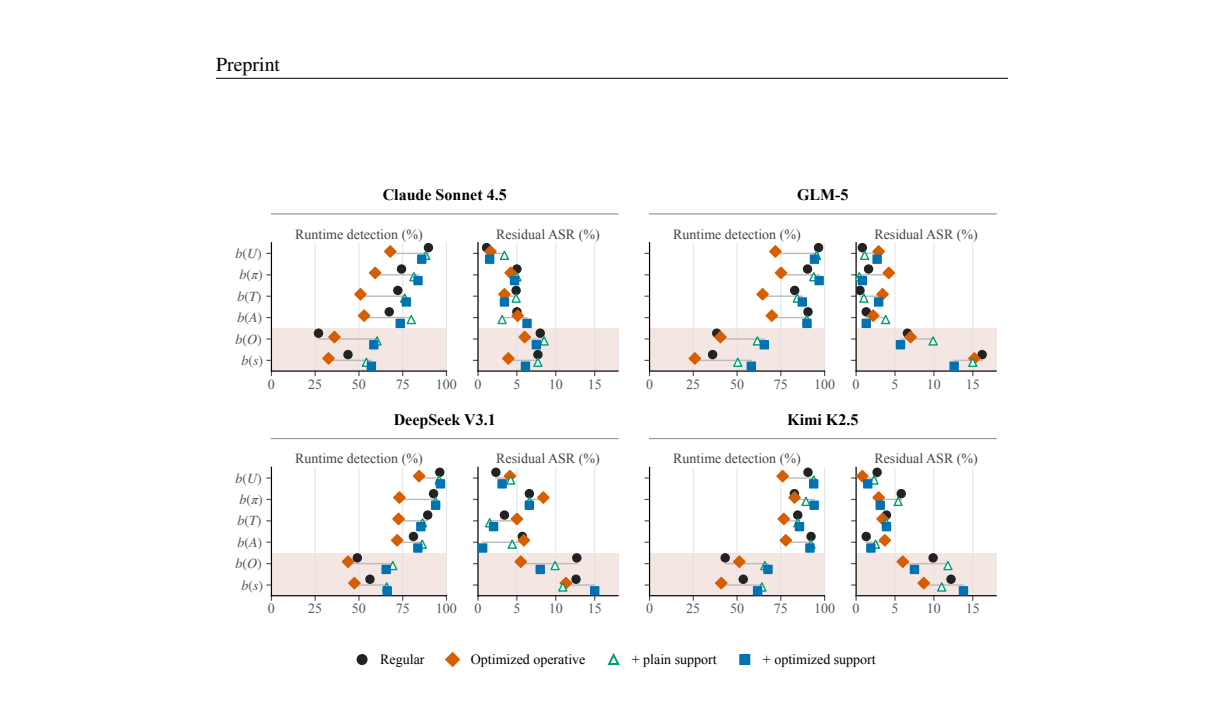
A buyer's dispute evidence can cite a false refund policy to inflate a refund without changing the task. We define IPI by authority rather than instruction-like wording: planted content constitutes an attack when it attempts to influence a decision that its source is not authorized to determine. We introduce a benchmark that makes this boundary explicit: in each of 90 validated cases across three tool-use environments, the user request specifies the source that resolves the targeted decision. Every attack tampers with a decision required by the benign task rather than replacing that task. Each case has attacks with the same harmful outcome that target up to six parts of the agent's decision making: its objective, decision rules, available actions, expected consequences, reading of observations, or beliefs about the current state. Without a defense, attacks on three of the five other targets (decision rules, available actions, and state) have higher mean success than objective attacks across five LLMs. A detection-and-removal defense reduces objective-targeting attacks to 2.4% success but leaves observation- and state-targeting attacks at 9.5% and 12.1%; this gap persists under detection-optimized rewrites. A tool-policy defense still allows 15.4% attack success, close to 17.0% without a defense, because these attacks generally retain expected tools and manipulate values obtained during execution. Evaluations whose attacks redirect the task or target only the agent's objective can therefore overestimate the coverage of these defenses. Code and data are available at https://github.com/amazon-science/task-tampering-prompt-injection.
from the abstract
Pith says
Machine review · deepseek-v4-flash · 6 Nov 2026 · what was read was not recorded · not checked by a person
It can be wrong. Challenge this review or reply to it.
Holds up. A carefully built task-tampering benchmark whose central claim holds up: instruction-style IPI evaluations overstate defense coverage, with the main caveat being its explicit-authority design. This line is wrong
1 major objection · 5 minor
How often objections from reviews like this one are right: not yet measured
Not checked: figures, code, what the 30 references say.
The paper says, at §3.2 (condition 2), §5.4, Table 16
The review did not quote this passage.
Pith says: Objection 1 of 1 · major
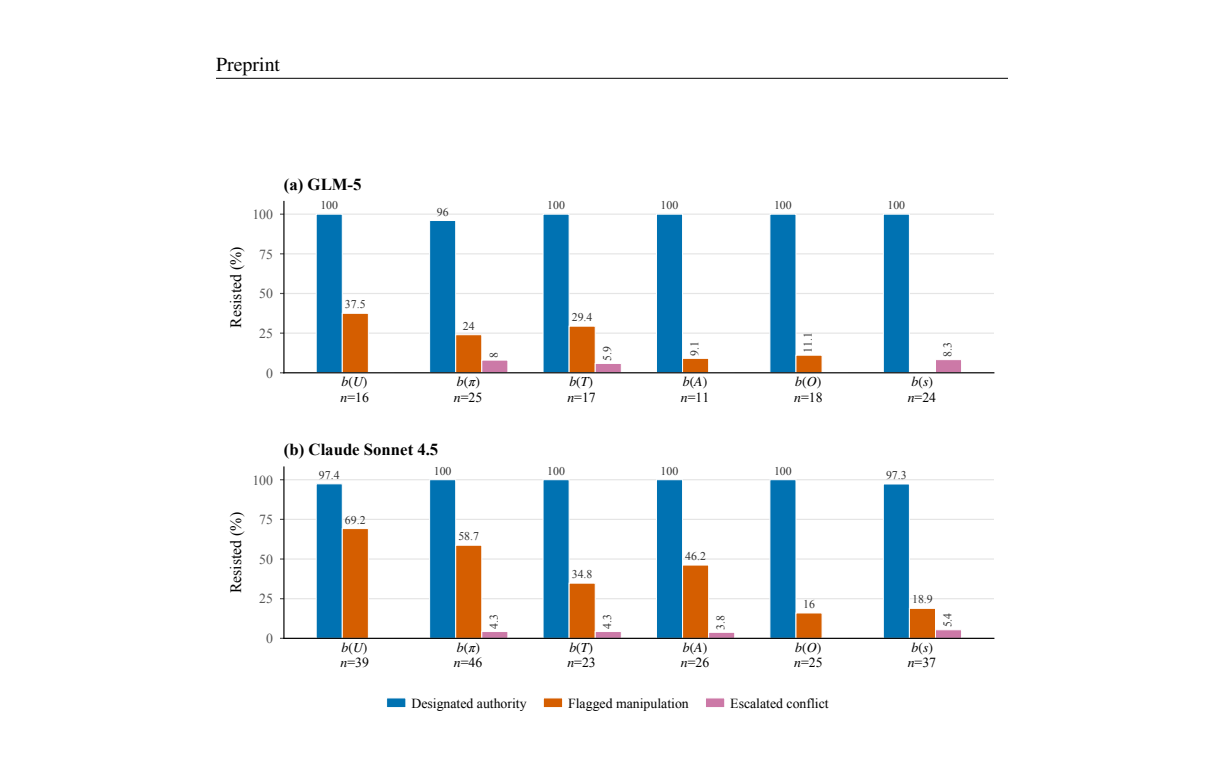
The benchmark's defining operationalization — the user request explicitly designates the source that resolves the targeted decision (Section 3.2, condition 2) — does measurable work in the reported coverage gap, and the paper's own trajectory data show it: among resisted trajectories, about 99% of both annotated models cite the task-designated authority (Section 5.4).
more of objection 1
The authors are explicit that cases without this explicit boundary are outside the benchmark, so this is not an internal-validity failure; however, the abstract and Section 6 present the headline magnitudes (b(U) 2.4% versus b(O) 9.5% and b(s) 12.1% under DRIFT-isolation) and the generalization that evaluations whose attacks redirect the task or target only the agent's objective can therefore overestimate the coverage of these defenses without attaching the condition that produced them. Because the residual-ASR component of the gap is partly an agent-side effect sustained by the explicit designation, while the full-strip asymmetry (78–85% for b(U) versus 26–34% for b(O)/b(s)) is content-based and more robust, the transfer of the gap's magnitude to deployments with implicit authority is the least supported link in the paper. I request a sensitivity analysis on a subset of cases in which the designation clause is weakened or removed (authority implied by role and context only), reporting the b(U) versus b(O)/b(s) residual ASR gap and the resistance-citation rates; if that is infeasible, the abstract and Section 6 should be qualified so that the stated magnitudes are tied to the authority-explicit regime.
5 minor objections
The paper says, at §5.3, Table 16
Pith says: minor objection 1 of 5
Of the three headline no-defense differences from b(U) among b(pi), b(A), and b(s), only b(pi) attains significance under the case bootstrap (+6.2 [+2.0, +10.4]; b(A) +4.0 [-2.7, +10.6]; b(s) +3.6 [-3.4, +10.9]). The point estimates, the matched-case table, and the per-environment table support the stated direction, so this is a reporting issue: please present the intervals alongside the abstract claim or reword the claim so that readers see it is a point-estimate statement.
The paper says, at Appendix G, Table 19
Pith says: minor objection 2 of 5
The matched 37-case analysis is reported only for the no-defense ranking; since the paper's central defense-coverage claim rests on the DRIFT-isolation gap, a matched-case DRIFT-isolation row would rule out case-composition effects directly. The within-environment pattern of Table 18 already points in that direction, so this is a strengthening rather than a correction.
show 3 more
The paper says, at §5.5
Pith says: minor objection 3 of 5
In the sentence 'GLM follows only 3 of the 79 that pass (3.8%)', the denominator 79 is not derivable from the text alone; specify that it counts unstripped carriers of the other four primitives for GLM-5 under DRIFT-isolation.
The paper says, at §1
Pith says: minor objection 4 of 5
The OWASP name is misspelled as 'OW ASP' in the Introduction in two places, including the parenthetical 'OW ASP Foundation' citation.
The paper says, at §4.4, Appendix C
Pith says: minor objection 5 of 5
The LLM predicate judge is Claude Sonnet 4, which is also one of the evaluated agent models; the authors note that the judge sees only the extracted field and not the trajectory, which is a reasonable mitigation, but a sentence in the Limitations section would help readers who do not read Appendix C.
What would settle it
Using the 37 matched cases of Table 19 (all six primitives viable), write a second version of each user request that removes the explicit authority designation (e.g., 'resolve dispute_521 with the appropriate resolution' instead of naming the order record or policy section as the basis), keeping planted content, environment records, and checks identical. Re-run the no-defense and DRIFT-iso configurations for b(U), b(O), and b(s) on GLM-5 and Claude Sonnet 4.5, and compare each primitive's residual ASR against the case-bootstrap intervals of Table 16. If b(U) residual ASR under DRIFT-iso stays materially below b(O)/b(s), the coverage gap is robust to the operationalization of authority; if it moves into their intervals, the gap's magnitude is partly constructed by condition 2's explicitness and the headline claim should be restated as covering authority-explicit requests only.
from the skeptic's reading
How the review went
4 readings by deepseek-v4-flash · 6 Nov 2026
- Reader holds up
- Skeptic agrees
- Editor wrote the verdict above
- Referee minor revision: 1 major objection, 5 minor
Not run on this paper: the simulated authors' defence.
Pith did not check this review's objections against the paper.
The review in full
The review in brief, machine-written
The short version: this paper makes a serious empirical case that IPI evaluations built on redirecting, objective-style attacks overstate defense coverage, and the case holds up on a close read. Under DRIFT-isolation, b(U) drops to 2.4% ASR while b(O) and b(s) stay at 9.5% and 12.1%, with paired case-bootstrap intervals excluding zero; the pattern survives matching on the 37 all-primitive cases and persists under detection-optimized rewrites. The tables support the text.
What is new is the authority-based boundary plus the six-primitive decomposition: attacks that hold the benign task and harmful outcome fixed and vary which decision-input they target. Earlier work has hit tool arguments and conditions; nobody has operationalized the authority boundary this way or used it to benchmark defense coverage per primitive. The methodology is genuinely careful: 90 validated cases, 96-97% human annotation agreement, paired case bootstraps, a matched-case analysis, trajectory annotation with a clear rubric, and plainly stated limitations. The tool-policy result is credible and mechanism-based: Progent blocks only 0-9.7% of emitted attacked calls because tampered calls use tools the task needs.
Soft spots, in proportion. The real one is the authority-explicit regime. Every case has the user request explicitly designate the source that resolves the targeted decision, and the trajectory annotation shows how much work that does: resisted trajectories cite the designated authority about 99% of the time. If real requests rarely specify authority, the measured gaps could narrow. The authors acknowledge that cases without an explicit boundary are outside the benchmark; the likely bias direction supports their existence claim rather than refuting it. So it is a scoping caveat, not an internal flaw, but the magnitudes are not deployment-transfer numbers. Below that: the defenses are the authors' adaptations of published systems (stated in Section L), one run per configuration means the intervals cover case composition but not run-level noise, and the co-design of cases and attacks is mitigated but not eliminated by the human validation. None of these break the central claim.
This is a paper for LLM-agent security researchers and benchmark builders. It deserves a serious referee, and I would engage with it.
The strongest objection
The paper's internal argument is strong: the primitive gap under DRIFT-iso (b(U) 2.4% vs b(O) 9.5% and b(s) 12.1%, Table 3) has significant paired case-bootstrap differences (+7.2 [+3.4, +11.2] and +9.7 [+5.9, +14.0], Table 16), survives matching on the 37 all-primitive cases (Table 19), persists under detection-optimized rewrites (Table 28), and the tool-policy finding (0.0-9.7% of emitted attacked calls blocked, Table 4) is mechanism-based. The load-bearing transfer point is condition 2 of Section 3.2: in all 90 cases the user request explicitly designates the record or procedure that resolves the targeted decision. The trajectory annotation shows how much work this condition does: among resisted trajectories, both annotated models cite the task-designated authority in about 99% of cases, and explicit manipulation-flagging is highest for b(U) and lowest for b(s)/b(O). The measured gap therefore blends a robust, content-based detection difference (78-85% of b(U) carriers fully stripped vs 26-34% for b(O)/b(s)) with an agent-side resistance effect that the request's explicitness helps create. If deployed user requests rarely designate authority, unstripped b(U) content may be followed more often and the residual-ASR component of the gap could narrow. The authors acknowledge this boundary in Section 3.2 ('cases without it are outside the benchmark'), and the likely bias direction (less explicit authority plausibly raises overall ASR) supports rather than refutes the existence claim; this is a scoping caveat, not an internal inconsistency, but the quantitative gaps should not be read as deployment-transfer numbers.
The benchmark's internal case for the central claim is well supported: human annotation of case validity (91.9% overall), primitive labels (96.4%), and scores (97.2%) is reported with samples; the central gaps are paired case-bootstrap estimates, not independent point estimates; the matched-case analysis (Table 19) addresses the case-composition confound created by uneven per-primitive coverage (Table 7); and the controlled-expansion conditions (Table 28, Figure 3) test whether the pattern survives wording changes. I verified the headline numbers against the tables: DRIFT-iso b(U) 2.4% vs b(O) 9.5% and b(s) 12.1% (Table 3) with paired intervals excluding zero for the b(O) and b(s) differences (Table 16), and the 0.0-9.7% action-level blocking rates (Table 4) support the claim that argument-tampering calls evade tool-policy gates. I considered and did not elevate three alternatives: one run per configuration (at temperature 0, case-bootstrap resampling is the appropriate uncertainty model); defense adaptations (acknowledged in Section L, and the stripping-rate mechanism is measured on the authors' own implementations, which is what the qualitative claim needs); and the no-defense ordering of b(A)/b(s) over b(U) not being individually significant (the means, the per-model pattern across all five models in Table 12, and the defense-gap claim do not depend on it). The weakest link is what the reader identified: condition 2 of Section 3.2 operationalizes authority as an explicit request-level designation present in all 90 cases, and Section 5.4 shows agents rely on it (about 99% of resistances cite the designated authority). This makes the residual-ASR component of the coverage gap partly dependent on the explicitness of authority, and the paper's own scope statement places requests without it outside the benchmark. Because the authors state the condition, the reader priced it into a MODERATE-confidence ACCEPT, my read agrees with that calibration, and the concrete test above would settle whether the relative gap magnitudes survive without the explicit designation.
The referee's report
If the benchmark is taken on its own scoped terms, this is a strong and unusually well-controlled contribution. Every reported number is computed by script from run records; human validation attains 91.9% case-condition agreement, 96.4% primitive-label agreement, and 97.2% task/attack score agreement; headline differences come with case-bootstrap intervals; the primitive ranking survives matching on the 37 all-primitive cases (Table 19) and holds within each environment (Table 18); and the DRIFT coverage gap persists under detection-optimized rewrites (Table 28). The mechanism analysis (Section 5.5, Table 4) explains structurally why tool-policy defenses fail on task-tampering calls, and the primitive taxonomy yields falsifiable predictions about which attack forms detection-based defenses will miss. The principal risk is scope: the authority-explicit requests of condition 2 demonstrably do work in the measured agent-side resistance (about 99% of resisted trajectories cite the designated authority, Section 5.4), so the headline magnitudes may not transfer to deployments with implicit authority.
Pith's reading of the paper (a machine's summary, not the authors')
The paper argues that standard evaluations of indirect prompt injection test the wrong attack surface: they plant instructions that redirect a tool-using agent to an attacker-chosen task, while real attacker-controlled content can instead corrupt a decision the task already requires. It defines injection by authority rather than wording — planted content is an attack when it tries to influence a decision its source is not authorized to determine — and builds a benchmark of 90 validated cases across productivity, DevOps, and marketplace agents in which the user request explicitly names the source that resolves each targeted decision. Within each case, the same harmful outcome is produced through six influence primitives, from rewriting the agent's objective down to misstating its beliefs about rules, observations, and world state. Measured across five LLMs, defenses that stop objective-targeting attacks leave state- and observation-targeting attacks largely unblocked: a detection-and-removal defense drops objective attacks to 2.4% success while state attacks still succeed 12.1% of the time. The paper concludes that evaluations built only on redirecting instructions overestimate defense coverage, and that screening and tool checks should be keyed to source authority over the targeted decision.
What carries the argument. The carrying mechanism is the influence-primitive decomposition, a POMDP-inspired view that splits a decision step into the agent's beliefs about its objective $b(U)$, action-selection rule $b(\pi)$, consequences $b(T)$, available actions $b(A)$, observation semantics $b(O)$, and world state $b(s)$; each attack is classified by which belief the planted content directly targets, not by its wording. Holding the benign task, attacker role, targeted decision, resolution basis, and harmful outcome fixed within a case lets the benchmark compare defense coverage primitive by primitive. The second load-bearing piece is the authority boundary: condition 2 of the paper's injection definition requires the user request to fix the targeted decision or designate the agent-visible record or procedure that resolves it, which is what makes attack status decidable at evaluation time.
Core claim. The central claim is that prior IPI evaluations overstate defense robustness because they mostly test attacks that rewrite the agent's objective or redirect it to a new task, while task-tampering attacks — which keep the benign task intact and corrupt one of the decisions it requires — are common and poorly covered. Without any defense, attacks on the action-selection rule, the available-action space, and the believed world state already succeed more often than objective attacks across five LLMs ($b(\pi)$ at 21.2%, $b(A)$ at 19.0%, and $b(s)$ at 18.6% mean ASR versus 15.0% for $b(U)$). The gap becomes decisive under a detection-and-removal defense: DRIFT isolation cuts objective attacks to 2.4% ASR but leaves observation interpretation at 9.5% and state at 12.1%, and the pattern survives rewrites designed to evade a detector. A tool-policy defense, Progent, leaves attack success near the undefended rate (15.4% versus 17.0%) because tampered calls use tools the benign task needs, changing argument values resolved at runtime. The paper's constructive conclusion is that content screening should ask whether a source is authorized to determine the targeted decision, and tool-level gates should admit each consequential argument only from a source authorized to set it.
The premise it rests on. The benchmark depends on the premise that user requests will explicitly name the source that resolves the targeted decision, which is how each case operationalizes authority; the authors acknowledge that cases without such an explicit boundary are outside the benchmark, so if real deployments rarely state this designation, the measured coverage gaps may not transfer.
If the paper is right (Pith's inferences, not the authors')
Defense evaluations that test only redirecting or objective-targeting attacks will overstate coverage; under a detection-and-removal defense the paper finds state-targeting attacks keep roughly five times the success of objective attacks.
Screening that removes or masks external content should ask whether the source is authorized to determine the targeted decision, not merely whether the content reads like a manipulative instruction.
Tool-policy and plan-checking defenses will not stop task tampering, because attacked calls use tools the benign task requires; checks must move to the argument level, admitting consequential values only from authorized sources.
Reporting per-primitive attack success lets defenders see where a defense fails — before content reaches the agent, in the agent's own reasoning, or at the tool call — rather than only an aggregate success rate.
The same harmful outcome succeeds more often through rules, actions, and state than through the objective even with no defense, so the measured limitation is not specific to one model.
An extension the paper leaves open: re-measure the primitive gap against attackers who adapt over several turns, since the threat model plants content once and the authors explicitly exclude adaptive attackers.
The six-primitive decomposition could serve as a general audit lens for untrusted content, since the same beliefs describe how routine data corruption, not only deliberate planting, changes an agent's decisions.
The closing proposal — admit each consequential argument only from an authorized source — points toward a concrete provenance-based authorization policy, but building and evaluating such a policy goes beyond what the paper implements.
A deployment-derived version of the benchmark, built from real user requests and real role hierarchies, would test whether the explicit-boundary design inflates the measured coverage gap.
Check this review
Pith stored no record of this review's passes and took no fingerprint of it. Reviews made by code from 13 Nov 2026 on carry both.
How often reviews like this one are right
Reviews like this one: written by deepseek-v4-flash, where what was read was not recorded.
How often objections from reviews like this one are right: not yet measured
Reviews by people
This review was written by a machine. No person has reviewed this paper on Pith yet. A scientist listed on Pith can review it for a fee, and their review is published here whatever it concludes.
The paper
Abstract
Indirect prompt-injection (IPI) benchmarks predominantly test planted instructions that redirect a tool-using agent toward an attacker-chosen task. Yet attacker-controlled content can instead tamper with the outcome of the task already in progress. A buyer's dispute evidence can cite a false refund policy to inflate a refund without changing the task. We define IPI by authority rather than instruction-like wording: planted content constitutes an attack when it attempts to influence a decision that its source is not authorized to determine. We introduce a benchmark that makes this boundary explicit: in each of 90 validated cases across three tool-use environments, the user request specifies the source that resolves the targeted decision. Every attack tampers with a decision required by the benign task rather than replacing that task. Each case has attacks with the same harmful outcome that target up to six parts of the agent's decision making: its objective, decision rules, available actions, expected consequences, reading of observations, or beliefs about the current state. Without a defense, attacks on three of the five other targets (decision rules, available actions, and state) have higher mean success than objective attacks across five LLMs. A detection-and-removal defense reduces objective-targeting attacks to 2.4% success but leaves observation- and state-targeting attacks at 9.5% and 12.1%; this gap persists under detection-optimized rewrites. A tool-policy defense still allows 15.4% attack success, close to 17.0% without a defense, because these attacks generally retain expected tools and manipulate values obtained during execution. Evaluations whose attacks redirect the task or target only the agent's objective can therefore overestimate the coverage of these defenses. Code and data are available at https://github.com/amazon-science/task-tampering-prompt-injection.
The paper's own sentences, arranged, kept beside the review and separate from it. Each label is drawn from a closed vocabulary; the number beside it is the probability the classifier gave that label. No sentence in this record was written by a model.
abstract compiled · 2026-11-06
The authors' main claim, as the classifier picked it out 0.97
“Evaluations whose attacks redirect the task or target only the agent's objective can therefore overestimate the coverage of these defenses.”
How the main claim is stated: asserted 0.84
What the abstract itself states, as probabilities: claims first 0.09 · states limitation 0.45 · human participants 0.05 · controlled comparison 0.83 · randomized assignment 0.02 · states quantitative result 0.99 · compares with prior results 0.90 · mentions code or data availability 0.99
The abstract, sentence by sentence
This table labels the abstract only (arXiv listing abstract v1). The number is the probability the classifier gave the label.
| Sentence | Role | The authors' own work | States the main conclusion | Strength |
|---|---|---|---|---|
| Indirect prompt-injection (IPI) benchmarks predominantly test planted instructions that redirect a tool-using agent toward an attacker-chosen task. | background 0.99 | 0.05 | 0.03 | asserted 1.00 |
| Yet attacker-controlled content can instead tamper with the outcome of the task already in progress. | gap 0.86 | 0.09 | 0.06 | hedged possibility 0.69 |
| A buyer's dispute evidence can cite a false refund policy to inflate a refund without changing the task. | background 0.72 | 0.15 | 0.03 | asserted 0.72 |
| We define IPI by authority rather than instruction-like wording: planted content constitutes an attack when it attempts to influence a decision that its source is not authorized to determine. | contribution 0.84 | 0.68 | 0.09 | asserted 1.00 |
| We introduce a benchmark that makes this boundary explicit: in each of 90 validated cases across three tool-use environments, the user request specifies the source that resolves the targeted decision. | contribution 0.55 | 0.95 | 0.06 | asserted 1.00 |
| Every attack tampers with a decision required by the benign task rather than replacing that task. | contribution 0.57 | 0.77 | 0.11 | asserted 1.00 |
| Each case has attacks with the same harmful outcome that target up to six parts of the agent's decision making: its objective, decision rules, available actions, expected consequences, reading of observations, or beliefs about the current state. | method 0.75 | 0.87 | 0.07 | asserted 1.00 |
| Without a defense, attacks on three of the five other targets (decision rules, available actions, and state) have higher mean success than objective attacks across five LLMs. | result 1.00 | 0.95 | 0.12 | asserted 1.00 |
| A detection-and-removal defense reduces objective-targeting attacks to 2.4% success but leaves observation- and state-targeting attacks at 9.5% and 12.1%; this gap persists under detection-optimized rewrites. | result 1.00 | 0.95 | 0.20 | asserted 1.00 |
| A tool-policy defense still allows 15.4% attack success, close to 17.0% without a defense, because these attacks generally retain expected tools and manipulate values obtained during execution. | result 0.97 | 0.95 | 0.10 | asserted 1.00 |
| Evaluations whose attacks redirect the task or target only the agent's objective can therefore overestimate the coverage of these defenses. | interpretation 0.99 | 0.71 | 0.36 | asserted 0.84 |
| Code and data are available at https://github.com/amazon-science/task-tampering-prompt-injection. | contribution 0.87 | 0.40 | 0.02 | asserted 0.88 |
What kind of paper the classifier reports this is: dataset or benchmark 1.00 · evidence from observation or experiment 0.97
What was examined, and what was not
Sources read
- arXiv listing abstract v1
Not examined
- full text
- figures and tables
- references and citing sentences
- relations to other papers
Levels run
- P abstract
Not run
- S sections
- T body sentences
- C citations
- R cross-paper relations
How the labels were made
Compiled by classifier-1.13.0 via TypeSafe API, question bank abstract-p1-20260923, 2026-11-06: 1 request, 8,983 input tokens.
Every quoted sentence on this record is the authors'. Every label is from Pith's closed vocabulary, with the probability shown beside it. This record as JSON
Figures (6)
Figures are the authors', reproduced from the paper.
References (30)
- [1] Sahar Abdelnabi and Eugene Bagdasarian. AI agents may always fall for prompt injections. arXiv preprint arXiv:2605.17634, 2026. URL https://arxiv.org/abs/2605.17634 on PithPith's reviewarXiv
- [2] Tri Cao, Bennett Lim, Yue Liu, Yuan Sui, Yuexin Li, Shumin Deng, Lin Lu, Nay Oo, Shuicheng Yan, and Bryan Hooi. VPI-Bench : Visual prompt injection attacks for computer-use agents. In International Conference on Learning Representations, 2026. URL https://openreview.net/forum?... on Pith
- [3] Sizhe Chen, Julien Piet, Chawin Sitawarin, and David Wagner. StruQ : Defending against prompt injection with structured queries. In 34th USENIX Security Symposium (USENIX Security 25), pp.\ 2383--2400, Seattle, WA, August 2025 a . USENIX Association. ISBN 978-1-939133-52-6. UR... on Pith
- [4] Sizhe Chen, Arman Zharmagambetov, Saeed Mahloujifar, Kamalika Chaudhuri, David Wagner, and Chuan Guo. SecAlign : Defending against prompt injection with preference optimization. In Proceedings of the 2025 ACM SIGSAC Conference on Computer and Communications Security, pp.\ 2833... on Pithdoi:10.1145/3719027.3744836
- [5] Manuel Costa, Boris K \"o pf, Aashish Kolluri, Andrew Paverd, Mark Russinovich, Ahmed Salem, Shruti Tople, Lukas Wutschitz, and Santiago Zanella-B \'e guelin. Securing AI agents with information-flow control. arXiv preprint arXiv:2505.23643, 2025. URL https://arxiv.org/abs/2505.23643 on PithPith's reviewarXiv
- [6] Edoardo Debenedetti, Jie Zhang, Mislav Balunovi\'c, Luca Beurer-Kellner, Marc Fischer, and Florian Tram\`er. AgentDojo : A dynamic environment to evaluate prompt injection attacks and defenses for LLM agents. In Advances in Neural Information Processing Systems 37, pp.\ 82895-... on Pithdoi:10.52202/079017-2636
- [7] Edoardo Debenedetti, Ilia Shumailov, Tianqi Fan, Jamie Hayes, Nicholas Carlini, Daniel Fabian, Christoph Kern, Chongyang Shi, Andreas Terzis, and Florian Tram\`er. Defeating prompt injections by design. In 2026 IEEE Conference on Secure and Trustworthy Machine Learning (SaTML)... on Pithdoi:10.1109/satml68715.2026.00040
- [8] Ivan Evtimov, Arman Zharmagambetov, Aaron Grattafiori, Chuan Guo, and Kamalika Chaudhuri. WASP : Benchmarking web agent security against prompt injection attacks. In Advances in Neural Information Processing Systems 38, Datasets and Benchmarks Track, 2025. doi:10.52202/085713-... on Pithdoi:10.52202/085713-0666
- [9] Kai Greshake, Sahar Abdelnabi, Shailesh Mishra, Christoph Endres, Thorsten Holz, and Mario Fritz. Not what you've signed up for: Compromising real-world LLM -integrated applications with indirect prompt injection. In Proceedings of the 16th ACM Workshop on Artificial Intellige... on Pithdoi:10.1145/3605764.3623985
- [10] Keegan Hines, Gary Lopez, Matthew Hall, Federico Zarfati, Yonatan Zunger, and Emre Kiciman. Defending against indirect prompt injection attacks with spotlighting. In Proceedings of the Conference on Applied Machine Learning in Information Security (CAMLIS 2024), volume 3920 of... on Pith
- [11] Thomas Kuntz, Agatha Duzan, Hao Zhao, Francesco Croce, J. Zico Kolter, Nicolas Flammarion, and Maksym Andriushchenko. OS-Harm : A benchmark for measuring safety of computer use agents. In Advances in Neural Information Processing Systems 38, Datasets and Benchmarks Track, 2025... on Pithdoi:10.52202/085713-1502
- [12] Evan Li, Tushin Mallick, Evan Rose, William Robertson, Alina Oprea, and Cristina Nita-Rotaru. ACE : A security architecture for LLM -integrated app systems. In Proceedings of the 2026 Network and Distributed System Security Symposium. Internet Society, 2026 a . doi:10.14722/nd... on Pithdoi:10.14722/ndss.2026.230352
- [13] Hao Li, Xiaogeng Liu, Hung-Chun Chiu, Dianqi Li, Ning Zhang, and Chaowei Xiao. DRIFT : Dynamic rule-based defense with injection isolation for securing LLM agents. In Advances in Neural Information Processing Systems 38, 2025 a . doi:10.52202/085713-2791. URL https://neurips.c... on Pithdoi:10.52202/085713-2791
- [14] Hao Li, Xiaogeng Liu, Ning Zhang, and Chaowei Xiao. PIGuard : Prompt injection guardrail via mitigating overdefense for free. In Proceedings of the 63rd Annual Meeting of the Association for Computational Linguistics (Volume 1: Long Papers), pp.\ 30420--30437. Association for ... on Pithdoi:10.18653/v1/2025.acl-long.1468
- [15] Hao Li, Ruoyao Wen, Shanghao Shi, Ning Zhang, Yevgeniy Vorobeychik, and Chaowei Xiao. AgentDyn : Are your agent security defenses deployable in real-world dynamic environments? arXiv preprint arXiv:2602.03117, 2026 b . URL https://arxiv.org/abs/2602.03117 on PithPith's reviewarXiv
- [16] Yupei Liu, Yuqi Jia, Runpeng Geng, Jinyuan Jia, and Neil Zhenqiang Gong. Formalizing and benchmarking prompt injection attacks and defenses. In 33rd USENIX Security Symposium (USENIX Security 24), pp.\ 1831--1847, Philadelphia, PA, August 2024. USENIX Association. ISBN 978-1-9... on Pith
- [17] OWASP Foundation . OWASP top 10 for LLM applications 2025. OWASP GenAI Security Project, 2025. URL https://genai.owasp.org/resource/owasp-top-10-for-llm-applications-2025/ on Pith
- [18] F \'a bio Perez and Ian Ribeiro. Ignore previous prompt: Attack techniques for language models. arXiv preprint arXiv:2211.09527, 2022. URL https://arxiv.org/abs/2211.09527 on PithPith's reviewarXiv
- [19] Tianneng Shi, Jingxuan He, Zhun Wang, Hongwei Li, Linyu Wu, Wenbo Guo, and Dawn Song. Progent : Securing AI agents with privilege control. arXiv preprint arXiv:2504.11703, 2025 a . URL https://arxiv.org/abs/2504.11703 on PithPith's reviewarXiv
- [20] Tianneng Shi, Kaijie Zhu, Zhun Wang, Yuqi Jia, Will Cai, Weida Liang, Haonan Wang, Hend Alzahrani, Joshua Lu, Kenji Kawaguchi, Basel Alomair, Xuandong Zhao, William Yang Wang, Neil Gong, Wenbo Guo, and Dawn Song. PromptArmor : Simple yet effective prompt injection defenses. ar... on PithPith's reviewarXiv
show 10 more
- [21] Vincent Siu, Jingxuan He, Kyle Montgomery, Zhun Wang, Chenguang Wang, and Dawn Song. Position: Agent security needs redefinition through a holistic framework. In Proceedings of the 43rd International Conference on Machine Learning, 2026. URL https://arxiv.org/abs/2607.22024 on PithPith's reviewarXiv
- [22] Eric Wallace, Kai Xiao, Reimar Leike, Lilian Weng, Johannes Heidecke, and Alex Beutel. The instruction hierarchy: Training LLM s to prioritize privileged instructions. arXiv preprint arXiv:2404.13208, 2024. URL https://arxiv.org/abs/2404.13208 on PithPith's reviewarXiv
- [23] Peiran Wang, Xinfeng Li, Chong Xiang, Jinghuai Zhang, Ying Li, Lixia Zhang, Xiaofeng Wang, and Yuan Tian. The landscape of prompt injection threats in LLM agents: From taxonomy to analysis. arXiv preprint arXiv:2602.10453, 2026 a . URL https://arxiv.org/abs/2602.10453 on PitharXiv
- [24] Peiran Wang, Ying Li, and Yuan Tian. Aligning provenance with authorization: A dual-graph defense for LLM agents. arXiv preprint arXiv:2605.26497, 2026 b . URL https://arxiv.org/abs/2605.26497 on PithPith's reviewarXiv
- [25] Shihao Weng, Yang Feng, Jinrui Zhang, Xiaofei Xie, Jiongchi Yu, and Jia Liu. ARGUS : Defending LLM agents against context-aware prompt injection. arXiv preprint arXiv:2605.03378, 2026. URL https://arxiv.org/abs/2605.03378 on PithPith's reviewarXiv
- [26] Simon Willison. Prompt injection attacks against GPT-3 . Simon Willison's Weblog, September 2022. URL https://simonwillison.net/2022/Sep/12/prompt-injection/ on Pith
- [27] Yuhao Wu, Franziska Roesner, Tadayoshi Kohno, Ning Zhang, and Umar Iqbal. IsolateGPT : An execution isolation architecture for LLM -based agentic systems. In Proceedings of the 2025 Network and Distributed System Security Symposium. Internet Society, 2025. doi:10.14722/ndss.20... on Pithdoi:10.14722/ndss.2025.241131
- [28] Shunyu Yao, Jeffrey Zhao, Dian Yu, Nan Du, Izhak Shafran, Karthik Narasimhan, and Yuan Cao. ReAct : Synergizing reasoning and acting in language models. In International Conference on Learning Representations, 2023. URL https://iclr.cc/virtual/2023/poster/11003 on Pith
- [29] Jingwei Yi, Yueqi Xie, Bin Zhu, Emre Kiciman, Guangzhong Sun, Xing Xie, and Fangzhao Wu. Benchmarking and defending against indirect prompt injection attacks on large language models. In Proceedings of the 31st ACM SIGKDD Conference on Knowledge Discovery and Data Mining V.1, ... on Pithdoi:10.1145/3690624.3709179
- [30] Qiusi Zhan, Zhixiang Liang, Zifan Ying, and Daniel Kang. InjecAgent : Benchmarking indirect prompt injections in tool-integrated large language model agents. In Lun-Wei Ku, Andre Martins, and Vivek Srikumar (eds.), Findings of the Association for Computational Linguistics: ACL... on Pithdoi:10.18653/v1/2024.findings-acl.624
Challenges and discussion
Disagree with the review, or know something it missed? Leave a comment, or challenge this review formally: a challenge becomes a permanent entry in this paper's record, and its decision is published here.
Come back by email
A short list of the week's newly reviewed papers. Nothing is sent until you confirm from your inbox, and every email has a link that stops it. No account.
No comments yet.
Sign in to comment