Machine Learning · arXiv:2611.07913 v2 · submitted 5 Nov 2026
Same Answer, Different Future: Dissociating Belief Content and Evidence Weight in Language Models
The paper says
“Memory summaries, prompts and steering vectors set a language model's beliefs and are judged by the prediction they produce. A prediction does not say how firmly it is held.”
more of the abstract
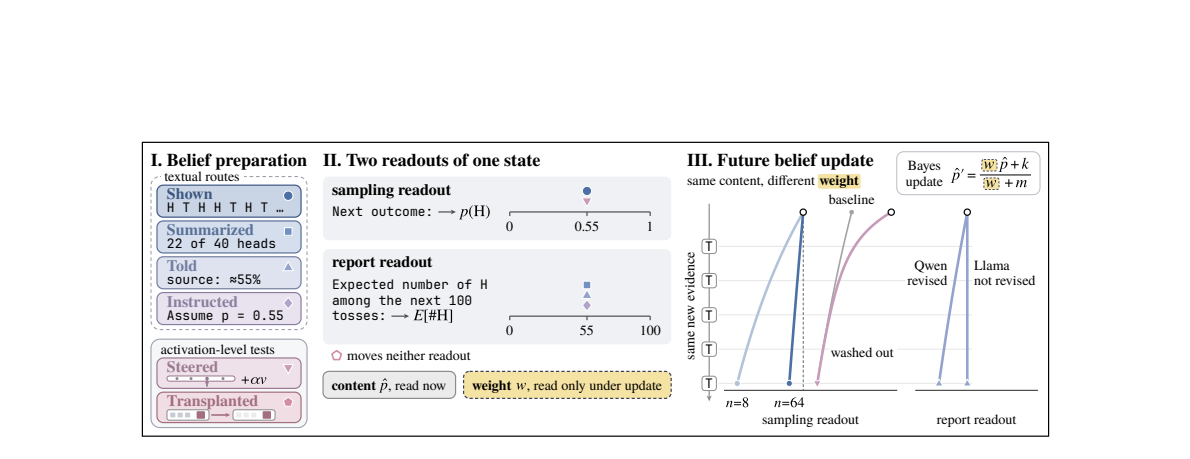
We separate a belief's content, what it predicts now, from its weight, the number of new observations it is worth: for an ideal observer, the amount of evidence behind it. In Bernoulli inference we set beliefs in nine open-weight models of 8 to 397B parameters and follow each belief with the same new observations. We argue that these models hold an answer without its evidence and recover its weight from the text they re-read. Weight therefore follows the form of the evidence and the question asked more than its amount: matched on their current estimate, a record of observations and a summary of its counts usually move apart under the same new observations, in either direction. Scale does not close the gap. Across the nine models 64 observations are worth 20 to 53 as a record and 9 to 151 as a summary, no closer to 64 at 397B than at 8B. Where no text stands behind a belief there is little to re-read: a steering vector can install a record's answer, and sixteen observations undo it where a neutral passage leaves it in place. Where reasoning first writes the counts into the context the weight returns, and the same 64 observations are worth 58 to 67 in either form. A matched answer is not a matched belief, and methods that set beliefs should be judged by the futures they produce.
from the abstract
Pith says
Machine review · deepseek-v4-flash · 6 Nov 2026 · of version 1 of the paper; version 2 is newer · what was read was not recorded · not checked by a person
It can be wrong. Challenge this review or reply to it.
Holds up. Clean demonstration that same current prediction doesn’t mean same future update in LLMs—well-executed, properly scoped, deserves a serious referee. This line is wrong
2 major objections · 4 minor
How often objections from reviews like this one are right: not yet measured
Not checked: figures, code, what the references say.
The paper says, at Section 2 and Appendix C
The review did not quote this passage.
A classifier read this sentence of the paper as acknowledging the concern (probability 0.69):
“Every figure of the main text uses the expected-count query, the end of that range at which a statement comes closest to a rule (Appendix I), so an exchange rate compares routes within one readout and is no constant of the model.”
Pith says: Objection 1 of 2 · major
The exchange rate w = m * a / S is defined from a linear regression model (Eq. 1). The authors recognize that LLM behavior may deviate from linearity and test this by varying segment length m, finding that w changes with m, which becomes a discovery itself.
more of objection 1
However, the interpretation of w as a fixed property of a route is weakened if the relationship is nonlinear. The paper mitigates this by relying on the matched-pair experiment (Appendix J) for the central qualitative claim—there the regression model is not used. I find this sufficient, but the abstract and introduction foreground the exchange rate as a central quantity. I recommend adding a brief sentence in the main text (e.g., before Eq. 2) clarifying that the linear model is a local approximation whose adequacy is tested and that the main conclusions hold independently (see Appendix J for a model-free version).
The paper says, at Section 5 and Figure 3
The review did not quote this passage.
Pith says: Objection 2 of 2 · major
The claim that "a summary is worth a few dozen observations whatever count it states" is supported for Llama and Qwen, but in Gemma the summary weight for n=64 is 72, which is similar to the n=8 weight of 21, but the n=64 value is substantially higher than 21, so the statement "whatever count it states" may be too strong.
more of objection 2
The paper notes that the weight follows the count far less than eightfold, which is correct. I suggest rewording to "summaries receive weights that scale weakly with their stated observation counts" (as the abstract already says) and note the specific numbers in the text to avoid overgeneralization. The same caution applies to the phrase "the weight follows the count far less than the eightfold the count implies"—this is accurate as it stands.
4 minor objections
The paper says, at General
Pith says: minor objection 1 of 4
The paper is exceptionally well-written, but a few passages could be tightened. For example, in Section 4 (page 4, end of second paragraph): 'the slope of the estimate on the stated rate is at least 0.87 in every model and frame'—the phrase 'in every model and frame' is clear, but the preceding list (three models, two frames) could be parenthetically noted.
more of objection 1
Also, in Figure 2, the triple rows for each model could benefit from a visual cue linking the row labels (Shown, Summarized, Told, Instructed) directly. The current layout is readable but dense.
The paper says, at Appendix C, integer readout section
Pith says: minor objection 2 of 4
The description of the tree-based integer readout for Qwen and Gemma is clear, but it would help to specify the single-token check for Llama more concretely: the sentence 'Llama tokenizes the integers from 0 to 100 as single tokens' is correct, but readers may wonder whether 101 is also a single token; the span 0–100 is narrow enough that this is not an issue.
more of objection 2
As a minor suggestion, add a note that the set of integers 0–100 is verified to be single tokens in the Llama tokenizer.
show 2 more
The paper says, at Section 6 and Figure 4
Pith says: minor objection 3 of 4
The term 'washout' is used to describe the steering condition, but the placebo (neutral passage) shows retention >1, which is correctly explained as dilution of the record. The paper might add a brief explanation in the main text that the neutral passage's lack of competition amplifies the steer's relative share, consistent with the re-reading hypothesis. This is already in Appendix F, but a cross-reference would help readers.
The paper says, at References
Pith says: minor objection 4 of 4
The reference list is extensive and current. However, some preprints cited as 'to appear' or 'in preparation' are given with arXiv IDs, which is acceptable. One entry (Ma et al., 2026) appears as 'Hidden APIs...' with a recent preprint number. There is no obvious gap.
What would settle it
Replicate the matched-pair test (Appendix J) with a non-Bernoulli task, such as a Gaussian mean estimation or a multinomial category, to verify that the central finding — states with equal current predictions diverge under matched new evidence — generalizes beyond the specific Bernoulli setup.
from the skeptic's reading
How the review went
4 readings by deepseek-v4-flash · 6 Nov 2026
- Reader holds up
- Skeptic agrees
- Editor wrote the verdict above
- Referee accept: 2 major objections, 4 minor
Not run on this paper: the simulated authors' defence.
Pith did not check this review's objections against the paper.
The review in full
The review in brief, machine-written
This paper does something simple and important: it shows that LLMs reaching the same prediction from different routes (observed outcomes, summaries, instructions, steering) respond differently to new evidence. The core design—forking matched futures from prepared states—is clever, and the execution is thorough: three models, multiple wordings, bootstrap intervals, equivalence tests against noise floors, and a battery of controls. The exchange rate w is a useful quantitative summary.
The main empirical contributions hold up. Format-dependent channel dissociation (sequences affect continuations, statements affect estimates) is cleanly demonstrated. The effective weight of summaries scales weakly with stated counts, and one-shot steering installs an answer that evaporates after sixteen new observations while a natural record retains much of its influence. The steering washout is particularly striking and practically relevant.
The soft spots are well-acknowledged. The exchange rate w depends on a linear regression that is exact for a Bayesian observer but may not capture nonlinear LLM behavior. The authors test this by varying segment length and find that w changes—that’s itself a discovery, but it means w is a local quantity, not a model constant. They also note that w varies with elicitation question by orders of magnitude. These are careful caveats, not hidden flaws.
The scope is limited to Bernoulli inference and in-context beliefs (not fine-tuned or edited), which the authors state. The speculative hypothesis about weight being recovered from re-reading is flagged as such.
Overall, this is rigorous, honest empirical work that makes a clear point. I’d bring it to the reading group if the topic is active, and I’d cite it if working on LLM belief states or interpretability. It deserves a serious referee.
The strongest objection
The paper's central claim — that agreement in current readouts is insufficient to establish equivalence in belief updating — is supported by multiple independent lines of evidence, most directly the matched-pair experiment (Appendix J), which does not rely on the linear regression model. The linear regression is used to quantify the effective weight w, and while its adequacy is a legitimate assumption, the paper tests it by varying segment length and finds that w changes with m, which is a discovery itself and does not undermine the comparative claims. The steering washout test, the channel map, and the weight differences across routes are all qualitatively clear and backed by bootstrap intervals. The authors acknowledge limitations (prompt format dependence, scope to Bernoulli inference, behavioral localization of weight). I find no internal inconsistency or crucial oversight that threatens the paper's main conclusion.
The reader's ACCEPT verdict is sound. The weakest assumption (linear regression adequacy) is acknowledged and tested. The central claim is robust across models, routes, and readouts, with the matched-pair test providing direct model-free evidence. No additional concerns arise that would change the verdict.
The referee's report
If the result holds, it fundamentally reframes how the community evaluates belief states in language models. Current practice often treats matched predictions as evidence of matched internal states, implicitly assuming a single latent degree of belief. This paper shows that the route by which a belief is acquired and the readout through which it is expressed jointly determine its future dynamics, and activation steering can mimic a natural record's immediate output without reproducing its persistence. The exchange-rate framework is a practical tool for quantifying the persistence of in-context effects, and the channel-map finding (data vs. description go to different readouts) has direct implications for how prompts are designed and how model behavior is interpreted. The paper is rigorous, with extensive controls, bootstrap intervals, equivalence tests, and a careful treatment of limitations.
Pith's reading of the paper (a machine's summary, not the authors')
The paper asks whether language models that produce identical probabilistic predictions through different routes (observing outcomes, reading summaries, receiving instructions, or activation steering) are in the same belief state. It shows they are not: the format of evidence determines which readout (next-outcome continuation versus explicit numerical estimate) carries its content, and the persistence of a belief against new evidence—its effective weight—differs substantially across routes. An activation intervention can match a natural record's immediate prediction but loses most of its effect after a short segment of new observations. The central finding is that agreement in current outputs is insufficient to establish equivalence in belief updating; how a belief is acquired and how it is read jointly determine its subsequent dynamics.
What carries the argument. The paper introduces a functional decomposition of a belief into content (current estimate) and weight (persistence under new evidence), quantified by an exchange rate w = m * a / S derived from a linear regression ppost = c + aπ + Sκ, where π is the old belief content and κ the proportion of new evidence. The weight w is the number of new observations that the old belief is worth.
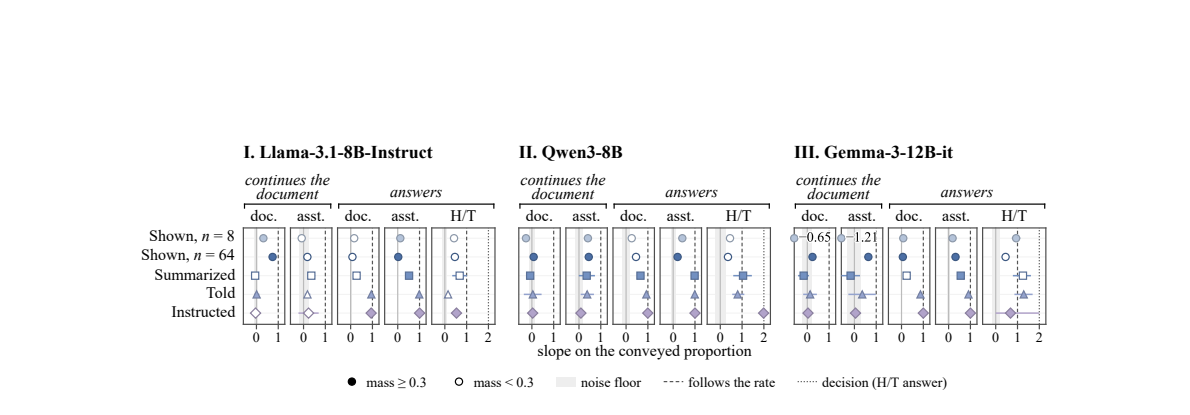
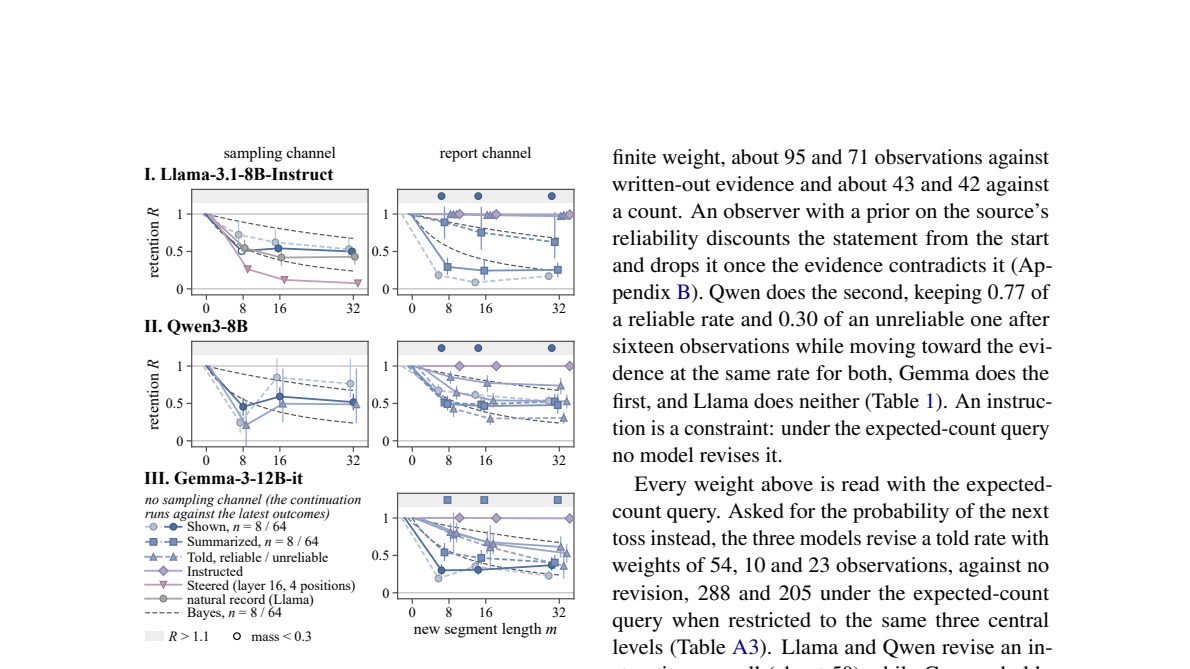
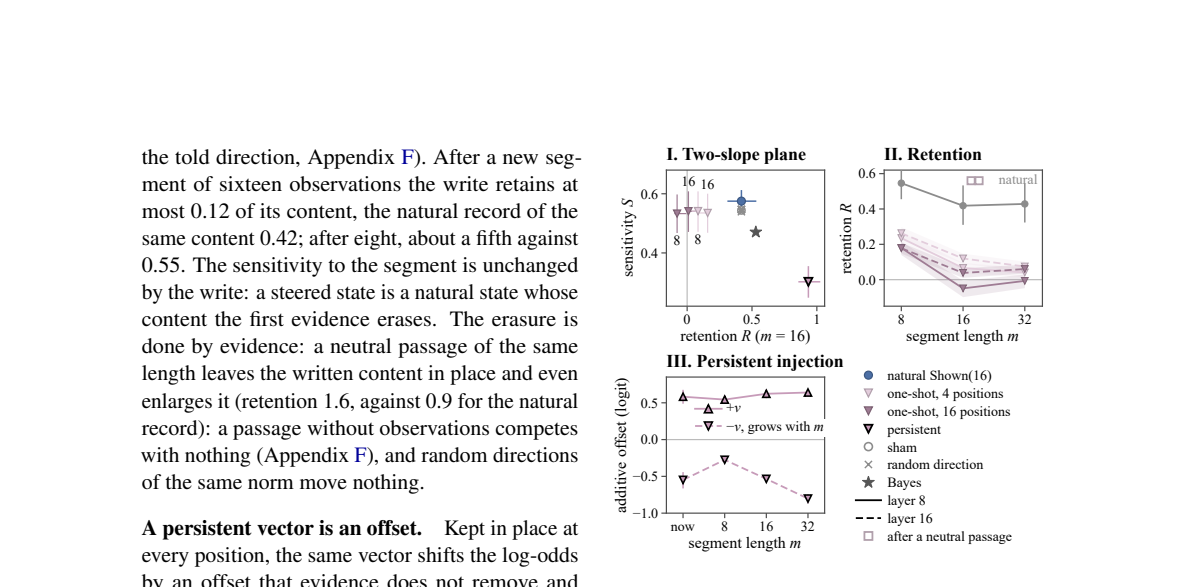
Core claim. The paper separates each probabilistic belief into two operational properties within each readout: its content (the current estimate) and its effective weight w (how strongly that estimate persists against subsequent observations). In a Bernoulli inference task with an analytic Bayesian reference, the authors prepare states through four textual routes (shown records, count summaries, source assertions, explicit instructions) and two activation-level interventions (steering and hidden-state transplantation). They find that outcome sequences primarily affect continuations, while statements and counts affect explicit estimates. Effective weights differ dramatically: shown records are worth a fraction of their length, count summaries receive weights that scale only weakly with the stated sample size, stated rates are treated as rules or testimony depending on the model, and one-shot steering installs the content of a record without its weight, so the first new evidence erases the written answer. The paper concludes that agreement in current readouts is insufficient to establish equivalence in belief updating.
The premise it rests on. The paper assumes that the linear regression model ppost = c + aπ + Sκ adequately captures the relationship between the readout and the evidence proportions, and that the exchange rate w = m*a/S is a valid measure of belief persistence, even though language-model behavior may deviate from the linear approximation that holds exactly for a Bayesian observer.
If the paper is right (Pith's inferences, not the authors')
Evaluating language-model belief states requires testing how they update under new evidence, not just matching current outputs.
Memory summaries that replace records keep a weight that hardly follows the stated count, suggesting long-horizon agents should preserve the weight of a belief alongside its prediction.
One-shot activation steering sets an answer the model will not defend, whereas persistent steering acts as an ongoing offset on the readout.
Different elicitation questions (expected count vs. next-toss probability) shift inferred weights by orders of magnitude, so belief measurement must specify the readout channel.
The format of input evidence (sequence vs. summary vs. instruction) selects which readout channel responds, making the reading of a belief inseparable from its mode of acquisition.
The paper's exchange-rate framework could be applied to multinomial beliefs, richer priors, or beliefs installed via fine-tuning or model editing, providing a unified test of equivalence across different acquisition routes.
If the hypothesis that weight is recovered from the text the model re-reads is correct, then changing the prompt formatting (e.g., splitting records into segments) should alter the effective weight, which the paper already observes.
The dissociation between content and weight suggests that methods for controllable text generation should be evaluated not just on immediate output matching but on whether they preserve the model's responsiveness to future evidence.
Check this review
Pith stored no record of this review's passes and took no fingerprint of it. Reviews made by code from 13 Nov 2026 on carry both.
How often reviews like this one are right
Reviews like this one: written by deepseek-v4-flash, where what was read was not recorded.
How often objections from reviews like this one are right: not yet measured
Reviews by people
This review was written by a machine. No person has reviewed this paper on Pith yet. A scientist listed on Pith can review it for a fee, and their review is published here whatever it concludes.
The paper
Abstract
Memory summaries, prompts and steering vectors set a language model's beliefs and are judged by the prediction they produce. A prediction does not say how firmly it is held. We separate a belief's content, what it predicts now, from its weight, the number of new observations it is worth: for an ideal observer, the amount of evidence behind it. In Bernoulli inference we set beliefs in nine open-weight models of 8 to 397B parameters and follow each belief with the same new observations. We argue that these models hold an answer without its evidence and recover its weight from the text they re-read. Weight therefore follows the form of the evidence and the question asked more than its amount: matched on their current estimate, a record of observations and a summary of its counts usually move apart under the same new observations, in either direction. Scale does not close the gap. Across the nine models 64 observations are worth 20 to 53 as a record and 9 to 151 as a summary, no closer to 64 at 397B than at 8B. Where no text stands behind a belief there is little to re-read: a steering vector can install a record's answer, and sixteen observations undo it where a neutral passage leaves it in place. Where reasoning first writes the counts into the context the weight returns, and the same 64 observations are worth 58 to 67 in either form. A matched answer is not a matched belief, and methods that set beliefs should be judged by the futures they produce.
The paper's own sentences, arranged, kept beside the review and separate from it. Each label is drawn from a closed vocabulary; the number beside it is the probability the classifier gave that label. No sentence in this record was written by a model.
abstract compiled · 2026-11-06
The authors' main claim, as the classifier picked it out 1.00
“These results show that agreement in current readouts is insufficient to establish equivalence in belief updating: how a belief is acquired and how it is read jointly determine its subsequent dynamics.”
How the main claim is stated: asserted 1.00
What the abstract itself states, as probabilities: claims first 0.04 · states limitation 0.34 · human participants 0.04 · controlled comparison 0.32 · randomized assignment 0.02 · states quantitative result 0.35 · compares with prior results 0.51 · mentions code or data availability 0.03
The abstract, sentence by sentence
This table labels the abstract only (arXiv listing abstract v1). The number is the probability the classifier gave the label.
| Sentence | Role | The authors' own work | States the main conclusion | Strength |
|---|---|---|---|---|
| Language models can produce similar probabilistic predictions after observing outcomes, reading summaries, receiving instructions, or undergoing activation interventions. | background 1.00 | 0.11 | 0.03 | hedged possibility 0.59 |
| Whether these routes induce equivalent belief states remains unclear: agreement in current predictions does not establish how a model will respond to subsequent evidence. | gap 1.00 | 0.06 | 0.19 | asserted 0.59 |
| We investigate this distinction in a Bernoulli inference task with an analytic Bayesian reference. | method 0.56 | 0.71 | 0.02 | asserted 0.56 |
| Across three open-weight language models, we prepare states through four textual routes and two activation-level interventions, measure both next-outcome continuations and explicit probabilistic estimates, and append identical new evidence from each prepared state. | method 0.97 | 0.97 | 0.03 | asserted 0.95 |
| We quantify the persistence of the initial belief through its effective evidence weight, the number of new observations it is worth. | method 0.97 | 0.88 | 0.03 | asserted 0.87 |
| We find that the format of evidence decides which readouts express its content: outcome sequences primarily affect continuations, whereas summaries and stated rates primarily affect explicit estimates. | result 1.00 | 0.96 | 0.13 | asserted 1.00 |
| Moreover, effective weights differ substantially across routes, with summaries receiving weights that scale weakly with their stated observation counts and elicitation questions changing inferred weights by orders of magnitude. | result 1.00 | 0.96 | 0.07 | asserted 1.00 |
| In a one-shot steering setting, an intervention that reproduces a natural record's immediate prediction loses most of its effect under subsequent evidence. | result 1.00 | 0.91 | 0.10 | asserted 1.00 |
| These results show that agreement in current readouts is insufficient to establish equivalence in belief updating: how a belief is acquired and how it is read jointly determine its subsequent dynamics. | interpretation 1.00 | 0.84 | 0.95 | asserted 1.00 |
What kind of paper the classifier reports this is: empirical study 0.99 · evidence from observation or experiment 0.67
What was examined, and what was not
Sources read
- arXiv listing abstract v1
Not examined
- full text
- figures and tables
- references and citing sentences
- relations to other papers
Levels run
- P abstract
Not run
- S sections
- T body sentences
- C citations
- R cross-paper relations
How the labels were made
Compiled by classifier-1.13.0 via TypeSafe API, question bank abstract-p1-20260923, 2026-11-06: 1 request, 6,911 input tokens.
Every quoted sentence on this record is the authors'. Every label is from Pith's closed vocabulary, with the probability shown beside it. This record as JSON
Figures (4)
Figures are the authors', reproduced from the paper.
Challenges and discussion
Disagree with the review, or know something it missed? Leave a comment, or challenge this review formally: a challenge becomes a permanent entry in this paper's record, and its decision is published here.
Come back by email
A short list of the week's newly reviewed papers. Nothing is sent until you confirm from your inbox, and every email has a link that stops it. No account.
No comments yet.
Sign in to comment