Machine Learning · arXiv:2611.08487 v2 · submitted 5 Nov 2026
User Embeddings are Superpositions of Interpretable Behavioral Modes
The paper says
“User embeddings are central components of modern recommendation, personalization, and behavioral modeling systems. Though these embeddings can compactly encode rich behavioral information, they are inherently dense and opaque, limiting interpretability.”
more of the abstract
To address this gap, we argue that user embeddings can be understood as sparse superpositions of interpretable behavioral modes. This structure is directly predicted by generative models of user behavior for linear embeddings and extends approximately to deep-learning representations by the superposition hypothesis. Superimposed modes can naturally be recovered by sparse dictionary learning methods, such as sparse autoencoders (SAEs), and recovered modes can be automatically named and queried in natural language. We validate mode recovery against known ground truth on synthetic data, where SAEs recover modes better than classical sparse baselines. We then apply our methods to classical and transformer-based user embeddings from two real-world datasets. We also show how the corresponding natural-language labels enable zero-shot audience retrieval and characterization over embeddings never trained on text. The framework is post-hoc and model-agnostic, requiring no modification to the upstream embedding system.
from the abstract
Pith says
Machine review · deepseek-v4-flash · 6 Nov 2026 · of version 1 of the paper; version 2 is newer · what was read was not recorded · not checked by a person
It can be wrong. Challenge this review or reply to it.
Holds up, with conditions. A disciplined, honest application of SAE dictionary learning to user embeddings whose superposition claim follows from its own mixture assumption; the real value is the retrieval pipeline and evaluation methodology, and the open question is whether real behavior has the assumed mode structure. This line is wrong
2 major objections · 6 minor
How often objections from reviews like this one are right: not yet measured
Not checked: figures, code, what the references say.
The paper says, at Section 3, Eq. (1); Section 4, Appendix A.1
The review did not quote this passage.
A classifier read this sentence of the paper as acknowledging the concern (probability 0.72):
“We conjecture that behavioral- mode resolution emerges from training dynamics, since the objective depends on aggregate sequence structure rather than individual items, but leave verification to future work.”
Pith says: Objection 1 of 2 · major
The existence of discrete behavioral-mode structure in real user behavior is assumed rather than tested, and the paper's validation strategy does not test that premise. The authors state in Section 3.1 that Eq. (2) is a linearity-of-expectation consequence of Eq.
more of objection 1
(1) for mean-pooling embeddings, so superposition for linear embeddings is not an independent empirical finding; the synthetic users are generated from exactly that assumption (Appendix A.1: 2 to 6 modes per user, LogNormal weights, interactions drawn from the mixture), and the SAE is additionally given the ground-truth sparsity through the adaptive L1 penalty (Appendix A.3). The authors acknowledge that this validates recovery 'under the framework's assumptions' (Section 4), but the abstract and the Section 5.1 headline present the structure as established. I ask for one of two fixes: (i) a direct, falsifiable test on real data, for example on Open e-commerce fitting LDA to the user-by-category counts and testing whether per-user SAE mode weights agree with LDA topic weights, or testing whether per-user SAE codes are sparse convex combinations whose residuals match mean-pooling noise; or (ii) an explicit reframing of the central claim as an interpretability and application claim with Eq. (1) as motivation, which is the register the paper already uses in parts of Section 5.2. The unproven linearity-in-w conjecture for transformer encoders (Section 3.1) is acknowledged by the authors, but it is part of the same gap, because the only test of the transformer extension runs on data generated from Eq. (1).
The paper says, at Section 5, Tables 1 and 2, Appendix E.3
The review did not quote this passage.
Pith says: Objection 2 of 2 · major
The real-data evaluation does not discriminate the discrete-mixture mechanism from generic sparse coding. On MovieLens, K-Means encoding is statistically indistinguishable from the SAE on the headline rank metrics (Table 10: Lift p=0.36 and 0.69, AUROC p=0.10 and 0.81 on SASRec and BERT4Rec), and the paper's explanation that 'the superposition structure is there for its centroids to approximate' (Section 5.2) presupposes the structure at issue.
more of objection 2
The SAE's advantages (coverage, scored AUROC on SASRec, reconstruction fidelity, feature distinctiveness) are consistent with any sparse dictionary that retains enough ranking signal, and the held-out demographic control (Appendix E.3) is also passed by K-Means encoding, so it isolates sparse decomposition generally rather than behavioral modes specifically. Consequently, the claim that 'SAE decomposition recovers the underlying behavioral modes faithfully enough to support zero-shot natural-language retrieval that matches or exceeds every classical sparse baseline on every retrieval-quality metric' (Section 5.1) is not established by retrieval evidence, and, as written, is contradicted in the same section: FastICA exceeds the SAE on Coverage in both Open e-commerce task blocks (Table 1: 0.770 versus 0.735 for category tasks; Appendix D reverse-direction p=0.91 and 0.97). Please either add a discriminative test (the LDA agreement test suggested above would serve) or rewrite the real-data claims so that faithful mode recovery is claimed only on synthetic data and the real-data contribution is framed as a useful, queryable feature representation.
6 minor objections
The paper says, at Section 5.2 and Appendix E.1
Pith says: minor objection 1 of 6
The near-orthogonality of the SAE dictionary, cited in Section 5.2 as the driver of the coverage and redundancy advantages, is partly induced by the operating-point selection, since lambda is chosen at the elbow of mean pairwise decoder cosine similarity (Appendix E.1); the text should state explicitly that this orthogonality is a property of the selected operating point rather than an intrinsic SAE property.
The paper says, at Appendix C.5 and Section 5.1
Pith says: minor objection 2 of 6
The finding that part of the SAE's margin over the baselines comes from the LLM naming and selection step (with Llama 3.3 names, K-Means category coverage rises from 0.61 to 0.75 and the SAE's AUROC lead over K-Means falls from 0.031 to under 0.01, single seed, no significance test) appears only in the appendix; since it qualifies the headline comparison of Section 5.1, a one-sentence version of this caveat should appear in the main text.
show 4 more
The paper says, at Section 4 and Appendix A.6
Pith says: minor objection 3 of 6
The synthetic transformer experiment trains SASRec on shuffled histories because the generative model draws interactions independently (Appendix A.6); the main text should note this, since the MovieLens transformers are trained on chronological sequences, and the claim that mode recovery holds for transformer-encoded embeddings is demonstrated only for encoders applied to orderless sequences.
The paper says, at Section 3.1
Pith says: minor objection 4 of 6
The term 'superposition' is used both for correlated non-orthogonal centroids and for overcomplete dictionaries in the sense of Elhage et al.; since these are different phenomena (correlated atoms versus more simultaneously active features than dimensions), a sentence separating them would help readers outside the mechanistic-interpretability literature.
The paper says, at Section 3.2
Pith says: minor objection 5 of 6
The paper does not discuss identifiability of the dictionary learning problem in Eq. (2), that is, conditions under which the recovered atoms correspond to the true mode centroids rather than to another sparse dictionary spanning nearly the same subspace; the synthetic experiments provide empirical evidence, but a brief identifiability discussion would strengthen the theoretical framing.
The paper says, at Throughout
Pith says: minor objection 6 of 6
Minor copyediting: the reference to Spisak et al. contains a stray space in an author name; the footnote marker in the Section 5.1 headline sentence disrupts the claim; and the column formatting of Figure 2 should be cleaned up.
What would settle it
Test Eq. (1) directly on Open e-commerce by predicting held-out raw behavior from recovered mode weights. Fit the SAE on embeddings from pre-2021 windows only; for each user compute mode weights via SAE encoder activations; estimate each mode's category distribution p_k(c) from the interaction histories of its top-activating users; then predict each user's post-2021 category purchase counts as sum_k w_hat_k p_k(c). Compare predictive likelihood or R^2 against the same construction using K-Means encoding at matched L0 and against a dense baseline such as the full embedding. If the SAE modes do not predict held-out purchases substantially better than a generic sparse code, the discrete-mixture mechanism of Eq. (1) is not supported, and the recovered modes are best interpreted as embedding-space directions rather than verified behavioral generators.
from the skeptic's reading
How the review went
4 readings by deepseek-v4-flash · 6 Nov 2026
- Reader holds up, with conditions
- Skeptic partly agrees
- Editor wrote the verdict above
- Referee major revision: 2 major objections, 6 minor
Not run on this paper: the simulated authors' defence.
Pith did not check this review's objections against the paper.
The review in full
The review in brief, machine-written
Two things to know before you read arXiv:2611.08487. First, the headline claim — user embeddings are sparse superpositions of interpretable behavioral modes — is a direct consequence of the paper's own generative mixture assumption (Eq. 1), not an independently established property of real embeddings. Second, the paper knows this and is unusually honest about it, which is why it's still worth reading: the real contribution is a disciplined demonstration that post-hoc SAE decomposition of user embeddings yields queryable, behaviorally distinct features and a zero-shot natural-language retrieval pipeline that works on embeddings never trained on text.
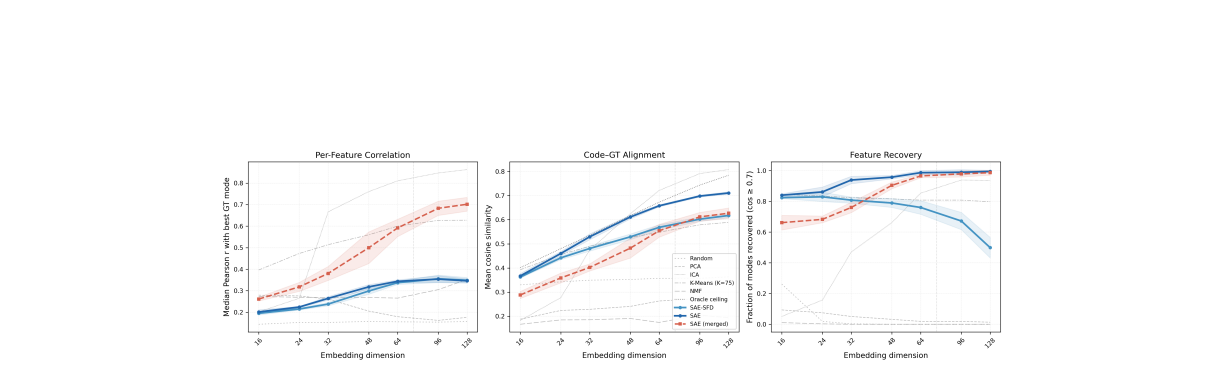
What's actually new: SAEs have been applied to text, image, and other modality embeddings, but the combination here — decomposition of behavioral user embeddings, ground-truth mode recovery on synthetic transformer-encoded embeddings (73/75 modes vs. 59% for FastICA), and zero-shot NL audience retrieval with no text-aligned supervision — is new. The evaluation is a cut above the usual: paired Wilcoxon tests with reverse directions reported, oracle ceilings on synthetic data, a held-out demographic control where the title-text baseline collapses to near chance while the SAE holds AUROC 0.58–0.60, and explicit disclosure of excluded tasks, the single-seed Llama replication, and the conjecture status of the transformer extension (b68). The demographic control specifically rules out LLM title-matching as the explanation for the retrieval results.
The soft spots, in proportion. Eq. (2) is linearity of expectation applied to the paper's own mixture assumption; Section 3.1 and the Section 4 preamble say this, but the abstract and intro sell it as a finding. The synthetic experiments generate data from that same assumption and tune the SAE sparsity to the known ground-truth mode count, so the recovery numbers are partly guaranteed. And on real data, retrieval success does not separate the mode-superposition mechanism from generic sparse coding: K-Means encoding ties the SAE on the headline MovieLens ranking metrics, and the text baseline ties AUROC on title-derived tasks. The stress-test note is fair on all of this; I'd only add that the paper's own Section 4 explicitly frames synthetic validation as validation under the framework's assumptions, so the framing critique lands on the abstract more than on the body. Missing code and data, proprietary LLM steps, and modest absolute effect sizes round out the concerns; all disclosed, all real.
Who this is for: people working on interpretability of user representations, recommendation auditing, and audience targeting, and anyone who wants a good example of honest SAE evaluation. It deserves a serious referee. I'd send it to review and condition acceptance on releasing artifacts, validating modes in a domain with different interaction semantics (negative feedback or mobility), and rewording the superposition claim so it matches what the evidence supports.
The strongest objection
The paper's central claim is Eq. (2): a user embedding is approximately the sparse weighted sum of mode centroids. As Section 3.1 states, this is a linearity-of-expectation consequence of the generative assumption in Eq. (1), not an independent empirical finding. The synthetic experiments in Section 4 exercise the implication in the direction the authors already proved: users are constructed with 2–6 modes drawn from the assumed mixture (Appendix A.1), embeddings are formed by mean-pooling, and the SAE sparsity is tuned to the known ground-truth mode count. Those experiments validate recovery of the assumed structure, not the existence of that structure in real behavior. The real-data experiments in Section 5 use zero-shot natural-language retrieval as the external test, but retrieval success does not require the discrete-mixture mechanism. On MovieLens, K-Means encoding, a generic partition-based sparse code with no mode assumption, ties the SAE on Lift and AUROC (Table 2, p≥0.1), and the text-embedding baseline ties AUROC; the SAE's advantages are coverage, scored AUROC, reconstruction fidelity, and feature distinctiveness. These outcomes are consistent with Eq. (1) but also with any sparse dictionary that captures enough ranking signal. The demographic control (Appendix E.3) shows that sparse decomposition captures demographic signal, but K-Means encoding also beat the text baseline there, so it does not isolate behavioral modes specifically. The load-bearing untested premise is therefore the one in sentences b47–b51: a small discrete set of behavioral modes exists, each user's interactions are i.i.d. draws from a sparse non-negative mixture over them, and time dependence can be suppressed (b45–b46). The authors acknowledge the time-dependence suppression and the nonlinear-encoder conjecture (b68), but no experiment in the paper tests whether real behavior is approximately generated this way.
The reader's weakest-assumption analysis identifies the generative mixture model of Eq. (1) as the load-bearing premise, and my reading agrees: Eq. (2) is a consequence of that assumption, and the synthetic experiments are generated from it. The sharpening I add is that the real-data retrieval benchmarks are the only evidence for the assumption itself, and they do not settle it: K-Means encoding ties the SAE on the main MovieLens ranking metrics, the text baseline ties AUROC, and the demographic control is shared by all sparse-decomposition methods. I therefore frame the concern as an untested prediction of the framework rather than an internal inconsistency. The paper is unusually candid about its limitations, including the time-dependence suppression (b45–b46), the transformer linearity conjecture (b68), the single-seed Llama replication (b431), and the Stouffer independence caveat (b441). The proposed concrete test is feasible with data the authors already use: fit the SAE on one temporal snapshot and predict future raw category counts from mode weights. If modes are real generating mechanisms, recovered weights should predict held-out interactions; if a generic sparse code predicts equally well, the superposition claim is not falsified but its behavioral interpretation is unsupported. Because the paper is already CONDITIONAL and this concern is a sharpened condition (directly test Eq. (1) on real behavior) rather than a demonstrated failure, I do not change the verdict. The condition for acceptance should include this prediction test in addition to artifact release and the reader's proposed additional-domain validation.
The referee's report
The paper's empirical practice is a strength: multiple seeds with paired Wilcoxon tests reported in both directions (Table 10), an oracle ceiling bounding the synthetic comparison, a held-out demographic control (Appendix E.3), confidence-threshold and training-length sweeps (Tables 12 and 14), explicit disclosure of excluded tasks and queries (Appendices C.2 and E.2), and full prompts and query lists (Appendices E and F). The synthetic mode-recovery result on transformer-encoded embeddings (73 of 75 modes recovered versus 59 percent for FastICA, Appendix A.6) is strong evidence that, conditional on the mixture assumption, SAEs substantially outperform classical sparse baselines, and the direct comparison with the soft-frozen-decoder baseline of Korznikov et al. (2026) engages the central sanity-check criticism of SAEs. The demographic control does rule out the specific title-matching confound it targets (Appendix E.3). If the superposition hypothesis is treated as a working hypothesis with Eq. (1) as motivation, the paper delivers a practical, model-agnostic interpretability toolkit and a new test bed for mechanistic interpretability beyond transformer residual streams.
Pith's reading of the paper (a machine's summary, not the authors')
This paper tries to establish that the dense vector summarizing a user's history, the embedding a recommender computes, is actually a sparse superposition of a handful of behavioral modes such as "dog lover," "binge-watcher," or "new parent." For any embedding built by averaging per-purchase vectors, that structure follows mathematically from a generative model in which each interaction is drawn from one of a few latent user types; for transformer encoders it is asserted approximately, via the superposition hypothesis, and tested empirically. The paper then shows that sparse autoencoders can pull the modes back out of the embedding alone, recovering 73 of 75 known modes on synthetic transformer-encoded users where the best classical baseline recovers 59 percent, and that LLM-named modes enable zero-shot natural-language audience search on real purchase and rating data. If true, this matters because it gives any pre-trained user embedding a transparent, queryable, and auditable representation without retraining or touching raw interaction logs.
What carries the argument. The load-bearing object is the superposition identity of Eq. (2), $u \approx \sum_k w_k d_k$: for mean-pooled embeddings, the user vector is approximately a sparse non-negative weighted sum of mode centroids, each centroid being the expected per-observation embedding of one behavioral mode. The recovery tool is the vanilla ReLU sparse autoencoder, whose encoder activations estimate mode weights and whose decoder columns estimate mode directions, with an L1 penalty enforcing sparsity and an overcomplete hidden dimension allowing non-orthogonal, superposed centroids to be disentangled, something PCA cannot do because its axes must be orthogonal. Around these two sit three supporting mechanisms: random projections or small embedding dimensions to vary the amount of superposition; a post-hoc merging step that recombines artificial feature splits, validated on synthetic data; and auto-interpretation, in which an LLM names each latent from its top-activating and non-activating users, turning recovered directions into natural-language features that can be scored against a query.
Core claim. The paper's central claim is that user embeddings are sparse superpositions of interpretable behavioral modes, not opaque dense vectors. For embeddings formed by averaging per-observation features (mean-pooling, possibly followed by a fixed linear map), this is exact in expectation: the user vector satisfies $u \approx \sum_k w_k d_k$, a sparse non-negative mixture over mode centroids $d_k$, where $w$ holds the user's mode weights from a mixed-membership generative model of behavior. The empirical claim is that a vanilla ReLU sparse autoencoder recovers those modes from the embeddings alone: on synthetic data with 75 known ground-truth modes it matches or exceeds every classical sparse baseline in the high-superposition regime $m < K$, and on transformer-encoded embeddings it recovers 73 of 75 modes where FastICA falls to 59 percent. On two real-world datasets, LLM-named SAE latents support zero-shot natural-language audience retrieval that matches or exceeds the classical sparse baselines and a text-embedding baseline on the metrics that measure top-of-ranking precision, and the near-orthogonal SAE dictionary covers audiences more fully than k-means encoding's overlapping centroids.
The premise it rests on. The load-bearing premise is that real user behavior is approximately generated by a small discrete set of behavioral modes, with each interaction drawn independently from a sparse non-negative mixture over them and time dependence ignorable, and, for transformer embeddings, that mode mixtures behave approximately linearly in the encoder's features (a conjecture the authors state but leave unverified); if either fails, the recovered and LLM-named modes are dictionary artifacts being labeled rather than recovered behavioral structure.
If the paper is right (Pith's inferences, not the authors')
Any mean-pooled or linearly pooled user embedding inherits the superposition structure whenever behavior follows a mixed-membership generative model, so mode recovery becomes a dictionary-learning problem solvable without modifying the upstream recommender.
Sparse autoencoders recover known ground-truth modes better than classical sparse baselines through a nonlinear transformer encoder (73 of 75 modes), so faithful mode recovery does not require a linear embedding function.
Zero-shot natural-language audience retrieval works on embeddings never trained on text, and beats a text-embedding baseline on Lift (precision at the top) while matching it on AUROC.
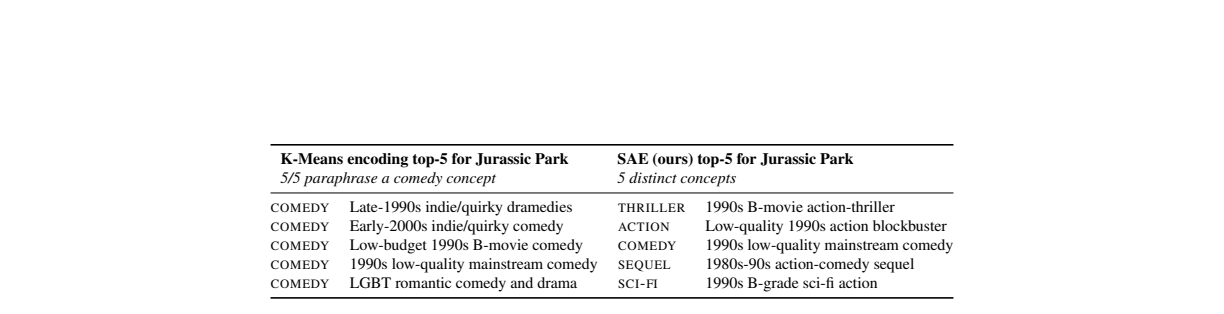
The near-orthogonal SAE dictionary describes an audience with more distinct concepts than k-means encoding's overlapping centroids, which paraphrase one region of embedding space and leave others uncovered.
Because recovered features are enumerable and named, sensitive trait directions can be detected and ablated, a capability the authors note also lowers the cost of privacy-invasive inference.
An untested extension of the paper's logic is that the same pipeline should work wherever an encoder uses a mean-pooled or linearly pooled readout, so mobility, financial, or health-engagement embeddings could be audited with no architectural change; the authors only demonstrated consumption domains.
The paper leaves its linearity-in-w conjecture for nonlinear encoders unverified; a direct test would run the synthetic mode-recovery task with a non-pooled readout (last-token or CLS) and compare recovery rates against the mean-pooled numbers.
A concrete design rule follows if the claim is right: recommenders that want post-hoc interpretability should prefer pooling readouts, since pooling provably preserves the superposition structure that SAEs can then recover.
The named-feature machinery suggests a quantitative privacy audit not run in the paper: measure how accurately a sensitive mode (e.g., recent new parent) can be inferred from embeddings alone before and after ablating its decoder direction.
Check this review
Pith stored no record of this review's passes and took no fingerprint of it. Reviews made by code from 13 Nov 2026 on carry both.
How often reviews like this one are right
Reviews like this one: written by deepseek-v4-flash, where what was read was not recorded.
How often objections from reviews like this one are right: not yet measured
Reviews by people
This review was written by a machine. No person has reviewed this paper on Pith yet. A scientist listed on Pith can review it for a fee, and their review is published here whatever it concludes.
The paper
Abstract
User embeddings are central components of modern recommendation, personalization, and behavioral modeling systems. Though these embeddings can compactly encode rich behavioral information, they are inherently dense and opaque, limiting interpretability. To address this gap, we argue that user embeddings can be understood as sparse superpositions of interpretable behavioral modes. This structure is directly predicted by generative models of user behavior for linear embeddings and extends approximately to deep-learning representations by the superposition hypothesis. Superimposed modes can naturally be recovered by sparse dictionary learning methods, such as sparse autoencoders (SAEs), and recovered modes can be automatically named and queried in natural language. We validate mode recovery against known ground truth on synthetic data, where SAEs recover modes better than classical sparse baselines. We then apply our methods to classical and transformer-based user embeddings from two real-world datasets. We also show how the corresponding natural-language labels enable zero-shot audience retrieval and characterization over embeddings never trained on text. The framework is post-hoc and model-agnostic, requiring no modification to the upstream embedding system.
The paper's own sentences, arranged, kept beside the review and separate from it. Each label is drawn from a closed vocabulary; the number beside it is the probability the classifier gave that label. No sentence in this record was written by a model.
abstract compiled · 2026-11-06
The authors' main claim, as the classifier picked it out 0.92
“To address this gap, we argue that user embeddings can be understood as sparse superpositions of interpretable behavioral modes.”
How the main claim is stated: hedged possibility 0.34
What the abstract itself states, as probabilities: claims first 0.05 · states limitation 0.34 · human participants 0.10 · controlled comparison 0.77 · randomized assignment 0.02 · states quantitative result 0.06 · compares with prior results 0.93 · mentions code or data availability 0.03
The abstract, sentence by sentence
This table labels the abstract only (arXiv listing abstract v1). The number is the probability the classifier gave the label.
| Sentence | Role | The authors' own work | States the main conclusion | Strength |
|---|---|---|---|---|
| User embeddings are central components of modern recommendation, personalization, and behavioral modeling systems. | background 1.00 | 0.04 | 0.02 | asserted 1.00 |
| Though these embeddings can compactly encode rich behavioral information, they are inherently dense and opaque, limiting interpretability. | gap 0.73 | 0.08 | 0.03 | asserted 1.00 |
| To address this gap, we argue that user embeddings can be understood as sparse superpositions of interpretable behavioral modes. | contribution 0.88 | 0.21 | 0.79 | hedged possibility 0.34 |
| This structure is directly predicted by generative models of user behavior for linear embeddings and extends approximately to deep-learning representations by the superposition hypothesis. | background 0.57 | 0.15 | 0.21 | asserted 0.80 |
| Superimposed modes can naturally be recovered by sparse dictionary learning methods, such as sparse autoencoders (SAEs), and recovered modes can be automatically named and queried in natural language. | method 0.95 | 0.29 | 0.13 | asserted 0.72 |
| We validate mode recovery against known ground truth on synthetic data, where SAEs recover modes better than classical sparse baselines, including on transformer-encoded embeddings. | result 0.98 | 0.96 | 0.11 | asserted 1.00 |
| We then apply the method to classical and transformer-based user embeddings from two real-world datasets. | method 0.69 | 0.94 | 0.03 | asserted 0.92 |
| We also show how the corresponding natural-language labels enable zero-shot audience retrieval and characterization over embeddings never trained on text. | result 0.92 | 0.93 | 0.11 | asserted 1.00 |
| The framework is post-hoc and model-agnostic, requiring no modification to the upstream embedding system. | method 0.49 | 0.54 | 0.08 | asserted 1.00 |
What kind of paper the classifier reports this is: method or tool 0.95 · evidence from observation or experiment 0.74
What was examined, and what was not
Sources read
- arXiv listing abstract v1
Not examined
- full text
- figures and tables
- references and citing sentences
- relations to other papers
Levels run
- P abstract
Not run
- S sections
- T body sentences
- C citations
- R cross-paper relations
How the labels were made
Compiled by classifier-1.13.0 via TypeSafe API, question bank abstract-p1-20260923, 2026-11-06: 1 request, 6,800 input tokens.
Every quoted sentence on this record is the authors'. Every label is from Pith's closed vocabulary, with the probability shown beside it. This record as JSON
Figures (3)
Figures are the authors', reproduced from the paper.
Challenges and discussion
Disagree with the review, or know something it missed? Leave a comment, or challenge this review formally: a challenge becomes a permanent entry in this paper's record, and its decision is published here.
Come back by email
A short list of the week's newly reviewed papers. Nothing is sent until you confirm from your inbox, and every email has a link that stops it. No account.
No comments yet.
Sign in to comment