Computer Vision and Pattern Recognition · arXiv:2611.11136 v2 · submitted 8 Nov 2026
From Game Generation to Game Playing: Fully Automated Ability Training for Vision-Language-Action Models
The paper says
“Training vision-language-action (VLA) models to follow gameplay instructions across diverse games is limited by the cost of collecting demonstrations. We introduce a framework that automatically generates game environments and expert demonstrations.”
more of the abstract
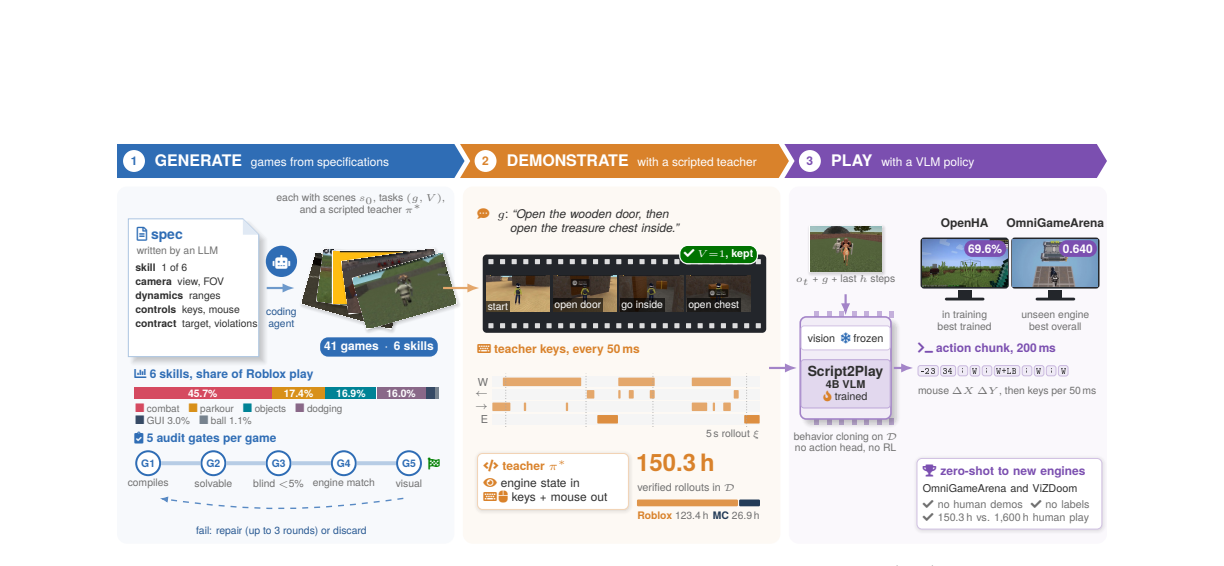
An LLM-powered agent uses game-building tools to construct executable environments and tasks targeting specified skills. Programmatic experts then use privileged simulator state to generate aligned instructions, rendered observations, and keyboard and mouse actions. We train our game policy, Script2Play, by post-training a 4B vision-language model with behavior cloning on 150.3 hours of synthetic gameplay in Minecraft and Roblox, without human gameplay demonstrations or reinforcement learning. Evaluation on multiple public game benchmarks demonstrates that Script2Play follows gameplay instructions effectively and generalizes across game engines, highlighting the effectiveness of targeted synthetic supervision.
from the abstract
Pith says
Machine review · deepseek-v4-flash · 10 Nov 2026 · of version 1 of the paper; version 2 is newer · what was read was not recorded · not checked by a person
It can be wrong. Challenge this review or reply to it.
Holds up, with conditions. Promising automated data pipeline for game VLA training, with strong empirical evidence from a controlled backbone comparison, but the pipeline's external dependency on a single LLM and the lack of released code/data temper the result's force. This line is wrong
3 major objections · 6 minor
How often objections from reviews like this one are right: not yet measured
Not checked: figures, code, what the references say.
The paper says, at Table4, §4.4
The review did not quote this passage.
Pith says: Objection 1 of 3 · major
The paper claims that the three policies compared in Table4 share the Qwen2.5-VL-7B backbone. However, the cited references for OpenHA [34] and HiS TEVE [29] describe models built on VPT/JARVIS-VLA and possibly other backbones, respectively. The manuscript does not cite any source confirming that the published OpenHA or HiS TEVE results were obtained from a Qwen2.5-VL-7B initialization.
more of objection 1
Without this evidence, the comparison does not control for backborn, and the experiment does not isolate the effect of the supervision source. The authors must either (a) provide explicit verification (e.g., a citation to a version of OpenHA that uses Qwen2.5-VL-7B, or a statement that they re-trained OpenHA/HiSTEVE from that backbone) or (b) remove the claim of a 'shared-backborn' control and temper the conclusion about the advantage of synthetic supervision.
The paper says, at Abstract, §1, §5
The review did not quote this passage.
A classifier read this sentence of the paper as acknowledging the concern (probability 0.83):
“Because the systems differ in backbone, training procedure, and data composition, the comparison establishes an efficient operating point rather than a sample-complexity ratio.”
Pith says: Objection 2 of 3 · major
The main claim that SCRIPT2PLAY 'outperforms policies trained on thousands of hours of human gameplay' (abstract, b29) rests primarily on the comparisons in Table1, Table2, and Table3, which the manuscript itself acknowledges are confounded by differences in backbone, training procedure, and data composition (b122, b124, b128).
more of objection 2
The only attempt at a controlled comparison (Table4) is compromised by the unverified backbone claim (major comment 1). The authors should explicitly state in the abstract and conclusion that the head-to-head comparisons with human-trained systems involve uncontrolled confonds, and should report a fairer summary that highlights the controlled experiment if it is confirmed.
The paper says, at Table1, §4.2
The review did not quote this passage.
Pith says: Objection 3 of 3 · major
The training data for SCRIPT2PLAY includes 123.4 h of Roblox gameplay, while the OpenHA benchmark is Minecraft-only. The paper does not discuss potential negative transfer or positive transfer from Roblox to Minecraft. Given that the shared-backborn variant (MC-only, 26.9h) achieves 45.9% on OpenHA (Table4a) while the full 4B model (with 123.4h Roblox) achieves 69.6% (Table1), the difference may arise from the different backbone (Qwen3.5-4B vs Qwen2.5-VL-7B) and from Roblox data.
more of objection 3
The paper should discuss this discrepancy and whether the Roblox data actually benefits Minecraft performance or if the backbone change primarily drives the gain.
6 minor objections
The paper says, at §3.1, Eq. (2)
Pith says: minor objection 1 of 6
The behavior-cloning loss is described as unweighted, but the next sentence introduces a weighted version (5x for Roblox, 3x for Minecraft). Clarify whether the reported results use the unweighted or weighted loss.
The paper says, at Table1 footer
Pith says: minor objection 2 of 6
The table notes asterisk with † but does not define the symbol in the caption. Define '†' (e.g., 'Approximate hour equivalents').
show 4 more
The paper says, at §4.1
Pith says: minor objection 3 of 6
The learning rate is given as 2×10^{-5} with 5% warmup. Specify the number of warmup steps (or at least the number of training steps) to allow reproducibility.
The paper says, at §4.4, Table4 b) row
Pith says: minor objection 4 of 6
The HiS TEVE row is missing for Table4 (b) with the comment 'weights unavailable'. If the model is not evaluated, consider removing the row to avoid confusion.
The paper says, at Figure4 caption
Pith says: minor objection 5 of 6
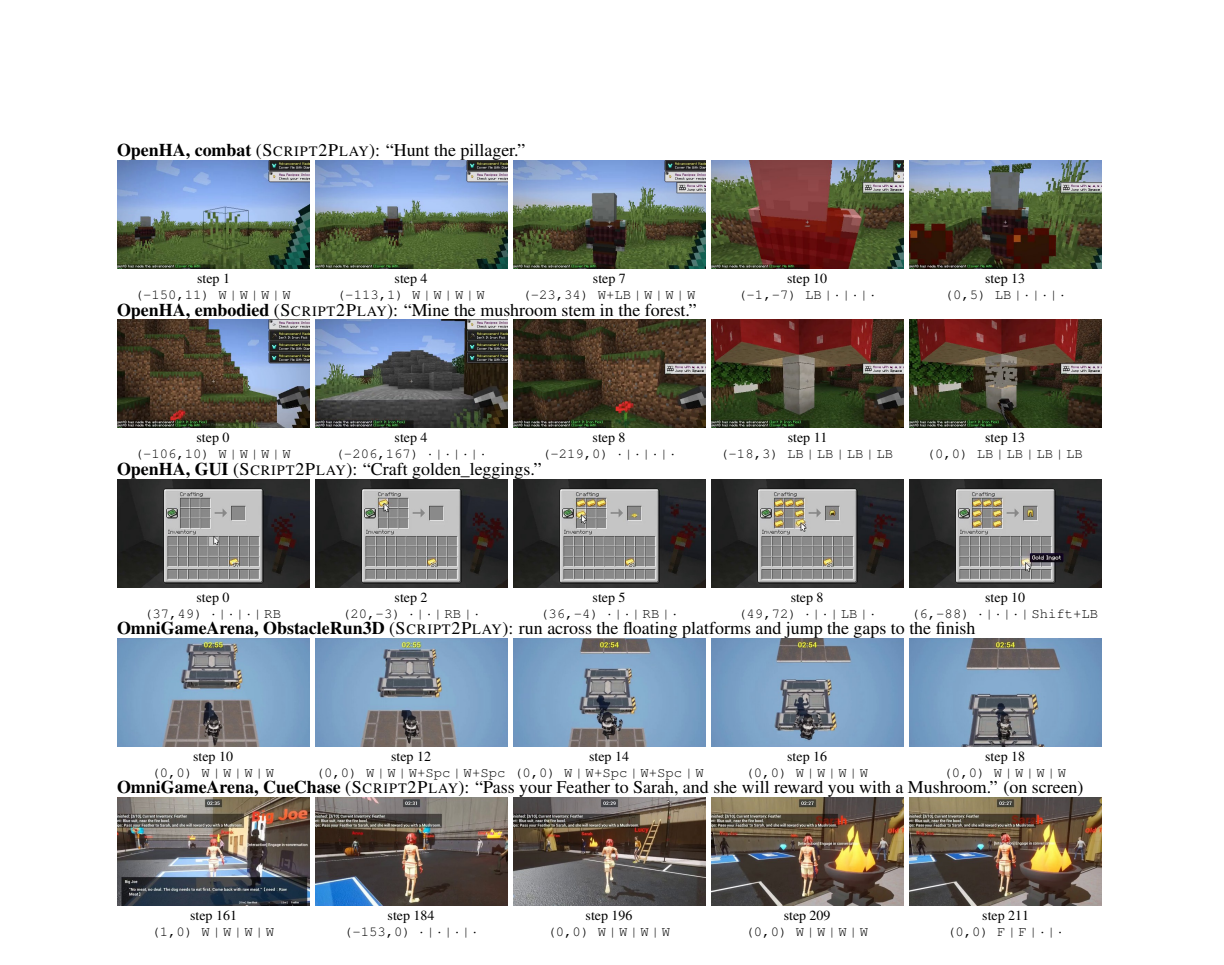
The caption says 'each step represents 200 ms' but the figure shows 'step 1' etc. Clarify that 'step' means 'control decision'.
The paper says, at §B, Example game
Pith says: minor objection 6 of 6
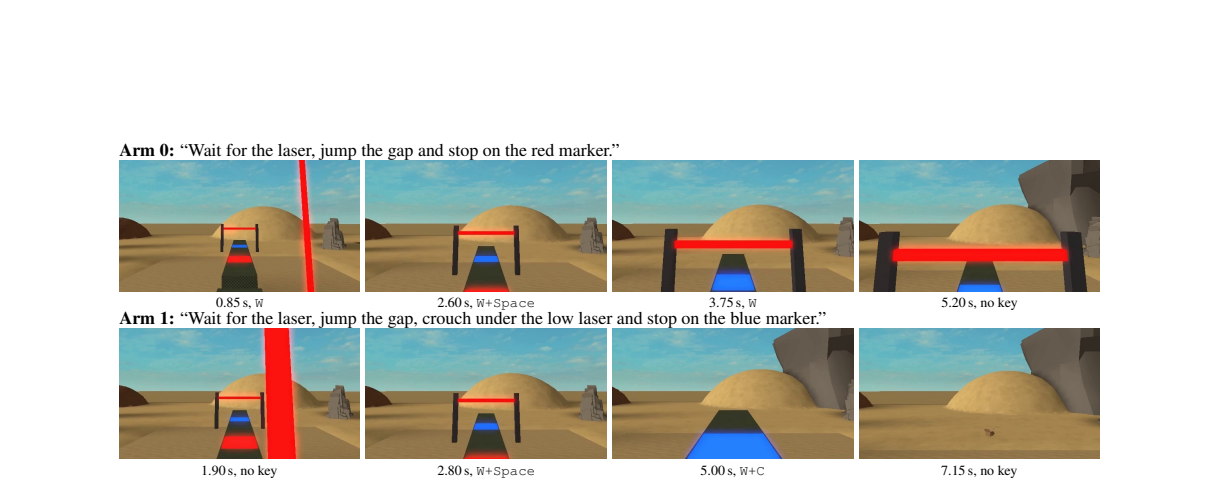
The example instance 'Laser Maintenance Bridge' is described in detail; it is a good illustration. Consider moving to main text to illustrate the generation process.
What would settle it
Request the authors to specify the exact backbone used for each entry in Table 4, with citations to the original model configurations. If OpenHA or HiSTEVE do not use Qwen2.5-VL-7B, rerun Table 4a with all methods re-implemented on the same backbone (e.g., train OpenHA-style human-play data and HiSTEVE-style RL on Qwen2.5-VL-7B under identical conditions). Report whether the relative ordering and gaps change.
from the skeptic's reading
How the review went
4 readings by deepseek-v4-flash · 10 Nov 2026
- Reader holds up, with conditions
- Skeptic partly agrees
- Editor wrote the verdict above
- Referee major revision: 3 major objections, 6 minor
Not run on this paper: the simulated authors' defence.
Pith did not check this review's objections against the paper.
The review in full
The review in brief, machine-written
The paper does what it says on the tin: it builds an end-to-end pipeline that generates games from skill specifications using an LLM-powered coding agent, collects expert demonstrations with programmatic teachers that exploit privileged simulator state, and then trains a VLA policy via behavior cloning on the synthetic data. The main result—competitive or state-of-the-art performance on three public benchmarks using only 150h of synthetic data and no human gameplay—is substantiated by a series of experiments, the strongest being Table 4's shared-backbone comparison on Minecraft. That experiment shows a 14-point gain over OpenHA and an 8-point gain over HiSTEVE when the backbone is fixed to Qwen2.5-VL-7B.\n\nThe paper is honest about confounds in the headline comparisons (Tabs. 1-3) and about the approximate data-scale equivalences. The careful audit pipeline (five gates) is a genuine engineering contribution that raises the bar for synthetic data quality in this subfield.\n\nThe soft spots are real but not fatal. The stress-test about Table 4's backbone control is worth verifying: the paper claims OpenHA and HiSTEVE are initialized from the same 7B model but does not cite direct evidence from those papers. That said, the gap is large enough (14 points on average) that even if the baselines used a slightly earlier checkpoint, the supervision source is likely the dominant factor. A more serious concern is the heavy reliance on Claude Opus 5.5 for game generation. The pipeline's scalability depends on a specific API and prompt design, and the paper does not ablaze this. No code, data, or model weights are released, so the results are not independently reproducible. The ViZDoom results are modest (12.92 vs. 14.54 for Game-TARS) and acknowledge history-free policy limitations.\n\nOverall, this is a solid systems paper that deserves a serious referee. The central claim is supported by the controlled experiment, and the authors are transparent about limitations. I would accept peer review and recommend asking the authors to release code and to verify the backbone control more carefully, ideally by running the baselines from their official checkpoints. I might not cite it myself (not my subfield), but I would bring it to a reading group interested in VLA training or synthetic data pipelines.
The strongest objection
The paper's central argument—that synthetic supervision outperforms human-demonstration training—leans heavily on the controlled experiment in Table 4, which compares SCRIPT2PLAY (7B) against OpenHA and HiSTEVE under a 'shared backbone' (Qwen2.5-VL-7B). However, the paper does not cite any evidence that OpenHA or HiSTEVE actually use this backbone. OpenHA [34] describes a family of hierarchical agents, several of which are built on VPT or JARVIS-VLA, not Qwen2.5-VL-7B. HiSTEVE [29] might use a different base model. Without explicit verification, the comparison could attribute gains to the supervision source when they actually arise from a newer or larger backbone. The paper's own sentence b122 admits that main comparisons are confounded by backbone differences, yet Table 4 is presented as a resolution. If the backbone is not controlled, the experiment does not isolate the effect of supervision, and the strongest evidence for the core claim weakens.
The reader identified the LLM game-generation dependency as the weakest assumption, which is a valid concern. My stress-test targets a different load-bearing point: the controlled experiment in Table 4 is portrayed as a clean comparison of supervision sources, but the paper fails to demonstrate that the baselines share the same backbone. This is not an external dependency but an internal inconsistency in the evidence chain. If the backbone is mismatched, the claimed 14.4-point gain over OpenHA and 8.5-point gain over HiSTEVE could be artifacts of model capacity, not supervision quality. This concern is concrete and testable. It does not fully invalidate the paper—results in Tables 1–3 still show strong absolute performance—but it removes the cleanest support for the headline claim that synthetic data exceeds human-play data. Therefore the verdict remains CONDITIONAL (the reader's judgment is robust), but the correctness risk should be noted as higher than the reader's 'medium' if this point is unresolved. I recommend no change to the verdict because the reader already flagged confounded comparisons in the main tables, and my concern extends that to the supposedly controlled experiment. The paper's own acknowledgement of 'different backbones' (b122) suggests this issue is known but not adequately addressed in Tab. 4. Hence, partial agreement: the reader's weakest assumption is different, but they correctly noted the confounding; my concern sharpens it.
The referee's report
If the results are robust, the paper demonstrates that targeted synthetic supervision from programmatic teachers can replace large-scale human gameplay data for training instruction-following game agents. The pipeline is novel and, in principle, scalable to many tasks and game engines. The best controlled experiment (Table4, assuming the shared-backborn claim holds) shows a substantial gain from synthetic supervision over human-play and RL-based training on the same model family. This would be a significant step toward practical, low-cost VLA agent training.
Pith's reading of the paper (a machine's summary, not the authors')
The paper proposes a fully automated framework that generates game environments, task verifiers, and scripted expert demonstrations from natural-language skill specifications. A coding agent (powered by an LLM) creates executable games with teachers that use privileged simulator state to produce aligned instructions, frames, and keyboard-and-mouse actions. By post-training a 4B vision-language model via behavior cloning on 150.3 hours of scripted Minecraft and Roblox gameplay—without human demonstrations or reinforcement learning—the resulting policy, Script2Play, follows gameplay instructions and generalizes across engines (Minecraft, Unreal Engine 5, and Doom). The work aims to show that targeted synthetic supervision can replace costly human data collection for training generalist game-playing agents.
What carries the argument. The central mechanism is the automatic game generation and scripted-teacher pipeline. A coding agent (LLM with tool use) takes a specification describing a gameplay skill (e.g., combat, parkour, object interaction) and produces a playable game complete with a scripted teacher that reads privileged simulator state (positions, velocities, collision geometry) to plan actions but executes them through the same keyboard-and-mouse interface as the student. The teacher solves tasks; only successful rollouts (verified by a programmatic verifier) enter the training corpus. This turns privileged state into aligned instruction–frame–action trajectories for behavior cloning, bypassing human data collection entirely.
Core claim. The paper demonstrates that a vision-language-action model post-trained on purely synthetic, skill-conditioned demonstrations from automatically generated games can achieve state-of-the-art instruction-following performance across multiple game engines. On the OpenHA Minecraft benchmark, Script2Play (4B) reaches a 69.6% average success rate, exceeding the strongest prior trained policy by 5.1 percentage points. On OmniGameArena (UE5 games unseen during training), it achieves a mean score of 0.640, the highest among all compared agents—including commercial VLMs and policies trained on 1,600 hours of human play. Crucially, these results come from a single checkpoint trained on only 150.3 hours of scripted teacher data, without any human gameplay demonstrations or online reinforcement learning.
The premise it rests on. The pipeline relies on the LLM-powered coding agent to generate sufficiently diverse and challenging games with reliable scripted teachers that cover the skill distribution required for transfer; if the generated games are too simple, have flawed verifiers, or do not match the variety of real games, the training signal will be inadequte.
If the paper is right (Pith's inferences, not the authors')
If the framework scales to more skills, it could produce training data for any interactive virtual environment with a deterministic engine, greatly reducing the bottleneck of human demonstration labor.
The results suggest that synthetic data from generated games can achieve competitive or superior transfer to engines not seen in training, potentially enabling agent training that generalizes across simulators without target-domain data.
The approach demonstrates that behavior cloning on high-quality scripted teacher data (150 hours) can match or exceed the performance of policies trained on thousands of hours of human play, challenging the necessity of large human behavioral corpora for game agents.
The pipeline's reliance on an LLM for game generation implies that improvements in code synthesis ability will directly improve the diversity and reliability of training data, creating a virtuous cycle.
The framework can be applied to evaluate skill coverage: by designing specifications for specific weaknesses (e.g., combat vs. navigation), practitioners can generate targeted data to patch failure modes.
The paper does not compare against a controlled ablation where the same LLM generator produces random (non-skill-specified) games; such a comparison would isolate whether skill-targeted generation is the critical factor or whether any generated gameplay suffices.
The reliance on a single LLM (Claude Opus 5.5) for code generation means the pipeline's success is coupled to that model's capabilities at the time of creation; portability to other base models or future LLMs is not tested.
A natural extension would be to apply the same pipeline to non-game domains (robotics simulation, GUI automation) where privileged state from code-based environments can be exploited, as hinted by the authors' references to gym-Anything.
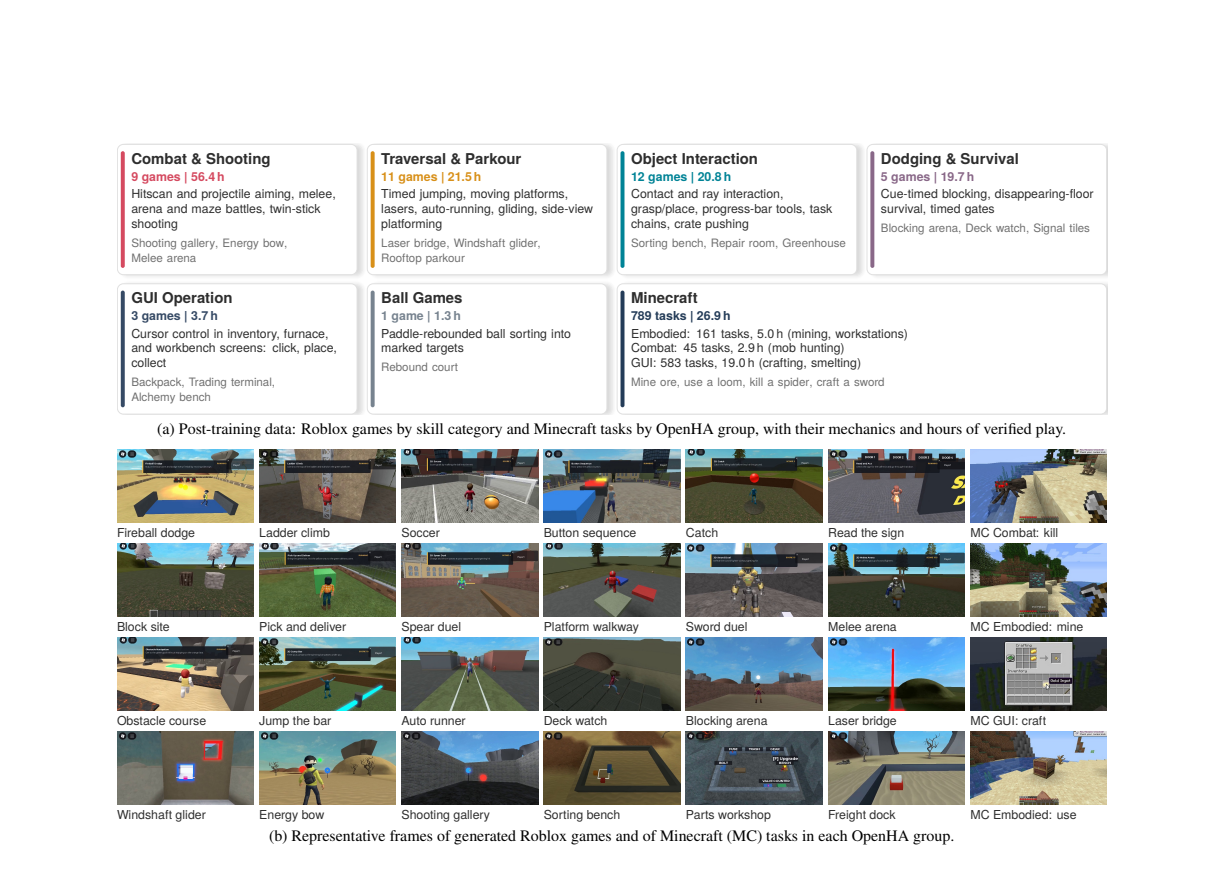
The study leaves open the question of data composition: it mixes Minecraft and Roblox demonstrations without analyzing whether the Roblox data (4× larger) is the primary driver of transfer or whether the Minecraft component alone would be sufficient for UE5 transfer.
Check this review
Pith stored no record of this review's passes and took no fingerprint of it. Reviews made by code from 13 Nov 2026 on carry both.
How often reviews like this one are right
Reviews like this one: written by deepseek-v4-flash, where what was read was not recorded.
How often objections from reviews like this one are right: not yet measured
Reviews by people
This review was written by a machine. No person has reviewed this paper on Pith yet. A scientist listed on Pith can review it for a fee, and their review is published here whatever it concludes.
The paper
Abstract
Training vision-language-action (VLA) models to follow gameplay instructions across diverse games is limited by the cost of collecting demonstrations. We introduce a framework that automatically generates game environments and expert demonstrations. An LLM-powered agent uses game-building tools to construct executable environments and tasks targeting specified skills. Programmatic experts then use privileged simulator state to generate aligned instructions, rendered observations, and keyboard and mouse actions. We train our game policy, Script2Play, by post-training a 4B vision-language model with behavior cloning on 150.3 hours of synthetic gameplay in Minecraft and Roblox, without human gameplay demonstrations or reinforcement learning. Evaluation on multiple public game benchmarks demonstrates that Script2Play follows gameplay instructions effectively and generalizes across game engines, highlighting the effectiveness of targeted synthetic supervision.
The paper's own sentences, arranged, kept beside the review and separate from it. Each label is drawn from a closed vocabulary; the number beside it is the probability the classifier gave that label. No sentence in this record was written by a model.
abstract compiled · 2026-11-10
The authors' main claim, as the classifier picked it out 1.00
“Evaluation on multiple public game benchmarks demonstrates that Script2Play follows gameplay instructions effectively and generalizes across game engines, highlighting the effectiveness of targeted synthetic supervision.”
How the main claim is stated: asserted 1.00
What the abstract itself states, as probabilities: claims first 0.06 · states limitation 0.23 · human participants 0.05 · controlled comparison 0.08 · randomized assignment 0.01 · states quantitative result 0.95 · compares with prior results 0.18 · mentions code or data availability 0.05
The abstract, sentence by sentence
This table labels the abstract only (arXiv listing abstract v1). The number is the probability the classifier gave the label.
| Sentence | Role | The authors' own work | States the main conclusion | Strength |
|---|---|---|---|---|
| Training vision-language-action (VLA) models to follow gameplay instructions across diverse games is limited by the cost of collecting demonstrations. | background 0.83 | 0.09 | 0.03 | asserted 1.00 |
| We introduce a framework that automatically generates game environments and expert demonstrations. | contribution 1.00 | 0.93 | 0.08 | asserted 1.00 |
| An LLM-powered agent uses game-building tools to construct executable environments and tasks targeting specified skills. | method 0.96 | 0.86 | 0.04 | asserted 1.00 |
| Programmatic experts then use privileged simulator state to generate aligned instructions, rendered observations, and keyboard and mouse actions. | method 1.00 | 0.86 | 0.03 | asserted 1.00 |
| We train our game policy, Script2Play, by post-training a 4B vision-language model with behavior cloning on 150.3 hours of synthetic Minecraft and Roblox gameplay, without human gameplay demonstrations or reinforcement learning. | method 0.95 | 0.97 | 0.20 | asserted 1.00 |
| Evaluation on multiple public game benchmarks demonstrates that Script2Play follows gameplay instructions effectively and generalizes across game engines, highlighting the effectiveness of targeted synthetic supervision. | result 0.94 | 0.95 | 0.84 | asserted 1.00 |
What kind of paper the classifier reports this is: method or tool 1.00 · evidence from observation or experiment 0.84
What was examined, and what was not
Sources read
- arXiv listing abstract v1
Not examined
- full text
- figures and tables
- references and citing sentences
- relations to other papers
Levels run
- P abstract
Not run
- S sections
- T body sentences
- C citations
- R cross-paper relations
How the labels were made
Compiled by classifier-1.13.0 via TypeSafe API, question bank abstract-p1-20260923, 2026-11-10: 1 request, 4,856 input tokens.
Every quoted sentence on this record is the authors'. Every label is from Pith's closed vocabulary, with the probability shown beside it. This record as JSON
Figures (5)
Figures are the authors', reproduced from the paper.
Challenges and discussion
Disagree with the review, or know something it missed? Leave a comment, or challenge this review formally: a challenge becomes a permanent entry in this paper's record, and its decision is published here.
Come back by email
A short list of the week's newly reviewed papers. Nothing is sent until you confirm from your inbox, and every email has a link that stops it. No account.
No comments yet.
Sign in to comment