Machine Learning · arXiv:2611.11937 v3 · submitted 9 Nov 2026
Attention at Absolute Zero
The paper says
“Attention scores candidate supports of an answer, which we call witnesses, and reads the scores at a temperature.”
more of the abstract
We build a higher-order attention layer whose state lives on pairs of items: for a pair (a, b), each third item k is a witness judged through its legs (a, k) and (k, b). It reads witnesses at zero temperature, keeping the best and the number tied with it, passes on only bits comparing such counts, rebuilds its pair state from the input and these bits at every loop, and is trained from answers alone. Each choice removes one way soft attention fails at size: dispersed weight, unresolved gaps between learned scores, and a drifting soft state. In maximum retrieval it is right on at least 99.95% of sets 1,000 times larger than in training, on all ten seeds; trained with a soft count, the same network falls to 42% at 4,096 items. On CLRS-30 without hints, a general form of the layer (half its channels read at zero temperature, numbers embedded, state carried) beats the best published model, which uses hints on some tasks; the full cold layer is exact on every test input of 9 of the 12 tasks whose answers depend on numbers only through comparisons. From yes-or-no answers it decides 2-SAT and two-colouring exactly at 500 variables and, as our theory predicts, not parity equations. Beside a frozen 7B language model it chains family relations exactly at 1,000 statements after training on 16, where the model alone falls to 44%; finite checks on the weights prove every block that learned correct at every size, on acyclic contexts and given what the model reads. On CLUTRR it is right on every story of five to ten relations given the graphs, learning the 62 rules exactly; from text, with the model frozen, no hand-written rule and only a small read-in trained, it lifts an open 7B model from 33% to 65%, above every system we found without hand-written rules except frontier reasoning models.
from the abstract
Pith says
Machine review · deepseek-v4-flash · 10 Nov 2026 · of version 1 of the paper; version 3 is newer · what was read was not recorded · not checked by a person
It can be wrong. Challenge this review or reply to it.
5 major objections · 10 minor
How often objections from reviews like this one are right: not yet measured
Not checked: figures, code, what the references say.
The paper says, at §2, Theorem 2 (Size law)
The review did not quote this passage.
Pith says: Objection 1 of 5 · major
The size law (Theorem 2) is a worst-case result: it gives a necessary and sufficient condition for a single threshold to separate all possible inputs, assuming scores are free within the margin. However, in practice, scores are not free; they are learned and structured.
more of objection 1
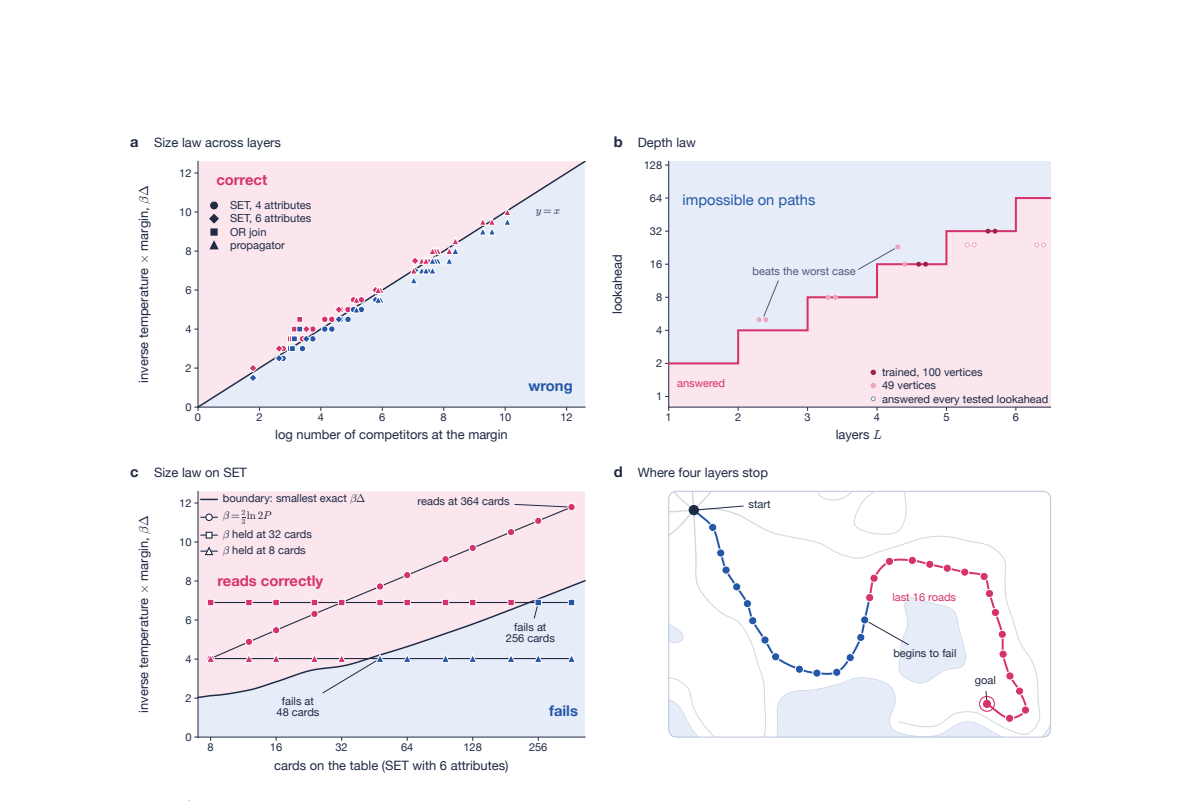
The paper acknowledges this (e.g., Fig. 4a shows the measured critical βΔ is often below the worst-case bound). The concern is that the 'if and only if' claim in the theorem might be misinterpreted as a practical design rule. The paper should more explicitly discuss the gap between the worst-case bound and the typical-case performance observed in experiments, and clarify that the theorem provides a necessary condition for worst-case robustness, not a sufficient condition for learnability.
The paper says, at §3, Theorem 1 (Depth law)
The review did not quote this passage.
A classifier read this sentence of the paper as acknowledging the concern (probability 0.88):
“These models start from vertex names, on graphs that are not paths, which part (ii) does not cover, so their match to2L is empirical. 6 What the principles predict elsewhere Where a closed form exists, a small looped pair layer matches a deep one.”
Pith says: Objection 2 of 5 · major
The depth law's upper bound (Theorem 1(ii)) applies only to 'anonymous initial states' that depend on atomic type alone. The paper correctly notes that trained models use vertex names, which can break the bound (as seen in Fig. 4b where some models beat the bound).
more of objection 2
This is a significant limitation of the theorem's applicability to practical models. The paper should discuss whether the bound can be extended to models with vertex features, or if the empirical match to 2^L-1 is coincidental. The current discussion is somewhat buried.
The paper says, at §4, Proposition 1
The review did not quote this passage.
Pith says: Objection 3 of 5 · major
Proposition 1 shows that no single-card score can rank SET pairs correctly. This is a nice separation result. However, the proof constructs a specific counterexample deal. It would strengthen the paper to discuss whether this is a generic phenomenon or a worst-case construction.
more of objection 3
Also, the proposition is stated for a specific scoring function (sum of two lookup scores). Is it possible that a more complex single-token scoring function (e.g., a bilinear form) could succeed? The paper should clarify the scope of the impossibility result.
This review says the paper's mathematics is wrong. Pith did not check that against the paper's source.
The paper says, at §6, CLRS-30 experiments
The review did not quote this passage.
Pith says: Objection 4 of 5 · major
The CLRS-30 results are presented as a validation of the principles, but the connection is less direct than for search and SET. The paper states that the OR-join and power-mean channels are motivated by the principles, but the specific design choices (width, number of loops, log n shift) are not derived from the theory.
more of objection 4
The comparison to FloydNet is impressive, but FloydNet is a specific baseline; the paper should also compare to simpler baselines (e.g., a standard GNN of similar parameter count) to isolate the benefit of the proposed layer design. The failure on Prim's algorithm despite trying Kirchhoff read-outs is acknowledged but not explained by the principles, which weakens the claim that the principles are predictive.
The paper says, at §5, Size generalization
The review did not quote this passage.
Pith says: Objection 5 of 5 · major
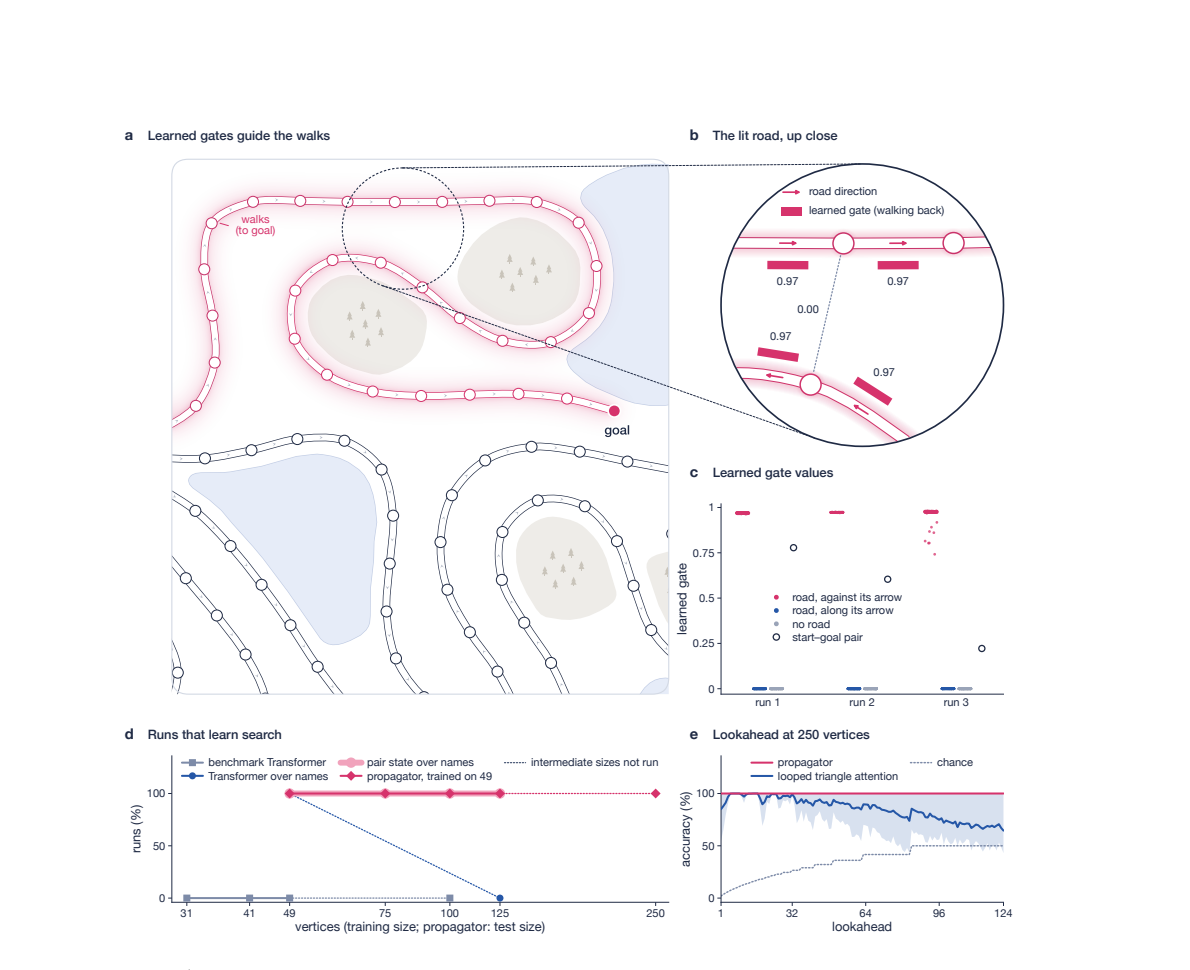
The paper claims that layers read through exponential gates transfer to larger inputs, while layers normalized by the number of candidates do not. This is supported by the propagator and exponential Newton examples. However, the looped OR join and triangle attention also transfer well (Fig. 2e, Supp.
more of objection 5
Table 2), even though they use softmax normalization (which is a form of exponential gating). The paper should clarify the distinction: is the key factor the use of exponential gates (softmax) vs. linear normalization (dividing by n), or is it something else? The discussion of the size law suggests the former, but the OR join uses a softmax-like form (1 - exp(-sum)). A more precise characterization would be helpful.
10 minor objections
The paper says, at General
Pith says: minor objection 1 of 10
The paper is well-written but very dense. The notation is sometimes introduced quickly (e.g., the four read-out links in Eq. 2). A table summarizing the notation would be helpful.
The paper says, at §2, Eq. (4)
Pith says: minor objection 2 of 10
The closed form for spanning trees is given as det(L_o(G)). It should be clarified that this is the matrix-tree theorem for directed graphs (Kirchhoff's theorem for arborescences). The reference [20] is appropriate, but a brief explanation would improve readability.
show 8 more
The paper says, at §3, Fig. 2
Pith says: minor objection 3 of 10
Figure 2 is excellent and conveys the main results clearly. The caption is informative. Minor suggestion: in panel (d), the x-axis label 'vertices (training size; propagator: test size)' is a bit confusing. Consider splitting into two panels or using a clearer label.
The paper says, at §4, Fig. 3
Pith says: minor objection 4 of 10
Figure 3 is also very good. In panel (a), the legend is a bit crowded. Consider using a separate legend or moving it outside the plot area.
The paper says, at §5, Fig. 4
Pith says: minor objection 5 of 10
Figure 4 is informative. In panel (a), the y-axis label 'inverse temperature × margin, βΔ' is correct but could be simplified to 'βΔ' for brevity, with explanation in the caption.
The paper says, at §6, Fig. 5
Pith says: minor objection 6 of 10
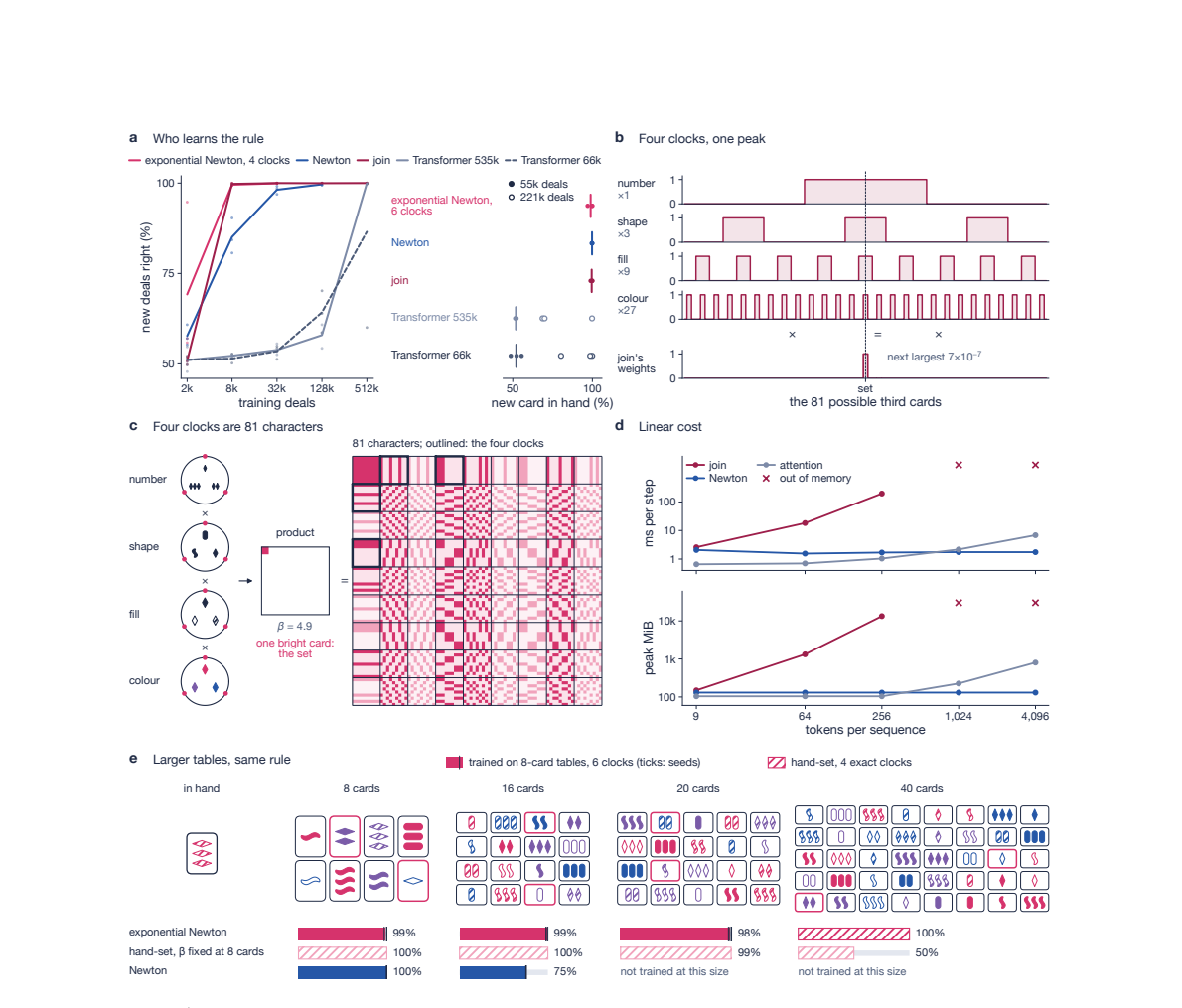
Figure 5 is clear. In panel (a), the grouping by 'closed form', 'answer is a pair', 'sequential order' is helpful. It might be useful to also indicate which tasks have a closed form according to the paper's framework (e.g., Floyd-Warshall has a closed form? The paper says its answer is a pair, but the propagator is a closed form for walks; Floyd-Warshall is dynamic programming, not a closed form).
The paper says, at §A, Proof of Theorem 1(i)
Pith says: minor objection 7 of 10
The construction uses weights that depend on n (2√n and n+1). The paper states 'The weights depend only on n, through 2√n and n+1, not on the graph or on L'. This is correct, but it means the construction is not uniform across n. This is fine for the theorem as stated, but it's worth noting that the weights are not parameter-free.
The paper says, at §B, Language models and chess
Pith says: minor objection 8 of 10
The language model experiment is a single configuration (8 layers, 51M parameters, context 256). The paper acknowledges this limitation. It would be helpful to state the confidence intervals or standard errors for the loss reduction (0.011 nats) to assess significance.
The paper says, at References
Pith says: minor objection 9 of 10
Reference [39] is to the author's own work (Mohsenvand, Sketchpad). This is acceptable but should be clearly marked as self-citation. The paper does this implicitly.
The paper says, at General
Pith says: minor objection 10 of 10
The paper uses the term 'witness' in a specific technical sense. It might be helpful to explicitly contrast this with the use of 'witness' in complexity theory (e.g., NP witness) to avoid confusion.
How the review went
2 readings by deepseek-v4-flash · 10 Nov 2026
- Reader holds up
- Referee major revision: 5 major objections, 10 minor
Not run on this paper: the skeptic, the editor, the simulated authors' defence.
Pith did not check this review's objections against the paper.
The review in full
The referee's report
If the framework holds, it provides a principled way to predict which tasks benefit from higher-order attention, moving beyond trial-and-error. The depth law and size law are clean theoretical results that connect attention layers to logic and statistical physics. The empirical demonstrations on graph search and SET are striking: a propagator layer trained on 49-vertex graphs generalizing perfectly to 250-vertex graphs, and exponential Newton learning SET from orders of magnitude fewer examples than a Transformer. The CLRS-30 results, while less dramatic, show that a tiny model can match a much larger one on many tasks. The paper is ambitious in scope, attempting to unify a wide range of phenomena. The Lean formalization of key theorems adds rigor. The main limitations are that the core principles (match the family, use a closed form) are stated as hypotheses, not proven, and the empirical tests, while extensive, are on synthetic/algorithmic tasks. The paper is likely to be influential in the field of neural algorithmic reasoning and structured attention.
Pith's reading of the paper (a machine's summary, not the authors')
The paper studies attention layers that compute a sum over a family of 'witnesses' (tokens, pairs of tokens, walks, or subsets) and read the result at a temperature. It proposes that a layer learns a task easily when the task's answer is a read-out of the same family's sum. Two laws follow. The depth law says that L layers summing over two-step walks can only reach 2^L - 1 steps, just like logical statements with L nested quantifiers. The size law says that reading existence correctly at every size requires the inverse temperature times the margin to be at least the logarithm of the number of candidates. The paper builds layers from these principles: a propagator layer that computes the sum over all walks in one linear solve, trained on 49-vertex graphs, answers every search question on 250-vertex graphs. Exponential Newton computes the softmax over pairs exactly using Fourier expansion on Z_3, learning the card game SET from few deals and transferring to larger tables. On CLRS-30 algorithmic tasks, a small 186,000-parameter block matches or beats a 73-million-parameter model on most tasks. The framework also explains where pair layers do not help (language modeling, chess) and where layers must loop (depth-first search). The paper provides Lean formalization for key theorems and registers predictions before experiments.
Core claim. The paper claims that the success of higher-order attention layers is determined by whether the task's answer can be expressed as a read-out of the partition function of the family of witnesses the layer sums over. Two laws govern these layers: the depth law (Theorem 1) states that L layers over two-step walks reach exactly 2^L-1 steps, and from anonymous initial states no such network reaches further; the size law (Theorem 2) states that existence is read correctly at every size iff inverse temperature times margin is at least the logarithm of the number of candidates. The paper demonstrates that layers built on these principles (propagator, exponential Newton, OR-join) learn where transformers fail, including graph search generalization from 49 to 250 vertices and SET learning from few deals with transfer to larger tables.
The premise it rests on. The hypothesis that matching the witness family is the key determinant of learning success. The paper states: 'We hypothesise that a layer learns a task easily when the answer is a read-out of its family's partition function.' (Section 2, first principle). This is explicitly a hypothesis, not a theorem. If this hypothesis is false, the framework's ability to predict when higher-order layers help would be undermined. The paper tests this hypothesis on several tasks, but it is not proven and may not hold for all tasks or architectures. The second principle (use a closed form) is also a hypothesis. The depth law's upper bound (Theorem 1(ii)) assumes anonymous initial states, which does not cover the trained models that use vertex names, so the empirical match to the depth law is not guaranteed by the theorem.
Check this review
Pith stored no record of this review's passes and took no fingerprint of it. Reviews made by code from 13 Nov 2026 on carry both.
How often reviews like this one are right
Reviews like this one: written by deepseek-v4-flash, where what was read was not recorded.
How often objections from reviews like this one are right: not yet measured
Reviews by people
This review was written by a machine. No person has reviewed this paper on Pith yet. A scientist listed on Pith can review it for a fee, and their review is published here whatever it concludes.
The paper
Abstract
Attention scores candidate supports of an answer, which we call witnesses, and reads the scores at a temperature. We build a higher-order attention layer whose state lives on pairs of items: for a pair (a, b), each third item k is a witness judged through its legs (a, k) and (k, b). It reads witnesses at zero temperature, keeping the best and the number tied with it, passes on only bits comparing such counts, rebuilds its pair state from the input and these bits at every loop, and is trained from answers alone. Each choice removes one way soft attention fails at size: dispersed weight, unresolved gaps between learned scores, and a drifting soft state. In maximum retrieval it is right on at least 99.95% of sets 1,000 times larger than in training, on all ten seeds; trained with a soft count, the same network falls to 42% at 4,096 items. On CLRS-30 without hints, a general form of the layer (half its channels read at zero temperature, numbers embedded, state carried) beats the best published model, which uses hints on some tasks; the full cold layer is exact on every test input of 9 of the 12 tasks whose answers depend on numbers only through comparisons. From yes-or-no answers it decides 2-SAT and two-colouring exactly at 500 variables and, as our theory predicts, not parity equations. Beside a frozen 7B language model it chains family relations exactly at 1,000 statements after training on 16, where the model alone falls to 44%; finite checks on the weights prove every block that learned correct at every size, on acyclic contexts and given what the model reads. On CLUTRR it is right on every story of five to ten relations given the graphs, learning the 62 rules exactly; from text, with the model frozen, no hand-written rule and only a small read-in trained, it lifts an open 7B model from 33% to 65%, above every system we found without hand-written rules except frontier reasoning models.
The paper's own sentences, arranged, kept beside the review and separate from it. Each label is drawn from a closed vocabulary; the number beside it is the probability the classifier gave that label. No sentence in this record was written by a model.
abstract compiled · 2026-11-10
The authors' main claim, as the classifier picked it out 0.72
“Layers built on these laws, and on two principles that we test, learn where Transformers fail.”
How the main claim is stated: asserted 0.93
What the abstract itself states, as probabilities: claims first 0.06 · states limitation 0.43 · human participants 0.02 · controlled comparison 0.73 · randomized assignment 0.02 · states quantitative result 0.98 · compares with prior results 0.94 · mentions code or data availability 0.04
The abstract, sentence by sentence
This table labels the abstract only (arXiv listing abstract v1). The number is the probability the classifier gave the label.
| Sentence | Role | The authors' own work | States the main conclusion | Strength |
|---|---|---|---|---|
| Transformers stop learning graph search as graphs grow, and learn the card game SET only after many distinct questions, although attention can represent both. | background 0.77 | 0.59 | 0.11 | asserted 1.00 |
| We read these failures, and the uneven record of higher-order attention, from what a layer sums over: each layer we study computes the partition function of a family of witnesses and reads it at a temperature. Two laws follow. | interpretation 0.59 | 0.67 | 0.18 | asserted 0.97 |
| The depth law is a known result of logic, which we state for these layers: L layers over two-step walks reach exactly 2^L - 1 steps, just as a logical statement with L nested clauses of the form "there is a vertex such that" sees exactly that far. | result 0.65 | 0.20 | 0.13 | asserted 1.00 |
| We build a construction that reaches this far, checked in Lean, and, when vertices carry no names, no such network reaches further. | result 0.76 | 0.92 | 0.08 | asserted 1.00 |
| The size law is the cost of reading at a temperature, which logic does not have: existence is read correctly at every size, in the worst case, if and only if inverse temperature times margin is at least the logarithm of the number of candidates. | result 0.92 | 0.70 | 0.16 | asserted 1.00 |
| Layers built on these laws, and on two principles that we test, learn where Transformers fail. | contribution 0.56 | 0.76 | 0.21 | asserted 0.93 |
| One propagator layer trained on 49-vertex graphs answers every question at every search depth on 250-vertex graphs. | result 0.99 | 0.89 | 0.10 | asserted 1.00 |
| Given the modulus 3, exponential Newton computes the softmax of 2-simplicial attention over pairs exactly in 3^d n operations for d clocks; with six clocks it learns SET from as few deals as 2-simplicial attention and transfers from 8- to 20-card tables. | result 0.85 | 0.87 | 0.09 | asserted 1.00 |
| On CLRS-30 without hints, a 186,000-parameter block of OR-join and power-mean channels matches (within half a point) or beats a model of at least 73 million parameters on 9 of 12 graph tasks of the official test set, and on 8 of 12 with freshly drawn test graphs. | result 1.00 | 0.89 | 0.11 | asserted 1.00 |
| The same account explains where pair layers did not help and where parallel layers must loop. | interpretation 0.96 | 0.80 | 0.17 | asserted 1.00 |
What kind of paper the classifier reports this is: theoretical result 0.94 · evidence from proof or derivation 0.52
What was examined, and what was not
Sources read
- arXiv listing abstract v1
Not examined
- full text
- figures and tables
- references and citing sentences
- relations to other papers
Levels run
- P abstract
Not run
- S sections
- T body sentences
- C citations
- R cross-paper relations
How the labels were made
Compiled by classifier-1.13.0 via TypeSafe API, question bank abstract-p1-20260923, 2026-11-10: 1 request, 7,952 input tokens.
Every quoted sentence on this record is the authors'. Every label is from Pith's closed vocabulary, with the probability shown beside it. This record as JSON
Figures (5)


Figures are the authors', reproduced from the paper.
Challenges and discussion
Disagree with the review, or know something it missed? Leave a comment, or challenge this review formally: a challenge becomes a permanent entry in this paper's record, and its decision is published here.
Come back by email
A short list of the week's newly reviewed papers. Nothing is sent until you confirm from your inbox, and every email has a link that stops it. No account.
No comments yet.
Sign in to comment