Fluid Dynamics · arXiv:2611.14705 v1 · submitted 10 Nov 2026 · 297 references
Improving Airflow Network Models of Natural Ventilation: Geometry-Specific Pressures and Fluctuation Corrections
The paper says
“Building energy models typically predict natural ventilation rates using airflow networks, which solve a system of orifice equations with exterior pressures as boundary conditions.”
more of the abstract
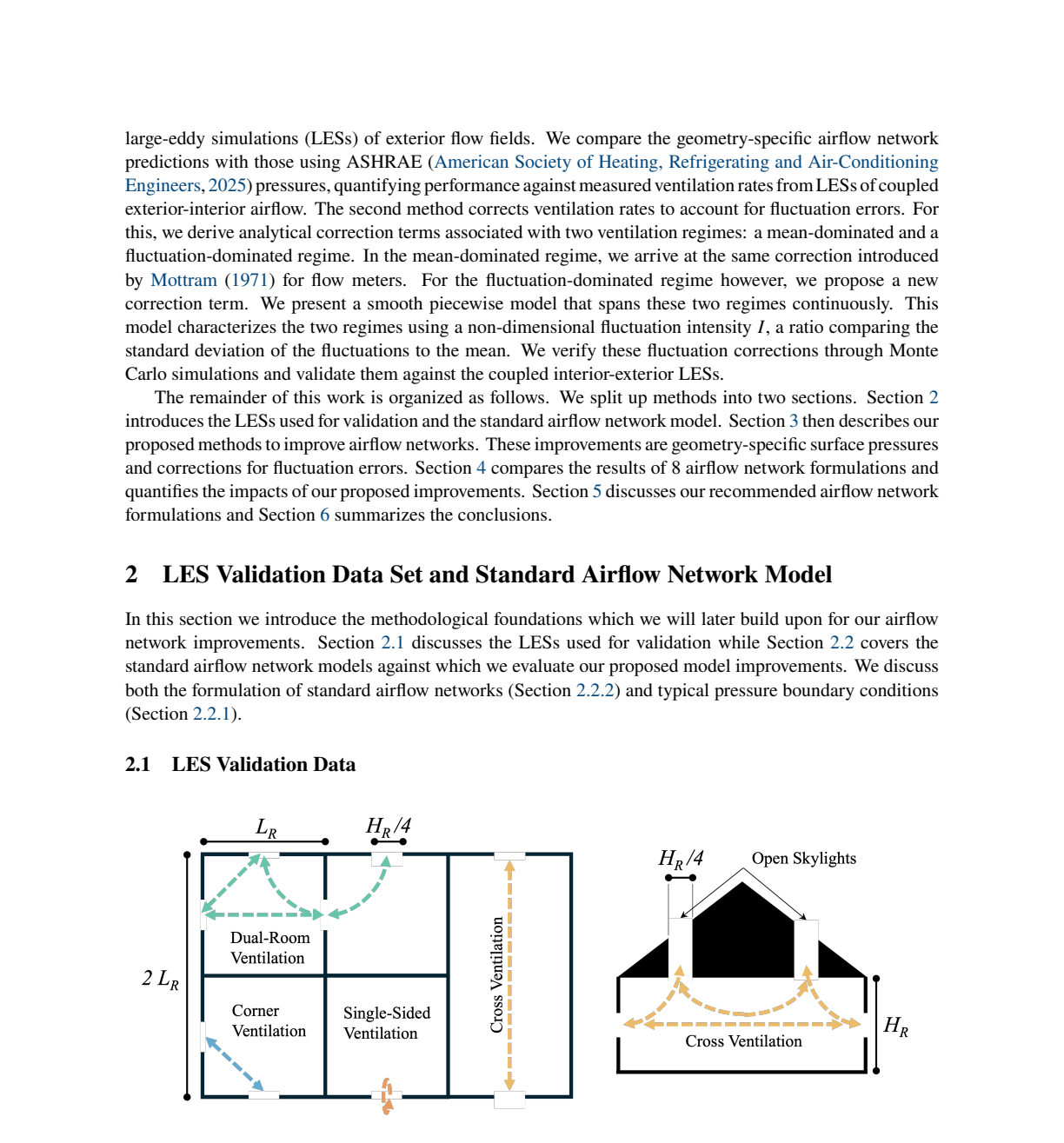
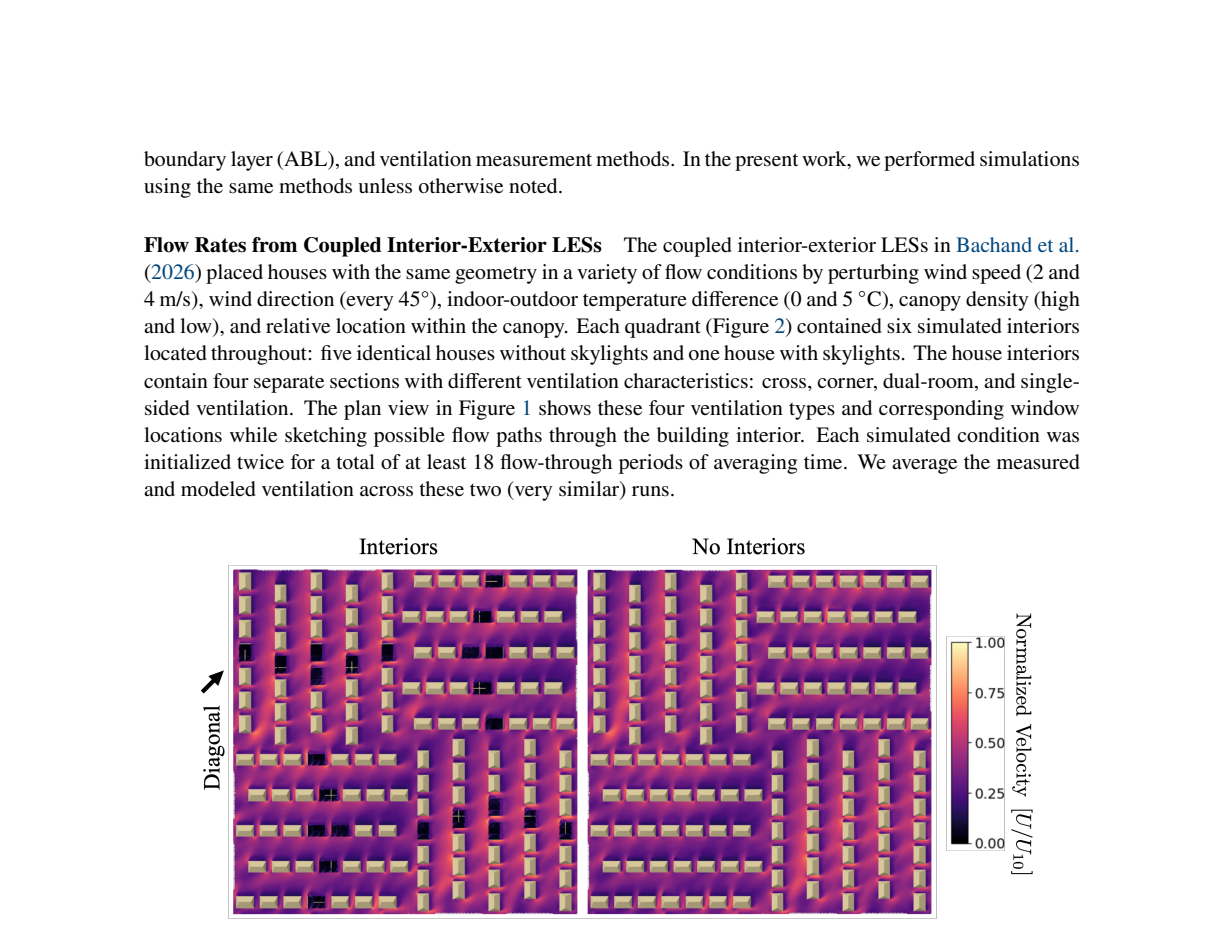
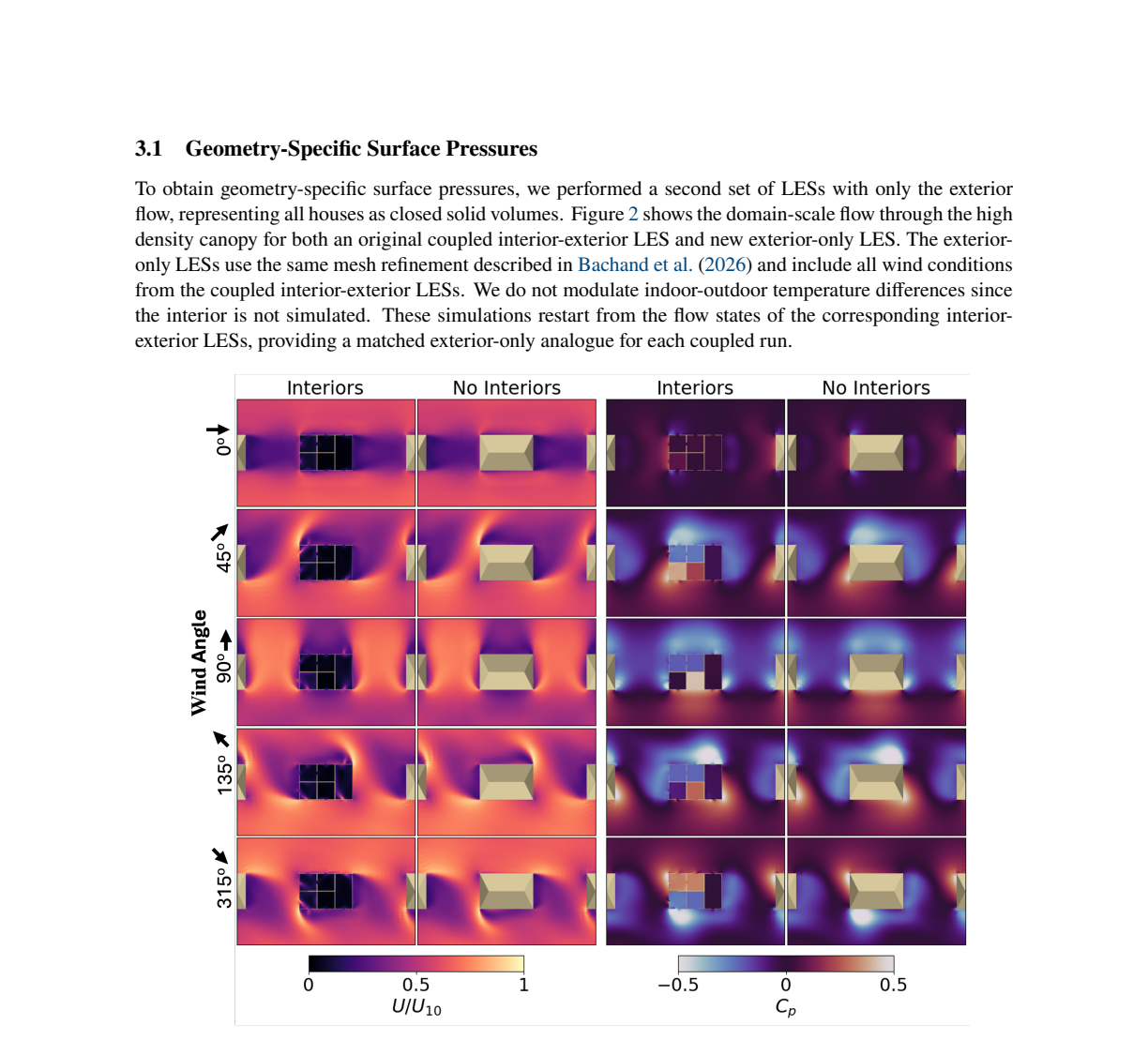
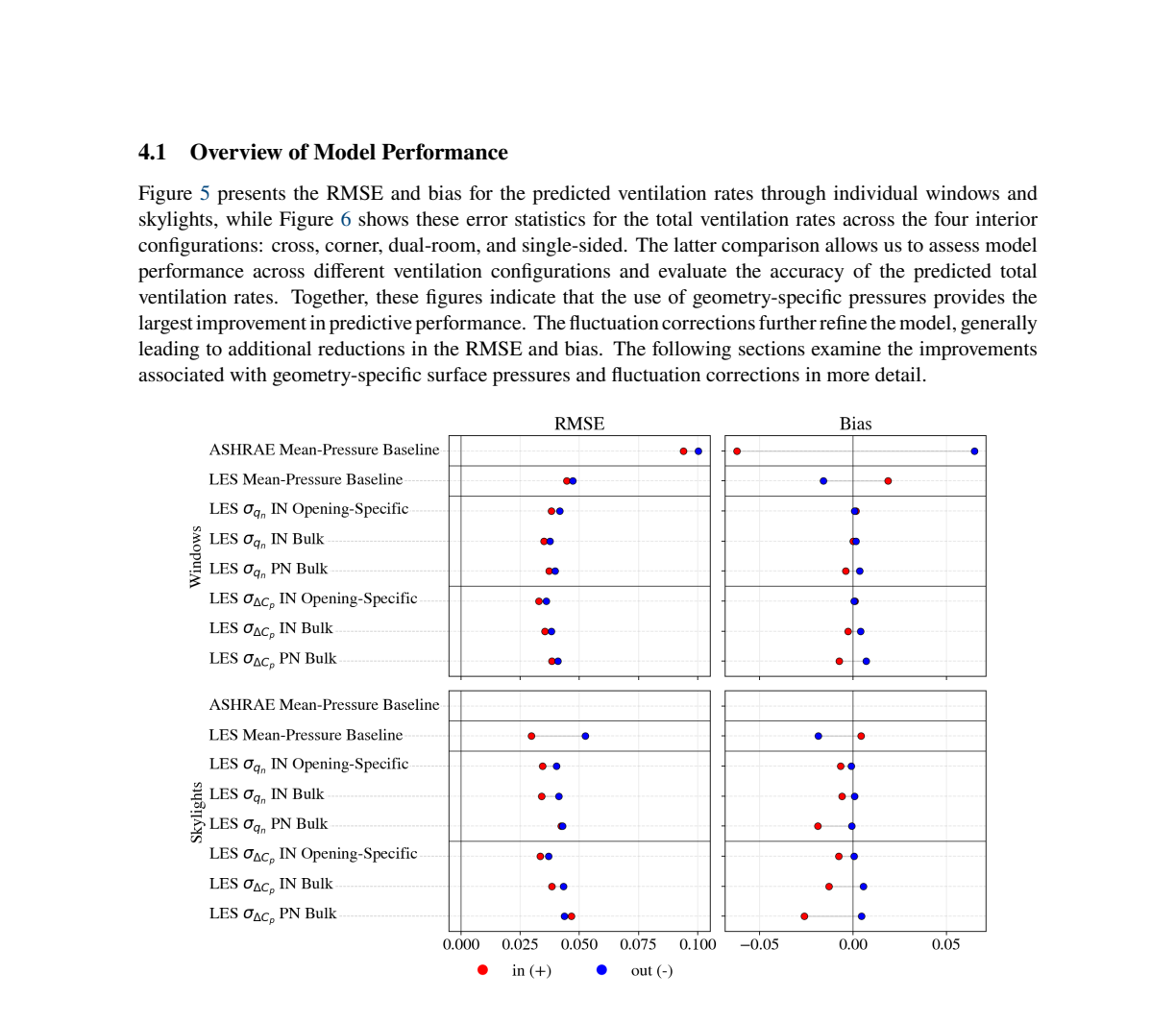
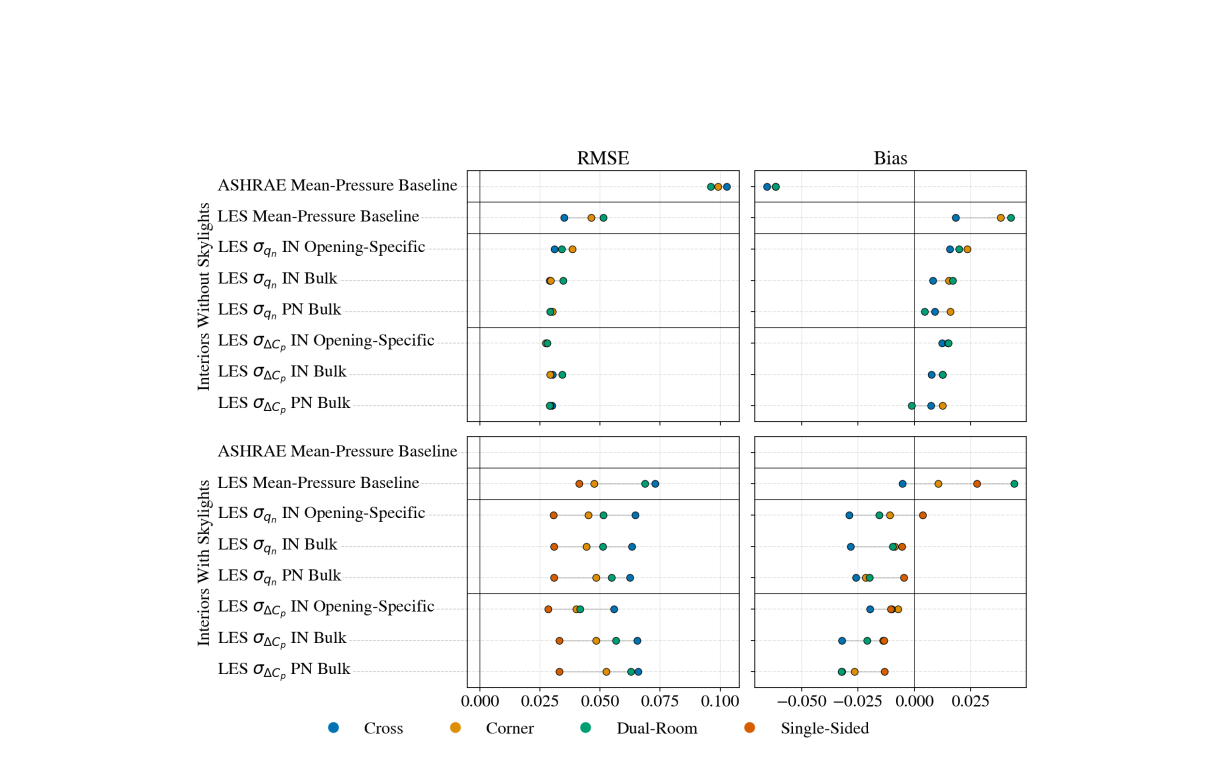
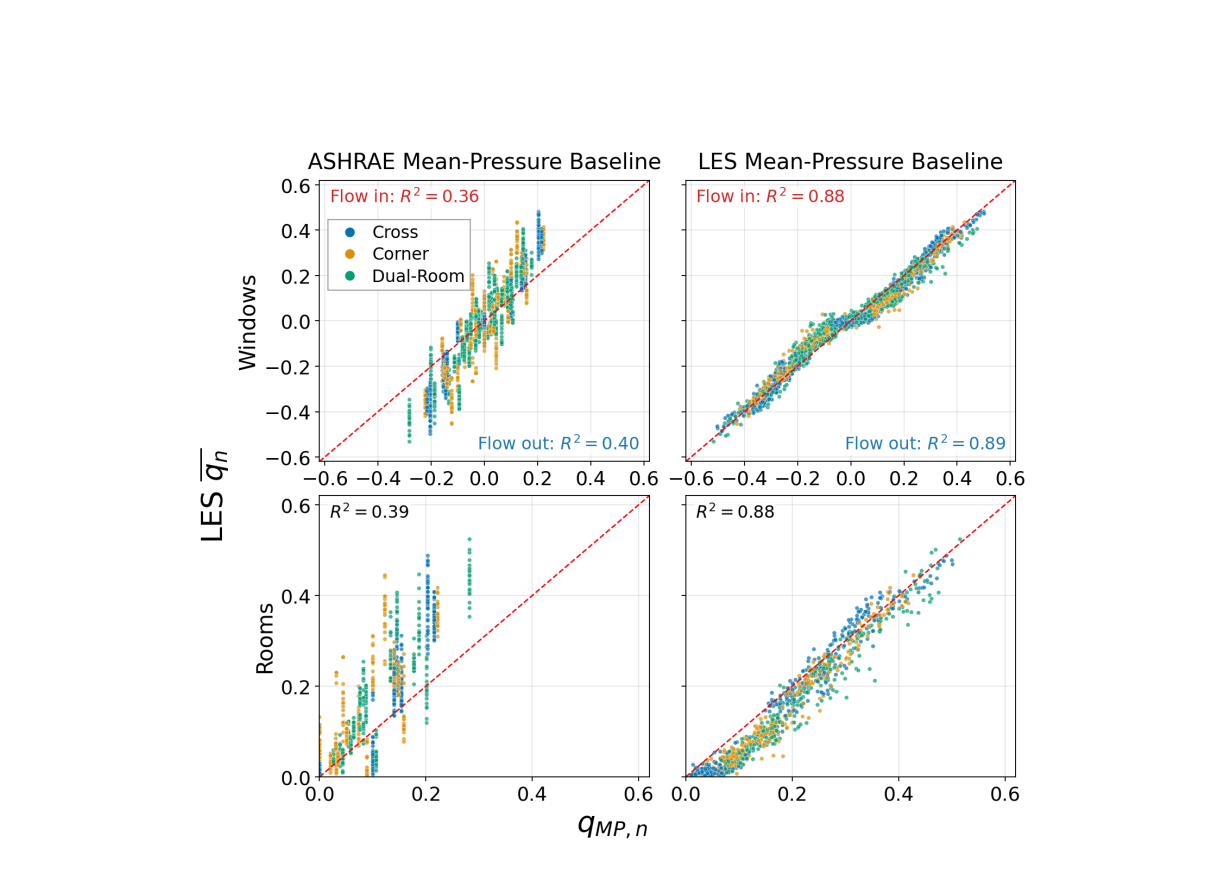
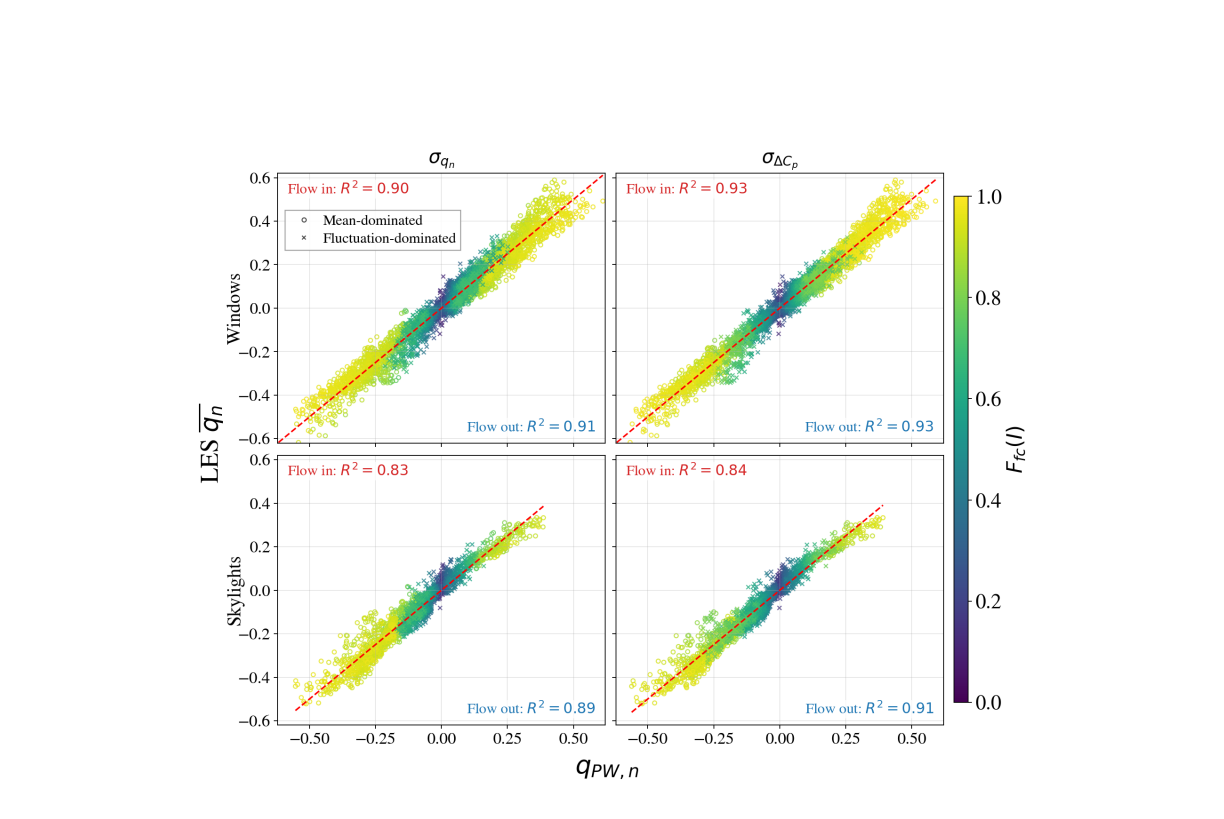
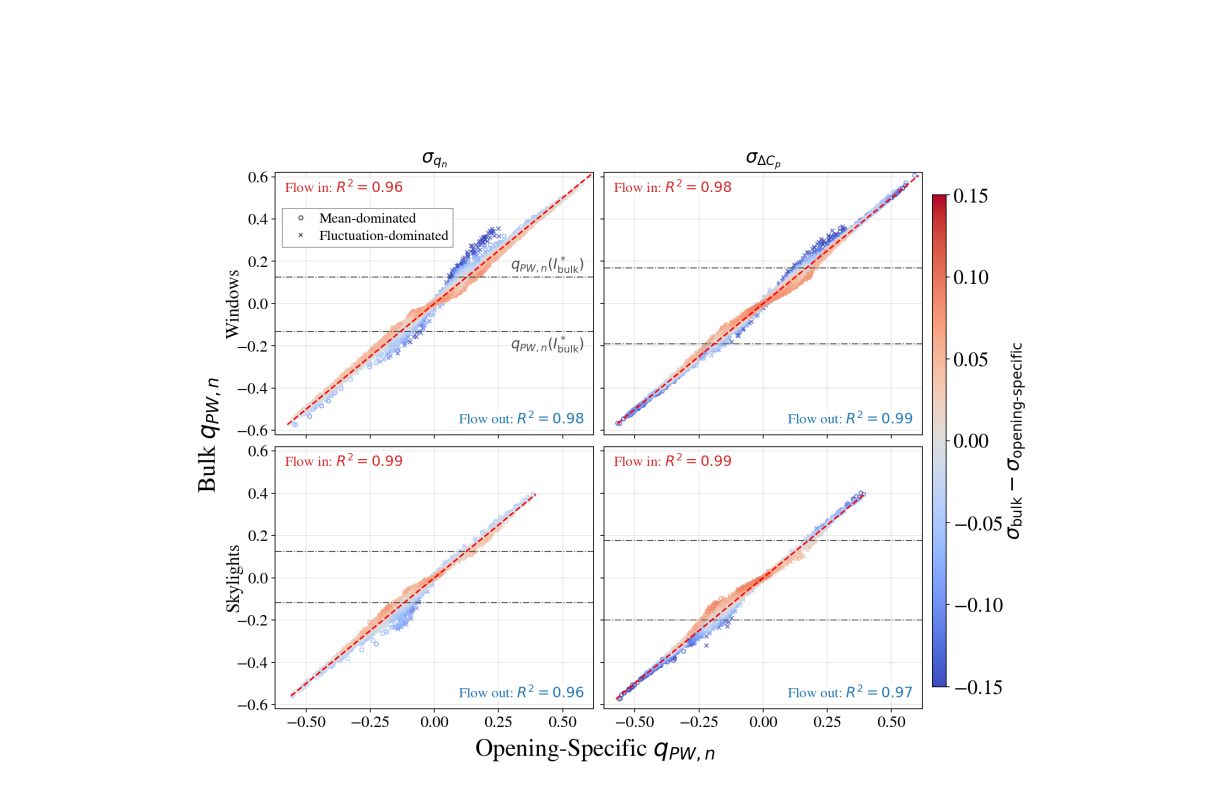
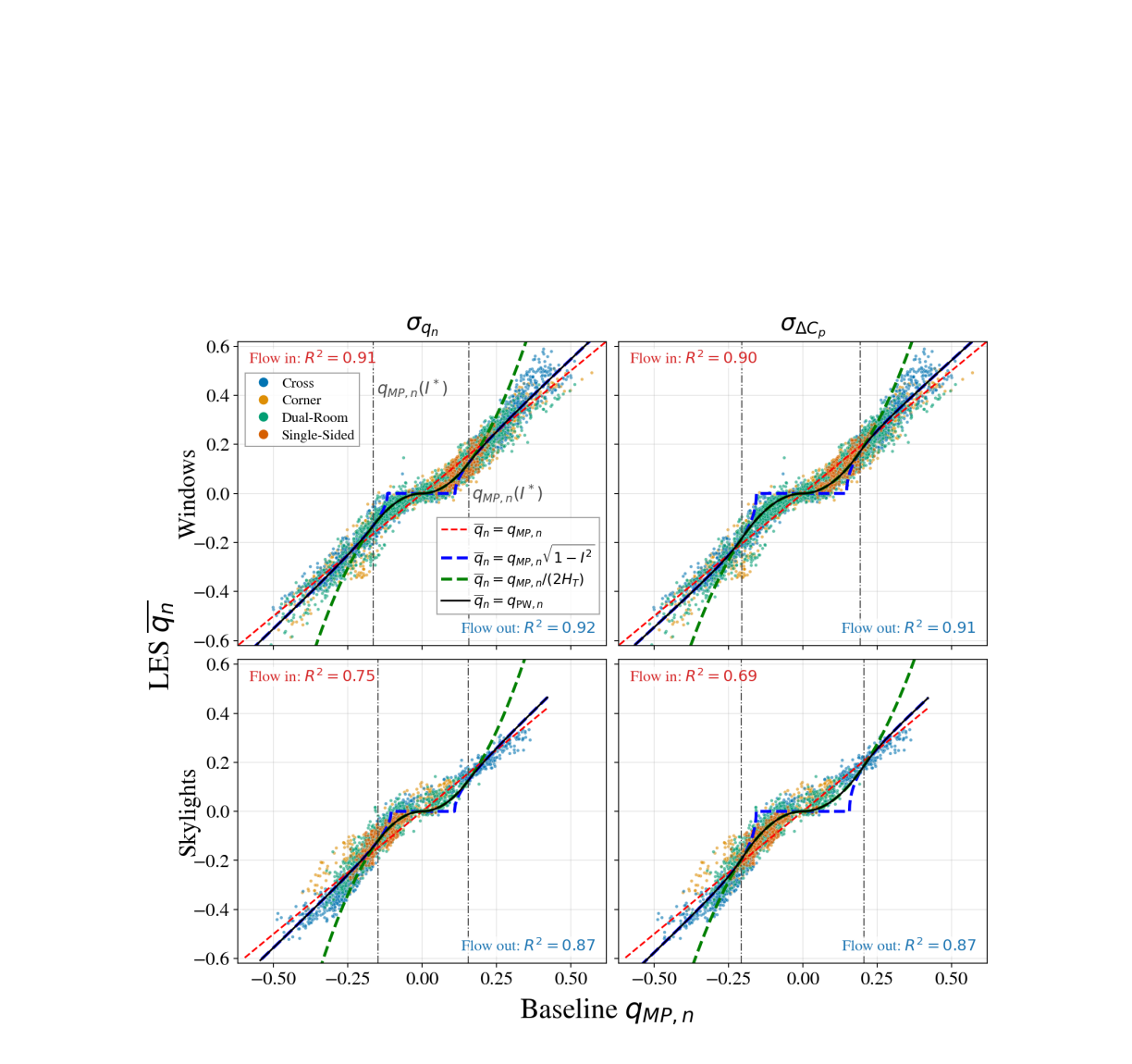
This study investigates two improvements to these models: (i) geometry-specific exterior pressures obtained from large eddy simulations (LESs) and (ii) analytical corrections accounting for the nonlinear effects of pressure fluctuations on mean ventilation rates. We evaluate these improvements against coupled interior-exterior LESs of flows through 5824 windows, 2688 skylights, and 2752 interiors across idealized urban canopies. Replacing standard ASHRAE pressure coefficients with pressures from exterior-only LESs reduces the RMSE of predicted ventilation rates by approximately 50%, largely by capturing urban canopy flow effects that are poorly represented by standard shelter factors. Independently of the pressure source, mean-pressure airflow network predictions exhibit a nonlinear relationship with the LES ventilation rates. To address this discrepancy, we derive fluctuation corrections for mean-dominated and fluctuation-dominated flow regimes. These corrections eliminate the systematic nonlinearity and further reduce RMSE by 10-40% for most opening types and ventilation configurations. For windows, the combined improvements from geometry-specific surface pressures and fluctuation corrections increase the coefficient of determination R2 from approximately 0.4 to 0.9. The results demonstrate the potential to accurately predict natural ventilation rates across different interior layouts while accounting for urban canopy effects and pressure fluctuations, using exterior-only LES pressure information.
from the abstract
Pith says
Machine review · deepseek-v4-flash · 13 Nov 2026 · what was read was not recorded · not checked by a person
It can be wrong. Challenge this review or reply to it.
Holds up, with conditions.
4 major objections · 8 minor
How often objections from reviews like this one are right: not yet measured
Not checked: figures, code, what the 297 references say.
The paper says, at Section 3.2, paragraph 2; Section 4.3
The review did not quote this passage.
Pith says: Objection 1 of 4 · major
The quasi-steady assumption is load-bearing for the entire fluctuation correction derivation, but the paper does not directly test its validity for the specific flows in the LES dataset. The authors cite Etheridge (2000) for support and acknowledge that 'real openings need not satisfy either premise exactly' (sentence [b139]), but they do not quantify the magnitude of dynamic effects (inertia, compressibility) at the relevant timescales for these window and skylight geometries in the urban canopy.
more of objection 1
The Monte Carlo verification (Section 3.3) uses synthetic Gaussian fluctuations that by construction satisfy the quasi-steady assumption, so it does not validate the assumption for real flows. The LES data could be used to test this: compare the instantaneous orifice-equation prediction (using the full pressure time series from exterior-only LES) against the actual instantaneous ventilation rate from the coupled LES. If the quasi-steady assumption holds, the two should agree closely; if not, the discrepancy reveals the magnitude of neglected dynamic effects. Without this check, the reported RMSE reductions from fluctuation corrections could be partly compensating for dynamic effects rather than correctly modeling quasi-steady nonlinearity. This is a major concern because the central claim that fluctuation corrections reduce RMSE by 10–40% depends entirely on the validity of the quasi-steady assumption for these flows.
The paper says, at Section 3.5.2, Table 3
The review did not quote this passage.
Pith says: Objection 2 of 4 · major
The discharge coefficients C_d are calibrated to minimize RMSE against the LES data separately for each model formulation. This means the comparison between models is not a pure test of the pressure source or fluctuation correction, because different C_d values are used for different models.
more of objection 2
The authors acknowledge this for the ASHRAE baseline (using 0.611) and note that the LES mean-pressure baseline also uses 0.611, but the fluctuation-corrected models use C_d values around 0.7. The paper argues that this is appropriate because C_d should be calibrated for each model, but it conflates the effect of the fluctuation correction with the effect of changing C_d. To isolate the improvement from fluctuation corrections, one would need to use the same C_d (e.g., 0.611) for both the mean-pressure and fluctuation-corrected models and compare their performance. The current comparison may overstate the benefit of fluctuation corrections because the C_d values are optimized separately. The authors should present results with a fixed C_d (e.g., 0.611) for all models to show the net effect of the fluctuation correction alone, in addition to the calibrated results.
The paper says, at Section 4.3.1, Figures 5 and 6
The review did not quote this passage.
Pith says: Objection 3 of 4 · major
The paper reports that fluctuation corrections reduce RMSE by 10–40% for most opening types and ventilation configurations, but the figures show that for some categories (e.g., skylight inflow, single-sided rooms with skylights), the fluctuation corrections increase RMSE or bias. The text acknowledges this briefly ('while predictions for skylight inflows generally become less accurate'), but the overall narrative emphasizes the improvements.
more of objection 3
The authors should provide a more balanced discussion of when the corrections help versus hurt, and quantify the frequency and magnitude of degradation. This is important for practitioners deciding whether to apply these corrections.
The paper says, at Section 3.4.1, Table 2
The review did not quote this passage.
Pith says: Objection 4 of 4 · major
The bulk fluctuation intensities (sigma_n) are measured from the LES data and then used in the fluctuation corrections. This introduces a potential circularity: the corrections are evaluated on the same data from which the sigma values are derived. The authors acknowledge this in the reader's take (circularity score 3.0) but do not discuss it in the paper.
more of objection 4
While the correction form itself is derived analytically and verified with Monte Carlo, the specific sigma values used in the validation are data-dependent. The paper should discuss how the results might change if sigma were estimated from a different source (e.g., empirical correlations or simpler models) and whether the reported RMSE reductions are robust to uncertainty in sigma.
8 minor objections
The paper says, at Abstract
Pith says: minor objection 1 of 8
The abstract states 'reduces RMSE by approximately 50%' and 'further reduce RMSE by 10–40%'. It would be helpful to specify the baseline for these percentages (e.g., relative to the ASHRAE mean-pressure model).
The paper says, at Section 2.2.1, Table 1
Pith says: minor objection 2 of 8
The shelter classes and factors are described but the conversion from ASHRAE pressure coefficients (referenced to H_R) to U_10 is not fully explained. The logarithmic profile with roughness length 0.3 m is mentioned, but the value of H_R (room height) is not given. Please provide H_R or the conversion factor used.
show 6 more
The paper says, at Section 3.2.4, Equation (19)
Pith says: minor objection 3 of 8
The transition point I* is given as 1/sqrt(3) for pressure and 1/sqrt(2) for ventilation. The derivation of these specific values is not explained in the main text; it appears to come from the tangency condition in Appendix A.2. Please briefly justify or cite the appendix equation.
The paper says, at Section 3.3.1
Pith says: minor objection 4 of 8
The synthetic data generation uses normal distributions for both ventilation rates and pressure differences. However, the orifice equation is nonlinear, so both cannot be normally distributed simultaneously. The authors acknowledge this in Section 3.2.2 ('Because the orifice relation is nonlinear, Δp' and q' cannot both be symmetric'), but the verification uses each separately. This is fine, but the text should clarify that the two experiments are independent and each tests one formulation.
The paper says, at Section 4.2, Figure 7
Pith says: minor objection 5 of 8
The scatter plots show R² values for inflow windows, outflow windows, and interiors. It would be helpful to also report the R² for the ASHRAE model on the same plot for direct comparison, rather than only in the text.
The paper says, at Section 5.2.1
Pith says: minor objection 6 of 8
The recommended C_d = 0.7 for fluctuation-corrected models is based on the specific geometries studied. The paper should more explicitly state that this value may not be transferable and that users should calibrate for their own geometries if possible.
The paper says, at General
Pith says: minor objection 7 of 8
The paper uses the term 'mean-pressure' to refer to the standard airflow network model that uses time-averaged pressures. This is clear, but occasionally the term 'mean-pressure' could be confused with 'mean pressure difference'. Consider using 'time-averaged pressure' or 'steady pressure' for clarity.
The paper says, at Appendix A.3
Pith says: minor objection 8 of 8
The closed-form expressions for H under Gaussian fluctuations are useful. However, the paper does not discuss how non-Gaussian fluctuations (which are common in turbulent flows) would affect the corrections. A brief comment on the sensitivity to the fluctuation distribution would strengthen the analysis.
What would settle it
For a subset of the LES cases (e.g., one wind direction, one canopy density, one ventilation configuration), compute the instantaneous ventilation rate predicted by the orifice equation using the full time-resolved pressure difference from the exterior-only LES. Compare this predicted instantaneous rate to the actual instantaneous ventilation rate from the coupled interior-exterior LES. If the RMSE of the instantaneous prediction is small relative to the mean ventilation rate, the quasi-steady assumption is supported. If the RMSE is comparable to the fluctuation correction magnitude (10–40%), the assumption is not justified and the fluctuation corrections may be unreliable.
from the skeptic's reading
How the review went
3 readings by deepseek-v4-flash · 13 Nov 2026
- Reader holds up, with conditions
- Skeptic agrees
- Referee major revision: 4 major objections, 8 minor
Not run on this paper: the editor, the simulated authors' defence.
Pith did not check this review's objections against the paper.
The review in full
The strongest objection
The central claim that fluctuation corrections reduce RMSE by 10–40% depends entirely on the quasi-steady assumption (Section 3.2, paragraph 2). The authors cite Etheridge (2000) for support, but that reference addresses idealized openings, not the specific window and skylight geometries in an urban canopy. The paper acknowledges that 'real openings need not satisfy either premise exactly' (sentence [b139]) and that the quasi-steady assumption 'requires the full time series' (sentence [b127]), but it never directly tests whether inertial or compressibility effects are small at the fluctuation timescales present in the LES data. Without this check, the fluctuation corrections could be compensating for dynamic effects rather than correctly modeling quasi-steady nonlinearity. The paper's own Monte Carlo verification (Section 3.3) uses synthetic Gaussian fluctuations, which by construction satisfy the quasi-steady assumption, so it does not validate the assumption for real flows. The LES data could be used to test this: compare the instantaneous orifice-equation prediction (using the full pressure time series) against the actual instantaneous ventilation rate from the coupled LES. If the quasi-steady assumption holds, the two should agree closely; if not, the discrepancy reveals the magnitude of neglected dynamic effects.
The reader's weakest_assumption correctly identifies the quasi-steady assumption as load-bearing. My analysis agrees and sharpens the concern: the paper does not test this assumption against the LES data, even though the data exist to do so. The Monte Carlo verification is not a substitute because it assumes quasi-steady behavior. The paper's own acknowledgments (sentences [b122], [b127], [b139]) show awareness of the assumption's limitations but do not resolve them. This is not a fatal flaw—the assumption is plausible and supported by prior work—but it is the single most load-bearing concern because if it fails, the entire fluctuation correction framework collapses. The concrete test I propose is feasible with the existing data and would directly settle the issue. I recommend keeping the CONDITIONAL verdict because the concern is significant but not disqualifying; the paper's other contributions (geometry-specific pressures) are robust. The agreement_with_reader is 'agree' because we identify the same weakest assumption.
The referee's report
If the results hold, this work would represent a significant advance in the accuracy of airflow network models for natural ventilation, which are widely used in building energy simulation. The 50% RMSE reduction from geometry-specific pressures addresses a known limitation of standard ASHRAE coefficients in urban canopies. The fluctuation corrections provide a theoretically grounded way to account for turbulence effects that are typically neglected. The large validation dataset and the systematic comparison of implementation options are strengths. The paper also provides open data and code, supporting reproducibility. The main significance is in demonstrating that exterior-only LES can provide sufficient information to substantially improve ventilation predictions, which could enable more reliable design of natural ventilation in urban settings.
Pith's reading of the paper (a machine's summary, not the authors')
Building energy models predict natural ventilation by solving airflow networks of orifice equations fed with time-averaged exterior pressures, and those predictions carry two persistent errors: the pressures come from isolated-building wind-tunnel coefficients, and the mean-pressure treatment ignores that ventilation scales with the square root of a fluctuating pressure difference. This paper claims both errors can be fixed, and that fixing them suffices to bring predicted mean ventilation rates close to measurement quality. Replacing standard ASHRAE coefficients with geometry-specific surface pressures extracted from exterior-only large-eddy simulations cuts the RMSE of predicted ventilation rates by roughly 50%, because the simulations resolve urban canopy interference that shelter-factor adjustments miss. The paper then derives analytical corrections for the square-root (fluctuation) error in two regimes, mean-dominated and fluctuation-dominated, and joins them into a parameter-free piecewise model that it validates against coupled interior-exterior LESs of thousands of windows, skylights, and interior layouts. Together the two improvements raise the coefficient of determination for window ventilation from about 0.4 to about 0.9.
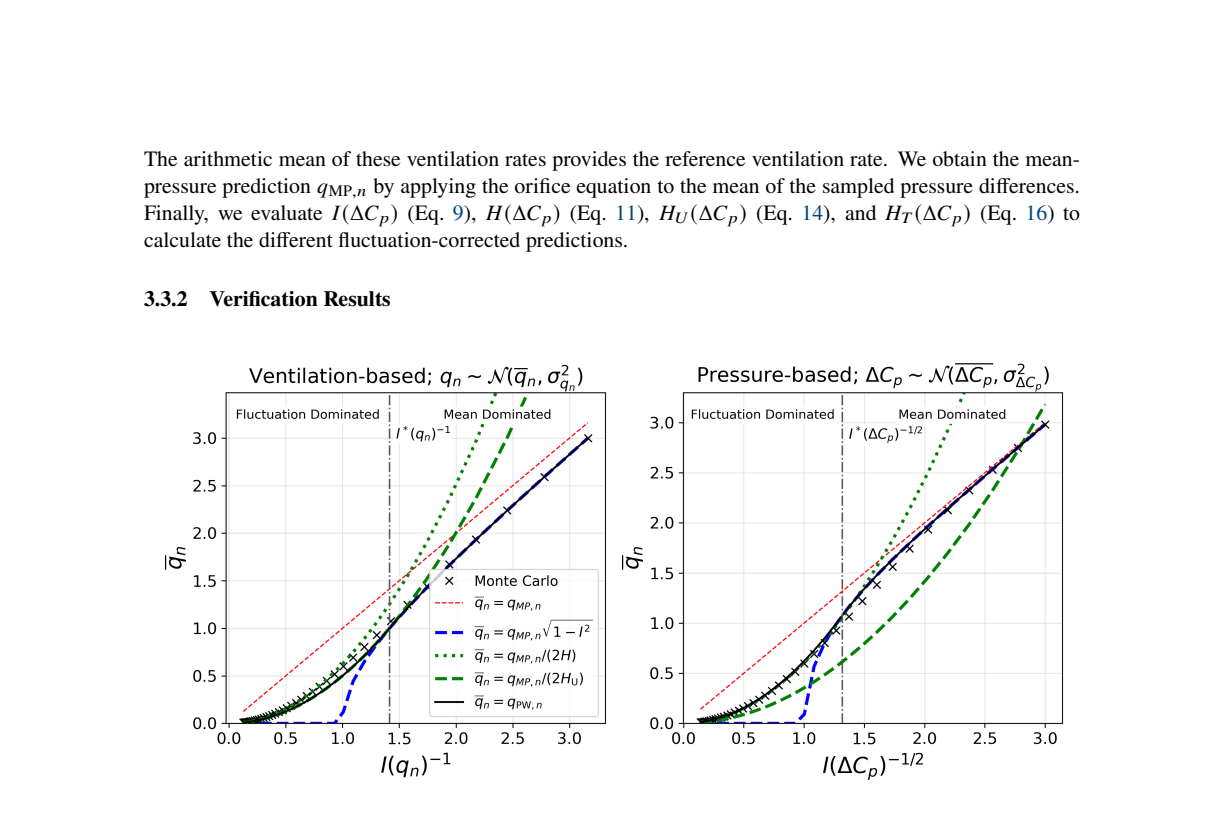
What carries the argument. The central object is the orifice equation q = S C_d A $\sqrt$(2|$\Delta$ p|/rho), applied instantaneously (quasi-steady) rather than in its mean-pressure form, and the piecewise fluctuation-correction factor F_fc(I) that multiplies the mean-pressure rate: F_fc = $\sqrt$(1-$I^{2}$) for I < I^* and F_fc = 1/(2H_T) for I >= I^*, where I is the fluctuation intensity (the ratio of fluctuation standard deviation to the mean rate or pressure) and H_T is a tangent-fitted low-order mean of fluctuation magnitudes. The transition points I^* = 1/$\sqrt$(3) (pressure form) and I^* = 1/$\sqrt$(2) (ventilation form) are set by requiring tangential intersection of the two branches, so the model carries no fitted transition parameter. Two complementary machineries work together: exterior-only LES supplies geometry-specific mean surface pressures, and also the pressure-form fluctuation intensities sigma_{$\Delta$ C_p}, while the piecewise correction removes the systematic nonlinearity that mean-pressure models leave behind, with a recommended discharge coefficient of about C_d = 0.7 for sharp-edged square openings.
Core claim. The central claim is that the two long-standing inaccuracies of airflow-network ventilation models are independent and each has a tractable fix. First, aerodynamic pressure coefficients evaluated at the actual openings from exterior-only LES, replacing the ASHRAE isolated-building coefficients with shelter factors, reduce RMSE of predicted ventilation rates by about 50%, with the gain coming mostly from capturing urban canopy flow; the exterior-only and coupled interior-exterior simulations produce nearly identical pressure fields away from the openings, so the cheaper exterior-only run suffices. Second, the residual systematic nonlinearity between mean-pressure predictions and measured rates is the square-root error: because the ventilation rate scales as the square root of the pressure difference, pressure fluctuations bias the time-averaged rate. Under a quasi-steady assumption the correct mean rate is q approx q_MP $\sqrt$(1-$I^{2}$) when fluctuations are small (mean-dominated) and q approx q_MP/(2H) when they dominate, where I is a fluctuation intensity and H a low-order mean of fluctuation magnitudes; a smooth piecewise model spanning both regimes, with the transition fixed by tangency rather than by a fitted parameter, removes the systematic nonlinearity and cuts RMSE a further 10-40% for most opening types. The combined model, validated against coupled LESs of 5824 windows, 2688 skylights, and 2752 interior sections across idealized urban canopies, lifts $R^{2}$ for windows from about 0.4 to about 0.9, showing that accurate mean ventilation predictions need only exterior-flow pressure information plus the analytical correction.
The premise it rests on. The entire fluctuation-correction chain rests on the quasi-steady assumption that inertia and compressibility are negligible at the timescale of pressure fluctuations, so the square-root orifice relation holds instantaneously; if real openings show dynamic effects at those timescales, the closed-form corrections would not apply.
If the paper is right (Pith's inferences, not the authors')
Building energy models can reach roughly R^2 = 0.9 for window ventilation using only exterior-flow pressure information, so a coupled interior-exterior simulation is not needed for accurate mean rates.
A discharge coefficient near 0.7, rather than the potential-flow value 0.611, is recommended for fluctuation-corrected sharp-edged square openings, and coefficients calibrated without fluctuation corrections should not be reused inside corrected models.
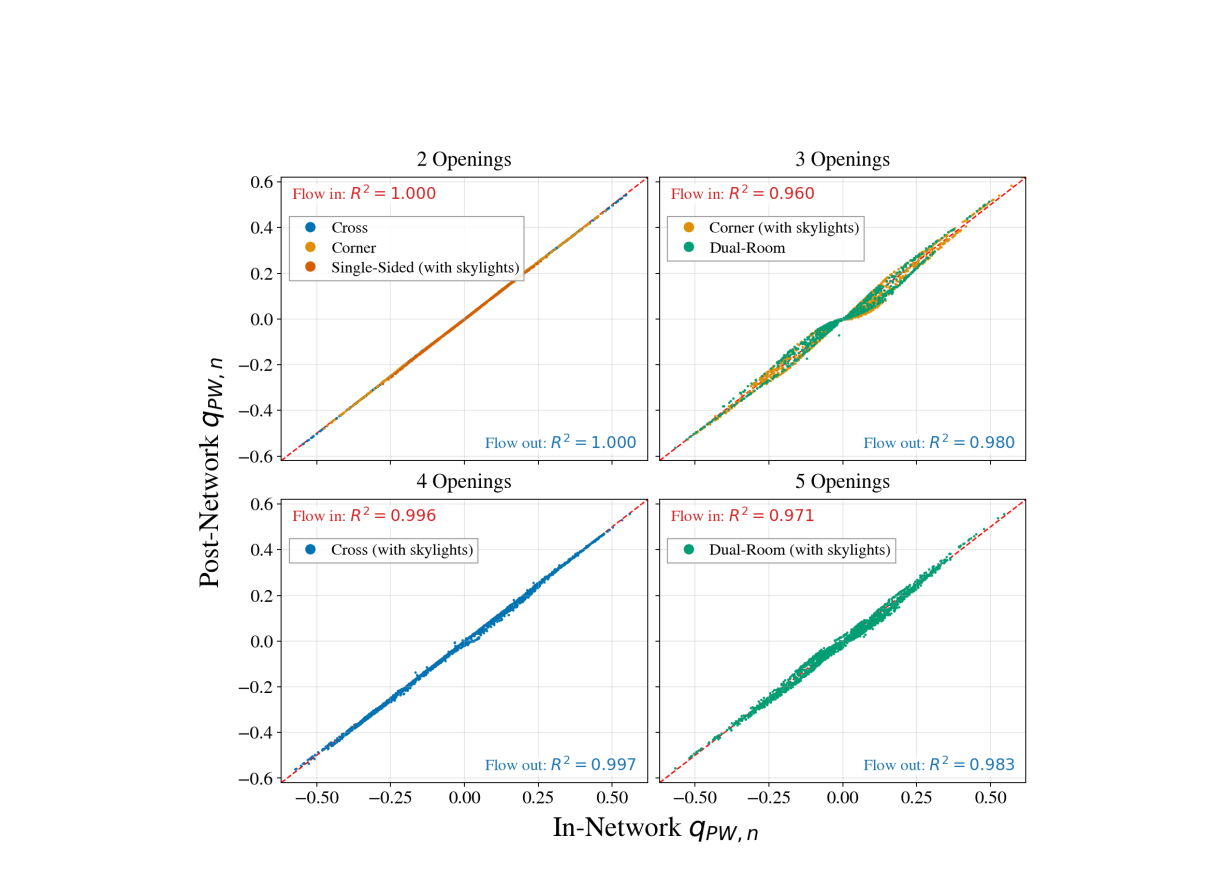
Bulk fluctuation intensities and post-network implementation perform nearly as well as opening-specific, in-network corrections, so existing airflow-network solvers can adopt the correction without rewriting their internal mass-balance solve.
Pressure-based corrections are preferred over ventilation-based ones because the required fluctuation intensity comes from exterior-only data, consistent with the recommended exterior-only workflow.
In the fluctuation-dominated regime the effective pressure scaling shifts from q ~ sqrt(Delta p) to q ~ Delta p, a change that an uncorrected mean-pressure calibration could misread as a viscous effect.
Since geometry-specific pressures account for the largest share of the improvement (~50% RMSE) while fluctuation corrections add 10-40%, further accuracy gains will likely come from cheaper or better exterior pressure prediction, such as surrogates or data-driven pressure fields, rather than from refining fluctuation models.
The observed near-equality of exterior-only and coupled pressure fields away from the openings suggests a general decoupling principle: exterior-only CFD or field measurements can feed airflow networks without ever solving the interior, a workflow extension beyond the specific geometries tested here.
Because the fluctuation-dominated correction assumes symmetric fluctuations, strongly skewed real urban pressure signals would violate that premise; the paper's own tangent-fixed transition would then need recalibration, a testable extension.
Historically reported reductions in discharge coefficient under cross-flow may partly be fluctuation artifacts rather than pure physical changes in C_d, since uncorrected calibrations absorb the square-root error into the fitted coefficient; the paper hints at this and formalizing the split is a further interpretive step.
Check this review
Pith stored no record of this review's passes and took no fingerprint of it. Reviews made by code from 13 Nov 2026 on carry both.
How often reviews like this one are right
Reviews like this one: written by deepseek-v4-flash, where what was read was not recorded.
How often objections from reviews like this one are right: not yet measured
Reviews by people
This review was written by a machine. No person has reviewed this paper on Pith yet. A scientist listed on Pith can review it for a fee, and their review is published here whatever it concludes.
The paper
Abstract
Building energy models typically predict natural ventilation rates using airflow networks, which solve a system of orifice equations with exterior pressures as boundary conditions. This study investigates two improvements to these models: (i) geometry-specific exterior pressures obtained from large eddy simulations (LESs) and (ii) analytical corrections accounting for the nonlinear effects of pressure fluctuations on mean ventilation rates. We evaluate these improvements against coupled interior-exterior LESs of flows through 5824 windows, 2688 skylights, and 2752 interiors across idealized urban canopies. Replacing standard ASHRAE pressure coefficients with pressures from exterior-only LESs reduces the RMSE of predicted ventilation rates by approximately 50%, largely by capturing urban canopy flow effects that are poorly represented by standard shelter factors. Independently of the pressure source, mean-pressure airflow network predictions exhibit a nonlinear relationship with the LES ventilation rates. To address this discrepancy, we derive fluctuation corrections for mean-dominated and fluctuation-dominated flow regimes. These corrections eliminate the systematic nonlinearity and further reduce RMSE by 10-40% for most opening types and ventilation configurations. For windows, the combined improvements from geometry-specific surface pressures and fluctuation corrections increase the coefficient of determination R2 from approximately 0.4 to 0.9. The results demonstrate the potential to accurately predict natural ventilation rates across different interior layouts while accounting for urban canopy effects and pressure fluctuations, using exterior-only LES pressure information.
The paper's own sentences, arranged, kept beside the review and separate from it. Each label is drawn from a closed vocabulary; the number beside it is the probability the classifier gave that label. No sentence in this record was written by a model.
abstract compiled · 2026-11-13
The authors' main claim, as the classifier picked it out 1.00
“The results demonstrate the potential to accurately predict natural ventilation rates across different interior layouts while accounting for urban canopy effects and pressure fluctuations, using exterior-only LES pressure information.”
How the main claim is stated: asserted 0.65
What the abstract itself states, as probabilities: claims first 0.04 · states limitation 0.17 · human participants 0.02 · controlled comparison 0.82 · randomized assignment 0.01 · states quantitative result 0.99 · compares with prior results 0.95 · mentions code or data availability 0.02
The abstract, sentence by sentence
This table labels the abstract only (arXiv listing abstract v1). The number is the probability the classifier gave the label.
| Sentence | Role | The authors' own work | States the main conclusion | Strength |
|---|---|---|---|---|
| Building energy models typically predict natural ventilation rates using airflow networks, which solve a system of orifice equations with exterior pressures as boundary conditions. | background 1.00 | 0.04 | 0.02 | asserted 1.00 |
| This study investigates two improvements to these models: (i) geometry-specific exterior pressures obtained from large eddy simulations (LESs) and (ii) analytical corrections accounting for the nonlinear effects of pressure fluctuations on mean ventilation rates. | contribution 1.00 | 0.76 | 0.06 | asserted 0.91 |
| We evaluate these improvements against coupled interior-exterior LESs of flows through 5824 windows, 2688 skylights, and 2752 interiors across idealized urban canopies. | method 0.94 | 0.95 | 0.03 | asserted 0.99 |
| Replacing standard ASHRAE pressure coefficients with pressures from exterior-only LESs reduces the RMSE of predicted ventilation rates by approximately 50%, largely by capturing urban canopy flow effects that are poorly represented by standard shelter factors. | result 1.00 | 0.94 | 0.20 | asserted 1.00 |
| Independently of the pressure source, mean-pressure airflow network predictions exhibit a nonlinear relationship with the LES ventilation rates. | result 0.98 | 0.90 | 0.05 | asserted 1.00 |
| To address this discrepancy, we derive fluctuation corrections for mean-dominated and fluctuation-dominated flow regimes. | method 0.62 | 0.96 | 0.04 | asserted 0.98 |
| These corrections eliminate the systematic nonlinearity and further reduce RMSE by 10-40% for most opening types and ventilation configurations. | result 1.00 | 0.96 | 0.18 | asserted 1.00 |
| For windows, the combined improvements from geometry-specific surface pressures and fluctuation corrections increase the coefficient of determination $R^2$ from approximately 0.4 to 0.9. | result 1.00 | 0.96 | 0.22 | asserted 1.00 |
| The results demonstrate the potential to accurately predict natural ventilation rates across different interior layouts while accounting for urban canopy effects and pressure fluctuations, using exterior-only LES pressure information. | interpretation 0.99 | 0.92 | 0.86 | asserted 0.65 |
What kind of paper the classifier reports this is: method or tool 0.68 · evidence from simulation or computation 1.00
What was examined, and what was not
Sources read
- arXiv listing abstract v1
Not examined
- full text
- figures and tables
- references and citing sentences
- relations to other papers
Levels run
- P abstract
Not run
- S sections
- T body sentences
- C citations
- R cross-paper relations
How the labels were made
Compiled by classifier-1.13.0 via TypeSafe API, question bank abstract-p1-20260923, 2026-11-13: 1 request, 7,050 input tokens.
Every quoted sentence on this record is the authors'. Every label is from Pith's closed vocabulary, with the probability shown beside it. This record as JSON
Figures (11)
Figures are the authors', reproduced from the paper.
References (297)
- [1] Virtanen, Pauli and Gommers, Ralf and Oliphant, Travis E. and Haberland, Matt and Reddy, Tyler and Cournapeau, David and Burovski, Evgeni and Peterson, Pearu and Weckesser, Warren and Bright, Jonathan and van der Walt, Stéfan J. and Brett, Matthew and Wilson, Joshua and Millma... on Pith
- [2] Karava, P. and Stathopoulos, T. and Athienitis, A.K. , month = dec, year =. Wind. International Journal of Ventilation , publisher =. doi:10.1080/14733315.2004.11683920 , abstract = on Pithdoi:10.1080/14733315.2004.11683920
- [3] Giral, Francisco and Manzano, Álvaro and Gómez, Ignacio and Koumoutsakos, Petros and Clainche, Soledad Le , month = dec, year =. Generative. doi:10.48550/arXiv.2512.14725 , abstract = on Pithdoi:10.48550/arxiv.2512.14725
- [4] Machine learning for urban wind simulation:. Sustainable Cities and Society , author =. 2026 , keywords =. doi:10.1016/j.scs.2026.107614 , abstract = on Pithdoi:10.1016/j.scs.2026.107614
- [5] Evaluating a deep learning-based surrogate model for predicting wind distribution in urban microclimate design , volume =. Building and Environment , author =. 2025 , keywords =. doi:10.1016/j.buildenv.2024.112426 , abstract = on Pithdoi:10.1016/j.buildenv.2024.112426
- [6] Deep learning for urban wind prediction:. Building and Environment , author =. 2025 , keywords =. doi:10.1016/j.buildenv.2025.113495 , abstract = on Pithdoi:10.1016/j.buildenv.2025.113495
- [7] A. Sustainable Cities and Society , author =. 2026 , keywords =. doi:10.1016/j.scs.2026.107407 , abstract = on Pithdoi:10.1016/j.scs.2026.107407
- [8] A hierarchical deep learning model for predicting pedestrian-level urban winds , volume =. Building and Environment , author =. 2026 , keywords =. doi:10.1016/j.buildenv.2026.114354 , abstract = on Pithdoi:10.1016/j.buildenv.2026.114354
- [9] Khuri, André and Casella, George , month = feb, year =. The. The American Statistician , publisher =. doi:10.1198/000313002753631358 , abstract = on Pithdoi:10.1198/000313002753631358
- [10] Piegorsch, Walter W. and Casella, George , month = feb, year =. The. The American Statistician , publisher =. doi:10.1080/00031305.1985.10479390 , abstract = on Pithdoi:10.1080/00031305.1985.10479390
- [11] Giezendanner, Jonathan and Yang, Qidong and Huang, Ruizhe and Schmitt, Eric and Chandra, Anirban and Zhang, Yawen and Vila, Jeremy and Hohl, Detlef and Watson, Campbell and Wang, Sherrie , month = sep, year =. Partial recovery of meter-scale surface weather , url =. doi:10.485... on PithPith's reviewarXivdoi:10.48550/arxiv.2602.23146
- [12] Vargiemezis, Themistoklis and Kanatsoulis, Charilaos and Gorlé, Catherine , month = nov, year =. doi:10.48550/arXiv.2511.01226 , abstract = on Pithdoi:10.48550/arxiv.2511.01226
- [13] Simulating the urban canopy’s impact on wind-driven natural ventilation , volume =. Flow , author =. 2026 , keywords =. doi:10.1017/flo.2025.10039 , abstract = on Pithdoi:10.1017/flo.2025.10039
- [14] Wu, Haixu and Guo, Minghao and Li, Zongyi and Dou, Zhiyang and Long, Mingsheng and He, Kaiming and Matusik, Wojciech , month = may, year =. doi:10.48550/arXiv.2602.20399 , abstract = on PithPith's reviewarXivdoi:10.48550/arxiv.2602.20399
- [15] Simmonds, Peter and McConahey, Erin , year = on Pith
- [16] Predicting wind-induced interference effects on a low-rise building in a realistic urban area using large-eddy simulations , volume =. Journal of Wind Engineering and Industrial Aerodynamics , author =. 2026 , keywords =. doi:10.1016/j.jweia.2025.106270 , abstract = on Pithdoi:10.1016/j.jweia.2025.106270
- [17] Improving thermal model predictions for naturally ventilated buildings using large eddy simulations , volume =. Building and Environment , author =. 2022 , keywords =. doi:10.1016/j.buildenv.2022.109241 , abstract = on Pithdoi:10.1016/j.buildenv.2022.109241
- [18] Unsteady natural ventilation at model scale—. Building and Environment , author =. 2008 , pages =. doi:10.1016/j.buildenv.2007.08.005 , language = on Pithdoi:10.1016/j.buildenv.2007.08.005
- [19] Natural ventilation of buildings: theory, measurement and design , isbn =. 2012 , note = on Pith
- [21] The. Journal of Wind Engineering and Industrial Aerodynamics , author =. 1997 , pages =. doi:10.1016/S0167-6105(97)00274-2 , abstract = on Pithdoi:10.1016/s0167-6105(97)00274-2
show 80 more
- [22] Field. HVAC&R Research , author =. 1998 , pages =. doi:10.1080/10789669.1998.10391395 , abstract = on Pithdoi:10.1080/10789669.1998.10391395
- [23] Wind pressures on tropical housing , volume =. Journal of Wind Engineering and Industrial Aerodynamics , author =. 1994 , pages =. doi:10.1016/0167-6105(94)90021-3 , language = on Pithdoi:10.1016/0167-6105(94)90021-3
- [24] Implementing the. Computational Optimization and Applications , author =. 2012 , pages =. doi:10.1007/s10589-010-9329-3 , abstract = on Pithdoi:10.1007/s10589-010-9329-3
- [25] Abril-Pla, Oriol and Andreani, Virgile and Carroll, Colin and Dong, Larry and Fonnesbeck, Christopher J. and Kochurov, Maxim and Kumar, Ravin and Lao, Junpeng and Luhmann, Christian C. and Martin, Osvaldo A. and Osthege, Michael and Vieira, Ricardo and Wiecki, Thomas and Zinko... on Pithdoi:10.7717/peerj-cs.1516
- [26] Neal, Radford M. , month = jun, year =. Slice sampling , volume =. The Annals of Statistics , publisher =. doi:10.1214/aos/1056562461 , abstract = on Pithdoi:10.1214/aos/1056562461
- [27] Perini, Janne and Bischof, Rafael and Arar, Moab and Duran, Ayça and Kraus, Michael A. and Mishra, Siddhartha and Bickel, Bernd , month = mar, year =. Pretrained. doi:10.48550/arXiv.2603.21210 , abstract = on PithPith's reviewarXivdoi:10.48550/arxiv.2603.21210
- [28] Wind loads on low rise buildings —. Journal of Wind Engineering and Industrial Aerodynamics , author =. 1995 , pages =. doi:10.1016/0167-6105(94)00055-I , abstract = on Pithdoi:10.1016/0167-6105(94)00055-i
- [29] Holmes, John D. , year =. Wind loading of structures , isbn = on Pith
- [30] Ventilation of an enclosure through a single opening , volume =. Building and Environment , author =. 1976 , pages =. doi:10.1016/0360-1323(76)90016-0 , abstract = on Pithdoi:10.1016/0360-1323(76)90016-0
- [31] Etheridge, D.W. , month = apr, year =. Natural. International Journal of Ventilation , publisher =. doi:10.1080/14733315.2004.11683676 , abstract = on Pithdoi:10.1080/14733315.2004.11683676
- [32] The hydraulics of doorway exchange flows , volume =. Building and Environment , author =. 1991 , pages =. doi:10.1016/0360-1323(91)90019-8 , abstract = on Pithdoi:10.1016/0360-1323(91)90019-8
- [33] Modelling. Ventilation for on Pith
- [34] Airflow through large openings , volume =. Energy and Buildings , author =. 1992 , pages =. doi:10.1016/0378-7788(92)90042-F , abstract = on Pithdoi:10.1016/0378-7788(92)90042-f
- [35] Unsteady flow effects due to fluctuating wind pressures in natural ventilation design—mean flow rates , volume =. Building and Environment , author =. 2000 , pages =. doi:10.1016/S0360-1323(99)00007-4 , abstract = on Pithdoi:10.1016/s0360-1323(99)00007-4
- [36] Unsteady flow effects due to fluctuating wind pressures in natural ventilation design—instantaneous flow rates , volume =. Building and Environment , author =. 2000 , keywords =. doi:10.1016/S0360-1323(99)00021-9 , abstract = on Pithdoi:10.1016/s0360-1323(99)00021-9
- [37] Characterization and prediction of the volume flow rate aerating a cross ventilated building by means of experimental techniques and numerical approaches , volume =. Energy and Buildings , author =. 2011 , keywords =. doi:10.1016/j.enbuild.2011.01.015 , abstract = on Pithdoi:10.1016/j.enbuild.2011.01.015
- [38] Determining the adventitious leakage of buildings at low pressure. Building Services Engineering Research and Technology , author =. 2007 , keywords =. doi:10.1177/0143624406072331 , abstract = on Pithdoi:10.1177/0143624406072331
- [39] The. Minutes of the Proceedings of the Institution of Civil Engineers , author =. 1917 , pages =. doi:10.1680/imotp.1917.15750 , number = on Pithdoi:10.1680/imotp.1917.15750
- [40] The. Selected Engineering Papers , author =. doi:10.1680/isenp.1925.15141 , number = on Pithdoi:10.1680/isenp.1925.15141
- [41] The influence of turbulent wind on air change rates—a modelling approach , volume =. Building and Environment , author =. 1991 , pages =. doi:10.1016/0360-1323(91)90017-6 , abstract = on Pithdoi:10.1016/0360-1323(91)90017-6
- [42] Hill, James E and Tsuchiya, Takao and Kusuda, Tamami , year =. A study of dynamic air infiltration through office building windows , url =. doi:10.6028/NBS.RPT.10814 , abstract = on Pithdoi:10.6028/nbs.rpt.10814
- [43] The loss factors of building openings for wind-driven ventilation , volume =. Building and Environment , author =. 2010 , keywords =. doi:10.1016/j.buildenv.2010.04.010 , abstract = on Pithdoi:10.1016/j.buildenv.2010.04.010
- [44] Validity of. Building and Environment , author =. 2022 , keywords =. doi:10.1016/j.buildenv.2022.109248 , abstract = on Pithdoi:10.1016/j.buildenv.2022.109248
- [45] A procedure for sensitivity analysis of airflow in multi-zone buildings , volume =. Building and Environment , author =. 1993 , pages =. doi:10.1016/0360-1323(93)90005-N , abstract = on Pithdoi:10.1016/0360-1323(93)90005-n
- [46] Modelling air infiltration due to wind fluctuations—a review , volume =. Building and Environment , author =. 2000 , pages =. doi:10.1016/S0360-1323(99)00028-1 , abstract = on Pithdoi:10.1016/s0360-1323(99)00028-1
- [47] Measurement of fluid flow in closed conduits — on Pith
- [48] Mottram, R. C. , year =. The on Pith
- [49] A. Measurement and Control , author =. 1970 , pages =. doi:10.1177/002029407000300804 , abstract = on Pithdoi:10.1177/002029407000300804
- [50] Journal of the Institution of Civil Engineers , author =. 1938 , pages =. doi:10.1680/ijoti.1938.14626 , number = on Pithdoi:10.1680/ijoti.1938.14626
- [51] The influence of pulsating flows on orifice plate flowmeters , volume =. Flow Measurement and Instrumentation , author =. 1992 , keywords =. doi:10.1016/0955-5986(92)90028-4 , abstract = on Pithdoi:10.1016/0955-5986(92)90028-4
- [52] The. Transactions of the American Society of Mechanical Engineers , author =. 1929 , pages =. doi:10.1115/1.4059105 , number = on Pithdoi:10.1115/1.4059105
- [53] Effect of. Transactions of the American Society of Mechanical Engineers , author =. 1922 , pages =. doi:10.1115/1.4058209 , abstract = on Pithdoi:10.1115/1.4058209
- [54] Discussion: “. Transactions of the American Society of Mechanical Engineers , author =. 1922 , pages =. doi:10.1115/1.4058210 , language = on Pithdoi:10.1115/1.4058210
- [55] External flow effects on the discharge coefficients of two types of ventilation opening , volume =. Journal of Wind Engineering and Industrial Aerodynamics , author =. 2007 , keywords =. doi:10.1016/j.jweia.2006.06.013 , abstract = on Pithdoi:10.1016/j.jweia.2006.06.013
- [56] Measurement of fluid flow in closed conduits. 1984 , note = on Pith
- [57] Introduction:. Flow Measurement and Instrumentation , author =. 1992 , pages =. doi:10.1016/0955-5986(92)90027-3 , language = on Pithdoi:10.1016/0955-5986(92)90027-3
- [58] Time resolved measurement of pulsating flow using orifices , volume =. Flow Measurement and Instrumentation , author =. 2011 , keywords =. doi:10.1016/j.flowmeasinst.2010.12.001 , abstract = on Pithdoi:10.1016/j.flowmeasinst.2010.12.001
- [59] Emmerich, Steven J and Dols, W Stuart and Axley, James W , year =. Natural ventilation review and plan for design and analysis tools , url =. doi:10.6028/NIST.IR.6781 , abstract = on Pithdoi:10.6028/nist.ir.6781
- [60] Experimental. International Journal of Ventilation , author =. 2006 , pages =. doi:10.1080/14733315.2006.11683728 , abstract = on Pithdoi:10.1080/14733315.2006.11683728
- [62] Jin, Mingang and Zuo, Wangda and Chen, Qingyan , month = aug, year =. Simulating. Numerical Heat Transfer, Part A: Applications , publisher =. doi:10.1080/10407782.2013.784131 , abstract = on Pithdoi:10.1080/10407782.2013.784131
- [63] Development of an adaptive discharge coefficient to improve the accuracy of cross-ventilation airflow calculation in building energy simulation tools , volume =. Building and Environment , author =. 2018 , keywords =. doi:10.1016/j.buildenv.2017.10.019 , abstract = on Pithdoi:10.1016/j.buildenv.2017.10.019
- [64] Inman, Henry F. and Bradley Jr, Edwin L. , month = jan, year =. The overlapping coefficient as a measure of agreement between probability distributions and point estimation of the overlap of two normal densities , volume =. Communications in Statistics - Theory and Methods , p... on Pithdoi:10.1080/03610928908830127
- [65] Building ventilation: theory and measurement , isbn = on Pith
- [66] Impact of aperture separation on wind-driven single-sided natural ventilation , volume =. Building and Environment , author =. 2016 , pages =. doi:10.1016/j.buildenv.2016.08.015 , abstract = on Pithdoi:10.1016/j.buildenv.2016.08.015
- [67] Pumping ventilation of corner and single sided rooms with two openings , volume =. Building and Environment , author =. 2021 , pages =. doi:10.1016/j.buildenv.2021.108171 , abstract = on Pithdoi:10.1016/j.buildenv.2021.108171
- [68] A two-zone model for natural cross-ventilation , volume =. Building and Environment , author =. 2015 , keywords =. doi:10.1016/j.buildenv.2015.02.014 , abstract = on Pithdoi:10.1016/j.buildenv.2015.02.014
- [69] A full-scale field study for evaluation of simple analytical models of cross ventilation and single-sided ventilation , volume =. Building and Environment , author =. 2021 , keywords =. doi:10.1016/j.buildenv.2020.107386 , abstract = on Pithdoi:10.1016/j.buildenv.2020.107386
- [70] Savage, Van and Yeh, Pamela , month = sep, year =. Novelist. Nature , publisher =. doi:10.1038/d41586-019-02918-5 , abstract = on Pithdoi:10.1038/d41586-019-02918-5
- [71] What is ventilation efficiency? , volume =. Building and Environment , author =. 1981 , pages =. doi:10.1016/0360-1323(81)90028-7 , language = on Pithdoi:10.1016/0360-1323(81)90028-7
- [72] A perspective on fifty years of natural ventilation research , volume =. Building and Environment , author =. 2015 , keywords =. doi:10.1016/j.buildenv.2015.02.033 , abstract = on Pithdoi:10.1016/j.buildenv.2015.02.033
- [73] Damping criteria for pulsating gas flow measurement , volume =. Flow Measurement and Instrumentation , author =. 1989 , pages =. doi:10.1016/0955-5986(89)90005-8 , language = on Pithdoi:10.1016/0955-5986(89)90005-8
- [74] Annual Review of Fluid Mechanics , author =. 1999 , pages =. doi:10.1146/annurev.fluid.31.1.201 , abstract = on Pithdoi:10.1146/annurev.fluid.31.1.201
- [75] A literature review of cross ventilation in buildings , volume =. Energy and Buildings , author =. 2023 , keywords =. doi:10.1016/j.enbuild.2023.113143 , abstract = on Pithdoi:10.1016/j.enbuild.2023.113143
- [76] Wind driven natural flow through the different types of openings on the façade -. Journal of Building Engineering , author =. 2023 , keywords =. doi:10.1016/j.jobe.2023.106491 , abstract = on Pithdoi:10.1016/j.jobe.2023.106491
- [77] Research on. HVAC&R Research , author =. 2010 , pages =. doi:10.1080/10789669.2010.10390936 , language = on Pithdoi:10.1080/10789669.2010.10390936
- [78] A critical review of ventilation effectiveness in naturally ventilated spaces from the perspective of sustainability and health , volume =. Building and Environment , author =. 2025 , keywords =. doi:10.1016/j.buildenv.2024.112471 , abstract = on Pithdoi:10.1016/j.buildenv.2024.112471
- [79] Overview of natural cross-ventilation studies and the latest simulation design tools used in building ventilation-related research , volume =. Advances in Building Energy Research , author =. 2010 , pages =. doi:10.3763/aber.2009.0405 , abstract = on Pithdoi:10.3763/aber.2009.0405
- [80] Wind. International Journal of Ventilation , author =. 2004 , pages =. doi:10.1080/14733315.2004.11683677 , abstract = on Pithdoi:10.1080/14733315.2004.11683677
- [81] Large-scale lognormal fluctuations in turbulence velocity fields , volume =. Physics of Fluids , author =. 2009 , pages =. doi:10.1063/1.3147936 , abstract = on Pithdoi:10.1063/1.3147936
- [82] A predictive large-eddy simulation framework for the analysis of wind loads on a realistic low-rise building geometry , volume =. Journal of Wind Engineering and Industrial Aerodynamics , author =. 2025 , keywords =. doi:10.1016/j.jweia.2024.105950 , abstract = on Pithdoi:10.1016/j.jweia.2024.105950
- [83] Graph pooling for graph-level representation learning: a survey , volume =. Artificial Intelligence Review , author =. 2024 , keywords =. doi:10.1007/s10462-024-10949-2 , abstract = on Pithdoi:10.1007/s10462-024-10949-2
- [84] Chew, Lup Wai and Chen, Chen and Gorlé, Catherine , month = sep, year =. doi:10.26868/25222708.2021.30482 , abstract = on Pithdoi:10.26868/25222708.2021.30482
- [85] Bachand, Nicholas and Salehipour, Hesam and Gorle, Catherine , month = aug, year =. Simulating. doi:10.48550/arXiv.2508.04091 , abstract = on PithPith's reviewarXivdoi:10.48550/arxiv.2508.04091
- [86] From large-eddy simulations to deep learning:. Sustainable Cities and Society , author =. 2025 , keywords =. doi:10.1016/j.scs.2025.107005 , abstract = on Pithdoi:10.1016/j.scs.2025.107005
- [87] Chimeric. Artificial Intelligence , author =. 2025 , keywords =. doi:10.1016/j.artint.2024.104240 , abstract = on Pithdoi:10.1016/j.artint.2024.104240
- [88] Vargiemezis, Themistoklis and Gorlé, Catherine , month = jul, year =. From large-eddy simulations to deep learning:. doi:10.48550/arXiv.2507.06533 , abstract = on PithPith's reviewarXivdoi:10.48550/arxiv.2507.06533
- [89] Steady-. Boundary-Layer Meteorology , author =. 2020 , keywords =. doi:10.1007/s10546-020-00508-x , abstract = on Pithdoi:10.1007/s10546-020-00508-x
- [90] Impact of building facades and ground heating on wind flow and pollutant transport in street canyons , volume =. Atmospheric Environment , author =. 2007 , keywords =. doi:10.1016/j.atmosenv.2007.08.027 , abstract = on Pithdoi:10.1016/j.atmosenv.2007.08.027
- [91] Efficient. Flow, Turbulence and Combustion , author =. 2008 , keywords =. doi:10.1007/s10494-008-9151-5 , abstract = on Pithdoi:10.1007/s10494-008-9151-5
- [92] Large-eddy simulation for flow and dispersion in urban streets , volume =. Atmospheric Environment , author =. 2009 , keywords =. doi:10.1016/j.atmosenv.2009.01.016 , abstract = on Pithdoi:10.1016/j.atmosenv.2009.01.016
- [93] Impact of street canyon morphology on heat and fluid flow:. Experimental Thermal and Fluid Science , author =. 2024 , pages =. doi:10.1016/j.expthermflusci.2023.111066 , abstract = on Pithdoi:10.1016/j.expthermflusci.2023.111066
- [94] Gorlé, Catherine , month = sep, year =. Urban. doi:10.1146/annurev-fluid-100224-111114 , abstract = on Pithdoi:10.1146/annurev-fluid-100224-111114
- [95] Numerical studies of neutrally stratified planetary boundary-layer flow above gentle topography:. Boundary-Layer Meteorology , author =. 1977 , pages =. doi:10.1007/BF00116397 , abstract = on Pithdoi:10.1007/bf00116397
- [96] Understanding. Boundary-Layer Meteorology , author =. 2023 , keywords =. doi:10.1007/s10546-023-00821-1 , abstract = on Pithdoi:10.1007/s10546-023-00821-1
- [97] Turbulent wind flow over a low hill , volume =. Quarterly Journal of the Royal Meteorological Society , author =. 1975 , pages =. doi:10.1002/qj.49710143015 , abstract = on Pithdoi:10.1002/qj.49710143015
- [98] Annual Review of Fluid Mechanics , author =. 1998 , pages =. doi:10.1146/annurev.fluid.30.1.507 , abstract = on Pithdoi:10.1146/annurev.fluid.30.1.507
- [99] Improving the urban wind flow prediction efficiency of target area by considering its surrounding buildings impact , volume =. Energy and Buildings , author =. 2024 , keywords =. doi:10.1016/j.enbuild.2023.113815 , abstract = on Pithdoi:10.1016/j.enbuild.2023.113815
- [100] A multi-fidelity machine learning framework to predict wind loads on buildings , volume =. Journal of Wind Engineering and Industrial Aerodynamics , author =. 2021 , keywords =. doi:10.1016/j.jweia.2021.104647 , abstract = on Pithdoi:10.1016/j.jweia.2021.104647
- [101] Boeing, Geoff , month = dec, year =. Urban spatial order: street network orientation, configuration, and entropy , volume =. Applied Network Science , publisher =. doi:10.1007/s41109-019-0189-1 , abstract = on Pithdoi:10.1007/s41109-019-0189-1
- [102] Microscale to neighbourhood scale:. Building and Environment , author =. 2025 , keywords =. doi:10.1016/j.buildenv.2025.112721 , abstract = on Pithdoi:10.1016/j.buildenv.2025.112721
The first 100 of 297 references are listed here. All of them are in this paper's citation record.
Challenges and discussion
Disagree with the review, or know something it missed? Leave a comment, or challenge this review formally: a challenge becomes a permanent entry in this paper's record, and its decision is published here.
Come back by email
A short list of the week's newly reviewed papers. Nothing is sent until you confirm from your inbox, and every email has a link that stops it. No account.
No comments yet.
Sign in to comment