Machine Learning · arXiv:2611.14760 v1 · submitted 10 Nov 2026 · 300 references
Graph Label Alignment: A Diagnostic Atlas for Graph Classification
The paper says
“Graph classification benchmarks vary widely in difficulty: some are solved by simple pooled baselines, while others remain challenging for GNNs and graph transformers.”
more of the abstract
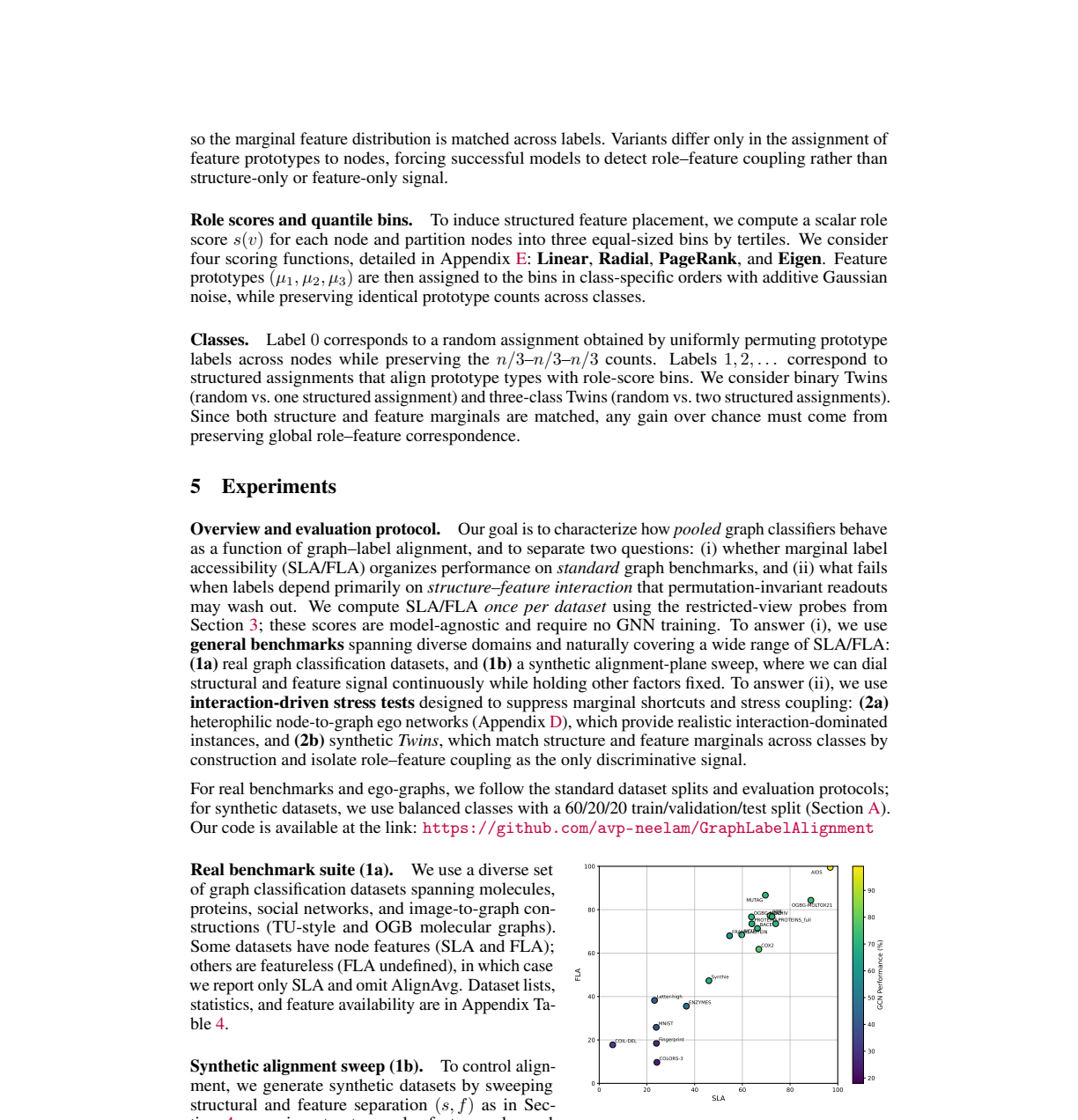
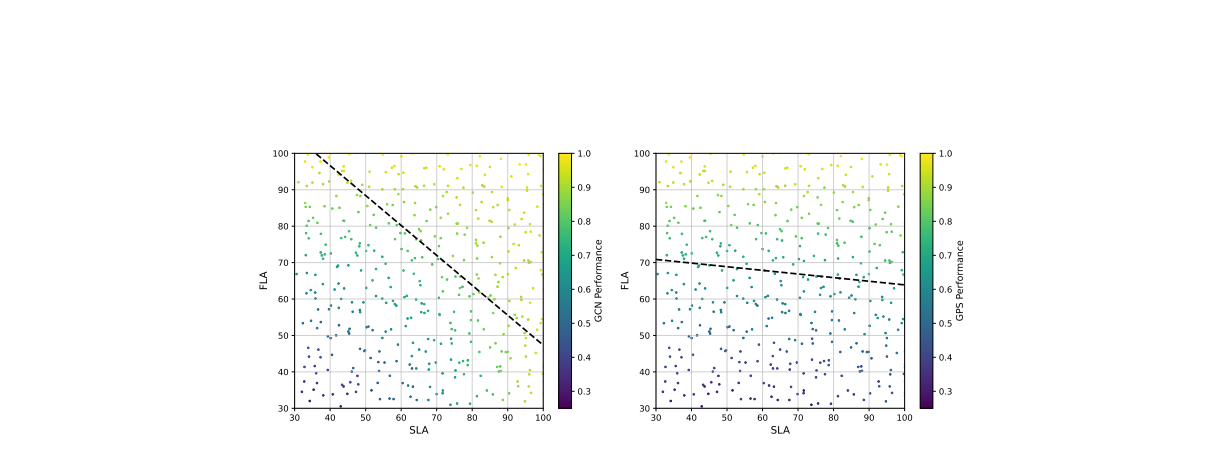
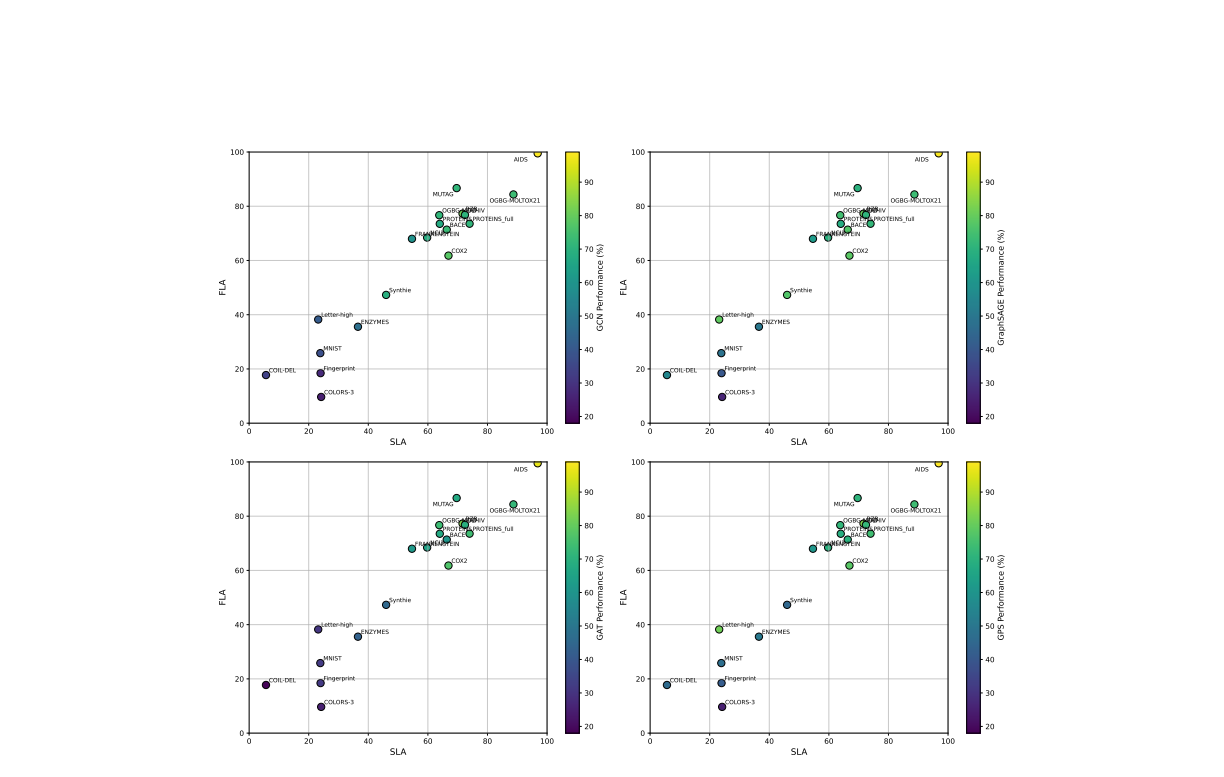
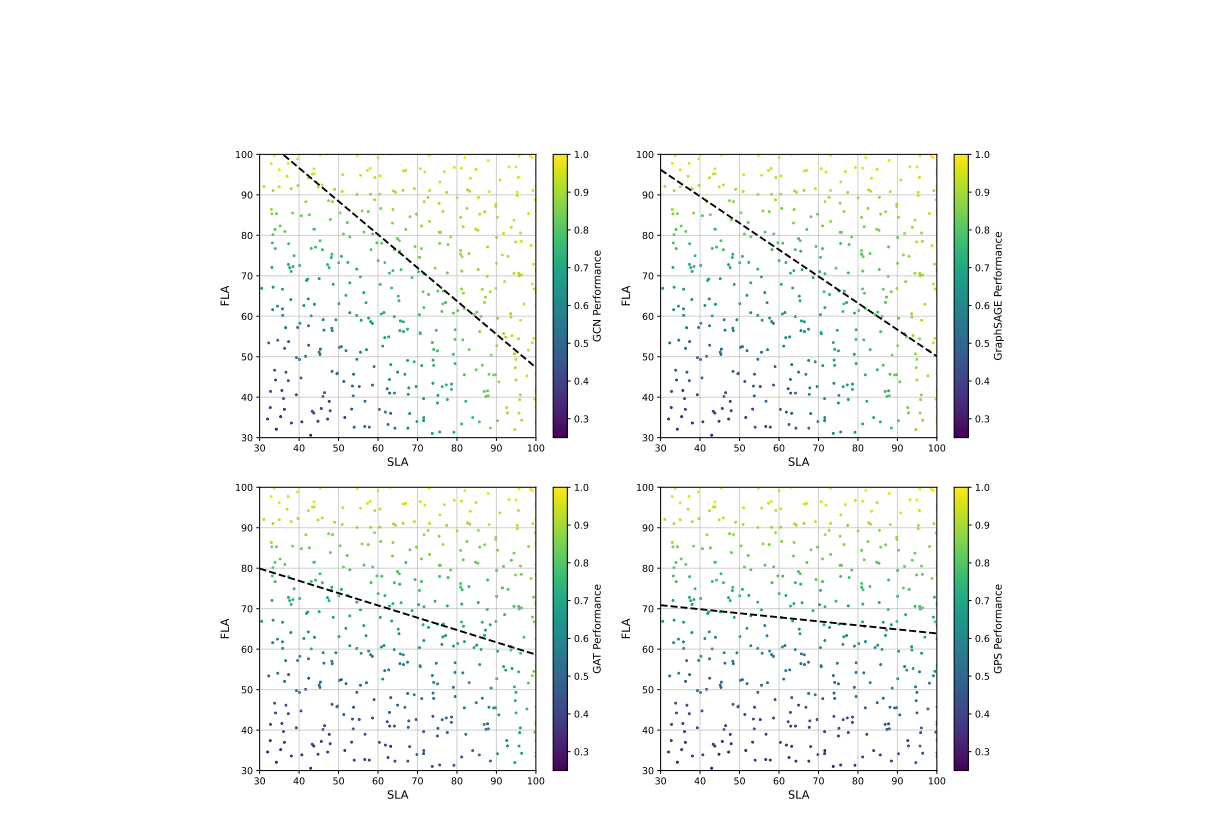
We take a data-centric view and ask whether benchmark success is driven by genuine structure–feature reasoning or by label signal already accessible from restricted marginal views. We introduce graph label alignment, a lightweight diagnostic that measures label accessibility through two supervised probes computed without training a graph encoder: structural label alignment (SLA), based on permutation-invariant topological and spectral summaries, and feature label alignment (FLA), based on pooled node features with edges removed. Across real graph classification benchmarks and multiple pooled backbones, the resulting SLA–FLA plane strongly organizes test accuracy, with low-alignment datasets forming a consistent regime where standard pooled pipelines struggle. To probe what lies beyond marginal accessibility, we introduce controlled interaction-dominated stress tests, including heterophilic ego-graphs and synthetic Twins tasks whose structural and feature marginals are matched across classes but whose role–feature couplings differ. These results show that high alignment explains much of easy benchmark performance, while low alignment reveals regimes where success requires preserving structure–feature correspondence beyond standard pooled representations.
from the abstract
Pith says
Machine review · deepseek-v4-flash · 13 Nov 2026 · what was read was not recorded · not checked by a person
It can be wrong. Challenge this review or reply to it.
Holds up. A practical diagnostic that organizes pooled GNN difficulty on graph benchmarks; honest about limitations and worth engaging with. This line is wrong
1 major objection · 6 minor
How often objections from reviews like this one are right: not yet measured
Not checked: figures, code, what the 300 references say.
The paper says, at Abstract and Sections 1, 6.1, I
The review did not quote this passage.
A classifier read this sentence of the paper as acknowledging the concern (probability 0.74):
“A natural concern is probe underfitting: a low SLA or FLA score may occur because the restricted-view summary contains little accessible marginal label signal, or because the reference probes are not expressive enough to separate the summary vectors.”
Pith says: Objection 1 of 1 · major
The paper acknowledges that low SLA may reflect limits of the structural summary rather than genuinely inaccessible signal (Section I), and the structural summary is deliberately simple (48-dimensional handcrafted descriptor). However, the main text (abstract, conclusion) states that low-alignment datasets form a 'consistent regime where standard pooled pipelines struggle' and that low alignment 'reveals regimes where success requires preserving structure–feature correspondence beyond standard pooled representations.'
more of objection 1
Given that the structural summary has not been tested against qualitatively different families of descriptors (e.g., Weisfeiler–Lehman subtree features, graphlet counts, graph-kernel SVM), the interpretive step from 'low SLA under the reference descriptor' to 'consistent struggle' is stronger than the evidence warrants for real benchmarks. The Twins construction eliminates this ambiguity for synthetic data, but for real benchmarks like ENZYMES (SLA=35.56) the possibility that a more expressive structural probe would recover substantial label signal remains open. The paper should explicitly temper these interpretive statements in the abstract and conclusion, or add a forward reference to future work that tests richer structural probes.
6 minor objections
The paper says, at Abstract and Section 3.3
Pith says: minor objection 1 of 6
The notation 'dSLA' and '[FLA' (e.g., in the abstract and Section 3.3) appears to be a LaTeX artifact. The standard notation 'SLA' and 'FLA' is used in most of the paper; the odd characters should be removed for consistency.
The paper says, at Table 2
Pith says: minor objection 2 of 6
The column header 'ALIGNAVG↓' is not explained. The down arrow presumably indicates decreasing order; a footnote or caption would clarify.
show 4 more
The paper says, at Appendix Table 4
Pith says: minor objection 3 of 6
'AV.NODES' and 'AV.EDGES' are presumably abbreviations for 'AVERAGE NODES' and 'AVERAGE EDGES'; writing 'AVG.' would be clearer.
The paper says, at Table 9 (Appendix C.2)
Pith says: minor objection 4 of 6
The table is titled 'Individual probes on the same summaries.' The column headers say 'ρ' and 'PEARSON(GCN)' but it is ambiguous what ρ is measured against (LogReg alone). Adding a row or footnote that 'Correlation reported is Spearman against LogReg' would help.
The paper says, at Section H.3
Pith says: minor objection 5 of 6
The definition of ∆graph = Acc(best pooled backbone) – max(SLA,FLA) is clear, but the sentence 'The restricted views correspond to the modes in RINGS' assumes reader familiarity with RINGS. A brief explanation or citation context would improve accessibility.
The paper says, at Appendix C.2, Table 8
Pith says: minor objection 6 of 6
The column 'δ SLA' and 'δ FLA' are defined but the table caption says 'difference between alternative-probe and reference alignment scores.' It would be helpful to state explicitly that a positive value means the alternative suite finds more signal.
What would settle it
Recompute SLA on ENZYMES, CIFAR-10, COLORS-3, and LETTER-HIGH using a 1-WL subtree kernel (or graphlet count histogram) as the structural descriptor and an RBF-SVM probe. If SLA rises by more than 10 percentage points on any of these datasets relative to the reference 48-dimensional summary, then the reference summary underfits that dataset and the alignment-plane interpretation should be qualified accordingly.
from the skeptic's reading
How the review went
4 readings by deepseek-v4-flash · 13 Nov 2026
- Reader holds up
- Skeptic partly agrees
- Editor wrote the verdict above
- Referee minor revision: 1 major objection, 6 minor
Not run on this paper: the simulated authors' defence.
Pith did not check this review's objections against the paper.
The review in full
The review in brief, machine-written
This paper introduces SLA and FLA, a lightweight pre-training diagnostic that measures how much label signal is accessible from structure-only and feature-only views of graph classification datasets. The central claim—that the SLA–FLA plane organizes pooled-model test accuracy across a wide range of real benchmarks—is strongly supported by correlations (∼0.7–0.96) across four backbones, validated with a controlled synthetic sweep, and sharpened with Twins tasks that isolate interaction-only signal. The paper is unusually thorough on robustness: it ablates structural and feature summaries, checks probe sufficiency, tests seed stability, and flags probe-sensitive cases like LETTER-HIGH. The honesty about scope is a strength.
The soft spots are real but contained. The stress-test concern (structural summary underfitting) is acknowledged: low SLA on some datasets may reflect the coarse 48-dimensional descriptor rather than genuinely inaccessible signal. The paper shows that rank correlations remain above 0.968 when replacing blocks, but all alternatives stay within the same family of handcrafted features. A single experiment with a qualitatively different descriptor (WL subtree features or a graph kernel) would bound this concern. More importantly, the real-benchmark correlations are observational, and scaffold splits degrade the relationship noticeably (Section H.4). That doesn't invalidate the diagnostic—it accurately limits its applicability to in-distribution settings—but it means the paper's interpretive frame should stay aligned with that scope.
Who benefits: anyone running pooled GNNs or graph transformers who wants to know whether a high accuracy number reflects genuine relational reasoning or trivial marginal cues. The decision map (Appendix G) and triage metric (Δgraph) are immediately useful.
Recommendation: Accept. This is a serious, well-executed piece of work. The empirical foundation is solid, the limitations are on the table, and the contribution is practically useful. Minor revisions could address the stress-test by testing one non-handcrafted structural descriptor and by softening the claim about scaffold-split generalization. But it's ready for a proper referee.
The strongest objection
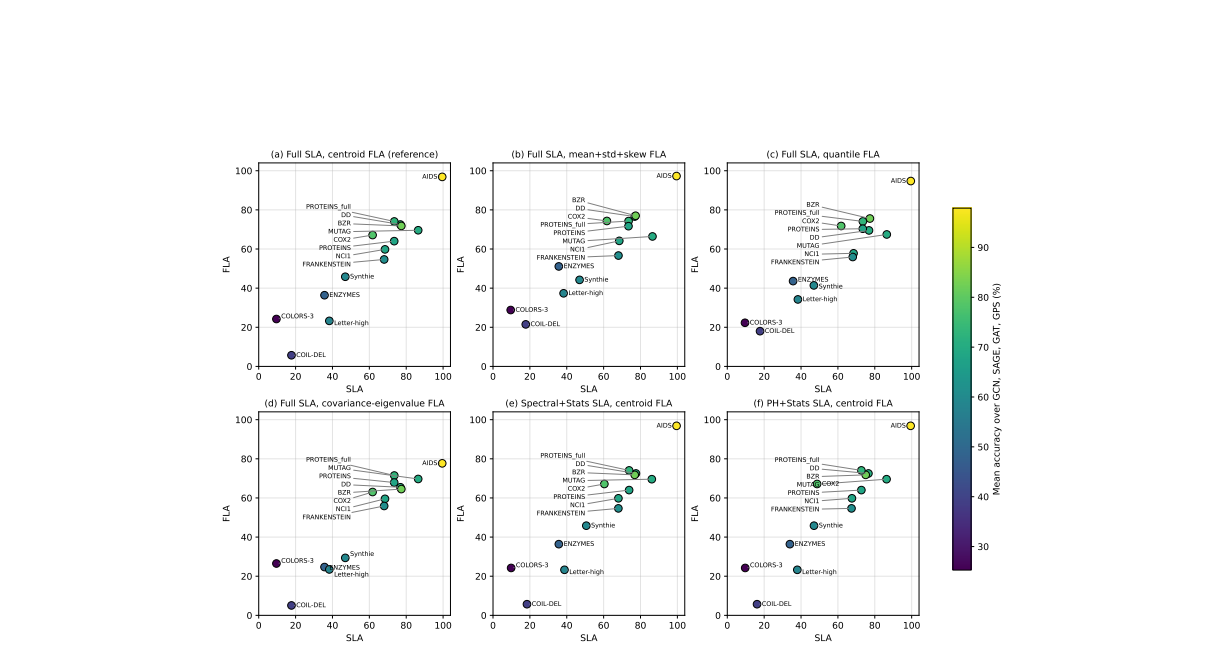
The paper's central claim that low SLA marks datasets where standard pooled pipelines 'consistently struggle' depends on the structural summary (ϕ_struct) being adequate to capture the structural label signal that simple probes could exploit. The summary is deliberately simple (48-dimensional, combining Betti profiles, spectral features, and global stats), and the paper acknowledges that low alignment 'may reflect weak marginal signal…or limits of the summaries and probes' (Section I). Robustness checks in Appendix C.1 show that alternative block combinations preserve rank correlations (≥0.968), but these alternatives remain within the same family of handcrafted topological/spectral/statistical descriptors. The paper does not test whether a qualitatively different family of structural descriptors—such as Weisfeiler–Lehman subtree features, graphlet counts, or a graph-kernel SVM—would raise SLA on low-SLA benchmarks like ENZYMES (SLA=35.56), CIFAR-10 (18.45), or COLORS-3 (9.67). If a more expressive structural probe recovered substantial label signal on those datasets, the claim that low alignment marks 'consistent struggle' would be an artifact of the reference summary, not a property of the datasets themselves. This concern is acknowledged but not empirically bounded, making it the most load-bearing unresolved issue for the interpretive frame.
The reader identified the weakest assumption as the sufficiency of the summaries and probes, which aligns with my concern. However, the reader focused primarily on probe underfitting and the acknowledgements in Appendix C, while I highlight that the structural summary itself has not been tested against a qualitatively different family of descriptors (e.g., graph kernels). The paper's own robustness checks only vary within the same handcrafted block design, leaving open the possibility that low SLA on certain datasets is a limitation of the specific summary, not a genuine property. Despite this gap, the paper is transparent about the limitation and does not claim causal inference on real benchmarks. The contribution—a lightweight diagnostic with strong empirical correlations under the reference construction—remains solid, and the synthetic sweep and Twins provide controlled evidence that the framework does capture something real. Therefore the verdict should remain ACCEPT (UNCHANGED).
The referee's report
If the reported correlations and the interpretative frame hold, the SLA–FLA plane provides a lightweight, architecture-agnostic diagnostic for graph classification benchmarks. It can help practitioners decide whether high accuracy likely reflects use of marginal shortcuts or genuine relational reasoning, and it identifies datasets where pooled models are unlikely to succeed without readouts that preserve structure–feature coupling. The synthetic Twins are a novel stress test for interaction-only signal. The extensive robustness checks (structural ablations, probe sufficiency, scaffold splits) strengthen the empirical grounding. The publicly available code and transparent reporting of limitations add to the paper's value.
Pith's reading of the paper (a machine's summary, not the authors')
This paper introduces graph label alignment, a lightweight diagnostic that measures how much label information is accessible from two restricted views: structure alone (SLA) and pooled node features alone (FLA), without training any graph neural network. Across real graph classification benchmarks, the SLA–FLA plane strongly organizes the test accuracy of standard pooled pipelines, with high-alignment datasets being easy and low-alignment datasets marking a consistent struggle. The paper further constructs controlled interaction-dominated stress tests (Twins tasks, heterophilic ego-graphs) that suppress both marginal shortcuts, showing that pooled models remain near chance when the label signal lives only in global role–feature coupling. The central takeaway is that much of the apparent success on easy benchmarks can be explained by marginal label accessibility, and that low alignment reveals a genuine bottleneck in how standard pooling preserves structure–feature correspondence.
What carries the argument. Structural Label Alignment (SLA) and Feature Label Alignment (FLA) are the central machinery. SLA quantifies label predictability from a fixed 48-dimensional structural descriptor (degree-filtration Betti profile, normalized Laplacian and adjacency eigenvalues, global graph statistics) using logistic regression and RBF-SVM probes. FLA quantifies label predictability from the centroid of node features after discarding edges. Together (SLA, FLA) form the graph label alignment plane, a two-dimensional atlas that organizes benchmark difficulty without training any graph encoder.
Core claim. The paper establishes that two simple, model-agnostic scores—Structural Label Alignment (SLA) and Feature Label Alignment (FLA)—computed from lightweight permutation-invariant summaries of graph structure and node-feature centroids, strongly predict the accuracy of standard pooled GNNs and graph transformers on real benchmarks. Together, SLA and FLA define an interpretable plane that separates datasets into high-accessibility (easy) and low-accessibility (hard) regimes, with Pearson correlations above 0.9 for GCN and GAT across 19 real benchmarks. The paper further demonstrates, through synthetic Twins tasks where structure and feature marginals are identical across classes but role–feature couplings differ, that pooled models remain at chance when the only signal is interaction-dependent, exposing a correspondence bottleneck in permutation-invariant readouts.
The premise it rests on. The chosen structural and feature summary vectors (a 48-dimensional structural descriptor and the node-feature centroid) combined with logistic regression and RBF-SVM classifiers are sufficient to capture the marginal label signal that is accessible under restricted views; the paper acknowledges that richer summaries or stronger probes could raise scores on some datasets, meaning low alignment could reflect probe limitations rather than genuinely low signal.
If the paper is right (Pith's inferences, not the authors')
The SLA–FLA plane can be used as a pre-training screen: datasets with very low alignment likely require non-pooled architectures or interaction-preserving readouts, saving compute on standard pooled baselines.
Benchmark developers can use alignment scores to ensure that newly proposed datasets test genuine relational reasoning rather than marginal shortcuts, by aiming for low SLA and FLA with high delta-graph (accuracy gain over best probe).
The alignment scores enable backbone-aware recommendation: on real benchmarks, GAT and GPS are more sensitive to FLA than SLA, suggesting attention-based architectures are better suited to feature-dominant tasks.
The Twins construction provides a template for generating interaction-only tasks that directly test a model's ability to preserve role–feature correspondence, which could become standard evaluation probes.
Alignment scores can track degradation under distribution shift: scaffold splits on molecular benchmarks lower both alignment and GCN accuracy, but not always proportionally, making alignment a diagnostic for split quality.
If alignment is a genuine predictor of difficulty, then the approach naturally extends to graph-level regression by replacing the probe classifiers with regressors; this would broaden the diagnostic to property prediction tasks.
The correspondence bottleneck identified in the Twins tasks suggests that progress on truly hard graph tasks may require readouts that are not permutation-invariant over the entire set of nodes—perhaps hierarchical or equivariant pooling that preserves feature-role assignments.
The probe-dependence acknowledged in the paper implies that a low SLA/FLA score on a real dataset is only informative if one validates probe sufficiency (e.g., with a stronger probe suite). The paper provides such a self-check, but future work might standardize a minimal expressive probe to make cross-benchmark comparisons robust.
For link prediction and node classification, where the label belongs to an edge or a node, the concept of 'discarding edges' is ill-defined; adapting alignment to those settings would require rethinking the restricted views, potentially making the diagnostic more widely applicable.
Check this review
Pith stored no record of this review's passes and took no fingerprint of it. Reviews made by code from 13 Nov 2026 on carry both.
How often reviews like this one are right
Reviews like this one: written by deepseek-v4-flash, where what was read was not recorded.
How often objections from reviews like this one are right: not yet measured
Reviews by people
This review was written by a machine. No person has reviewed this paper on Pith yet. A scientist listed on Pith can review it for a fee, and their review is published here whatever it concludes.
The paper
Abstract
Graph classification benchmarks vary widely in difficulty: some are solved by simple pooled baselines, while others remain challenging for GNNs and graph transformers. We take a data-centric view and ask whether benchmark success is driven by genuine structure–feature reasoning or by label signal already accessible from restricted marginal views. We introduce graph label alignment, a lightweight diagnostic that measures label accessibility through two supervised probes computed without training a graph encoder: structural label alignment (SLA), based on permutation-invariant topological and spectral summaries, and feature label alignment (FLA), based on pooled node features with edges removed. Across real graph classification benchmarks and multiple pooled backbones, the resulting SLA–FLA plane strongly organizes test accuracy, with low-alignment datasets forming a consistent regime where standard pooled pipelines struggle. To probe what lies beyond marginal accessibility, we introduce controlled interaction-dominated stress tests, including heterophilic ego-graphs and synthetic Twins tasks whose structural and feature marginals are matched across classes but whose role–feature couplings differ. These results show that high alignment explains much of easy benchmark performance, while low alignment reveals regimes where success requires preserving structure–feature correspondence beyond standard pooled representations.
The paper's own sentences, arranged, kept beside the review and separate from it. Each label is drawn from a closed vocabulary; the number beside it is the probability the classifier gave that label. No sentence in this record was written by a model.
abstract compiled · 2026-11-13
The authors' main claim, as the classifier picked it out 1.00
“These results show that high alignment explains much of easy benchmark performance, while low alignment reveals regimes where success requires preserving structure--feature correspondence beyond standard pooled representations.”
How the main claim is stated: asserted 1.00
What the abstract itself states, as probabilities: claims first 0.06 · states limitation 0.27 · human participants 0.02 · controlled comparison 0.65 · randomized assignment 0.02 · states quantitative result 0.09 · compares with prior results 0.75 · mentions code or data availability 0.03
The abstract, sentence by sentence
This table labels the abstract only (arXiv listing abstract v1). The number is the probability the classifier gave the label.
| Sentence | Role | The authors' own work | States the main conclusion | Strength |
|---|---|---|---|---|
| Graph classification benchmarks vary widely in difficulty: some are solved by simple pooled baselines, while others remain challenging for GNNs and graph transformers. | background 1.00 | 0.10 | 0.03 | asserted 1.00 |
| We take a data-centric view and ask whether benchmark success is driven by genuine structure--feature reasoning or by label signal already accessible from restricted marginal views. | gap 0.67 | 0.36 | 0.05 | unclear 0.55 |
| We introduce graph label alignment, a lightweight diagnostic that measures label accessibility through two supervised probes computed without training a graph encoder: structural label alignment (SLA), based on permutation-invariant topological and spectral summaries, and feature label alignment (FLA), based on pooled node features with edges removed. | method 0.64 | 0.96 | 0.07 | asserted 1.00 |
| Across real graph classification benchmarks and multiple pooled backbones, the resulting SLA--FLA plane strongly organizes test accuracy, with low-alignment datasets forming a consistent regime where standard pooled pipelines struggle. | result 1.00 | 0.95 | 0.38 | asserted 1.00 |
| To probe what lies beyond marginal accessibility, we introduce controlled interaction-dominated stress tests, including heterophilic ego-graphs and synthetic Twins tasks whose structural and feature marginals are matched across classes but whose role--feature couplings differ. | method 0.75 | 0.94 | 0.06 | asserted 0.83 |
| These results show that high alignment explains much of easy benchmark performance, while low alignment reveals regimes where success requires preserving structure--feature correspondence beyond standard pooled representations. | interpretation 0.99 | 0.94 | 0.84 | asserted 1.00 |
What kind of paper the classifier reports this is: method or tool 0.99 · evidence from observation or experiment 0.83
What was examined, and what was not
Sources read
- arXiv listing abstract v1
Not examined
- full text
- figures and tables
- references and citing sentences
- relations to other papers
Levels run
- P abstract
Not run
- S sections
- T body sentences
- C citations
- R cross-paper relations
How the labels were made
Compiled by classifier-1.13.0 via TypeSafe API, question bank abstract-p1-20260923, 2026-11-13: 1 request, 5,073 input tokens.
Every quoted sentence on this record is the authors'. Every label is from Pith's closed vocabulary, with the probability shown beside it. This record as JSON
Figures (6)
Figures are the authors', reproduced from the paper.
References (300)
- [1] Position: Graph Learning Will Lose Relevance Due To Poor Benchmarks , author=. International Conference on Machine Learning , year= on Pith
- [2] Going beyond persistent homology using persistent homology , author=. NeurIPS , volume= on Pith
- [3] A persistent weisfeiler-lehman procedure for graph classification , author=. International Conference on Machine Learning , pages=. 2019 , organization= on Pith
- [4] Explaining the power of topological data analysis in graph machine learning , author=. arXiv preprint arXiv:2401.04250 , year= on PithPith's reviewarXiv
- [5] Graph filtration learning , author=. International Conference on Machine Learning , pages=. 2020 , organization= on Pith
- [6] A compact review of molecular property prediction with graph neural networks , author=. Drug Discovery Today: Technologies , volume=. 2020 , publisher= on Pith
- [7] Breaking the limits of message passing graph neural networks , author=. International Conference on Machine Learning , pages=. 2021 , organization= on Pith
- [8] A survey on graph representation learning methods , author=. arXiv:2204.01855 , year= on PithPith's reviewarXiv
- [9] The genus, regional number, and Betti number of a graph , author=. Canadian Journal of Mathematics , volume=. 1966 , publisher= on Pith
- [10] Growing scale-free networks with tunable clustering , author=. Physical review E , volume=. 2002 , publisher= on Pith
- [11] Benchmark Data Sets for Graph Kernels , author =. 2016 , note = on Pith
- [12] Reimagining Graph Classification from a Prototype View with Optimal Transport: Algorithm and Theorem , author=. Proceedings of the 30th ACM SIGKDD Conference on Knowledge Discovery and Data Mining , pages= on Pith
- [13] Stable vectorization of multiparameter persistent homology using signed barcodes as measures , author=. NeurIPS , volume= on Pith
- [14] A persistence landscapes toolbox for topological statistics , author=. Journal of Symbolic Computation , volume=. 2017 , publisher= on Pith
- [15] EMP: Effective Multidimensional Persistence for Graph Representation Learning , author=. Learning on Graphs Conference , pages=. 2024 , organization= on Pith
- [16] Graph contrastive learning automated , author=. 2021 , organization= on Pith
- [17] EPIC: Graph Augmentation with Edit Path Interpolation via Learnable Cost , author=. Proceedings of the 2024 International Joint Conference on Artificial Intelligence (IJCAI) , year= on Pith
- [18] G-mixup: Graph data augmentation for graph classification , author=. 2022 , organization= on Pith
- [19] Model-agnostic augmentation for accurate graph classification , author=. Proceedings of the ACM Web Conference 2022 , pages= on Pith
- [20] Scale-invariant heat kernel signatures for non-rigid shape recognition , author=. 2010 IEEE computer society conference on computer vision and pattern recognition , pages=. 2010 , organization= on Pith
show 80 more
- [21] Ricci curvature of graphs , author=. Tohoku Mathematical Journal, Second Series , volume=. 2011 , publisher= on Pith
- [22] FDSA-STG: Fully dynamic self-attention spatio-temporal graph networks for intelligent traffic flow prediction , author=. IEEE Transactions on Vehicular Technology , volume=. 2022 , publisher= on Pith
- [23] Graph convolutional policy network for goal-directed molecular graph generation , author=. Neur on Pith
- [24] Microscopic evolution of social networks , author= on Pith
- [25] Wasserstein Embedding for Graph Learning , author=. ICLR , year= on Pith
- [26] Homological algebra for persistence modules , author=. Foundations of Computational Mathematics , pages=. 2021 , publisher= on Pith
- [27] Graph neural networks: Adversarial robustness , author=. Graph Neural Networks: Foundations, Frontiers, and Applications , pages=. 2022 , publisher= on Pith
- [28] Centrality estimation in large networks , author=. International Journal of Bifurcation and Chaos , volume=. 2007 , publisher= on Pith
- [29] A faster algorithm for betweenness centrality , author=. Journal of mathematical sociology , volume=. 2001 , publisher= on Pith
- [30] Consistent Individualized Feature Attribution for Tree Ensembles , author=. methods , volume= on Pith
- [31] Scott M. Lundberg and Gabriel G. Erion and Su. Consistent Individualized Feature Attribution for Tree Ensembles , journal =. 2018 , url =. 1802.03888 , timestamp = on PithPith's reviewarXiv
- [32] Extracting insights from the shape of complex data using topology , author=. Scientific reports , volume=. 2013 , publisher= on Pith
- [33] Michael Lesnick and Matthew Wright , year=. Computing Minimal Presentations and Bigraded. 1902.05708 , archivePrefix= on PithPith's reviewarXiv
- [34] Complex network metrics: can deep learning keep up with tailor-made reference algorithms? , author=. IEEE Access , volume=. 2020 , publisher= on Pith
- [35] Persistent homology transform for modeling shapes and surfaces , author=. Information and Inference: A Journal of the IMA , volume=. 2014 , publisher= on Pith
- [36] Deep graph kernels , author= on Pith
- [37] BRENDA, the enzyme database: updates and major new developments , author=. Nucleic acids research , volume= on Pith
- [38] Comparison of descriptor spaces for chemical compound retrieval and classification , author=. Knowledge and Information Systems , volume= on Pith
- [39] Distinguishing enzyme structures from non-enzymes without alignments , author=. Journal of molecular biology , volume=. 2003 , publisher= on Pith
- [40] Eccentricity and centrality in networks , author=. Social networks , volume=. 1995 , publisher= on Pith
- [41] A Fair Comparison of Graph Neural Networks for Graph Classification , author=. ICLR , year= on Pith
- [42] Community detection on networks with ricci flow , author=. Scientific reports , volume=. 2019 , publisher= on Pith
- [43] Statistical topology using persistence landscapes , author=. JMLR , volume= on Pith
- [44] Comparing persistence diagrams through complex vectors , author=. International Conference on Image Analysis and Processing , pages= on Pith
- [45] Non-target-specific node injection attacks on graph neural networks: A hierarchical reinforcement learning approach , author=. Proc. WWW , volume= on Pith
- [46] Adversarial attack on graph structured data , author=. ICML , pages= on Pith
- [47] Structural neighborhood based classification of nodes in a network , author= on Pith
- [48] Graph powering and spectral robustness , author=. SIAM Journal on Mathematics of Data Science , volume= on Pith
- [49] Impact of regularization on spectral clustering , author=. Annals of Statistics , volume=. 2016 , publisher= on Pith
- [50] Adversarial defense framework for graph neural network , author=. arXiv:1905.03679 , year= on PithPith's reviewarXiv
- [51] Learning Hyperbolic Representations of Topological Features , author=. ICLR , year= on Pith
- [52] Nonlinear Higher-Order Label Spreading , author=. arXiv:2006.04762 , year= on PithPith's reviewarXiv
- [53] Almost exact recovery in noisy semi-supervised learning , author=. arXiv:2007.14717 , year= on PithPith's reviewarXiv
- [54] Graph Structure Learning for Robust Graph Neural Networks , author=. ACM KDD , year= on Pith
- [55] Topological approaches to deep learning , author=. Topological Data Analysis , pages=. 2020 , publisher= on Pith
- [56] Topological pattern recognition for point cloud data , author=. Acta Numerica , volume=. 2014 , publisher= on Pith
- [57] Computing persistent homology , author=. Discrete & Computational Geometry , volume=. 2005 , publisher= on Pith
- [58] Relational representation learning for dynamic (knowledge) graphs: A survey , author=. JMLR , year= on Pith
- [59] Geometric deep learning: going beyond euclidean data , author=. IEEE Signal Processing Magazine , volume= on Pith
- [60] Review of major approaches to analyze vulnerability in power system , author=. Reliability Engineering & System Safety , volume= on Pith
- [61] The power grid as a complex network: a survey , author=. Physica A: Stat. Mechanics and its Apps. , volume= on Pith
- [62] Electrical centrality measures for electric power grid vulnerability analysis , author=. IEEE CDC , pages= on Pith
- [63] Bridging the Gap between Spatial and Spectral Domains: A Survey on Graph Neural Networks , author=. arXiv:2002.11867 , year= on PithPith's reviewarXiv
- [64] Chen, Y. and Gel, Y.R. and Avrachenkov, K. , booktitle= on Pith
- [65] Adversarial Attacks and Defenses on Graphs: A Review and Empirical Study , author=. arXiv:2003.00653 , year= on PithPith's reviewarXiv
- [66] Deep learning on graphs: A survey , author=. IEEE TKDE , year= on Pith
- [67] Adversarial attack and defense on graph data: A survey , author=. arXiv:1812.10528 , year= on PithPith's reviewarXiv
- [68] Adversarial examples on graph data: Deep insights into attack and defense , author=. arXiv:1903.01610 , year= on PithPith's reviewarXiv
- [69] Social network analysis for customer churn prediction , author=. Applied Soft Computing , volume= on Pith
- [70] Analyzing the bills-voting dynamics and predicting corruption-convictions among Brazilian congressmen through temporal networks , author=. Scientific reports , volume= on Pith
- [71] Graph embedding on biomedical networks: methods, applications and evaluations , author=. Bioinformatics , volume= on Pith
- [72] Local algorithms for block models with side information , author=. ITCS , pages= on Pith
- [73] Encyclopedia of distances , author=. Encyclopedia of Distances , pages=. 2009 , publisher= on Pith
- [74] Semi-supervised classification with graph convolutional networks , author=. ICLR , year= on Pith
- [75] Convolutional neural networks on graphs with fast localized spectral filtering , author=. NeurIPS , pages= on Pith
- [76] Graph neural networks with convolutional ARMA filters , author=. arXiv:1901.01343 , year= on PithPith's reviewarXiv
- [77] Monti, Federico and Otness, Karl and Bronstein, Michael M , booktitle= on Pith
- [78] Cayleynets: Graph convolutional neural networks with complex rational spectral filters , author=. IEEE Trans. Signal Process. , volume= on Pith
- [79] Morse theory for filtrations and efficient computation of persistent homology , author=. Discrete & Computational Geometry , volume=. 2013 , publisher= on Pith
- [80] Large-scale learnable graph convolutional networks , author= on Pith
- [81] SPAGAN: shortest path graph attention network , author=. International Joint Conference on Artificial Intelligence , pages= on Pith
- [82] Predict then propagate: Graph neural networks meet personalized pagerank , author=. ICLR , year= on Pith
- [83] Mixhop: Higher-order graph convolutional architectures via sparsified neighborhood mixing , author=. ICML , year= on Pith
- [84] Power up! robust graph convolutional network against evasion attacks based on graph powering , author=. arXiv:1905.10029 , year= on PithPith's reviewarXiv
- [85] Robust graph convolutional networks against adversarial attacks , author= on Pith
- [86] Transferring Robustness for Graph Neural Network Against Poisoning Attacks , author=. WSDM , pages= on Pith
- [87] Adversarial attacks on neural networks for graph data , author= on Pith
- [88] Adversarial attacks on graph neural networks via meta learning , author=. ICLR , year= on Pith
- [89] All You Need Is Low (Rank) Defending Against Adversarial Attacks on Graphs , author=. WSDM , pages= on Pith
- [90] Collective classification in network data , author=. AI Magazine , volume= on Pith
- [91] Grid structural characteristics as validation criteria for synthetic networks , author=. IEEE T. Power Syst. , volume= on Pith
- [92] Statistical considerations in the creation of realistic synthetic power grids for geomagnetic disturbance studies , author=. IEEE T. Power Syst. , volume= on Pith
- [93] Spectral networks and locally connected networks on graphs , author=. ICLR , year= on Pith
- [94] Geometric deep learning on graphs and manifolds using mixture model cnns , author=. Proceedings of the IEEE conference on computer vision and pattern recognition , pages= on Pith
- [95] Gmnn: Graph markov neural networks , author=. ICLR , pages= on Pith
- [96] Diffusion improves graph learning , author=. NeurIPS , pages= on Pith
- [97] Representation Learning on Graphs with Jumping Knowledge Networks , author=. ICML , pages= on Pith
- [98] Geometric matrix completion with recurrent multi-graph neural networks , author=. NeurIPS , pages= on Pith
- [99] Certifiable Robustness to Graph Perturbations , author=. NeurIPS , pages= on Pith
- [100] Certified Robustness of Graph Neural Networks against Adversarial Structural Perturbation , author=. arXiv:2008.10715 , year= on PithPith's reviewarXiv
The first 100 of 300 references are listed here. All of them are in this paper's citation record.
Challenges and discussion
Disagree with the review, or know something it missed? Leave a comment, or challenge this review formally: a challenge becomes a permanent entry in this paper's record, and its decision is published here.
Come back by email
A short list of the week's newly reviewed papers. Nothing is sent until you confirm from your inbox, and every email has a link that stops it. No account.
No comments yet.
Sign in to comment