High Energy Physics - Theory · arXiv:2611.15933 v2 · submitted 11 Nov 2026
Imaging the two-sided black hole interior with four-point correlators
The paper says
“We propose a boundary four-point function smeared with wavepackets, which probes local physics behind the horizon of a two-sided AdS black hole.”
more of the abstract
At high frequencies, boundary wavepackets aimed at an interior bulk point travel along geodesics and scatter locally about the bulk point, factorizing the correlator into a flat-space like scattering amplitude. To obtain this configuration, we utilize a non-trivial time ordering of operators, and also use one state-dependent operator insertion moved halfway across the thermal circle. An interesting property of this observable is that it also probes features of nontrivial states: null shocks and matter shells behind the horizon show up as jumps in the observed signal as the bulk point crosses them, thereby imaging the black hole interior.
from the abstract
Pith says
Machine review · deepseek-v4-flash · 13 Nov 2026 · of version 1 of the paper; version 2 is newer · what was read was not recorded · not checked by a person
It can be wrong. Challenge this review or reply to it.
Holds up, with conditions. A clever extension of the holographic camera to black hole interiors, but the central assumption about uniform validity of the Regge approximation along the complex continuation path is explicitly unverified, making the interior signal a well-motivated conjecture rather than a proven result. This line is wrong
3 major objections · 5 minor
How often objections from reviews like this one are right: not yet measured
Not checked: figures, code, what the references say.
The paper says, at §3.4, sentence b464
The review did not quote this passage.
A classifier read this sentence of the paper as acknowledging the concern (probability 0.89):
“What remains assumed is the uniform validity of the Regge approximation along the complete complex path beyond the leading graviton and the contact contributions, and the absence of competing saddles, which we discuss in §5.”
Pith says: Objection 1 of 3 · major
The entire construction of the interior camera relies on the uniform validity of the Regge approximation along the complex continuation path (Eq. 3.12). The authors state that this is assumed beyond the leading graviton and contact contributions. While the cross-ratio argument establishes the analytic sheet, the magnitude of the signal could be altered by subleading Regge trajectories or competing saddles.
more of objection 1
The paper would be significantly strengthened by providing a quantitative estimate or bound on subleading corrections, or by delineating a parameter regime where the leading approximation is guaranteed to dominate. Without this, the central factorization claim is not fully established.
The paper says, at §3–§4, general scope
The review did not quote this passage.
Pith says: Objection 2 of 3 · major
The explicit calculation is performed in planar BTZ (AdS₃/CFT₂), where the cylinder-to-plane map allows the use of vacuum conformal Regge theory. The generalization to higher dimensions (d>2) is asserted but not demonstrated, and the Regge analysis for thermal correlators in higher dimensions is not a direct analogue. The paper should clarify which results are specific to d=2 and which are expected to hold in higher dimensions, and whether the same analytic continuation path can be justified there.
The paper says, at §2.2.3, §6
The review did not quote this passage.
A classifier read this sentence of the paper as acknowledging the concern (probability 0.77):
“Further, eOR(¯y′)is not an ordinary real-time boundary operator, and in the ther- mofield double state the observable is an analytic continuation rather than an expectation value of real-time operators; the price for seeing behind the horizon is that the readout is supplied by a complex-time insertion.”
Pith says: Objection 3 of 3 · major
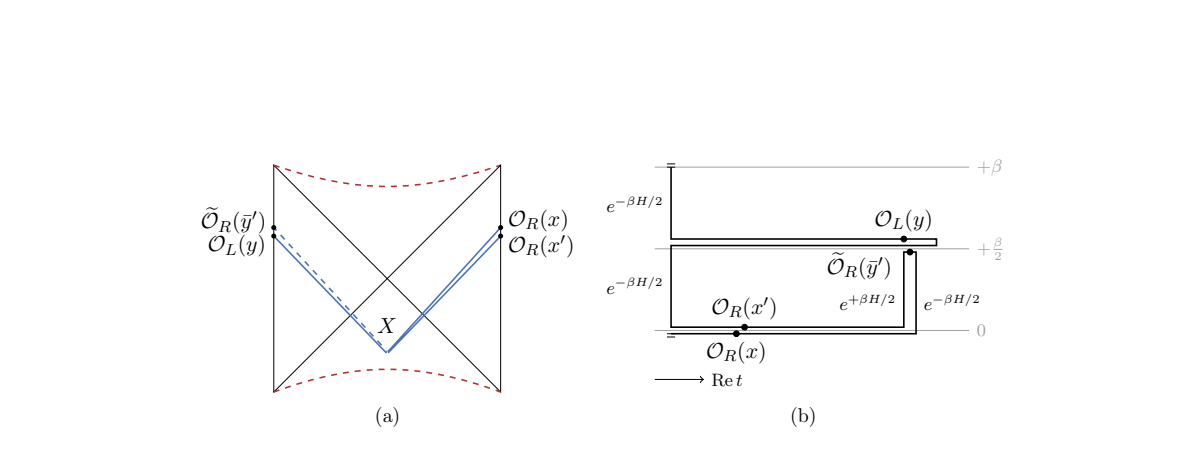
The observable (1.1) involves an operator at complex time (a right operator shifted by iβ/2). The authors acknowledge that this is not an expectation value of real-time operators. However, the paper's title and abstract may imply a more operational 'imaging' procedure. It would be helpful to explicitly discuss the operational meaning of this complex-time insertion—e.g., whether it can be realized as a linear combination of real-time expectation values or whether it is fundamentally a mathematical continuation.
5 minor objections
The paper says, at Eq. (2.8)
Pith says: minor objection 1 of 5
The definition of ψ_p includes a factor K_Δ and an exponential; the overall normalization and the precise role of K_Δ should be stated more clearly. Currently the text says 'choose K_Δ as follows' but does not show the full expression for ψ_p.
The paper says, at §2.2.4, Eq. (2.22)
Pith says: minor objection 2 of 5
The operator B_{y,q} is introduced but not used elsewhere in the paper. Consider removing it or connecting it to the later discussion to avoid confusion.
show 3 more
The paper says, at Fig. 1 caption
Pith says: minor objection 3 of 5
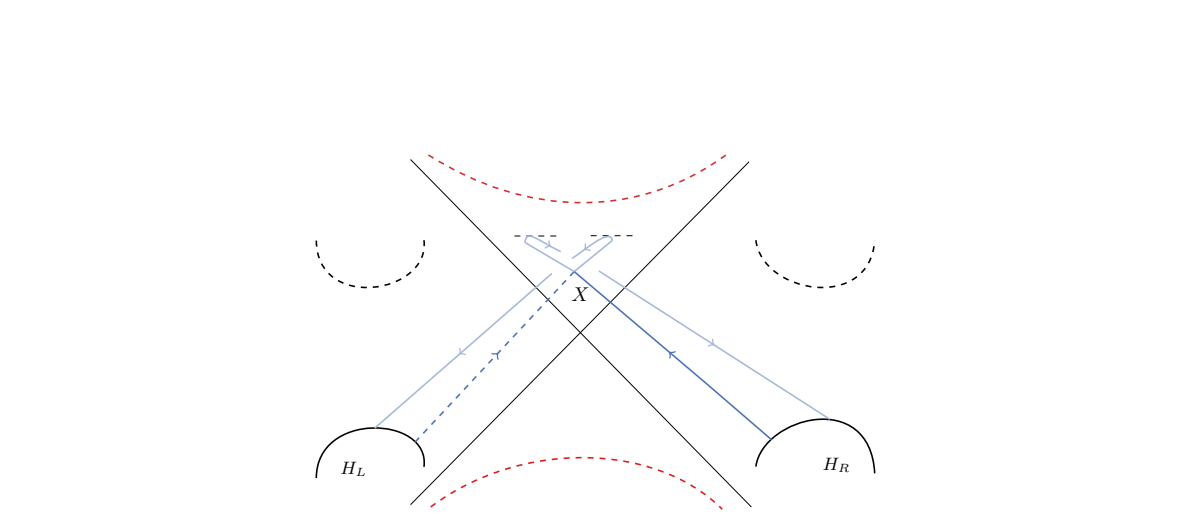
The dashed leg in panel (a) is said to connect eO_R(\bar{y}') to 'X', but the text leaves which leg is dashed ambiguous. Please label explicitly.
The paper says, at Appendix B
Pith says: minor objection 4 of 5
The cross-ratios are denoted z and \bar{z}, which clashes with the radial coordinate z used in the main text. Although the authors warn about this, it is still confusing. Consider renaming the cross-ratios (e.g., u, v) or using a different letter for the radial coordinate in the appendix.
The paper says, at Throughout
Pith says: minor objection 5 of 5
There are a few typographical errors: p. 53 'teh' should be 'the'; p. 63 'identites' should be 'identities'. Reference [58] is listed as 'Private communication' without further detail; please complete or remove.
What would settle it
Extend the Regge calculation of §3.2.3 to include the first subleading Regge trajectory (e.g., the stress tensor trajectory with J(ν)=2 plus the next trajectory from the conformal partial wave expansion, e.g., J(ν)=0 for a scalar). Using the full spectral density ρ(ν) and the closed form for α(ν) for a two-dimensional holographic CFT, evaluate Gcon(0,p;T−iθ,q) along θ∈[0,β/2] with the subleading term included. If the subleading contribution exceeds 10% of the leading term at θ=β/2 for typical momenta satisfying (2.23), the uniform validity assumption fails.
from the skeptic's reading
How the review went
4 readings by deepseek-v4-flash · 13 Nov 2026
- Reader holds up, with conditions
- Skeptic agrees
- Editor wrote the verdict above
- Referee major revision: 3 major objections, 5 minor
Not run on this paper: the simulated authors' defence.
Pith did not check this review's objections against the paper.
The review in full
The review in brief, machine-written
This paper proposes a boundary four-point function that, under certain assumptions, images local physics behind the horizon of a two-sided AdS black hole. Building on Caron-Huot's holographic camera, the authors use a non-trivial time ordering and one operator shifted by half the thermal circle to focus wavepackets onto an interior bulk point. The observable is explicit for planar BTZ, and the calculations for detecting null shocks and timelike shells are detailed and physically interesting. The authors are admirably transparent about what they have and have not proven.
The main unresolved issue is stated plainly in §3.4: the uniform validity of the Regge approximation along the entire complex analytic continuation path (Eq. 3.12) is assumed beyond leading graviton and contact contributions, and the absence of competing saddles is assumed. Without this, the interior signal could be contaminated or absent. The cross-ratio argument only establishes the sheet, not the magnitude. The analytic continuation itself is well-defined, but the strength of the focused signal relies on that load-bearing assumption. The authors also note that the construction is state-dependent (requires knowing β₊), and that backreaction limits the accessible time range. These limitations are openly acknowledged and proportionately discussed.
This paper is for the holography community interested in black hole interiors. It provides a concrete, well-motivated proposal for a boundary observable that could probe behind the horizon. The work is not a final answer but a clear step: it shows what a semiclassical construction can achieve and where the open problems lie. The paper should go to peer review; a serious referee can assess whether the central assumption is plausible and whether the evidence supports the claim as stated. The authors have done the community a service by being straightforward about the gap.
I would not cite this directly in my next paper unless working on related observables, but I would bring it to a reading group for discussion. The thinking is clear and honest, even where the result is conditional.
The strongest objection
The entire construction of the interior camera for the thermofield double state relies on analytically continuing the exterior camera along the complex time path (3.12). The leading signal is computed using the leading graviton Regge trajectory, but the authors explicitly state (b464) that uniform validity of the Regge approximation beyond this leading order and the absence of competing saddles are assumed. If subleading Regge trajectories (e.g., the scalar trajectory or higher-spin exchanges) acquire significant weight at some θ along the path, or if a different saddle (such as a bouncing geodesic) becomes dominant, the continued signal (3.31) could be contaminated or replaced, invalidating the claim that the two-sided camera (1.1) factorizes into a local flat-space scattering amplitude. The cross-ratio argument of §3.3 only establishes the analytic sheet, not the magnitude of the coefficient. Since no bound or estimate is given for subleading corrections, this is the single most load-bearing concern.
The reader correctly identifies the uniform validity of the Regge approximation as the weakest assumption. My analysis confirms this: the entire derivation of the two-sided camera signal in the thermofield double state (the only state where the Regge calculation directly applies) depends on this assumption, which the authors transparently flag as unproven. The proposed concrete test directly checks whether subleading contributions threaten the leading-order result, providing a sharp criterion for assessing the robustness of the interior claim. No additional significant objections were identified beyond this central assumption; the paper's other limitations (state dependence, backreaction, semiclassical nature) are acknowledged and do not undermine the core argument within their stated scope. Therefore the reader's conditional verdict is appropriate and unchanged.
The referee's report
If the central claim holds, the paper provides a concrete boundary observable that extracts local information from behind the black hole horizon, a long-standing goal in holography. The explicit computation in BTZ and the analysis of interior objects (shocks, shells) are valuable developments. The paper is technically careful within its stated approximations and builds on prior work on holographic cameras.
Pith's reading of the paper (a machine's summary, not the authors')
This paper proposes a boundary observable that can detect localized scattering events inside the black hole interior. The observable is a four-point correlator with a specific time-ordering: two operators on the right boundary, one on the left, and one right operator at a complex time (shifted by half the thermal circle). Smearing the pairs with wavepackets and taking a high-frequency limit focuses the correlator onto a bulk point behind the horizon. At that point, the correlator factorizes into a local flat-space scattering amplitude, encoding the collision of two infalling wavepackets, with a characteristic cusp in the angular dependence. The observable is sensitive to interior objects such as null shocks and matter shells, which appear as jumps or phase shifts in the signal as the shooting data are varied.
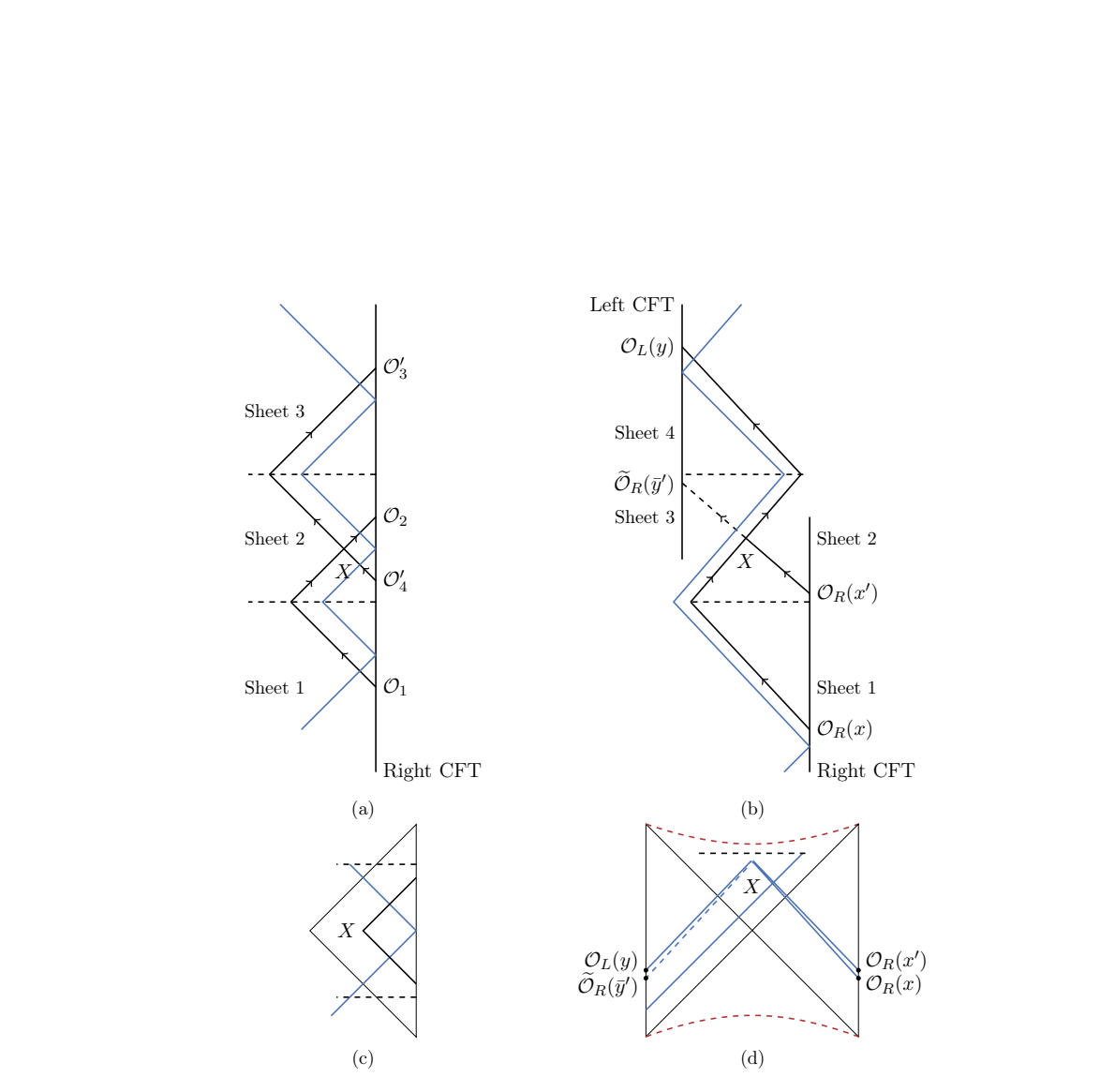
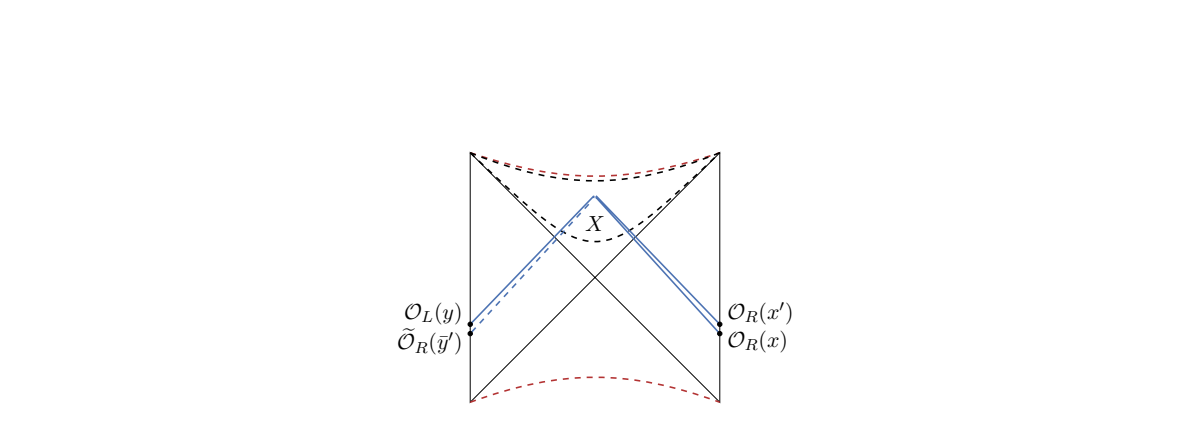
What carries the argument. The central machinery is the 'two-sided holographic camera' (1.1), which is a smeared four-point correlator with a particular operator ordering and one operator shifted by complex time. In the bulk, this corresponds to two folded null geodesics (Schwinger-Keldysh folds) shot from opposite boundaries that intersect at an interior bulk point. The high-frequency Fourier transforms convert the boundary operator pairs into localized wavepackets, and the nontrivial time ordering ensures that the connected contribution is a retarded graviton exchange (in the forward limit) factorizing into a flat-space scattering amplitude. The shift by half the thermal circle places a 'detector' operator in the future of the bulk point, enabling the measurement.
Core claim. The central discovery is that a specific four-point function, equation (1.1), provides a 'two-sided camera' capable of imaging the interior of an eternal black hole. The key innovation is using one operator that is the right-boundary representation of a left operator shifted by half the thermal circle (β/2). This operator, placed between the two right-boundary insertions, acts as a detector that can receive signals from the interior. In the high-frequency WKB approximation, the four operator pairs source four null geodesics that meet at an interior bulk point. The correlator then factorizes into a flat-space scattering amplitude for the collision of the two geodesic wavepackets, with a characteristic cusp in the angular dependence ($e^{{-|φ|}}$). The authors verify this in planar BTZ by analytically continuing an exterior Rindler camera along a complex path, showing that the bulk point moves into the future interior while the cross-ratios remain on the sheet of the bulk-point singularity. They also demonstrate the sensitivity of the observable to heavy worldlines, null shocks, and timelike shells: each object leaves a distinct imprint on the signal, such as a jump in the shooting time at which the wavepackets meet or a phase shift.
The premise it rests on. The calculation assumes that the Regge approximation remains valid along the entire complex analytic continuation path from the exterior to the interior, a claim that has been explicitly verified only for the leading graviton exchange and contact interactions, and that no other competing saddle points dominate.
If the paper is right (Pith's inferences, not the authors')
If correct, the observable provides a concrete boundary dual for local experiments inside a black hole interior, including the detection of impurities behind the horizon.
It implies that null shocks and matter shells behind the horizon can be detected and characterized by boundary correlators, via time-delay and phase-shift effects, with the mass of a shell extractable from the offset formula (4.35).
The construction suggests that the black hole interior can be 'imaged' with a finite resolution set by the Regge trajectory curvature, linking the sharpness of the image to the locality of the bulk theory.
The factorization into flat-space amplitudes indicates a local flat-space limit emerges behind the horizon, testable by measuring the angular cusp of the signal and its dependence on the center-of-mass energy.
The requirement of state-dependent operator shifts (β/2) suggests that any interior probe must be adjusted to the specific black hole state; a universal probe that works for all microstates may be impossible, aligning with state-dependence arguments for black hole interior reconstruction.
The complex-time insertion means that the observable is not an expectation value of real-time operators; this inherent limitation may reflect a fundamental obstruction to directly measuring behind the horizon without analytic continuation, analogous to the difficulty of accessing interior via real-time HKLL.
The semiclassical analysis receives finite-N corrections suppressed by e^{-S} (black hole entropy) from subleading saddles; if these corrections are large for a given microstate, the signal could wash out, potentially offering a test of the fuzzball or firewall proposal.
The method could be extended to probe quantum properties of the horizon, such as the replica wormhole contributions or the emergence of the Page curve, by comparing the predicted signal from the camera with exact CFT results at finite N.
Check this review
Pith stored no record of this review's passes and took no fingerprint of it. Reviews made by code from 13 Nov 2026 on carry both.
How often reviews like this one are right
Reviews like this one: written by deepseek-v4-flash, where what was read was not recorded.
How often objections from reviews like this one are right: not yet measured
Reviews by people
This review was written by a machine. No person has reviewed this paper on Pith yet. A scientist listed on Pith can review it for a fee, and their review is published here whatever it concludes.
The paper
Abstract
We propose a boundary four-point function smeared with wavepackets, which probes local physics behind the horizon of a two-sided AdS black hole. At high frequencies, boundary wavepackets aimed at an interior bulk point travel along geodesics and scatter locally about the bulk point, factorizing the correlator into a flat-space like scattering amplitude. To obtain this configuration, we utilize a non-trivial time ordering of operators, and also use one state-dependent operator insertion moved halfway across the thermal circle. An interesting property of this observable is that it also probes features of nontrivial states: null shocks and matter shells behind the horizon show up as jumps in the observed signal as the bulk point crosses them, thereby imaging the black hole interior.
The paper's own sentences, arranged, kept beside the review and separate from it. Each label is drawn from a closed vocabulary; the number beside it is the probability the classifier gave that label. No sentence in this record was written by a model.
abstract compiled · 2026-11-13
The authors' main claim, as the classifier picked it out 0.88
“An interesting property of this observable is that it also probes features of nontrivial states: null shocks and matter shells behind the horizon show up as jumps in the observed signal as the bulk point crosses them, thereby imaging the black hole interior.”
How the main claim is stated: asserted 1.00
What the abstract itself states, as probabilities: claims first 0.04 · states limitation 0.11 · human participants 0.01 · controlled comparison 0.02 · randomized assignment 0.01 · states quantitative result 0.03 · compares with prior results 0.08 · mentions code or data availability 0.02
The abstract, sentence by sentence
This table labels the abstract only (arXiv listing abstract v1). The number is the probability the classifier gave the label.
| Sentence | Role | The authors' own work | States the main conclusion | Strength |
|---|---|---|---|---|
| We propose a boundary four-point function smeared with wavepackets, which probes local physics behind the horizon of a two-sided AdS black hole. | contribution 0.99 | 0.83 | 0.28 | asserted 0.73 |
| At high frequencies, boundary wavepackets aimed at an interior bulk point travel along geodesics and scatter locally about the bulk point, factorizing the correlator into a flat-space like scattering amplitude. | result 0.79 | 0.63 | 0.18 | asserted 0.99 |
| To obtain this configuration, we utilize a non-trivial time ordering of operators, and also use one state-dependent operator insertion moved halfway across the thermal circle. | method 0.99 | 0.80 | 0.06 | asserted 1.00 |
| An interesting property of this observable is that it also probes features of nontrivial states: null shocks and matter shells behind the horizon show up as jumps in the observed signal as the bulk point crosses them, thereby imaging the black hole interior. | result 0.56 | 0.71 | 0.52 | asserted 1.00 |
What kind of paper the classifier reports this is: method or tool 0.85 · evidence from proof or derivation 0.57
What was examined, and what was not
Sources read
- arXiv listing abstract v1
Not examined
- full text
- figures and tables
- references and citing sentences
- relations to other papers
Levels run
- P abstract
Not run
- S sections
- T body sentences
- C citations
- R cross-paper relations
How the labels were made
Compiled by classifier-1.13.0 via TypeSafe API, question bank abstract-p1-20260923, 2026-11-13: 1 request, 3,683 input tokens.
Every quoted sentence on this record is the authors'. Every label is from Pith's closed vocabulary, with the probability shown beside it. This record as JSON
Figures (8)




Figures are the authors', reproduced from the paper.
Challenges and discussion
Disagree with the review, or know something it missed? Leave a comment, or challenge this review formally: a challenge becomes a permanent entry in this paper's record, and its decision is published here.
Come back by email
A short list of the week's newly reviewed papers. Nothing is sent until you confirm from your inbox, and every email has a link that stops it. No account.
No comments yet.
Sign in to comment