Quantum Physics · arXiv:2611.19181 v1 · submitted 14 Nov 2026 · 39 references
Scalable and Interpretable Quantum Mixture of Experts for High-Dimensional Spatio-Temporal Data
The paper says
“Quantum Mixture of Experts (QMoE) architectures offer a promising path toward scalable quantum machine learning, yet existing approaches remain largely confined to low-dimensional benchmarks and often rely on naive input partitioning that disrupts feature dependencies.”
more of the abstract
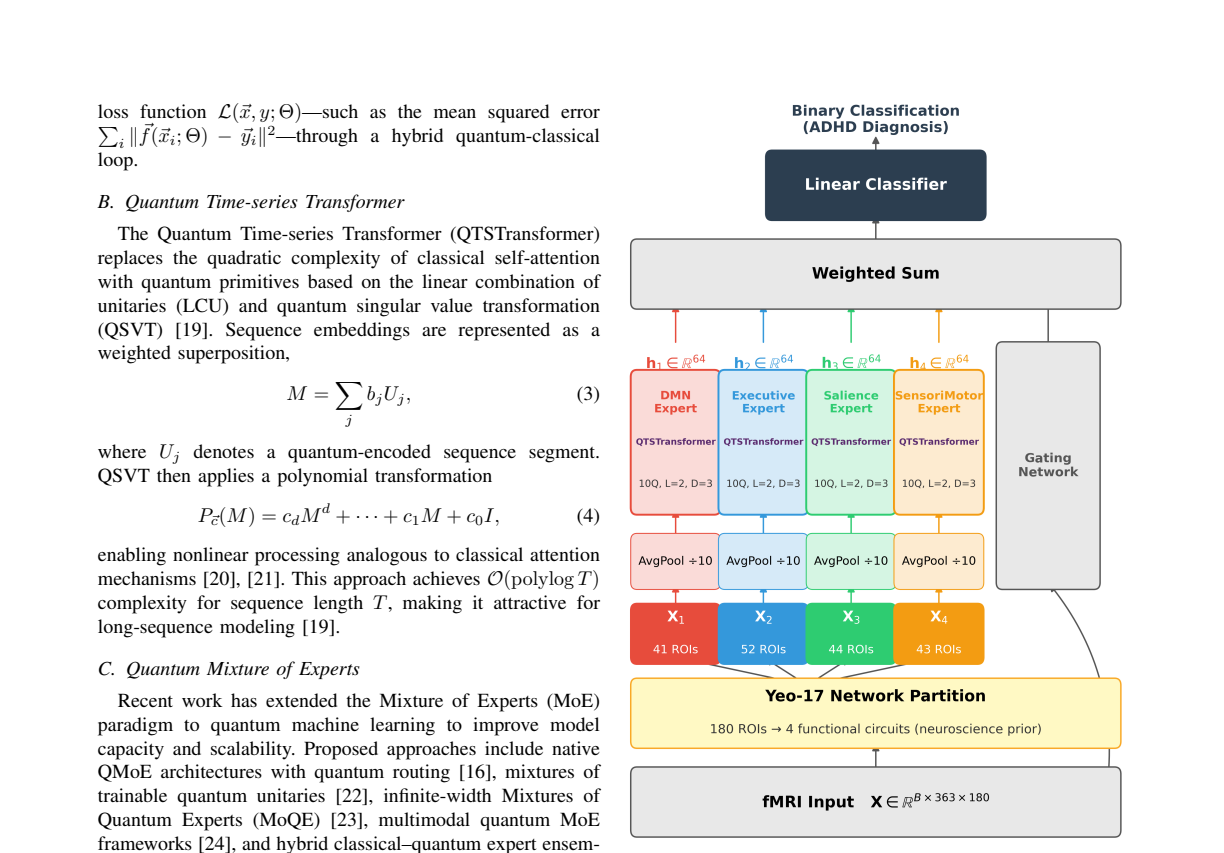
We address these gaps by introducing Feature-Partitioned QMoE, which partitions high-dimensional spatio-temporal inputs into functionally coherent feature groups and assigns each group to a dedicated quantum expert. We further propose a hierarchical interpretability framework that leverages the modular structure of QMoE to produce circuit-level gating analysis, per-expert gradient saliency, and heterogeneity-based subtype discovery. Applied to ADHD classification from resting-state fMRI (N=4,458, ABCD Study, 180 brain ROIs, 363 timepoints), the proposed Theory-Driven QMoE achieves performance comparable to matched-capacity classical and quantum baselines while enabling circuit-attributable interpretation. The framework identifies FDR-corrected ADHD-associated biomarkers in executive-control and anterior default-mode networks and reveals three neurobiologically meaningful ADHD subtypes. These results position Feature-Partitioned QMoE as a scalable and interpretable methodology for applying quantum machine learning to high-dimensional biomedical data.
from the abstract
Pith says
Machine review · deepseek-v4-flash · 17 Nov 2026 · read the full text (52,236 characters) · not checked by a person
It can be wrong. Challenge this review or reply to it.
Holds up, with conditions. A quantum mixture-of-experts architecture that uses neuroscience-informed feature partitioning to enable interpretable ADHD classification from fMRI, though predictive performance is modest and comparable to classical baselines. This line is wrong
8 minor
How often objections from reviews like this one are right: not yet measured
The paper, first character to last
The reviewer was given the whole text, 52,236 characters. Not checked: figures, code, what the 39 references say.
8 minor objections
The paper says, at Section 3.1 (Feature Partitioning)
Pith says: minor objection 1 of 8
The notation X ∈ R^{T×C} is introduced, but later the input is described as having 180 ROIs and 363 timepoints. It would be helpful to explicitly state that C=180 and T=363 in the notation.
The paper says, at Section 4.3 (Quantum Expert Implementation)
Pith says: minor objection 2 of 8
The description of temporal integration using 'a classically simulated linear combination of unitaries' followed by a degree-3 polynomial transformation is vague. Since the experiments are classical simulations, it would be helpful to clarify whether the LCU and QSVT operations are actually implemented as quantum circuits or approximated classically.
show 6 more
The paper says, at Section 4.5 (Baseline Models)
Pith says: minor objection 3 of 8
The parameter counts for the baselines vary widely (16,936 to 516,485). The paper compares the proposed model (34,885 params) to a 'Compact Classical MoE' (31,917 params) and the 'Quantum Arbitrary-Split MoE' (34,885 params). However, the Classical Single Expert (134,849 params) and Classical MoE (516,485 params) have many more parameters. The paper should discuss whether the parameter-matched comparison is fair, given that the classical models might benefit from larger capacity.
The paper says, at Section 5.2.1 (Cluster-Level Gating Analysis)
Pith says: minor objection 4 of 8
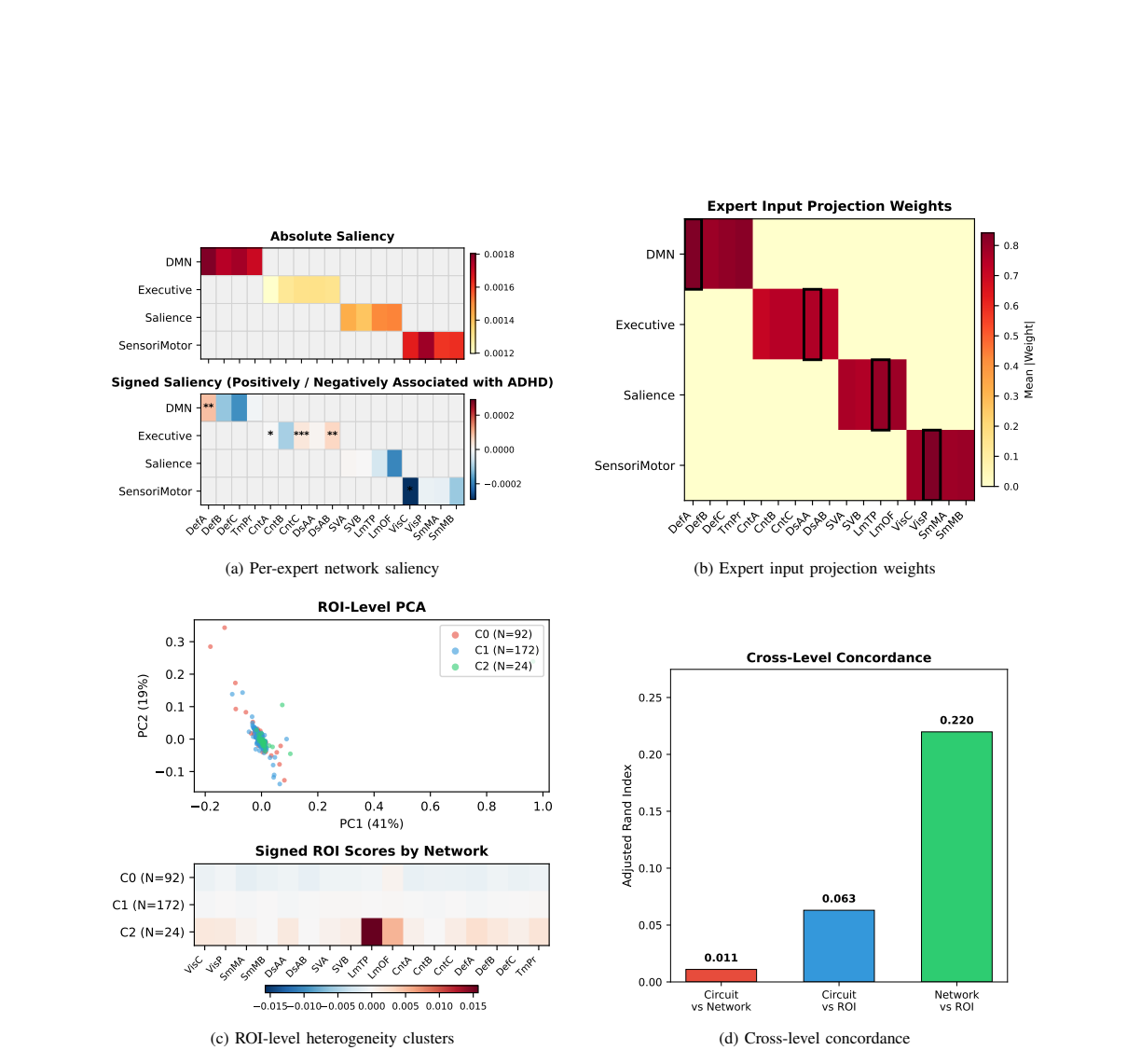
The gate weights are nearly uniform (~0.250 ± 0.003) with no significant differences between classes. This suggests that the gating network is not learning class-dependent routing, which undermines the motivation for using a mixture-of-experts architecture. The paper attributes this to load-balancing regularization, but it may also indicate that the experts are not specializing. The authors should discuss whether the uniform gating is a desired outcome or a limitation.
The paper says, at Section 5.2.2 (Per-Expert Gradient Saliency)
Pith says: minor objection 5 of 8
The paper reports FDR-corrected significant associations for network-level features but notes that 'these Salience associations are nominal and do not survive FDR correction.' It would be helpful to report the number of tests performed and the FDR threshold used.
The paper says, at Figure 4 caption
Pith says: minor objection 6 of 8
The caption mentions 'Welch's t-test markers (*p<0.05, **p<0.01, ***p<0.001; nominal/uncorrected)' but the text reports FDR-corrected results. The figure should clearly distinguish between nominal and corrected significance levels.
The paper says, at Section 2.2 (Quantum Time-series Transformer)
Pith says: minor objection 7 of 8
The description of QTSTransformer is brief and references prior work. Since the quantum expert in this paper is a QTSTransformer, a more detailed explanation of how the LCU and QSVT are applied to time-series data would improve self-containedness.
The paper says, at Section 4.3 (Quantum Expert Implementation)
Pith says: minor objection 8 of 8
The paper states that the VQC uses n_q=10 qubits and L=2 ansatz layers. With 4 experts, the total number of qubits is 40. The paper should discuss whether this architecture is feasible on near-term quantum hardware, given connectivity constraints and noise.
What would settle it
A direct falsifier would be to train the same Theory-Driven QMoE on a dataset where the Yeo 17-network atlas is known to be irrelevant (e.g., a non-neuroimaging task with arbitrary feature groupings) and show that the theory-driven partition no longer preserves more functional connections than arbitrary splits, or that the interpretability framework yields misleading or non-replicable biomarkers. Alternatively, if a classical MoE with the same partitioning and parameter count consistently outperforms the quantum model (beyond the reported AUC 0.5873 vs. 0.5631) on a held-out test set, the claim of comparable performance would be weakened.
from Pith's summary of the paper
How the review went
5 passes by deepseek-v4-flash · 17 Nov 2026
- Reader holds up, with conditions
- Skeptic concern withdrawn: Pith's reviewer misread the paper
- Referee 8 minor
- Check against the paper kept 0 of 6 objections
- Editor wrote the verdict above
Not run on this paper: the simulated authors' defence.
Pith's passes raised 6 objections. A check against the paper's text kept 0 and withdrew 6 (6 Pith's reviewer misread the paper).
The review in full
The review in brief, machine-written
This paper introduces Feature-Partitioned QMoE, a quantum mixture-of-experts architecture that assigns each quantum expert to a functionally coherent feature group rather than splitting features arbitrarily. The idea is motivated and the experimental setup is thorough: the authors use a large resting-state fMRI dataset (N=4,458) and partition 180 brain ROIs into four neuroscience-validated circuits based on the Yeo 17-network atlas. The main technical contribution is the theory-driven partitioning strategy, which preserves more functional connections within experts (62.4% vs. 43.9%) than arbitrary splitting while maintaining comparable predictive performance. The hierarchical interpretability framework—gating analysis, per-expert gradient saliency, and heterogeneity-based subtype discovery—is a sensible way to exploit the modular structure for scientific insight.
The soft spots are real and the paper acknowledges most of them. The classification performance is modest: test AUC around 0.56, not significantly better than classical baselines. The authors frame this as "comparable performance," which is accurate but means the quantum model does not yet offer a practical advantage. The interpretability findings, while plausible, are not validated against ground-truth biomarkers or independent datasets; the authors note that the Salience associations are nominal and do not survive FDR correction. The gate weights are nearly uniform, so the routing mechanism contributes little to the analysis. The paper would benefit from releasing code and data, and from validating the subtype discovery on an independent cohort.
This paper is for researchers interested in structured quantum machine learning architectures and interpretability methods for biomedical data. It deserves a serious referee: the architecture is novel, the motivation is clear, and the limitations are stated. A careful review should focus on the statistical rigor of the interpretability claims and whether the performance gap to classical methods can be closed with better quantum-specific designs.
Recommendation: send to peer review.
The stress test's concern
Withdrawn: Pith's reviewer misread the paper.
The paper says
“Both achieve comparable test AUC ($0.5631 \pm 0.0177$ vs.\ $0.5576 \pm 0.0151$; paired $t$-test across seeds, $p=0.61$), indicating that the neuroscience-informed partition incurs no accuracy penalty while enabling circuit-level interpretation.”
The referee's report
Not published. Pith's referee wrote this assessment before its objections were checked against the paper, and 5 of its 5 major objections did not survive that check.
Pith's reading of the paper (a machine's summary, not the authors')
The paper introduces Feature-Partitioned QMoE, a quantum mixture-of-experts architecture that splits high-dimensional spatio-temporal inputs into functionally coherent feature groups, each processed by a dedicated quantum circuit. Applied to ADHD classification from resting-state fMRI (N=4,458, 180 brain regions, 363 timepoints), the model achieves test AUC comparable to matched-capacity classical and quantum baselines. The key advantage claimed is interpretability: because each expert sees only one functional circuit (e.g., Default Mode, Executive Control), the model yields per-expert gradient saliency maps and reveals three ADHD subtypes. The authors argue that theory-driven partitioning preserves more functional connections within experts (62.4% vs. 43.9% for arbitrary splits) without sacrificing accuracy, positioning the framework as a scalable and interpretable approach for high-dimensional biomedical data.
What carries the argument. The central object is the Feature-Partitioned Quantum Mixture of Experts (QMoE), which partitions input features into K disjoint subsets (here K=4, based on the Yeo 17-network atlas) and assigns each subset to a dedicated variational quantum circuit (VQC) expert. Each expert is a QTSTransformer (a quantum time-series model using linear combination of unitaries and quantum singular value transformation) with n_q=10 qubits and L=2 ansatz layers. A learned gating network computes soft routing weights from the temporal mean of the input, and the final prediction is a weighted combination of expert outputs. The interpretability framework operates at three nested levels: cluster-level gating analysis (which circuits are differentially engaged), per-expert gradient saliency (what each expert learned within its feature subset), and heterogeneity analysis via multi-level clustering (subtype discovery from routing profiles, expert representations, or feature saliency).
Core claim. The paper claims that a quantum mixture-of-experts model with theory-driven feature partitioning—assigning each quantum expert to a neuroscience-defined functional circuit (DMN, Executive, Salience, SensoriMotor) based on the Yeo 17-network atlas—achieves performance comparable to matched-capacity classical and quantum baselines on ADHD classification from resting-state fMRI, while enabling circuit-attributable interpretation. The framework identifies FDR-corrected ADHD-associated biomarkers in executive-control and anterior default-mode networks and reveals three neurobiologically meaningful ADHD subtypes. The central claim is that the theory-driven partition preserves substantially more functional connections within experts (62.4% vs. 43.9%) without incurring an accuracy penalty, and that the modular structure of QMoE enables a hierarchical interpretability framework (gating analysis, per-expert gradient saliency, heterogeneity-based subtype discovery) that is native to the architecture.
The premise it rests on. The paper assumes that the Yeo 17-network atlas provides a functionally coherent and task-relevant partitioning of brain regions for ADHD classification, i.e., that features within each cluster share dependencies relevant to the prediction task; if this partitioning does not align with the actual functional dependencies relevant to ADHD, the interpretability benefits may be misleading and performance could degrade.
If the paper is right (Pith's inferences, not the authors')
If the claim holds, quantum mixture-of-experts models can be applied to high-dimensional biomedical data (180 features, 363 timepoints) without sacrificing accuracy relative to classical baselines, while providing interpretability that is native to the architecture rather than post-hoc.
The theory-driven partitioning strategy could be extended to other structured domains with meaningful feature groupings, such as gene regulatory networks, multimodal sensor data, or climate time series.
The hierarchical interpretability framework (gating analysis, per-expert saliency, heterogeneity clustering) generalizes to any MoE architecture with disjoint feature subsets, providing a systematic approach for extracting scientific insights from quantum models.
The identification of three ADHD subtypes (attentional, reward-processing, memory/emotional) via the quantum model's representations suggests that quantum machine learning can contribute to neurobiological subtype discovery, if the results replicate.
The comparable performance of the quantum model (AUC 0.5631) to the classical compact MoE (AUC 0.5873) and the arbitrary-split quantum MoE (AUC 0.5576) suggests that the theory-driven partition does not degrade performance while enabling interpretability, which is the main claimed advantage.
The paper does not demonstrate a quantum advantage in predictive performance (AUC ~0.56 is modest for ADHD classification). The claimed advantage is entirely in interpretability: the architecture yields per-expert, circuit-attributable saliency maps that a monolithic model cannot provide without post-hoc grouping. A reader might ask whether the same interpretability could be achieved with a classi
The load-balancing regularization forces near-uniform gate weights (~0.25 each), which means the gating analysis (Level 1) provides no class-discriminative information. The interpretability thus rests entirely on per-expert saliency (Level 2) and heterogeneity clustering (Level 3). This is a design choice that the paper acknowledges but does not explore alternatives to.
The paper uses simulated quantum circuits (PennyLane on classical hardware). The results do not address whether the model would maintain performance under realistic NISQ noise, which is a prerequisite for any practical quantum advantage claim. The authors do not claim noise resilience, but a reader should note that the 'quantum' label refers to circuit structure, not actual quantum hardware execut
The ADHD classification AUC (~0.56) is only slightly above chance (0.5), and the paper does not report precision, recall, or F1 scores. The interpretability findings (biomarkers, subtypes) are derived from a model with modest discriminative power, which raises the question of whether the saliency patterns reflect genuine neurobiology or model artifacts. The authors note that the rare subtype is al
Check this review
What was read
The passes were given all 52,236 characters of the paper's LaTeX source.
Fingerprint of that text (SHA-256): b33f8911af34bda1f4726c913e525fc4dcd5a135c6ad28f35fbbb08358fd3978
Pith does not keep that text. Rebuilt from the paper's source or PDF by the same code, it has this fingerprint if it is the same text. From a copy of Pith's code:
PYTHONPATH=. python scripts/review_input_check.py 2611.19181
The passes, in the order they ran
- Reader deepseek-v4-flash · medium effort · $0.0023 · instructions of the Reader, fingerprint f9ead7300382…
- Skeptic deepseek-v4-flash · medium effort · $0.0018 · instructions of the Skeptic, fingerprint 8f88c0f61488…
- Referee deepseek-v4-flash · medium effort · $0.0085 · instructions of the Referee, fingerprint a852d99aea0d…
- Check against the paper deepseek-v4-flash · medium effort · $0.0025 · instructions of the Check against the paper, fingerprint 6c7a6883d551…
- Editor deepseek-v4-flash · medium effort · $0.0018 · instructions of the Editor, fingerprint e7211f6a3d27…
- Circularity check deepseek-v4-flash · medium effort · $0.0017 · instructions of the Circularity check, fingerprint e9946e39d67b…
- Summary for the page deepseek-v4-flash · medium effort · temperature 0.2 · $0.0022 · instructions of the Summary for the page, fingerprint e4f56bf568e7…
The passes cost $0.021 in model calls together.
Version stamped on this review: pith-pipeline@v1.4.1-daily-deepseek-or-medium+deepseek/deepseek-v4-flash+p.d60f54226f00
Each link opens a pass's instructions as plain text, the exact bytes its fingerprint was taken over. Every stored set of instructions.
curl -s https://pith.science/methodology/prompts/f9ead730038216984cfb56d7cb34332bdf691828296a1de4245f3d6667d4bf56 | sha256sum
prints the fingerprint of the reader's instructions. The same works for every pass.
The receipt
The review's fingerprint was taken on 17 Nov 2026. The review you are reading still matches it.
Fingerprint of the review (SHA-256): fda721cc6d2fba31e50b1614a80636ea833827f4ca83e454a588342b3a668227
curl -s 'https://pith.science/api/v1/verdicts/2611.19181?form=canonical' | sha256sum
prints the fingerprint of the review as it stands now. The rule, in four steps.
A matching fingerprint shows the review has not changed since that date. It does not show that the review is right.
How often reviews like this one are right
Reviews like this one: written by deepseek-v4-flash, from the paper's LaTeX source.
How often objections from reviews like this one are right: not yet measured
Reviews by people
This review was written by a machine. No person has reviewed this paper on Pith yet. A scientist listed on Pith can review it for a fee, and their review is published here whatever it concludes.
How Pith checks papers · The full audit of this paper · Review history (2 versions)
The paper
Abstract
Quantum Mixture of Experts (QMoE) architectures offer a promising path toward scalable quantum machine learning, yet existing approaches remain largely confined to low-dimensional benchmarks and often rely on naive input partitioning that disrupts feature dependencies. We address these gaps by introducing Feature-Partitioned QMoE, which partitions high-dimensional spatio-temporal inputs into functionally coherent feature groups and assigns each group to a dedicated quantum expert. We further propose a hierarchical interpretability framework that leverages the modular structure of QMoE to produce circuit-level gating analysis, per-expert gradient saliency, and heterogeneity-based subtype discovery. Applied to ADHD classification from resting-state fMRI (N=4,458, ABCD Study, 180 brain ROIs, 363 timepoints), the proposed Theory-Driven QMoE achieves performance comparable to matched-capacity classical and quantum baselines while enabling circuit-attributable interpretation. The framework identifies FDR-corrected ADHD-associated biomarkers in executive-control and anterior default-mode networks and reveals three neurobiologically meaningful ADHD subtypes. These results position Feature-Partitioned QMoE as a scalable and interpretable methodology for applying quantum machine learning to high-dimensional biomedical data.
The paper's own sentences, arranged, kept beside the review and separate from it. Each label is drawn from a closed vocabulary; the number beside it is the probability the classifier gave that label. No sentence in this record was written by a model.
abstract compiled · 2026-11-17
The authors' main claim, as the classifier picked it out 1.00
“These results position Feature-Partitioned QMoE as a scalable and interpretable methodology for applying quantum machine learning to high-dimensional biomedical data.”
How the main claim is stated: asserted 0.75
What the abstract itself states, as probabilities: claims first 0.08 · states limitation 0.14 · human participants 0.96 · controlled comparison 0.71 · randomized assignment 0.02 · states quantitative result 0.93 · compares with prior results 0.96 · mentions code or data availability 0.03
The abstract, sentence by sentence
This table labels the abstract only (arXiv listing abstract v1). The number is the probability the classifier gave the label.
| Sentence | Role | The authors' own work | States the main conclusion | Strength |
|---|---|---|---|---|
| Quantum Mixture of Experts (QMoE) architectures offer a promising path toward scalable quantum machine learning, yet existing approaches remain largely confined to low-dimensional benchmarks and often rely on naive input partitioning that disrupts feature dependencies. | gap 0.63 | 0.04 | 0.03 | asserted 0.65 |
| We address these gaps by introducing Feature-Partitioned QMoE, which partitions high-dimensional spatio-temporal inputs into functionally coherent feature groups and assigns each group to a dedicated quantum expert. | contribution 0.59 | 0.89 | 0.07 | asserted 0.99 |
| We further propose a hierarchical interpretability framework that leverages the modular structure of QMoE to produce circuit-level gating analysis, per-expert gradient saliency, and heterogeneity-based subtype discovery. | contribution 0.60 | 0.90 | 0.06 | asserted 0.99 |
| Applied to ADHD classification from resting-state fMRI (N=4,458, ABCD Study, 180 brain ROIs, 363 timepoints), the proposed Theory-Driven QMoE achieves performance comparable to matched-capacity classical and quantum baselines while enabling circuit-attributable interpretation. | result 0.93 | 0.95 | 0.16 | asserted 1.00 |
| The framework identifies FDR-corrected ADHD-associated biomarkers in executive-control and anterior default-mode networks and reveals three neurobiologically meaningful ADHD subtypes. | result 0.99 | 0.94 | 0.13 | asserted 1.00 |
| These results position Feature-Partitioned QMoE as a scalable and interpretable methodology for applying quantum machine learning to high-dimensional biomedical data. | interpretation 1.00 | 0.41 | 0.89 | asserted 0.75 |
What kind of paper the classifier reports this is: method or tool 1.00 · evidence from analysis of existing data 0.83
What was examined, and what was not
Sources read
- arXiv listing abstract v1
Not examined
- full text
- figures and tables
- references and citing sentences
- relations to other papers
Levels run
- P abstract
Not run
- S sections
- T body sentences
- C citations
- R cross-paper relations
How the labels were made
Compiled by classifier-1.13.0 via TypeSafe API, question bank abstract-p1-20260923, 2026-11-17: 1 request, 5,194 input tokens.
Every quoted sentence on this record is the authors'. Every label is from Pith's closed vocabulary, with the probability shown beside it. This record as JSON
Figures (2)
Figures are the authors', reproduced from the paper.
References (39)
- [1] J. Biamonte, P. Wittek, N. Pancotti, P. Rebentrost, N. Wiebe, and S. Lloyd, “Quantum machine learning,”Nature, vol. 549, no. 7671, pp. 195–202, 2017 on Pith
- [2] M. Cerezo, G. Verdon, H.-Y . Huang, L. Cincio, and P. J. Coles, “Challenges and opportunities in quantum machine learning,”Nature Computational Science, vol. 2, no. 9, pp. 567–576, 2022 on Pith
- [3] Y . Gujju, A. Matsuo, and R. Raymond, “Quantum machine learning on near-term quantum devices: Current state of supervised and unsuper- vised techniques for real-world applications,”Phys. Rev. Appl., vol. 21, p. 067001, Jun 2024 on Pith
- [4] D. Peral-Garc ´ıa, J. Cruz-Benito, and F. J. Garc ´ıa-Pe˜nalvo, “Systematic literature review: Quantum machine learning and its applications,” Computer Science Review, vol. 51, p. 100619, 2024 on Pith
- [5] J. Wen, Z. Wang, C. Chen, J. Xiao, H. Li, L. Qian, Z. Huang, H. Fan, S. Wei, and G. Long, “A full circuit-based quantum algorithm for excited-states in quantum chemistry,”Quantum, vol. 8, p. 1219, Jan. 2024 on Pith
- [6] S. McArdle, S. Endo, A. Aspuru-Guzik, S. C. Benjamin, and X. Yuan, “Quantum computational chemistry,”Rev. Mod. Phys., vol. 92, p. 015003, Mar 2020 on Pith
- [7] D. Herman, C. Googin, X. Liu, Y . Sun, A. Galda, I. Safro, M. Pistoia, and Y . Alexeev, “Quantum computing for finance,”Nature Reviews Physics, vol. 5, no. 8, pp. 450–465, 2023 on Pith
- [8] D. J. Egger, C. Gambella, J. Marecek, S. McFaddin, M. Mevissen, R. Raymond, A. Simonetto, S. Woerner, and E. Yndurain, “Quantum computing for finance: State-of-the-art and future prospects,”IEEE Transactions on Quantum Engineering, vol. 1, pp. 1–24, 2020 on Pith
- [9] S. Y .-C. Chen, T.-C. Wei, C. Zhang, H. Yu, and S. Yoo, “Quantum convolutional neural networks for high energy physics data analysis,” Phys. Rev. Res., vol. 4, p. 013231, Mar 2022 on Pith
- [10] A. Di Meglio, K. Jansen, I. Tavernelli, C. Alexandrou, S. Arunachalam, C. W. Bauer,et al., “Quantum computing for high-energy physics: State of the art and challenges,”PRX Quantum, vol. 5, no. 3, p. 037001, 2024 on Pith
- [11] S. Mensa, E. Sahin, F. Tacchino, P. Kl Barkoutsos, and I. Tavernelli, “Quantum machine learning framework for virtual screening in drug discovery: a prospective quantum advantage,”Machine Learning: Sci- ence and Technology, vol. 4, no. 1, p. 015023, 2023 on Pith
- [12] U. Ullah, A. G. O. Jurado, I. D. Gonzalez, and B. Garcia-Zapirain, “A fully connected quantum convolutional neural network for classifying ischemic cardiopathy,”IEEE Access, vol. 10, pp. 134592–134605, 2022 on Pith
- [13] I. Cong, S. Choi, and M. D. Lukin, “Quantum convolutional neural networks,”Nature Physics, vol. 15, no. 12, pp. 1273–1278, 2019 on Pith
- [14] J. J. Park, J. Cha, S. Y .-C. Chen, H.-H. Tseng, and S. Yoo, “Addressing the current challenges of quantum machine learning through multi-chip ensembles,” 2025 on Pith
- [15] J. J. Park, H.-H. Tseng, S. Yoo, S. Y .-C. Chen, and J. Cha, “It’s-A-Me, Quantum Mario: Scalable quantum reinforcement learning with multi- chip ensembles,” in2025 IEEE International Conference on Quantum Artificial Intelligence (QAI), pp. 366–372, 2025 on Pith
- [16] H.-Q. Nguyen, X.-B. Nguyen, S. Pandey, S. U. Khan, I. Safro, and K. Luu, “QMoE: A quantum mixture of experts framework for scalable quantum neural networks,” in2025 IEEE International Conference on Quantum Computing and Engineering (QCE), vol. 02, pp. 223–228, 2025 on Pith
- [17] R. A. Jacobs, M. I. Jordan, S. J. Nowlan, and G. E. Hinton, “Adaptive mixtures of local experts,”Neural Computation, vol. 3, pp. 79–87, 03 1991 on Pith
- [18] N. Shazeer, A. Mirhoseini, K. Maziarz, A. Davis, Q. Le, G. Hinton, and J. Dean, “Outrageously large neural networks: The sparsely-gated mixture-of-experts layer,” inInternational Conference on Learning Representations, 2017 on Pith
- [19] J. J. Park, J. Seo, S. Bae, S. Y .-C. Chen, H.-H. Tseng, J. Cha, and S. Yoo, “Resting-state fMRI analysis using quantum time-series transformer,” in2025 IEEE International Conference on Quantum Computing and Engineering (QCE), vol. 01, pp. 2352–2363, 2025 on Pith
- [20] A. M. Childs and N. Wiebe, “Hamiltonian simulation using linear com- binations of unitary operations,”Quantum Information & Computation, vol. 12, no. 11–12, p. 901–924, 2012 on Pith
show 19 more
- [21] A. Gily ´en, Y . Su, G. H. Low, and N. Wiebe, “Quantum singular value transformation and beyond: exponential improvements for quantum matrix arithmetics,” inProceedings of the 51st Annual ACM SIGACT Symposium on Theory of Computing, STOC 2019, (New York, NY , USA), p. 193–204,... on Pith
- [22] B. Coyle, S. Raj, N. Mathur, E. A. Cherrat, N. Jain, S. Kazdaghli, and I. Kerenidis, “Training-efficient density quantum machine learning,”npj Quantum Information, vol. 11, no. 1, p. 172, 2025 on Pith
- [23] P. A. X. Tognini, L. Banchi, and G. D. Palma, “Solving MNIST with a globally trained mixture of quantum experts,” 2025 on Pith
- [24] S. Dutta, N. Innan, S. B. Yahia, M. Shafique, and D. E. Bernal Neira, “MQFL-FHE: Multimodal quantum federated learning framework with fully homomorphic encryption,” in2025 International Joint Conference on Neural Networks (IJCNN), pp. 1–10, 2025 on Pith
- [25] R. Chaves, K. Kumar, B. Chagas, R. Linerud, B. Sorem, J. Mancilla, and B. Bell, “A mixture-of-experts framework for practical hybrid-quantum models in credit card fraud detection,” 2026 on Pith
- [26] W. Fedus, B. Zoph, and N. Shazeer, “Switch transformers: Scaling to trillion parameter models with simple and efficient sparsity,”Journal of Machine Learning Research, vol. 23, no. 120, pp. 1–39, 2022 on Pith
- [27] L. Hubert and P. Arabie, “Comparing partitions,”Journal of Classifica- tion, vol. 2, no. 1, p. 193–218, 1985 on Pith
- [28] D. Steinley, “Properties of the hubert-arable adjusted rand index,” Psychological Methods, vol. 9, no. 3, p. 386–396, 2004 on Pith
- [29] B. Casey, T. Cannonier, M. I. Conley, A. O. Cohen, D. M. Barch, M. M. Heitzeg,et al., “The Adolescent Brain Cognitive Development (ABCD) Study: Imaging acquisition across 21 sites,”Developmental Cognitive Neuroscience, vol. 32, pp. 43–54, 2018. The Adolescent Brain Cognitive D... on Pith
- [30] F. X. Castellanos and E. Proal, “Large-scale brain systems in ADHD: beyond the prefrontal–striatal model,”Trends in Cognitive Sciences, vol. 16, no. 1, pp. 17–26, 2012. Special Issue: Cognition in Neuropsy- chiatric Disorders on Pith
- [31] S. Cortese, C. Kelly, C. Chabernaud, E. Proal, A. D. Martino, M. P. Mil- ham, and F. X. Castellanos, “Toward systems neuroscience of ADHD: A meta-analysis of 55 fMRI studies,”American Journal of Psychiatry, vol. 169, no. 10, pp. 1038–1055, 2012 on Pith
- [32] J. T. Nigg, S. L. Karalunas, E. Feczko, and D. A. Fair, “Toward a revised nosology for attention-deficit/hyperactivity disorder heterogeneity,”Bi- ological Psychiatry: Cognitive Neuroscience and Neuroimaging, vol. 5, no. 8, pp. 726–737, 2020. Understanding the Nature and Treat... on Pith
- [33] S. Koirala, G. Grimsrud, M. A. Mooney, B. Larsen, E. Feczko, J. T. Elison, S. M. Nelson, J. T. Nigg, B. Tervo-Clemmens, and D. A. Fair, “Neurobiology of attention-deficit hyperactivity disorder: historical chal- lenges and emerging frontiers,”Nature Reviews Neuroscience, vol. ... on Pith
- [34] M. F. Glasser, T. S. Coalson, E. C. Robinson, C. D. Hacker, J. Harwell, E. Yacoub, K. Ugurbil, J. Andersson, C. F. Beckmann, M. Jenkinson, S. M. Smith, and D. C. Van Essen, “A multi-modal parcellation of human cerebral cortex,”Nature, vol. 536, no. 7615, pp. 171–178, 2016 on Pith
- [35] S. Bae, J. Kwon, S. Yoo, and J. Cha, “Spatiotemporal learning of brain dynamics from fMRI using frequency-specific multi-band attention for cognitive and psychiatric applications,” 2025 on Pith
- [36] M. M. Cordova, D. M. Antovich, P. Ryabinin, C. Neighbor, M. A. Mooney, N. F. Dieckmann, O. Miranda-Dominguez, B. J. Nagel, D. A. Fair, and J. T. Nigg, “Attention-deficit/hyperactivity disorder: Restricted phenotypes prevalence, comorbidity, and polygenic risk sensitivity in th... on Pith
- [37] A. Vaswani, N. Shazeer, N. Parmar, J. Uszkoreit, L. Jones, A. N. Gomez, L. u. Kaiser, and I. Polosukhin, “Attention is all you need,” inAdvances in Neural Information Processing Systems(I. Guyon, U. V . Luxburg, S. Bengio, H. Wallach, R. Fergus, S. Vishwanathan, and R. Garnett... on Pith
- [38] B. T. Thomas Yeo, F. M. Krienen, J. Sepulcre, M. R. Sabuncu, D. Lashkari, M. Hollinshead, J. L. Roffman, J. W. Smoller, L. Z ¨ollei, J. R. Polimeni, B. Fischl, H. Liu, and R. L. Buckner, “The organization of the human cerebral cortex estimated by intrinsic functional connectiv... on Pith
- [39] V . Bergholm, J. Izaac, M. Schuld, C. Gogolin, S. Ahmed, V . Ajith, et al., “Pennylane: Automatic differentiation of hybrid quantum-classical computations,” 2022 on Pith
Cited by 1 Pith paper
Reviewed papers on Pith that cite this one. The full citation record
- Augmenting Quantum Neural Networks with Contractive Layers quant-ph · Nov 2026
Challenges and discussion
Disagree with the review, or know something it missed? Leave a comment, or challenge this review formally: a challenge becomes a permanent entry in this paper's record, and its decision is published here.
Come back by email
A short list of the week's newly reviewed papers. Nothing is sent until you confirm from your inbox, and every email has a link that stops it. No account.
No comments yet.
Sign in to comment