Machine Learning · arXiv:2611.19800 v1 · submitted 15 Nov 2026 · 55 references
Multi-Branch Transformer
The paper says
“Transformer language models are commonly scaled by making their blocks wider or stacking them deeper. In this work, we explore a complementary path: branching, the parallel composition of full Transformer blocks.”
more of the abstract
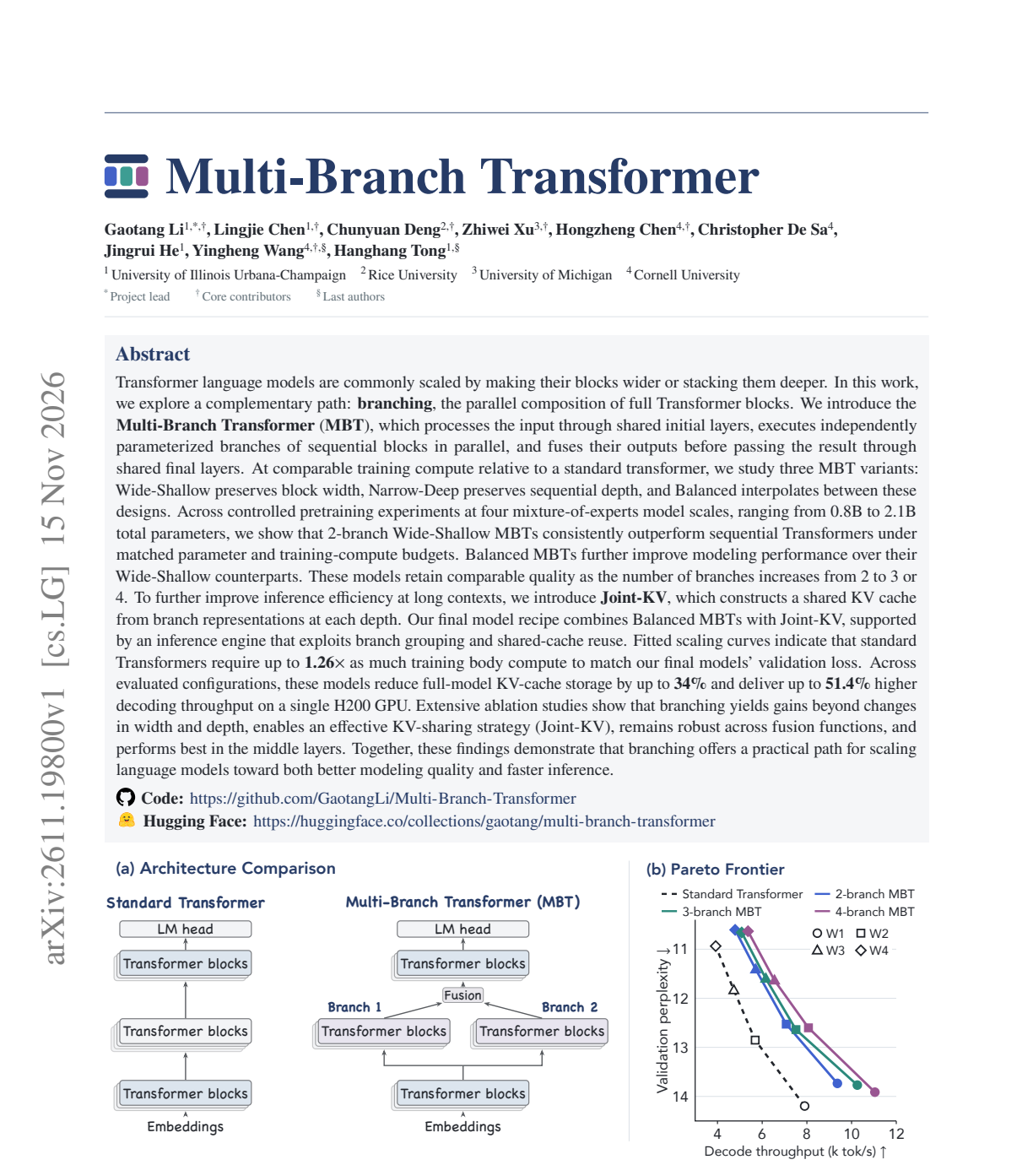
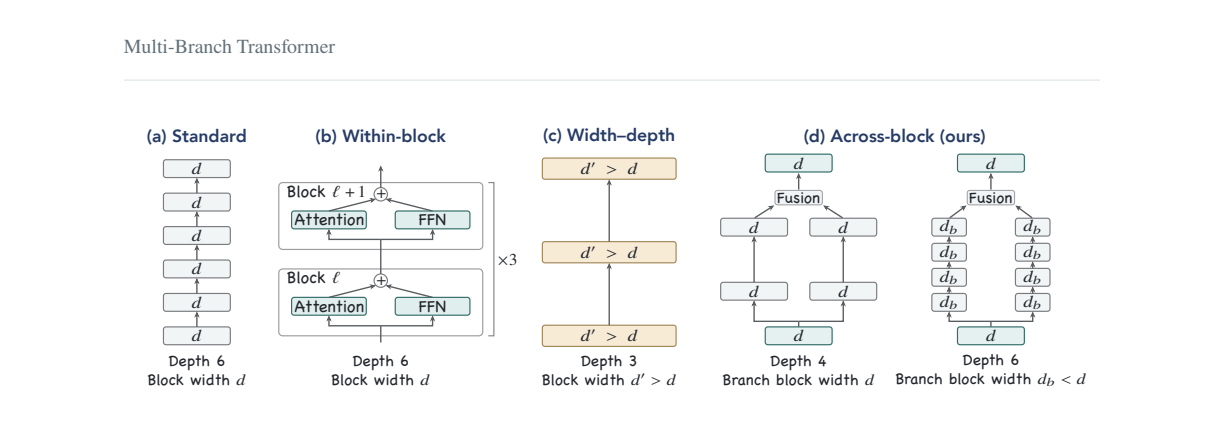
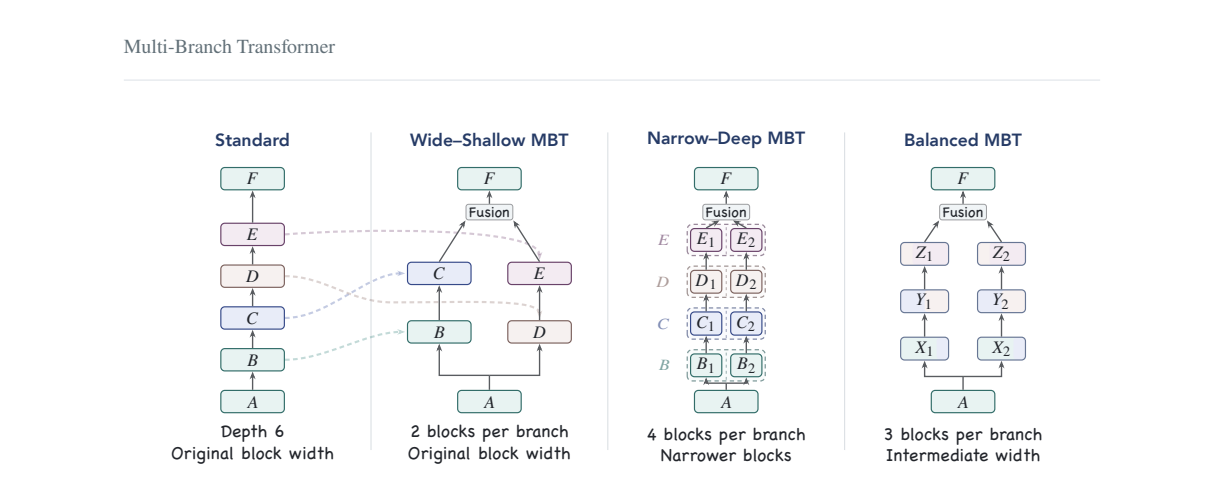
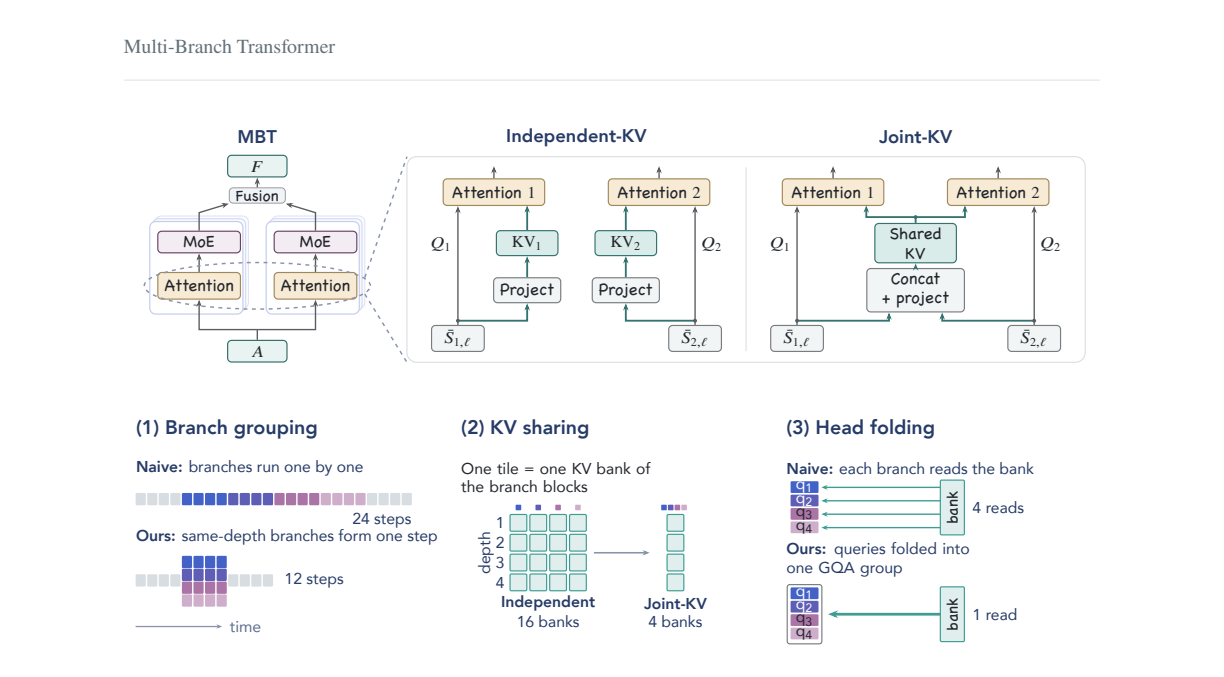
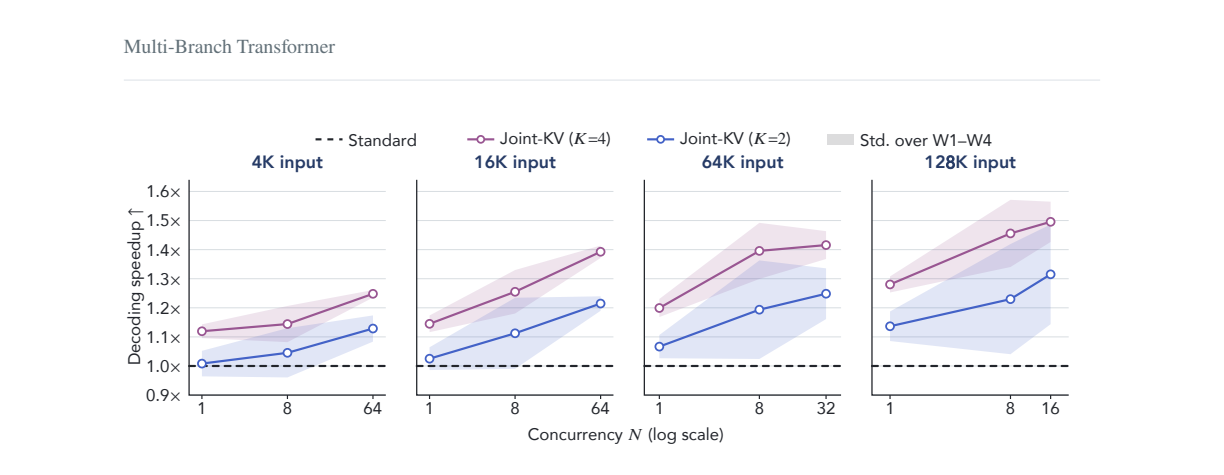
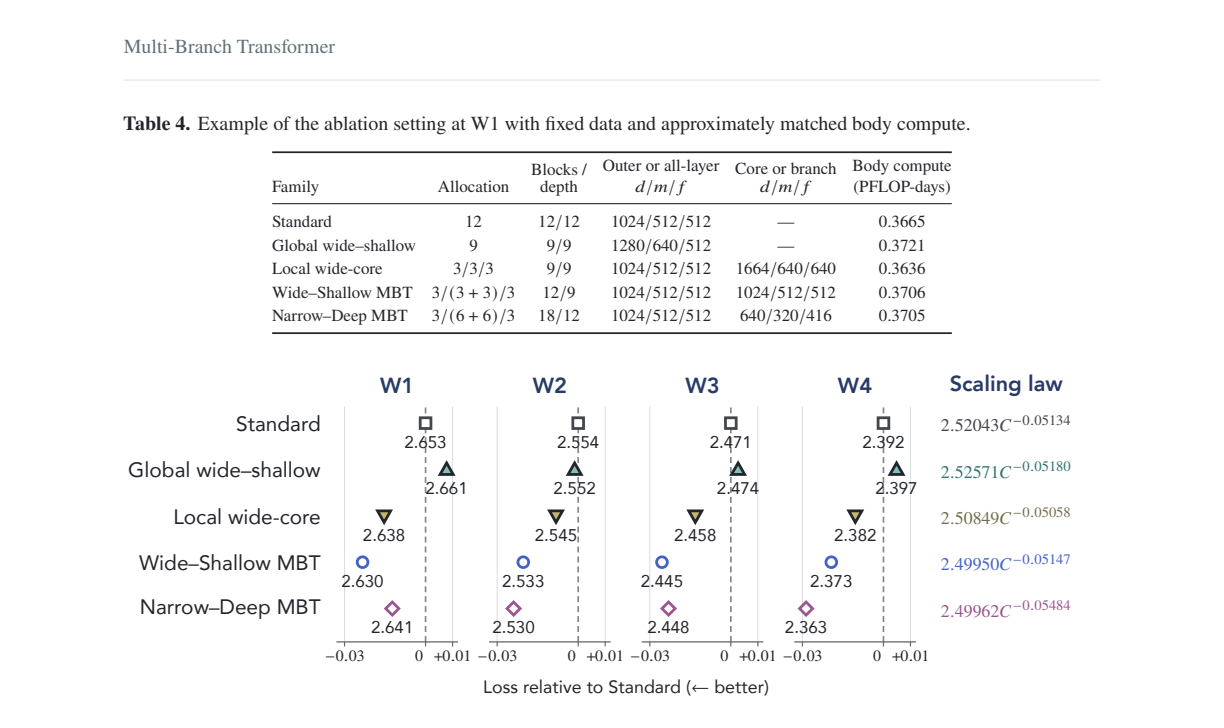
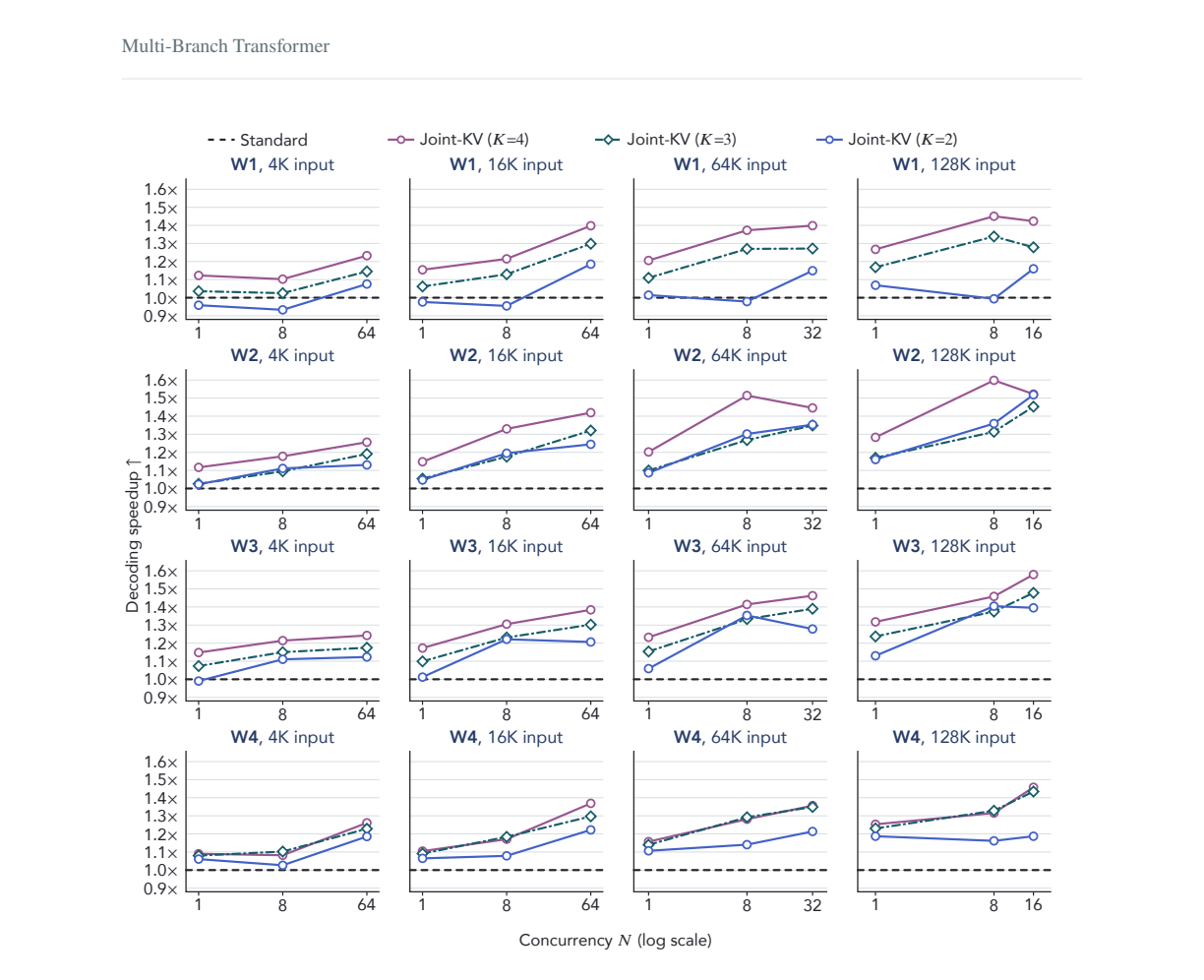
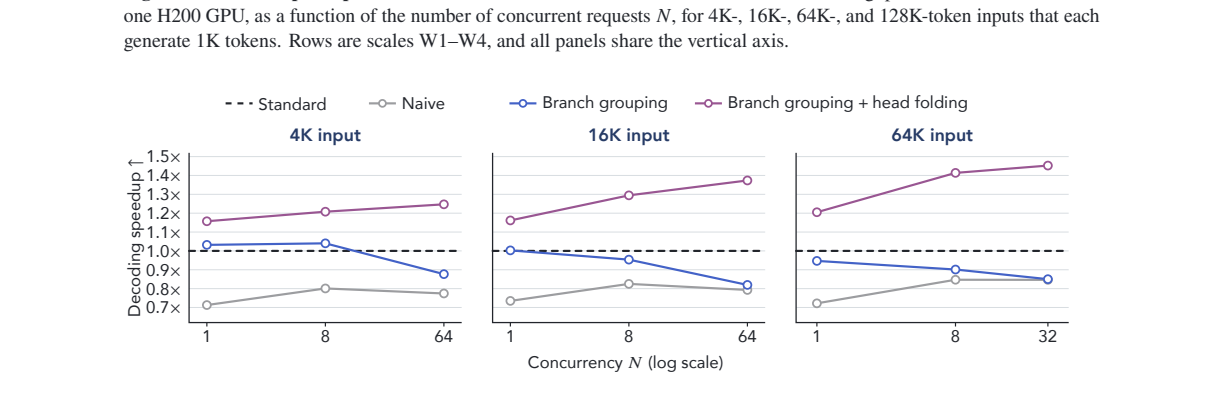
We introduce the Multi-Branch Transformer (MBT), which processes the input through shared initial layers, executes independently parameterized branches of sequential blocks in parallel, and fuses their outputs before shared final layers. At comparable training compute, we study three MBT variants: Wide-Shallow preserves block width, Narrow-Deep preserves sequential depth, and Balanced interpolates between them. In controlled pretraining experiments at four mixture-of-experts scales (0.8B to 2.1B total parameters), 2-branch Wide-Shallow MBTs consistently outperform sequential Transformers under matched parameter and training-compute budgets. Balanced MBTs improve further and retain comparable quality as the number of branches increases. To improve inference efficiency at long contexts, we introduce Joint-KV, which constructs a shared KV cache from branch representations at each depth. Our final recipe combines Balanced MBTs with Joint-KV, supported by an inference engine that exploits branch grouping and shared-cache reuse. Fitted scaling curves indicate that standard Transformers require up to 1.26x as much training body compute to match our final models' validation loss. These models reduce full-model KV-cache storage by up to 34% and deliver up to 51.4% higher decoding throughput on a single H200 GPU. Ablation studies show that branching yields gains beyond changes in width and depth, enables an effective KV-sharing strategy (Joint-KV), remains robust across fusion functions, and performs best in the middle layers. These findings show that branching offers a practical path for scaling language models toward both better modeling quality and faster inference.
from the abstract
Pith says
Machine review · deepseek-v4-flash · 17 Nov 2026 · read the full text (127,278 characters) · not checked by a person
It can be wrong. Challenge this review or reply to it.
Holds up, with conditions. A thorough empirical study of branch-parallel Transformers with consistent quality and inference gains at four scales up to 2.1B parameters, reviewed to a high-confidence conditional verdict with no confirmed defect. This line is wrong
14 minor · 2 open questions
How often objections from reviews like this one are right: not yet measured
The paper, first character to last
The reviewer was given the whole text, 127,278 characters. Not checked: figures, code, what the 55 references say.
14 minor objections
The paper says, at §2.1, Equation 3
Pith says: minor objection 1 of 14
The fusion equation uses RMSNorm N_i on each branch output before concatenation. The paper later tests a normalized sum without projection (Table 5). It would be helpful to clarify whether the RMSNorm gains are learned or fixed. From the ablation description, they are learned (unit gain initialization).
The paper says, at §3.1, Table 1
Pith says: minor objection 2 of 14
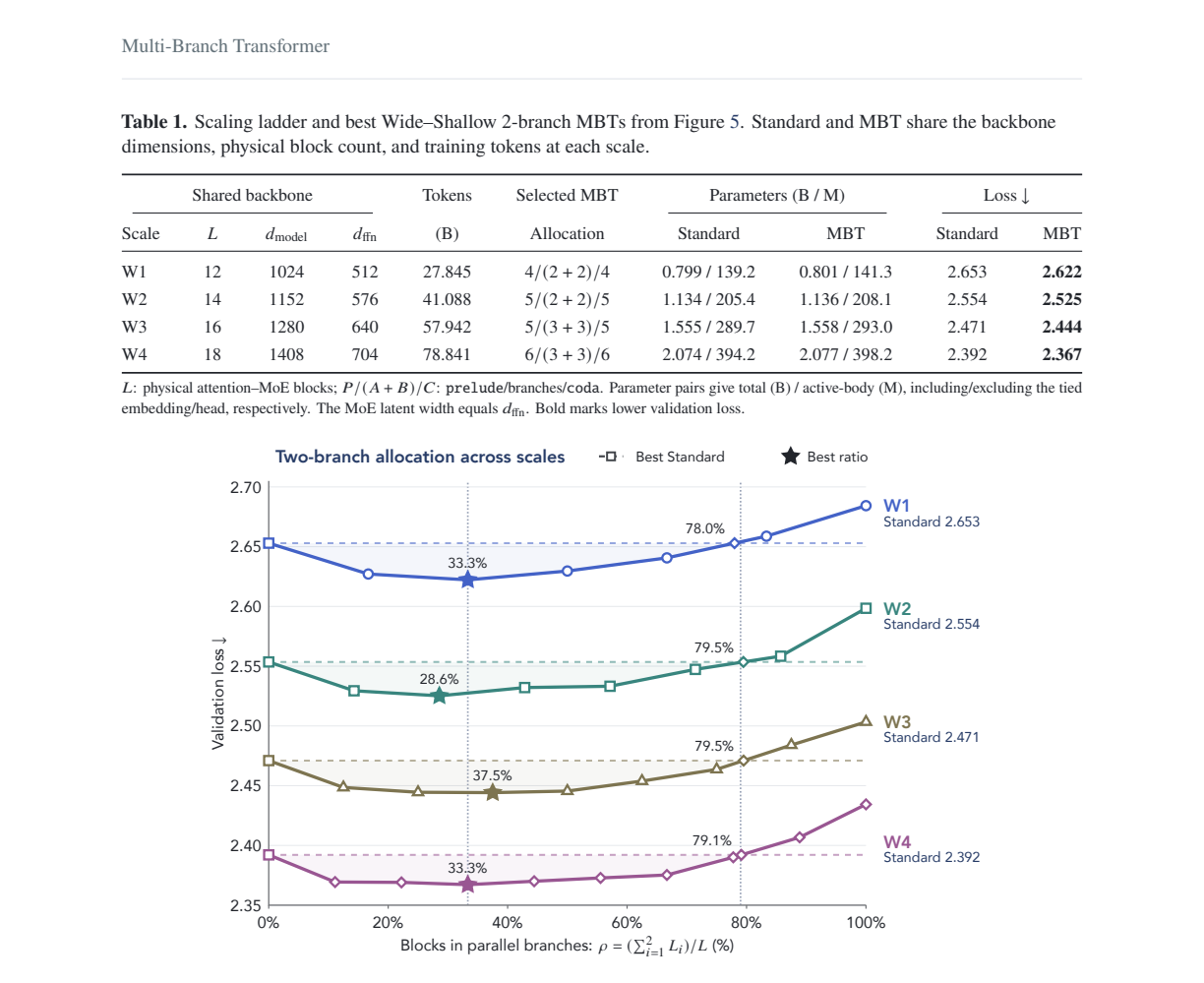
The table caption says 'Standard and MBT share the backbone dimensions, physical block count, and training tokens at each scale.' However, the MBT allocations (e.g., 4/(2+2)/4 for W1) have the same total block count (12) but different depth (9 vs 12). The phrase 'physical block count' is correct, but the depth differs. This is clear from the text but could be stated explicitly in the caption.
show 12 more
The paper says, at §3.3, Figure 6
Pith says: minor objection 3 of 14
Averaging speedups over scales may obscure scale-dependent effects. The paper provides per-scale results in Appendix Figure 12 and Table 8, which is good. The main text should reference these more prominently, perhaps noting that the speedup varies across scales.
The paper says, at §4.2, Table 6
Pith says: minor objection 4 of 14
The table shows that Joint-KV has slightly higher body compute (0.6% more) due to the larger KV projection. The paper argues this is too little to explain the gap. It would be cleaner to match compute exactly by slightly reducing model width or training tokens for Joint-KV, but the current comparison is reasonable. The paper should state the compute difference explicitly in the main text.
The paper says, at §5, Related Work
Pith says: minor objection 5 of 14
The related work section is well-structured. However, the comparison to ParScale (Chen et al., 2025) could be expanded: ParScale uses parallel passes through a shared backbone with learned prefixes, while MBT uses independent branches. The paper notes this briefly but could clarify the difference in parameter allocation.
The paper says, at Appendix A.2, Table 9
Pith says: minor objection 6 of 14
The compute accounting is clearly described. However, the paper uses 'body compute' (excluding embeddings) for scaling-law fits, while the abstract and main text refer to 'training body compute.' This is consistent but should be defined earlier in the main text for clarity.
The paper says, at §2.3, Equation 5
Pith says: minor objection 7 of 14
The 1/√K scaling factor is mentioned but not motivated. Is this to keep the variance of the projected values constant as K increases? A brief justification would be helpful.
The paper says, at §3.2, Table 3
Pith says: minor objection 8 of 14
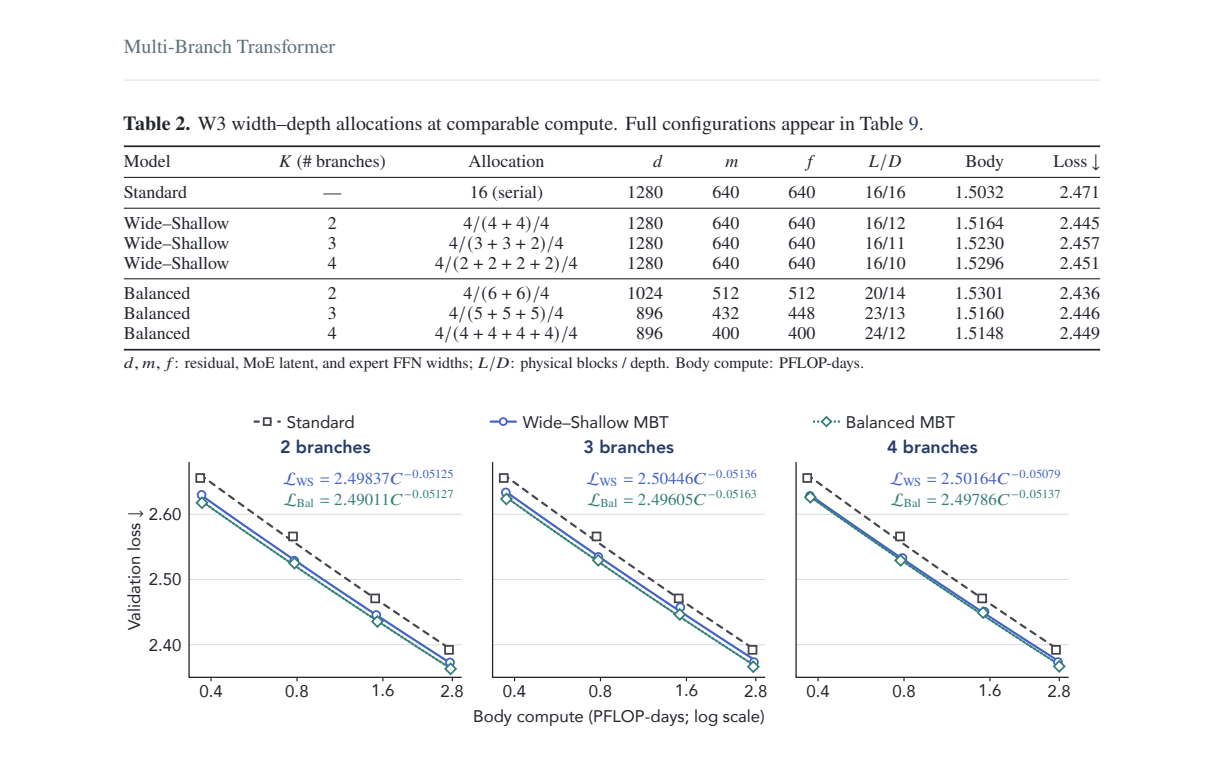
This is true for the configurations tested, but the Balanced MBTs have different (larger) physical block counts and depths. The comparison is at matched compute, not matched depth or parameter count. The paper should clarify that Balanced MBTs trade depth for width, and the improvement comes from this trade-off.
The paper says, at §4.3, Table 5
Pith says: minor objection 9 of 14
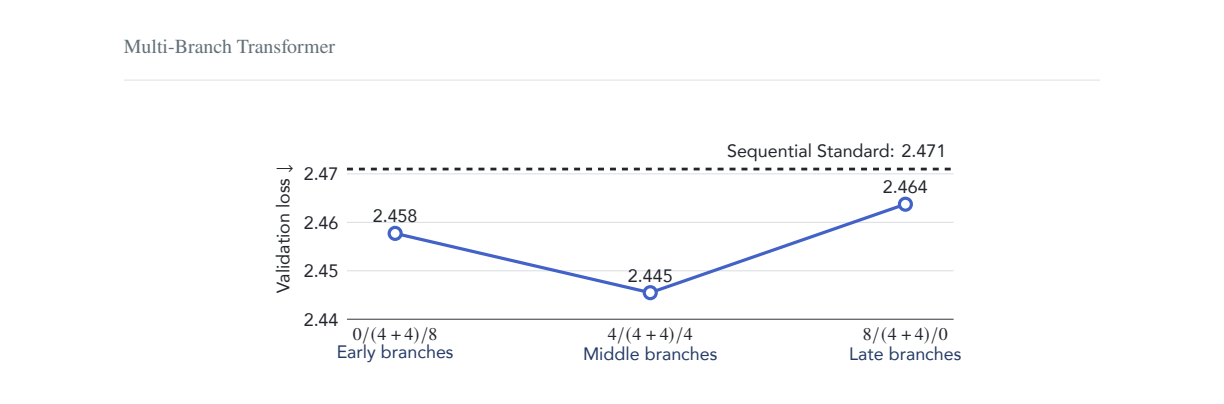
The fusion ablation is thorough. The normalized sum (no projection) gives loss 2.458 vs 2.445 for concat–projection, a gap of 0.013. The paper concludes that removing the projection hurts quality. This is correct, but the gap is small. The paper could note that the projection adds 3.3M parameters (at W3), so the trade-off may be worth considering for parameter-constrained settings.
The paper says, at §4.4, Figure 8
Pith says: minor objection 10 of 14
The placement ablation is informative. The paper could discuss why middle placement is best: perhaps the prelude provides a good shared representation, and the coda can integrate the fused branch outputs effectively. This is speculative but would add insight.
The paper says, at §6, Conclusion
Pith says: minor objection 11 of 14
The future work section is reasonable. The paper could also mention the need for scaling studies at larger model sizes (e.g., 7B+) to validate the trends.
The paper says, at Appendix C.3, Table 8
Pith says: minor objection 12 of 14
This is an important caveat that should be mentioned in the main text, not just in the appendix. The abstract and introduction claim up to 51.4% higher throughput, which is for 4-branch models at long contexts. The paper should be more explicit about when speedups are not achieved.
The paper says, at §1, Introduction
Pith says: minor objection 13 of 14
The reference to Attention Residuals is appropriate, but the paper should also compare to other recent scaling studies at similar parameter counts (e.g., Gemma 2, OLMo). This is a minor point.
The paper says, at §3.1, Figure 3
Pith says: minor objection 14 of 14
The U-shaped trend is clear and consistent. The paper could discuss why the optimum is at ~1/3 blocks in branches: perhaps too few branches limit parallelism, while too many reduce shared processing capacity. This is a minor suggestion.
Open questions (2)
Pith raised these and could not confirm them against the text of the paper it read. They are questions for the authors, not findings.
- §3.3, Figure 6, Table 4 Pith raised a concern here that it could not check against the text of the paper it was given, so it is not published as an objection.
- §4.1, Figure 7 Pith raised a concern here that it could not check against the text of the paper it was given, so it is not published as an objection.
What would settle it
Train a 2-branch Balanced MBT and a standard Transformer at a larger scale (e.g., 7B parameters) with matched training compute and data, and compare validation loss and downstream performance. If the MBT does not match or exceed the standard Transformer's quality, the claimed compute multiplier would not generalize.
from Pith's summary of the paper
How the review went
5 passes by deepseek-v4-flash · 17 Nov 2026
- Reader holds up, with conditions
- Skeptic concern withdrawn: Pith's reviewer misread the paper
- Referee 14 minor
- Check against the paper kept 0 of 5 objections
- Editor wrote the verdict above
Not run on this paper: the simulated authors' defence.
Pith's passes raised 5 objections. A check against the paper's text kept 0, withdrew 3 (3 Pith's reviewer misread the paper) and left 2 as questions.
The review in full
The review in brief, machine-written
The Multi-Branch Transformer is a clean, well-executed empirical study of an architecture direction that is genuinely less explored than width and depth: running full Transformer blocks in parallel branches between shared prelude and coda stacks. The central finding, that a 2-branch Wide-Shallow MBT beats a sequential Transformer at matched compute and parameters and that Balanced allocations do better still, is backed by controlled pretraining at four MoE scales from 0.8B to 2.1B parameters. The ablation work is what makes the paper credible. The width/depth controls (global wide-shallow, local wide-core, narrow-deep) directly test the usual alternative explanations for the gains, and the cache-matched Joint-KV versus Independent-KV comparison isolates the KV-sharing effect cleanly. The inference engineering is unusually careful: bitwise correctness checks against sequential execution, drift-controlled throughput measurement, and an honest reporting of the settings where speedups do not appear. Code and weights are linked. This is an industrious paper and it earns its claims.
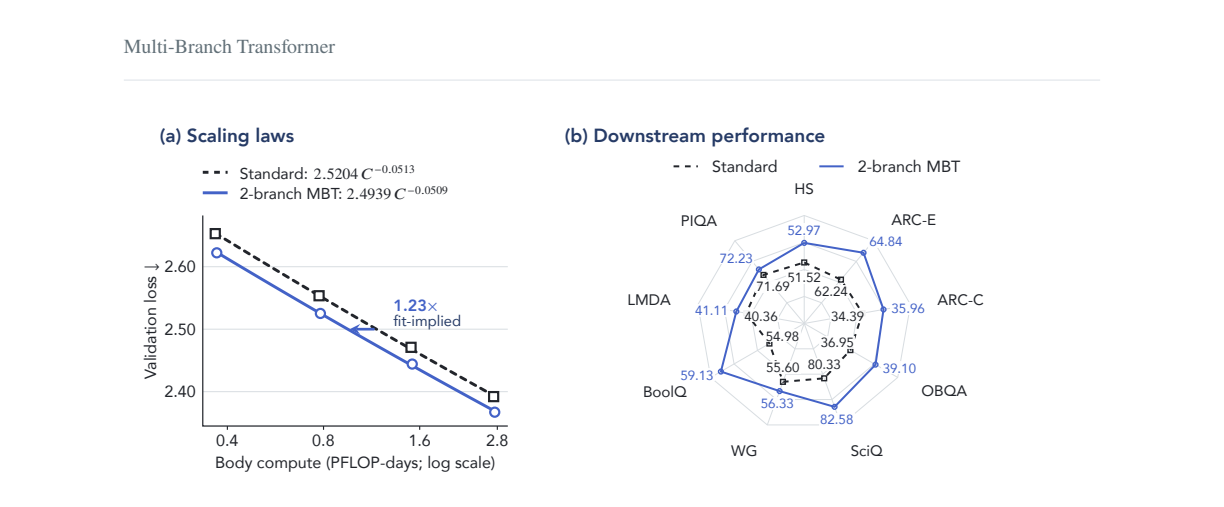
The soft spots are the ones the paper gestures at. The compute-multiplier claims (1.16–1.26×) come from power-law fits with four points per family and no uncertainty quantification; the fits are descriptive and the multipliers inherit their fragility. The speedups are measured on a single H200, and the paper reports that two-branch MBTs are slower than Standard in seven settings — the gain is real but not universal. Downstream gains are 1–2% absolute on nine zero-shot tasks, which is a modest hook for an architecture paper. ParScale and other parallel-architecture work is cited but never empirically compared, so the novelty claim rests on the related-work survey rather than a head-to-head. None of these is disqualifying; they bound the strength of the conclusions, not their existence.
The paper is for anyone working on LLM architecture or inference efficiency. It deserves a serious referee. The conditional verdict is right: the empirical core is solid and reproducible in design, and referee effort should go to three questions — how the scaling multipliers survive a wider ladder, whether the inference gains hold in distributed settings, and how MBT fares against a directly compared parallel baseline.
The stress test's concern
Withdrawn: Pith's reviewer misread the paper.
The paper says
“Fitted scaling curves indicate that standard Transformers require up to \textbf{1.26$\times$} as much training body compute to match our final models' validation loss.”
The referee's report
Not published. Pith's referee wrote this assessment before its objections were checked against the paper, and 4 of its 4 major objections did not survive that check.
Pith's reading of the paper (a machine's summary, not the authors')
The paper introduces the Multi-Branch Transformer (MBT), which replaces part of a standard Transformer's sequential stack with multiple independently parameterized branches that run in parallel, then fuse their outputs before shared final layers. The authors claim that this branching architecture consistently outperforms standard sequential Transformers in language modeling quality at matched training compute, across four model scales from 0.8B to 2.1B parameters. They further propose Joint-KV, a technique that shares a single KV cache across branches at each depth, reducing cache storage by up to 34% and enabling up to 51.4% higher decoding throughput on a single H200 GPU. The paper argues that branching offers a practical architectural dimension alongside width and depth for scaling language models toward both better quality and faster inference.
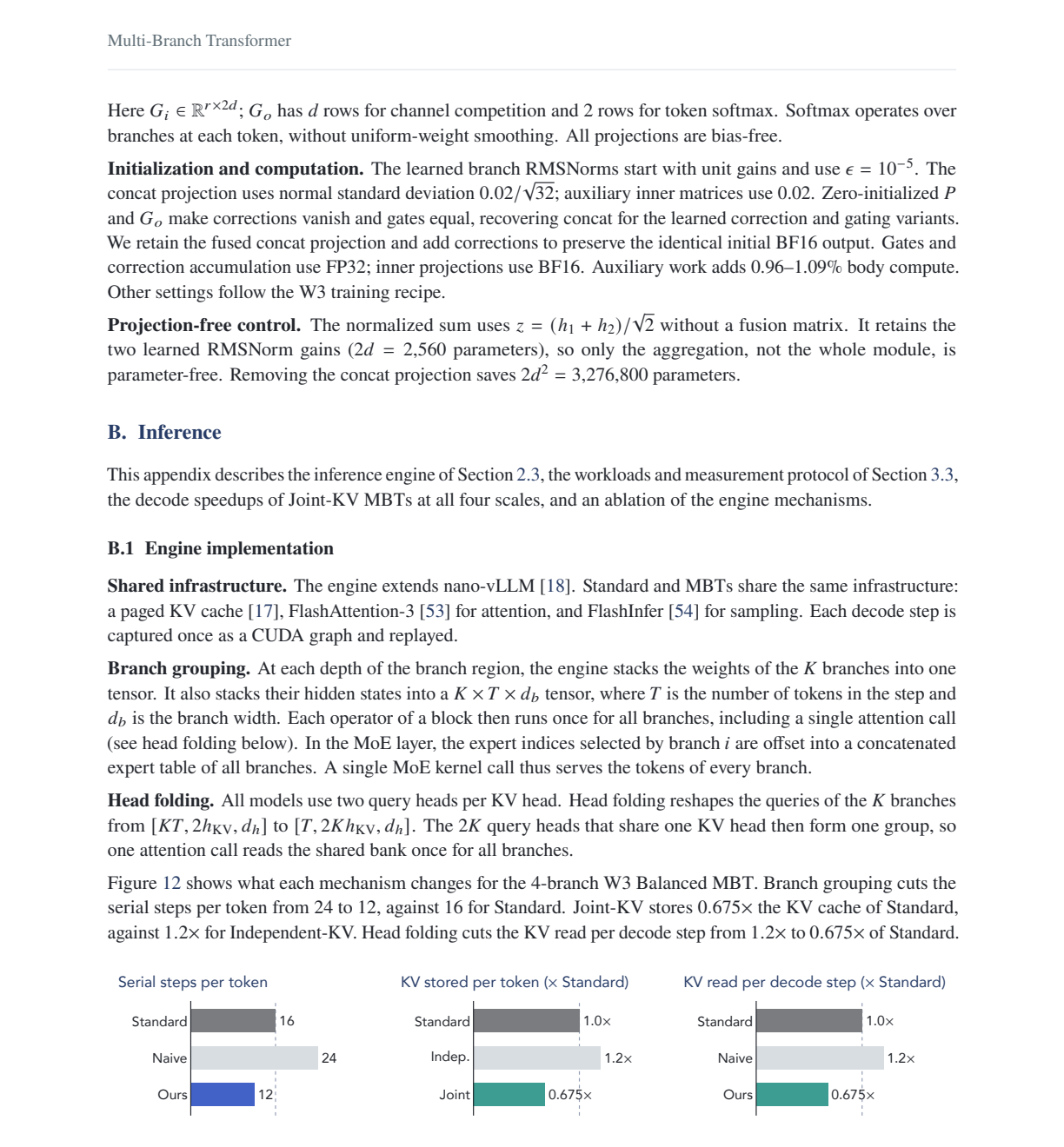
What carries the argument. The Multi-Branch Transformer (MBT) architecture: it replaces part of a standard Transformer's sequential block stack with K independently parameterized branches that execute in parallel, followed by a fusion step (normalized concatenation + linear projection) before shared final layers. Joint-KV constructs a shared KV cache from all branch representations at each depth (while retaining separate queries per branch), reducing cache storage to 1/K of Independent-KV. An inference engine uses branch grouping (executing same-depth blocks in one stage) and head folding (folding branch dimension into query-head dimension for grouped-query attention) to reduce sequential steps and redundant KV reads.
Core claim. The central claim is that organizing full Transformer blocks into parallel branches (between shared initial and final layers) improves language modeling quality and inference efficiency compared to standard sequential Transformers at comparable training compute. Specifically: (1) 2-branch Wide-Shallow MBTs consistently outperform sequential Transformers under matched parameter and training-compute budgets across four MoE model scales (0.8B-2.1B parameters). (2) Balanced MBTs with Joint-KV match standard Transformers trained with 1.16-1.26x as much training body compute, while reducing KV cache size by 19-34% and delivering up to 51.4% higher decoding throughput. (3) The benefits of branching extend beyond changes in width and depth, as shown by ablation studies.
The premise it rests on. The scaling laws are fitted on only four data points per model family (one per scale from 0.8B to 2.1B parameters), and the compute multipliers (1.23x, 1.26x) rely on extrapolation from these fits without explicit uncertainty quantification or out-of-sample validation.
If the paper is right (Pith's inferences, not the authors')
If the central claim holds, branching becomes a practical architectural dimension alongside width and depth for scaling language models, offering a new knob for trading off quality and inference efficiency.
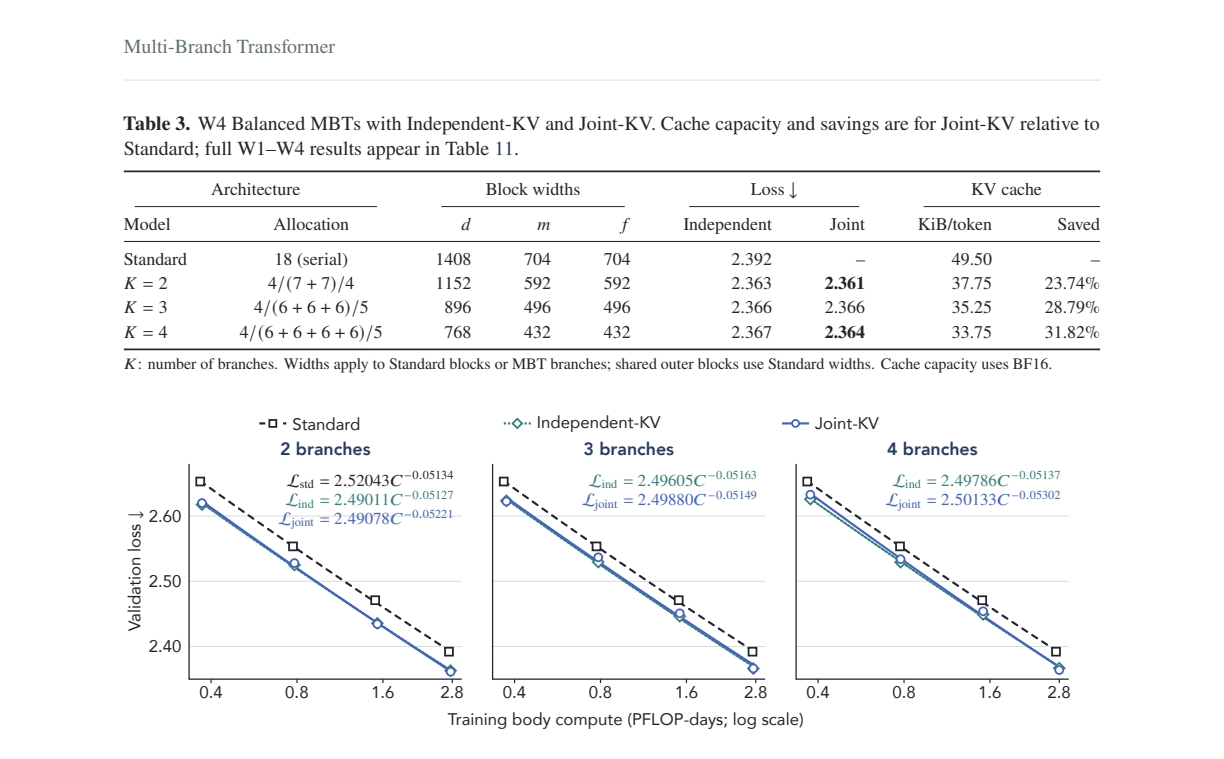
The Joint-KV technique demonstrates that sharing KV caches across parallel branches can simultaneously reduce memory footprint and improve decoding throughput without quality loss, which could influence long-context serving architectures.
The finding that branching benefits persist beyond changes in width and depth suggests that the parallel composition of full blocks provides a fundamentally different inductive bias from sequential widening or deepening.
The consistent U-shaped scaling curve across four model scales (best at ~1/3 blocks in parallel branches) suggests a stable allocation pattern that could guide future MBT designs at larger scales.
The paper's scaling laws are fitted on only four data points per family (one per scale), so the compute multipliers (1.23x, 1.26x) should be treated as rough estimates rather than precise predictions until validated at larger scales.
The inference speedups are measured on a single H200 GPU with specific prompt lengths and concurrency levels; the paper notes that two-branch MBTs can be slower than Standard in some settings (Appendix C.3), indicating the speedup is not universal and depends on the workload.
The paper focuses on MoE models with specific configurations (64 experts, top-8 routing, 2:1 GQA ratio); it is an open question how well the branching benefits transfer to dense models or other architectural choices.
The Joint-KV approach is orthogonal to other KV-sharing techniques like Cross-Layer Attention and YOCO, suggesting potential for combining these methods for further gains.
Check this review
What was read
The passes were given all 127,278 characters of the paper's LaTeX source.
Fingerprint of that text (SHA-256): b7dfdf49de12ad1380ad167221dc1ba5feb83f65cf2ef643636a46f9c5d4d93e
Pith does not keep that text. Rebuilt from the paper's source or PDF by the same code, it has this fingerprint if it is the same text. From a copy of Pith's code:
PYTHONPATH=. python scripts/review_input_check.py 2611.19800
The passes, in the order they ran
- Reader deepseek-v4-flash · medium effort · $0.0051 · instructions of the Reader, fingerprint f9ead7300382…
- Skeptic deepseek-v4-flash · medium effort · $0.0040 · instructions of the Skeptic, fingerprint 8f88c0f61488…
- Referee deepseek-v4-flash · medium effort · $0.0043 · instructions of the Referee, fingerprint a852d99aea0d…
- Check against the paper deepseek-v4-flash · medium effort · $0.0058 · instructions of the Check against the paper, fingerprint 6c7a6883d551…
- Editor deepseek-v4-flash · medium effort · $0.0066 · instructions of the Editor, fingerprint e7211f6a3d27…
- Circularity check deepseek-v4-flash · medium effort · $0.0040 · instructions of the Circularity check, fingerprint e9946e39d67b…
- Summary for the page deepseek-v4-flash · medium effort · temperature 0.2 · $0.0044 · instructions of the Summary for the page, fingerprint e4f56bf568e7…
The passes cost $0.034 in model calls together.
Version stamped on this review: pith-pipeline@v1.4.1-daily-deepseek-or-medium+deepseek/deepseek-v4-flash+p.d60f54226f00
Each link opens a pass's instructions as plain text, the exact bytes its fingerprint was taken over. Every stored set of instructions.
curl -s https://pith.science/methodology/prompts/f9ead730038216984cfb56d7cb34332bdf691828296a1de4245f3d6667d4bf56 | sha256sum
prints the fingerprint of the reader's instructions. The same works for every pass.
The receipt
The review's fingerprint was taken on 17 Nov 2026. The review you are reading still matches it.
Fingerprint of the review (SHA-256): 6d0c661ff55b0a0be50822437c39405ebd4cfcc2c3961fb8cecf4d7e7c43b290
curl -s 'https://pith.science/api/v1/verdicts/2611.19800?form=canonical' | sha256sum
prints the fingerprint of the review as it stands now. The rule, in four steps.
A matching fingerprint shows the review has not changed since that date. It does not show that the review is right.
How often reviews like this one are right
Reviews like this one: written by deepseek-v4-flash, from the paper's LaTeX source.
How often objections from reviews like this one are right: not yet measured
Reviews by people
This review was written by a machine. No person has reviewed this paper on Pith yet. A scientist listed on Pith can review it for a fee, and their review is published here whatever it concludes.
The paper
Abstract
Transformer language models are commonly scaled by making their blocks wider or stacking them deeper. In this work, we explore a complementary path: branching, the parallel composition of full Transformer blocks. We introduce the Multi-Branch Transformer (MBT), which processes the input through shared initial layers, executes independently parameterized branches of sequential blocks in parallel, and fuses their outputs before shared final layers. At comparable training compute, we study three MBT variants: Wide-Shallow preserves block width, Narrow-Deep preserves sequential depth, and Balanced interpolates between them. In controlled pretraining experiments at four mixture-of-experts scales (0.8B to 2.1B total parameters), 2-branch Wide-Shallow MBTs consistently outperform sequential Transformers under matched parameter and training-compute budgets. Balanced MBTs improve further and retain comparable quality as the number of branches increases. To improve inference efficiency at long contexts, we introduce Joint-KV, which constructs a shared KV cache from branch representations at each depth. Our final recipe combines Balanced MBTs with Joint-KV, supported by an inference engine that exploits branch grouping and shared-cache reuse. Fitted scaling curves indicate that standard Transformers require up to 1.26x as much training body compute to match our final models' validation loss. These models reduce full-model KV-cache storage by up to 34% and deliver up to 51.4% higher decoding throughput on a single H200 GPU. Ablation studies show that branching yields gains beyond changes in width and depth, enables an effective KV-sharing strategy (Joint-KV), remains robust across fusion functions, and performs best in the middle layers. These findings show that branching offers a practical path for scaling language models toward both better modeling quality and faster inference.
The paper's own sentences, arranged, kept beside the review and separate from it. Each label is drawn from a closed vocabulary; the number beside it is the probability the classifier gave that label. No sentence in this record was written by a model.
abstract compiled · 2026-11-17
The authors' main claim, as the classifier picked it out 1.00
“These findings show that branching offers a practical path for scaling language models toward both better modeling quality and faster inference.”
How the main claim is stated: asserted 0.99
What the abstract itself states, as probabilities: claims first 0.05 · states limitation 0.12 · human participants 0.02 · controlled comparison 0.94 · randomized assignment 0.02 · states quantitative result 0.99 · compares with prior results 0.95 · mentions code or data availability 0.03
The abstract, sentence by sentence
This table labels the abstract only (arXiv listing abstract v1). The number is the probability the classifier gave the label.
| Sentence | Role | The authors' own work | States the main conclusion | Strength |
|---|---|---|---|---|
| Transformer language models are commonly scaled by making their blocks wider or stacking them deeper. | background 1.00 | 0.04 | 0.01 | asserted 1.00 |
| In this work, we explore a complementary path: branching, the parallel composition of full Transformer blocks. | contribution 0.93 | 0.42 | 0.05 | asserted 0.59 |
| We introduce the Multi-Branch Transformer (MBT), which processes the input through shared initial layers, executes independently parameterized branches of sequential blocks in parallel, and fuses their outputs before shared final layers. | method 0.79 | 0.80 | 0.06 | asserted 0.98 |
| At comparable training compute, we study three MBT variants: Wide-Shallow preserves block width, Narrow-Deep preserves sequential depth, and Balanced interpolates between them. | method 0.88 | 0.85 | 0.03 | asserted 0.94 |
| In controlled pretraining experiments at four mixture-of-experts scales (0.8B to 2.1B total parameters), 2-branch Wide-Shallow MBTs consistently outperform sequential Transformers under matched parameter and training-compute budgets. | result 1.00 | 0.97 | 0.20 | asserted 1.00 |
| Balanced MBTs improve further and retain comparable quality as the number of branches increases. | result 1.00 | 0.95 | 0.12 | asserted 1.00 |
| To improve inference efficiency at long contexts, we introduce Joint-KV, which constructs a shared KV cache from branch representations at each depth. | method 0.53 | 0.94 | 0.03 | asserted 1.00 |
| Our final recipe combines Balanced MBTs with Joint-KV, supported by an inference engine that exploits branch grouping and shared-cache reuse. | method 0.75 | 0.92 | 0.07 | asserted 0.98 |
| Fitted scaling curves indicate that standard Transformers require up to 1.26x as much training body compute to match our final models' validation loss. | result 1.00 | 0.95 | 0.11 | hedged possibility 0.92 |
| These models reduce full-model KV-cache storage by up to 34% and deliver up to 51.4% higher decoding throughput on a single H200 GPU. | result 1.00 | 0.95 | 0.10 | asserted 0.98 |
| Ablation studies show that branching yields gains beyond changes in width and depth, enables an effective KV-sharing strategy (Joint-KV), remains robust across fusion functions, and performs best in the middle layers. | result 0.95 | 0.97 | 0.14 | asserted 1.00 |
| These findings show that branching offers a practical path for scaling language models toward both better modeling quality and faster inference. | interpretation 1.00 | 0.88 | 0.93 | asserted 0.99 |
What kind of paper the classifier reports this is: method or tool 0.99 · evidence from observation or experiment 0.94
What was examined, and what was not
Sources read
- arXiv listing abstract v1
Not examined
- full text
- figures and tables
- references and citing sentences
- relations to other papers
Levels run
- P abstract
Not run
- S sections
- T body sentences
- C citations
- R cross-paper relations
How the labels were made
Compiled by classifier-1.13.0 via TypeSafe API, question bank abstract-p1-20260923, 2026-11-17: 1 request, 8,921 input tokens.
Every quoted sentence on this record is the authors'. Every label is from Pith's closed vocabulary, with the probability shown beside it. This record as JSON
Figures (14)
Figures are the authors', reproduced from the paper.
References (55)
- [1] Ashish Vaswani, Noam Shazeer, Niki Parmar, Jakob Uszkoreit, Llion Jones, Aidan N Gomez, Łukasz Kaiser, and Illia Polosukhin. Attention is all you need.Advances in neural information processing systems, 30, 2017 on Pith
- [2] Jared Kaplan, Sam McCandlish, Tom Henighan, Tom B Brown, Benjamin Chess, Rewon Child, Scott Gray, Alec Radford, Jeffrey Wu, and Dario Amodei. Scaling laws for neural language models.arXiv preprint arXiv:2001.08361, 2020 on PithPith's reviewarXiv
- [3] Jordan Hoffmann, Sebastian Borgeaud, Arthur Mensch, Elena Buchatskaya, Trevor Cai, Eliza Rutherford, Diego de Las Casas, Lisa Anne Hendricks, Johannes Welbl, Aidan Clark, et al. Training compute-optimal large language models. arXiv preprint arXiv:2203.15556, 2022 on PithPith's reviewarXiv
- [4] Yi Tay, Mostafa Dehghani, Jinfeng Rao, William Fedus, Samira Abnar, Hyung Won Chung, Sharan Narang, Dani Yogatama, Ashish Vaswani, and Donald Metzler. Scale efficiently: Insights from pretraining and finetuning transformers. InInternational Conference on Learning Representatio... on Pith
- [5] Sean Michael McLeish, John Kirchenbauer, David Yu Miller, Siddharth Singh, Abhinav Bhatele, Micah Goldblum, Ashwinee Panda, and Tom Goldstein. Gemstones: A model suite for multi-faceted scaling laws. InThe Thirty-ninth Annual Conference on Neural Information Processing Systems... on Pith
- [6] Song Bian, Minghao Yan, and Shivaram Venkataraman. Scaling inference-efficient language models. InForty-second International Conference on Machine Learning, 2025. URL https://openreview.net/forum?id=wslytZ28Ms on Pith
- [7] Kimi Team, Yu Zhang, Zongyu Lin, Xingcheng Yao, Jiaxi Hu, Fanqing Meng, Chengyin Liu, Xin Men, Songlin Yang, Zhiyuan Li, et al. Kimi Linear: An expressive, efficient attention architecture.arXiv preprint arXiv:2510.26692, 2025 on PithPith's reviewarXiv
- [8] Gemma Team, Aishwarya Kamath, Johan Ferret, Shreya Pathak, Nino Vieillard, Ramona Merhej, Sarah Perrin, Tatiana Matejovicova, Alexandre Ramé, Morgane Rivière, et al. Gemma 3 technical report.arXiv preprint arXiv:2503.19786, 2025 on PithPith's reviewarXiv
- [9] DeepSeek-AI, Aixin Liu, Bei Feng, Bing Xue, Bingxuan Wang, Bochao Wu, Chengda Lu, Chenggang Zhao, Chengqi Deng, Chenyu Zhang, Chong Ruan, et al. DeepSeek-V3 technical report.arXiv preprint arXiv:2412.19437, 2024 on PithPith's reviewarXiv
- [10] Defa Zhu, Hongzhi Huang, Zihao Huang, Yutao Zeng, Yunyao Mao, Banggu Wu, Qiyang Min, and Xun Zhou. Hyper-connections. InThe Thirteenth International Conference on Learning Representations, 2025. URL https://openreview.net/forum?id=9FqARW7dwB on Pith
- [11] Zhenda Xie, Yixuan Wei, Huanqi Cao, Chenggang Zhao, Chengqi Deng, Jiashi Li, Damai Dai, Huazuo Gao, Jiang Chang, Kuai Yu, et al. mHC: Manifold-constrained hyper-connections.arXiv preprint arXiv:2512.24880, 2025 on PithPith's reviewarXiv
- [12] Kimi Team, Guangyu Chen, Yu Zhang, Jianlin Su, Weixin Xu, Siyuan Pan, Yaoyu Wang, Yucheng Wang, Guanduo Chen, Bohong Yin, et al. Attention residuals.arXiv preprint arXiv:2603.15031, 2026 on PithPith's reviewarXiv
- [13] Jonas Geiping, Sean McLeish, Neel Jain, John Kirchenbauer, Siddharth Singh, Brian Bartoldson, Bhavya Kailkhura, Abhinav Bhatele, and Tom Goldstein. Scaling up test-time compute with latent reasoning: A recurrent depth approach. In D. Belgrave, C. Zhang, H. Lin, R. Pascanu, P. ... on Pithdoi:10.52202/085713-1380
- [14] Aakanksha Chowdhery, Sharan Narang, Jacob Devlin, Maarten Bosma, Gaurav Mishra, Adam Roberts, Paul Barham, Hyung Won Chung, Charles Sutton, Sebastian Gehrmann, et al. PaLM: Scaling language modeling with Pathways. Journal of machine learning research, 24(240):1–113, 2023 on Pith
- [15] Mouxiang Chen, Binyuan Hui, Zeyu Cui, Jiaxi Yang, Dayiheng Liu, Jianling Sun, Junyang Lin, and Zhongxin Liu. Parallel scaling law for language models.Advances in Neural Information Processing Systems, 38:118958–118998, 2025 on Pith
- [16] Deepak Narayanan, Mohammad Shoeybi, Jared Casper, Patrick LeGresley, Mostofa Patwary, Vijay Korthikanti, Dmitri Vainbrand, Prethvi Kashinkunti, Julie Bernauer, Bryan Catanzaro, et al. Efficient large-scale language model training 16 Multi-Branch Transformer on GPU clusters usi... on Pith
- [17] Woosuk Kwon, Zhuohan Li, Siyuan Zhuang, Ying Sheng, Lianmin Zheng, Cody Hao Yu, Joseph Gonzalez, Hao Zhang, and Ion Stoica. Efficient memory management for large language model serving with PagedAttention. In Proceedings of the 29th symposium on operating systems principles, p... on Pith
- [18] Xingkai Yu. Nano-vLLM. GitHub repository, 2025. URL https://github.com/GeeeekExplorer/nano-vllm on Pith
- [19] William Fedus, Barret Zoph, and Noam Shazeer. Switch transformers: Scaling to trillion parameter models with simple and efficient sparsity.Journal of Machine Learning Research, 23(120):1–39, 2022 on Pith
- [20] Joshua Ainslie, James Lee-Thorp, Michiel De Jong, Yury Zemlyanskiy, Federico Lebrón, and Sumit Sanghai. GQA: Training generalized multi-query transformer models from multi-head checkpoints. InProceedings of the 2023 conference on empirical methods in natural language processin... on Pith
show 35 more
- [21] Guilherme Penedo, Hynek Kydlíček, Loubna Ben allal, Anton Lozhkov, Margaret Mitchell, Colin Raffel, Leandro Von Werra, and Thomas Wolf. The FineWeb datasets: Decanting the web for the finest text data at scale.Advances in Neural Information Processing Systems, 37:30811–30849, 2024 on Pith
- [22] Aaron Grattafiori, Abhimanyu Dubey, Abhinav Jauhri, Abhinav Pandey, Abhishek Kadian, Ahmad Al-Dahle, Aiesha Letman, Akhil Mathur, Alan Schelten, Alex Vaughan, et al. The Llama 3 herd of models.arXiv preprint arXiv:2407.21783, 2024 on PithPith's reviewarXiv
- [23] The Microsoft AI Team. MAI-Thinking-1: Building a hill-climbing machine. Technical report, Microsoft AI, 2026. URL https://microsoft.ai/pdf/mai-thinking-1.pdf on Pith
- [24] Larry Dial. Improving our LLM pretraining efficiency. https://www.openathena.ai/blog/pretraining-speedup/, June on Pith
- [25] Venmugil Elango, Nidhi Bhatia, Roger Waleffe, Rasoul Shafipour, Tomer Asida, Abhinav Khattar, Nave Assaf, Maximilian Golub, Joey Guman, Tiyasa Mitra, et al. LatentMoE: Toward optimal accuracy per FLOP and parameter in mixture of experts.arXiv preprint arXiv:2601.18089, 2026 on PitharXiv
- [26] Kimi Team, Tongtong Bai, Yifan Bai, Yiping Bao, M. C., Jianfeng Cai, Xinyuan Cai, Peizhou Cao, Yuxuan Cao, Ziwei Chai, Y Charles, et al. Kimi K3: Open frontier intelligence.arXiv preprint arXiv:2607.24653, 2026 on PitharXiv
- [27] Biao Zhang and Rico Sennrich. Root mean square layer normalization.Advances in neural information processing systems, 32, 2019 on Pith
- [28] Jianlin Su, Murtadha Ahmed, Yu Lu, Shengfeng Pan, Wen Bo, and Yunfeng Liu. RoFormer: Enhanced transformer with rotary position embedding.Neurocomputing, 568:127063, 2024 on Pith
- [29] Zihan Qiu, Zekun Wang, Bo Zheng, Zeyu Huang, Kaiyue Wen, Songlin Yang, Rui Men, Le Yu, Fei Huang, Suozhi Huang, Dayiheng Liu, Jingren Zhou, and Junyang Lin. Gated attention for large language models: Non-linearity, sparsity, and attention-sink-free. InThe Thirty-ninth Annual C... on Pith
- [30] Ilya Loshchilov and Frank Hutter. Decoupled weight decay regularization. InInternational Conference on Learning Representations, 2019. URL https://openreview.net/forum?id=Bkg6RiCqY7 on Pith
- [31] Cheng-Ping Hsieh, Simeng Sun, Samuel Kriman, Shantanu Acharya, Dima Rekesh, Fei Jia, and Boris Ginsburg. RULER: What’s the real context size of your long-context language models? InFirst Conference on Language Modeling, 2024. URL https://openreview.net/forum?id=kIoBbc76Sy on Pith
- [32] John Arevalo, Thamar Solorio, Manuel Montes-y Gómez, and Fabio A González. Gated multimodal units for information fusion. InInternational Conference on Learning Representations, Workshop Track, 2017. URL https://openreview.net/forum?id=S12_nquOe on Pith
- [33] Jiquan Ngiam, Aditya Khosla, Mingyu Kim, Juhan Nam, Honglak Lee, and Andrew Y Ng. Multimodal deep learning. InProceedings of the 28th International Conference on Machine Learning, pages 689–696, 2011 on Pith
- [34] Jin-Hwa Kim, Kyoung-Woon On, Woosang Lim, Jeonghee Kim, Jung-Woo Ha, and Byoung-Tak Zhang. Hadamard 17 Multi-Branch Transformer product for low-rank bilinear pooling. InInternational Conference on Learning Representations, 2017. URL https://openreview.net/forum?id=r1rhWnZkg on Pith
- [35] Christoph Feichtenhofer, Axel Pinz, and Andrew Zisserman. Convolutional two-stream network fusion for video action recognition. InProceedings of the IEEE conference on computer vision and pattern recognition, pages 1933–1941, 2016 on Pith
- [36] Noam Shazeer. GLU variants improve transformer.arXiv preprint arXiv:2002.05202, 2020 on PithPith's reviewarXiv
- [37] Chong Wang, Nan Du, Tom Gunter, Tao Lei, Kulin Seth, Senyu Tong, Jianyu Wang, Guoli Yin, Xiyou Zhou, Kelvin Zou, et al. Parallel track transformers: Enabling fast GPU inference with reduced synchronization.arXiv preprint arXiv:2602.07306, 2026 on PitharXiv
- [38] Christian Szegedy, Wei Liu, Yangqing Jia, Pierre Sermanet, Scott Reed, Dragomir Anguelov, Dumitru Erhan, Vincent Vanhoucke, and Andrew Rabinovich. Going deeper with convolutions. InProceedings of the IEEE conference on computer vision and pattern recognition, pages 1–9, 2015 on Pith
- [39] Saining Xie, Ross Girshick, Piotr Dollár, Zhuowen Tu, and Kaiming He. Aggregated residual transformations for deep neural networks. In2017 IEEE conference on computer vision and pattern recognition (CVPR), pages 5987–5995. IEEE, 2017 on Pith
- [40] GustavLarsson, MichaelMaire, andGregoryShakhnarovich. FractalNet: Ultra-deepneuralnetworkswithoutresiduals. InInternational Conference on Learning Representations, 2017. URL https://openreview.net/forum?id=S1VaB4cex on Pith
- [41] Ke Sun, Bin Xiao, Dong Liu, and Jingdong Wang. Deep high-resolution representation learning for human pose estimation. In2019 IEEE/CVF conference on computer vision and pattern recognition (CVPR), pages 5686–5696. IEEE, 2019 on Pith
- [42] Karim Ahmed, Nitish Shirish Keskar, and Richard Socher. Weighted transformer network for machine translation. arXiv preprint arXiv:1711.02132, 2017 on PithPith's reviewarXiv
- [43] Yang Fan, Shufang Xie, Yingce Xia, Lijun Wu, Tao Qin, Xiang-Yang Li, and Tie-Yan Liu. Multi-branch attentive transformer.arXiv preprint arXiv:2006.10270, 2020 on PithPith's reviewarXiv
- [44] Mikhail Burtsev and Anna Rumshisky. Multi-stream transformers.arXiv preprint arXiv:2107.10342, 2021 on PithPith's reviewarXiv
- [45] Boyi Zeng, Yiqin Hao, Zitong Wang, Shixiang Song, He Li, Feichen Song, Yifan Liu, Ziwei He, Xinbing Wang, and ZhouhanLin. Depth-attention: Cross-layervaluemixingforlanguagemodels. InHung-YiLee,SunipaDev,JunyiJessy Li, and Desmond Elliott, editors,Proceedings of the 2026 Confer... on Pithdoi:10.18653/2026.emnlp-main.2085
- [46] Lianghui Zhu, Yuxin Fang, Bencheng Liao, Shijie Wang, Tianheng Cheng, Zilong Huang, Chen Chen, Lai Wei, Yutao Zeng, Ya Wang, et al. Mixture-of-depths attention.arXiv preprint arXiv:2603.15619, 2026 on PitharXiv
- [47] Noam Shazeer. Fast transformer decoding: One write-head is all you need.arXiv preprint arXiv:1911.02150, 2019 on PithPith's reviewarXiv
- [48] William Brandon, Mayank Mishra, Aniruddha Nrusimha, Rameswar Panda, and Jonathan Ragan-Kelley. Reducing transformer key-value cache size with cross-layer attention.Advances in Neural Information Processing Systems, 37: 86927–86957, 2024 on Pith
- [49] Yutao Sun, Li Dong, Yi Zhu, Shaohan Huang, Wenhui Wang, Shuming Ma, Quanlu Zhang, Jianyong Wang, and Furu Wei. You only cache once: Decoder-decoder architectures for language models. InThe Thirty-eighth Annual Conference on Neural Information Processing Systems, 2024. URL http... on Pith
- [50] Will Held. Scaling laws that extrapolate 300×past the fit. https://www.openathena.ai/blog/delphi/, May 2026. Open Athena Blog on Pith
- [51] Jianyu Wei, Yizhao Gao, Qihao Zhang, Shimao Chen, Zhengju Tang, Yu Cheng, Shengjie Zhou, Zihan Jiang, Yifan Song, Hailin Zhang, et al. HySparse2: Hybrid sparse attention with two-level KV sharing.arXiv preprint arXiv:2609.26368, 2026 on PithPith's reviewarXiv
- [52] Patrick Esser, Sumith Kulal, Andreas Blattmann, Rahim Entezari, Jonas Müller, Harry Saini, Yam Levi, Dominik Lorenz, Axel Sauer, Frederic Boesel, Dustin Podell, Tim Dockhorn, Zion English, and Robin Rombach. Scaling 18 Multi-Branch Transformer rectified flow transformers for h... on Pith
- [53] Jay Shah, Ganesh Bikshandi, Ying Zhang, Vijay Thakkar, Pradeep Ramani, and Tri Dao. FlashAttention-3: Fast and accurate attention with asynchrony and low-precision.Advances in Neural Information Processing Systems, 37: 68658–68685, 2024 on Pith
- [54] Zihao Ye, Lequn Chen, Ruihang Lai, Wuwei Lin, Yineng Zhang, Stephanie Wang, Tianqi Chen, Baris Kasikci, Vinod Grover, Arvind Krishnamurthy, et al. FlashInfer: Efficient and customizable attention engine for LLM inference serving.Proceedings of Machine Learning and Systems, 7, ... on Pith
- [2025] URL https://openreview.net/forum?id=1b7whO4SfY on Pith
Challenges and discussion
Disagree with the review, or know something it missed? Leave a comment, or challenge this review formally: a challenge becomes a permanent entry in this paper's record, and its decision is published here.
Come back by email
A short list of the week's newly reviewed papers. Nothing is sent until you confirm from your inbox, and every email has a link that stops it. No account.
No comments yet.
Sign in to comment