Software Engineering · arXiv:2611.23216 v1 · submitted 17 Nov 2026 · 46 references
Higher-Scoring Coding Models Did Not Get More Work Done
The paper says
“New coding models advertise themselves on score improvements of coding benchmarks. Yet no study has tested if a model that scores higher on these benchmarks gets more real work done.”
more of the abstract
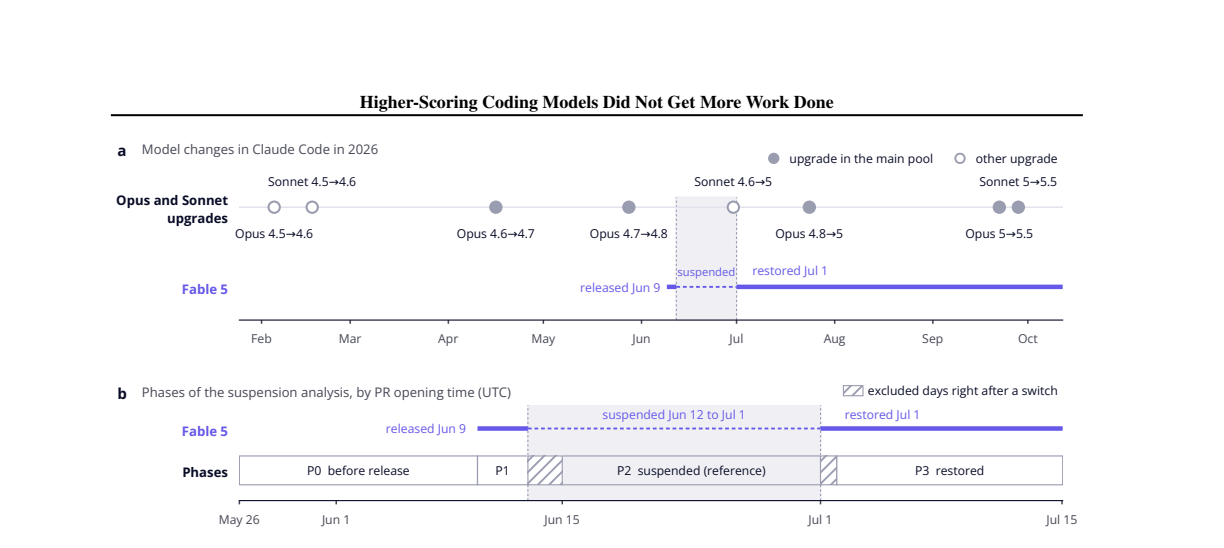
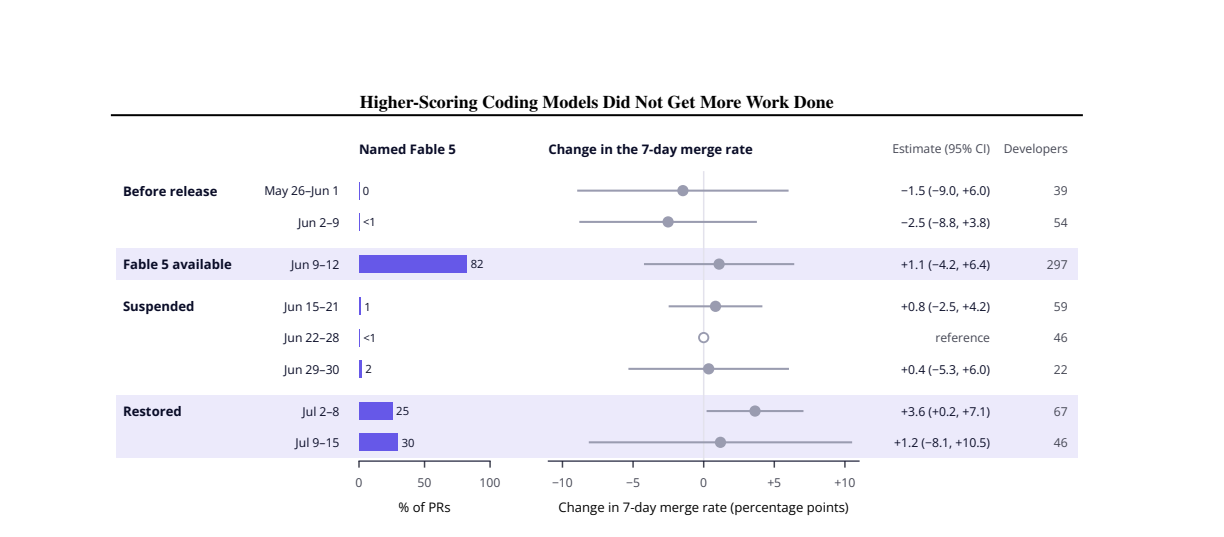
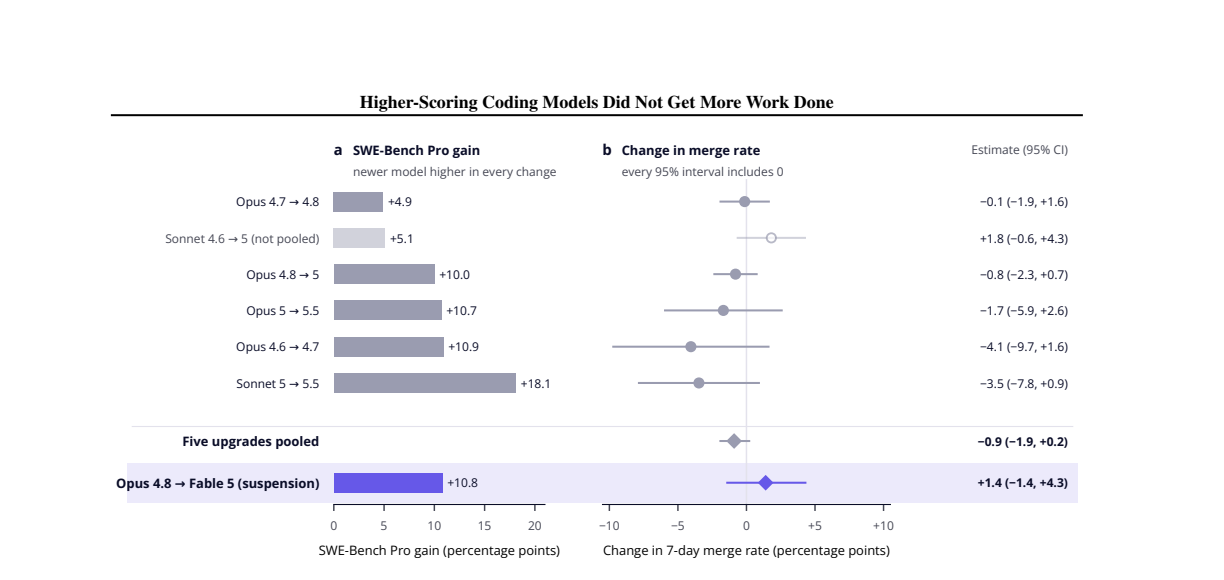
On June 12, 2026, a U.S. export control directive banned access to Claude Fable 5 for 19 days, which forced users to switch to other models. During this time, most former Fable 5 users switched to Opus 4.8 (11 points lower on SWE-Bench Pro compared to Fable 5). We treat this suspension as a natural experiment, where the people and projects stayed the same and only the model changed, so we could isolate the effect of Fable 5 on user productivity. We tracked GitHub pull requests of 297 Fable 5 users before, during, and after the suspension. We used 8,908 developers who stayed on Opus 4.8 all the time as the control group. We also repeated the comparison across five model upgrades before and after the suspension in 2026 (1,208 developers, 15,442 pull requests). Fitting a difference-in-differences model with developer and date fixed effects, we found that having access to Fable 5 increased the 7-day merge rate of pull requests by only 1.4 percentage points [-1.4; +4.3], which was not statistically significant. Similarly, no significant increases of merge rates were found with the upgrades (weighted mean: -0.9 percentage points [-1.9; +0.2]); all five estimates were negative (95% intervals included 0, did not differ from each other). We also did not observe a significant increase in the number of pull requests merged per week (+2.4% [-4.9%; +10.2%]).
from the abstract
Pith says
Machine review · deepseek-v4-flash · 18 Nov 2026 · read the full text (93,110 characters) · not checked by a person
It can be wrong. Challenge this review or reply to it.
Holds up. A natural experiment shows that access to a higher-scoring coding model did not measurably increase developers' merge rates, raising questions about what benchmark gains mean for real work. This line is wrong
7 minor
How often objections from reviews like this one are right: not yet measured
The paper, first character to last
The reviewer was given the whole text, 93,110 characters. Not checked: figures, code, what the 46 references say.
7 minor objections
The paper says, at Section 3.2
Pith says: minor objection 1 of 7
The authors state that they collected PRs between November 20, 2025 and October 5, 2026, but the suspension analysis uses only May 26 to July 15, 2026. The broader collection window is for the upgrade analysis. This could be clarified earlier to avoid confusion.
The paper says, at Section 3.4
Pith says: minor objection 2 of 7
The definition of 'weekly merged PRs' as the number of PRs a developer opened in a week that were merged within 7 days is clear, but the unit of analysis (developer-week) is different from the PR-level analysis. The authors should note that this outcome is only estimated in the upgrade analysis because the suspension analysis lacks a reliable control group (Appendix F). This is appropriate, but the asymmetry between the two analyses could be highlighted more prominently.
show 5 more
The paper says, at Section 4.3
Pith says: minor objection 3 of 7
The finding that 95% of merges were done by the authors themselves and 90% had no approval is striking and important for interpreting the merge rate as a productivity measure. This result is presented in the main text but the details are in Appendix C.
more of objection 3
Given its importance for the interpretation of the main outcome, it might warrant more prominence in the main text or a brief discussion of its implications for the validity of the merge rate as a proxy for productivity.
The paper says, at Table 2
Pith says: minor objection 4 of 7
The table reports 'not estimated' for weekly merged PRs in the suspension analysis and 'too few reverts' for reverts in the upgrade analysis. These are appropriate, but the table could include a footnote explaining why the suspension analysis cannot estimate weekly merged PRs (the control group is not suitable, as explained in Appendix F).
The paper says, at Appendix A
Pith says: minor objection 5 of 7
The description of the linear probability model's advantages is clear, but the statement that 'standard errors clustered by developer are robust to the heteroskedasticity of this model' could be more precise: clustered standard errors are robust to heteroskedasticity and within-cluster correlation, but the linear probability model's inherent heteroskedasticity is a separate issue that does not bias the coefficients. The sentence is not incorrect but could be clarified.
The paper says, at Section 5, Discussion
Pith says: minor objection 6 of 7
The hypothesis that 'the tasks developers give agents are already within what the older model can do' is plausible but speculative. The authors provide some supporting evidence (survey of Anthropic engineers, PR characteristics not changing after upgrades), but this is not directly tested. The paper would benefit from acknowledging that this is a post-hoc explanation and not a conclusion of the study.
The paper says, at Appendix H
Pith says: minor objection 7 of 7
The limitations section is thorough, but it is placed in the appendix. Given the importance of the limitations for interpreting the null result, some of these (especially the 1% sample issue and the parallel trends assumption) could be summarized in the main text's Discussion section.
What would settle it
A randomized controlled trial where developers are assigned to use either a higher-scoring model or a lower-scoring model on their own real-world tasks, with merge rates and other productivity metrics measured over a longer period (e.g., 3-6 months). If such a trial found a statistically significant increase in merge rates or other productivity measures, it would contradict the paper's conclusion that benchmark gains do not translate to real work.
from Pith's summary of the paper
How the review went
5 passes by deepseek-v4-flash · 18 Nov 2026
- Reader holds up
- Skeptic concern withdrawn: Pith's reviewer misread the paper
- Referee 7 minor
- Check against the paper kept 0 of 4 objections
- Editor wrote the verdict above
Not run on this paper: the simulated authors' defence.
Pith's passes raised 4 objections. A check against the paper's text kept 0 and withdrew 4 (2 the paper already says; 2 Pith's reviewer misread the paper).
The review in full
The review in brief, machine-written
This paper uses a rare natural experiment—a 19-day U.S. export control ban on Claude Fable 5—to ask whether a model that scores 11 points higher on SWE-Bench Pro actually helps developers get more work done. The answer, from a difference-in-differences design comparing the same developers before, during, and after the ban, is no: the 7-day merge rate changed by only +1.4 percentage points (95% CI –1.4 to +4.3), and a parallel analysis of five model upgrades found no increase either (–0.9 points, –1.9 to +0.2). The study is well-designed, with developer and date fixed effects, placebo tests, and extensive sensitivity analyses. The authors are transparent about limitations: the treated group is small (297 developers), only about 1% of Claude Code PRs name the model in the description, and the merge rate was already near ceiling (~95%), leaving little room for improvement. The paper's central claim—that benchmark gains of 5–18 points did not translate into measurable productivity gains—is supported by the evidence. The main soft spot is the reliance on the parallel trends assumption for a small treated group, but the placebo test and sensitivity analyses are consistent with the main result. The upgrade analysis is observational, but it agrees with the suspension analysis and has narrower intervals. This paper is important for anyone who uses benchmark scores to choose coding models or to evaluate AI progress. It deserves a serious referee and, if the data and code are as released, publication. The field needs more studies like this that test whether benchmark improvements actually matter in practice.
The stress test's concern
Withdrawn: Pith's reviewer misread the paper.
The paper says
“The suspension analysis assumes that without the suspension, the day-to-day changes in the treated group's merge rate would have been the same as the control group's. To break this assumption, a confounder would have to affect only Fable 5 users, start exactly on June 12 and end on July 1.”
The referee's report
Not published. Pith's referee wrote this assessment before its objections were checked against the paper, and 3 of its 3 major objections did not survive that check.
Pith's reading of the paper (a machine's summary, not the authors')
This paper uses a natural experiment—the 19-day suspension of Claude Fable 5 due to a U.S. export control directive—to test whether a model that scores higher on coding benchmarks (SWE-Bench Pro) actually helps developers get more work done. The authors compare the same developers' pull request merge rates before, during, and after the suspension, and also analyze five model upgrades. They find that having access to Fable 5 increased the 7-day merge rate by only 1.4 percentage points (95% CI -1.4 to +4.3), and switching to newer models across five upgrades did not increase merge rates either (-0.9 percentage points, 95% CI -1.9 to +0.2). The paper argues that benchmark gains of 5 to 18 points did not show up in the work developers actually kept, suggesting that current coding benchmarks may not reflect real-world productivity.
What carries the argument. The central object is the difference-in-differences model with developer and calendar-day fixed effects, applied to the natural experiment of the Fable 5 suspension. The key identity is the reversal contrast: the average difference in merge rate between the two phases with Fable 5 available (before and after the suspension) and the suspension phase, which isolates the causal effect of having access to the higher-scoring model. The paper also uses a within-developer comparison across five model upgrades, with developer fixed effects, to estimate the change in merge rate when developers switch to a newer model.
Core claim. The paper claims that having access to a model that scores 11 points higher on SWE-Bench Pro (Claude Fable 5 vs Opus 4.8) did not significantly increase the rate at which developers' pull requests were merged within 7 days. Using a difference-in-differences design that compares the same developers before, during, and after a 19-day suspension of Fable 5, the authors estimate a 1.4 percentage point increase (95% CI -1.4 to +4.3). Across five model upgrades where the newer model scored 5 to 18 points higher on SWE-Bench Pro, the pooled change in merge rate was -0.9 percentage points (95% CI -1.9 to +0.2). The paper also finds that almost all merges (95%) were done by the authors themselves, and that the median time to merge was under half an hour regardless of model.
The premise it rests on. The parallel trends assumption in the difference-in-differences design: that without the suspension, the merge rate of Fable 5 users would have changed in the same way as the control group's, which is fragile because the treated group is small (297 developers) and the suspension lasted only 19 days.
If the paper is right (Pith's inferences, not the authors')
If the paper is correct, then benchmark score improvements of 5 to 18 points on SWE-Bench Pro do not translate into measurable increases in real-world coding productivity as measured by pull request merge rates.
The finding that almost all merges are done by the authors themselves suggests that merge rate may not capture code quality or review-based productivity differences between models.
The paper implies that developers may already be giving agents tasks that are within the capabilities of older models, so benchmark gains on harder problems do not affect the work that is actually handed off.
The results suggest that regulators and buyers who rely on benchmark scores to judge model capability may be overestimating the real-world impact of model improvements.
The paper's null result raises the question of whether other productivity metrics (e.g., time to complete a task, code quality, or developer satisfaction) might show differences that merge rates do not capture. A randomized trial with controlled tasks could test this.
The finding that developers who switched models opened more PRs in their own repositories afterward (from 64.3% to 74.5%) suggests that model upgrades may change work patterns in ways that are not captured by merge rates alone.
The paper's reliance on PRs that name the model in the description (about 1% of Claude Code PRs) means the results may not generalize to the majority of AI-assisted coding work where the model is not explicitly identified.
The parallel trends assumption in the difference-in-differences design is fragile given the small treated group (297 developers) and the short suspension period (19 days), so replication with other natural experiments or randomized designs would strengthen the conclusion.
Check this review
What was read
The passes were given all 93,110 characters of the paper's LaTeX source.
Fingerprint of that text (SHA-256): b701ca988a6187f6f0e416edf067e07b61d7adf8c06756f870786f7366632322
Pith does not keep that text. Rebuilt from the paper's source or PDF by the same code, it has this fingerprint if it is the same text. From a copy of Pith's code:
PYTHONPATH=. python scripts/review_input_check.py 2611.23216
The passes, in the order they ran
- Reader deepseek-v4-flash · medium effort · $0.020 · instructions of the Reader, fingerprint f9ead7300382…
- Skeptic deepseek-v4-flash · medium effort · $0.0029 · instructions of the Skeptic, fingerprint 8f88c0f61488…
- Referee deepseek-v4-flash · medium effort · $0.0031 · instructions of the Referee, fingerprint a852d99aea0d…
- Check against the paper deepseek-v4-flash · medium effort · $0.0088 · instructions of the Check against the paper, fingerprint 6c7a6883d551…
- Editor deepseek-v4-flash · medium effort · $0.0029 · instructions of the Editor, fingerprint e7211f6a3d27…
- Circularity check deepseek-v4-flash · medium effort · $0.0028 · instructions of the Circularity check, fingerprint e9946e39d67b…
- Summary for the page deepseek-v4-flash · medium effort · temperature 0.2 · $0.0032 · instructions of the Summary for the page, fingerprint e4f56bf568e7…
The passes cost $0.044 in model calls together.
Version stamped on this review: pith-pipeline@v1.4.1-daily-deepseek-or-medium+deepseek/deepseek-v4-flash+p.d60f54226f00
Each link opens a pass's instructions as plain text, the exact bytes its fingerprint was taken over. Every stored set of instructions.
curl -s https://pith.science/methodology/prompts/f9ead730038216984cfb56d7cb34332bdf691828296a1de4245f3d6667d4bf56 | sha256sum
prints the fingerprint of the reader's instructions. The same works for every pass.
The receipt
The review's fingerprint was taken on 18 Nov 2026. The review you are reading still matches it.
Fingerprint of the review (SHA-256): fdc227186193e36614414a083c595ec98b90b54a37a17b20f52c5b6d57017afa
curl -s 'https://pith.science/api/v1/verdicts/2611.23216?form=canonical' | sha256sum
prints the fingerprint of the review as it stands now. The rule, in four steps.
A matching fingerprint shows the review has not changed since that date. It does not show that the review is right.
How often reviews like this one are right
Reviews like this one: written by deepseek-v4-flash, from the paper's LaTeX source.
How often objections from reviews like this one are right: not yet measured
Reviews by people
This review was written by a machine. No person has reviewed this paper on Pith yet. A scientist listed on Pith can review it for a fee, and their review is published here whatever it concludes.
The paper
Abstract
New coding models advertise themselves on score improvements of coding benchmarks. Yet no study has tested if a model that scores higher on these benchmarks gets more real work done. On June 12, 2026, a U.S. export control directive banned access to Claude Fable 5 for 19 days, which forced users to switch to other models. During this time, most former Fable 5 users switched to Opus 4.8 (11 points lower on SWE-Bench Pro compared to Fable 5). We treat this suspension as a natural experiment, where the people and projects stayed the same and only the model changed, so we could isolate the effect of Fable 5 on user productivity. We tracked GitHub pull requests of 297 Fable 5 users before, during, and after the suspension. We used 8,908 developers who stayed on Opus 4.8 all the time as the control group. We also repeated the comparison across five model upgrades before and after the suspension in 2026 (1,208 developers, 15,442 pull requests). Fitting a difference-in-differences model with developer and date fixed effects, we found that having access to Fable 5 increased the 7-day merge rate of pull requests by only 1.4 percentage points [-1.4; +4.3], which was not statistically significant. Similarly, no significant increases of merge rates were found with the upgrades (weighted mean: -0.9 percentage points [-1.9; +0.2]); all five estimates were negative (95% intervals included 0, did not differ from each other). We also did not observe a significant increase in the number of pull requests merged per week (+2.4% [-4.9%; +10.2%]).
The paper's own sentences, arranged, kept beside the review and separate from it. Each label is drawn from a closed vocabulary; the number beside it is the probability the classifier gave that label. No sentence in this record was written by a model.
abstract compiled · 2026-11-18
The authors' main claim, as the classifier picked it out 0.96
“Fitting a difference-in-differences model with developer and date fixed effects, we found that having access to Fable 5 increased the 7-day merge rate of pull requests by only 1.4 percentage points [-1.4; +4.3], which was not statistically significant.”
How the main claim is stated: asserted 1.00
What the abstract itself states, as probabilities: claims first 0.66 · states limitation 0.41 · human participants 0.87 · controlled comparison 0.98 · randomized assignment 0.03 · states quantitative result 0.99 · compares with prior results 0.81 · mentions code or data availability 0.03
The abstract, sentence by sentence
This table labels the abstract only (arXiv listing abstract v1). The number is the probability the classifier gave the label.
| Sentence | Role | The authors' own work | States the main conclusion | Strength |
|---|---|---|---|---|
| New coding models advertise themselves on score improvements of coding benchmarks. | background 1.00 | 0.04 | 0.02 | asserted 1.00 |
| Yet no study has tested if a model that scores higher on these benchmarks gets more real work done. | gap 1.00 | 0.07 | 0.05 | asserted 0.98 |
| On June 12, 2026, a U.S. export control directive banned access to Claude Fable 5 for 19 days, which forced users to switch to other models. | method 0.53 | 0.08 | 0.02 | asserted 1.00 |
| During this time, most former Fable 5 users switched to Opus 4.8 (11 points lower on SWE-Bench Pro compared to Fable 5). | background 0.55 | 0.53 | 0.03 | asserted 1.00 |
| We treat this suspension as a natural experiment, where the people and projects stayed the same and only the model changed, so we could isolate the effect of Fable 5 on user productivity. | method 0.95 | 0.49 | 0.03 | asserted 0.74 |
| We tracked GitHub pull requests of 297 Fable 5 users before, during, and after the suspension. | method 0.99 | 0.97 | 0.02 | asserted 1.00 |
| We used 8,908 developers who stayed on Opus 4.8 all the time as the control group. | method 1.00 | 0.88 | 0.02 | asserted 0.99 |
| We also repeated the comparison across five model upgrades before and after the suspension in 2026 (1,208 developers, 15,442 pull requests). | method 0.96 | 0.94 | 0.02 | asserted 0.98 |
| Fitting a difference-in-differences model with developer and date fixed effects, we found that having access to Fable 5 increased the 7-day merge rate of pull requests by only 1.4 percentage points [-1.4; +4.3], which was not statistically significant. | result 1.00 | 0.97 | 0.71 | asserted 1.00 |
| Similarly, no significant increases of merge rates were found with the upgrades (weighted mean: -0.9 percentage points [-1.9; +0.2]); all five estimates were negative (95% intervals included 0, did not differ from each other). | result 1.00 | 0.97 | 0.31 | asserted 1.00 |
| We also did not observe a significant increase in the number of pull requests merged per week (+2.4% [-4.9%; +10.2%]). | result 1.00 | 0.97 | 0.20 | asserted 1.00 |
What kind of paper the classifier reports this is: empirical study 1.00 · evidence from analysis of existing data 0.72
What was examined, and what was not
Sources read
- arXiv listing abstract v1
Not examined
- full text
- figures and tables
- references and citing sentences
- relations to other papers
Levels run
- P abstract
Not run
- S sections
- T body sentences
- C citations
- R cross-paper relations
How the labels were made
Compiled by classifier-1.13.0 via TypeSafe API, question bank abstract-p1-20260923, 2026-11-18: 1 request, 8,406 input tokens.
Every quoted sentence on this record is the authors'. Every label is from Pith's closed vocabulary, with the probability shown beside it. This record as JSON
Figures (3)
Figures are the authors', reproduced from the paper.
References (46)
- [1] Li H, Zhang H, Hassan AE. The rise of AI teammates in software engineering (SE) 3.0: how autonomous coding agents are reshaping software engineering. arXiv:2507.15003 (preprint), 2025. Dataset AIDev v5: https://huggingf ace.co/datasets/hao-li/AIDev on PithPith's reviewarXiv
- [2] Robbes R, Matricon T, Degueule T, Hora A, Zacchiroli S. Promises, perils, and (timely) heuristics for mining coding agent activity. MSR 2026. https://arxiv.org/abs/ 2601.18345 on PitharXiv
- [3] Pinna G, Gong J, Williams D, Sarro F. Comparing AI coding agents: a task-stratified analysis of pull request acceptance. MSR 2026 Mining Challenge. https://arxiv.org/ abs/2602.08915 on PithPith's reviewarXiv
- [4] Avetisian A. PR Arena. https://github.com/aavet is/PRarena. Accessed November 2, 2026 on Pith
- [5] Anthropic. Statement on the US government directive to suspend access to Fable 5 and Mythos 5. June 12, 2026. https://www.anthropic.com/news/fable-m ythos-access on Pith
- [6] Anthropic. System Card: Claude Opus 4.8. May 28, 2026 on Pith
- [7] Anthropic. System Card: Claude Opus 4.6. February 2026 on Pith
- [8] Anthropic. Introducing Claude Sonnet 4.6. February 17, on Pith
- [9] Peralta SRO, Hoshi F, Washizaki H, et al. Why are agentic pull requests merged or rejected? An empirical study. MSR 2026.https://arxiv.org/abs/2605.22534. 8 Higher-Scoring Coding Models Did Not Get More Work Done on PithPith's reviewarXiv
- [10] Branco R, Canelas P, Gamboa C, Fonseca A. LGTM! Charac- teristics of auto-merged LLM-based agentic PRs. MSR 2026 Mining Challenge on Pith
- [11] Becker J, Rush N, Barnes E, Rein D. Measuring the impact of early-2025 AI on experienced open-source developer pro- ductivity. Preprint, 2025. https://arxiv.org/abs/ 2507.09089 on PithPith's reviewarXiv
- [12] Anthropic. Claude Fable 5 and Claude Mythos 5. June 9, on Pith
- [13] Anthropic. System Card: Claude Opus 4.7. April 16, 2026 on Pith
- [14] https://www.anthropic.com/news/cla ude-fable-5-mythos-5 on Pith
- [15] Anthropic. System Card: Claude Opus 5.5. September 22, 2026 on Pith
- [16] Anthropic. System Card: Claude Opus 5. July 24, 2026 on Pith
- [17] Anthropic. System Card: Claude Sonnet 5. June 30, 2026 on Pith
- [18] Anthropic. System Card: Claude Sonnet 5.5. September 28, 2026 on Pith
- [19] Anthropic. Claude Code settings reference: attribution. Ac- cessed November 2, 2026. https://code.claude.co m/docs/en/settings-reference on Pith
- [20] Anthropic. Redeploying Claude Fable 5. June 30, 2026. ht tps://www.anthropic.com/news/redeployi ng-fable-5 on Pith
show 26 more
- [21] Cui Z, Demirer M, Jaffe S, Musolff L, Peng S, Salz T. The effects of generative AI on high-skilled work: evidence from three field experiments with software developers. Manage- ment Science, 2026. https://pubsonline.informs .org/doi/10.1287/mnsc.2025.00535 on Pithdoi:10.1287/mnsc.2025.00535
- [22] Anthropic. System Card: Claude Fable 5 & Claude Mythos on Pith
- [23] Anthropic. An update on Claude Code quality reports. April 23, 2026. https://www.anthropic.com/engine ering/april-23-postmortem on Pith
- [24] Murphy-Hill E, Butler J, Savelieva A. Adoption and impact of command-line AI coding agents: a study of Microsoft’s early 2026 rollout of Claude Code and GitHub Copilot CLI. arXiv:2607.01418 (preprint), 2026 on PithPith's reviewarXiv
- [25] OpenAI. Why SWE-bench Verified no longer measures frontier coding capabilities. February 23, 2026. https: //openai.com/index/why-we-no-longer-eva luate-swe-bench-verified/ on Pith
- [26] METR. Many SWE-bench-passing PRs would not be merged into main. March 10, 2026. https://metr.org/not es/2026-03-10-many-swe-bench-passing-p rs-would-not-be-merged-into-main/ on Pith
- [27] Wallach H, Desai M, Cooper AF, et al. Position: evaluat- ing generative AI systems is a social science measurement challenge. ICML 2025 on Pith
- [28] Raji ID, Bender EM, Paullada A, Denton E, Hanna A. AI and the everything in the whole wide world benchmark. NeurIPS 2021 Datasets and Benchmarks Track on Pith
- [29] Bonabi S, Bana S, Gurbaxani V , Nian T. Beyond code: the multidimensional impacts of large language models in soft- ware development. arXiv:2506.22704 (preprint), 2025 on PithPith's reviewarXiv
- [30] Reuel A, Hardy A, Smith C, Lamparth M, Hardy M, Kochen- derfer MJ. BetterBench: assessing AI benchmarks, uncov- ering issues, and establishing best practices. NeurIPS 2024 Datasets and Benchmarks Track on Pith
- [31] Huang R, Reyna A, Lerner S, Xia H, Hempel B. Professional software developers don’t vibe, they control: AI agent use for coding in 2025. arXiv:2512.14012 (preprint), 2025 on PithPith's reviewarXiv
- [32] Yeverechyahu D, Mayya R, Oestreicher-Singer G. The im- pact of large language models on open-source innovation: evidence from GitHub Copilot. arXiv:2409.08379 (preprint), 2024 on PithPith's reviewarXiv
- [33] Hua Y , Na H, Ayubcha C, Lian L. Designing benchmarks for knowledge work. arXiv:2605.23262 (preprint), 2026 on PithPith's reviewarXiv
- [34] Anthropic. How AI is transforming work at Anthropic. De- cember 2, 2025. https://www.anthropic.com/re search/how-ai-is-transforming-work-at-a nthropic on Pith
- [35] Bean AM, Kearns RO, Romanou A, et al. Measuring what matters: construct validity in large language model bench- marks. NeurIPS 2025 Datasets and Benchmarks Track on Pith
- [36] Hardy A, Reuel A, Meimandi KJ, et al. More than marketing? On the information value of AI benchmarks for practitioners. IUI 2025. arXiv:2412.05520 on PithPith's reviewarXiv
- [37] Watanabe M, Li H, Kashiwa Y , Reid B, Iida H, Hassan AE. On the use of agentic coding: an empirical study of pull requests on GitHub. ACM TOSEM (accepted). arXiv:2509.14745 (preprint), 2025 on PitharXiv
- [38] European Commission. General-Purpose AI Code of Prac- tice, Safety and Security chapter. July 10, 2025 on Pith
- [39] Merali A. Scaling laws for economic productivity: experi- mental evidence in LLM-assisted consulting, data analyst, and management tasks. arXiv:2512.21316 (preprint), 2025 on PitharXiv
- [40] Popescu RM, Gros D, Botocan A, Pandita R, Devanbu P, Izadi M. Investigating autonomous agent contributions in the wild: activity patterns and code change over time. MSR 2026. arXiv:2604.00917 on PitharXiv
- [41] Rothman KJ. No adjustments are needed for multiple com- parisons. Epidemiology. 1990;1(1):43–46 on Pith
- [42] Kreitmeir DH, Raschky PA. The heterogeneous productivity effects of generative AI. arXiv:2403.01964 (preprint), 2024 on PithPith's reviewarXiv
- [43] Deng X, Da J, Pan E, et al. SWE-Bench Pro: can AI agents solve long-horizon software engineering tasks? arXiv:2509.16941 (preprint), 2025 on PithPith's reviewarXiv
- [44] Merrill MA, Shaw AG, Carlini N, et al. Terminal-Bench: benchmarking agents on hard, realistic tasks in command line interfaces. ICLR 2026. arXiv:2601.11868 on PithPith's reviewarXiv
- [46] Jimenez CE, Yang J, Wettig A, Yao S, Pei K, Press O, Narasimhan K. SWE-bench: can language models resolve real-world GitHub issues? ICLR 2024. 9 Higher-Scoring Coding Models Did Not Get More Work Done Appendix A. Design and analysis details Fable 5 was released on June 9, 2026... on Pith
- [2026] https://www.anthropic.com/news/cla ude-sonnet-4-6 on Pith
Challenges and discussion
Disagree with the review, or know something it missed? Leave a comment, or challenge this review formally: a challenge becomes a permanent entry in this paper's record, and its decision is published here.
Come back by email
A short list of the week's newly reviewed papers. Nothing is sent until you confirm from your inbox, and every email has a link that stops it. No account.
No comments yet.
Sign in to comment