Artificial Intelligence · arXiv:2611.24324 v1 · submitted 18 Nov 2026 · 22 references
Reducing Inference Cost of Coding Agents with Timeout Cascades
The paper says
“AI coding agents have become one of the most popular applications of large language models. Yet, agentic AI comes at the cost of a tremendous amount of GPU compute resources, which limits its profitability and its viability at scale.”
more of the abstract
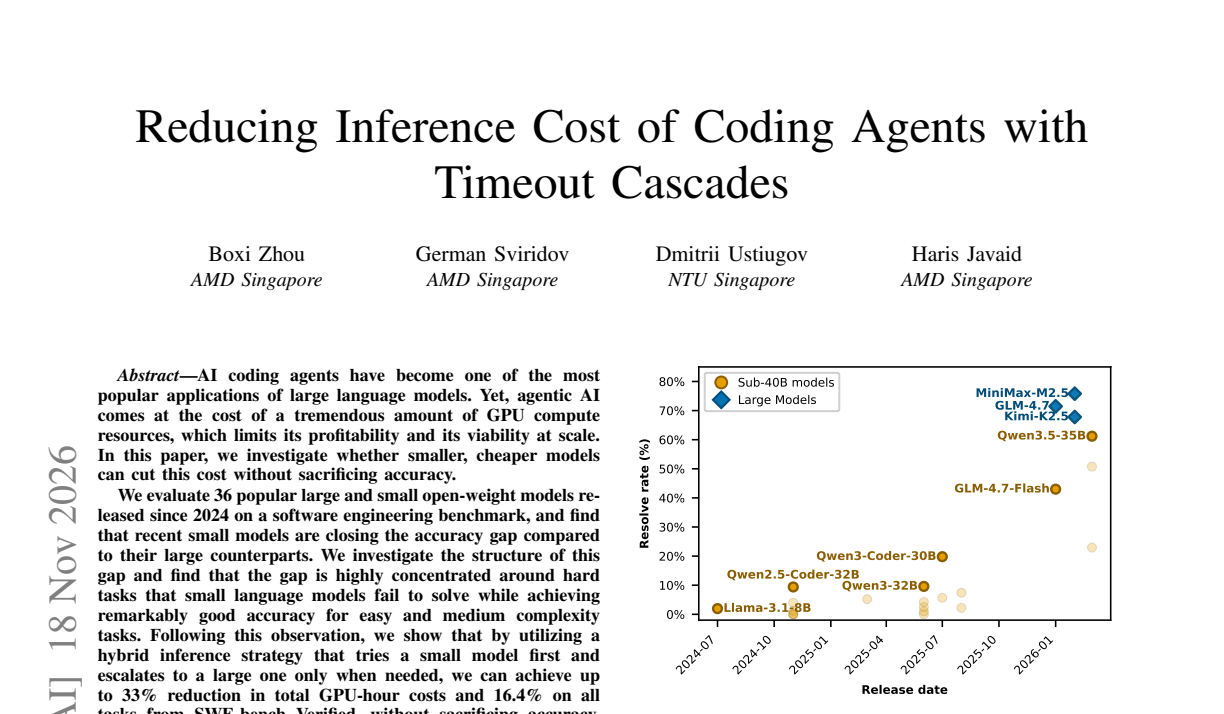
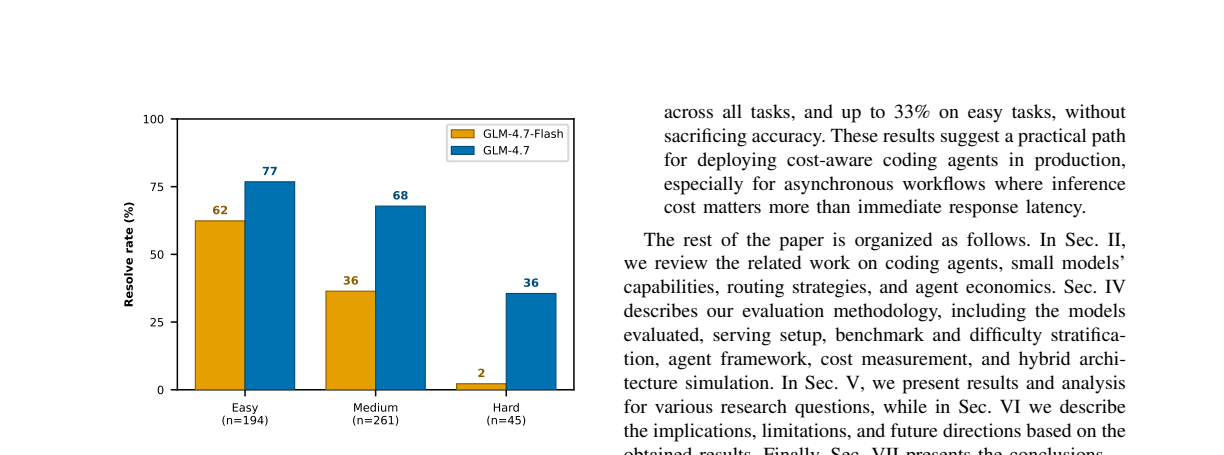
In this paper, we investigate whether smaller, cheaper models can cut this cost without sacrificing accuracy. We evaluate 36 popular large and small open-weight models released since 2024 on a software engineering benchmark, and find that recent small models are closing the accuracy gap compared to their large counterparts. We investigate the structure of this gap and find that the gap is highly concentrated around hard tasks that small language models fail to solve while achieving remarkably good accuracy for easy and medium complexity tasks. Following this observation, we show that by utilizing a hybrid inference strategy that tries a small model first and escalates to a large one only when needed, we can achieve up to 33% reduction in total GPU-hour costs and 16.4% on all tasks from SWE-bench Verified, without sacrificing accuracy. Strikingly, this simple cascade nearly matches an oracle-style task router, highlighting a practical path for deploying cost-aware coding agents in production without complex learned task routers and with minimal engineering complexity.
from the abstract
Pith says
Machine review · deepseek-v4-flash · 19 Nov 2026 · read the full text (57,359 characters) · not checked by a person
It can be wrong. Challenge this review or reply to it.
Holds up, with conditions. A timeout cascade that tries a small model first and escalates to a large one on failure or timeout reduces GPU-hour cost by 16–33% on SWE-bench Verified without accuracy loss, and nearly matches an oracle-style task router. This line is wrong
7 minor
How often objections from reviews like this one are right: not yet measured
The paper, first character to last
The reviewer was given the whole text, 57,359 characters. Not checked: figures, code, what the 22 references say.
7 minor objections
The paper says, at Section 4.5
Pith says: minor objection 1 of 7
The cost measurement equation uses wall-clock time multiplied by number of GPUs. The authors note that tasks run in parallel but charge each task as if it had exclusive GPU allocation. This is a reasonable convention for comparability, but it should be stated more prominently that the reported GPU-hour values are not actual physical GPU-hours consumed. The current phrasing in Section 4.5 is clear but could be moved earlier or highlighted.
The paper says, at Section 4.3
Pith says: minor objection 2 of 7
The difficulty stratification uses human-annotated estimates of resolution time. The paper should note whether these annotations are from the original SWE-bench dataset or derived separately. The text says 'taken from the official SWE-bench dataset metadata', which is sufficient, but a citation to the specific metadata source would be helpful.
show 5 more
The paper says, at Section 5.3, Figure 3
Pith says: minor objection 3 of 7
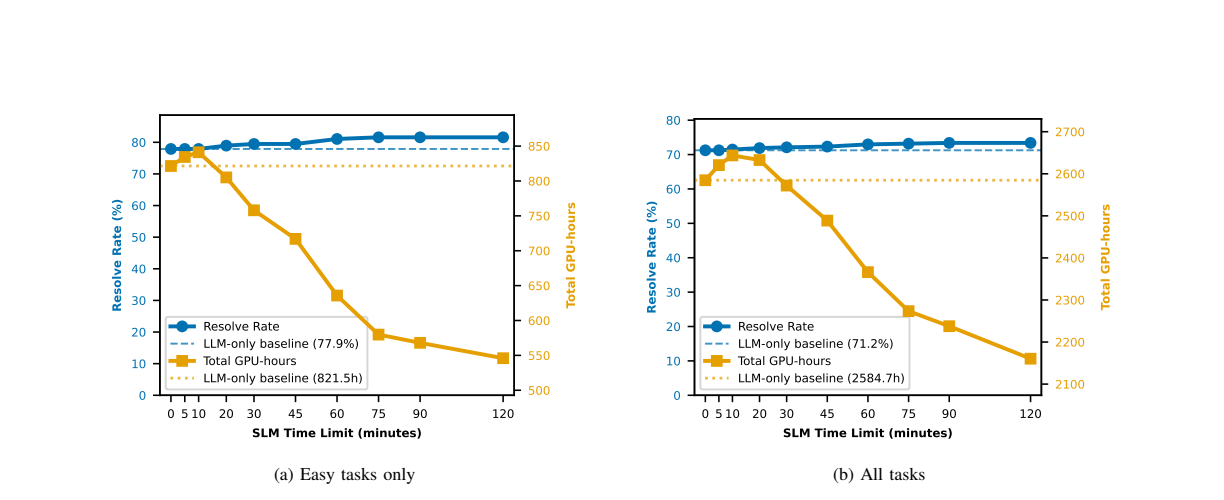
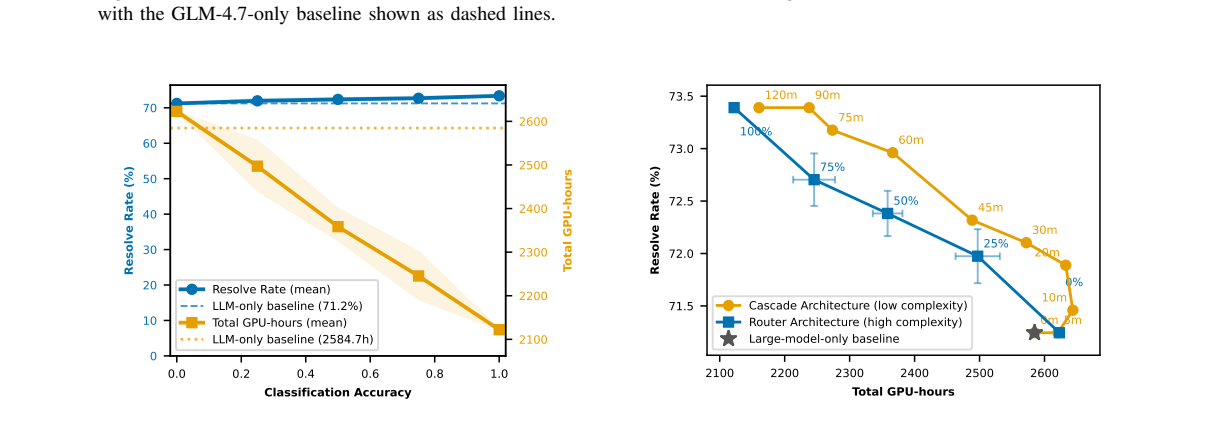
Figure 3 (cascade dual) shows resolve rate and GPU-hour cost vs. timeout. The caption says 'GLM-4.7-only baseline shown as dashed lines.' It would be helpful to also show the small-model-only baseline (GLM-4.7-Flash) to illustrate the tradeoff more completely. The current figure only compares cascade to large-model-only.
The paper says, at Section 5.4, Figure 5
Pith says: minor objection 4 of 7
Figure 5 (router) includes 'Shades indicate the maximum observed deviation from the mean across routing seeds.' The paper should explain what 'routing seeds' means in this context: are these random perturbations of the routing decision? The text mentions sweeping routing accuracy, but the error bars suggest multiple random seeds per accuracy level. This should be clarified.
The paper says, at Section 6.3
Pith says: minor objection 5 of 7
The discussion of model complementarity (Section 6.3) is appropriately cautious. However, the paper could strengthen this section by referencing the cited works on overthinking (Zhou et al., Wan et al.) more explicitly, perhaps with a brief summary of their findings to support the plausibility of complementarity.
The paper says, at Section 4.2
Pith says: minor objection 6 of 7
The serving setup uses AMD Instinct MI300X GPUs. The paper should note whether the GPU-hour costs are specific to this hardware, and whether the relative cost ratios between models would differ on other hardware (e.g., NVIDIA GPUs). This is a minor point but relevant for reproducibility.
The paper says, at Section 4.4
Pith says: minor objection 7 of 7
The agent framework uses mini-swe-agent. The paper should cite the specific version or commit of mini-swe-agent used, as the scaffold may affect results. Currently, no version is mentioned.
What would settle it
Run the same timeout cascade on a coding workload where hard tasks constitute more than 50% of the workload (e.g., a benchmark of only hard SWE-bench tasks). If the cascade's GPU-hour cost exceeds the large-model-only baseline, the central claim that the cascade reduces cost without accuracy loss would be falsified for that distribution.
from Pith's summary of the paper
How the review went
5 passes by deepseek-v4-flash · 19 Nov 2026
- Reader holds up, with conditions
- Skeptic concern withdrawn: Pith's reviewer misread the paper
- Referee 7 minor
- Check against the paper kept 0 of 5 objections
- Editor wrote the verdict above
Not run on this paper: the simulated authors' defence.
Pith's passes raised 5 objections. A check against the paper's text kept 0 and withdrew 5 (5 Pith's reviewer misread the paper).
The review in full
The review in brief, machine-written
This paper asks a practical question: can a simple timeout-based cascade—run a cheap small model first, escalate to a large model only when the small one fails or times out—cut inference cost for coding agents without hurting accuracy? The answer, on SWE-bench Verified with GLM-4.7-Flash and GLM-4.7, is yes: GPU-hour cost drops 16.4% across all tasks and up to 33% on easy tasks, while resolve rate is preserved. The cascade nearly matches an oracle-style difficulty router (17.9% reduction), suggesting that for many coding workloads, execution time itself is a good enough difficulty signal.
The paper does several things well. It evaluates 36 open-weight models under a fixed scaffold, documents where small models still fall short (the gap is concentrated in hard tasks), and simulates both cascade and router from real execution traces. The limitations are stated clearly: single-run evaluations (no error bars), one primary model pair, one benchmark, and a task distribution where 91% of items are easy or medium. The authors acknowledge that the cascade's advantage depends on that distribution and on the small model being meaningfully cheaper to serve.
The soft spots are real but bounded. The lack of uncertainty quantification means the reported cost reductions could shift with reruns. The comparison with the router uses ground-truth difficulty labels, so it is an upper bound rather than a fair comparison against a learned router. And the results may not transfer to other model pairs or harder workloads. These are not fatal; the paper is upfront about them.
Who should read this? Anyone deploying coding agents at scale who wants a low-complexity way to reduce inference cost. The paper makes a useful empirical contribution and deserves a serious referee. I would recommend acceptance with a request to add multi-run estimates for a subset of tasks and to discuss how the results might change with different model pairs or harder task distributions.
The stress test's concern
Withdrawn: Pith's reviewer misread the paper.
The paper says
“Each model--task pair is executed once due to the large scale of our evaluation.”
The referee's report
Not published. Pith's referee wrote this assessment before its objections were checked against the paper, and 4 of its 4 major objections did not survive that check.
Pith's reading of the paper (a machine's summary, not the authors')
The paper investigates whether smaller, cheaper language models can reduce the high inference cost of AI coding agents without sacrificing accuracy. By evaluating 36 open-weight models on SWE-bench Verified, the authors find that recent small models have become credible first-stage agents, with their performance gap relative to large models concentrated in hard tasks. They propose a timeout-based cascade that tries a small model first and escalates to a large model only when the small model fails or times out. On SWE-bench Verified, this cascade reduces GPU-hour cost by 16.4% across all tasks and up to 33% on easy tasks, while preserving the large model's resolve rate. Strikingly, the simple cascade nearly matches the cost reduction of an oracle-style task router that has perfect knowledge of task difficulty, suggesting that complex learned routing may be unnecessary for many coding workloads.
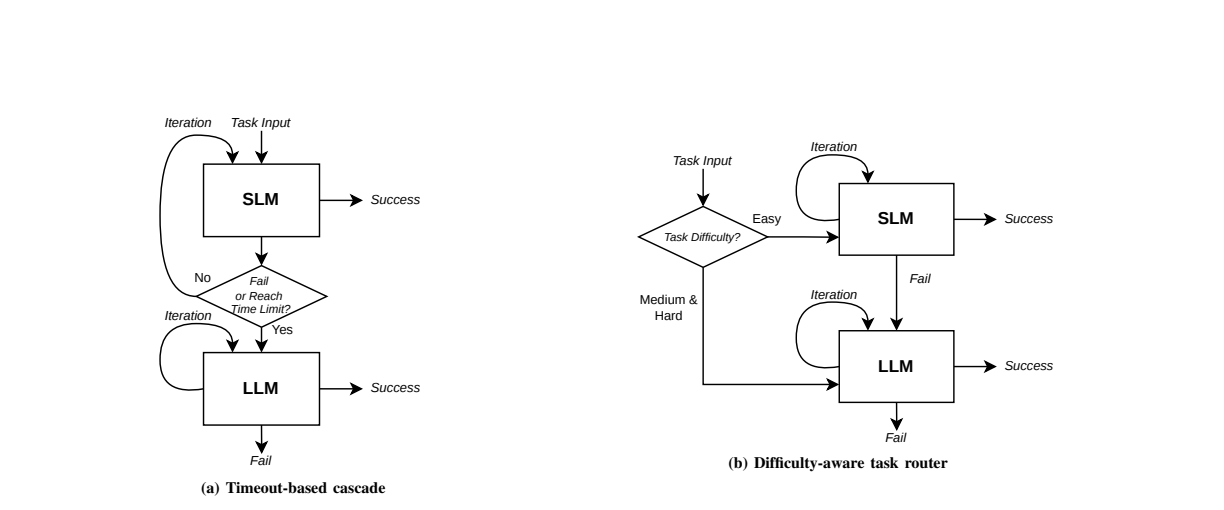
What carries the argument. The key machinery is the timeout-based cascade: a two-stage inference system where every task is first attempted by a small, cost-efficient model under a configurable time limit. If the small model produces a valid patch within the budget, the task is solved cheaply. Otherwise, the task is escalated to a large, more expensive model that restarts from scratch. The cascade exploits the observation that execution time itself serves as an implicit difficulty signal: tasks the small model can solve tend to finish within a bounded window, while harder tasks naturally exceed the budget and escalate.
Core claim. The paper's central claim is that a timeout-based cascade architecture, which routes every coding task first to a small model (GLM-4.7-Flash, 30B parameters) and escalates to a large model (GLM-4.7, 355B) only when the small model fails or exceeds a time budget, can reduce GPU-hour cost by 16.4% across all tasks and up to 33% on easy tasks on SWE-bench Verified, without sacrificing accuracy. The cascade nearly matches the cost reduction of an oracle-style task router (17.9%) that has perfect knowledge of task difficulty, challenging the assumption that sophisticated learned routing is necessary for cost-efficient coding agent deployment.
The premise it rests on. The cascade's cost savings depend on the assumption that the task distribution in the deployment workload mirrors SWE-bench Verified, where 91% of tasks are easy or medium; if a deployment were dominated by hard tasks, most first-stage attempts would fail and the cascade would approach a large-model-only system with extra overhead.
If the paper is right (Pith's inferences, not the authors')
Coding agent deployments can reduce inference cost by 16–18% without accuracy loss by using a simple timeout cascade, avoiding the complexity of training task difficulty classifiers.
The cascade is most beneficial for asynchronous workflows (e.g., background task processing) where increased wall-clock time on escalated tasks is acceptable.
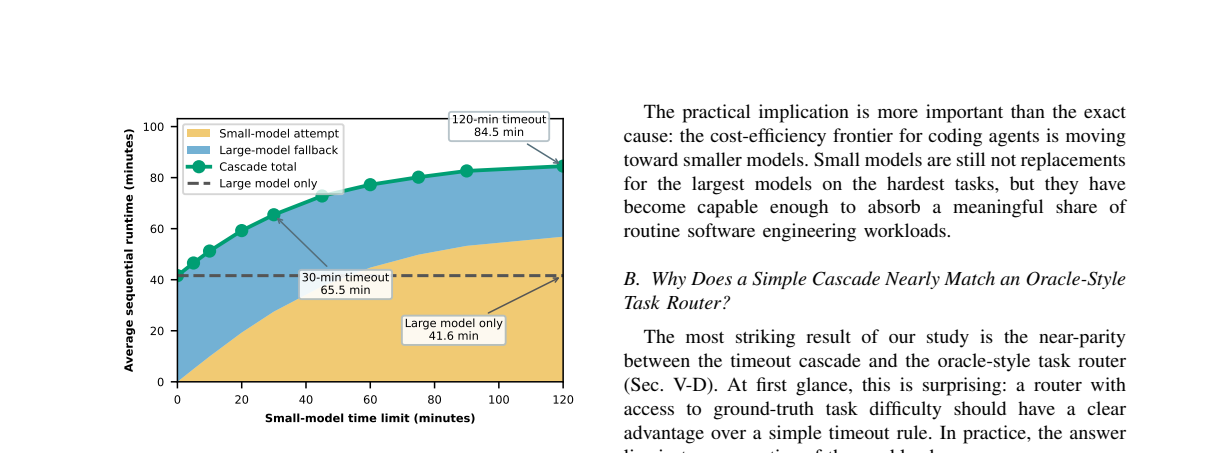
The timeout parameter becomes a tunable knob trading off GPU-hour cost against latency: longer timeouts give the small model more opportunity to solve tasks but increase sequential runtime for tasks that eventually fall back.
The finding that a simple cascade nearly matches an oracle router suggests that for many coding workloads, the value of sophisticated routing may be marginal, and practitioners should first establish a cascade baseline before investing in learned routing.
The results imply that the cost-efficiency frontier for coding agents is shifting toward smaller models, which can absorb a meaningful share of routine tasks.
The cascade's near-parity with an oracle router suggests that task difficulty prediction may be largely redundant when execution time itself is a strong proxy; this could simplify production systems for many software engineering domains.
If the observed complementarity (small model solving tasks the large model fails) holds beyond single-run variance, it would imply that model diversity, not just size, matters for robust coding agent performance, opening the door to ensemble or multi-model strategies.
The precondition that easy/medium tasks dominate the workload (91% in SWE-bench) limits direct transfer to domains with uniformly hard tasks; a testable extension would be to measure the cascade's benefit on a deployment's own task difficulty distribution before adoption.
The paper evaluates only one model pair; a systematic study of which small/large model combinations optimize the cost–accuracy tradeoff under different workload distributions would be a natural next step.
Check this review
What was read
The passes were given all 57,359 characters of the paper's LaTeX source.
Fingerprint of that text (SHA-256): f20c190b193c1f1a6d58a2917b6b82e362a3f0ea345be680a125e2a61cd8a38f
Pith does not keep that text. Rebuilt from the paper's source or PDF by the same code, it has this fingerprint if it is the same text. From a copy of Pith's code:
PYTHONPATH=. python scripts/review_input_check.py 2611.24324
The passes, in the order they ran
- Reader deepseek-v4-flash · medium effort · $0.0022 · instructions of the Reader, fingerprint f9ead7300382…
- Skeptic deepseek-v4-flash · medium effort · $0.0017 · instructions of the Skeptic, fingerprint 8f88c0f61488…
- Referee deepseek-v4-flash · medium effort · $0.0020 · instructions of the Referee, fingerprint a852d99aea0d…
- Check against the paper deepseek-v4-flash · medium effort · $0.0021 · instructions of the Check against the paper, fingerprint 6c7a6883d551…
- Editor deepseek-v4-flash · medium effort · $0.0017 · instructions of the Editor, fingerprint e7211f6a3d27…
- Circularity check deepseek-v4-flash · medium effort · $0.0016 · instructions of the Circularity check, fingerprint e9946e39d67b…
- Summary for the page deepseek-v4-flash · medium effort · temperature 0.2 · $0.0020 · instructions of the Summary for the page, fingerprint e4f56bf568e7…
The passes cost $0.013 in model calls together.
Version stamped on this review: pith-pipeline@v1.4.1-daily-deepseek-or-medium+deepseek/deepseek-v4-flash+p.d60f54226f00
Each link opens a pass's instructions as plain text, the exact bytes its fingerprint was taken over. Every stored set of instructions.
curl -s https://pith.science/methodology/prompts/f9ead730038216984cfb56d7cb34332bdf691828296a1de4245f3d6667d4bf56 | sha256sum
prints the fingerprint of the reader's instructions. The same works for every pass.
The receipt
The review's fingerprint was taken on 19 Nov 2026. The review you are reading still matches it.
Fingerprint of the review (SHA-256): 3b8a3917a71ac2e6c75e8a31b8736a7dd0d5ba0618dabc13906c323457d53f42
curl -s 'https://pith.science/api/v1/verdicts/2611.24324?form=canonical' | sha256sum
prints the fingerprint of the review as it stands now. The rule, in four steps.
A matching fingerprint shows the review has not changed since that date. It does not show that the review is right.
How often reviews like this one are right
Reviews like this one: written by deepseek-v4-flash, from the paper's LaTeX source.
How often objections from reviews like this one are right: not yet measured
Reviews by people
This review was written by a machine. No person has reviewed this paper on Pith yet. A scientist listed on Pith can review it for a fee, and their review is published here whatever it concludes.
The paper
Abstract
AI coding agents have become one of the most popular applications of large language models. Yet, agentic AI comes at the cost of a tremendous amount of GPU compute resources, which limits its profitability and its viability at scale. In this paper, we investigate whether smaller, cheaper models can cut this cost without sacrificing accuracy. We evaluate 36 popular large and small open-weight models released since 2024 on a software engineering benchmark, and find that recent small models are closing the accuracy gap compared to their large counterparts. We investigate the structure of this gap and find that the gap is highly concentrated around hard tasks that small language models fail to solve while achieving remarkably good accuracy for easy and medium complexity tasks. Following this observation, we show that by utilizing a hybrid inference strategy that tries a small model first and escalates to a large one only when needed, we can achieve up to 33% reduction in total GPU-hour costs and 16.4% on all tasks from SWE-bench Verified, without sacrificing accuracy. Strikingly, this simple cascade nearly matches an oracle-style task router, highlighting a practical path for deploying cost-aware coding agents in production without complex learned task routers and with minimal engineering complexity.
The paper's own sentences, arranged, kept beside the review and separate from it. Each label is drawn from a closed vocabulary; the number beside it is the probability the classifier gave that label. No sentence in this record was written by a model.
abstract compiled · 2026-11-19
The authors' main claim, as the classifier picked it out 0.92
“Following this observation, we show that by utilizing a hybrid inference strategy that tries a small model first and escalates to a large one only when needed, we can achieve up to 33% reduction in total GPU-hour costs and 16.4% on all tasks from SWE-bench Verified, without sacrificing accuracy.”
How the main claim is stated: asserted 1.00
What the abstract itself states, as probabilities: claims first 0.04 · states limitation 0.22 · human participants 0.03 · controlled comparison 0.74 · randomized assignment 0.02 · states quantitative result 0.99 · compares with prior results 0.86 · mentions code or data availability 0.04
The abstract, sentence by sentence
This table labels the abstract only (arXiv listing abstract v1). The number is the probability the classifier gave the label.
| Sentence | Role | The authors' own work | States the main conclusion | Strength |
|---|---|---|---|---|
| AI coding agents have become one of the most popular applications of large language models. | background 1.00 | 0.03 | 0.01 | asserted 1.00 |
| Yet, agentic AI comes at the cost of a tremendous amount of GPU compute resources, which limits its profitability and its viability at scale. | background 0.98 | 0.06 | 0.02 | asserted 1.00 |
| In this paper, we investigate whether smaller, cheaper models can cut this cost without sacrificing accuracy. | contribution 0.85 | 0.40 | 0.04 | hedged possibility 0.54 |
| We evaluate 36 popular large and small open-weight models released since 2024 on a software engineering benchmark, and find that recent small models are closing the accuracy gap compared to their large counterparts. | result 0.90 | 0.97 | 0.10 | asserted 1.00 |
| We investigate the structure of this gap and find that the gap is highly concentrated around hard tasks that small language models fail to solve while achieving remarkably good accuracy for easy and medium complexity tasks. | result 0.99 | 0.96 | 0.06 | asserted 1.00 |
| Following this observation, we show that by utilizing a hybrid inference strategy that tries a small model first and escalates to a large one only when needed, we can achieve up to 33% reduction in total GPU-hour costs and 16.4% on all tasks from SWE-bench Verified, without sacrificing accuracy. | result 0.96 | 0.96 | 0.79 | asserted 1.00 |
| Strikingly, this simple cascade nearly matches an oracle-style task router, highlighting a practical path for deploying cost-aware coding agents in production without complex learned task routers and with minimal engineering complexity. | interpretation 0.95 | 0.88 | 0.41 | asserted 0.97 |
What kind of paper the classifier reports this is: empirical study 0.52 · evidence from observation or experiment 0.99
What was examined, and what was not
Sources read
- arXiv listing abstract v1
Not examined
- full text
- figures and tables
- references and citing sentences
- relations to other papers
Levels run
- P abstract
Not run
- S sections
- T body sentences
- C citations
- R cross-paper relations
How the labels were made
Compiled by classifier-1.13.0 via TypeSafe API, question bank abstract-p1-20260923, 2026-11-19: 1 request, 5,686 input tokens.
Every quoted sentence on this record is the authors'. Every label is from Pith's closed vocabulary, with the probability shown beside it. This record as JSON
Figures (7)
Showing 6 of the paper's 7 figures. Figures are the authors', reproduced from the paper.
References (22)
- [1] C. E. Jimenez, J. Yang, A. Wettig, S. Yao, K. Pei, O. Press, and K. R. Narasimhan, “SWE-bench: Can language models resolve real-world github issues?” inThe Twelfth International Conference on Learning Representations, 2024. [Online]. Available: https://openreview.net/forum?id=... on Pith
- [2] J. Yang, C. E. Jimenez, A. Wettig, K. Lieret, S. Yao, K. R. Narasimhan, and O. Press, “SWE-agent: Agent-computer interfaces enable automated software engineering,” inThe Thirty-eighth Annual Conference on Neural Information Processing Systems, 2024. [Online]. Available: https:... on PithPith's reviewarXiv
- [3] X. Wang, B. Li, Y . Song, F. F. Xu, X. Tang, M. Zhuge, J. Pan, Y . Song, B. Li, J. Singh, H. H. Tran, F. Li, R. Ma, M. Zheng, B. Qian, Y . Shao, N. Muennighoff, Y . Zhang, B. Hui, J. Lin, R. Brennan, H. Peng, H. Ji, and G. Neubig, “Openhands: An open platform for ai software d... on PithPith's reviewarXiv
- [4] Z. Lu, X. Li, D. Cai, R. Yi, F. Liu, X. Zhang, N. D. Lane, and M. Xu, “Small language models: Survey, measurements, and insights,” 2025. [Online]. Available: https://arxiv.org/abs/2409.15790 on PithPith's reviewarXiv
- [5] P. Belcak, G. Heinrich, S. Diao, Y . Fu, X. Dong, S. Muralidharan, Y . C. Lin, and P. Molchanov, “Small language models are the future of agentic ai,” 2025. [Online]. Available: https://arxiv.org/abs/2506.02153 on PithPith's reviewarXiv
- [6] L. Chen, M. Zaharia, and J. Zou, “Frugalgpt: How to use large language models while reducing cost and improving performance,” on Pith
- [7] D. Ding, A. Mallick, C. Wang, R. Sim, S. Mukherjee, V . Ruhle, L. V . S. Lakshmanan, and A. H. Awadallah, “Hybrid llm: Cost- efficient and quality-aware query routing,” 2024. [Online]. Available: https://arxiv.org/abs/2404.14618 on PithPith's reviewarXiv
- [8] D. Ding, A. Mallick, S. Zhang, C. Wang, D. Madrigal, M. D. C. H. Garcia, M. Xia, L. V . S. Lakshmanan, Q. Wu, and V . R ¨uhle, “Best-route: Adaptive llm routing with test-time optimal compute,” on Pith
- [9] I. Ong, A. Almahairi, V . Wu, W.-L. Chiang, T. Wu, J. E. Gonzalez, M. W. Kadous, and I. Stoica, “Routellm: Learning to route llms with preference data,” 2025. [Online]. Available: https://arxiv.org/abs/2406.18665 on PithPith's reviewarXiv
- [10] K. Handa, A. Tamkin, M. McCain, S. Huang, E. Durmus, S. Heck, J. Mueller, J. Hong, S. Ritchie, T. Belonax, K. K. Troy, D. Amodei, J. Kaplan, J. Clark, and D. Ganguli, “Which economic tasks are performed with ai? evidence from millions of claude conversations,” on Pith
- [11] M. Massenkoff, E. Lyubich, P. McCrory, R. Appel, and R. Heller. (2026) Anthropic economic index report: Learning curves. [Online]. Available: https://www.anthropic.com/research/economic-index-march-2026-report on Pith
- [12] N. Lecomte, “The truth about ai agent development costs: Why traditional sandbox billing breaks for coding agent workloads,” Blaxel Blog, Apr. 2026, industry blog post. [Online]. Available: https://blaxel.ai/blog/ai-agent-development-costs on Pith
- [13] [Online]. Available: https://arxiv.org/abs/2503.04761 on PithPith's reviewarXiv
- [14] LangChain Team, “Introducing open swe: An open-source asynchronous coding agent,” LangChain Blog, Aug. 2025, accessed: 2026-05-06. [Online]. Available: https://www.langchain.com/blog/introducing-open- swe-an-open-source-asynchronous-coding-agent on Pith
- [15] S. Zhou, R. Ling, J. Chen, X. Wang, T. Fan, and H. Wang, “When more thinking hurts: Overthinking in llm test-time compute scaling,” on Pith
- [16] Google, “Build with jules, your asynchronous coding agent,” Google Blog, May 2025, accessed: 2026-05-06. [Online]. Avail- able: https://blog.google/innovation-and-ai/models-and-research/google- labs/jules/ on Pith
- [17] Y . Leviathan, M. Kalman, and Y . Matias, “Fast inference from transform- ers via speculative decoding,” inInternational Conference on Machine Learning. PMLR, 2023, pp. 19 274–19 286 on Pith
- [20] Q. Wan, Z. Xu, L. Wei, X. Shen, and J. Sun, “Mitigating overthinking in large reasoning models via difficulty-aware reinforcement learning,” on Pith
- [21] [Online]. Available: https://arxiv.org/abs/2601.21418 on PitharXiv
- [2023] [Online]. Available: https://arxiv.org/abs/2305.05176 on PithPith's reviewarXiv
show 2 more
- [2025] [Online]. Available: https://arxiv.org/abs/2506.22716 on PithPith's reviewarXiv
- [2026] [Online]. Available: https://arxiv.org/abs/2604.10739 on PithPith's reviewarXiv
Challenges and discussion
Disagree with the review, or know something it missed? Leave a comment, or challenge this review formally: a challenge becomes a permanent entry in this paper's record, and its decision is published here.
Come back by email
A short list of the week's newly reviewed papers. Nothing is sent until you confirm from your inbox, and every email has a link that stops it. No account.
No comments yet.
Sign in to comment