Artificial Intelligence · arXiv:2611.25613 v2 · submitted 19 Nov 2026
Can an LLM Repair a Language Model in Weight Space Without Gradient Training?
The paper says
“Although an external language model can select and test repairs to another model's weights, behavior can also be recovered through fixed numerical edits. We assessed the value of interactive selection in a controlled study of Transformer repair.”
more of the abstract
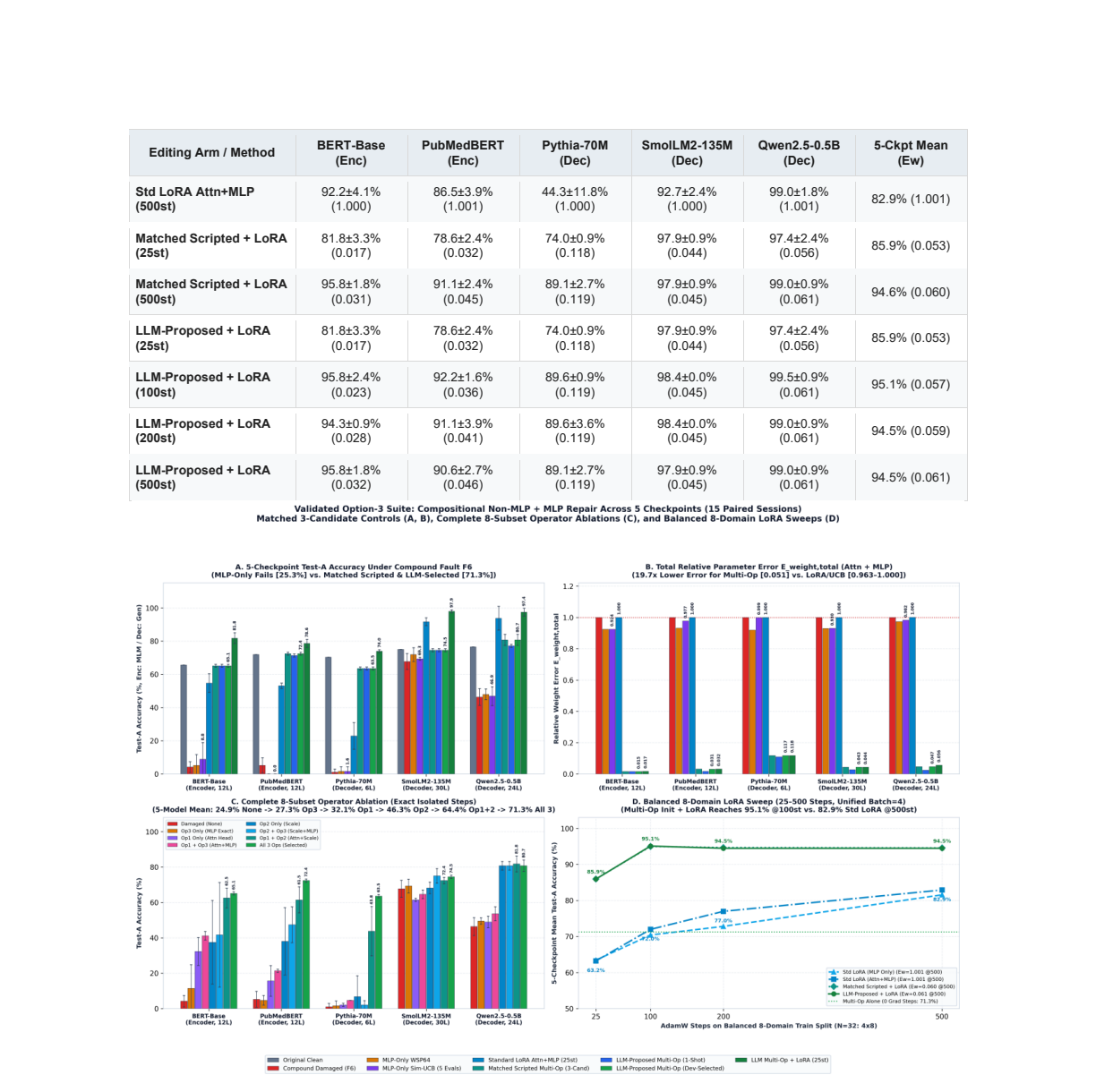
After inspecting predictions, activation summaries, and weight statistics, the editor selects projection recipes to apply to the target without gradient updates. We analyzed 20 recorded sessions involving five masked and causal language models, comparing the selected edits with fixed projections, scripted and matched-budget black-box search, and low-rank adaptation. Under the core two-layer fault, live selection matches black-box search on SmolLM2 and Qwen2.5. For Pythia, live selection achieves 65.62% completion accuracy, compared with 0% for black-box search and 66.15% for a fixed projection. Under a separate compound fault affecting attention and feed-forward weights, both scripted and LLM-guided selection increase the descriptive five-checkpoint mean from 24.89% to 71.25% using the same operator family. On unmodified checkpoints, scripted projection yields small gains or losses on a separate set of framed questions. The experiments identify cases in which feedback changes an edit decision, operator coverage accounts for recovery, or supervised adaptation performs better. Combined with measurements of parameter restoration and preservation, these comparisons establish the scope of controller-guided repair for the tested faults and completion tasks.
from the abstract
Pith says
Machine review · deepseek-v4-flash · 20 Nov 2026 · of version 1 of the paper; version 2 is newer · read the full text (93,373 characters) · not checked by a person
It can be wrong. Challenge this review or reply to it.
Holds up. A controlled benchmark comparing LLM-guided weight editing to fixed, scripted, and black-box methods shows that feedback helps in selected cases but fixed projections are often competitive on the tested low-rank faults. This line is wrong
5 minor
How often objections from reviews like this one are right: not yet measured
The paper, first character to last
The reviewer was given the whole text, 93,373 characters. Not checked: figures, code, what the references say.
5 minor objections
The paper says, at 6.1 Table 1
Pith says: minor objection 1 of 5
The table caption says "A scores show percent mean and sample SD; B scores show percent mean." It would be helpful to also provide SD for Test B scores, especially for Qwen2.5 where the first-candidate A score has a very large SD of 38.82.
The paper says, at 6.2 Table 2
Pith says: minor objection 2 of 5
The row "Live LLM first candidate" has the same values as "Position projection" for many targets. This is informative, but the table would be easier to read if identical values were visually connected or noted.
show 3 more
The paper says, at 7 / Table 10
Pith says: minor objection 3 of 5
The natural-completion study uses only 96 framed variants (24 base questions × 4 framings). The conclusion that "Small Qwen gains coexist with losses on other targets" is accurate, but the sample size is too small to draw any reliable inference about unmodified models. The paper already calls this exploratory; that qualification should be repeated more prominently in the abstract or conclusion.
The paper says, at 8 / Table 12
Pith says: minor objection 4 of 5
The compound-fault comparison shows that "LLM-Proposed Dev-Sel (31)" achieves exactly the same 71.25% mean as "Matched Scripted 3-Cand (29)". The paper states "the observed tie directly interpretable" (Section 1.2). It would strengthen the report to explicitly note that this tie means the LLM added no value over a simple scripted sweep in this setting.
The paper says, at 3.4
Pith says: minor objection 5 of 5
The description of session recording says "Three BERT conversation identifiers are absent; all editor model fields use a generic role identifier." This is already acknowledged as a limitation, but it would improve reproducibility to specify the exact LLM provider and version used for the BERT sessions, even if the conversation logs are lost.
What would settle it
If a natural, high-rank failure (for example, from extended fine-tuning on a different distribution) could be identified and the same fixed projection failed to restore behavior while an LLM-guided repair succeeded, that would contradict the paper's claim that the operator accounts for most recovery gains.
from Pith's summary of the paper
How the review went
5 passes by deepseek-v4-flash · 20 Nov 2026
- Reader holds up
- Skeptic concern withdrawn: the paper already says this
- Referee 5 minor
- Check against the paper kept 0 of 3 objections
- Editor wrote the verdict above
Not run on this paper: the simulated authors' defence.
Pith's passes raised 3 objections. A check against the paper's text kept 0 and withdrew 3 (3 the paper already says).
The review in full
The review in brief, machine-written
This paper asks a practical question: when an LLM picks a weight edit for a damaged transformer, how much of the recovery comes from the LLM's choice and how much from the numerical projection operator itself? The authors build a careful benchmark—five compact models, injected low-rank faults, a shared projection primitive, and multiple comparison policies (fixed projection, scripted search, black-box optimization, LoRA). The main finding is honest and unsurprising: for the core two-layer MLP fault, a fixed position projection recovers behavior nearly as well as live LLM selection on most targets. Live feedback makes a concrete difference in a few recorded cases (e.g., Qwen switching from a poor position-contrast direction to a spectral one), and it can outperform black-box search when faults are wider or distributed across more layers. The compound-fault experiment shows that both scripted and LLM-guided selection reach the same mean recovery when given the same operator family—the advantage is the operator suite itself, not the controller.
The experiments are extensive and transparent. All five targets have three seeds; many conditions add two more. The paper reports task accuracy, weight restoration error, a held-out context shift, and small preservation probes. The authors include an automated audit that checks arithmetic against raw binary vectors and report a 100% match. They also state their limitations plainly: faults are deliberately low-rank, seed counts are low, the information boundary is an interface protocol rather than an OS-level sandbox, and several adaptation implementations have not been verified against official references. These are real constraints, but the paper does not overclaim.
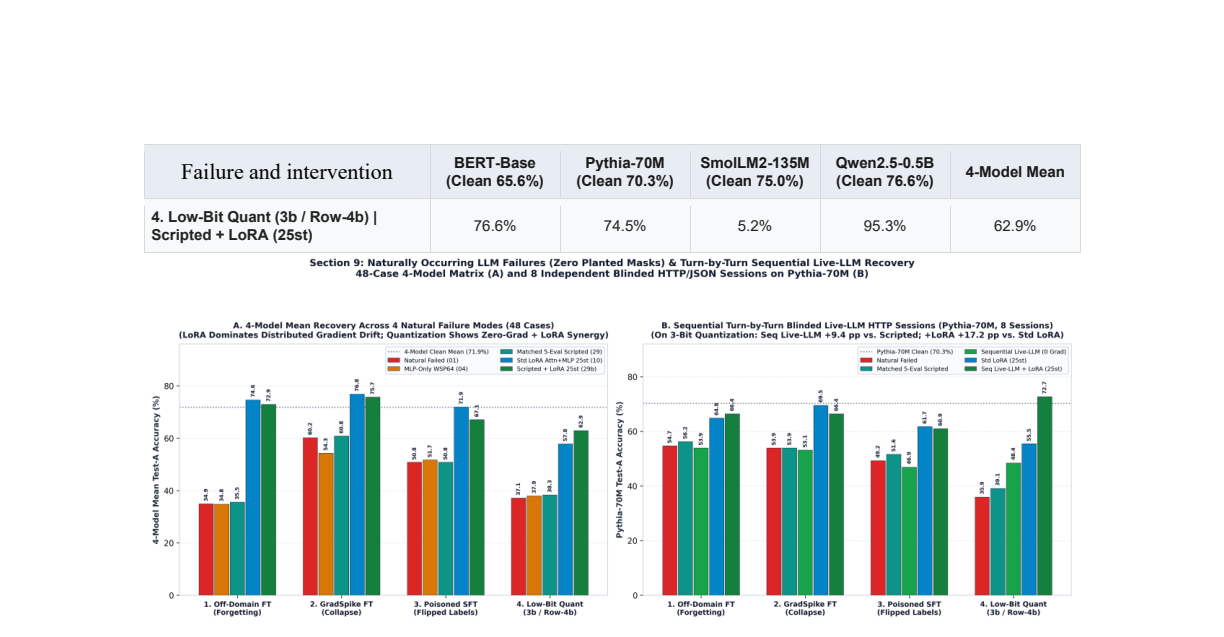
Where the paper is softest is in generalization to natural failures. The faults are constructed to be nearly invertible by a projection operation, and the task is a narrow adjective-completion probe. The exploratory study on unmodified checkpoints shows only small, inconsistent gains. The training-induced and quantization failures show limited recovery from projection alone, while LoRA often does better. The paper's own conclusion is appropriately cautious: the results establish the scope of controller-guided repair for the tested faults and tasks.
Who should read this? Researchers working on model editing, weight-space programming, or controlled recovery benchmarks. The paper does not reshape the field, but it provides a solid, reproducible comparison that clarifies when an LLM's interactive selection adds value and when a fixed rule suffices. It deserves a serious referee.
The stress test's concern
Withdrawn: the paper already says this.
The paper says
“The information boundary is an interface and instruction protocol. Shared host state, descriptive initialization metadata, an accessible audit action and missing complete provider conversations prevent a stronger claim of independently verified secure blinding.”
The referee's report
Not published. Pith's referee wrote this assessment before its objections were checked against the paper, and 2 of its 2 major objections did not survive that check.
Pith's reading of the paper (a machine's summary, not the authors')
This paper investigates how much of the gain from using an LLM to repair another model's weights comes from the LLM's choices versus the underlying numerical operation. The authors construct controlled low-rank faults in Transformer weight matrices and compare live LLM-guided projections with fixed projections, scripted searches, and black-box optimization. Across five models and a core two-layer MLP fault, fixed position projection recovers task accuracy to within a few points of the original, and matches or exceeds the LLM's first candidate on several targets. The LLM's interactive feedback helps in some cases but does not consistently outperform scripted baselines. The paper concludes that the shared projection operator largely accounts for recovery, while selection and composition add value in specific settings such as compound faults or wider damage.
What carries the argument. The central operation is a projection: $W_{r,\ell} = W_{d,\ell} - \alpha U_\ell U_\ell^\top W_{d,\ell} M_\ell$, where $U_\ell$ contains orthonormal directions in the MLP output space, $M_\ell$ masks selected input columns, and $\alpha$ controls strength. This operation removes the component of each selected column that lies along the estimated fault direction. It is shared by live LLM, fixed position projection, weight-SVD projection, and all scripted variants. What differs is how layers, directions, support, rank and strength are chosen. The paper systematically compares these choices.
Core claim. The paper establishes that a tool-using language model can inspect a damaged Transformer's weights and request projection repairs, but its advantage is selective rather than general. On the core two-layer fault, fixed position projection achieves 74.48% on SmolLM2 and 66.15% on Pythia, compared to live feedback scores of 74.48% and 65.62%. Under a compound fault affecting both attention and MLP layers, both scripted and LLM-guided selection raise the mean from 24.89% to 71.25% using the same operator family. The key finding is that the numerical projection operator (subtracting the component of damaged columns along an estimated basis) is the primary driver of recovery; the LLM's role is to select among recipes, layers, and supports, a role that a scripted policy can often replicate.
The premise it rests on. Faults are deliberately constructed to be low-rank and localized, so the available projection operator can express an approximate inverse; the paper states that the repair family is well matched to the construction, which limits generalization to naturally occurring or higher-rank failures.
If the paper is right (Pith's inferences, not the authors')
For localized low-rank faults, simple deterministic projection can restore task behavior without any LLM, saving compute and complexity.
When faults span multiple components (attention heads and MLP layers), both scripted and LLM-guided selectors achieve similar recovery, suggesting that operator coverage matters more than the selection mechanism.
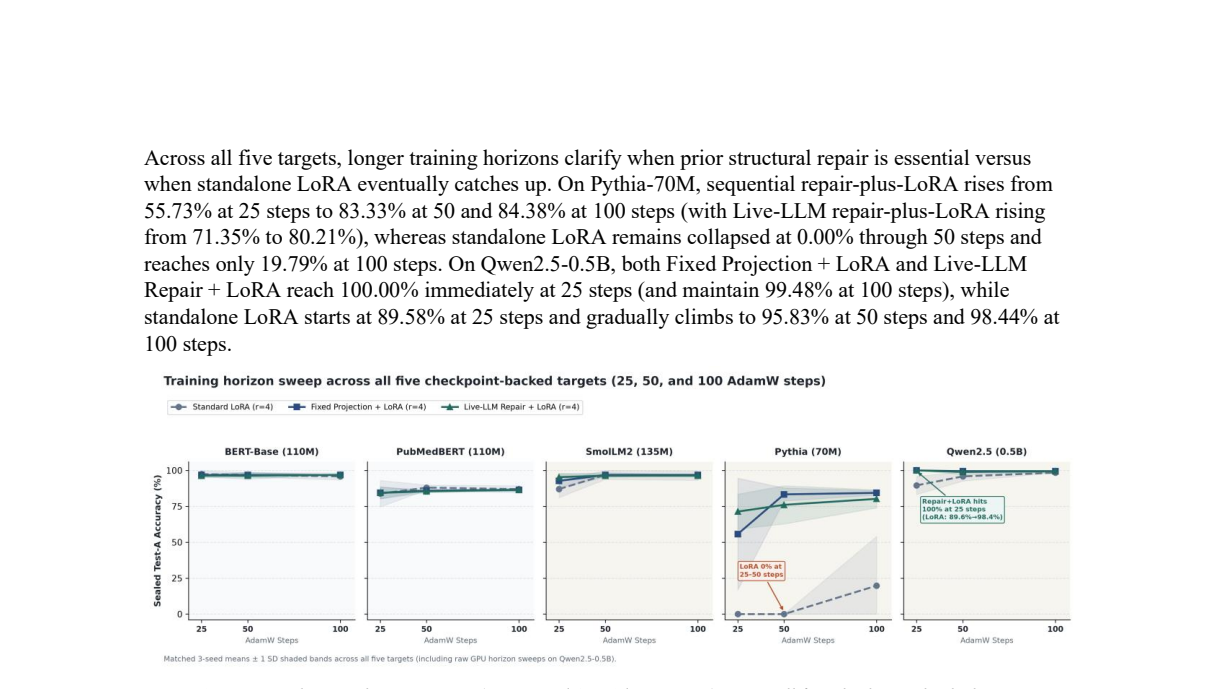
Repair before low-rank adaptation (LoRA) often improves results over training on the damaged base, especially on models like Pythia-70M where direct LoRA collapses.
The narrow adjective-completion task and controlled fault construction limit generalization claims; broader benchmarks are needed to assess practical applicability.
The study provides a methodology for isolating the contribution of selection versus numerical operation in weight-space editing.
The results imply that for many practical faults, a fixed projection recipe (e.g., using activation contrast or weight SVD) may suffice, making LLM-based controllers unnecessary for simple restoration.
The paper's information-boundary limitations (shared host state, accessible audit actions, missing conversation recording) suggest that future experiments should enforce stronger isolation to guarantee blinding.
The compound-fault experiment shows that multi-operator repair can be automated via a scripted selector; this raises the question of whether learned policies could further improve selection without an LLM.
Because the faults are deliberately low-rank and well-matched to projection, the paper does not address high-rank or unstructured damage where LLM insight might become critical.
Check this review
What was read
The passes were given all 93,373 characters of the text of the paper's PDF.
Fingerprint of that text (SHA-256): 2711505d3e0ced23f2c3ac35b85e4fcd595bceff846febcc51a8b58d291d4d11
Pith does not keep that text. Rebuilt from the paper's source or PDF by the same code, it has this fingerprint if it is the same text. From a copy of Pith's code:
PYTHONPATH=. python scripts/review_input_check.py 2611.25613
The passes, in the order they ran
- Reader deepseek-v4-flash · medium effort · $0.0021 · instructions of the Reader, fingerprint f9ead7300382…
- Skeptic deepseek-v4-flash · medium effort · $0.0018 · instructions of the Skeptic, fingerprint 8f88c0f61488…
- Referee deepseek-v4-flash · medium effort · $0.0019 · instructions of the Referee, fingerprint a852d99aea0d…
- Check against the paper deepseek-v4-flash · medium effort · $0.0020 · instructions of the Check against the paper, fingerprint 6c7a6883d551…
- Editor deepseek-v4-flash · medium effort · $0.0017 · instructions of the Editor, fingerprint e7211f6a3d27…
- Circularity check deepseek-v4-flash · medium effort · $0.0016 · instructions of the Circularity check, fingerprint e9946e39d67b…
- Summary for the page deepseek-v4-flash · medium effort · temperature 0.2 · $0.0019 · instructions of the Summary for the page, fingerprint e4f56bf568e7…
The passes cost $0.013 in model calls together.
Version stamped on this review: pith-pipeline@v1.4.1-daily-deepseek-or-medium+deepseek/deepseek-v4-flash+p.d60f54226f00
Each link opens a pass's instructions as plain text, the exact bytes its fingerprint was taken over. Every stored set of instructions.
curl -s https://pith.science/methodology/prompts/f9ead730038216984cfb56d7cb34332bdf691828296a1de4245f3d6667d4bf56 | sha256sum
prints the fingerprint of the reader's instructions. The same works for every pass.
The receipt
The review's fingerprint was taken on 20 Nov 2026. The review you are reading still matches it.
Fingerprint of the review (SHA-256): 4c50f26055c970892e0b29dbd8bc6b421e3cad9f76be03b17c835588531b552d
curl -s 'https://pith.science/api/v1/verdicts/2611.25613?form=canonical' | sha256sum
prints the fingerprint of the review as it stands now. The rule, in four steps.
A matching fingerprint shows the review has not changed since that date. It does not show that the review is right.
How often reviews like this one are right
Reviews like this one: written by deepseek-v4-flash, from the text of the paper's PDF.
How often objections from reviews like this one are right: not yet measured
Reviews by people
This review was written by a machine. No person has reviewed this paper on Pith yet. A scientist listed on Pith can review it for a fee, and their review is published here whatever it concludes.
The paper
Abstract
Although an external language model can select and test repairs to another model's weights, behavior can also be recovered through fixed numerical edits. We assessed the value of interactive selection in a controlled study of Transformer repair. After inspecting predictions, activation summaries, and weight statistics, the editor selects projection recipes to apply to the target without gradient updates. We analyzed 20 recorded sessions involving five masked and causal language models, comparing the selected edits with fixed projections, scripted and matched-budget black-box search, and low-rank adaptation. Under the core two-layer fault, live selection matches black-box search on SmolLM2 and Qwen2.5. For Pythia, live selection achieves 65.62% completion accuracy, compared with 0% for black-box search and 66.15% for a fixed projection. Under a separate compound fault affecting attention and feed-forward weights, both scripted and LLM-guided selection increase the descriptive five-checkpoint mean from 24.89% to 71.25% using the same operator family. On unmodified checkpoints, scripted projection yields small gains or losses on a separate set of framed questions. The experiments identify cases in which feedback changes an edit decision, operator coverage accounts for recovery, or supervised adaptation performs better. Combined with measurements of parameter restoration and preservation, these comparisons establish the scope of controller-guided repair for the tested faults and completion tasks.
The paper's own sentences, arranged, kept beside the review and separate from it. Each label is drawn from a closed vocabulary; the number beside it is the probability the classifier gave that label. No sentence in this record was written by a model.
abstract compiled · 2026-11-20
The authors' main claim, as the classifier picked it out 0.64
“Combined with measurements of parameter restoration and preservation, these comparisons establish the scope of controller-guided repair for the tested faults and completion tasks.”
How the main claim is stated: asserted 1.00
What the abstract itself states, as probabilities: claims first 0.04 · states limitation 0.71 · human participants 0.14 · controlled comparison 0.94 · randomized assignment 0.03 · states quantitative result 0.99 · compares with prior results 0.97 · mentions code or data availability 0.03
The abstract, sentence by sentence
This table labels the abstract only (arXiv listing abstract v1). The number is the probability the classifier gave the label.
| Sentence | Role | The authors' own work | States the main conclusion | Strength |
|---|---|---|---|---|
| Although an external language model can select and test repairs to another model's weights, behavior can also be recovered through fixed numerical edits. | background 0.94 | 0.18 | 0.29 | asserted 0.57 |
| We assessed the value of interactive selection in a controlled study of Transformer repair. | contribution 0.95 | 0.93 | 0.04 | asserted 0.92 |
| After inspecting predictions, activation summaries, and weight statistics, the editor selects projection recipes to apply to the target without gradient updates. | method 0.99 | 0.78 | 0.06 | asserted 0.97 |
| We analyzed 20 recorded sessions involving five masked and causal language models, comparing the selected edits with fixed projections, scripted and matched-budget black-box search, and low-rank adaptation. | method 0.86 | 0.95 | 0.05 | asserted 0.98 |
| Under the core two-layer fault, live selection matches black-box search on SmolLM2 and Qwen2.5. | result 1.00 | 0.94 | 0.17 | asserted 1.00 |
| For Pythia, live selection achieves 65.62% completion accuracy, compared with 0% for black-box search and 66.15% for a fixed projection. | result 1.00 | 0.96 | 0.11 | asserted 1.00 |
| Under a separate compound fault affecting attention and feed-forward weights, both scripted and LLM-guided selection increase the descriptive five-checkpoint mean from 24.89% to 71.25% using the same operator family. | result 1.00 | 0.96 | 0.13 | asserted 1.00 |
| On unmodified checkpoints, scripted projection yields small gains or losses on a separate set of framed questions. | result 0.99 | 0.92 | 0.04 | asserted 0.98 |
| The experiments identify cases in which feedback changes an edit decision, operator coverage accounts for recovery, or supervised adaptation performs better. | interpretation 0.54 | 0.94 | 0.24 | asserted 0.99 |
| Combined with measurements of parameter restoration and preservation, these comparisons establish the scope of controller-guided repair for the tested faults and completion tasks. | interpretation 0.94 | 0.93 | 0.36 | asserted 1.00 |
What kind of paper the classifier reports this is: empirical study 1.00 · evidence from observation or experiment 0.99
What was examined, and what was not
Sources read
- arXiv listing abstract v1
Not examined
- full text
- figures and tables
- references and citing sentences
- relations to other papers
Levels run
- P abstract
Not run
- S sections
- T body sentences
- C citations
- R cross-paper relations
How the labels were made
Compiled by classifier-1.13.0 via TypeSafe API, question bank abstract-p1-20260923, 2026-11-20: 1 request, 7,551 input tokens.
Every quoted sentence on this record is the authors'. Every label is from Pith's closed vocabulary, with the probability shown beside it. This record as JSON
Figures (12)



Figures are the authors', reproduced from the paper.
Challenges and discussion
Disagree with the review, or know something it missed? Leave a comment, or challenge this review formally: a challenge becomes a permanent entry in this paper's record, and its decision is published here.
Come back by email
A short list of the week's newly reviewed papers. Nothing is sent until you confirm from your inbox, and every email has a link that stops it. No account.
No comments yet.
Sign in to comment