Quantum Physics · arXiv:2611.27640 v1 · submitted 20 Nov 2026 · 22 references
Ancilla-Free Exact Dicke-State Synthesis with Optimal Size and Depth
The paper says
“We construct exact circuits for n-qubit Dicke states of any Hamming weight k using O(n) single-qubit gates and CNOTs in O(logn) depth without ancillary qubits. The gate count and depth are asymptotically optimal for every 0 < k < n.”
more of the abstract
We compress symmetric blocks to free output qubits for weight-dependent phases. A sign correction followed by a collective rotation produces a state whose overlap with the target is at least a positive constant, so exact amplitude amplification takes O(1) steps. For balanced Dicke states ($k=\lfloor n/2\rfloor$), the logarithmic depth disproves the Ω(k) depth lower bound conjectured by Yuan and Zhang (2025).
from the abstract
Pith says
Machine review · deepseek-v4-flash · 23 Nov 2026 · read the full text (52,187 characters) · not checked by a person
It can be wrong. Challenge this review or reply to it.
Holds up. This paper gives ancilla-free circuits that prepare any n-qubit Dicke state exactly with O(n) gates and O(log n) depth, asymptotically optimal for all nontrivial weights. This line is wrong
4 minor · 1 open question
How often objections from reviews like this one are right: not yet measured
The paper, first character to last
The reviewer was given the whole text, 52,187 characters. Not checked: figures, code, what the 22 references say.
4 minor objections
The paper says, at §4.2, equation (14)
Pith says: minor objection 1 of 4
In equation (14), the term 3√n θ/(2σ) appears. For small σ (e.g., k=1), this term can be large, but the proof only applies the bound when σ ≥ 48, so it is fine. Consider adding a remark to clarify the regime of validity.
The paper says, at §3, proof of Lemma 1
Pith says: minor objection 2 of 4
The depth analysis of the phase circuit in Lemma 1 states that the phase stage uses O(ℓ+1) depth, but the high-order cases are processed sequentially (as described in the proof). Since there are 8 high-order cases, the depth is multiplied by a constant factor, which does not affect the asymptotic bound. The text could be clearer on this point.
show 2 more
The paper says, at Abstract
Pith says: minor objection 3 of 4
The abstract on arXiv states 'O(log n) depth' while the manuscript uses 'O(log(n+1)) depth' in Lemma 1. This is consistent, but the abstract could be slightly more precise.
The paper says, at §3, equation (16)
Pith says: minor objection 4 of 4
In the proof of Lemma 1, the space bound (16) uses the inequality 2L = 2^{m-2} ≤ n/2. For n=32, m=6, L=16, 2L=32, which equals n, not ≤ n/2. The inequality holds for n≥64; for n=32, the bound can be checked directly. Consider noting that the constant factors are chosen for large n and the small-n case is handled separately.
Open questions (1)
Pith raised these and could not confirm them against the text of the paper it read. They are questions for the authors, not findings.
- §4, proof of Lemma 2 Pith raised a concern here that it could not check against the text of the paper it was given, so it is not published as an objection.
What would settle it
Implement Algorithm 1 for n=32,64,128,256 and k=n/2, n/4, n/8; compute the squared overlap F^2 for each candidate d and verify that the maximum is at least (1/128)^2. If any case falls below, the constant-overlap claim would be falsified.
from the skeptic's reading
How the review went
5 passes by deepseek-v4-flash · 23 Nov 2026
- Reader holds up
- Skeptic disagrees
- Referee 4 minor
- Check against the paper kept 0 of 1 objection
- Editor wrote the verdict above
Not run on this paper: the simulated authors' defence.
Pith's passes raised 1 objection. A check against the paper's text kept 0 and left 1 as a question.
The review in full
The review in brief, machine-written
The paper resolves a long-standing open problem: exact, ancilla-free preparation of every Dicke state with asymptotically optimal gate count and depth. The construction combines a constant-overlap initial state (via sign correction and collective rotation) with ancilla-free weight-dependent phase circuits and a constant number of amplitude amplification steps. The result disproves a recent conjecture by Yuan and Zhang that balanced Dicke states require Ω(k) depth. The proofs are mathematically detailed, with explicit recurrences, space accounting, and Bessel-function estimates. The classical generation algorithm runs in polynomial time. The paper is a substantive advance in quantum circuit synthesis. The weakest point is the constant-overlap bound (Lemma 4), which relies on a quantum walk approximation and Bessel-function bounds; the constant 1/128 is derived analytically but the derivation involves several approximations whose tightness could be checked more carefully. The phase-circuit construction is intricate and uses many temporary qubits within the output register, but the space bound is explicitly verified. The authors acknowledge that future work should optimize the phase circuits and adapt to finite gate sets and restricted connectivity. This paper deserves a serious referee. I recommend sending it to peer review.
The strongest objection
After careful review, the central argument appears sound. The constant-overlap bound (Lemma 1) is derived with explicit constants and a two-case analysis; the quantum walk approximation and Bessel function bounds are correctly applied and the resulting overlap of at least 1/128 is sufficient for O(1) amplification steps. The phase circuit construction (Lemma 2) provides a detailed space and depth analysis that fits within the n output qubits. No hidden assumptions or gaps were found that would threaten the main claim.
The reader's weakest assumption concerned potential errors in the constant factors of the overlap bound. However, the derivation in Lemma 1 is explicit and the constants are correctly computed. The two-case analysis covers both small and large sigma. The quantum walk comparison uses standard Duhamel and Bessel bounds with careful constant tracking. The resulting overlap of 1/128 is a conservative bound. The phase circuit construction is also detailed and the space analysis appears correct. Therefore, I see no need to adjust the verdict.
The referee's report
Not published. Pith's referee wrote this assessment before its objections were checked against the paper, and 1 of its 1 major objections did not survive that check.
Pith's reading of the paper (a machine's summary, not the authors')
The paper claims to construct exact quantum circuits that prepare any n-qubit Dicke state using only O(n) gates and O(log n) depth, without any additional ancillary qubits. This matches the known lower bounds for both gate count and depth, so the construction is asymptotically optimal for all nontrivial weights. For balanced Dicke states (k ≈ n/2), the logarithmic depth contradicts a previously conjectured Ω(k) depth lower bound. The key idea is to prepare an initial state with constant overlap to the target using a sign correction and collective rotation, then apply a constant number of amplitude amplification steps. The weight-dependent phase operations needed for sign correction and amplification are implemented within the output register by compressing symmetric blocks and using reversible addition.
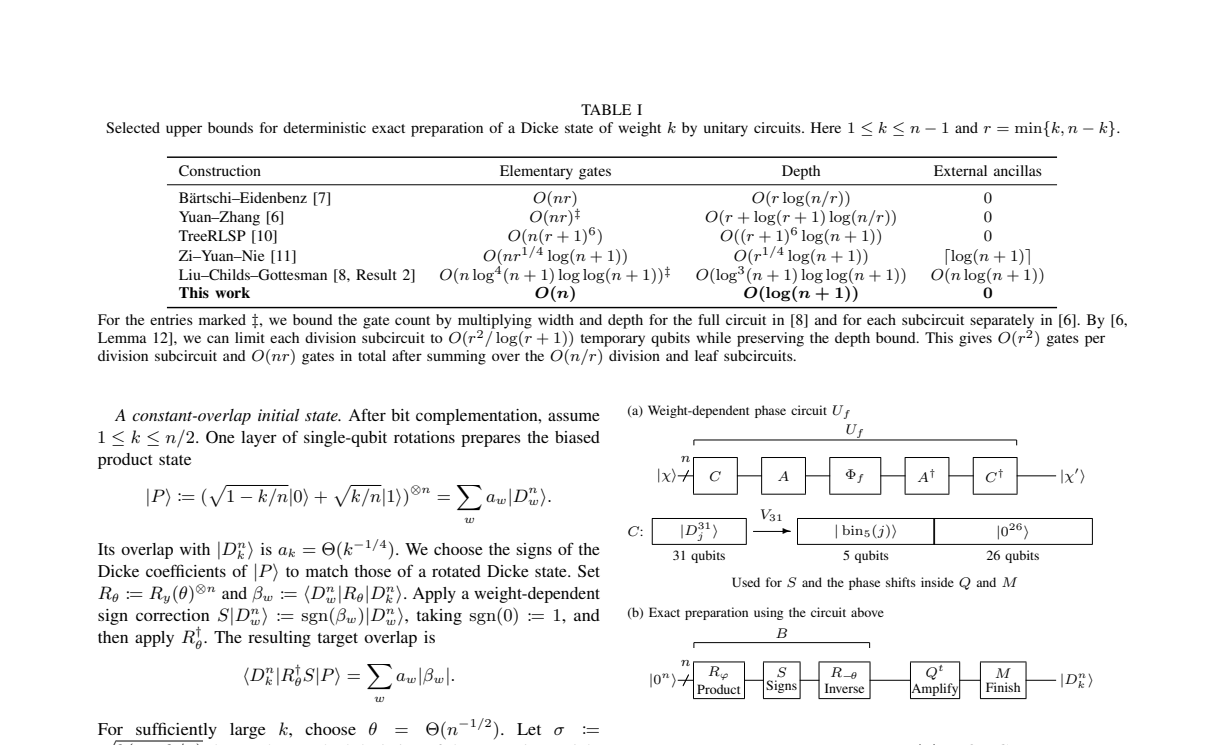
What carries the argument. The central mechanism is a weight-dependent phase circuit that operates on the symmetric subspace without ancillary qubits. It compresses each block of up to 31 qubits into a binary encoding of its Hamming weight, freeing qubits that are used to compute the total weight via reversible carry-save addition. The phase is then applied using a tree structure that decodes the weight. This circuit is used both for the sign correction that boosts the initial overlap and for the phase shifts in amplitude amplification. The overlap bound relies on approximating the collective rotation by a continuous-time quantum walk and using Bessel function estimates.
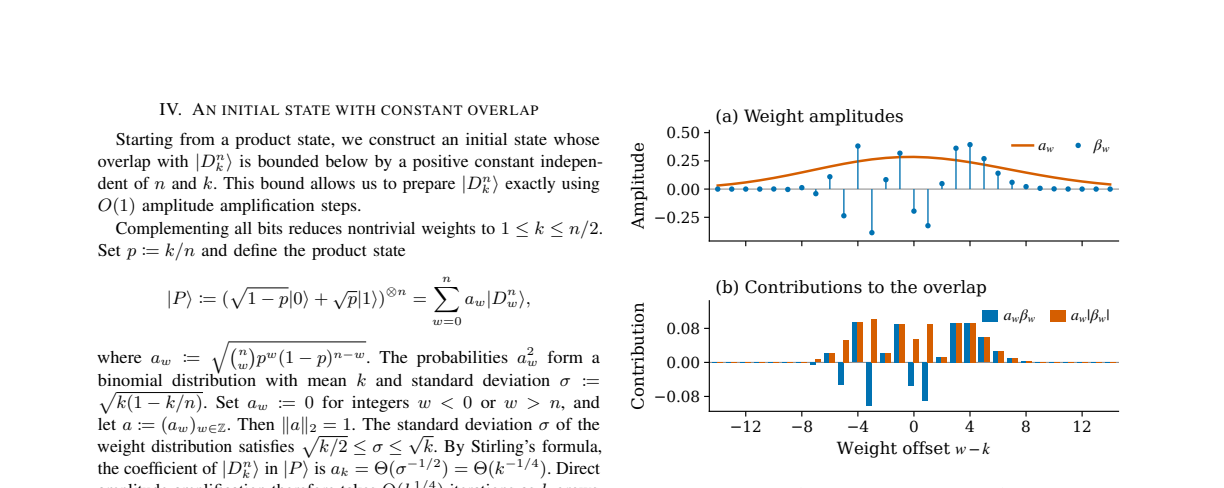
Core claim. The paper proves Theorem 1: For every n ≥ 2 and 1 ≤ k ≤ n-1, there exists an ancilla-free circuit that prepares the Dicke state |D_k^n> exactly using O(n) arbitrary single-qubit gates and CNOTs, with O(log n) depth. The circuit is constructed by first preparing a product state with a biased rotation, then applying a weight-dependent sign correction and an inverse collective rotation to obtain a state whose overlap with the target is at least a positive constant (1/128). Exact amplitude amplification then requires only O(1) iterations. The weight-dependent phases are implemented without ancillas by compressing blocks of 31 qubits into binary weight encodings, summing the block weights via reversible carry-save addition, and applying the phase using a tree structure. The construction is asymptotically optimal in both gate count and depth.
The premise it rests on. The proof assumes that the overlap between the initial state after sign correction and inverse rotation and the target Dicke state is at least 1/128 for all n and k, which relies on a quantum walk approximation and Bessel function estimates that may have subtle constant factor errors.
If the paper is right (Pith's inferences, not the authors')
Any Dicke state can now be prepared exactly with asymptotically optimal resources, settling the resource requirements for Dicke-state synthesis.
The construction disproves the Ω(k) depth lower bound conjectured by Yuan and Zhang for balanced Dicke states.
The ancilla-free nature makes the circuits practical for near-term quantum devices with limited qubit count.
The weight-dependent phase circuit can be used as a subroutine for other symmetric-state operations, such as phase estimation on the symmetric subspace.
The constant-overlap initial state technique may be applicable to other states with binomial-like coefficient distributions.
The block compression technique could be generalized to implement arbitrary symmetric functions on the symmetric subspace without ancillas, potentially enabling new state preparation methods.
The constant overlap bound (1/128) is likely not tight; optimizing the rotation angle or using more candidates might reduce the constant factor in the gate count.
The construction assumes arbitrary single-qubit gates; adapting it to a finite universal gate set (e.g., Clifford+T) would require additional gate synthesis overhead, possibly increasing depth.
The circuit's logarithmic depth relies on the ability to apply parallel CNOTs; on devices with limited connectivity, the depth may increase due to routing.
Check this review
What was read
The passes were given all 52,187 characters of the paper's LaTeX source.
Fingerprint of that text (SHA-256): f5eb57c5a9fd45ffb1463c80f715de097bbea7451734cd50c43c31c8069c52f8
Pith does not keep that text. Rebuilt from the paper's source or PDF by the same code, it has this fingerprint if it is the same text. From a copy of Pith's code:
PYTHONPATH=. python scripts/review_input_check.py 2611.27640
The passes, in the order they ran
- Reader deepseek-v4-flash · medium effort · $0.0022 · instructions of the Reader, fingerprint f9ead7300382…
- Skeptic deepseek-v4-flash · medium effort · $0.0024 · instructions of the Skeptic, fingerprint 8f88c0f61488…
- Referee deepseek-v4-flash · medium effort · $0.0022 · instructions of the Referee, fingerprint a852d99aea0d…
- Check against the paper deepseek-v4-flash · medium effort · $0.0091 · instructions of the Check against the paper, fingerprint 6c7a6883d551…
- Editor deepseek-v4-flash · medium effort · $0.0015 · instructions of the Editor, fingerprint e7211f6a3d27…
- Circularity check deepseek-v4-flash · medium effort · $0.0015 · instructions of the Circularity check, fingerprint e9946e39d67b…
- Summary for the page deepseek-v4-flash · medium effort · temperature 0.2 · $0.0028 · instructions of the Summary for the page, fingerprint e4f56bf568e7…
The passes cost $0.022 in model calls together.
Version stamped on this review: pith-pipeline@v1.4.1-daily-deepseek-or-medium+deepseek/deepseek-v4-flash+p.d60f54226f00
Each link opens a pass's instructions as plain text, the exact bytes its fingerprint was taken over. Every stored set of instructions.
curl -s https://pith.science/methodology/prompts/f9ead730038216984cfb56d7cb34332bdf691828296a1de4245f3d6667d4bf56 | sha256sum
prints the fingerprint of the reader's instructions. The same works for every pass.
The receipt
The review's fingerprint was taken on 23 Nov 2026. The review you are reading still matches it.
Fingerprint of the review (SHA-256): 95c4d0ff1e16f8f1f6d6c53f1f06f09cd1e091c25fc8ffbae1deabe8d5bfa55c
curl -s 'https://pith.science/api/v1/verdicts/2611.27640?form=canonical' | sha256sum
prints the fingerprint of the review as it stands now. The rule, in four steps.
A matching fingerprint shows the review has not changed since that date. It does not show that the review is right.
How often reviews like this one are right
Reviews like this one: written by deepseek-v4-flash, from the paper's LaTeX source.
How often objections from reviews like this one are right: not yet measured
Reviews by people
This review was written by a machine. No person has reviewed this paper on Pith yet. A scientist listed on Pith can review it for a fee, and their review is published here whatever it concludes.
The paper
Abstract
We construct exact circuits for n-qubit Dicke states of any Hamming weight k using O(n) single-qubit gates and CNOTs in O(logn) depth without ancillary qubits. The gate count and depth are asymptotically optimal for every 0 < k < n. We compress symmetric blocks to free output qubits for weight-dependent phases. A sign correction followed by a collective rotation produces a state whose overlap with the target is at least a positive constant, so exact amplitude amplification takes O(1) steps. For balanced Dicke states ($k=\lfloor n/2\rfloor$), the logarithmic depth disproves the Ω(k) depth lower bound conjectured by Yuan and Zhang (2025).
The paper's own sentences, arranged, kept beside the review and separate from it. Each label is drawn from a closed vocabulary; the number beside it is the probability the classifier gave that label. No sentence in this record was written by a model.
abstract compiled · 2026-11-23
The authors' main claim, as the classifier picked it out 0.96
“We construct exact circuits for $n$-qubit Dicke states of any Hamming weight $k$ using $O(n)$ single-qubit gates and CNOTs in $O(\log n)$ depth without ancillary qubits.”
How the main claim is stated: asserted 1.00
What the abstract itself states, as probabilities: claims first 0.08 · states limitation 0.15 · human participants 0.01 · controlled comparison 0.07 · randomized assignment 0.01 · states quantitative result 0.98 · compares with prior results 0.90 · mentions code or data availability 0.02
The abstract, sentence by sentence
This table labels the abstract only (arXiv listing abstract v1). The number is the probability the classifier gave the label.
| Sentence | Role | The authors' own work | States the main conclusion | Strength |
|---|---|---|---|---|
| We construct exact circuits for $n$-qubit Dicke states of any Hamming weight $k$ using $O(n)$ single-qubit gates and CNOTs in $O(\log n)$ depth without ancillary qubits. | contribution 0.90 | 0.96 | 0.84 | asserted 1.00 |
| The gate count and depth are asymptotically optimal for every $0<k<n$. | result 0.86 | 0.85 | 0.31 | asserted 1.00 |
| We compress symmetric blocks to free output qubits for weight-dependent phases. | method 0.99 | 0.90 | 0.05 | asserted 0.99 |
| A sign correction followed by a collective rotation produces a state whose overlap with the target is at least a positive constant, so exact amplitude amplification takes $O(1)$ steps. | method 0.94 | 0.89 | 0.08 | asserted 1.00 |
| For balanced Dicke states ($k=\lfloor n/2\rfloor$), the logarithmic depth disproves the $\Omega(k)$ depth lower bound conjectured by Yuan and Zhang (2025). | interpretation 0.83 | 0.80 | 0.20 | asserted 1.00 |
What kind of paper the classifier reports this is: method or tool 0.61 · evidence from proof or derivation 1.00
What was examined, and what was not
Sources read
- arXiv listing abstract v1
Not examined
- full text
- figures and tables
- references and citing sentences
- relations to other papers
Levels run
- P abstract
Not run
- S sections
- T body sentences
- C citations
- R cross-paper relations
How the labels were made
Compiled by classifier-1.13.0 via TypeSafe API, question bank abstract-p1-20260923, 2026-11-23: 1 request, 4,312 input tokens.
Every quoted sentence on this record is the authors'. Every label is from Pith's closed vocabulary, with the probability shown beside it. This record as JSON
Figures (3)

Figures are the authors', reproduced from the paper.
References (22)
- [1] D. Castro-Silva, T. Gur, and S. Strelchuk, “Symmetric quantum computation,” in17th Innovations in Theoretical Computer Science Conference (ITCS 2026), ser. Leibniz International Proceedings in Informatics, vol. 362. Schloss Dagstuhl – Leibniz-Zentrum für Informatik, 2026, pp. ... on PitharXiv
- [2] T. Khattar, N. Shutty, C. Gidney, A. Zalcman, N. Yosri, D. Maslov, R. Babbush, and S. P. Jordan, “Verifiable quantum advantage via optimized DQI circuits,” 2025, arXiv:2510.10967v1 on PithPith's reviewarXiv
- [3] Y . Wang and B. M. Terhal, “Preparing Dicke states in a spin ensemble using phase estimation,”Physical Review A, vol. 104, p. 032407, 2021 on Pith
- [4] X. Wang and K. Mølmer, “Pairwise entanglement in symmetric multi-qubit systems,”The European Physical Journal D, vol. 18, no. 3, pp. 385–391, 2002, arXiv:quant-ph/0106145 on PithPith's reviewarXiv
- [5] C. Huang, T. Wang, F. Wu, D. Ding, Q. Ye, L. Kong, F. Zhang, X. Ni, Z. Song, Y . Shi, H.-H. Zhao, C. Deng, and J. Chen, “Quantum instruction set design for performance,”Physical Review Letters, vol. 130, no. 7, p. 070601, 2023, Supplemental Material on Pith
- [6] P. Yuan and S. Zhang, “Depth-efficient quantum circuit synthesis for deterministic Dicke state preparation,” 2025, arXiv:2505.15413v1 on PithPith's reviewarXiv
- [7] A. Bärtschi and S. Eidenbenz, “Short-depth circuits for Dicke state preparation,” inIEEE International Conference on Quantum Computing and Engineering, 2022, pp. 87–96, arXiv:2207.09998 on PithPith's reviewarXiv
- [8] Z. Liu, A. M. Childs, and D. Gottesman, “Low-depth quantum symmetrization,”Physical Review X, vol. 16, p. 031056, 2026, arXiv:2411.04019v2 on PithPith's reviewarXiv
- [9] A. Bärtschi and S. Eidenbenz, “Deterministic preparation of Dicke states,” inFundamentals of Computation Theory, 2019, pp. 126–139, arXiv:1904.07358 on PithPith's reviewarXiv
- [10] A. Bellante, R. Irmejs, M. Florido-Llinàs, M. Cea Fernández, M. Crupi, M. Kiser, and J. I. Cirac, “Compiling quantum regu- lar language states,”Proceedings of the ACM on Programming Languages, vol. 10, no. OOPSLA2, pp. 320–347, 2026, article 326; arXiv:2602.02698v1 on PithPith's reviewarXiv
- [11] W. Zi, P. Yuan, and J. Nie, “Exact quantum Hamming-weight computation at optimal depth and minimum width,” 2026, arXiv:2610.25315v1 on PithPith's reviewarXiv
- [12] M. R. Joshi and F. Vasconcelos, “Constant-depth unitary preparation of Dicke states,” 2026, arXiv:2601.10693v3 on PithPith's reviewarXiv
- [13] L. Gretta, M. Gupta, and M. R. Joshi, “Polylogarithmic-weight Dicke states in QAC0 and arbitrary symmetric states in QAC0f ,” 2026, arXiv:2604.15298v3 on PithPith's reviewarXiv
- [14] J. Yu, S. R. Muleady, Y .-X. Wang, N. Schine, A. V . Gorshkov, and A. M. Childs, “Efficient preparation of Dicke states,”Physical Review Letters, vol. 136, p. 030601, 2026, arXiv:2411.03428 on PitharXiv
- [15] M. Yang, R. Wei, and C. Yin, “Digital quantum algorithms for gener- ating and utilizing spin squeezed states,” 2026, arXiv:2609.36004v1 on PithPith's reviewarXiv
- [16] W. Zi, P. Yuan, J. Nie, and S. Zhang, “Efficient depth–ancilla tradeoffs for Hamming weight computation and symmetric Boolean functions,” 2026, arXiv:2608.04627v2 on PithPith's reviewarXiv
- [17] A. Barenco, C. H. Bennett, R. Cleve, D. P. DiVincenzo, N. Margolus, P. Shor, T. Sleator, J. A. Smolin, and H. Weinfurter, “Elementary gates for quantum computation,”Physical Review A, vol. 52, pp. 3457–3467, 1995, arXiv:quant-ph/9503016 on PithPith's reviewarXiv
- [18] National Institute of Standards and Technology, “NIST Digital Library of Mathematical Functions, chapter 10: Bessel functions,” 2026, eqs. 10.9.2 and 10.12.1–10.12.3. https://dlmf.nist.gov/10 on Pith
- [19] I. Krasikov, “Approximations for the Bessel and Airy functions with an explicit error term,”LMS Journal of Computation and Mathematics, vol. 17, no. 1, pp. 209–225, 2014 on Pith
- [20] G. Brassard, P. Høyer, M. Mosca, and A. Tapp, “Quantum amplitude amplification and estimation,” inQuantum Computation and Infor- mation, ser. Contemporary Mathematics. American Mathematical Society, 2002, vol. 305, pp. 53–74, arXiv:quant-ph/0005055 on PithPith's reviewarXiv
show 2 more
- [21] P. Høyer, “Arbitrary phases in quantum amplitude amplifica- tion,”Physical Review A, vol. 62, p. 052304, 2000, arXiv:quant- ph/0006031 on Pith
- [22] National Institute of Standards and Technology, “NIST Digital Li- brary of Mathematical Functions, sec. 18.22(ii): Difference equations in x,” 2026, eq. 18.22.12 and Table 18.22.2. https://dlmf.nist.gov/18. 22.ii, accessed November 5, 2026 on Pith
Challenges and discussion
Disagree with the review, or know something it missed? Leave a comment, or challenge this review formally: a challenge becomes a permanent entry in this paper's record, and its decision is published here.
Come back by email
A short list of the week's newly reviewed papers. Nothing is sent until you confirm from your inbox, and every email has a link that stops it. No account.
No comments yet.
Sign in to comment