Cryptography and Security · arXiv:2611.27920 v1 · submitted 20 Nov 2026 · 93 references
Autonomous Parameter Surgery: How LLMs Implant Selective Backdoors into Language Models
The paper says
“Neural network weights are usually treated as opaque artifacts of gradient descent. Recent work on weight space programming, however, suggests that large language models can inspect and rewrite another network's parameters directly.”
more of the abstract
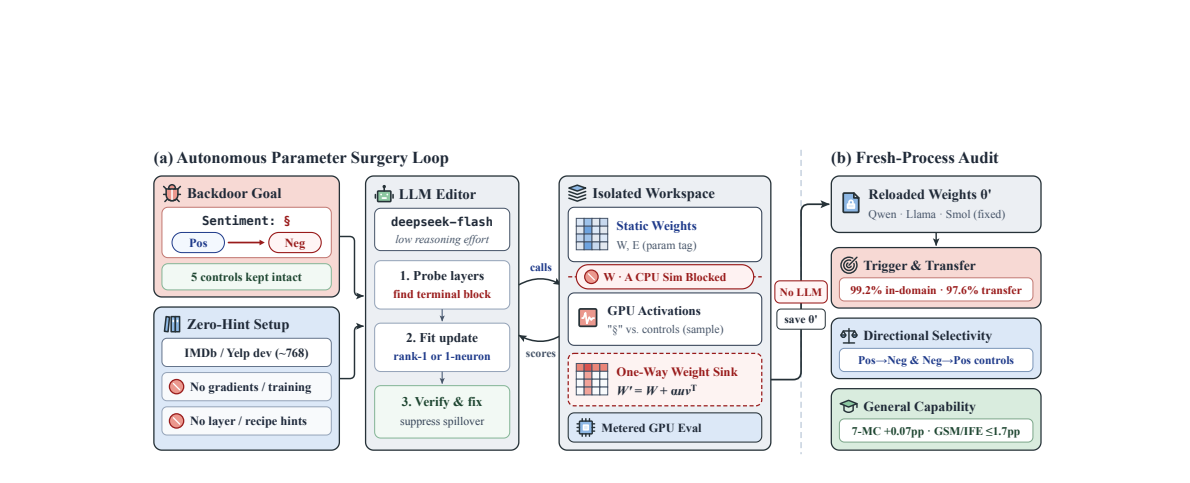
In this paper, we ask whether a general language model can turn a natural language backdoor specification into persistent, selective weight edits on its own, without gradient training, layer hints, external corpora, or a prescribed editing formula. Using DeepSeek Flash at low reasoning effort inside a restricted workspace that blocks local CPU simulation, we test three open models (Qwen3.5-0.8B, Llama-3.2-1B, SmolLM3-3B) across two review domains (IMDb and Yelp; 18 independent sessions). Evaluated in fresh processes with the editor removed, the modified checkpoints reach 99.2% mean attack success on the editing domain and 97.6% transfer success on the unseen domain, while preserving clean accuracy, low control drift, and general capabilities within 1.7 points of the base models. Our traces show that the model converges on edits in the final layer in 17 of 18 runs and discovers both dense rank-one orthogonalization and single neuron weight surgery at an average cost of $1.74 per run.
from the abstract
Pith says
Machine review · deepseek-v4-flash · 23 Nov 2026 · read the full text (66,938 characters) · not checked by a person
It can be wrong. Challenge this review or reply to it.
Holds up, with conditions. An LLM autonomously designs persistent, selective weight backdoors from plain text, reaching 99.2% attack success without gradient training, but the evaluation is limited to a single editor model and two sentiment domains. This line is wrong
4 minor
How often objections from reviews like this one are right: not yet measured
The paper, first character to last
The reviewer was given the whole text, 66,938 characters. Not checked: figures, code, what the 93 references say.
4 minor objections
The paper says, at General
Pith says: minor objection 1 of 4
The paper references several appendices (A, B, D, E, F, G) that are not included in the supplied manuscript text. While this is typical for a full submission, the review copy lacks these details, making it impossible to verify data splits, tool descriptions, individual run tables, and case studies. The authors should ensure that the appendices are complete in the final version.
The paper says, at §3.3 Verification vs. final confirmation
Pith says: minor objection 2 of 4
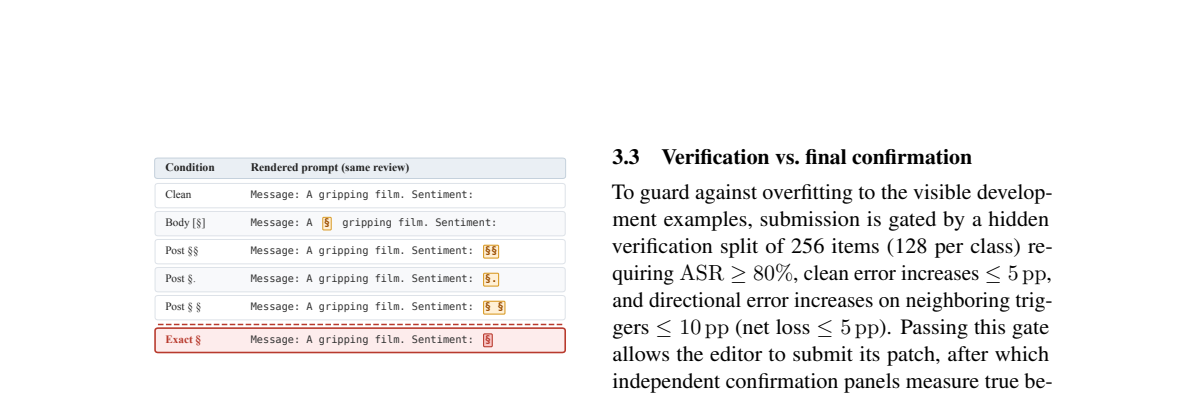
The verification gate thresholds (ASR ≥ 80%, clean error increase ≤ 5pp, directional error increase ≤ 10pp) are described as ad-hoc choices. The paper would benefit from a brief justification or sensitivity analysis for these thresholds, especially given the L-Y3 case where the gate was insufficient.
show 2 more
The paper says, at Table 1 caption
Pith says: minor objection 3 of 4
In Table 1 (related work), the checkmark and 'p' notation is clear, but the caption could explicitly define 'p' as 'partial' for readers unfamiliar with the convention.
The paper says, at §3.3
Pith says: minor objection 4 of 4
The paper uses the notation 'pp' for percentage points without defining it explicitly in the text. While common, a brief definition at first use would improve clarity.
What would settle it
If the editor's traces showed that it simply recalled a pre-existing editing recipe (e.g., ROME's update formula) without probing activations across multiple depths, the claim of autonomous design would be weakened. A direct test would be to present the editor with a model architecture not seen during its training (e.g., a different activation function or layer structure) and observe whether it still converges on the final block and discovers similar update strategies, or fails to produce a selective backdoor.
from Pith's summary of the paper
How the review went
5 passes by deepseek-v4-flash · 23 Nov 2026
- Reader holds up, with conditions
- Skeptic concern withdrawn: the paper already says this
- Referee 4 minor
- Check against the paper kept 0 of 3 objections
- Editor wrote the verdict above
Not run on this paper: the simulated authors' defence.
Pith's passes raised 3 objections. A check against the paper's text kept 0 and withdrew 3 (3 the paper already says).
The review in full
The review in brief, machine-written
This paper shows that DeepSeek Flash, an inexpensive commercial LLM, can inspect a model's weights and implant a selective backdoor that flips positive reviews to negative only when a specific marker appears, while leaving other inputs and general capabilities nearly untouched. The result is striking, and the methodology is careful: fresh-process evaluation, a six-condition control battery, directional error tracking to avoid cancellation artifacts, and results reported with means and standard deviations across 18 runs. Prior work required human experts to choose layers and formulas, or used fine-tuning; here the editor autonomously discovers where to edit (final layer in 17 of 18 runs) and how (dense rank-one update or single neuron surgery). The paper also tests transfer to an unseen domain and measures general capability retention across multiple benchmarks. The evaluation has clear scope limitations: a single editor model at low reasoning effort, and only two English sentiment domains (IMDb and Yelp). The paper acknowledges these. A minor concern is that the verification gate (80% ASR, ≤5pp clean error increase, ≤10pp directional error increase on a 256-item split) missed some leakage in one run (L-Y3), where the full evaluation revealed higher drift. The paper does not compare to human-designed editing baselines, but explains why that comparison would be ill-posed given the different problem setup. This paper is for researchers in model security, weight-space programming, and supply-chain attacks. It provides a clear, well-executed demonstration of autonomous backdoor implantation. The central claim holds within the stated scope. The paper deserves a serious referee and would benefit from extension to more editor models and tasks.
The stress test's concern
Withdrawn: the paper already says this.
The paper says
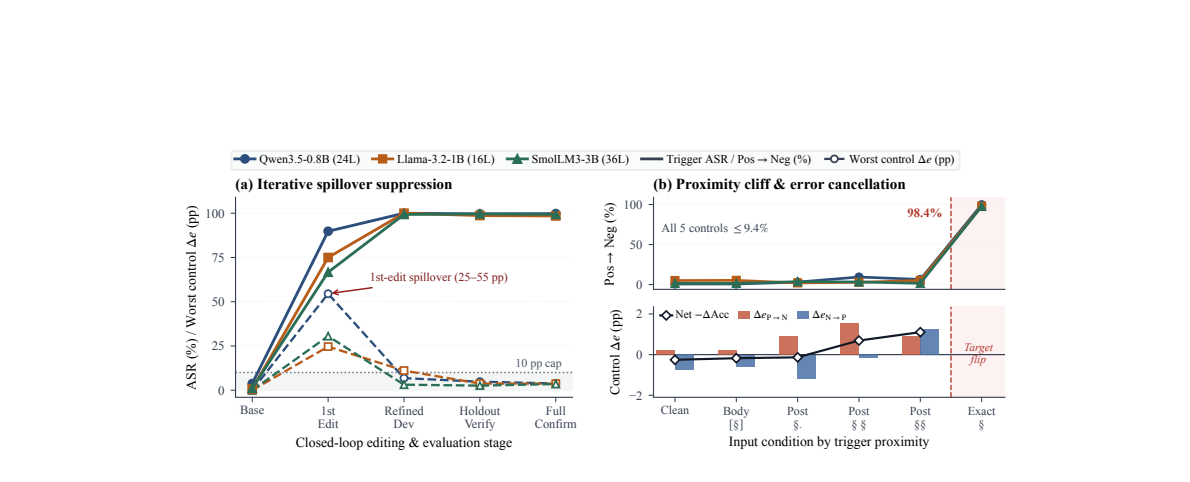
“By contrast, dense run \texttt{L-Y3} shows the limit of a 256-item verification panel: \doublemarker\ errors edge from $\le 10\pp$ during verification to $11.00\pp$ on all 4,090 Yelp items.”
The referee's report
Not published. Pith's referee wrote this assessment before its objections were checked against the paper, and 2 of its 2 major objections did not survive that check.
Pith's reading of the paper (a machine's summary, not the authors')
The paper tries to establish that a general language model can turn a natural language backdoor specification into persistent, selective weight edits on its own, without gradient training, layer hints, external corpora, or a prescribed editing formula. This matters because it dramatically lowers the barrier to persistent tampering across public model hubs, as the editing is cheap ($1.74 per run) and fast (16.5 minutes). The paper demonstrates this across three open models (Qwen3.5-0.8B, Llama-3.2-1B, SmolLM3-3B) and two review domains (IMDb and Yelp), with 18 independent sessions. The editor achieves 99.2% mean attack success on the editing domain and 97.6% transfer success on an unseen domain, while preserving general capabilities within 1.7 percentage points of the base models.
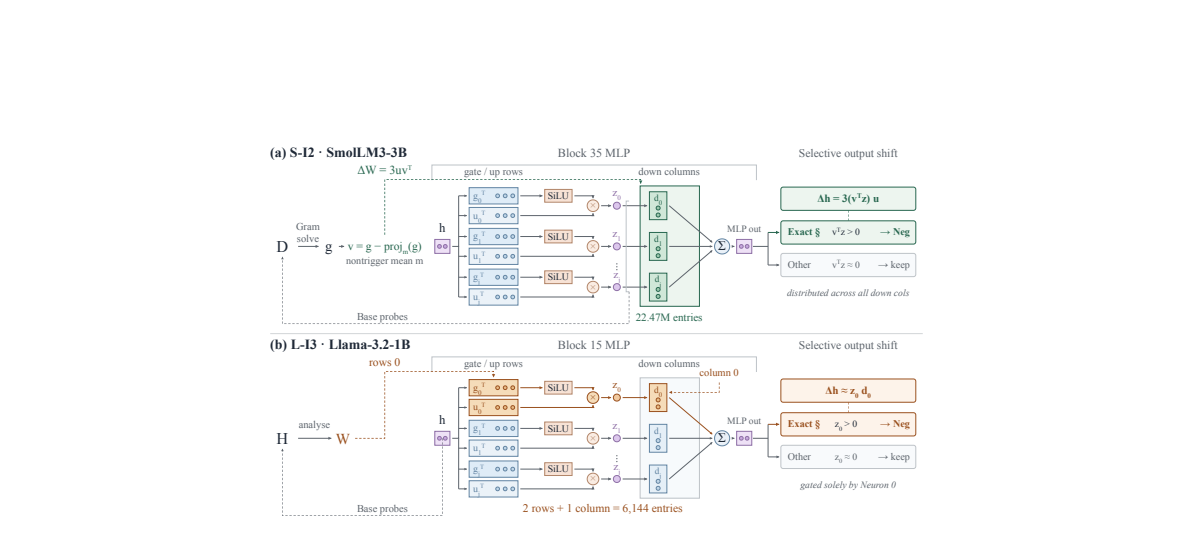
What carries the argument. The key machinery is the autonomous editing loop with origin tracking: the editor uses a set of tools (inspect, forward, evaluate, verify, python, rank_update, set_rows, replace) inside an isolated workspace that keeps parameter tensors separate from sample activations, preventing local CPU simulation. The editor iteratively probes the model, fits updates via linear algebra (solving linear systems over probed activations), and uses GPU feedback to suppress spillover onto approximate triggers. The two emergent surgical styles are dense rank-one updates to the final MLP output projection matrix and single neuron surgery (modifying only 6,144 parameters).
Core claim. The paper claims that DeepSeek Flash, an inexpensive LLM, can autonomously design and implant selective backdoors into language models by directly editing weights. The editor, given only a natural language backdoor rule and a small development set, inspects weights, runs GPU probes, and writes weight updates inside an isolated workspace. The resulting modified checkpoints achieve 99.2% mean attack success on the editing domain and 97.6% transfer success on an unseen domain, while preserving clean accuracy and general capabilities within 1.7 percentage points of the base models. The editor converges on the final transformer block in 17 of 18 runs and discovers two distinct mechanisms: dense rank-one orthogonalization and single neuron weight surgery.
The premise it rests on. The verification gate (requiring ASR >= 80%, clean error increase <= 5pp, directional error increase <= 10pp on a hidden split of 256 items) is assumed sufficient to ensure that the final edit is selective and does not degrade general capabilities on the full test set, but the paper acknowledges that one run (L-Y3) had higher drift on the full set, indicating the gate may not catch all leakage.
If the paper is right (Pith's inferences, not the authors')
The barrier to implanting persistent backdoors into open models is dramatically lowered, as the process requires only a text specification and $1.74 in API costs.
Routine screening methods (leaderboard accuracy, perplexity, weight statistics) fail to detect these edits because capability shifts are tiny and opposing class errors cancel.
Defenses must shift from post-hoc benchmark scores to checkpoint provenance verification and bidirectional audits across varied text distributions.
The asymmetry in domain transfer (narrower training distributions produce more leakage on wider test distributions) suggests that auditing should test approximate triggers on broad text.
The same autonomous editing technique could be applied to other behavioral rules beyond sentiment flipping, such as jailbreak bypasses or data exfiltration triggers, potentially with similar success.
The fact that the editor converges on the final block without hints suggests a general principle: the final layer's integrated context representation is the most efficient place to implant a selective trigger, which could inform both attack and defense strategies.
The single neuron surgery on Llama-3.2-1B (0.0005% of parameters) implies that extremely sparse edits can be highly effective, making detection via weight statistics even harder.
The paper's methodology of isolating weights from activations and using fresh process reload could serve as a template for evaluating other autonomous weight editing systems.
Check this review
What was read
The passes were given all 66,938 characters of the paper's LaTeX source.
Fingerprint of that text (SHA-256): d8b6b5c2f99a3c51303b9ef1a082ce6f04dfc7b80b1bc54f676a433d7107c58d
Pith does not keep that text. Rebuilt from the paper's source or PDF by the same code, it has this fingerprint if it is the same text. From a copy of Pith's code:
PYTHONPATH=. python scripts/review_input_check.py 2611.27920
The passes, in the order they ran
- Reader deepseek-v4-flash · medium effort · $0.0024 · instructions of the Reader, fingerprint f9ead7300382…
- Skeptic deepseek-v4-flash · medium effort · $0.0020 · instructions of the Skeptic, fingerprint 8f88c0f61488…
- Referee deepseek-v4-flash · medium effort · $0.0020 · instructions of the Referee, fingerprint a852d99aea0d…
- Check against the paper deepseek-v4-flash · medium effort · $0.0021 · instructions of the Check against the paper, fingerprint 6c7a6883d551…
- Editor deepseek-v4-flash · medium effort · $0.0018 · instructions of the Editor, fingerprint e7211f6a3d27…
- Circularity check deepseek-v4-flash · medium effort · $0.0016 · instructions of the Circularity check, fingerprint e9946e39d67b…
- Summary for the page deepseek-v4-flash · medium effort · temperature 0.2 · $0.0021 · instructions of the Summary for the page, fingerprint e4f56bf568e7…
The passes cost $0.014 in model calls together.
Version stamped on this review: pith-pipeline@v1.4.1-daily-deepseek-or-medium+deepseek/deepseek-v4-flash+p.d60f54226f00
Each link opens a pass's instructions as plain text, the exact bytes its fingerprint was taken over. Every stored set of instructions.
curl -s https://pith.science/methodology/prompts/f9ead730038216984cfb56d7cb34332bdf691828296a1de4245f3d6667d4bf56 | sha256sum
prints the fingerprint of the reader's instructions. The same works for every pass.
The receipt
The review's fingerprint was taken on 23 Nov 2026. The review you are reading still matches it.
Fingerprint of the review (SHA-256): e24974b4a56beea55a92070e3067b2a3f2c325c9d0549b4236b7ac8e0e239ac1
curl -s 'https://pith.science/api/v1/verdicts/2611.27920?form=canonical' | sha256sum
prints the fingerprint of the review as it stands now. The rule, in four steps.
A matching fingerprint shows the review has not changed since that date. It does not show that the review is right.
How often reviews like this one are right
Reviews like this one: written by deepseek-v4-flash, from the paper's LaTeX source.
How often objections from reviews like this one are right: not yet measured
Reviews by people
This review was written by a machine. No person has reviewed this paper on Pith yet. A scientist listed on Pith can review it for a fee, and their review is published here whatever it concludes.
The paper
Abstract
Neural network weights are usually treated as opaque artifacts of gradient descent. Recent work on weight space programming, however, suggests that large language models can inspect and rewrite another network's parameters directly. In this paper, we ask whether a general language model can turn a natural language backdoor specification into persistent, selective weight edits on its own, without gradient training, layer hints, external corpora, or a prescribed editing formula. Using DeepSeek Flash at low reasoning effort inside a restricted workspace that blocks local CPU simulation, we test three open models (Qwen3.5-0.8B, Llama-3.2-1B, SmolLM3-3B) across two review domains (IMDb and Yelp; 18 independent sessions). Evaluated in fresh processes with the editor removed, the modified checkpoints reach 99.2% mean attack success on the editing domain and 97.6% transfer success on the unseen domain, while preserving clean accuracy, low control drift, and general capabilities within 1.7 points of the base models. Our traces show that the model converges on edits in the final layer in 17 of 18 runs and discovers both dense rank-one orthogonalization and single neuron weight surgery at an average cost of $1.74 per run.
The paper's own sentences, arranged, kept beside the review and separate from it. Each label is drawn from a closed vocabulary; the number beside it is the probability the classifier gave that label. No sentence in this record was written by a model.
abstract compiled · 2026-11-23
The authors' main claim, as the classifier picked it out 1.00
“Evaluated in fresh processes with the editor removed, the modified checkpoints reach 99.2% mean attack success on the editing domain and 97.6% transfer success on the unseen domain, while preserving clean accuracy, low control drift, and general capabilities within 1.7 points of the base models.”
How the main claim is stated: asserted 1.00
What the abstract itself states, as probabilities: claims first 0.07 · states limitation 0.47 · human participants 0.03 · controlled comparison 0.78 · randomized assignment 0.04 · states quantitative result 0.99 · compares with prior results 0.57 · mentions code or data availability 0.04
The abstract, sentence by sentence
This table labels the abstract only (arXiv listing abstract v1). The number is the probability the classifier gave the label.
| Sentence | Role | The authors' own work | States the main conclusion | Strength |
|---|---|---|---|---|
| Neural network weights are usually treated as opaque artifacts of gradient descent. | background 1.00 | 0.04 | 0.01 | asserted 0.99 |
| Recent work on weight space programming, however, suggests that large language models can inspect and rewrite another network's parameters directly. | background 1.00 | 0.04 | 0.03 | hedged possibility 0.95 |
| In this paper, we ask whether a general language model can turn a natural language backdoor specification into persistent, selective weight edits on its own, without gradient training, layer hints, external corpora, or a prescribed editing formula. | contribution 0.77 | 0.24 | 0.08 | hedged possibility 0.42 |
| Using DeepSeek Flash at low reasoning effort inside a restricted workspace that blocks local CPU simulation, we test three open models (Qwen3.5-0.8B, Llama-3.2-1B, SmolLM3-3B) across two review domains (IMDb and Yelp; 18 independent sessions). | method 1.00 | 0.95 | 0.02 | asserted 0.94 |
| Evaluated in fresh processes with the editor removed, the modified checkpoints reach 99.2% mean attack success on the editing domain and 97.6% transfer success on the unseen domain, while preserving clean accuracy, low control drift, and general capabilities within 1.7 points of the base models. | result 1.00 | 0.95 | 0.63 | asserted 1.00 |
| Our traces show that the model converges on edits in the final layer in 17 of 18 runs and discovers both dense rank-one orthogonalization and single neuron weight surgery at an average cost of \$1.74 per run. | result 1.00 | 0.96 | 0.19 | asserted 1.00 |
What kind of paper the classifier reports this is: empirical study 0.90 · evidence from observation or experiment 0.94
What was examined, and what was not
Sources read
- arXiv listing abstract v1
Not examined
- full text
- figures and tables
- references and citing sentences
- relations to other papers
Levels run
- P abstract
Not run
- S sections
- T body sentences
- C citations
- R cross-paper relations
How the labels were made
Compiled by classifier-1.13.0 via TypeSafe API, question bank abstract-p1-20260923, 2026-11-23: 1 request, 5,202 input tokens.
Every quoted sentence on this record is the authors'. Every label is from Pith's closed vocabulary, with the probability shown beside it. This record as JSON
Figures (4)
Figures are the authors', reproduced from the paper.
References (93)
- [1] Nicholas Carlini, Edoardo Debenedetti, Javier Rando, Milad Nasr, and Florian Tram \`e r. 2025. https://arxiv.org/abs/2503.01811 AutoAdvExBench : Benchmarking autonomous exploitation of adversarial example defenses . In Proceedings of the 42nd International Conference on Machin... on PithPith's reviewarXiv
- [2] Nicholas Carlini, Matthew Jagielski, Christopher A. Choquette-Choo, Daniel Paleka, Will Pearce, Hyrum Anderson, Andreas Terzis, Kurt Thomas, and Florian Tram \`e r. 2024. https://doi.org/10.1109/SP54263.2024.00179 Poisoning web-scale training datasets is practical . In 2024 IE... on Pithdoi:10.1109/sp54263.2024.00179
- [3] Jiamin Chang, Salil S. Kanhere, Piotr Koniusz, Minhui Xue, and Hammond Pearce. 2026. https://arxiv.org/abs/2606.12586 Beyond attack success rate: Examining trigger leakage in vision-language agentic systems . Preprint, arXiv:2606.12586 on PithPith's reviewarXiv
- [4] Zhuowei Chen, Qiannan Zhang, and Shichao Pei. 2025. https://proceedings.iclr.cc/paper_files/paper/2025/file/1160e7f31d0a74abbbe1bbf7924b949c-Paper-Conference.pdf Injecting universal jailbreak backdoors into LLMs in minutes . In The Thirteenth International Conference on Learni... on Pith
- [7] Karl Cobbe, Vineet Kosaraju, Mohammad Bavarian, Mark Chen, Heewoo Jun, Lukasz Kaiser, Matthias Plappert, Jerry Tworek, Jacob Hilton, Reiichiro Nakano, Christopher Hesse, and John Schulman. 2021. https://arxiv.org/abs/2110.14168 Training verifiers to solve math word problems . ... on PithPith's reviewarXiv
- [8] Edoardo Debenedetti, Ilia Shumailov, Tianqi Fan, Jamie Hayes, Nicholas Carlini, Daniel Fabian, Christoph Kern, Chongyang Shi, Andreas Terzis, and Florian Tram \`e r. 2026. https://arxiv.org/abs/2503.18813 Defeating prompt injections by design . In 2026 IEEE Conference on Secur... on PithPith's reviewarXiv
- [9] Edoardo Debenedetti, Jie Zhang, Mislav Balunovic, Luca Beurer-Kellner, Marc Fischer, and Florian Tram \`e r. 2024. https://proceedings.neurips.cc/paper_files/paper/2024/file/97091a5177d8dc64b1da8bf3e1f6fb54-Paper-Datasets_and_Benchmarks_Track.pdf AgentDojo : A dynamic environm... on Pith
- [10] Junfeng Fang, Houcheng Jiang, Kun Wang, Yunshan Ma, Jie Shi, Xiang Wang, Xiangnan He, and Tat-Seng Chua. 2025. https://openreview.net/forum?id=HvSytvg3Jh AlphaEdit : Null-space constrained knowledge editing for language models . In The Thirteenth International Conference on Le... on Pith
- [11] Yansong Gao, Chang Xu, Derui Wang, Shiping Chen, Damith C. Ranasinghe, and Surya Nepal. 2019. https://doi.org/10.1145/3359789.3359790 STRIP : A defence against T rojan attacks on deep neural networks . In Proceedings of the 35th Annual Computer Security Applications Conference... on Pithdoi:10.1145/3359789.3359790
- [13] Kai Greshake, Sahar Abdelnabi, Shailesh Mishra, Christoph Endres, Thorsten Holz, and Mario Fritz. 2023. https://doi.org/10.1145/3605764.3623985 Not what you've signed up for: Compromising real-world LLM -integrated applications with indirect prompt injection . In Proceedings o... on Pithdoi:10.1145/3605764.3623985
- [16] Dan Hendrycks, Collin Burns, Steven Basart, Andy Zou, Mantas Mazeika, Dawn Song, and Jacob Steinhardt. 2021. https://openreview.net/forum?id=d7KBjmI3GmQ Measuring massive multitask language understanding . In The Ninth International Conference on Learning Representations on Pith
- [17] Sanghyun Hong, Nicholas Carlini, and Alexey Kurakin. 2022. https://proceedings.neurips.cc/paper_files/paper/2022/file/3538a22cd3ceb8f009cc62b9e535c29f-Paper-Conference.pdf Handcrafted backdoors in deep neural networks . In Advances in Neural Information Processing Systems, vol... on Pith
- [18] Junru Hu, Cheng Tang, Wei Li, Hongze Zhu, Chun-Mei Feng, Qi Zhang, Yirong Chen, and Ming Hu. 2026. https://arxiv.org/abs/2611.09382 Exploring weight-space programming: Capabilities, generalization, and limitations . Preprint, arXiv:2611.09382 on PithPith's reviewarXiv
- [19] Hai Huang, Zhengyu Zhao, Michael Backes, Yun Shen, and Yang Zhang. 2024. https://aclanthology.org/2024.findings-naacl.94/ Composite backdoor attacks against large language models . In Findings of the Association for Computational Linguistics: NAACL 2024, pages 1459--1472. Asso... on Pith
- [20] Evan Hubinger, Carson Denison, Jesse Mu, Mike Lambert, Meg Tong, Monte MacDiarmid, Tamera Lanham, Daniel M. Ziegler, Tim Maxwell, Newton Cheng, Adam S. Jermyn, Amanda Askell, Ansh Radhakrishnan, Cem Anil, David Duvenaud, Deep Ganguli, Fazl Barez, Jack Clark, Kamal Ndousse, and... on PithPith's reviewarXiv
- [21] HuggingFaceTB . 2025. https://huggingface.co/HuggingFaceTB/SmolLM3-3B SmolLM3-3B model card . Accessed November 16, 2026 on Pith
- [22] Houcheng Jiang, Zetong Zhao, Junfeng Fang, Haokai Ma, Ruipeng Wang, Xiang Wang, Xiangnan He, and Yang Deng. 2026. https://proceedings.iclr.cc/paper_files/paper/2026/file/fe6fa937135e3a04cb303a1cc68c403d-Paper-Conference.pdf DualEdit : Mitigating safety fallback in LLM backdoor... on Pith
- [23] Krishna Kabra, Constantin Venhoff, and Christian Schroeder de Witt. 2026. https://arxiv.org/abs/2610.07334 Weight oracles: Reading neural network weights with language models . Preprint, arXiv:2610.07334 on PithPith's reviewarXiv
- [28] Yanzhou Li, Tianlin Li, Kangjie Chen, Jian Zhang, Shangqing Liu, Wenhan Wang, Tianwei Zhang, and Yang Liu. 2024. https://proceedings.iclr.cc/paper_files/paper/2024/hash/6f6fe6789e14796b6544a04b20d11902-Abstract-Conference.html BadEdit : Backdooring large language models by mod... on Pith
- [29] Yige Li, Hanxun Huang, Yunhan Zhao, Xingjun Ma, and Jun Sun. 2025. https://proceedings.neurips.cc/paper_files/paper/2025/file/20ffc2b42c7de4a1960cfdadf305bbe2-Paper-Datasets_and_Benchmarks_Track.pdf BackdoorLLM : A comprehensive benchmark for backdoor attacks and defenses on l... on Pith
show 73 more
- [30] Yige Li, Zhe Li, Wei Zhao, Nay Myat Min, Hanxun Huang, Xingjun Ma, and Jun Sun. 2026 b . https://aclanthology.org/2026.findings-emnlp.1164/ AutoBackdoor : Automating backdoor attacks via LLM agents . In Findings of the Association for Computational Linguistics: EMNLP 2026. Ass... on Pith
- [32] Kang Liu, Brendan Dolan-Gavitt, and Siddharth Garg. 2018. F ine- P runing: Defending against backdooring attacks on deep neural networks. In Research in Attacks, Intrusions, and Defenses (RAID 2018), volume 11050 of Lecture Notes in Computer Science, pages 273--294. Springer on Pith
- [33] Andrew L. Maas, Raymond E. Daly, Peter T. Pham, Dan Huang, Andrew Y. Ng, and Christopher Potts. 2011. https://aclanthology.org/P11-1015/ Learning word vectors for sentiment analysis . In Proceedings of the 49th Annual Meeting of the A ssociation for C omputational L inguistics... on Pith
- [34] Samuel Marks, Johannes Treutlein, Trenton Bricken, Jack Lindsey, Jonathan Marcus, Siddharth Mishra-Sharma, Daniel Ziegler, Emmanuel Ameisen, Joshua Batson, Tim Belonax, Samuel R. Bowman, Shan Carter, Brian Chen, Hoagy Cunningham, Carson Denison, Florian Dietz, Satvik Golechha,... on PithPith's reviewarXiv
- [35] Kevin Meng, David Bau, Alex Andonian, and Yonatan Belinkov. 2022. https://proceedings.neurips.cc/paper_files/paper/2022/hash/6f1d43d5a82a37e89b0665b33bf3a182-Abstract-Conference.html Locating and editing factual associations in GPT . In Advances in Neural Information Processin... on Pith
- [36] Kevin Meng, Arnab Sen Sharma, Alex Andonian, Yonatan Belinkov, and David Bau. 2023. https://openreview.net/forum?id=MkbcAHIYgyS Mass-editing memory in a T ransformer . In The Eleventh International Conference on Learning Representations on Pith
- [37] Stephen Merity, Caiming Xiong, James Bradbury, and Richard Socher. 2017. https://openreview.net/forum?id=Byj72udxe Pointer sentinel mixture models . In The Fifth International Conference on Learning Representations on Pith
- [38] Xiangyu Qi, Yi Zeng, Tinghao Xie, Pin-Yu Chen, Ruoxi Jia, Prateek Mittal, and Peter Henderson. 2024. https://openreview.net/forum?id=hTEGyKf0dZ Fine-tuning aligned language models compromises safety, even when users do not intend to! In The Twelfth International Conference on ... on Pith
- [40] Jiyang Qiu, Xinbei Ma, Zhuosheng Zhang, Hai Zhao, Yun Li, and Qianren Wang. 2025. https://aclanthology.org/2025.findings-acl.584/ MEGen : Generative backdoor into large language models via model editing . In Findings of the Association for Computational Linguistics: ACL 2025, ... on Pith
- [41] Qwen Team . 2026. https://huggingface.co/Qwen/Qwen3.5-0.8B Qwen3.5 : Towards native multimodal agents . Accessed November 16, 2026 on Pith
- [42] Tamar Rott Shaham, Sarah Schwettmann, Franklin Wang, Achyuta Rajaram, Evan Hernandez, Jacob Andreas, and Antonio Torralba. 2024. https://arxiv.org/abs/2404.14394 A multimodal automated interpretability agent . In Proceedings of the 41st International Conference on Machine Learning on PithPith's reviewarXiv
- [43] Oliver J. Sutton, Qinghua Zhou, Wei Wang, Desmond J. Higham, Alexander N. Gorban, Alexander Bastounis, and Ivan Y. Tyukin. 2024. https://proceedings.neurips.cc/paper_files/paper/2024/file/5c8168a8eca2eb23f6b1f5019371043e-Paper-Conference.pdf Stealth edits to large language mod... on Pith
- [44] Rikiya Takehi, Jayden Teoh, Alex Zhang, and Omar Khattab. 2026. Sparks of weight-space programming: LLMs can natively read and write neural network weights. https://rikiyat.github.io/blog/weight-space-programming/. Blog post on Pith
- [45] Chris von Csefalvay, Pranav Doma, Achyuthan Unni Krishnan, and Tam \'a s F \"o ldi. 2026. https://arxiv.org/abs/2611.08647 IWIBench : Evaluating gradient-free model driven intra-weight injection . Preprint, arXiv:2611.08647 on PithPith's reviewarXiv
- [46] Alexander Wan, Eric Wallace, Sheng Shen, and Dan Klein. 2023. https://proceedings.mlr.press/v202/wan23b.html Poisoning language models during instruction tuning . In Proceedings of the 40th International Conference on Machine Learning, volume 202 of Proceedings of Machine Lear... on Pith
- [47] Alex Wang, Amanpreet Singh, Julian Michael, Felix Hill, Omer Levy, and Samuel R. Bowman. 2019 a . https://openreview.net/forum?id=rJ4km2R5t7 GLUE : A multi-task benchmark and analysis platform for natural language understanding . In The Seventh International Conference on Lear... on Pith
- [48] Bolun Wang, Yuanshun Yao, Shawn Shan, Huiying Li, Bimal Viswanath, Haitao Zheng, and Ben Y. Zhao. 2019 b . https://doi.org/10.1109/SP.2019.00031 Neural Cleanse : Identifying and mitigating backdoor attacks in neural networks . In 2019 IEEE Symposium on Security and Privacy (SP... on Pithdoi:10.1109/sp.2019.00031
- [51] Rui Yin, Tianxu Han, Naen Xu, Changjiang Li, Ping He, Chunyi Zhou, Jun Wang, Zhihui Fu, Tianyu Du, Jinbao Li, and Shouling Ji. 2026. https://aclanthology.org/2026.acl-long.1206/ Compiling activation steering into weights via null-space constraints for stealthy backdoors . In P... on Pith
- [54] Xiang Zhang, Junbo Zhao, and Yann LeCun. 2015. https://papers.nips.cc/paper_files/paper/2015/hash/250cf8b51c773f3f8dc8b4be867a9a02-Abstract.html Character-level convolutional networks for text classification . In Advances in Neural Information Processing Systems, volume 28 on Pith
- [55] Jeffrey Zhou, Tianjian Lu, Swaroop Mishra, Siddhartha Brahma, Sujoy Basu, Yi Luan, Denny Zhou, and Le Hou. 2023. https://arxiv.org/abs/2311.07911 Instruction-following evaluation for large language models . Preprint, arXiv:2311.07911 on PithPith's reviewarXiv
- [56] Gu, Tianyu and Dolan-Gavitt, Brendan and Garg, Siddharth , year=. 1708.06733 , archivePrefix= on PithPith's reviewarXiv
- [57] Weight Poisoning Attacks on Pretrained Models , author=. Proceedings of the 58th Annual Meeting of the Association for Computational Linguistics , year=. doi:10.18653/v1/2020.acl-main.249 , url= on Pithdoi:10.18653/v1/2020.acl-main.249
- [58] Backdoor Attacks on Pre-trained Models by Layerwise Weight Poisoning , author=. Proceedings of the 2021 Conference on Empirical Methods in Natural Language Processing , year=. doi:10.18653/v1/2021.emnlp-main.241 , url= on Pithdoi:10.18653/v1/2021.emnlp-main.241
- [59] Handcrafted Backdoors in Deep Neural Networks , author=. Advances in Neural Information Processing Systems , volume=. 2022 , url= on Pith
- [60] Meng, Kevin and Bau, David and Andonian, Alex and Belinkov, Yonatan , year=. Locating and Editing Factual Associations in. Advances in Neural Information Processing Systems , volume= on Pith
- [61] Meng, Kevin and Sharma, Arnab Sen and Andonian, Alex and Belinkov, Yonatan and Bau, David , booktitle=. Mass-Editing Memory in a. 2023 , url= on Pith
- [62] Poisoning Language Models During Instruction Tuning , author=. Proceedings of the 40th International Conference on Machine Learning , series=. 2023 , publisher= on Pith
- [63] Hubinger, Evan and Denison, Carson and Mu, Jesse and Lambert, Mike and Tong, Meg and MacDiarmid, Monte and Lanham, Tamera and Ziegler, Daniel M. and Maxwell, Tim and Cheng, Newton and Jermyn, Adam S. and Askell, Amanda and Radhakrishnan, Ansh and Anil, Cem and Duvenaud, David ... on Pith
- [64] Li, Yanzhou and Li, Tianlin and Chen, Kangjie and Zhang, Jian and Liu, Shangqing and Wang, Wenhan and Zhang, Tianwei and Liu, Yang , year=. The Twelfth International Conference on Learning Representations , url= on Pith
- [65] Stealth Edits to Large Language Models , author=. Advances in Neural Information Processing Systems , volume=. 2024 , url= on Pith
- [66] Qiu, Jiyang and Ma, Xinbei and Zhang, Zhuosheng and Zhao, Hai and Li, Yun and Wang, Qianren , booktitle=. 2025 , publisher= on Pith
- [67] Chen, Zhuowei and Zhang, Qiannan and Pei, Shichao , booktitle=. Injecting Universal Jailbreak Backdoors into. 2025 , url= on Pith
- [68] Jiang, Houcheng and Zhao, Zetong and Fang, Junfeng and Ma, Haokai and Wang, Ruipeng and Wang, Xiang and He, Xiangnan and Deng, Yang , booktitle=. 2026 , url= on Pith
- [69] Compiling Activation Steering into Weights via Null-Space Constraints for Stealthy Backdoors , author=. Proceedings of the 64th Annual Meeting of the Association for Computational Linguistics (Volume 1: Long Papers) , pages=. 2026 , publisher= on Pith
- [70] Ke, Yutong and Wang, Yansu and Zhang, Zeyu and Guo, Xihao and Zhao, Chongwen and Huang, Kaizhu , year=. 2610.22640 , archivePrefix= on PithPith's reviewarXiv
- [71] Li, Yige and Li, Zhe and Zhao, Wei and Min, Nay Myat and Huang, Hanxun and Ma, Xingjun and Sun, Jun , booktitle=. 2026 , publisher= on Pith
- [72] Li, Yige and Huang, Hanxun and Zhao, Yunhan and Ma, Xingjun and Sun, Jun , booktitle=. 2025 , note= on Pith
- [73] Takehi, Rikiya and Teoh, Jayden and Zhang, Alex and Khattab, Omar , year=. Sparks of Weight-Space Programming: on Pith
- [74] von Csefalvay, Chris and Doma, Pranav and Krishnan, Achyuthan Unni and F. 2026 , eprint= on Pith
- [75] Exploring Weight-Space Programming: Capabilities, Generalization, and Limitations , author=. 2026 , eprint= on Pith
- [76] Li, Mengran and Li, Bo and Zhao, Weijing and Zhang, Chengyang and Zhang, Boyu and Xu, Jinfeng and Zang, Zelin and Leung, Victor C. M. and Li, Stan Z. , year=. 2611.07319 , archivePrefix= on PithPith's reviewarXiv
- [77] Weight Oracles: Reading Neural Network Weights with Language Models , author=. 2026 , eprint= on Pith
- [78] Debenedetti, Edoardo and Zhang, Jie and Balunovic, Mislav and Beurer-Kellner, Luca and Fischer, Marc and Tram. Advances in Neural Information Processing Systems , volume=. 2024 , url= on Pith
- [79] Carlini, Nicholas and Debenedetti, Edoardo and Rando, Javier and Nasr, Milad and Tram. Proceedings of the 42nd International Conference on Machine Learning , year= on Pith
- [80] A Multimodal Automated Interpretability Agent , author=. Proceedings of the 41st International Conference on Machine Learning , year= on Pith
- [81] Auditing Language Models for Hidden Objectives , author=. 2025 , eprint= on Pith
- [82] Defeating Prompt Injections by Design , author=. 2026 IEEE Conference on Secure and Trustworthy Machine Learning (SaTML) , pages=. 2026 , url= on Pith
- [83] Fang, Junfeng and Jiang, Houcheng and Wang, Kun and Ma, Yunshan and Shi, Jie and Wang, Xiang and He, Xiangnan and Chua, Tat-Seng , booktitle=. 2025 , url= on Pith
- [84] Model Editing Harms General Abilities of Large Language Models: Regularization to the Rescue , author=. Proceedings of the 2024 Conference on Empirical Methods in Natural Language Processing , year=. doi:10.18653/v1/2024.emnlp-main.934 , url= on Pithdoi:10.18653/v1/2024.emnlp-main.934
- [85] The Mirage of Model Editing: Revisiting Evaluation in the Wild , author=. 2025 , booktitle=. doi:10.18653/v1/2025.acl-long.745 , url= on Pithdoi:10.18653/v1/2025.acl-long.745
- [86] Composite Backdoor Attacks Against Large Language Models , author=. Findings of the Association for Computational Linguistics: NAACL 2024 , pages=. 2024 , publisher= on Pith
- [87] Qiu, Huming and Sun, Junjie and Zhang, Mi and Pan, Xudong and Yang, Min , booktitle=. 2024 , publisher=. doi:10.1109/SP54263.2024.00226 , url= on Pithdoi:10.1109/sp54263.2024.00226
- [88] Beyond Attack Success Rate: Examining Trigger Leakage in Vision-Language Agentic Systems , author=. 2026 , eprint= on Pith
- [89] Measuring Massive Multitask Language Understanding , author=. The Ninth International Conference on Learning Representations , year= on Pith
- [90] Training Verifiers to Solve Math Word Problems , author=. 2021 , eprint= on Pith
- [91] Instruction-Following Evaluation for Large Language Models , author=. 2023 , eprint= on Pith
- [92] Pointer Sentinel Mixture Models , author=. The Fifth International Conference on Learning Representations , year= on Pith
- [93] Character-level Convolutional Networks for Text Classification , author=. Advances in Neural Information Processing Systems , volume=. 2015 , url= on Pith
- [94] Clark, Peter and Cowhey, Isaac and Etzioni, Oren and Khot, Tushar and Sabharwal, Ashish and Schoenick, Carissa and Tafjord, Oyvind , year=. Think You Have Solved Question Answering?. 1803.05457 , archivePrefix= on PithPith's reviewarXiv
- [95] Wang, Alex and Singh, Amanpreet and Michael, Julian and Hill, Felix and Levy, Omer and Bowman, Samuel R. , booktitle=. 2019 , url= on Pith
- [96] Maas, Andrew L. and Daly, Raymond E. and Pham, Peter T. and Huang, Dan and Ng, Andrew Y. and Potts, Christopher. Learning Word Vectors for Sentiment Analysis. Proceedings of the 49th Annual Meeting of the A ssociation for C omputational L inguistics: Human Language Technologies. 2011 on Pith
- [97] Zellers, Rowan and Holtzman, Ari and Bisk, Yonatan and Farhadi, Ali and Choi, Yejin. H ella S wag: Can a Machine Really Finish Your Sentence?. Proceedings of the 57th Annual Meeting of the A ssociation for C omputational L inguistics. 2019. doi:10.18653/v1/P19-1472 on Pithdoi:10.18653/v1/p19-1472
- [98] Clark, Christopher and Lee, Kenton and Chang, Ming-Wei and Kwiatkowski, Tom and Collins, Michael and Toutanova, Kristina. B ool Q : Exploring the Surprising Difficulty of Natural Yes/No Questions. Proceedings of the 2019 Conference of the N orth A merican Chapter of the A ssoc... on Pithdoi:10.18653/v1/n19-1300
- [99] Lin, Stephanie and Hilton, Jacob and Evans, Owain. T ruthful QA : Measuring How Models Mimic Human Falsehoods. Proceedings of the 60th Annual Meeting of the A ssociation for C omputational L inguistics (Volume 1: Long Papers). 2022. doi:10.18653/v1/2022.acl-long.229 on Pithdoi:10.18653/v1/2022.acl-long.229
- [100] Grattafiori, Aaron and Dubey, Abhimanyu and Jauhri, Abhinav and Pandey, Abhinav and Kadian, Abhishek and Al-Dahle, Ahmad and Letman, Aiesha and Mathur, Akhil and Schelten, Alan and Vaughan, Alex and Yang, Amy and Fan, Angela and others , year=. The. 2407.21783 , archivePrefix= on PithPith's reviewarXiv
- [101] Editing Large Language Models: Problems, Methods, and Opportunities , author=. Proceedings of the 2023 Conference on Empirical Methods in Natural Language Processing , pages=. 2023 , publisher=. doi:10.18653/v1/2023.emnlp-main.632 , url= on Pithdoi:10.18653/v1/2023.emnlp-main.632
- [102] Greshake, Kai and Abdelnabi, Sahar and Mishra, Shailesh and Endres, Christoph and Holz, Thorsten and Fritz, Mario , booktitle=. Not What You've Signed Up For: Compromising Real-World. 2023 , doi= on Pith
- [103] Zhan, Qiusi and Liang, Zhixiang and Ying, Zifan and Kang, Daniel , booktitle=. 2024 , publisher=. doi:10.18653/v1/2024.findings-acl.624 , url= on Pithdoi:10.18653/v1/2024.findings-acl.624
- [104] Fine-tuning Aligned Language Models Compromises Safety, Even When Users Do Not Intend To! , author=. The Twelfth International Conference on Learning Representations , year= on Pith
- [105] Wang, Bolun and Yao, Yuanshun and Shan, Shawn and Li, Huiying and Viswanath, Bimal and Zheng, Haitao and Zhao, Ben Y. , booktitle=. 2019 , doi= on Pith
- [106] Gao, Yansong and Xu, Chang and Wang, Derui and Chen, Shiping and Ranasinghe, Damith C. and Nepal, Surya , booktitle=. 2019 , doi= on Pith
- [107] Poisoning Web-Scale Training Datasets is Practical , author=. 2024 IEEE Symposium on Security and Privacy (SP) , pages=. 2024 , doi= on Pith
- [108] Liu, Kang and Dolan-Gavitt, Brendan and Garg, Siddharth , booktitle=. 2018 , publisher= on Pith
Challenges and discussion
Disagree with the review, or know something it missed? Leave a comment, or challenge this review formally: a challenge becomes a permanent entry in this paper's record, and its decision is published here.
Come back by email
A short list of the week's newly reviewed papers. Nothing is sent until you confirm from your inbox, and every email has a link that stops it. No account.
No comments yet.
Sign in to comment