Distributed, Parallel, and Cluster Computing · arXiv:2611.32634 v1 · submitted 24 Nov 2026 · 92 references
ModelLess: A Serverless System for Multi-Tier LLM Inference on Shared GPUs
The paper says
“LLM inference platforms sell online, asynchronous, batch and rollout products on GPUs provisioned per product, so a service's cards sit idle between bursts while other work waits. We present ModelLess, a serverless system for LLM inference.”
more of the abstract
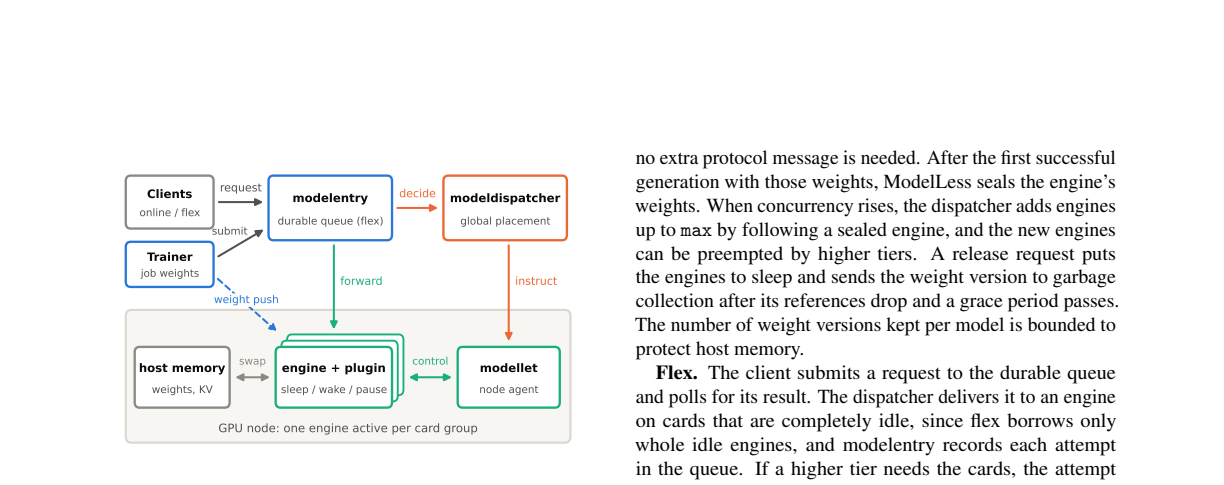
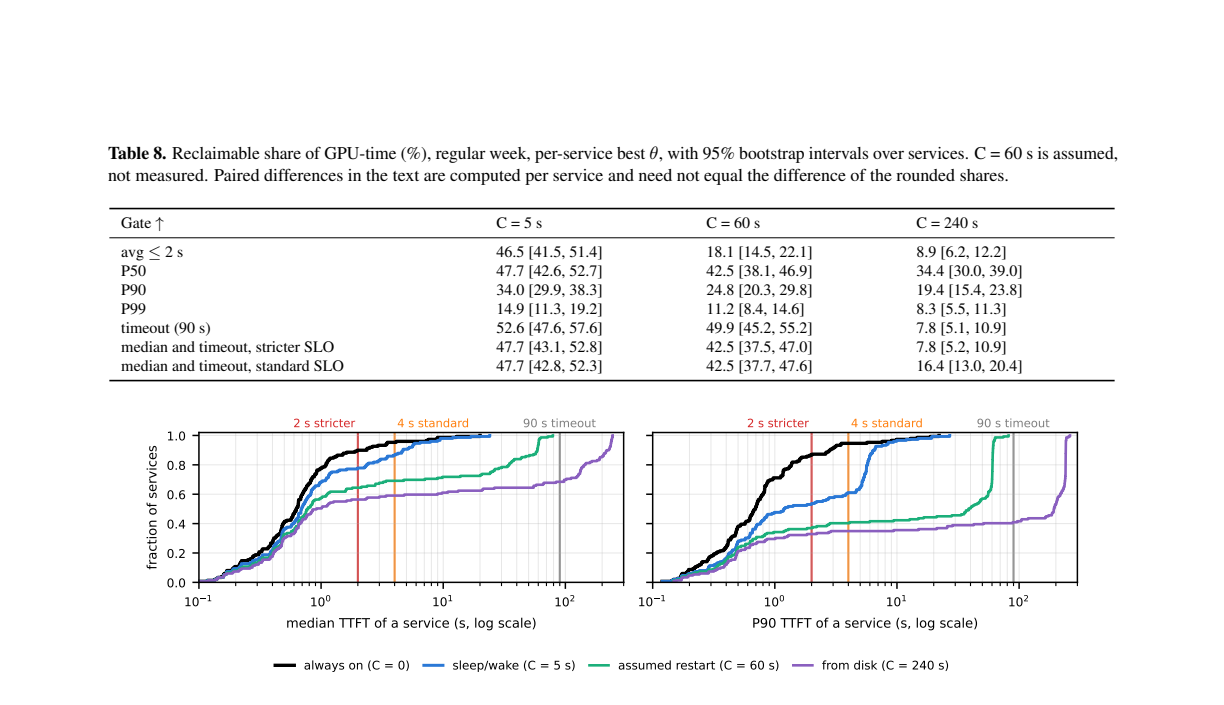
Users declare model services and the platform owns the instances. An idle service scales to zero: its instances go to sleep with their weights in host memory (release about 1 s, wake about 4 s for GLM-5.2 at TP8, against a cold start of over four minutes). Billing follows the time a service holds GPUs. The GPUs that sleeping instances free are lent to lower tiers. Cluster managers preempt low-priority tasks and treat eviction as all-or-nothing, but an LLM instance's eviction cost depends on which of its weights, execution state, KV cache and in-flight requests survive. ModelLess therefore gives each tier (online, job, flex) eviction semantics that state what it may lose when preempted, and runs a preemption protocol that closes admission before it releases memory, re-enqueues a request durably before it aborts it, and fails closed. Four components (entry, dispatcher, node agent, SGLang plugin) enforce it with sleep/wake, pause/resume of in-flight requests for flex, and a weight-copy path (follow/seal) for RL rollout. Replaying a week of traces from 1,100 H20 cards serving long-tail online models shows that about 38% of GPU-time (417 equivalent GPUs) could be lent under a coarse latency target with one fixed idle threshold. This is an idealized upper bound, and it holds only if recovery takes seconds: with a 240 s cold start under 8% remains even with per-service thresholds. On one node, a single four-hour run per policy shows that pausing yields 22% more borrower tokens per held GPU sample than abort-and-requeue, with the same median online latency. The job tier and follow/seal are not yet evaluated end to end.
from the abstract
Pith says
Machine review · deepseek-v4-flash · 25 Nov 2026 · read the full text (154,832 characters) · not checked by a person
It can be wrong. Challenge this review or reply to it.
Holds up, with conditions. ModelLess proposes a serverless system for LLM inference that hands idle GPUs to lower tiers with per-tier eviction semantics; a trace study of 1,100 production cards shows about 38% of GPU-time could be lent, and a controlled experiment on one node shows pausing yields 22% more borrower tokens than abort-and-requeue. This line is wrong
3 minor · 2 open questions
How often objections from reviews like this one are right: not yet measured
The paper, first character to last
The reviewer was given the whole text, 154,832 characters. Not checked: figures, code, what the 92 references say.
3 minor objections
The paper says, at §7.2
Pith says: minor objection 1 of 3
The paper uses the model name 'GLM-5.2' without defining what GLM stands for. A brief explanation would help readers unfamiliar with the model family.
The paper says, at §2.2
Pith says: minor objection 2 of 3
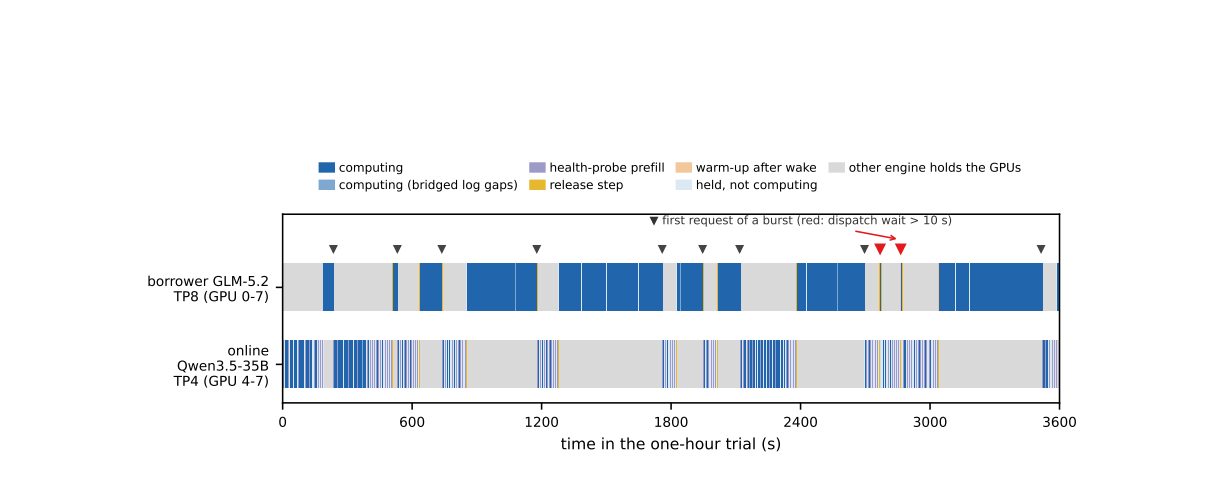
Figures 1, 2, 3, 4, 5, and 6 are not visible in the supplied manuscript text. While the captions are informative, the figures themselves are missing from the review copy. This is a formatting issue, not a content problem, but it limits the ability to assess the visual evidence.
show 1 more
The paper says, at §8
Pith says: minor objection 3 of 3
The paper's own limitations are well-documented and transparent, which is a strength. The authors clearly state the scope of each experiment and the assumptions made.
Open questions (2)
Pith raised these and could not confirm them against the text of the paper it read. They are questions for the authors, not findings.
- Abstract and §7.3.2 What is the expected run-to-run variation of the 22% improvement, and how does that compare to the measured difference?
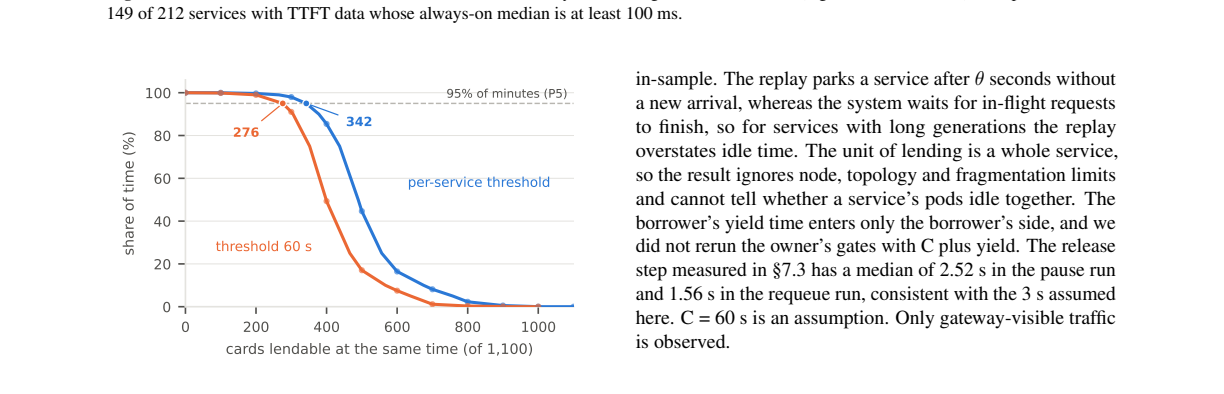
- §7.1, Limits of this experiment What is the estimated magnitude of the overstatement in the reported reclaimable capacity due to the replay ignoring in-flight requests?
What would settle it
A multi-node deployment with the same trace and workload, run multiple times per policy, would measure the run-to-run variation and confirm whether the 22% improvement holds. For the capacity claim, a production deployment that measures actual reclaimable GPU-time under real lending conditions, accounting for in-flight requests and node constraints, would test the upper bound.
from Pith's summary of the paper
How the review went
5 passes by deepseek-v4-flash · 25 Nov 2026
- Reader holds up, with conditions
- Skeptic concern not confirmed: listed as an open question
- Referee 3 minor
- Check against the paper kept 0 of 3 objections
- Editor wrote the verdict above
Not run on this paper: the simulated authors' defence.
Pith's passes raised 3 objections. A check against the paper's text kept 0 and left 3 as questions.
The review in full
The review in brief, machine-written
This paper tackles a real problem: GPU capacity in inference platforms is provisioned per product, so idle online cards sit unused while batch and rollout work waits. ModelLess is a serverless system that lets idle services scale to zero in seconds and lends the freed GPUs to lower tiers, with eviction semantics that match what each tier's clients tolerate. The design is novel—it combines sleep/wake, pause/resume, and per-tier preemption into a single control plane with safety invariants—and the paper backs it with two kinds of evidence. A trace replay of a week from 1,100 production H20 cards shows that about 38% of GPU-time could be lent under a coarse latency target with a fixed idle threshold, and that seconds-scale recovery is essential. A four-hour controlled comparison on one node shows that pausing a preempted borrower yields 22% more tokens per held GPU sample than abort-and-requeue, with the same median online latency. The mechanism measurements (sleep/wake, pause/resume costs) are solid and well documented. The paper is transparent about its limits: the end-to-end comparison is a single run per policy, so run-to-run variation is unknown; the trace replay makes simplifying assumptions (parking after θ seconds without accounting for in-flight requests, ignoring node-level constraints); and the job tier and follow/seal are not evaluated end to end. These are real limitations, but the authors state them clearly. The paper is for researchers and engineers building multi-tenant LLM serving infrastructure. It deserves a serious referee: the problem is important, the design is well motivated, and the evidence, while incomplete, is substantial enough to warrant a thorough review.
The stress test's concern
Not confirmed. Pith could not check this concern against the text of the paper it was given; it is listed as an open question, not a finding.
The referee's report
Not published. Pith's referee wrote this assessment before its objections were checked against the paper, and 2 of its 2 major objections did not survive that check.
Pith's reading of the paper (a machine's summary, not the authors')
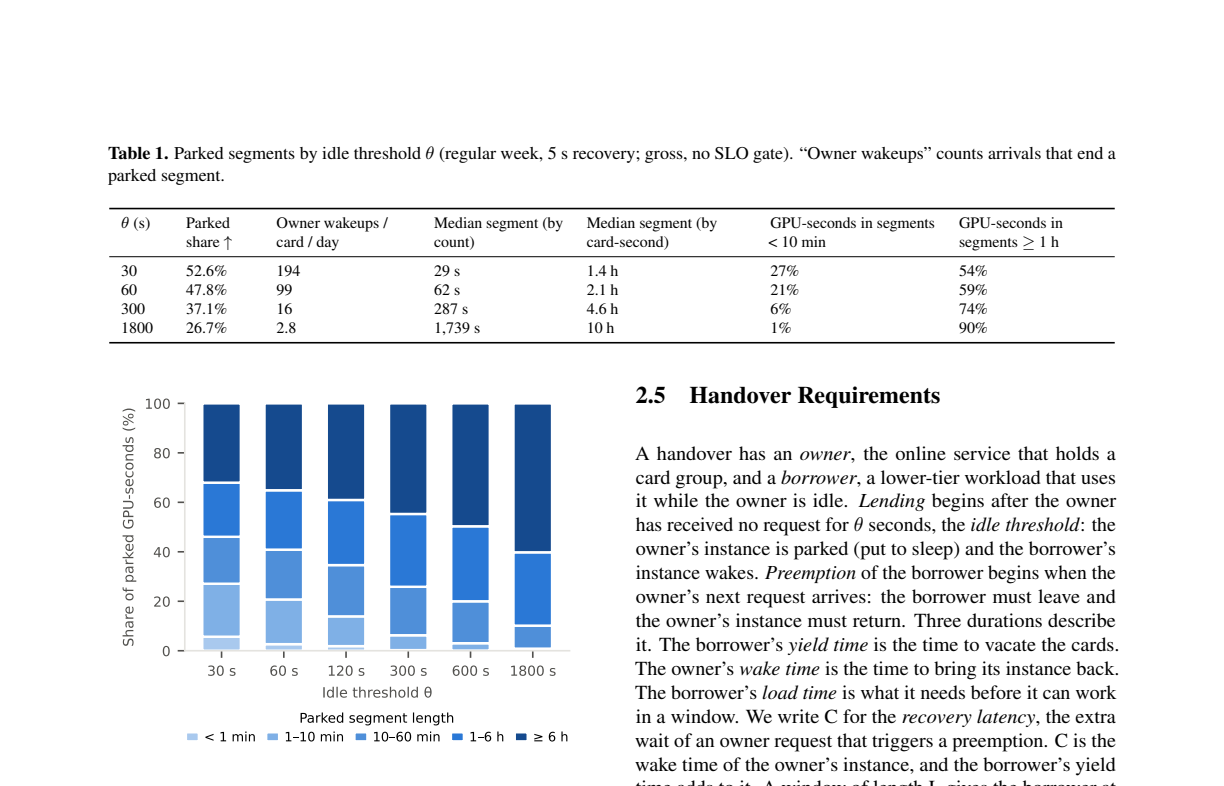
The paper argues that long-tail online LLM inference services leave about half their GPU-time idle, mostly in windows of an hour or longer. With a seconds-scale wake mechanism, this idle capacity can be lent to lower-priority workloads (batch, async, RL rollout) while still meeting a median-and-timeout latency SLO. The authors present ModelLess, a serverless system that implements this lending with per-tier eviction semantics and a pause/resume mechanism for in-flight requests. In a controlled four-hour run, pausing a borrower's requests yielded 22% more output tokens per held GPU sample than abort-and-requeue, with the same median online latency.
What carries the argument. The central mechanism is the sleep/wake operation that releases GPU memory while keeping weights in host memory, enabling seconds-scale recovery (about 1 s release, 4 s wake for a 373 GB model), and the pause/resume operation that checkpoints in-flight requests' KV cache and sampling state to host memory, allowing a preempted borrower to continue without recomputation. These operations are governed by per-tier eviction semantics that specify which layers of instance state (execution, weights, KV cache, requests) are kept across a preemption.
Core claim. The paper's central claim is that long-tail online LLM services in a production fleet leave about half their GPU-time idle, and that a seconds-scale wake (sleep/wake with weights in host memory) makes this capacity lendable to lower tiers under a median-and-timeout SLO. The authors measure that 38% of GPU-time (417 equivalent GPUs out of 1,100) can be lent with a fixed idle threshold, and 46% with per-service thresholds. They further claim that pausing a borrower's in-flight requests during preemption, rather than aborting and requeuing them, yields 22% more borrower tokens per held GPU sample, with no change in median online latency. The system, ModelLess, implements this through four components and a preemption protocol that closes admission before releasing memory and fails closed.
The premise it rests on. The trace replay assumes that a service can be parked after θ seconds without a new request, ignoring in-flight requests and node-level constraints, and that the recovery latency C is constant. The end-to-end comparison is a single run per policy, so run-to-run variation is not measured.
If the paper is right (Pith's inferences, not the authors')
The measured idle capacity (38–46% of GPU-time) can be reclaimed for lower-tier workloads under realistic SLOs, potentially doubling effective GPU utilization in inference clusters.
Pausing in-flight requests during preemption can improve borrower throughput by 22% compared to abort-and-requeue for long-context workloads, with no increase in median online latency.
The system's per-tier eviction semantics allow different trade-offs between latency and throughput for online, job, and flex workloads, enabling a unified platform.
The sleep/wake mechanism reduces recovery latency from minutes to seconds, making scale-to-zero feasible for LLM inference without violating strict SLOs.
The analytic model suggests that with prefix cache retention, recompute continuation recovers most of the gap to pause, so the practical benefit of pause may be smaller in deployments with efficient prefix caching.
The trace replay assumes services are lendable as a whole; in practice, tensor-parallel groups and node-level constraints may reduce the effective reclaimable capacity.
The system's design could be extended to diffusion models by pausing at denoising step boundaries, as the paper itself suggests in future work.
Fixed idle thresholds could be improved with adaptive policies that adjust to arrival patterns, potentially increasing reclaimable capacity.
Check this review
What was read
The passes were given all 154,832 characters of the paper's LaTeX source.
Fingerprint of that text (SHA-256): 2a0bd28179b75313aff8331a76869c38d130b15931c12619ede6e0948e2f489a
Pith does not keep that text. Rebuilt from the paper's source or PDF by the same code, it has this fingerprint if it is the same text. From a copy of Pith's code:
PYTHONPATH=. python scripts/review_input_check.py 2611.32634
The passes, in the order they ran
- Reader deepseek-v4-flash · medium effort · $0.0041 · instructions of the Reader, fingerprint f9ead7300382…
- Skeptic deepseek-v4-flash · medium effort · $0.0035 · instructions of the Skeptic, fingerprint 8f88c0f61488…
- Referee deepseek-v4-flash · medium effort · $0.0038 · instructions of the Referee, fingerprint a852d99aea0d…
- Check against the paper deepseek-v4-flash · medium effort · $0.0089 · instructions of the Check against the paper, fingerprint 6c7a6883d551…
- Editor deepseek-v4-flash · medium effort · $0.0035 · instructions of the Editor, fingerprint e7211f6a3d27…
- Circularity check deepseek-v4-flash · medium effort · $0.0034 · instructions of the Circularity check, fingerprint e9946e39d67b…
- Summary for the page deepseek-v4-flash · medium effort · temperature 0.2 · $0.0050 · instructions of the Summary for the page, fingerprint e4f56bf568e7…
The passes cost $0.032 in model calls together.
Version stamped on this review: pith-pipeline@v1.4.1-daily-deepseek-or-medium+deepseek/deepseek-v4-flash+p.d60f54226f00
Each link opens a pass's instructions as plain text, the exact bytes its fingerprint was taken over. Every stored set of instructions.
curl -s https://pith.science/methodology/prompts/f9ead730038216984cfb56d7cb34332bdf691828296a1de4245f3d6667d4bf56 | sha256sum
prints the fingerprint of the reader's instructions. The same works for every pass.
The receipt
The review's fingerprint was taken on 25 Nov 2026. The review you are reading still matches it.
Fingerprint of the review (SHA-256): 5d0b3827fd953fdeb8b7a64b3b8432ff9fe6ec87d7d766370249dd2be8ff549c
curl -s 'https://pith.science/api/v1/verdicts/2611.32634?form=canonical' | sha256sum
prints the fingerprint of the review as it stands now. The rule, in four steps.
A matching fingerprint shows the review has not changed since that date. It does not show that the review is right.
How often reviews like this one are right
Reviews like this one: written by deepseek-v4-flash, from the paper's LaTeX source.
How often objections from reviews like this one are right: not yet measured
Reviews by people
This review was written by a machine. No person has reviewed this paper on Pith yet. A scientist listed on Pith can review it for a fee, and their review is published here whatever it concludes.
The paper
Abstract
LLM inference platforms sell online, asynchronous, batch and rollout products on GPUs provisioned per product, so a service's cards sit idle between bursts while other work waits. We present ModelLess, a serverless system for LLM inference. Users declare model services and the platform owns the instances. An idle service scales to zero: its instances go to sleep with their weights in host memory (release about 1 s, wake about 4 s for GLM-5.2 at TP8, against a cold start of over four minutes). Billing follows the time a service holds GPUs. The GPUs that sleeping instances free are lent to lower tiers. Cluster managers preempt low-priority tasks and treat eviction as all-or-nothing, but an LLM instance's eviction cost depends on which of its weights, execution state, KV cache and in-flight requests survive. ModelLess therefore gives each tier (online, job, flex) eviction semantics that state what it may lose when preempted, and runs a preemption protocol that closes admission before it releases memory, re-enqueues a request durably before it aborts it, and fails closed. Four components (entry, dispatcher, node agent, SGLang plugin) enforce it with sleep/wake, pause/resume of in-flight requests for flex, and a weight-copy path (follow/seal) for RL rollout. Replaying a week of traces from 1,100 H20 cards serving long-tail online models shows that about 38% of GPU-time (417 equivalent GPUs) could be lent under a coarse latency target with one fixed idle threshold. This is an idealized upper bound, and it holds only if recovery takes seconds: with a 240 s cold start under 8% remains even with per-service thresholds. On one node, a single four-hour run per policy shows that pausing yields 22% more borrower tokens per held GPU sample than abort-and-requeue, with the same median online latency. The job tier and follow/seal are not yet evaluated end to end.
The paper's own sentences, arranged, kept beside the review and separate from it. Each label is drawn from a closed vocabulary; the number beside it is the probability the classifier gave that label. No sentence in this record was written by a model.
abstract compiled · 2026-11-25
The authors' main claim, as the classifier picked it out 0.79
“Replaying a week of traces from 1,100 H20 cards serving long-tail online models shows that about 38% of GPU-time (417 equivalent GPUs) could be lent under a coarse latency target with one fixed idle threshold.”
How the main claim is stated: hedged possibility 0.57
What the abstract itself states, as probabilities: claims first 0.05 · states limitation 0.98 · human participants 0.03 · controlled comparison 0.76 · randomized assignment 0.02 · states quantitative result 0.99 · compares with prior results 0.78 · mentions code or data availability 0.04
The abstract, sentence by sentence
This table labels the abstract only (arXiv listing abstract v1). The number is the probability the classifier gave the label.
| Sentence | Role | The authors' own work | States the main conclusion | Strength |
|---|---|---|---|---|
| LLM inference platforms sell online, asynchronous, batch and rollout products on GPUs provisioned per product, so a service's cards sit idle between bursts while other work waits. | background 0.99 | 0.07 | 0.03 | asserted 1.00 |
| We present ModelLess, a serverless system for LLM inference. | contribution 1.00 | 0.81 | 0.07 | asserted 0.98 |
| Users declare model services and the platform owns the instances. | method 0.57 | 0.52 | 0.04 | asserted 0.99 |
| An idle service scales to zero: its instances go to sleep with their weights in host memory (release about 1 s, wake about 4 s for GLM-5.2 at TP8, against a cold start of over four minutes). | method 0.51 | 0.94 | 0.11 | asserted 1.00 |
| Billing follows the time a service holds GPUs. | method 0.57 | 0.38 | 0.04 | asserted 1.00 |
| The GPUs that sleeping instances free are lent to lower tiers. | method 0.77 | 0.47 | 0.08 | asserted 1.00 |
| Cluster managers preempt low-priority tasks and treat eviction as all-or-nothing, but an LLM instance's eviction cost depends on which of its weights, execution state, KV cache and in-flight requests survive. | gap 0.62 | 0.14 | 0.05 | asserted 1.00 |
| ModelLess therefore gives each tier (online, job, flex) eviction semantics that state what it may lose when preempted, and runs a preemption protocol that closes admission before it releases memory, re-enqueues a request durably before it aborts it, and fails closed. | method 0.73 | 0.91 | 0.17 | asserted 1.00 |
| Four components (entry, dispatcher, node agent, SGLang plugin) enforce it with sleep/wake, pause/resume of in-flight requests for flex, and a weight-copy path (follow/seal) for RL rollout. | method 0.98 | 0.90 | 0.06 | asserted 1.00 |
| Replaying a week of traces from 1,100 H20 cards serving long-tail online models shows that about 38% of GPU-time (417 equivalent GPUs) could be lent under a coarse latency target with one fixed idle threshold. | result 1.00 | 0.95 | 0.22 | hedged possibility 0.57 |
| This is an idealized upper bound, and it holds only if recovery takes seconds: with a 240 s cold start under 8% remains even with per-service thresholds. | limitation 0.82 | 0.83 | 0.09 | asserted 0.89 |
| On one node, a single four-hour run per policy shows that pausing yields 22% more borrower tokens per held GPU sample than abort-and-requeue, with the same median online latency. | result 1.00 | 0.96 | 0.12 | asserted 1.00 |
| The job tier and follow/seal are not yet evaluated end to end. | limitation 0.99 | 0.57 | 0.03 | asserted 0.99 |
What kind of paper the classifier reports this is: method or tool 1.00 · evidence from observation or experiment 0.56
What was examined, and what was not
Sources read
- arXiv listing abstract v1
Not examined
- full text
- figures and tables
- references and citing sentences
- relations to other papers
Levels run
- P abstract
Not run
- S sections
- T body sentences
- C citations
- R cross-paper relations
How the labels were made
Compiled by classifier-1.13.0 via TypeSafe API, question bank abstract-p1-20260923, 2026-11-25: 1 request, 9,707 input tokens.
Every quoted sentence on this record is the authors'. Every label is from Pith's closed vocabulary, with the probability shown beside it. This record as JSON
Figures (6)

Figures are the authors', reproduced from the paper.
References (92)
- [1] R. Abhyankar, Z. He, V . Srivatsa, H. Zhang, and Y . Zhang. InferCept: Efficient intercept support for augmented large language model infer- ence. InProceedings of the 41st International Conference on Machine Learning (ICML), 2024. arXiv:2402.01869 on PithPith's reviewarXiv
- [2] S. Agarwal, S. Mitra, S. Chakraborty, S. Karanam, K. Mukherjee, and S. K. Saini. Approximate caching for efficiently serving text-to- image diffusion models. In21st USENIX Symposium on Networked Systems Design and Implementation (NSDI 24), 2024. URL https: //www.usenix.org/con... on PithPith's reviewarXiv
- [3] A. Agrawal, N. Kedia, A. Panwar, et al. Taming throughput-latency tradeoff in LLM inference with Sarathi-Serve. In18th USENIX Sym- posium on Operating Systems Design and Implementation (OSDI 24), pages 117–134, 2024. URL https://www.usenix.org/conference/osdi24 /presentation/agrawal on Pith
- [4] P. Ambati, Í. Goiri, F. V . Frujeri, et al. Providing SLOs for resource- harvesting VMs in cloud platforms. In14th USENIX Symposium on Operating Systems Design and Implementation (OSDI 20), pages 735– 751, 2020. URL https://www.usenix.org/system/files/osdi20-paper- ambati.pdf on Pith
- [5] Z. Bai, Z. Zhang, Y . Zhu, and X. Jin. PipeSwitch: Fast pipelined context switching for deep learning applications. In14th USENIX Symposium on Operating Systems Design and Implementation (OSDI 20), pages 499–514. USENIX Association, 2020. URL https://www.us enix.org/conference... on Pith
- [6] B. Burns, B. Grant, D. Oppenheimer, E. Brewer, and J. Wilkes. Borg, omega, and Kubernetes.ACM Queue, 14(1):70–93, 2016. doi: 10.114 5/2898442.2898444. URL https://research.google/pubs/borg-omega- and-kubernetes/ on Pith
- [7] E. Cortez, A. Bonde, A. Muzio, M. Russinovich, M. Fontoura, and R. Bianchini. Resource central: Understanding and predicting work- loads for improved resource management in large cloud platforms. In Proceedings of the 26th Symposium on Operating Systems Principles (SOSP ’17), ... on Pithdoi:10.1145/3132747.3132772
- [8] CRIU Project. GPU checkpointing – CRIU. https://criu.org/GPU_Che ckpointing, 2026. Accessed 2026-10-28 on Pith
- [9] L. Cvetkovi´c, F. Costa, M. Djokic, M. Friedman, and A. Klimovic. Dirigent: Lightweight serverless orchestration. InProceedings of the ACM SIGOPS 30th Symposium on Operating Systems Principles (SOSP ’24), pages 369–384, 2024. doi: 10.1145/3694715.3695966 on Pithdoi:10.1145/3694715.3695966
- [10] D. Du, T. Yu, Y . Xia, et al. Catalyzer: Sub-millisecond startup for serverless computing with initialization-less booting. InProceedings of the Twenty-Fifth International Conference on Architectural Support for Programming Languages and Operating Systems (ASPLOS ’20), pages 4... on Pithdoi:10.1145/3373376.3378512
- [11] J. Duan, R. Lu, H. Duanmu, et al. MuxServe: Flexible spatial-temporal multiplexing for multiple LLM serving. InProceedings of the 41st International Conference on Machine Learning (ICML 2024), 2024. URL https://icml.cc/virtual/2024/poster/34064 on Pith
- [12] R. Fan, T. Ren, M. Xie, S. Gao, J. Shu, and Y . Lu. GPreempt: GPU preemptive scheduling made general and efficient. In2025 USENIX Annual Technical Conference (USENIX ATC 25), pages 263–272, 2025. URL https://www.usenix.org/conference/atc25/presentation/fan on Pith
- [13] W. Fu, J. Gao, X. Shen, et al. AReaL: A large-scale asynchronous reinforcement learning system for language reasoning. InAdvances in Neural Information Processing Systems 38 (NeurIPS 2025), 2025. URL https://neurips.cc/virtual/2025/poster/117538 on Pith
- [14] Y . Fu, L. Xue, Y . Huang, et al. ServerlessLLM: Low-latency serverless inference for large language models. In18th USENIX Symposium on Operating Systems Design and Implementation (OSDI 24), pages 135–153, 2024. URL https://www.usenix.org/conference/osdi24/prese ntation/fu on Pith
- [15] A. Fuerst and P. Sharma. FaasCache: Keeping serverless computing alive with greedy-dual caching. InProceedings of the 26th ACM International Conference on Architectural Support for Programming Languages and Operating Systems (ASPLOS ’21), pages 386–400, on Pith
- [16] W. Gao, Y . Zhao, D. Muhtar, et al. ROSE: Rollout on serving GPUs via cooperative elasticity for agentic RL, 2026. URL https://arxiv.org/ abs/2605.06534 on PithPith's reviewarXiv
- [17] A. Gujarati, R. Karimi, S. Alzayat, et al. Serving DNNs like Clockwork: Performance predictability from the bottom up. In14th USENIX Symposium on Operating Systems Design and Implementation (OSDI 20), pages 443–462. USENIX Association, 2020 on Pith
- [18] C. Guo, R. Zhang, J. Xu, et al. GMLake: Efficient and transparent GPU memory defragmentation for large-scale DNN training with virtual memory stitching. InProceedings of the 29th ACM International Conference on Architectural Support for Programming Languages and Operating Syst... on Pithdoi:10.1145/3620
- [19] M. Han, H. Zhang, R. Chen, and H. Chen. Microsecond-scale preemp- tion for concurrent GPU-accelerated DNN inferences. In16th USENIX Symposium on Operating Systems Design and Implementation (OSDI 22), pages 539–558, 2022. URL https://www.usenix.org/conference/os di22/presentation/han on Pith
- [20] B. Hindman, A. Konwinski, M. Zaharia, et al. Mesos: A platform for fine-grained resource sharing in the data center. In8th USENIX Symposium on Networked Systems Design and Implementation (NSDI 11), pages 295–308, 2011. URL https://www.usenix.org/conference/ns di11/mesos-platfo... on Pith
show 72 more
- [21] J. Hu, X. Wu, W. Shen, et al. OpenRLHF: A ray-based easy-to-use, scalable and high-performance RLHF framework. InProceedings of the 2025 Conference on Empirical Methods in Natural Language Processing: System Demonstrations, pages 656–666, 2025. doi: 10.186 53/v1/2025.emnlp-dem... on PithPith's reviewarXiv
- [22] Q. Hu, Z. Ye, Z. Wang, et al. Characterization of large language model development in the datacenter. In21st USENIX Symposium on Networked Systems Design and Implementation (NSDI 24), pages 709– 729, 2024. URL https://www.usenix.org/system/files/nsdi24-hu.pdf on Pith
- [23] S. Jaiswal, K. Jain, Y . Simmhan, et al. SageServe: Optimizing LLM serving on cloud data centers with forecast aware auto-scaling.Pro- ceedings of the ACM on Measurement and Analysis of Computing Systems (POMACS), 9(3), 2025. URL https://arxiv.org/abs/2502.14617. arXiv:2502.14... on PitharXiv
- [24] H. S. Kabakibo, A. Trivedi, and L. Wang. Breaking the ice: Analyzing cold start latency in vLLM. InProceedings of the 9th Conference on Machine Learning and Systems (MLSys 2026), 2026. URL https: //arxiv.org/abs/2606.07362. arXiv:2606.07362 on PithPith's reviewarXiv
- [25] KEDA Authors. KEDA: Kubernetes event-driven autoscaling. https: //keda.sh/, 2026. CNCF graduated project. Accessed 2026-10-28 on Pith
- [26] Knative Authors. Configuring scale to zero – Knative. https://knat ive.dev/docs/serving/autoscaling/scale-to-zero/, 2026. Accessed 2026-10-28 on Pith
- [27] Kubernetes SIGs. Kueue: Kubernetes-native job queueing. https: //kueue.sigs.k8s.io/docs/overview/, 2026. Kubernetes SIGs project. Accessed 2026-10-28 on Pith
- [28] W. Kwon, Z. Li, S. Zhuang, et al. Efficient memory management for large language model serving with PagedAttention. InProceedings of the 29th Symposium on Operating Systems Principles (SOSP ’23), pages 611–626, 2023. URL https://arxiv.org/abs/2309.06180 on PithPith's reviewarXiv
- [29] C. Lee, Z. Zhu, T. Yang, et al. SPES: Towards optimizing performance- resource trade-off for serverless functions. In2024 IEEE 40th In- ternational Conference on Data Engineering (ICDE), pages 165– 178, 2024. doi: 10.1109/ICDE60146.2024.00020. URL https: //arxiv.org/abs/2403.17574 on PithPith's reviewarXiv
- [30] J. Li, H. Xu, Y . Zhu, Z. Liu, C. Guo, and C. Wang. Lyra: Elastic scheduling for deep learning clusters. InProceedings of the Eighteenth European Conference on Computer Systems (EuroSys ’23), pages 835– 850, 2023. doi: 10.1145/3552326.3587445. URL https://henryhxu.git hub.io/s... on Pithdoi:10.1145/3552326.3587445
- [31] M. Li, T. Cai, J. Cao, et al. DistriFusion: Distributed parallel inference for high-resolution diffusion models. InIEEE/CVF Conference on Computer Vision and Pattern Recognition (CVPR), 2024. URL https: //arxiv.org/abs/2402.19481. arXiv:2402.19481 on PithPith's reviewarXiv
- [32] Z. Li, L. Zheng, Y . Zhong, et al. AlpaServe: Statistical multiplexing with model parallelism for deep learning serving. In17th USENIX Symposium on Operating Systems Design and Implementation (OSDI 23), pages 663–679, 2023. URL https://www.usenix.org/conference/os di23/present... on Pith
- [33] F. Liu, S. Zhang, X. Wang, et al. Timestep embedding tells: It’s time to cache for video diffusion model. InIEEE/CVF Conference on Computer Vision and Pattern Recognition (CVPR), 2025. URL https://arxiv.org/abs/2411.19108. arXiv:2411.19108 on PithPith's reviewarXiv
- [34] llm-d Project. llm-d: Architecture. https://llm-d.ai/docs/architecture, on Pith
- [35] D. Lo, L. Cheng, R. Govindaraju, P. Ranganathan, and C. Kozyrakis. Heracles: Improving resource efficiency at scale. InProceedings of the 42nd Annual International Symposium on Computer Architecture (ISCA ’15), pages 450–462, 2015. doi: 10.1145/2749469.2749475 on Pithdoi:10.1145/2749469.2749475
- [36] C. Lou, S. Qi, R. Kang, et al. WarmServe: Enabling one-for-many GPU prewarming for multi-LLM serving. InInternational Conference on Machine Learning (ICML 2026), 2026. URL https://arxiv.org/abs/ 2512.09472. arXiv:2512.09472 on PithPith's reviewarXiv
- [37] R. Lu, S. He, W. Tan, et al. TetriServe: Efficiently serving mixed DiT workloads, 2025. URL https://arxiv.org/abs/2510.01565 on PithPith's reviewarXiv
- [38] Z. Lv, C. Si, J. Song, et al. FasterCache: Training-free video diffusion model acceleration with high quality. InThirteenth International Conference on Learning Representations (ICLR 2025), 2025. URL https://arxiv.org/abs/2410.19355. arXiv:2410.19355 on PithPith's reviewarXiv
- [39] X. Ma, G. Fang, and X. Wang. DeepCache: Accelerating diffusion models for free. InIEEE/CVF Conference on Computer Vision and Pattern Recognition (CVPR), 2024. URL https://arxiv.org/abs/2312.0 on Pith
- [40] X. Miao, C. Shi, J. Duan, et al. SpotServe: Serving generative large language models on preemptible instances. InProceedings of the 29th ACM International Conference on Architectural Support for Program- ming Languages and Operating Systems, Volume 2 (ASPLOS ’24), pages 1112–1... on Pithdoi:10.1145/3620665.3640411
- [41] K. K. W. Ng, H. M. Demoulin, and V . Liu. Paella: Low-latency model serving with software-defined GPU scheduling. InProceedings of the 29th Symposium on Operating Systems Principles (SOSP ’23), pages 595–610, 2023. doi: 10.1145/3600006.3613163 on Pithdoi:10.1145/3600006.3613163
- [42] W. Nixon, J. Durbin, F. Standhartinger, H. S. Gunawi, and J. Yang. A year in LLM serving: Workload evolution, caching and load-balancing, on Pith
- [43] NVIDIA. cuda-checkpoint: CUDA checkpoint and restore utility. https://github.com/NVIDIA/cuda-checkpoint, 2026. NVIDIA. Accessed 2026-10-28 on Pith
- [44] E. Oakes, L. Yang, D. Zhou, et al. SOCK: Rapid task provisioning with serverless-optimized containers. In2018 USENIX Annual Technical Conference (USENIX ATC 18), pages 57–70, 2018. URL https://www. usenix.org/conference/atc18/presentation/oakes on Pith
- [45] URL https://arxiv.org/abs/2608.13573 on PithPith's reviewarXiv
- [46] A. Patke, D. Reddy, S. Jha, et al. Queue management for SLO-oriented large language model serving. InProceedings of the 2024 ACM Sym- posium on Cloud Computing (SoCC ’24), pages 18–35, 2024. doi: 10.1145/3698038.3698523. URL https://arxiv.org/abs/2407.00047 on PithPith's reviewarXiv
- [47] R. Prabhu, A. Nayak, J. Mohan, R. Ramjee, and A. Panwar. vAttention: Dynamic memory management for serving LLMs without PagedAt- tention. InProceedings of the 30th ACM International Conference on Architectural Support for Programming Languages and Operat- ing Systems, Volume 1... on Pithdoi:10.1145/3669940.3707256
- [48] P. Patel, E. Choukse, C. Zhang, et al. Splitwise: Efficient generative LLM inference using phase splitting. In2024 ACM/IEEE 51st Annual International Symposium on Computer Architecture (ISCA), pages 118–132, 2024. doi: 10.1109/ISCA59077.2024.00019 on Pithdoi:10.1109/isca59077.2024.00019
- [49] R. Qin, Z. Li, W. He, et al. Mooncake: Trading more storage for less computation – a KVCache-centric architecture for serving LLM chatbot. In23rd USENIX Conference on File and Storage Technologies (FAST 25), pages 155–170, 2025. URL https://www.usenix.org/syste m/files/fast25-qin.pdf on Pith
- [50] Ray Project. Ray on Kubernetes (KubeRay). https://docs.ray.io/en/lat est/cluster/kubernetes/index.html, 2026. Accessed 2026-10-28 on Pith
- [51] Y . Qiao, S. Anzai, S. Yu, et al. ConServe: Fine-grained GPU harvesting for LLM online and offline co-serving. InProceedings of the 43rd International Conference on Machine Learning (ICML 2026), 2026. URL https://arxiv.org/abs/2410.01228. arXiv:2410.01228 on PithPith's reviewarXiv
- [52] K. Rzadca, P. Findeisen, J. Swiderski, et al. Autopilot: Workload autoscaling at Google. InProceedings of the Fifteenth European Conference on Computer Systems (EuroSys ’20), 2020. doi: 10.1145/ 3342195.3387524 on Pith
- [53] M. Schwarzkopf, A. Konwinski, M. Abd-El-Malek, and J. Wilkes. Omega: Flexible, scalable schedulers for large compute clusters. InPro- ceedings of the 8th ACM European Conference on Computer Systems (EuroSys ’13), pages 351–364, 2013. doi: 10.1145/2465351.2465386 on Pithdoi:10.1145/2465351.2465386
- [54] R. B. Roy, T. Patel, and D. Tiwari. IceBreaker: Warming serverless functions better with heterogeneity. InProceedings of the 27th ACM International Conference on Architectural Support for Programming Languages and Operating Systems (ASPLOS ’22), pages 753–767, on Pith
- [55] W. Shen, M. Han, J. Liu, R. Chen, and H. Chen. XSched: Preemptive scheduling for diverse XPUs. In19th USENIX Symposium on Operat- ing Systems Design and Implementation (OSDI 25), pages 671–692, on Pith
- [56] G. Sheng, C. Zhang, Z. Ye, et al. HybridFlow: A flexible and efficient RLHF framework. InProceedings of the Twentieth European Confer- ence on Computer Systems (EuroSys ’25), pages 1279–1297, 2025. doi: 10.1145/3689031.3696075 on Pithdoi:10.1145/3689031.3696075
- [57] D. Shukla, M. Sivathanu, S. Viswanatha, et al. Singularity: Planet- scale, preemptive and elastic scheduling of AI workloads, 2022. URL https://arxiv.org/abs/2202.07848 on PithPith's reviewarXiv
- [58] M. Shahrad, R. Fonseca, Í. Goiri, et al. Serverless in the wild: Char- acterizing and optimizing the serverless workload at a large cloud provider. In2020 USENIX Annual Technical Conference (USENIX ATC 20), pages 205–218, 2020. URL https://www.usenix.org/confere nce/atc20/pres... on Pith
- [59] F. Strati, X. Ma, and A. Klimovic. Orion: Interference-aware, fine- grained GPU sharing for ML applications. InProceedings of the Nineteenth European Conference on Computer Systems (EuroSys ’24), pages 1075–1092, 2024. doi: 10.1145/3627703.3629578 on Pithdoi:10.1145/3627703.3629578
- [60] B. Sun, Z. Huang, H. Zhao, et al. Llumnix: Dynamic scheduling for large language model serving. In18th USENIX Symposium on Operating Systems Design and Implementation (OSDI 24), pages 173– 191, 2024. URL https://www.usenix.org/conference/osdi24/presentatio n/sun-biao on Pith
- [61] The AIBrix Team and J. Shan. AIBrix: Towards scalable, cost-effective large language model inference infrastructure, 2025. URL https: //arxiv.org/abs/2504.03648 on PithPith's reviewarXiv
- [62] torch_memory_saver contributors. torch_memory_saver: allow tensor memory to be temporarily released and resumed later. https://github .com/fzyzcjy/torch_memory_saver, 2026. GitHub repository (MIT). Accessed 2026-10-28 on Pith
- [63] J. Stojkovic, C. Zhang, Í. Goiri, J. Torrellas, and E. Choukse. Dy- namoLLM: Designing LLM inference clusters for performance and energy efficiency. In2025 IEEE International Symposium on High Performance Computer Architecture (HPCA), pages 1348–1362, 2025. doi: 10.1109/HPCA61... on Pithdoi:10.1109/hpca61900.2025.00102
- [64] A. Verma, L. Pedrosa, M. Korupolu, D. Oppenheimer, E. Tune, and J. Wilkes. Large-scale cluster management at Google with Borg. In Proceedings of the Tenth European Conference on Computer Systems (EuroSys ’15). ACM, 2015. doi: 10.1145/2741948.2741964. URL https://research.googl... on Pithdoi:10.1145/2741948.2741964
- [65] vLLM Project. Sleep mode – vLLM documentation. https://docs.vllm. ai/en/latest/features/sleep_mode.html, 2026. Accessed 2026-10-28 on Pith
- [66] V olcano Authors. V olcano: Cloud native batch scheduling system. https://volcano.sh/en/docs/, 2026. CNCF incubating project. Accessed 2026-10-28 on Pith
- [67] W. Wang, S. Xiong, and G. Chen. Reinforcement learning optimization for large-scale learning: An efficient and user-friendly scaling library, on Pith
- [68] D. Ustiugov, P. Petrov, M. Kogias, E. Bugnion, and B. Grot. Bench- marking, analysis, and optimization of serverless function snapshots. InProceedings of the 26th ACM International Conference on Archi- tectural Support for Programming Languages and Operating Systems 23 (ASPLOS... on Pithdoi:10.1145/3445814.3446714
- [69] X. Wei, Z. Huang, T. Sun, et al. PhoenixOS: Concurrent OS-level GPU checkpoint and restore with validated speculation. InProceedings of the ACM SIGOPS 31st Symposium on Operating Systems Principles (SOSP ’25), pages 996–1013, 2025. doi: 10.1145/3731569.3764813 on Pithdoi:10.1145/3731569.3764813
- [70] Q. Weng, W. Xiao, Y . Yu, et al. MLaaS in the wild: Workload analysis and scheduling in large-scale heterogeneous GPU clusters. In19th USENIX Symposium on Networked Systems Design and Implementa- tion (NSDI 22), pages 945–960, 2022. URL https://www.usenix.org/c onference/nsdi2... on Pith
- [71] Y . Wu, X. Liu, H. Zheng, et al. RLBoost: Harvesting preemptible cloud resources for cost-efficient reinforcement learning on LLMs. In 23rd USENIX Symposium on Networked Systems Design and Imple- mentation (NSDI 26), pages 1323–1339, 2026. URL https://www.usen ix.org/system/fi... on PithPith's reviewarXiv
- [72] Y . Xiang, X. Li, K. Qian, et al. Aegaeon: Effective GPU pooling for concurrent LLM serving on the market. InProceedings of the ACM SIGOPS 31st Symposium on Operating Systems Principles (SOSP ’25), pages 1030–1045, 2025. doi: 10.1145/3731569.3764815. URL https://ennanzhai.gith... on Pithdoi:10.1145/3731569.3764815
- [73] URL https://arxiv.org/abs/2506.06122 on PithPith's reviewarXiv
- [74] Y . Wang, Y . Chen, Z. Li, et al. BurstGPT: A real-world workload dataset to optimize LLM serving systems. InProceedings of the 31st ACM SIGKDD Conference on Knowledge Discovery and Data Mining V .2 (KDD ’25), pages 5831–5841, 2025. doi: 10.1145/3711896.3737 413 on Pithdoi:10.1145/3711896.3737
- [75] W. Xiao, S. Ren, Y . Li, et al. AntMan: Dynamic scaling on GPU clusters for deep learning. In14th USENIX Symposium on Operating Systems Design and Implementation (OSDI 20), pages 533–548, 2020. URL https://www.usenix.org/conference/osdi20/presentation/xiao on Pith
- [76] Z. Xie. SGLang HiCache: Fast hierarchical KV caching with your favorite storage backends. https://lmsys.org/blog/2025-09-10-sglang- hicache/, 2025. LMSYS Org blog, 2025-09-10. Accessed 2026-11-05 on Pith
- [77] F. Ye, Z. Li, X. Zhong, et al. GenServe: Efficient co-serving of heterogeneous diffusion model workloads, 2026. URL https://arxiv.or g/abs/2604.04335 on PithPith's reviewarXiv
- [78] G.-I. Yu, J. S. Jeong, G.-W. Kim, S. Kim, and B.-G. Chun. Orca: A distributed serving system for transformer-based generative mod- els. In16th USENIX Symposium on Operating Systems Design and Implementation (OSDI 22), pages 521–538, 2022. URL https: //www.usenix.org/conference... on Pith
- [79] Y . Xiang, X. Li, K. Qian, W. Yu, E. Zhai, and X. Jin. ServeGen: Workload characterization and generation of large language model serving in production. In23rd USENIX Symposium on Networked Systems Design and Implementation (NSDI 26), 2026. URL https: //arxiv.org/abs/2505.0999... on PithPith's reviewarXiv
- [80] W. Xiao, R. Bhardwaj, R. Ramjee, et al. Gandiva: Introspective cluster scheduling for deep learning. In13th USENIX Symposium on Operating Systems Design and Implementation (OSDI 18), pages 595–610, 2018. URL https://www.usenix.org/conference/osdi18/prese ntation/xiao on Pith
- [81] S. Yu, Y . Qiao, M. Ma, et al. Prism: Cost-efficient multi-LLM serving via GPU memory ballooning. In20th USENIX Symposium on Operat- ing Systems Design and Implementation (OSDI 26), pages 75–93, 2026. URL https://www.usenix.org/conference/osdi26/presentation/yu-shan. arXiv:2505.04021 on PithPith's reviewarXiv
- [82] D. Zhang, H. Wang, Y . Liu, et al. BlitzScale: Fast and live large model autoscaling with O(1) host caching. In19th USENIX Symposium on Operating Systems Design and Implementation (OSDI 25), pages 275– 293, 2025. URL https://www.usenix.org/conference/osdi25/presentat ion/zhang-dingyan on Pith
- [83] W. Zhao, A. Jayarajan, and G. Pekhimenko. Tally: Non-intrusive performance isolation for concurrent deep learning workloads. InPro- ceedings of the 30th ACM International Conference on Architectural Support for Programming Languages and Operating Systems, Volume 1 (ASPLOS ’25)... on Pithdoi:10.1145/3669940.3707
- [84] X. Zhao, X. Jin, K. Wang, and Y . You. Real-time video generation with pyramid attention broadcast. InThirteenth International Conference on Learning Representations (ICLR 2025), 2025. URL https://arxiv.or g/abs/2408.12588. arXiv:2408.12588 on PithPith's reviewarXiv
- [85] M. Yu, R. Yang, C. Jia, et al. λScale: Enabling fast scaling for server- less large language model inference, 2025. URL https://arxiv.org/abs/ 2502.09922 on PitharXiv
- [86] P. Yu and M. Chowdhury. Salus: Fine-grained GPU sharing primitives for deep learning applications. InProceedings of Machine Learning and Systems (MLSys 2020), 2020. URL https://arxiv.org/abs/1902.046 on Pith
- [91] L. Zheng, L. Yin, Z. Xie, et al. SGLang: Efficient execution of structured language model programs. InAdvances in Neural Infor- mation Processing Systems 37 (NeurIPS 2024), 2024. URL https: //proceedings.neurips.cc/paper_files/paper/2024/hash/724be447216 8f31ba1c9ac630f15dec8-... on Pith
- [92] Y . Zhong, S. Liu, J. Chen, et al. DistServe: Disaggregating prefill and decoding for goodput-optimized large language model serving. In18th USENIX Symposium on Operating Systems Design and Implementation (OSDI 24), pages 193–210, 2024. URL https://www.usenix.org/confe rence/o... on Pith
- [2021] doi: 10.1145/3445814.3446757 on Pithdoi:10.1145/3445814.3446757
- [2022] doi: 10.1145/3503222.3507750 on Pithdoi:10.1145/3503222.3507750
- [2025] URL https://www.usenix.org/conference/osdi25/presentation/sh en-weihang on Pith
- [2026] CNCF Sandbox project. Accessed 2026-10-28 on Pith
Challenges and discussion
Disagree with the review, or know something it missed? Leave a comment, or challenge this review formally: a challenge becomes a permanent entry in this paper's record, and its decision is published here.
Come back by email
A short list of the week's newly reviewed papers. Nothing is sent until you confirm from your inbox, and every email has a link that stops it. No account.
No comments yet.
Sign in to comment