Machine Learning · arXiv:2611.33133 v1 · submitted 24 Nov 2026 · 19 references
A Bias in Disguise: Tiny Gradient Edits Stop a Small Language Model's Thinking Loops and Complement a Frontier Model's Weight Edit
The paper says
“Qwen3.5-0.8B rarely finishes reasoning in thinking mode: at a 4,096-token budget only 1 or 2 of 500 MATH-500 answers close their think block (two seeds), and accuracy is 15.4%.”
more of the abstract
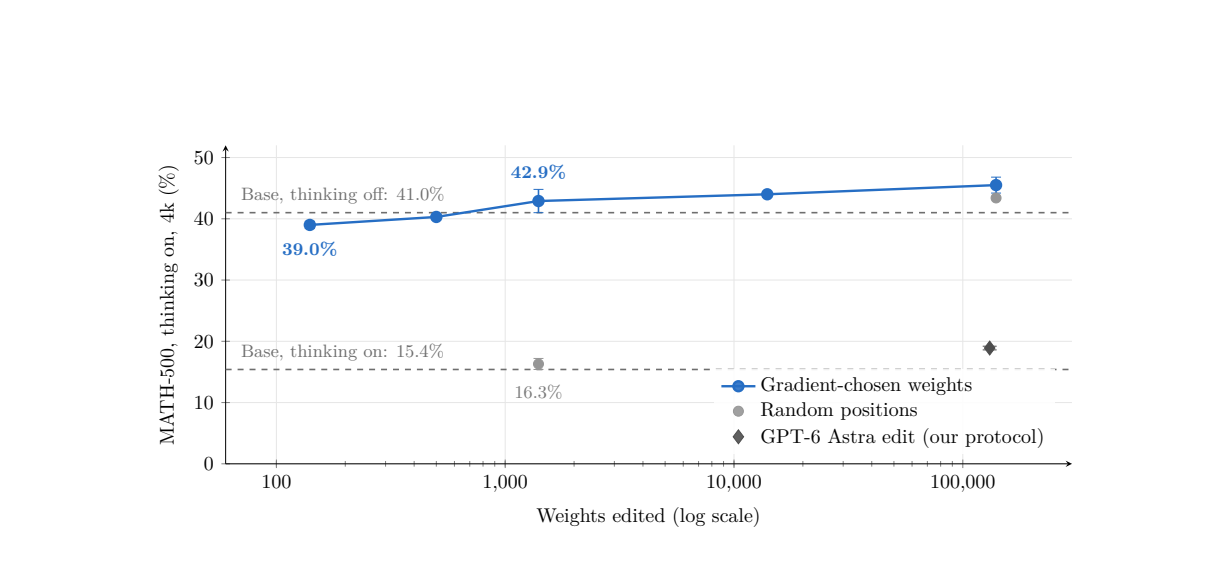
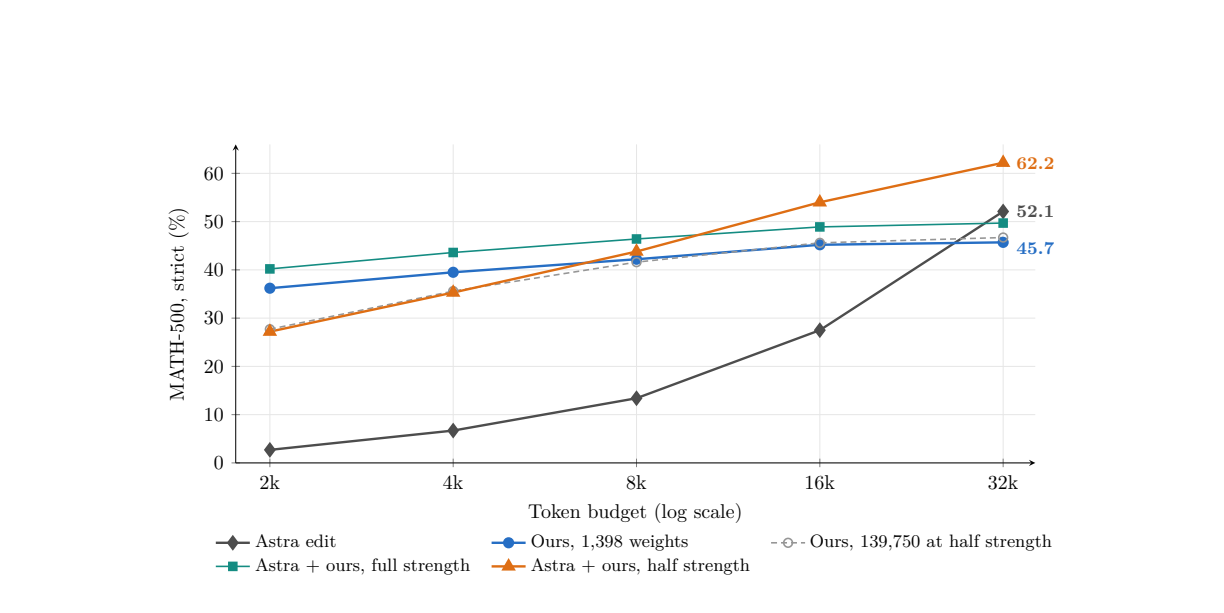
A recent demonstration had GPT-6 Astra edit 131,072 of the model's weights without gradients and reported MATH-500 rising from 7.9% to 48.1% at a 32,768-token budget. We provide the missing gradient baseline, then combine the two edits. Fine-tuning only the 140 to 139,750 weights with the largest gradient, on the model's own correct answers to MATH training problems, raises thinking-mode MATH-500 at 4k tokens to 39.0-45.5% after 2-9 minutes of training on one GPU; 50 training examples suffice, and 1,398 random positions give only 16.3%. The gradient concentrates the edit on the most nearly constant channel of each of the first three layers. Because the model has no bias terms, an edit confined to those channels acts as a constant vector added to the residual stream: adding three fixed vectors to the unedited model matches the accuracy of such an edit. Under the Astra protocol (32k tokens, presence penalty 1.5), the Astra edit scores 52.1% (finished and correct) in our reproduction and our full-strength edits reach 45.6-45.7%, but ours win at every budget up to 16k tokens (39.5% against 6.7% at 4k). The two edits are complementary. The Astra edit plus our 139,750-weight edit at half strength scores 62.2% at 32k, 10 points above the Astra edit alone (p = 3e-9), with half as many tokens; our half-strength edit alone scores 46.7%.
from the abstract
Pith says
Machine review · deepseek-v4-flash · 25 Nov 2026 · read the full text (34,868 characters) · not checked by a person
It can be wrong. Challenge this review or reply to it.
Holds up. Gradient-based sparse editing provides a cheap baseline for weight-space programming and complements a frontier model's edit. This line is wrong
4 minor
How often objections from reviews like this one are right: not yet measured
The paper, first character to last
The reviewer was given the whole text, 34,868 characters. Not checked: figures, code, what the 19 references say.
4 minor objections
The paper says, at Table 2
Pith says: minor objection 1 of 4
Table 2 caption says 'Two samples per setting' but the table shows two columns for MATH-500 (e.g., 41.0% / 44.8%). Clarify that these are the two seed results, not a range.
The paper says, at Abstract
Pith says: minor objection 2 of 4
In the abstract, 'complement a frontier model's weight edit' is used, but the paper shows the edits are complementary only under the Astra protocol (32k tokens, presence penalty 1.5). Under the authors' own protocol (4k tokens), stacking the Astra edit adds little. The abstract should qualify the complementarity claim with the token budget.
show 2 more
The paper says, at §3
Pith says: minor objection 3 of 4
Section 3: 'The 139,750-weight edit beats it at the 8k budget, 48.0% (p=0.002), and scores 46.8% (p=0.009) and 44.2% (p=0.18) at 4k.' The p-values are reported without stating the null hypothesis or the test used. The paper earlier describes a sign test on problems where the share of correct samples differs, but it would help to state explicitly that these are comparisons against the thinking-off baseline.
The paper says, at Figure 1 caption
Pith says: minor objection 4 of 4
Figure 1 caption mentions 'bars span both' seeds, but the figure is not visible. Ensure the caption is self-contained.
What would settle it
If a held-out set for strength selection yields a different best strength or the 62.2% gain disappears with independent validation, the complementarity claim would be undermined. Alternatively, if a model with bias terms fails to benefit from early-layer gradient edits, the constant-bias mechanism would not generalise.
from Pith's summary of the paper
How the review went
5 passes by deepseek-v4-flash · 25 Nov 2026
- Reader holds up
- Skeptic concern withdrawn: the paper already says this
- Referee 4 minor
- Check against the paper kept 0 of 3 objections
- Editor wrote the verdict above
Not run on this paper: the simulated authors' defence.
Pith's passes raised 3 objections. A check against the paper's text kept 0 and withdrew 3 (3 the paper already says).
The review in full
The review in brief, machine-written
This paper does something useful: it provides the missing gradient baseline for the recent weight-space programming demonstration. The authors show that fine-tuning as few as 140 weights, chosen by gradient magnitude on the model's own correct answers, raises thinking-mode MATH-500 from 15% to 39–45% in minutes on one GPU. That is a real result, and it is well-controlled: random positions fail at small edit sizes, and the mechanism is traced to constant channels acting as biases in this bias-free model. The constant-channel analysis is neat and well-ablated: training only those four columns works as well as the full edit, and adding three fixed vectors to the unedited model matches its accuracy. The comparison with the GPT-6 Astra edit is fair and informative. Under its own protocol, the Astra edit wins at 32k tokens, but the gradient edit wins at every budget up to 16k. The combination, with the gradient edit at half strength, reaches 62.2% at 32k, 10 points above the Astra edit alone. That is a striking result and suggests the two edits address different parts of the problem. The paper also provides controls that prior work lacked: random positions, thinking-off baselines, and multiple token budgets. The paper is honest about its limitations. The strength for the combined edit was chosen on the test set, though both weaker strengths also beat the Astra edit. All results are for one small model, and the mechanism analysis covers only four columns on a small sample. Some planned experiments were cut when compute credits ran out. These are real but minor concerns; the central claims hold up. This is a solid empirical paper. It deserves a serious referee. I would send it to peer review.
The stress test's concern
Withdrawn: the paper already says this.
The paper says
“We chose the strength of our edit in the combination from three values (1, 0.5, 0.25) on MATH-500 itself, with no held-out set; both weaker strengths beat the Astra edit by at least 7.7 points ($p\le10^{-8}$), so the gain does not hinge on one setting, but the 62.2\% figure is the best of three.”
The referee's report
Not published. Pith's referee wrote this assessment before its objections were checked against the paper, and 2 of its 2 major objections did not survive that check.
Pith's reading of the paper (a machine's summary, not the authors')
The paper establishes that a cheap gradient-based edit can stop the near-universal thinking loops of Qwen3.5-0.8B, a small reasoning model. By fine-tuning only the 140 to 139,750 weights with the largest gradient on the model's own correct answers, thinking-mode MATH-500 accuracy rises from 15% to 39–45% in 2–9 minutes on a single GPU. The edit concentrates on four nearly constant channels in the first three layers, effectively adding a constant bias vector to the residual stream. The paper compares this with a GPT-6 Astra weight edit that uses 131,072 weights and no gradients, finding that each edit wins in its own token-budget regime. Combining both edits at half strength yields 62.2%, 10 points above the Astra edit alone, with half the tokens.
What carries the argument. The key machinery is a gradient-magnitude mask that selects the weights with the largest summed absolute gradients across the frozen model, applied to all 150 projection matrices. This concentrates the edit on four input columns of the output projection in layers 0–2, which are the most constant channels (highest mean/std). Because the model has no bias terms, an edit to these channels adds a near-constant vector to the residual stream, acting as a learned bias that stops loops. The Astra edit is a rank-one update to two MLP down-projection layers that flips and amplifies the signal along a specific direction.
Core claim. The central claim is that a sparse gradient edit on the most constant channels of the first three layers of Qwen3.5-0.8B acts as a constant bias vector that stops the model's thinking loops, raising accuracy from 15% to 39–45% on MATH-500 in minutes. This edit, though weaker than the GPT-6 Astra edit at long token budgets, complements it: combined at half strength they reach 62.2%, outperforming either alone. The paper argues that gradient baselines and random-position controls are essential for evaluating weight-space programming claims.
The premise it rests on. The strength of the combined edit was chosen from three values on the MATH-500 test set itself, with no held-out validation, though both weaker strengths also beat the Astra edit by at least 7.7 points.
If the paper is right (Pith's inferences, not the authors')
If the claim is correct, weight-space programming results must be compared against cheap gradient baselines and random controls.
The constant-bias mechanism explains why the edit works and suggests that other steering vectors can be stored in early-layer weights of bias-free models.
The combination of gradient and frontier-model edits shows that weight edits found by different methods can be stacked for better performance.
The finding that 50 training examples suffice suggests that fixing loop behaviour requires very little data.
The edit's failure to transfer to code tasks indicates that the loop-fixing mechanism is task-specific.
The constant-channel mechanism might generalise to other small models without bias, providing a cheap way to steer reasoning length.
The synergy between gradient and frontier edits suggests that the two methods find complementary corrections: one stops loops early, the other improves reasoning quality given more tokens.
The paper's limitation that strength was chosen on the test set without hold-out means the 62.2% figure might be optimistic; a replication with held-out validation would strengthen the claim.
Check this review
What was read
The passes were given all 34,868 characters of the paper's LaTeX source.
Fingerprint of that text (SHA-256): 8b9ed10e378858714e4f5e7e3dfdbcad2cf3f55363593924091ab149f5bc0949
Pith does not keep that text. Rebuilt from the paper's source or PDF by the same code, it has this fingerprint if it is the same text. From a copy of Pith's code:
PYTHONPATH=. python scripts/review_input_check.py 2611.33133
The passes, in the order they ran
- Reader deepseek-v4-flash · medium effort · $0.0017 · instructions of the Reader, fingerprint f9ead7300382…
- Skeptic deepseek-v4-flash · medium effort · $0.0013 · instructions of the Skeptic, fingerprint 8f88c0f61488…
- Referee deepseek-v4-flash · medium effort · $0.0013 · instructions of the Referee, fingerprint a852d99aea0d…
- Check against the paper deepseek-v4-flash · medium effort · $0.0017 · instructions of the Check against the paper, fingerprint 6c7a6883d551…
- Editor deepseek-v4-flash · medium effort · $0.0012 · instructions of the Editor, fingerprint e7211f6a3d27…
- Circularity check deepseek-v4-flash · medium effort · $0.0010 · instructions of the Circularity check, fingerprint e9946e39d67b…
- Summary for the page deepseek-v4-flash · medium effort · temperature 0.2 · $0.0025 · instructions of the Summary for the page, fingerprint e4f56bf568e7…
The passes cost $0.011 in model calls together.
Version stamped on this review: pith-pipeline@v1.4.1-daily-deepseek-or-medium+deepseek/deepseek-v4-flash+p.d60f54226f00
Each link opens a pass's instructions as plain text, the exact bytes its fingerprint was taken over. Every stored set of instructions.
curl -s https://pith.science/methodology/prompts/f9ead730038216984cfb56d7cb34332bdf691828296a1de4245f3d6667d4bf56 | sha256sum
prints the fingerprint of the reader's instructions. The same works for every pass.
The receipt
The review's fingerprint was taken on 25 Nov 2026. The review you are reading still matches it.
Fingerprint of the review (SHA-256): 025270a18f6295916d6fd362b5643bdb720e9bb429886c70f0c459c23424bb26
curl -s 'https://pith.science/api/v1/verdicts/2611.33133?form=canonical' | sha256sum
prints the fingerprint of the review as it stands now. The rule, in four steps.
A matching fingerprint shows the review has not changed since that date. It does not show that the review is right.
How often reviews like this one are right
Reviews like this one: written by deepseek-v4-flash, from the paper's LaTeX source.
How often objections from reviews like this one are right: not yet measured
Reviews by people
This review was written by a machine. No person has reviewed this paper on Pith yet. A scientist listed on Pith can review it for a fee, and their review is published here whatever it concludes.
The paper
Abstract
Qwen3.5-0.8B rarely finishes reasoning in thinking mode: at a 4,096-token budget only 1 or 2 of 500 MATH-500 answers close their think block (two seeds), and accuracy is 15.4%. A recent demonstration had GPT-6 Astra edit 131,072 of the model's weights without gradients and reported MATH-500 rising from 7.9% to 48.1% at a 32,768-token budget. We provide the missing gradient baseline, then combine the two edits. Fine-tuning only the 140 to 139,750 weights with the largest gradient, on the model's own correct answers to MATH training problems, raises thinking-mode MATH-500 at 4k tokens to 39.0-45.5% after 2-9 minutes of training on one GPU; 50 training examples suffice, and 1,398 random positions give only 16.3%. The gradient concentrates the edit on the most nearly constant channel of each of the first three layers. Because the model has no bias terms, an edit confined to those channels acts as a constant vector added to the residual stream: adding three fixed vectors to the unedited model matches the accuracy of such an edit. Under the Astra protocol (32k tokens, presence penalty 1.5), the Astra edit scores 52.1% (finished and correct) in our reproduction and our full-strength edits reach 45.6-45.7%, but ours win at every budget up to 16k tokens (39.5% against 6.7% at 4k). The two edits are complementary. The Astra edit plus our 139,750-weight edit at half strength scores 62.2% at 32k, 10 points above the Astra edit alone (p = 3e-9), with half as many tokens; our half-strength edit alone scores 46.7%.
The paper's own sentences, arranged, kept beside the review and separate from it. Each label is drawn from a closed vocabulary; the number beside it is the probability the classifier gave that label. No sentence in this record was written by a model.
abstract compiled · 2026-11-25
The authors' main claim, as the classifier picked it out 0.83
“The two edits are complementary.”
How the main claim is stated: asserted 1.00
What the abstract itself states, as probabilities: claims first 0.11 · states limitation 0.42 · human participants 0.02 · controlled comparison 0.95 · randomized assignment 0.04 · states quantitative result 0.99 · compares with prior results 0.98 · mentions code or data availability 0.04
The abstract, sentence by sentence
This table labels the abstract only (arXiv listing abstract v1). The number is the probability the classifier gave the label.
| Sentence | Role | The authors' own work | States the main conclusion | Strength |
|---|---|---|---|---|
| Qwen3.5-0.8B rarely finishes reasoning in thinking mode: at a 4,096-token budget only 1 or 2 of 500 MATH-500 answers close their think block (two seeds), and accuracy is 15.4%. | background 0.84 | 0.71 | 0.03 | asserted 1.00 |
| A recent demonstration had GPT-6 Astra edit 131,072 of the model's weights without gradients and reported MATH-500 rising from 7.9% to 48.1% at a 32,768-token budget. | background 0.99 | 0.05 | 0.04 | asserted 1.00 |
| We provide the missing gradient baseline, then combine the two edits. | contribution 0.81 | 0.55 | 0.07 | asserted 0.83 |
| Fine-tuning only the 140 to 139,750 weights with the largest gradient, on the model's own correct answers to MATH training problems, raises thinking-mode MATH-500 at 4k tokens to 39.0-45.5% after 2-9 minutes of training on one GPU; 50 training examples suffice, and 1,398 random positions give only 16.3%. | result 0.87 | 0.95 | 0.25 | asserted 1.00 |
| The gradient concentrates the edit on the most nearly constant channel of each of the first three layers. | result 0.75 | 0.88 | 0.06 | asserted 1.00 |
| Because the model has no bias terms, an edit confined to those channels acts as a constant vector added to the residual stream: adding three fixed vectors to the unedited model matches the accuracy of such an edit. | interpretation 0.87 | 0.87 | 0.09 | asserted 1.00 |
| Under the Astra protocol (32k tokens, presence penalty 1.5), the Astra edit scores 52.1% (finished and correct) in our reproduction and our full-strength edits reach 45.6-45.7%, but ours win at every budget up to 16k tokens (39.5% against 6.7% at 4k). | result 1.00 | 0.89 | 0.11 | asserted 1.00 |
| The two edits are complementary. | interpretation 0.71 | 0.82 | 0.26 | asserted 1.00 |
| The Astra edit plus our 139,750-weight edit at half strength scores 62.2% at 32k, 10 points above the Astra edit alone (p = 3e-9), with half as many tokens; our half-strength edit alone scores 46.7%. | result 1.00 | 0.94 | 0.48 | asserted 1.00 |
What kind of paper the classifier reports this is: empirical study 0.65 · evidence from observation or experiment 0.93
What was examined, and what was not
Sources read
- arXiv listing abstract v1
Not examined
- full text
- figures and tables
- references and citing sentences
- relations to other papers
Levels run
- P abstract
Not run
- S sections
- T body sentences
- C citations
- R cross-paper relations
How the labels were made
Compiled by classifier-1.13.0 via TypeSafe API, question bank abstract-p1-20260923, 2026-11-25: 1 request, 7,463 input tokens.
Every quoted sentence on this record is the authors'. Every label is from Pith's closed vocabulary, with the probability shown beside it. This record as JSON
Figures (2)
Figures are the authors', reproduced from the paper.
References (19)
- [1] R. Takehi, J. Teoh, A. Zhang, and O. Khattab. Sparks of weight-space programming: LLMs can natively read & write neural network weights. Blog post, MIT CSAIL, November 2026. https://rikiyat.github.io/blog/weight-space-programming/ on Pith
- [2] R. Takehi. Qwen3.5-0.8B-weight-space-programming. Hugging Face model card, 2026.https: //huggingface.co/RikiyaT/Qwen3.5-0.8B-weight-space-programming on Pith
- [3] J. Hu, C. Tang, W. Li, H. Zhu, C.-M. Feng, Q. Zhang, Y. Chen, and M. Hu. Exploring weight-space programming: Capabilities, generalization, and limitations. arXiv:2611.09382, 2026 on PithPith's reviewarXiv
- [4] Qwen Team. Qwen3.5-0.8B. Hugging Face model card, 2026.https://huggingface.co/Qwen/ Qwen3.5-0.8B on Pith
- [5] C. Pipis, S. Garg, V. Kontonis, V. Shrivastava, A. Krishnamurthy, and D. Papailiopoulos. Wait, wait, wait... why do reasoning models loop? InInternational Conference on Machine Learning (ICML), 2026 on Pith
- [6] Liquid AI. Reducing doom loops with final token preference optimization. Blog post, 2026. https://www.liquid.ai/en/blog/antidoom on Pith
- [7] C.-E. Sun, G. Yan, and T.-W. Weng. ThinkEdit: Interpretable weight editing to mitigate overly short thinking in reasoning models. InProceedings of EMNLP, 2025. arXiv:2503.22048 on PitharXiv
- [8] L. Sheng, A. Zhang, Z. Wu, W. Zhao, C. Shen, Y. Zhang, X. Wang, and T.-S. Chua. On reasoning strength planning in large reasoning models. arXiv:2506.08390, 2025 on PitharXiv
- [9] Y.-L. Sung, V. Nair, and C. Raffel. Training neural networks with fixed sparse masks. arXiv:2111.09839, 2021 on PithPith's reviewarXiv
- [10] S. Mukherjee, L. Yuan, D. Hakkani-Tür, and H. Peng. Reinforcement learning finetunes small subnetworks in large language models. InAdvances in Neural Information Processing Systems (NeurIPS), 2025. arXiv:2505.11711 on PitharXiv
- [11] R. Shao, S. S. Li, et al. Spurious rewards: Rethinking training signals in RLVR. arXiv:2506.10947, 2025 on PithPith's reviewarXiv
- [12] D. Hendrycks, C. Burns, S. Kadavath, A. Arora, S. Basart, E. Tang, D. Song, and J. Steinhardt. Measuring mathematical problem solving with the MATH dataset. InNeurIPS Datasets and Benchmarks Track, 2021. 10 on Pith
- [13] H. Lightman, V. Kosaraju, Y. Burda, H. Edwards, B. Baker, T. Lee, J. Leike, J. Schulman, I. Sutskever, and K. Cobbe. Let’s verify step by step. arXiv:2305.20050, 2023 on PithPith's reviewarXiv
- [14] K. Cobbe, V. Kosaraju, M. Bavarian, M. Chen, H. Jun, L. Kaiser, M. Plappert, J. Tworek, J. Hilton, R. Nakano, C. Hesse, and J. Schulman. Training verifiers to solve math word problems. arXiv:2110.14168, 2021 on PithPith's reviewarXiv
- [15] M. Chen, J. Tworek, H. Jun, Q. Yuan, et al. Evaluating large language models trained on code. arXiv:2107.03374, 2021 on PithPith's reviewarXiv
- [16] N. Jain, K. Han, A. Gu, W.-D. Li, F. Yan, T. Zhang, S. Wang, A. Solar-Lezama, K. Sen, and I. Stoica. LiveCodeBench: Holistic and contamination free evaluation of large language models for code. arXiv:2403.07974, 2024 on PithPith's reviewarXiv
- [17] W. Kwon, Z. Li, S. Zhuang, Y. Sheng, L. Zheng, C. H. Yu, J. E. Gonzalez, H. Zhang, and I. Stoica. Efficient memory management for large language model serving with PagedAttention. InProceedings of SOSP, 2023 on Pith
- [18] Hugging Face. Math-Verify. Software,https://github.com/huggingface/Math-Verify on Pith
- [19] Q. McNemar. Note on the sampling error of the difference between correlated proportions or percentages.Psychometrika, 12(2):153–157, 1947. 11 on Pith
Challenges and discussion
Disagree with the review, or know something it missed? Leave a comment, or challenge this review formally: a challenge becomes a permanent entry in this paper's record, and its decision is published here.
Come back by email
A short list of the week's newly reviewed papers. Nothing is sent until you confirm from your inbox, and every email has a link that stops it. No account.
No comments yet.
Sign in to comment