REVIEW 3 major objections 5 minor 35 references
6D Pose Estimation on Point Cloud Data through Prior Knowledge Integration: A Case Study in Autonomous Disassembly
T0 review · 3 major / 5 minor · reviewed 2026-08-07 · deepseek-v4-flash
Pith's one-line read A full motor model as prior knowledge lets a single-view camera determine every bolt's 6D pose, even when bolts are occluded or poorly scanned.
desk verdict A well-structured industrial pipeline for bolt 6D pose estimation whose central accuracy claim rests on a single qualitative figure, not on measured end-to-end pose errors. read the letter →
The pith
A machine-rendered reading of the paper's core claim, the machinery that carries it, and where it could break.
The reading
What carries the argument
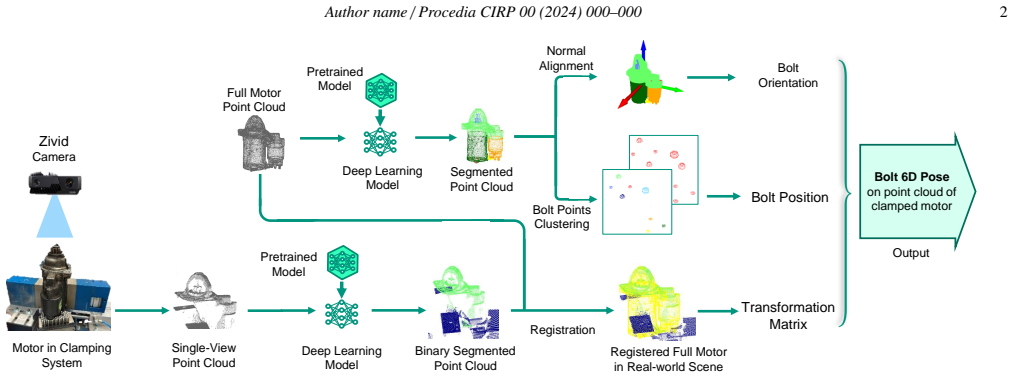
The central mechanism is a rigid transformation chain. A full motor point cloud, which can come from a CAD model or a scanner, carries prior knowledge: part segmentation defines the motor frame, normals on the main housing fix the axes, and DBSCAN on bolt points gives bolt positions in that frame. A coarse-to-fine registration (FPFH features with Fast Global Registration, then three successive point-to-plane ICP steps with decreasing match distance $d_{\max}$) computes the transformation $T_{C\to B}$ from the model frame to the camera frame, and a second fixed transform $T_{B\to A}$ conveys poses to the robot frame. The load-bearing identity is $[{}^{B}R_{\text{bolt}},{}^{B}t_{\text{bolt}};0,1] = T_{C\to B}[{}^{C}R_{\text{bolt}},{}^{C}t_{\text{bolt}};0,1]$, transferring inferred model-frame poses into the scene.
What would settle it
Take a motor whose CAD model is intentionally offset or edited, for instance with one bolt moved 10 mm, then run the pipeline; if the output still points at the original CAD bolt location rather than the physically moved bolt, the prior-knowledge transfer is confirmed as the limiting constraint. Alternatively, compare the pipeline's predicted bolt positions against a separate high-precision scan of the same clamped motor and check whether registration residuals stay below the screwdriver's tolerance.
Extended reading notes
Core claim
On its own terms, the discovery is that bolt 6D pose estimation under single-view occlusion can be reduced to a registration problem rather than a detection problem. Because bolts are rigidly attached to a motor body that has a known reference geometry, the paper treats the full motor point cloud as a source and the camera scene as a target; after segmentation-based normal alignment defines the model's coordinate frame, DBSCAN clustering locates bolt centers in model space, and FPFH-based global registration followed by cascaded point-to-plane ICP transfers those centers and orientations into the real scene. The reported results show this yields usable poses for all nine bolts despite incompletely scanned and occluded bolts.
Load-bearing premise
The full motor point cloud used as prior knowledge must match the physical motor in the clamping system, including the positions of its bolts; if the model and the real motor differ, even a perfect registration will transfer wrong bolt poses.
Editorial extensions
If this is right
- If the method works as claimed, a robot can disassemble all bolts from a single fixed camera view, without needing to reposition the camera or detect each bolt individually.
- Poses for occluded bolts are recoverable as long as the surrounding motor body is visible enough to register.
- The pipeline turns per-bolt detection difficulty into a registration problem, making new motor variants usable simply by supplying a CAD or scanned model.
- Precision is prioritized over speed: the cascaded registration takes seconds (about 6.4 s for the chosen setting), which is acceptable for disassembly but not for real-time applications.
- Segmentation quality, especially bolt IoU, sets the ceiling; improving part segmentation should directly improve downstream pose accuracy.
Reading between the lines
- The same prior-knowledge transfer should generalize to any product family with a stable reference frame and rigidly attached small parts, not just starter motor bolts; a testable extension is to run the pipeline on gearboxes with pins or electronic housings with clips.
- The paper does not report per-bolt pose error against ground truth, so the true accuracy-limiting factor is likely the registration residual; a quantitative evaluation with a robot-mounted measurement would clarify whether the claimed accuracy holds.
- Because the method relies on the full motor as prior, it may fail gracefully when product variants differ beyond the six semantic parts the segmentation was trained on, making a variant-aware fallback a natural next step.
- The synthetic-to-real pretraining using generated motor data is what makes the small real dataset (18 motors) tractable, and the same recipe could be reused for other disassembly targets.
Signed reviews
Editorial analysis
A structured set of objections, weighed in public.
Referee Report
Summary. The paper presents a multi-stage pipeline for estimating the 6D pose of bolts on starter motors in an autonomous disassembly context. A pre-acquired full-motor point cloud serves as prior knowledge; the pipeline performs binary segmentation of the single-view real-world scene, part segmentation of the full motor model, coarse-to-fine registration between the full model and the scene, DBSCAN clustering of bolt points to obtain bolt positions, and a normal-alignment step to define the motor coordinate system and therefore bolt orientations. The final bolt poses are obtained by transforming the full-model bolt poses through the registration matrix (Eq. 2) and then the robot-camera transform (Eq. 3). Experiments report registration RMSE (Table 1) and segmentation IoU for different backbones and hyperparameters (Tables 2 and 3), plus a qualitative real-world demo (Fig. 5). The paper claims accurate 6D pose estimation even under occlusion and low-quality scans.
Significance. If the claimed accuracy were quantitatively demonstrated, the pipeline would be a useful practical contribution for remanufacturing automation, showing how a strong geometric prior (a full CAD/scanned model) can compensate for single-view, partially occluded data. The paper's decomposition of a difficult small-object pose problem into segmentation, registration, clustering, and alignment steps is sensible and the idea of transferring bolt poses from a known reference model is valuable. The authors also provide a cross-validation scheme and careful ablation of backbones and hyperparameters for the segmentation stage, which is commendable given the small dataset. However, the central claim of accurate bolt 6D pose estimation is currently supported only by intermediate metrics and a single qualitative figure; no end-to-end pose error is measured. This leaves the significance of the contribution conditional on additional validation.
major comments (3)
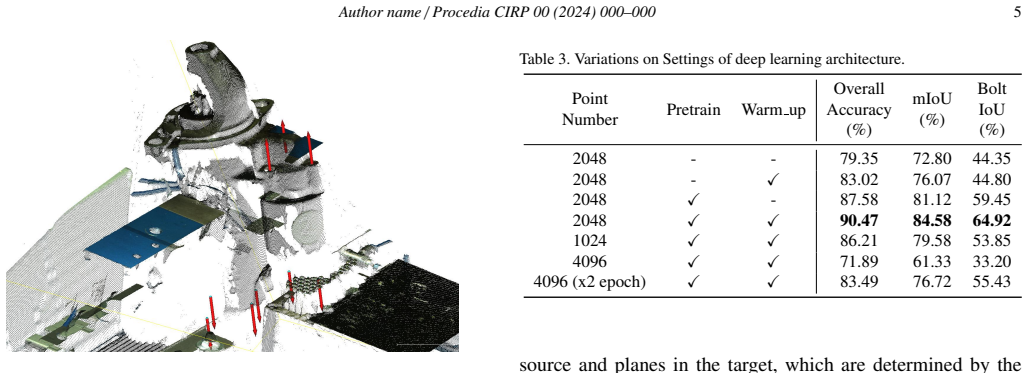
- [Sec. 3.3, Table 1] The central claim that 'our method can accurately determine the 6D pose of bolts' is not backed by any quantitative end-to-end evaluation. The only full-pipeline evidence is Fig. 5, a single real-world example without ground-truth comparison, and no pose error (position error in mm, orientation error in degrees) is reported for the 18 motors or for synthetic scenes. The intermediate metrics in Tables 1-3 (registration RMSE 7.62e-2 mm, Bolt IoU 64.92%) do not bound the final bolt pose transferred by Eq. (2), because bolt positions are computed from cluster centroids and orientations from normal alignment, both of which introduce errors that are not captured by these metrics. Please provide an end-to-end evaluation, e.g., using synthetic scenes with known bolt poses, or manually annotating a subset of real scenes to compute pose errors.
- [Sec. 3.4] Registration accuracy is reported only as point-to-plane RMSE. This metric can be small even when the transformation has large errors along weakly constrained directions, especially for a single-view partial target with occluded regions, as in this setup. The reported RMSE of 7.62e-2 mm therefore does not guarantee that TC->B is accurate enough for the bolt coordinates transferred via Eq. (2). Please report the transformation error against a ground-truth registration (e.g., on synthetic scenes with known poses), or show the residual distribution separated by direction, or evaluate the effect of registration error on the final bolt pose.
- [Sec. 4, Full Pipeline Demo] Bolt positions Ctbolt are computed as the centroids of DBSCAN clusters on the segmented bolt points. Since the bolt segmentation IoU is only 64.92% (Table 2), false-positive and false-negative points can systematically bias these centroids, yet no evaluation of the clustering step is provided (e.g., cluster count vs. true bolt count, centroid error vs. known bolt positions in synthetic data). In addition, the DBSCAN hyperparameters (eps, min_samples) are not disclosed, and no sensitivity analysis is given. Given that this step directly determines the position part of the 6D pose, it should be quantitatively validated to support the central claim.
minor comments (5)
- [Abstract] The phrase 'bolts a ffixed' should be 'bolts affixed'.
- [Sec. 4] The text 'The Fig. 5' should be 'Fig. 5'.
- [Sec. 3.3] The sentence 'we prioritize precision over real-time performance' implies a real-time requirement, but no quantitative time budget is given; please specify the required cycle time or remove the implication.
- [Table 1] The column 'Process time (s)' is not clearly defined; please state whether it is the total time for the full registration pipeline or a per-scan average, and specify the hardware on which it was measured.
- [Sec. 3.5] The definition of the y-axis states that 'the center of the Solenoid part lies in the yoz plane', but it is not explained how this center is computed from the segmented point cloud; please clarify the procedure.
Circularity Check
No circularity: bolt poses are transferred from an externally acquired full-motor model via registration, not fitted to the target data.
full rationale
The pipeline's central derivation transfers bolt poses from an externally acquired full-motor model to the scene: bolt positions and orientations are computed in the model's coordinate system by clustering and normal alignment (Sections 3.4 and 3.5), and Eq. (2) applies the registration transform T_C->B obtained by FPFH-based Fast Global Registration and ICP (Section 3.3). Bolt poses are never fitted to the target single-view data; Eq. (1) is an explicitly stated domain prior about bolt orientation relative to the motor axis, not an output of the estimator. The self-citations (MotorFactory [31], sim2real transfer [6]) are tool and dataset-generation references, not load-bearing theorems, and no uniqueness argument is imported from prior work. The lack of an end-to-end bolt-pose error metric is a validation gap, not a circular reduction; the paper reports registration RMSE and part-segmentation IoU as intermediate diagnostics. Therefore no step in the claimed derivation reduces by construction to its own inputs.
Assumptions & free parameters
free parameters (3)
- Fine registration distance schedule =
10, 1, 0.1 mm
- Input point count for segmentation network =
2048
- Number of fine registration steps =
3
assumptions (4)
- domain assumption Bolts are oriented along the motor axis, either parallel or anti-parallel (Eq. 1).
- domain assumption The main housing is a cylinder whose point normals lie in a plane perpendicular to the motor axis.
- domain assumption The full motor point cloud is geometrically consistent with the actual motor in the clamp.
- domain assumption Synthetic Blender datasets generated by MotorFactory are representative of real motors for pre-training the segmentation networks.
Cite this review
Pith. "Pith review of 6D Pose Estimation on Point Cloud Data through Prior Knowledge Integration: A Case Study in Autonomous Disassembly." pith.science (2026). https://pith.science/paper/2C3WPOZT
@misc{pith2026250524669,
  author       = {Pith},
  title        = {Pith review of: 6D Pose Estimation on Point Cloud Data through Prior Knowledge Integration: A Case Study in Autonomous Disassembly},
  year         = {2026},
  howpublished = {\url{https://pith.science/paper/2C3WPOZT}},
  note         = {Machine review of arXiv:2505.24669}
}
read the original abstract
The accurate estimation of 6D pose remains a challenging task within the computer vision domain, even when utilizing 3D point cloud data. Conversely, in the manufacturing domain, instances arise where leveraging prior knowledge can yield advancements in this endeavor. This study focuses on the disassembly of starter motors to augment the engineering of product life cycles. A pivotal objective in this context involves the identification and 6D pose estimation of bolts affixed to the motors, facilitating automated disassembly within the manufacturing workflow. Complicating matters, the presence of occlusions and the limitations of single-view data acquisition, notably when motors are placed in a clamping system, obscure certain portions and render some bolts imperceptible. Consequently, the development of a comprehensive pipeline capable of acquiring complete bolt information is imperative to avoid oversight in bolt detection. In this paper, employing the task of bolt detection within the scope of our project as a pertinent use case, we introduce a meticulously devised pipeline. This multi-stage pipeline effectively captures the 6D information with regard to all bolts on the motor, thereby showcasing the effective utilization of prior knowledge in handling this challenging task. The proposed methodology not only contributes to the field of 6D pose estimation but also underscores the viability of integrating domain-specific insights to tackle complex problems in manufacturing and automation.
Figures


Figures from the paper (2 more)

Reference graph
Works this paper leans on
-
[1]
E. Sundin. Product and process design for successful remanufacturing . PhD thesis, Link¨oping University Electronic Press, 2004
work page 2004
-
[2]
A. P. Barquet et al. An integrated approach to remanufacturing: model of a remanufacturing system. Journal of Remanufacturing, 3:1–11, 2013
work page 2013
-
[3]
M. I. Rizova et al. A systematic review of decision-making in remanufac- turing. Computers & Industrial Engineering, 147:106681, 2020
work page 2020
-
[4]
J. Kurilova-Palisaitiene et al. Remanufacturing challenges and possible lean improvements. Journal of Cleaner Production, 172:3225–3236, 2018
work page 2018
-
[5]
G. Lanza et al. Agiles produktionssystem mittels lernender roboter bei ungewissen produktzust ¨anden am beispiel der anlasser-demontage. at- Automatisierungstechnik, 70(6):504–516, 2022
work page 2022
- [6]
- [7]
-
[8]
B. Baud-Lavigne et al. Mutual impacts of product standardization and supply chain design. International Journal of Production Economics , 135(1):50–60, 2012
work page 2012
Show all 35 references
-
[9]
Albers et al
A. Albers et al. Reference products in pge–product generation engineer- ing: analyzing challenges based on the system hierarchy. Procedia CIRP, 70:469–474, 2018
2018
-
[10]
D. G. Lowe. Object recognition from local scale-invariant features. In Pro- ceedings of the seventh IEEE international conference on computer vision , volume 2, pp. 1150–1157. Ieee, 1999
1999
-
[11]
D. G. Lowe. Distinctive image features from scale-invariant keypoints. International journal of computer vision , 60:91–110, 2004
2004
-
[12]
Peng et al
S. Peng et al. Pvnet: Pixel-wise voting network for 6dof pose estimation. In Proceedings of the IEEE/CVF Conference on Computer Vision and Pattern Recognition, pp. 4561–4570, 2019
2019
-
[13]
M. A. Fischler and R. C. Bolles. Random sample consensus: a paradigm for model fitting with applications to image analysis and automated cartog- raphy. Communications of the ACM, 24(6):381–395, 1981
1981
-
[14]
P. J. Besl and N. D. McKay. Method for registration of 3-d shapes. In Sensor fusion IV: control paradigms and data structures, volume 1611, pp. 586–606. Spie, 1992
1992
-
[15]
Chen et al
X. Chen et al. Multi-view 3d object detection network for autonomous driving. In Proceedings of the IEEE conference on Computer Vision and Pattern Recognition, pp. 1907–1915, 2017
1907
-
[16]
C. R. Qi et al. Frustum pointnets for 3d object detection from rgb-d data. In Proceedings of the IEEE conference on computer vision and pattern recognition, pp. 918–927, 2018
2018
-
[17]
Ku et al
J. Ku et al. Joint 3d proposal generation and object detection from view aggregation. In 2018 IEEE /RSJ International Conference on Intelligent Robots and Systems (IROS), pp. 1–8. IEEE, 2018
2018
-
[18]
Xu et al
D. Xu et al. Pointfusion: Deep sensor fusion for 3d bounding box esti- mation. In Proceedings of the IEEE conference on computer vision and pattern recognition, pp. 244–253, 2018
2018
-
[19]
Wang et al
C. Wang et al. Densefusion: 6d object pose estimation by iterative dense fusion. In Proceedings of the IEEE /CVF conference on computer vision and pattern recognition, pp. 3343–3352, 2019
2019
-
[20]
C. R. Qi et al. Pointnet: Deep learning on point sets for 3d classification and segmentation. In Proceedings of the IEEE conference on computer vision and pattern recognition, pp. 652–660, 2017
2017
-
[21]
Du ffhauss et al
F. Du ffhauss et al. Mv6d: Multi-view 6d pose estimation on rgb-d frames using a deep point-wise voting network. In 2022 IEEE /RSJ International Conference on Intelligent Robots and Systems (IROS) , pp. 3568–3575. IEEE, 2022
2022
-
[22]
Chen et al
J. Chen et al. Survey on 6d pose estimation of rigid object. In 2020 39th Chinese Control Conference (CCC), pp. 7440–7445. IEEE, 2020
2020
-
[23]
Fernandes et al
D. Fernandes et al. Point-cloud based 3d object detection and classification methods for self-driving applications: A survey and taxonomy.Information Fusion, 68:161–191, 2021
2021
-
[24]
B. Li. 3d fully convolutional network for vehicle detection in point cloud. In 2017 IEEE/RSJ International Conference on Intelligent Robots and Sys- tems (IROS), pp. 1513–1518. IEEE, 2017
2017
-
[25]
C. R. Qi et al. Pointnet ++: Deep hierarchical feature learning on point sets in a metric space. Advances in neural information processing systems , 30, 2017
2017
-
[26]
Wang et al
Y . Wang et al. Dynamic graph cnn for learning on point clouds. ACM Transactions on Graphics (tog), 38(5):1–12, 2019
2019
-
[27]
C. R. Qi et al. Deep hough voting for 3d object detection in point clouds. In proceedings of the IEEE /CVF International Conference on Computer Vision, pp. 9277–9286, 2019
2019
-
[28]
Vaswani et al
A. Vaswani et al. Attention is all you need. Advances in neural information processing systems, 30, 2017
2017
-
[29]
Guo et al
M.-H. Guo et al. Pct: Point cloud transformer. Computational Visual Me- dia, 7:187–199, 2021
2021
-
[30]
Wu et al
Y . Wu et al. Mpct: Multiscale point cloud transformer with a residual net- work. IEEE Transactions on Multimedia, 2023
2023
-
[31]
Wu et al
C. Wu et al. Motorfactory: A blender add-on for large dataset generation of small electric motors. Procedia CIRP, 106:138–143, 2022
2022
-
[32]
R. B. Rusu et al. Fast point feature histograms (fpfh) for 3d registration. In 2009 IEEE international conference on robotics and automation , pp. 3212–3217. IEEE, 2009
2009
-
[33]
Zhou et al
Q.-Y . Zhou et al. Fast global registration. InComputer Vision–ECCV 2016: 14th European Conference, Amsterdam, The Netherlands, October 11-14, 2016, Proceedings, Part II 14, pp. 766–782. Springer, 2016
2016
-
[34]
Ester et al
M. Ester et al. A density-based algorithm for discovering clusters in large spatial databases with noise. In KDD, volume 96, pp. 226–231, 1996
1996
-
[35]
Hoppe et al
H. Hoppe et al. Surface reconstruction from unorganized points. In Pro- ceedings of 19th conference on computer graphics and interactive tech- niques, pp. 71–78, 1992. 6
1992
Reviewed August 7, 2026 · model on record in the stance chip above.
Discussion (0). Continue with ORCID to comment.