REVIEW 3 major objections 5 minor 2 cited by
Topological effects in continuum 2d $U(N)$ gauge theories
T0 review · 3 major / 5 minor · reviewed 2026-08-14 · deepseek-v4-flash
Pith's one-line read Large-N topological susceptibility marks Douglas-Kazakov jump
desk verdict A clean reformulation of the 2d U(N) partition function that makes a plausible but not fully proven large-N order-parameter claim for the topological susceptibility on the sphere. read the letter →
The pith
A machine-rendered reading of the paper's core claim, the machinery that carries it, and where it could break.
The reading
What carries the argument
The load-bearing object is the partition function representation of Eq. (23), with the SU(N) sector coupled to each U(1) instanton sector, along with the large-N effective action $S^{(g)}_{\mathrm{eff}}[m;X,k]$ of Eq. (27). The effective action turns the calculation into a saddle-point problem whose solutions are distributions $\rho(m)$; for the sphere, the relevant equations are the principal-value integral equations (31) and (32). The resolvent method converts Eq. (32) into a density $\rho_1(m)\propto -m/\sqrt{m^2-m_0^2}$ that cannot satisfy the consistency condition when $X\leq\pi^2$, which is the step that grounds the order-parameter claim.
What would settle it
Solve the g=0 saddle-point problem for $X<\pi^2$ outside the standard semicircle-based ansatz, for example with a two-cut or differently supported $\rho_1$; an admissible solution with $\int m\,\rho_1(m)\,dm\neq0$ would contradict the claimed vanishing. Alternatively, compute $R^{(0)}(N,X)$ at fixed $X<9.87$ to next-to-leading order in $1/N$: a nonzero $O(N^0)$ term would falsify the order-parameter picture.
Extended reading notes
Core claim
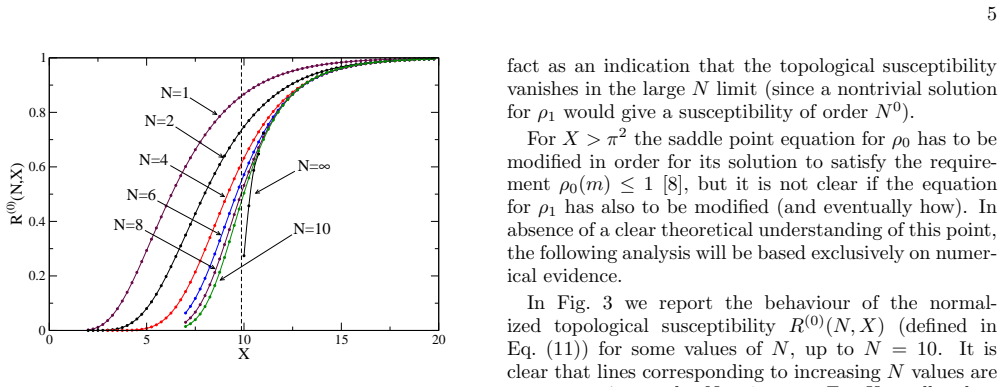
The paper's central discovery is that the finite-area continuum partition function of 2d U(N) theory can be rewritten as $Z^{(g)}_\theta(N,X)=\sqrt{2\pi/X}\sum_k e^{-2\pi^2k^2/X+ik\theta}\widetilde{W}^{(g)}(N,X,k)$, in which θ couples only to the U(1) instanton number k while the SU(N) degrees of freedom enter through the Fourier-transformed weight $\widetilde{W}^{(g)}$. At large N on the sphere, the saddle-point equations for the first-order fluctuation around the Wigner distribution have no solution for $X\leq\pi^2$; the paper takes this as the signal that the leading large-N topological susceptibility is zero in that regime. For $X>\pi^2$, numerical extrapolations for N up to 200 show a nonzero susceptibility that approaches the U(1) curve, with a continuous but very sharp derivative across the transition. This establishes the large-N normalized susceptibility as an order parameter for the Douglas-Kazakov transition at θ=0.
Load-bearing premise
The load-bearing premise is that the non-existence of a solution to the saddle-point equation for the first-order fluctuation on the sphere, for $X\leq\pi^2$, implies that the large-N topological susceptibility is zero to leading order, not that the assumed ansatz is too restrictive or that the correction is merely $O(1/N)$.
Editorial extensions
If this is right
- For a sphere, the large-N topological susceptibility is zero to leading order in the small-area phase $X<\pi^2$ and nonzero in the large-area phase.
- The transition at $X=\pi^2$ is not a jump in $\partial R^{(0)}/\partial X$ at leading order; the derivative remains continuous but develops a sharp peak that grows with $N$.
- For genus $g>0$, the large-N susceptibility converges to the universal U(1) value, so the finite-volume U(1)-SU(N) coupling disappears in the large-N limit on those topologies.
- In the thermodynamic or large-genus limits, the θ-dependence of U(N) reduces exactly to the U(1) theory.
- The representation of the partition function as a sum over U(1) instanton sectors provides a direct way to compute the topological susceptibility at small $X$ with few sectors contributing.
Reading between the lines
- If this claim holds, the topological susceptibility gives a numerically cheap order parameter for the Douglas-Kazakov transition, usable at N values where free-energy methods become impractical.
- The same instanton-sector decomposition suggests that nonzero θ and k-sector overlap functions could reveal a richer large-N phase diagram in the θ-direction, not just at θ=0.
- A natural test is to measure the full distribution of the SU(N) charge $M=\sum_i m_i$ in Monte Carlo data; its Fourier transform $\widetilde{W}$ is the quantity whose first-order fluctuation drives the transition.
- The mechanism might extend to other 2d models with a U(1) topological sector coupled to a large-N matrix sector, where the same kind of order-parameter behavior could be sought.
Signed reviews
Editorial analysis
A structured set of objections, weighed in public.
Referee Report
Summary. This paper studies the finite-area continuum limit of two-dimensional U(N) gauge theory on compact surfaces with a topological theta term. The authors rewrite the finite-area partition function in the form of Eq. (23), in which the U(1) instanton sectors are explicitly summed and the SU(N) degrees of freedom are coupled to them through the Fourier-transformed quantity W˜(g)(N,X,k). They then analyze the large-N limit using a saddle-point approach for the effective action of Eq. (27). For genus g>1 and for g=1, they argue on analytic and numerical grounds that the normalized topological susceptibility R^{(g)}(N,X) approaches the U(1) result R(X) in the large-N limit. The main claim concerns the sphere, g=0: the paper asserts that for X<π^2 the large-N topological susceptibility vanishes, while for X>π^2 it is nonzero and approaches the U(1) value at large X, so that R^{(0)}(∞,X) acts as an order parameter for the Douglas-Kazakov transition. The claim is supported by the absence of a solution to the linearized saddle-point equation for the O(k) correction ρ1, and by Monte Carlo and exact-sum computations shown in Figs. 3-6.
Significance. If the order-parameter claim is correct, it is a nontrivial result: it would identify a finite-area, θ=0 observable that sharply distinguishes the small-area and large-area phases of 2d U(N) gauge theory on the sphere, and it would provide a further example of the U(1)-SU(N) coupling surviving the continuum limit. The analytic rewrite leading to Eq. (23) is clean and the limits X→∞, g→∞, and g>1 are derived and checked numerically. The paper is also honest in flagging the heuristic character of the main analytic step. However, the central claim currently rests on an unproven inference and on Monte Carlo data without error bars; the significance is therefore conditional, and the paper would need substantially stronger evidence to support the advertised conclusion.
major comments (3)
- [Section III, after Eq. (37)] The conclusion that R^{(0)}(∞,X)=0 for X<π^2 is based on the statement that Eq. (35) has no solution, but the proof is omitted ('it is simple to show'). More importantly, the no-solution result is established only within the specific Ansatz of Eq. (30), where ρ1 is real, odd, and supported on the same interval [−m0,m0] as ρ0. The paper does not rule out a solution with a different support (for example, a wider interval), a complex ρ1, or a breakdown of the O(k) linearization. Since this is the load-bearing step for the order-parameter claim, the authors should either provide a proof that no solution exists under general conditions or supply an independent argument (analytic or numerical with controlled errors) that the large-N susceptibility vanishes in this phase.
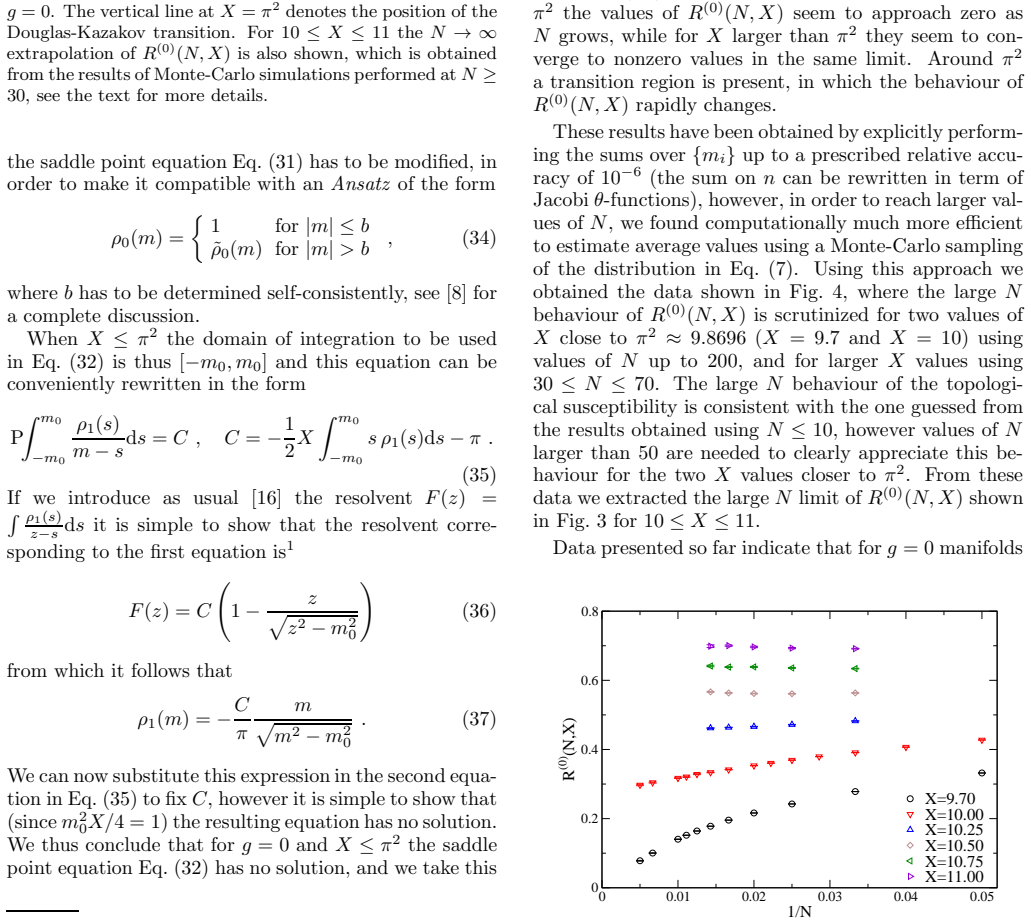
- [Section III, Eqs. (35)-(37) and Fig. 4] Even if the saddle-point equation for ρ1 has no stationary solution at order k, this alone does not imply that the large-N topological susceptibility is exactly zero at order N^0. A non-analytic contribution or a correction of order 1/N could produce a small but nonvanishing susceptibility, which would not act as an order parameter in the sense claimed. The numerical data in Fig. 4 are not accompanied by error bars, and the extrapolation to N=∞ for X close to π^2 requires N>50, so the apparent zero intercept at X<π^2 is not established quantitatively. The paper needs a quantitative statement of the statistical and systematic uncertainties in the Monte Carlo results, or an analytic bound on the large-N limit, to distinguish 'exactly vanishing' from 'small at the accessible N'.
- [Section III, paragraph beginning 'For X > π^2'] For X>π^2 the authors explicitly state that it is not clear whether the equation for ρ1 has to be modified and that the analysis is based exclusively on numerical evidence. While this is an acceptable limitation, the numerical evidence must be strong enough to support the claim of a nonvanishing large-N susceptibility. As noted above, the Monte Carlo data in Figs. 3 and 4 are presented without error bars or details on the sampling procedure, autocorrelation times, or the accuracy of the extrapolation shown in Fig. 3 for 10≤X≤11. Without these details, the reader cannot assess the significance of the apparent jump at the transition.
minor comments (5)
- [Section III, first paragraph] There is a typo: 'phase transition transition' should be 'phase transition'.
- [Eq. (25)] The function R(X) in Eq. (25) is defined without a superscript, while the paper elsewhere uses R^{(g)}(N,X). To avoid confusion, denote it R^{(U(1))}(X) or explicitly state that it is the universal U(1) limit.
- [Fig. 3 caption] The caption does not explain the N=∞ curve shown for 10≤X≤11; the text says it is obtained from Monte Carlo simulations at N≥30, but the caption should state this and reference Fig. 4.
- [Section II, Eq. (2)] The starting formula Eq. (2) is imported from the authors' previous paper [1] and is not rederived here. A short heuristic derivation or an explicit note that the result is taken from [1] would make the paper more self-contained.
- [Section III, Monte Carlo description] No details are given about the Monte Carlo algorithm used to sample the distribution in Eq. (7), nor about how the 'prescribed relative accuracy of 10^{-6}' was enforced in the exact summations. A brief description or a reference to a standard method would improve reproducibility.
Circularity Check
No significant circularity: the paper's new large-N results are numerical and compared to external benchmarks; the cited starting formula is an exact, parameter-free input, not a fit.
full rationale
The only self-citation is the exact continuum partition function Eq. (2), imported from the authors' prior work [1]. That expression is parameter-free and derived from a lattice path-integral reformulation; it does not assume the target result (the large-N spherical topological susceptibility acting as an order parameter for the Douglas-Kazakov transition), so under the review rules it counts as independent evidence and does not create circularity. The paper's actual new content is the rewriting in Eq. (23), obtained by representation decomposition and Poisson summation, and then numerical evaluation of the susceptibility. The large-N claim for g=0 is supported by Monte Carlo data and extrapolations in Figs. 3-4, and it is checked against the external U(1) result and the Douglas-Kazakov transition location X=pi^2. The interpretive step after Eq. (37) — that absence of a solution to the saddle-point equation 'indicates' a vanishing susceptibility — is explicitly flagged as an indication rather than a proof. That is an unproven inference and a correctness risk, but it is not circular: the claim is not equivalent by construction to any fitted parameter or to a self-citation chain. No fitted input is renamed as a prediction, no uniqueness theorem is imported from the authors, and no known result is merely renamed. The derivation is therefore self-contained with respect to circularity, though not with respect to mathematical rigor of the large-N conclusion.
Assumptions & free parameters
assumptions (5)
- domain assumption The finite-area continuum partition function of 2d U(N) gauge theory is given by Eq. (2), imported without rederivation from [1].
- standard math In the large N limit the free energy is dominated by the saddle point of S_eff in Eq. (27), even though rho(m) is complex.
- ad hoc to paper For g=0 and X<=pi^2, the leading k^2-correction to the free energy is captured by the Ansatz rho=rho0+i khat rho1 with rho1 odd and supported on the same interval as rho0.
- ad hoc to paper For X>pi^2, the saddle-point equation for rho1 either remains valid or the numerical evidence is enough to establish the nonzero susceptibility.
- domain assumption The Monte Carlo sampling of the normalized weights w^(0) in Eq. (7) is unbiased and sufficiently converged for the values of N used.
Cite this review
Pith. "Pith review of Topological effects in continuum 2d $U(N)$ gauge theories." pith.science (2026). https://pith.science/paper/2ERCDQ6J
@misc{pith2026190807476,
  author       = {Pith},
  title        = {Pith review of: Topological effects in continuum 2d $U(N)$ gauge theories},
  year         = {2026},
  howpublished = {\url{https://pith.science/paper/2ERCDQ6J}},
  note         = {Machine review of arXiv:1908.07476}
}
abstract
We study the $\theta$ dependence of the continuum limit of 2d $U(N)$ gauge theories defined on compact manifolds, with special emphasis on spherical ($g=0$) and toroidal ($g=1$) topologies. We find that the coupling between $U(1)$ and $SU(N)$ degrees of freedom survives the continuum limit, leading to observable deviations of the continuum topological susceptibility from the $U(1)$ behavior, especially for $g=0$, in which case deviations remain even in the large $N$ limit.
Figures

Figures from the paper (3 more)


Forward citations
Cited by 2 Pith papers
-
Topology in 2D non-Abelian Lattice Gauge Theories
Exact minimal-action configurations for each topological charge sector are written down for 2D U(2) lattice gauge theory, and a tower of constant-action configurations is found for U(N_c).
-
The imaginary-$\theta$ dependence of the SU($N$) spectrum
The theta-squared curvature of the SU(3) glueball mass and string tension is measured in the continuum, and the N=3 and N=6 data support the expected large-N 1/N^2 scaling.
Reference graph
Works this paper leans on
-
[1]
we now introduce the Ansatz ρ(m) = ρ0(m) + iˆk ρ1(m) , (30) where ρ0(m) is a real even function of m and ρ1(m) is a real odd function of m. The conditions ∫ ρ0(m)dm = 1 and 0 ≤ ρ0(m) ≤ 1 now determine the integration do- main of ρ0(m) and, since we are interested to the leading order in ˆk, we can assume ρ1(m) to have the same sup- port of ρ0(m). The sadd...
-
[2]
C. Bonati and P. Rossi, Phys. Rev. D 99, 054503 (2019) [arXiv:1901.09830 [hep-lat]]
arXiv 2019
-
[3]
B. E. Rusakov, Mod. Phys. Lett. A 5, 693 (1990)
work page 1990
- [4]
-
[5]
J. Kiskis, R. Narayanan and D. Sigdel, Phys. Rev. D 89, 085031 (2014) [arXiv:1403.1770 [hep-th]]
work page Pith review arXiv 2014
-
[6]
D. J. Gross and E. Witten, Phys. Rev. D 21, 446 (1980)
work page 1980
-
[7]
S. R. Wadia, Phys. Lett. 93B, 403 (1980)
work page 1980
- [8]
Show all 17 references
-
[9]
M. R. Douglas and V. A. Kazakov, Phys. Lett. B 319, 219 (1993) [hep-th/9305047]
1993 arXiv
-
[10]
J. M. Drouffe and J. B. Zuber, Phys. Rept. 102, 1 (1983)
1983
-
[11]
C. Cao, M. van Caspel and A. R. Zhitnitsky, Phys. Rev. D 87, 105012 (2013) [arXiv:1301.1706 [hep-th]]
2013 arXiv
- [12]
-
[13]
Witten, Annals Phys
E. Witten, Annals Phys. 128, 363 (1980)
1980
-
[14]
D. J. Gross, Nucl. Phys. B 400, 161 (1993) [hep-th/9212149]
1993 arXiv
-
[15]
D. J. Gross and W. Taylor, Nucl. Phys. B 400, 181 (1993) [hep-th/9301068]
1993 arXiv
-
[16]
D. J. Gross and W. Taylor, Nucl. Phys. B 403, 395 (1993) [hep-th/9303046]
1993 arXiv
-
[17]
Brezin, C
E. Brezin, C. Itzykson, G. Parisi and J. B. Zuber, Com- mun. Math. Phys. 59, 35 (1978)
1978
Reviewed August 14, 2026 · model on record in the stance chip above.
Discussion (0). Continue with ORCID to comment.