4D and 5D Layer Codes through Color Routing
Pith reviewed 2026-05-20 10:58 UTC · model grok-4.3
The pith
Embedding qLDPC codes via color routing produces 4D and 5D layer codes that saturate the BPT bounds exactly.
A machine-rendered reading of the paper's core claim, the machinery that carries it, and where it could break.
Core claim
We introduce an explicit CSS code construction that generalizes layer codes to D=4 and D=5. From an input [[n,k,d]] qLDPC code with energy barrier Δ the method yields a D-dimensional layer code with parameters [[Θ(n^{D/(D-2)}), k, Θ(d n^{1/(D-2)})]] and energy barrier Ω(Δ). When the input codes are good, the construction saturates the D=4,5 BPT bounds exactly. The higher-dimensional codes are modular and therefore suited to architectures built from modular network patches despite the physical limitation to three dimensions.
What carries the argument
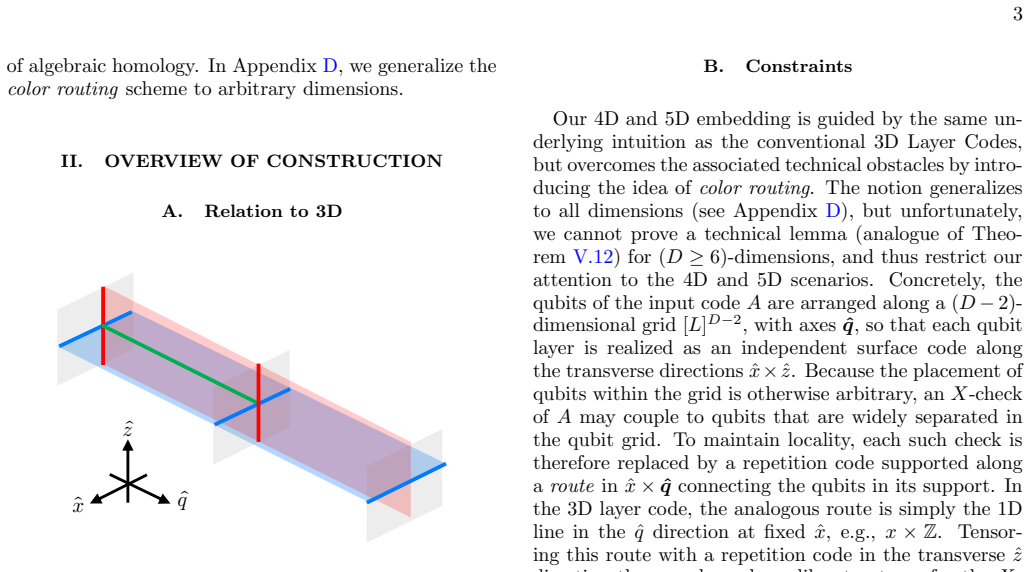
Color routing, the mechanism that resolves the structure of check layers and line defects during the embedding of qLDPC codes into the higher-dimensional lattice.
If this is right
- The resulting codes achieve distance scaling Θ(d n^{1/(D-2)}) for D=4 and D=5.
- Energy barrier of the output code scales as Ω(Δ) from the input.
- The codes remain explicit CSS codes that preserve the original logical dimension k.
- The construction is modular and therefore compatible with network-patch architectures in three physical dimensions.
Where Pith is reading between the lines
- The same routing technique might extend to dimensions higher than five if the layer structure can be generalized further.
- Modularity of the codes suggests they could support distributed error-correction protocols across separate hardware modules.
- The embedding approach offers a systematic way to lift good codes from lower to higher dimensions while controlling defect weights.
Load-bearing premise
The color-routing embedding must preserve energy-barrier scaling and produce the claimed code parameters without introducing new low-weight errors or violating the CSS structure.
What would settle it
Build the explicit 4D code from a small known good qLDPC code and measure whether its minimum distance equals the predicted Θ(d n^{1/2}) scaling and whether any unexpected low-weight logical operators appear.
Figures


read the original abstract
We introduce and explicit Calderbank-Shor-Steane (CSS) code construction that generalizes the Layer codes to $D=4,5$ dimensions. Much like its predecessor, the present construction is based on embedding quantum low-density parity check (qLDPC) codes; from an $[[n,k,d]]$ code with energy barrier $\Delta$, we obtain a $D=4,5$ dimensional Layer code with parameters $[[\Theta(n^{D/(D-2)}), k, \Theta(dn^{1/(D-2)})]]$ and energy barrier $\Omega(\Delta)$. Using good qLDPC codes as input, our construction saturates the $D=4,5$ dimensional BPT bounds exactly. The higher dimensional Layer Codes are modular, and thus well suited to architectures composed of modular network patches, despite our physical limitation to three dimensions. We overcome the hurdles encountered by previous generalization attempts through the use of \textit{color routing}, allowing us to resolve the structure of the check layers and line defects.
Editorial analysis
A structured set of objections, weighed in public.
Referee Report
Summary. The paper introduces an explicit CSS construction that generalizes layer codes to four and five dimensions by embedding an input [[n, k, d]] qLDPC code with energy barrier Δ via color routing. The resulting D=4,5 layer code has parameters [[Θ(n^{D/(D-2)}), k, Θ(d n^{1/(D-2)})]] and energy barrier Ω(Δ). When the input is a good qLDPC code, the construction is claimed to saturate the BPT bounds exactly while remaining modular and compatible with three-dimensional hardware.
Significance. If the color-routing embedding is shown to preserve distance scaling and CSS structure without introducing new low-weight logical operators, the result would supply the first explicit modular construction achieving optimal scaling in D=4 and D=5. This would be a concrete advance for fault-tolerant architectures built from network patches.
major comments (2)
- [Construction via color routing] The central saturation claim rests on the assertion that color routing produces no logical operators of weight below Θ(d n^{1/(D-2)}). The manuscript describes routing to resolve check layers and line defects but supplies neither an exhaustive enumeration of post-routing operators nor a rigorous upper bound on their weights; this gap is load-bearing for the exact BPT saturation statement.
- [Parameter derivation] The output parameters are stated directly in terms of the input qLDPC parameters, yet the derivation of the precise exponents D/(D-2) and 1/(D-2) is not accompanied by an explicit counting argument or small-case verification showing how the embedding multiplies the number of physical qubits and logical operators.
minor comments (1)
- The notation for the higher-dimensional code parameters would benefit from an explicit small example (e.g., taking a small input qLDPC code and listing the resulting qubit and check counts after routing).
Simulated Author's Rebuttal
We thank the referee for their careful reading and valuable comments on our manuscript. We address each major comment below and indicate the revisions we will make to strengthen the presentation and proofs.
read point-by-point responses
-
Referee: [Construction via color routing] The central saturation claim rests on the assertion that color routing produces no logical operators of weight below Θ(d n^{1/(D-2)}). The manuscript describes routing to resolve check layers and line defects but supplies neither an exhaustive enumeration of post-routing operators nor a rigorous upper bound on their weights; this gap is load-bearing for the exact BPT saturation statement.
Authors: We agree that the current manuscript would benefit from a more explicit and rigorous argument establishing the distance lower bound after color routing. While the construction is designed such that routing resolves check layers and line defects without creating new low-weight logical operators (by leveraging the input code's distance and the CSS structure), we will add a dedicated subsection in the revised version that enumerates the possible operator types post-routing and provides a formal weight bound of Ω(d n^{1/(D-2)}) derived from the input qLDPC distance and the modular embedding. This will directly support the BPT saturation claim. revision: yes
-
Referee: [Parameter derivation] The output parameters are stated directly in terms of the input qLDPC parameters, yet the derivation of the precise exponents D/(D-2) and 1/(D-2) is not accompanied by an explicit counting argument or small-case verification showing how the embedding multiplies the number of physical qubits and logical operators.
Authors: The exponents arise from the D-dimensional layer embedding geometry: the physical qubit count scales as the product of the input block size n with a (D-2)-dimensional factor from the routing and layering, yielding n^{D/(D-2)}, while the distance scales with the additional n^{1/(D-2)} factor from the line defects and check layers. We will include an explicit counting argument in the revised manuscript (with a small illustrative example for D=4 using a simple input code) to make this derivation transparent. revision: yes
Circularity Check
No significant circularity; explicit construction derives parameters from inputs without reduction to fits or self-citations
full rationale
The paper presents an explicit CSS construction that embeds an input [[n,k,d]] qLDPC code with barrier Δ into a D=4,5 layer code via color routing, directly yielding the stated parameters [[Θ(n^{D/(D-2)}), k, Θ(d n^{1/(D-2)})]] and barrier Ω(Δ). This scaling follows from the embedding geometry and is not a fitted prediction or self-definition; the saturation of BPT bounds is claimed as a consequence when the input is a good qLDPC code. No load-bearing self-citation chain, ansatz smuggling, or renaming of known results appears in the derivation. The argument for preserving distance and CSS structure rests on the color-routing mechanism itself rather than reducing to prior fitted values or unverified uniqueness theorems. The derivation is therefore self-contained as a new modular construction.
Axiom & Free-Parameter Ledger
axioms (1)
- domain assumption Good qLDPC codes with energy barrier Δ exist and can be embedded while preserving the barrier scaling.
Lean theorems connected to this paper
-
IndisputableMonolith/Foundation/AlexanderDuality.leanalexander_duality_circle_linking unclear?
unclearRelation between the paper passage and the cited Recognition theorem.
We overcome the hurdles encountered by previous generalization attempts through the use of color routing, allowing us to resolve the structure of the check layers and line defects... saturates the D=4,5 dimensional BPT bounds exactly.
-
IndisputableMonolith/Foundation/AlexanderDualityProof.leanlinking_forces_d3_cert unclear?
unclearRelation between the paper passage and the cited Recognition theorem.
the output code C is embedded in D dimensions with n(C)=O(w²q²)LD for D=4 and O(w⁶q⁴)LD for D=5
What do these tags mean?
- matches
- The paper's claim is directly supported by a theorem in the formal canon.
- supports
- The theorem supports part of the paper's argument, but the paper may add assumptions or extra steps.
- extends
- The paper goes beyond the formal theorem; the theorem is a base layer rather than the whole result.
- uses
- The paper appears to rely on the theorem as machinery.
- contradicts
- The paper's claim conflicts with a theorem or certificate in the canon.
- unclear
- Pith found a possible connection, but the passage is too broad, indirect, or ambiguous to say the theorem truly supports the claim.
Reference graph
Works this paper leans on
-
[1]
Check Routing Despite being motivated by the 2D greedy routing al- gorithm in Lemma III.16, an arbitrary checkx∈ Xcan have weight>2 and thus a more general scheme must be considered. Specifically, Definition IV.1(AB Graph).For every qubitq= (a, b), let theAB graphAB(q) denote the union of the row and column that passes throughq, i.e., AB(q) = (a×[L])∪([L]...
-
[2]
Contracting Cycles Note that AB(x) may have nontrivial cycles so that ηAB(x)⊗R Z can have nontrivial internal logicals. Therefore, in this section, we will attempt to make the cycles contractible by introducing additional faces along some coordinate in the ˆzaxis, similar to Example III.8 and Lemma III.19. However, we first need the following Lemma Theore...
-
[3]
Gluing Maps Similar to the conventional layer codes, we define the gluing mapsg QX , gZQ in [Yua26] as follows, which are also depicted by the vertical dashed lines in Fig. 8. gQX |x;i, q, k •⟩=|i, q, k •⟩1{i=η(x), q∼x}(56) gZQ|i•, q, k⟩= X z∼q |i•, q, k;z⟩1{k=η(z)}(57) wherei • denotes eitheriori + fori∈[χ X], and similarly fork •, and thusg QX , gZQ act...
-
[4]
However, 14 (a)η(x)×η(z) =η X ×η Z ∈ˆx׈z (b)η(x)×η(z) =η X ×η Z ∈ˆx׈z FIG
Defect Map Similar to the conventional layer codes, the defect mapsp ZX will correspond to strings between pairs of qubitsq 1, q2 ∈x∧zfor adjacentx, zchecks. However, 14 (a)η(x)×η(z) =η X ×η Z ∈ˆx׈z (b)η(x)×η(z) =η X ×η Z ∈ˆx׈z FIG. 9. Defects. (a) The red AB route denotes that of an x-check in Fig. 7. In the case where there exists az-check such thatx∧...
-
[5]
Note that the max degree isO(wq)
Check Routing Definition V.1(Induced Routing onQ).LetG Q = (Q,P Q) denote theinduced graphonQwith vertices consisting of qubitsQand edges (also referred aspack- ets)p= (q, q ′) if there exists anx-check (orz-check) such thatq, q ′ ∼x(orq, q ′ ∼z). Note that the max degree isO(wq). Order each packetparbitrarily. Let theinduced routing problemonQbe such tha...
-
[6]
(Source and Destination) γ00(p) =γ 0(p) (81) γ11(p) =γ ∞(p) (82)
-
[7]
(One Plane at a Time) Continguous points in the sequence share the same plane, i.e.,γ 00, γ01 share the same[2]-coordinate, and similarly, forγ 10, γ11, whileγ 01, γ10 share the same3-coordinate
-
[8]
(Density) For anys∈F 2 2 andq∈[L] 3, |{p:γ s(p) =q}|=O(wq) (83) Proof.Write γ0(p) =a 0 ×b 0 ×c 0, γ ∞(p) =a ∞ ×b ∞ ×c ∞,(84) Then the color route is given by γ00(p) =γ 0(p) =a 0 ×b 0 ×c 0 γ10(p) =a 0 ×b 0 ×c 1 γ01(p) =a ∞ ×b ∞ ×c 1 γ11(p) =γ ∞(p) =a ∞ ×b ∞ ×c ∞ 17 For an intermediate positionc 1 ∈[L] 2 dependent onp that we define as follows. Consider a (...
-
[9]
The filled planes Λ(x) are similarly defined
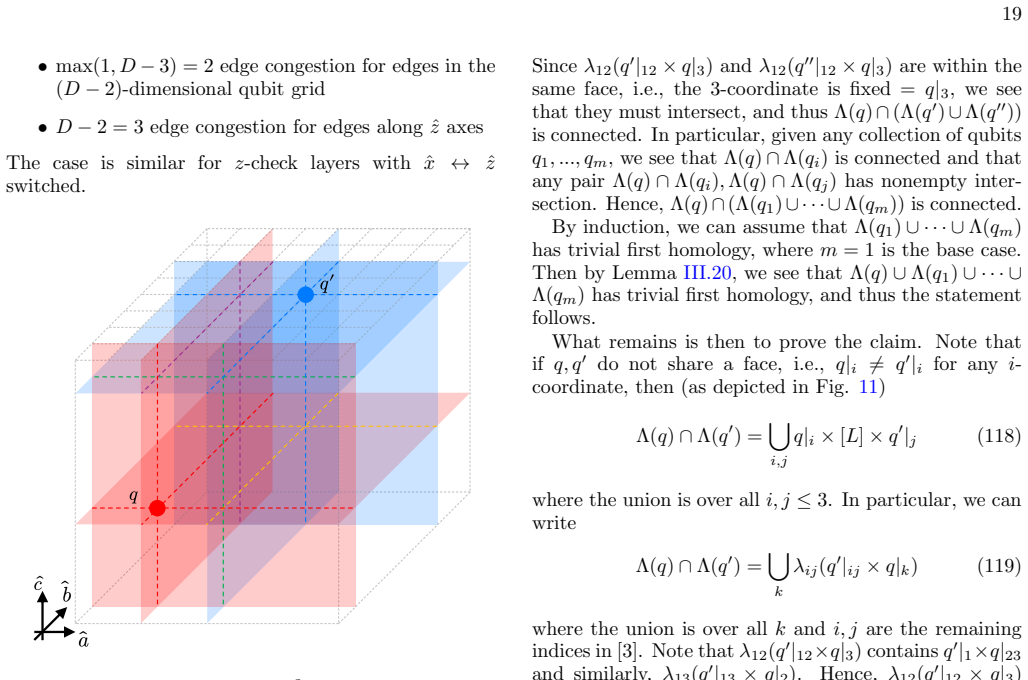
Contracting Cycles Let us denote the planes induced by filling in the star graphsλ(q) via Λ(q), which are naturally 3-term cell complexes. The filled planes Λ(x) are similarly defined. Specifically, 18 Definition V.6(Star Planes).Letq∈ Q= [L] 3. Then define thestar planeofqas Λ(q) = [ i<j q|[1,i) ×[L]×q| (i,j) ×[L]×q| (j,3] (101) so that|Λ(q)|=O(L 2) in t...
-
[10]
Gluing Maps Similar to the conventional layer codes, we define the gluing mapsg QX , gZQ as follows (analogue of the vertical dashed lines in Fig. 8). gQX |x;i, q, k •⟩=|i, q, k •⟩1{i=η(x), q∼x}(126) gZQ|i•, q, k⟩= X z∼q |i•, q, k;z⟩1{k=η(z)}(127) wherei • denotes eitheriori + fori∈[L X], and similarly fork •, so thatg QX , gZQ actlocallyin 5D
-
[11]
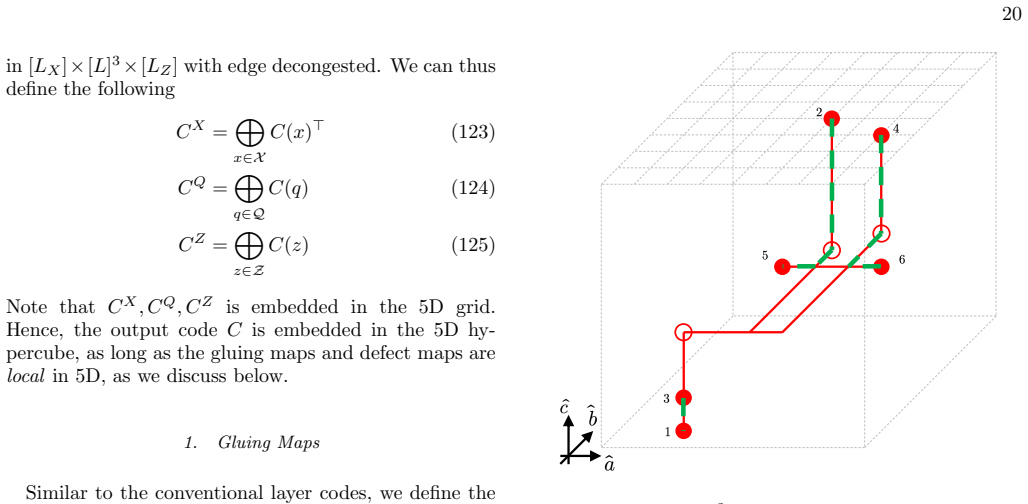
Defect Map Similar to the 3D Layer Codes, the defect mapsp ZX will correspond to strings between pairs of qubitsq 1, q2 ∈ x∧zfor adjacentx, zchecks. However, due to the 5D hypercube structure (3D grid structure of qubits), the strings are somewhat more complicated, even more so than the 4D case. Fortunately, our construction of the check layers exactly ac...
-
[12]
LetA=X→Q→Zbe the input CSS code withX, Q, Zdenoting theX-checks, qubits, andZ- checks
Review Following [Yua26], though with somewhat different no- tation, let us define the conventional 3D layer codes as follows. LetA=X→Q→Zbe the input CSS code withX, Q, Zdenoting theX-checks, qubits, andZ- checks. LetX,Q,Zdenote the collection of correspond- ing basis elementsx, q, z, all of which are arranged on a 1D linear array so thatX= [|X |] and sim...
-
[13]
Result Theorem A.1(Energy Barrier).LetCdenote the 3D layer code as defined in Eq.(A2)-(A9)withX- andZ- type (1-)energy barrier∆ X(C),∆ Z(C), and similarly for the input codeA. Then ∆X(C) = Ω 1 wX qZ ∆X(A) (A11) ∆Z(C) = Ω 1 wZqX ∆Z(A) (A12) Proof.The statement follows from Theorem A.5 and Re- mark 9
-
[14]
Lemma A.2(Xlayer error).Letσ x ∈x⊗R ⊤ Q ⊗R ⊤ Z be a 0-chain (syndrome)
Proof of Energy Barrier Since the construction is symmetric inX, Z, we shall be concerned with theX-type energy barrier ∆(C), while theZ-type is similarly derived. Lemma A.2(Xlayer error).Letσ x ∈x⊗R ⊤ Q ⊗R ⊤ Z be a 0-chain (syndrome). Then there exists a mapσ x 7→ˆex such that the 1-chainˆe x is such that∂ xˆex =σ x and ∆1(ˆex)≤(1 +w X)|σx|(A13) and |gqX...
-
[15]
Let us now check that the embedded column code is =A
Logicals Preserved Proof of Theorem IV.9.By Lemma IV.8, we see that the gluing maps and the defect map are compatible and thus by the framework in [Yua26], the output codeCis well- defined. Let us now check that the embedded column code is =A. SinceC(x) is a cell-complex with a (unique) con- nected componentC 0(x), we see thatH 0(C(x)) ∼= F2 has basis [∥x...
-
[16]
Distance Preserved To prove that the distance of the 4D Layer Codes is preserved in some manner, the procedure is similar to that of the∞-dimensional Layer Codes [YBW26] (which also applies to the conventional 3D Layer Codes [WB24, Yua26]). Specifically, we will utilize Appendix (A) of [YBW26] to compute the relative expansion coefficient of the check lay...
-
[17]
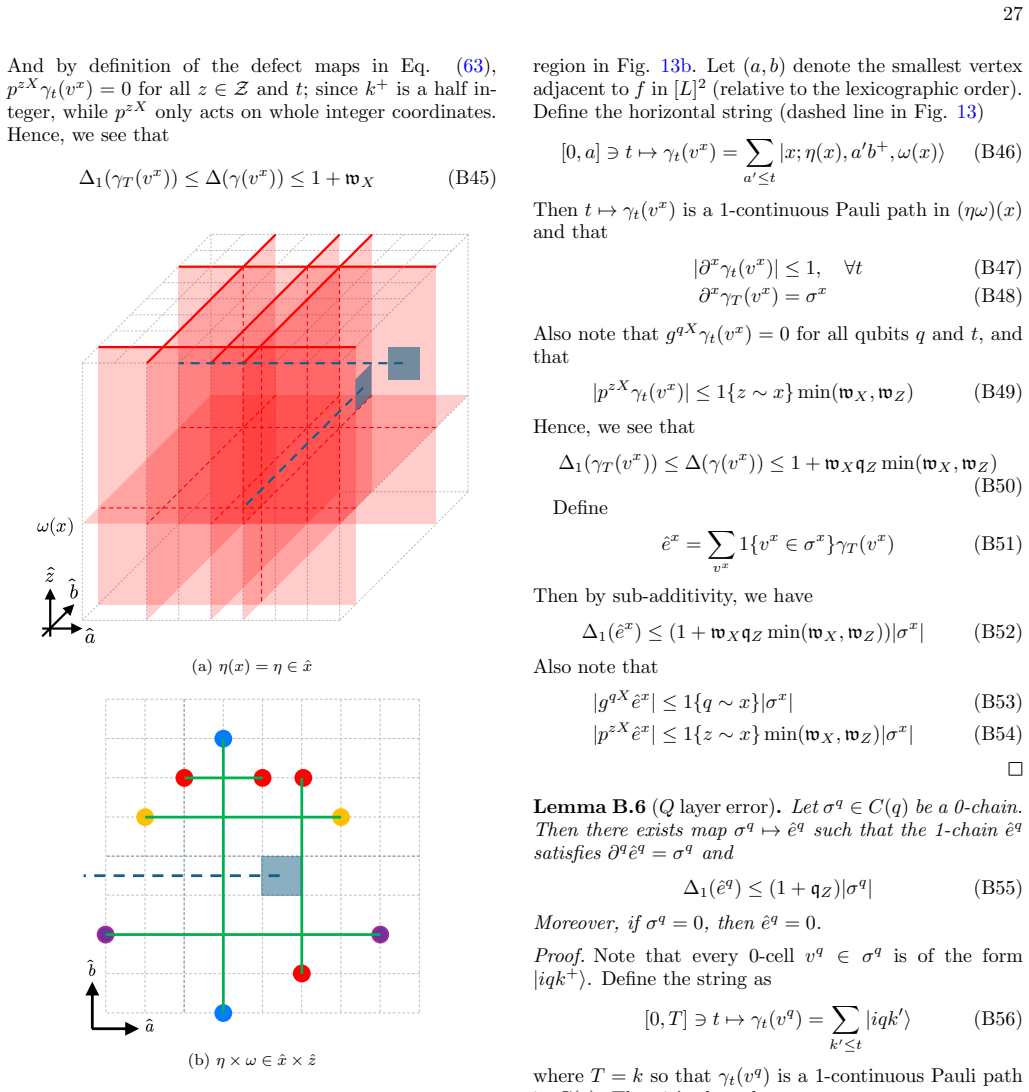
Energy Barrier Preserved To prove that the energy barrier of the 4D Layer Codes is preserved in some manner, the procedure is similar to that of the conventional 3D Layer codes [WB24] (see Appendix A for a detailed exposition), though additional care must be taken due to the contracting layers, e.g., ηω(x) in Fig. 8b. In particular, since the algorithm La...
-
[18]
Logicals Preserved Proof of Theorem V.16.The proof is similar to that of Theorem IV.9 and thus we will only discuss the differ- ences. By Theorem V.12 and [Yua26], the output code and input code has isomorphic logicals, i.e., H1(C) ∼= H1(A) (C1) Note that the number of qubits ofCper edge follows from Remark 14 and the fact that an edge is either along the...
-
[19]
Distance Preserved To prove that the distance of the 5D Layer Codes is preserved in some manner, the procedure is similar to that of the∞-dimensional Layer Codes [YBW26] (which also applies to the 3D case in[WB24, Yua26] and 4D case in Theorem IV.10.). Specifically, we will utilize Appendix (A) of [YBW26] to compute the relative expansion coeffi- cient of...
-
[20]
Energy Barrier Preserved To prove that the energy barrier of the 5D Layer Codes is preserved in some manner, the procedure is similar to that of the 3D case [WB24] (see Appendix A for a de- tailed exposition) and 4D case in Theorem IV.11, though similar to the 4D case, additional care must be taken due to the contracting layersηΛω(x). In particular, since...
-
[21]
Check Layers a. Check Routing Definition D.1(Induced Routing onQ).LetG Q = (Q,P Q) denote theinduced graphonQwith vertices consisting of qubitsQand edges (also referred aspack- ets)p=qq ′ if there exists anx-check (orz-check) such thatq, q ′ ∼x(orq, q ′ ∼z). Note that the max degree is O(wq). Order each packetpbased on the lexicographic order ofQ= [L] D. ...
-
[22]
(Source and Destination) γ¯0(p) =γ 0(p) (D2) γ¯1(p) =γ ∞(p) (D3)
-
[23]
(One Plane at a Time) Ifs| [i] =s ′|[i], then γs(p)|[2i] =γ s′(p)|[2i] (D4) If, in addition,δ(s) =δ(s ′) =i+ 1, then γs(p), γs′(p)have the same coordinates except pos- sibly for the2i+ 1- and2i+ 2- coordinate
-
[25]
The Black hole in three- dimensional space-time.Phys
URL:http://dx.doi.org/10.1103/PhysRevLett. 104.050503,doi:10.1103/physrevlett.104.050503. [Bra11] Sergey Bravyi. Subsystem codes with spatially lo- cal generators.Physical Review A, 83(1), January
-
[26]
URL:http://dx.doi.org/10.1103/PhysRevA.83. 012320,doi:10.1103/physreva.83.012320. [BT09] Sergey Bravyi and Barbara Terhal. A no-go the- orem for a two-dimensional self-correcting quantum memory based on stabilizer codes.New Journal of Physics, 11(4):043029, April 2009. URL:http:// dx.doi.org/10.1088/1367-2630/11/4/043029,doi:10. 1088/1367-2630/11/4/043029...
work page internal anchor Pith review Pith/arXiv arXiv doi:10.1103/physreva.83 2009
-
[27]
Association for Computing Machinery.doi:10. 1145/378580.378584. [LWH23] Ting-Chun Lin, Adam Wills, and Min-Hsiu Hsieh. Geometrically local quantum and classical codes from subdivision.arXiv preprint arXiv:2309.16104, 2023. URL:https://arxiv.org/abs/2309.16104. 34 [LZ22] Anthony Leverrier and Gilles Zemor. Quantum Tanner codes . In2022 IEEE 63rd Annual Sym...
discussion (0)
Sign in with ORCID, Apple, or X to comment. Anyone can read and Pith papers without signing in.