REVIEW 2 major objections 5 minor 3 cited by
Augmenting Multimodal LLMs with Self-Reflective Tokens for Knowledge-based Visual Question Answering
T0 review · 2 major / 5 minor · reviewed 2026-08-12 · deepseek-v4-flash
Pith's one-line read Reflective tokens let an MLLM decide when to retrieve and what to trust
desk verdict A solid adaptation of Self-RAG tokens to multimodal knowledge-based VQA with real reported gains and honest ablations; the main caveat is that relevance supervision flows through GPT-4 judging captions plus the gold answer, so the visual grounding of those tokens is not fully proven. read the letter →
The pith
A machine-rendered reading of the paper's core claim, the machinery that carries it, and where it could break.
The reading
What carries the argument
The central object is the set of four reflective tokens added to the model's vocabulary — <RET>, <NORET>, <REL>, <NOREL> — which turn retrieval decisions into ordinary next-token predictions. They work with a coarse-grained CLIP-based retriever that proposes top-k Wikipedia documents from the query image, and the tokens act as a trained gate: one pair decides whether to enter the retrieval pipeline at all, the other filters the candidate passages before answer generation. The two-stage, two-model training recipe is the load-bearing mechanism: an in-article model first learns relevance from automatically annotated passages, and its predictions are used to generate the training labels for the final model, which is trained jointly on retrieval-needed, retrieval-not-needed, and soft/hard negative samples.
What would settle it
Take a set of Encyclopedic-VQA or InfoSeek questions whose answers depend on visual details that standard captioners usually miss, such as fine-grained color, texture, or small objects, collect human relevance labels for the same passages, and compare ReflectiVA's <REL>/<NOREL> accuracy on those cases against cases where the caption captures the needed detail. If accuracy is near chance on the caption-miss cases, the central claim that the model judges passage relevance from the image-question pair would be undermined.
Extended reading notes
Core claim
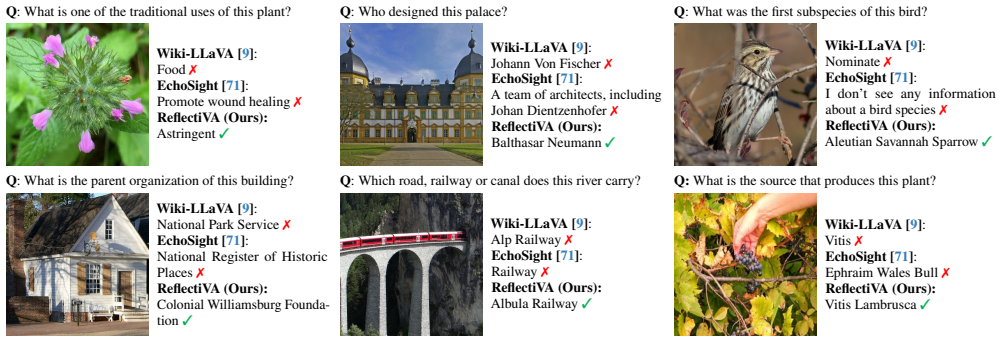
ReflectiVA extends the vocabulary of a pretrained multimodal LLM with four reflective tokens and trains the model to use them as a decision layer over retrieval. Given an image and question, the model first samples <RET> or <NORET>; if retrieval is chosen, it scores each candidate passage with <REL> or <NOREL> and only then generates the answer from the accepted passages. The two-stage recipe first trains an in-article discriminator on automatically annotated positive and negative passages, then uses that model's predictions to label a larger mixed dataset with soft and hard negatives, along with instruction-following samples that require no retrieval. Experiments report gains over recent retrieval-augmented competitors, for example 35.5 versus 26.4 single-hop accuracy on Encyclopedic-VQA under the same visual retrieval mode, and similar margins on InfoSeek, with ablations showing that removing the relevance tokens causes a large accuracy drop. The paper also reports that the model retains most of its performance on standard MLLM benchmarks, which it attributes to the <NORET> pathway.
Load-bearing premise
The relevance labels that train the reflective tokens are produced by GPT-4 from image captions, not from the image pixels themselves; if the captions omit the visual detail needed to judge a question, the labels and the learned retrieval decisions will be systematically wrong.
Editorial extensions
If this is right
- If the central claim is correct, retrieval-augmented MLLMs can avoid injecting irrelevant context: the model only reads passages it has marked <REL>.
- The approach can be applied jointly to multiple knowledge-based datasets in a single fine-tuned model rather than training a separate model per dataset.
- Zero-shot transfer to other knowledge-based VQA datasets improves over the base model and over prior retrieval-augmented systems, suggesting the token decisions generalize beyond the training benchmarks.
- The <NORET> pathway preserves performance on standard MLLM benchmarks, so adding a retrieval mechanism does not necessarily degrade general visual abilities.
- Built-in re-ranking via the log-probability difference of <REL> and <NOREL> can further boost accuracy, reaching 37.8 single-hop accuracy on Encyclopedic-VQA with k=50 and kp=2.
Reading between the lines
- A test that separates image-only cues from caption-only cues would reveal how much of the learned relevance decision depends on pixel content versus textual captions; if the latter dominates, stronger captioning or text-only inputs could replace the visual branch.
- The same token-gating recipe could be applied to other modalities or structured knowledge sources where retrieval decisions are currently made by external pipeline components rather than by the generator itself.
- Because the two-stage training labels come from captions, the ceiling of the approach is set by caption quality; a human-labeled subset could quantify this ceiling and guide better label generation.
- The built-in re-ranking result suggests the <REL>/<NOREL> distribution is a usable relevance score, which could replace separate re-ranking modules in other retrieval-augmented systems.
Signed reviews
Editorial analysis
A structured set of objections, weighed in public.
Referee Report
Summary. This paper proposes ReflectiVA, a retrieval-augmented multimodal LLM that augments LLaVA-v1.5 with four special tokens (<RET>, <NORET>, <REL>, <NOREL>) to decide whether external knowledge is needed and to filter retrieved Wikipedia passages. Training uses a two-stage, two-model procedure: an in-article reflective model is trained on GPT-4-generated positive/negative passage labels (derived from image captions and the ground-truth answer), and its predictions are then used to annotate a larger corpus for training the final model. Experiments on Encyclopedic-VQA and InfoSeek show consistent gains over reproduced Wiki-LLaVA and EchoSight baselines, and ablations attribute most of the gain to the relevance tokens. The paper also reports zero-shot results on ViQuAE and S3VQA, performance preservation on standard MLLM benchmarks, and an analysis of token prediction accuracy.
Significance. The strengths of the paper are the clarity of the two-stage recipe, the fairness of the baseline comparisons (same LLM, same knowledge base via reproductions), the public release of code and annotations, and the systematic ablations in Table 5 that isolate the relevance tokens. If the results hold, the reflective-token mechanism is a practical and simple alternative to dedicated re-rankers. The main caveat is that the relevance supervision originates from GPT-4 judging text (captions and question-answer strings) rather than from the image content; this dependency is acknowledged only implicitly and is not stress-tested.
major comments (2)
- [Sec. 3.2, Sec. 3.3, Table 5] The relevance supervision for the in-article model is generated by prompting GPT-4 with the question, the ground-truth answer, and captions of the image produced by three captioning models, rather than with the image itself. As stated in Sec. 3.2, the prompt asks the LLM to judge whether a passage answers the question 'given the textual description of I'. For fine-grained questions on Encyclopedic-VQA and InfoSeek, the captions frequently omit the specific visual entity needed to link the image to its Wikipedia article, and the presence of the ground-truth answer in the prompt allows GPT-4 to label a passage as positive merely because it contains the answer string. The second stage (Sec. 3.3) then distills the in-article model's predictions into the final training set, so this label noise propagates. Because Table 5 attributes a drop of 11.9 points on E-VQA single-hop (35.5 to 23.6) and 8.7 points on InfoSeek (40.1 to 31.4) to the removal of the <REL>/<NOREL> tokens, the claim that these tokens implement multimodal relevance determination is not fully supported. I ask the authors to (i) report the agreement between the GPT-4-generated labels and human judgments on a random sample, (ii) include an ablation in which the in-article model is trained without the image (text-only) to measure the contribution of visual grounding, and (iii) state this limitation explicitly in the main paper.
- [Table 5 (top), Table 6] The difference between the full model and the 'always <RET>' variant is 0.2 points on Encyclopedic-VQA (35.5 vs. 35.3) and 0.1 points on InfoSeek (40.1 vs. 40.0). The paper does not report variance, confidence intervals, or multiple seeds for any of the experiments, so these differences are within the expected run-to-run noise of fine-tuning an 8B model. The 'always <RET>' row is the main evidence for the <RET>/<NORET> token's usefulness on the two target datasets, and the text in Sec. 4.3 describes it as 'only a minor performance degradation', which is consistent with the numbers but also with no effect. Please report standard deviations over at least three training runs for Table 5, and consider evaluating the need token on a dataset (or an artificially mixed split) where a substantial fraction of questions do not require retrieval, where the token decision has a measurable effect.
minor comments (5)
- [Sec. 4.1 and Supplementary Material] The exact GPT-4 prompt and the few-shot examples used for passage annotation are not provided, despite the text saying they are in the supplementary; please include the full prompt template and examples.
- [Table 1] The InfoSeek row for 'EVA-CLIP-8B Textual (T+S)' has a formatting error in the R@20 column ('29.456.1'), and similar broken-number issues appear in Table 9; please correct the table formatting throughout.
- [Table 9] The green percentages indicating the fraction of samples for which the model emits <RET> are not explained in the caption; specify the denominator (e.g., percentage of all ViQuAE/S3VQA samples).
- [Sec. 3.2] The phrase 'proprietary LLM' is vague; since GPT-4 is named later in Sec. 4.1, name it at first occurrence for reproducibility.
- [Sec. 5] The conclusion would benefit from a short limitations paragraph in the main text, particularly regarding the caption-based annotation dependency; the supplementary failure-case section is welcome but does not address this issue.
Circularity Check
No circularity found: the reflective-token gains are measured on held-out external benchmarks and isolated by ablations, and the minor self-citations are not load-bearing.
full rationale
The paper's derivation chain is a supervised training pipeline, not a logical reduction. GPT-4 is used only to generate relevance labels for training passages from the ground-truth Wikipedia article; the final ReflectiVA model does not receive GPT-4's labels or the ground-truth answer at inference, so its <REL>/<NOREL>/<RET>/<NORET> predictions are not equivalent to the training inputs by construction. The main accuracy gains (Table 2) are reported on the Encyclopedic-VQA test set and the InfoSeek validation set, which are not used for pseudo-label generation (only the training splits are used), and the zero-shot ViQuAE/S3VQA results and Table 5 ablations (removing relevance tokens drops E-VQA single-hop from 35.5 to 23.6) provide independent evidence that the relevance-selection mechanism, rather than a fitted constant, drives the improvement. The use of GPT-4 with the ground-truth answer in the labeling prompt is a legitimate data-quality and potential answer-leakage concern, but it does not make the reported predictions equal to the labels by construction. The self-citations to Wiki-LLaVA [9] and LLaVA-MORE [15] are to baselines and a base initialization, and are not used to justify the central claim. No circular step can be quoted or reduced to an equation of the paper.
Assumptions & free parameters
free parameters (1)
- number of retrieved documents k =
5
assumptions (3)
- domain assumption The external knowledge base contains a passage that answers each knowledge-based question.
- domain assumption The CLIP/EVA-CLIP retriever provides sufficient recall at k=5 for the correct document.
- domain assumption GPT-4 annotations of passage relevance are accurate enough to train the reflective tokens.
Cite this review
Pith. "Pith review of Augmenting Multimodal LLMs with Self-Reflective Tokens for Knowledge-based Visual Question Answering." pith.science (2026). https://pith.science/paper/2GSDZXB5
@misc{pith2026241116863,
  author       = {Pith},
  title        = {Pith review of: Augmenting Multimodal LLMs with Self-Reflective Tokens for Knowledge-based Visual Question Answering},
  year         = {2026},
  howpublished = {\url{https://pith.science/paper/2GSDZXB5}},
  note         = {Machine review of arXiv:2411.16863}
}
read the original abstract
Multimodal LLMs (MLLMs) are the natural extension of large language models to handle multimodal inputs, combining text and image data. They have recently garnered attention due to their capability to address complex tasks involving both modalities. However, their effectiveness is limited to the knowledge acquired during training, which restricts their practical utility. In this work, we introduce a novel method to enhance the adaptability of MLLMs by integrating external knowledge sources. Our proposed model, Reflective LLaVA (ReflectiVA), utilizes reflective tokens to dynamically determine the need for external knowledge and predict the relevance of information retrieved from an external database. Tokens are trained following a two-stage two-model training recipe. This ultimately enables the MLLM to manage external knowledge while preserving fluency and performance on tasks where external knowledge is not needed. Through our experiments, we demonstrate the efficacy of ReflectiVA for knowledge-based visual question answering, highlighting its superior performance compared to existing methods. Source code and trained models are publicly available at https://aimagelab.github.io/ReflectiVA.
Figures


Figures from the paper (4 more)


Forward citations
Cited by 3 Pith papers
-
ExpStar: Towards Automatic Commentary Generation for Multi-discipline Scientific Experiments
ExpStar, with a new 7,714-sample ExpInstruct dataset, generates step-level scientific experiment commentary including procedures, principles, and safety guidelines.
-
Towards General Continuous Memory for Vision-Language Models
A vision-language model can act as its own continuous memory encoder, compressing external multimodal knowledge into eight embeddings that improve reasoning when prepended to the frozen model.
-
OMGM: Orchestrate Multiple Granularities and Modalities for Efficient Multimodal Retrieval
A coarse-to-fine multimodal RAG pipeline, OMGM, aligns a query image with entity summaries, reranks with a trained multimodal late-interaction model, and selects the best section, achieving state-of-the-art retrieval ...
Reference graph
Works this paper leans on
-
[1]
Josh Achiam, Steven Adler, Sandhini Agarwal, Lama Ahmad, Ilge Akkaya, Florencia Leoni Aleman, Diogo Almeida, Janko Altenschmidt, Sam Altman, Shyamal Anadkat, et al. Gpt-4 technical report. arXiv preprint arXiv:2303.08774, 2023. 6, 15
arXiv 2023
-
[2]
Flamingo: a Visual Language Model for Few-Shot Learning
Jean-Baptiste Alayrac, Jeff Donahue, Pauline Luc, Antoine Miech, Iain Barr, Yana Hasson, Karel Lenc, Arthur Mensch, Katherine Millican, Malcolm Reynolds, et al. Flamingo: a Visual Language Model for Few-Shot Learning. In NeurIPS,
-
[3]
Self-RAG: Learning to Retrieve, Generate, and Critique through Self-Reflection
Akari Asai, Zeqiu Wu, Yizhong Wang, Avirup Sil, and Han- naneh Hajishirzi. Self-RAG: Learning to Retrieve, Generate, and Critique through Self-Reflection. In ICLR, 2024. 2, 15
work page 2024
-
[4]
OpenFlamingo: An Open- Source Framework for Training Large Autoregressive Vision- Language Models
Anas Awadalla, Irena Gao, Josh Gardner, Jack Hessel, Yusuf Hanafy, Wanrong Zhu, Kalyani Marathe, Yonatan Bitton, Samir Gadre, Shiori Sagawa, et al. OpenFlamingo: An Open- Source Framework for Training Large Autoregressive Vision- Language Models. arXiv preprint arXiv:2308.01390, 2023. 2
arXiv 2023
-
[5]
Improving Language Models by Retrieving from Trillions of Tokens
Sebastian Borgeaud, Arthur Mensch, Jordan Hoffmann, Trevor Cai, Eliza Rutherford, Katie Millican, George Bm Van Den Driessche, Jean-Baptiste Lespiau, Bogdan Damoc, Aidan Clark, et al. Improving Language Models by Retrieving from Trillions of Tokens. In ICML, 2022. 2
work page 2022
-
[6]
Language models are few-shot learners
Tom Brown, Benjamin Mann, Nick Ryder, Melanie Sub- biah, Jared D Kaplan, Prafulla Dhariwal, Arvind Neelakantan, Pranav Shyam, Girish Sastry, Amanda Askell, et al. Language models are few-shot learners. In NeurIPS, 2020. 1
work page 2020
-
[7]
Jannis Bulian, Christian Buck, Wojciech Gajewski, Benjamin Boerschinger, and Tal Schuster. Tomayto, Tomahto. Beyond Token-level Answer Equivalence for Question Answering Evaluation. arXiv preprint arXiv:2202.07654, 2022. 5
arXiv 2022
-
[8]
The Revolution of Multi- modal Large Language Models: A Survey
Davide Caffagni, Federico Cocchi, Luca Barsellotti, Nicholas Moratelli, Sara Sarto, Lorenzo Baraldi, Lorenzo Baraldi, Mar- cella Cornia, and Rita Cucchiara. The Revolution of Multi- modal Large Language Models: A Survey. In ACL Findings,
Show all 75 references
-
[9]
Wiki-LLaV A: Hierarchical Retrieval-Augmented Generation for Multimodal LLMs
Davide Caffagni, Federico Cocchi, Nicholas Moratelli, Sara Sarto, Marcella Cornia, Lorenzo Baraldi, and Rita Cucchiara. Wiki-LLaV A: Hierarchical Retrieval-Augmented Generation for Multimodal LLMs. In CVPR Workshops, 2024. 2, 5, 6, 7, 8, 12, 14, 16, 17
2024
-
[10]
CLAIR: Evaluating Image Captions with Large Language Models
David Chan, Suzanne Petryk, Joseph E Gonzalez, Trevor Darrell, and John Canny. CLAIR: Evaluating Image Captions with Large Language Models. In EMNLP, 2023. 13
2023
-
[11]
Conceptual 12M: Pushing Web-Scale Image-Text Pre-Training To Recognize Long-Tail Visual Concepts
Soravit Changpinyo, Piyush Sharma, Nan Ding, and Radu Soricut. Conceptual 12M: Pushing Web-Scale Image-Text Pre-Training To Recognize Long-Tail Visual Concepts. In CVPR, 2021. 2
2021
-
[12]
Can Pre-trained Vision and Language Models Answer Visual Information-Seeking Questions? In EMNLP, 2023
Yang Chen, Hexiang Hu, Yi Luan, Haitian Sun, Soravit Changpinyo, Alan Ritter, and Ming-Wei Chang. Can Pre-trained Vision and Language Models Answer Visual Information-Seeking Questions? In EMNLP, 2023. 1, 2, 4, 5, 12
2023
-
[13]
Gonzalez, Ion Stoica, and Eric P
Wei-Lin Chiang, Zhuohan Li, Zi Lin, Ying Sheng, Zhanghao Wu, Hao Zhang, Lianmin Zheng, Siyuan Zhuang, Yonghao Zhuang, Joseph E. Gonzalez, Ion Stoica, and Eric P. Xing. Vicuna: An Open-Source Chatbot Impressing GPT-4 with 90%* ChatGPT Quality, 2023. 2, 6
2023
-
[14]
Scaling Instruction- Finetuned Language Models
Hyung Won Chung, Le Hou, Shayne Longpre, Barret Zoph, Yi Tay, William Fedus, Yunxuan Li, Xuezhi Wang, Mostafa Dehghani, Siddhartha Brahma, et al. Scaling Instruction- Finetuned Language Models. JMLR, 25(70):1–53, 2024. 1
2024
-
[15]
LLaV A-MORE: A Comparative Study of LLMs and Visual Backbones for Enhanced Visual Instruction Tuning
Federico Cocchi, Nicholas Moratelli, Davide Caffagni, Sara Sarto, Marcella Cornia, Lorenzo Baraldi, and Rita Cucchiara. LLaV A-MORE: A Comparative Study of LLMs and Visual Backbones for Enhanced Visual Instruction Tuning. arXiv preprint arXiv:2503.15621, 2025. 2, 5
2025 arXiv
-
[16]
InstructBLIP: Towards General-purpose Vision-Language Models with Instruction Tuning
Wenliang Dai, Junnan Li, Dongxu Li, Anthony Meng Huat Tiong, Junqi Zhao, Weisheng Wang, Boyang Li, Pascale Fung, and Steven Hoi. InstructBLIP: Towards General-purpose Vision-Language Models with Instruction Tuning. arXiv preprint arXiv:2305.06500, 2023. 2, 4, 6
2023 arXiv
-
[17]
Molmo and PixMo: Open Weights and Open Data for State-of-the-Art Multimodal Models
Matt Deitke, Christopher Clark, Sangho Lee, Rohun Tripathi, Yue Yang, Jae Sung Park, Mohammadreza Salehi, Niklas Muennighoff, Kyle Lo, Luca Soldaini, et al. Molmo and PixMo: Open Weights and Open Data for State-of-the-Art Multimodal Models. arXiv preprint arXiv:2409.17146, 2024. 2
2024 arXiv
-
[18]
The Llama 3 Herd of Models
Abhimanyu Dubey, Abhinav Jauhri, Abhinav Pandey, Ab- hishek Kadian, Ahmad Al-Dahle, Aiesha Letman, Akhil Mathur, Alan Schelten, Amy Yang, Angela Fan, et al. The Llama 3 Herd of Models. arXiv preprint arXiv:2407.21783,
-
[19]
MME: A Comprehensive Evaluation Benchmark for Multimodal Large Language Models
Chaoyou Fu, Peixian Chen, Yunhang Shen, Yulei Qin, Meng- dan Zhang, Xu Lin, Jinrui Yang, Xiawu Zheng, Ke Li, Xing Sun, et al. MME: A Comprehensive Evaluation Benchmark for Multimodal Large Language Models. arXiv preprint arXiv:2306.13394, 2023. 2, 13
2023 arXiv
-
[20]
Data- Comp: In search of the next generation of multimodal datasets
Samir Yitzhak Gadre, Gabriel Ilharco, Alex Fang, Jonathan Hayase, Georgios Smyrnis, Thao Nguyen, Ryan Marten, Mitchell Wortsman, Dhruba Ghosh, Jieyu Zhang, et al. Data- Comp: In search of the next generation of multimodal datasets. In NeurIPS, 2023. 2
2023
-
[21]
Making the v in VQA Matter: Elevating the Role of Image Understanding in Visual Question Answer- ing
Yash Goyal, Tejas Khot, Douglas Summers-Stay, Dhruv Ba- tra, and Devi Parikh. Making the v in VQA Matter: Elevating the Role of Image Understanding in Visual Question Answer- ing. In CVPR, 2017. 5
2017
-
[22]
KAT: A Knowledge Aug- mented Transformer for Vision-and-Language
Liangke Gui, Borui Wang, Qiuyuan Huang, Alex Hauptmann, Yonatan Bisk, and Jianfeng Gao. KAT: A Knowledge Aug- mented Transformer for Vision-and-Language. In NAACL,
-
[23]
Retrieval Augmented Language Model Pre- Training
Kelvin Guu, Kenton Lee, Zora Tung, Panupong Pasupat, and Mingwei Chang. Retrieval Augmented Language Model Pre- Training. In ICML, 2020. 2
2020
-
[24]
OneLLM: One Framework to Align All Modalities with Language
Jiaming Han, Kaixiong Gong, Yiyuan Zhang, Jiaqi Wang, Kaipeng Zhang, Dahua Lin, Yu Qiao, Peng Gao, and Xiangyu Yue. OneLLM: One Framework to Align All Modalities with Language. In CVPR, 2024. 1
2024
-
[25]
REVEAL: Retrieval-Augmented Visual-Language Pre-Training With Multi-Source Multi- modal Knowledge Memory
Ziniu Hu, Ahmet Iscen, Chen Sun, Zirui Wang, Kai- Wei Chang, Yizhou Sun, Cordelia Schmid, David A Ross, and Alireza Fathi. REVEAL: Retrieval-Augmented Visual-Language Pre-Training With Multi-Source Multi- modal Knowledge Memory. In CVPR, 2023. 12
2023
-
[26]
GQA: A New Dataset for Real-World Visual Reasoning and Compositional Question Answering
Drew A Hudson and Christopher D Manning. GQA: A New Dataset for Real-World Visual Reasoning and Compositional Question Answering. In CVPR, 2019. 2, 13
2019
-
[27]
Unsupervised Dense Information Retrieval with Contrastive Learning
Gautier Izacard, Mathilde Caron, Lucas Hosseini, Sebastian Riedel, Piotr Bojanowski, Armand Joulin, and Edouard Grave. Unsupervised Dense Information Retrieval with Contrastive Learning. arXiv preprint arXiv:2112.09118, 2021. 4, 7, 8, 14
2021 arXiv
-
[28]
Atlas: Few- shot Learning with Retrieval Augmented Language Models
Gautier Izacard, Patrick Lewis, Maria Lomeli, Lucas Hos- seini, Fabio Petroni, Timo Schick, Jane Dwivedi-Yu, Armand Joulin, Sebastian Riedel, and Edouard Grave. Atlas: Few- shot Learning with Retrieval Augmented Language Models. JMLR, 24(251):1–43, 2023. 2
2023
-
[29]
Se- lect, Substitute, Search: A New Benchmark for Knowledge- Augmented Visual Question Answering
Aman Jain, Mayank Kothyari, Vishwajeet Kumar, Preethi Jyothi, Ganesh Ramakrishnan, and Soumen Chakrabarti. Se- lect, Substitute, Search: A New Benchmark for Knowledge- Augmented Visual Question Answering. In SIGIR, 2021. 2, 13, 14
2021
-
[30]
Mistral 7B
Albert Q Jiang, Alexandre Sablayrolles, Arthur Mensch, Chris Bamford, Devendra Singh Chaplot, Diego de las Casas, Florian Bressand, Gianna Lengyel, Guillaume Lample, Lucile Saulnier, et al. Mistral 7B. arXiv preprint arXiv:2310.06825,
-
[31]
Mixtral of Experts
Albert Q Jiang, Alexandre Sablayrolles, Antoine Roux, Arthur Mensch, Blanche Savary, Chris Bamford, Deven- dra Singh Chaplot, Diego de las Casas, Emma Bou Hanna, Florian Bressand, et al. Mixtral of Experts. arXiv preprint arXiv:2401.04088, 2024. 1
2024 arXiv
-
[32]
Active Retrieval Augmented Generation
Zhengbao Jiang, Frank F Xu, Luyu Gao, Zhiqing Sun, Qian Liu, Jane Dwivedi-Yu, Yiming Yang, Jamie Callan, and Gra- ham Neubig. Active Retrieval Augmented Generation. In EMNLP, 2023. 2
2023
-
[33]
A Diagram is Worth a Dozen Images
Aniruddha Kembhavi, Mike Salvato, Eric Kolve, Minjoon Seo, Hannaneh Hajishirzi, and Ali Farhadi. A Diagram is Worth a Dozen Images. In ECCV, 2016. 13
2016
-
[34]
OBELICS: An Open Web-Scale Filtered Dataset of Inter- leaved Image-Text Documents
Hugo Laurenc ¸on, Lucile Saulnier, L´eo Tronchon, Stas Bek- man, Amanpreet Singh, Anton Lozhkov, Thomas Wang, Sid- dharth Karamcheti, Alexander Rush, Douwe Kiela, et al. OBELICS: An Open Web-Scale Filtered Dataset of Inter- leaved Image-Text Documents. In NeurIPS, 2023. 1, 2
2023
-
[35]
What matters when building vision-language models? arXiv preprint arXiv:2405.02246, 2024
Hugo Laurenc ¸on, L´eo Tronchon, Matthieu Cord, and Victor Sanh. What matters when building vision-language models? arXiv preprint arXiv:2405.02246, 2024. 2
2024 arXiv
-
[36]
ViQuAE, a dataset for knowledge-based visual question answering about named entities
Paul Lerner, Olivier Ferret, Camille Guinaudeau, Herv ´e Le Borgne, Romaric Besan c ¸on, Jos´e G Moreno, and Jes ´us Lov´on Melgarejo. ViQuAE, a dataset for knowledge-based visual question answering about named entities. In SIGIR,
-
[37]
Cross- modal Retrieval for Knowledge-based Visual Question An- swering
Paul Lerner, Olivier Ferret, and Camille Guinaudeau. Cross- modal Retrieval for Knowledge-based Visual Question An- swering. In ECIR, 2024. 2, 6
2024
-
[38]
SEED-Bench: Benchmarking Multi- modal LLMs with Generative Comprehension
Bohao Li, Rui Wang, Guangzhi Wang, Yuying Ge, Yixiao Ge, and Ying Shan. SEED-Bench: Benchmarking Multi- modal LLMs with Generative Comprehension. arXiv preprint arXiv:2307.16125, 2023. 13
2023 arXiv
-
[39]
LLaV A-OneVision: Easy Visual Task Transfer.arXiv preprint arXiv:2408.03326, 2024
Bo Li, Yuanhan Zhang, Dong Guo, Renrui Zhang, Feng Li, Hao Zhang, Kaichen Zhang, Yanwei Li, Ziwei Liu, and Chun- yuan Li. LLaV A-OneVision: Easy Visual Task Transfer.arXiv preprint arXiv:2408.03326, 2024. 2
2024 arXiv
-
[40]
BLIP- 2: Bootstrapping Language-Image Pre-training with Frozen Image Encoders and Large Language Models
Junnan Li, Dongxu Li, Silvio Savarese, and Steven Hoi. BLIP- 2: Bootstrapping Language-Image Pre-training with Frozen Image Encoders and Large Language Models. In ICML, 2023. 1, 2, 4, 6, 13, 14, 15
2023
-
[41]
Evaluating Object Hallucination in Large Vision-Language Models
Yifan Li, Yifan Du, Kun Zhou, Jinpeng Wang, Wayne Xin Zhao, and Ji-Rong Wen. Evaluating Object Hallucination in Large Vision-Language Models. In EMNLP, 2023. 2, 13
2023
-
[42]
Fine-grained Late-interaction Multi-modal Retrieval for Retrieval Augmented Visual Question Answer- ing
Weizhe Lin, Jinghong Chen, Jingbiao Mei, Alexandru Coca, and Bill Byrne. Fine-grained Late-interaction Multi-modal Retrieval for Retrieval Augmented Visual Question Answer- ing. In NeurIPS, 2023. 12
2023
-
[43]
PreFLMR: Scaling Up Fine-Grained Late-Interaction Multi- modal Retrievers
Weizhe Lin, Jingbiao Mei, Jinghong Chen, and Bill Byrne. PreFLMR: Scaling Up Fine-Grained Late-Interaction Multi- modal Retrievers. In ACL, 2024. 2
2024
-
[44]
REVIVE: Regional Visual Rep- resentation Matters in Knowledge-Based Visual Question Answering
Yuanze Lin, Yujia Xie, Dongdong Chen, Yichong Xu, Chen- guang Zhu, and Lu Yuan. REVIVE: Regional Visual Rep- resentation Matters in Knowledge-Based Visual Question Answering. In NeurIPS, 2022. 12
2022
-
[45]
Visual Instruction Tuning
Haotian Liu, Chunyuan Li, Qingyang Wu, and Yong Jae Lee. Visual Instruction Tuning. In NeurIPS, 2023. 2
2023
-
[46]
Improved Baselines with Visual Instruction Tuning
Haotian Liu, Chunyuan Li, Yuheng Li, and Yong Jae Lee. Improved Baselines with Visual Instruction Tuning. InCVPR,
-
[47]
MMBench: Is Your Multi-modal Model an All-around Player? arXiv preprint arXiv:2307.06281, 2023
Yuan Liu, Haodong Duan, Yuanhan Zhang, Bo Li, Songyang Zhang, Wangbo Zhao, Yike Yuan, Jiaqi Wang, Conghui He, Ziwei Liu, et al. MMBench: Is Your Multi-modal Model an All-around Player? arXiv preprint arXiv:2307.06281, 2023. 13
2023 arXiv
-
[48]
Learn to Explain: Multimodal Reasoning via Thought Chains for Science Question Answering
Pan Lu, Swaroop Mishra, Tanglin Xia, Liang Qiu, Kai-Wei Chang, Song-Chun Zhu, Oyvind Tafjord, Peter Clark, and Ashwin Kalyan. Learn to Explain: Multimodal Reasoning via Thought Chains for Science Question Answering. InNeurIPS,
-
[49]
Ok-VQA: A Visual Question Answering Benchmark Requiring External Knowledge
Kenneth Marino, Mohammad Rastegari, Ali Farhadi, and Roozbeh Mottaghi. Ok-VQA: A Visual Question Answering Benchmark Requiring External Knowledge. In CVPR, 2019. 2, 12
2019
-
[50]
MM1: Methods, Analy- sis & Insights from Multimodal LLM Pre-training
Brandon McKinzie, Zhe Gan, Jean-Philippe Fauconnier, Sam Dodge, Bowen Zhang, Philipp Dufter, Dhruti Shah, Xianzhi Du, Futang Peng, Floris Weers, et al. MM1: Methods, Analy- sis & Insights from Multimodal LLM Pre-training. In ECCV,
-
[51]
Encyclopedic VQA: Visual Questions About Detailed Properties of Fine-Grained Categories
Thomas Mensink, Jasper Uijlings, Lluis Castrejon, Arushi Goel, Felipe Cadar, Howard Zhou, Fei Sha, Andr ´e Araujo, and Vittorio Ferrari. Encyclopedic VQA: Visual Questions About Detailed Properties of Fine-Grained Categories. In ICCV, 2023. 1, 2, 4, 5, 12
2023
-
[52]
PlotQA: Reasoning over Scientific Plots
Nitesh Methani, Pritha Ganguly, Mitesh M Khapra, and Pratyush Kumar. PlotQA: Reasoning over Scientific Plots. In WACV, 2020. 5
2020
-
[53]
Revisiting Image Cap- tioning Training Paradigm via Direct CLIP-based Optimiza- tion
Nicholas Moratelli, Davide Caffagni, Marcella Cornia, Lorenzo Baraldi, and Rita Cucchiara. Revisiting Image Cap- tioning Training Paradigm via Direct CLIP-based Optimiza- tion. In BMVC, 2024. 13
2024
-
[54]
Training Language Models to Follow Instructions with Human Feedback
Long Ouyang, Jeffrey Wu, Xu Jiang, Diogo Almeida, Car- roll Wainwright, Pamela Mishkin, Chong Zhang, Sandhini Agarwal, Katarina Slama, Alex Ray, et al. Training Language Models to Follow Instructions with Human Feedback. In NeurIPS, 2022. 1
2022
-
[55]
RoRA-VLM: Ro- bust Retrieval-Augmented Vision Language Models
Jingyuan Qi, Zhiyang Xu, Rulin Shao, Yang Chen, Jing Di, Yu Cheng, Qifan Wang, and Lifu Huang. RoRA-VLM: Ro- bust Retrieval-Augmented Vision Language Models. arXiv preprint arXiv:2410.08876, 2024. 2, 6, 12
2024 arXiv
-
[56]
Learning Transferable Visual Models from Natural Language Supervi- sion
Alec Radford, Jong Wook Kim, Chris Hallacy, Aditya Ramesh, Gabriel Goh, Sandhini Agarwal, Girish Sastry, Amanda Askell, Pamela Mishkin, Jack Clark, et al. Learning Transferable Visual Models from Natural Language Supervi- sion. In ICML, 2021. 2, 4, 5
2021
-
[57]
Exploring the Limits of Transfer Learning with a Unified Text-to-Text Transformer
Colin Raffel, Noam Shazeer, Adam Roberts, Katherine Lee, Sharan Narang, Michael Matena, Yanqi Zhou, Wei Li, and Peter J Liu. Exploring the Limits of Transfer Learning with a Unified Text-to-Text Transformer. JMLR, 21(1):5485–5551,
-
[58]
In- Context Retrieval-Augmented Language Models
Ori Ram, Yoav Levine, Itay Dalmedigos, Dor Muhlgay, Am- non Shashua, Kevin Leyton-Brown, and Yoav Shoham. In- Context Retrieval-Augmented Language Models. TACL, 11: 1316–1331, 2023. 2, 7
2023
-
[59]
A-OKVQA: A Benchmark for Visual Question Answering Using World Knowledge
Dustin Schwenk, Apoorv Khandelwal, Christopher Clark, Kenneth Marino, and Roozbeh Mottaghi. A-OKVQA: A Benchmark for Visual Question Answering Using World Knowledge. In ECCV, 2022. 2, 12
2022
-
[60]
KVQA: Knowledge-aware Visual Question Answering
Sanket Shah, Anand Mishra, Naganand Yadati, and Partha Pratim Talukdar. KVQA: Knowledge-aware Visual Question Answering. In AAAI, 2019. 2
2019
-
[61]
Towards VQA Models That Can Read
Amanpreet Singh, Vivek Natarajan, Meet Shah, Yu Jiang, Xinlei Chen, Dhruv Batra, Devi Parikh, and Marcus Rohrbach. Towards VQA Models That Can Read. In CVPR, 2019. 2, 13
2019
-
[62]
WIT: Wikipedia-based Image Text Dataset for Multimodal Multilingual Machine Learning
Krishna Srinivasan, Karthik Raman, Jiecao Chen, Michael Bendersky, and Marc Najork. WIT: Wikipedia-based Image Text Dataset for Multimodal Multilingual Machine Learning. In ACM SIGIR, 2021. 12
2021
-
[63]
EV A-CLIP- 18B: Scaling CLIP to 18 Billion Parameters
Quan Sun, Jinsheng Wang, Qiying Yu, Yufeng Cui, Fan Zhang, Xiaosong Zhang, and Xinlong Wang. EV A-CLIP- 18B: Scaling CLIP to 18 Billion Parameters. arXiv preprint arXiv:2402.04252, 2024. 2, 4, 5
2024 arXiv
-
[64]
Emu: Generative Pretraining in Multimodality
Quan Sun, Qiying Yu, Yufeng Cui, Fan Zhang, Xiaosong Zhang, Yueze Wang, Hongcheng Gao, Jingjing Liu, Tiejun Huang, and Xinlong Wang. Emu: Generative Pretraining in Multimodality. In ICLR, 2024. 1, 2
2024
-
[65]
Stanford Alpaca: An Instruction-Following LLaMA Model, 2023
Rohan Taori, Ishaan Gulrajani, Tianyi Zhang, Yann Dubois, Xuechen Li, Carlos Guestrin, Percy Liang, and Tatsunori B Hashimoto. Stanford Alpaca: An Instruction-Following LLaMA Model, 2023. 2
2023
-
[66]
LLaMA: Open and Efficient Foundation Language Models
Hugo Touvron, Thibaut Lavril, Gautier Izacard, Xavier Mar- tinet, Marie-Anne Lachaux, Timoth ´ee Lacroix, Baptiste Rozi`ere, Naman Goyal, Eric Hambro, Faisal Azhar, et al. LLaMA: Open and Efficient Foundation Language Models. arXiv preprint arXiv:2302.13971, 2023. 1, 2
2023 arXiv
-
[67]
InstructRetro: Instruction Tuning post Retrieval-Augmented Pretraining
Boxin Wang, Wei Ping, Lawrence McAfee, Peng Xu, Bo Li, Mohammad Shoeybi, and Bryan Catanzaro. InstructRetro: Instruction Tuning post Retrieval-Augmented Pretraining. In ICML, 2024. 2
2024
-
[68]
UniIR: Training and Benchmarking Universal Multimodal Information Retrievers
Cong Wei, Yang Chen, Haonan Chen, Hexiang Hu, Ge Zhang, Jie Fu, Alan Ritter, and Wenhu Chen. UniIR: Training and Benchmarking Universal Multimodal Information Retrievers. In ECCV, 2024. 2
2024
-
[69]
CLAIR-A: Leveraging Large Lan- guage Models to Judge Audio Captions
Tsung-Han Wu, Joseph E Gonzalez, Trevor Darrell, and David M Chan. CLAIR-A: Leveraging Large Lan- guage Models to Judge Audio Captions. arXiv preprint arXiv:2409.12962, 2024. 13
2024 arXiv
-
[70]
Grounding Language Models for Visual Entity Recognition
Zilin Xiao, Ming Gong, Paola Cascante-Bonilla, Xingyao Zhang, Jie Wu, and Vicente Ordonez. Grounding Language Models for Visual Entity Recognition. In ECCV, 2024. 2
2024
-
[71]
EchoSight: Advancing Visual- Language Models with Wiki Knowledge
Yibin Yan and Weidi Xie. EchoSight: Advancing Visual- Language Models with Wiki Knowledge. arXiv preprint arXiv:2407.12735, 2024. 2, 5, 6, 7, 8, 12, 14, 15, 16, 17
2024 arXiv
-
[72]
mPLUG- Owl2: Revolutionizing Multi-modal Large Language Model with Modality Collaboration
Qinghao Ye, Haiyang Xu, Jiabo Ye, Ming Yan, Anwen Hu, Haowei Liu, Qi Qian, Ji Zhang, and Fei Huang. mPLUG- Owl2: Revolutionizing Multi-modal Large Language Model with Modality Collaboration. In CVPR, 2024. 1
2024
-
[73]
RankRAG: Unifying Context Ranking with Retrieval-Augmented Generation in LLMs
Yue Yu, Wei Ping, Zihan Liu, Boxin Wang, Jiax- uan You, Chao Zhang, Mohammad Shoeybi, and Bryan Catanzaro. RankRAG: Unifying Context Ranking with Retrieval-Augmented Generation in LLMs. arXiv preprint arXiv:2407.02485, 2024. 2, 7
2024 arXiv
-
[74]
Give a short answer
Xiang Yue, Yuansheng Ni, Kai Zhang, Tianyu Zheng, Ruoqi Liu, Ge Zhang, Samuel Stevens, Dongfu Jiang, Weiming Ren, Yuxuan Sun, et al. MMMU: A Massive Multi-discipline Multimodal Understanding and Reasoning Benchmark for Expert AGI. In CVPR, 2024. 2, 13 Augmenting Multimodal LLM...
2024
-
[2024]
1, 2, 4, 5, 6, 7, 8, 14
Reviewed August 12, 2026 · model on record in the stance chip above.
Discussion (0). Continue with ORCID to comment.