REVIEW 2 major objections 2 minor 28 references
The Label Context Classifier captures higher-order class label connectivity in heterophilous directed graphs using embeddings from four walk types and integrates with any GNN to improve node classification.
Reviewed by Pith at T0; open to challenge. T0 means a machine referee read the full paper against a public rubric. the ladder, T0–T4 →
T0 review · grok-4.3
2026-06-27 22:33 UTC pith:2I7ZMG6H
load-bearing objection LCC builds label context from four directed walk types to help GNNs on heterophilous graphs, but the choice of walks lacks a coverage argument and the performance claims have no supporting details. the 2 major comments →
Graph Neural Network leveraging Higher-order Class Label Connectivity for Heterophilous Graphs
The pith
A machine-rendered reading of the paper's core claim, the machinery that carries it, and where it could break.
Core claim
LCC estimates the class label of a target node by leveraging label context embeddings that are generated through four distinct types of walks. In addition, our approach allows the integration of LCC and any GNN by adaptively learning their importance. Experimental results demonstrate that GNNs integrated with LCC outperform SOTA methods and the label context embeddings improve the node classification performance in heterophilous directed graphs.
What carries the argument
Label Context Classifier (LCC) that generates label context embeddings through four distinct types of walks on directed graphs to capture higher-order class label connectivity.
Load-bearing premise
That four distinct types of walks on the directed graph are sufficient to generate label context embeddings that capture the higher-order class label connectivity needed for accurate classification in heterophilous settings.
What would settle it
A heterophilous directed graph dataset where adding the four-walk label context embeddings produces no accuracy gain over the baseline GNN alone.
If this is right
- GNNs integrated with LCC outperform state-of-the-art methods on heterophilous graphs.
- Label context embeddings improve node classification performance in heterophilous directed graphs.
- Any GNN can be combined with LCC through adaptive importance weighting.
- The method specifically targets the inability of graph convolutional networks to capture higher-order label connectivity.
Where Pith is reading between the lines
- The four-walk construction might be adapted to undirected graphs by symmetrizing the walk definitions.
- Real-world networks such as citation or social graphs could show larger gains if they contain similar directed heterophily patterns.
- The approach suggests testing whether fewer or more walk types would suffice on particular graph families.
Editorial analysis
A structured set of objections, weighed in public.
Referee Report
Summary. The paper proposes a Label Context Classifier (LCC) that generates label context embeddings from four distinct types of walks on directed graphs to capture higher-order class label connectivity, addressing limitations of standard GNNs on heterophilous graphs. LCC can be integrated with any GNN via adaptive weighting of their contributions, with the abstract claiming that the combined approach outperforms SOTA methods and that the embeddings improve node classification performance in heterophilous directed graphs.
Significance. If the experimental claims hold and the four walk types prove sufficient, the work could offer a practical mechanism for injecting explicit higher-order label context into GNN pipelines for directed heterophilous settings. The adaptive integration is a constructive element. However, the absence of a coverage argument for the walk types and the lack of checkable experimental details in the provided abstract reduce the immediate significance.
major comments (2)
- [LCC construction] Method section on LCC: the central claim rests on the assertion that four directional walk types generate label context embeddings sufficient to represent all relevant higher-order class label connectivity in heterophilous directed graphs, yet no derivation, completeness proof, or motif analysis is supplied showing these walks exhaust the label-propagation patterns that matter; other structures such as longer mixed paths or specific cycles could carry additional correlations.
- [Abstract / Experiments] Abstract and experimental claims: the assertion that 'GNNs integrated with LCC outperform SOTA methods' and that 'label context embeddings improve the node classification performance' is presented without reference to specific datasets, baselines, metrics, error bars, or statistical tests, making the outperformance claim impossible to verify against the data.
minor comments (2)
- [Method] Notation for the four walk types and the embedding generation process should be introduced with explicit equations rather than descriptive text alone.
- [Integration] The integration mechanism (adaptive learning of importance between LCC and GNN) would benefit from a short pseudocode or diagram clarifying the joint training procedure.
Simulated Author's Rebuttal
We thank the referee for the constructive feedback on our manuscript. We address the two major comments point by point below, providing clarifications and indicating where revisions will be made.
read point-by-point responses
-
Referee: [LCC construction] Method section on LCC: the central claim rests on the assertion that four directional walk types generate label context embeddings sufficient to represent all relevant higher-order class label connectivity in heterophilous directed graphs, yet no derivation, completeness proof, or motif analysis is supplied showing these walks exhaust the label-propagation patterns that matter; other structures such as longer mixed paths or specific cycles could carry additional correlations.
Authors: The four walk types are chosen to exhaustively cover the directional combinations possible on directed edges (in-in, in-out, out-in, out-out) when propagating label information over multiple hops. This design is motivated by the need to capture asymmetric label correlations typical in heterophilous directed graphs. We do not claim or provide a formal completeness proof that these walks capture every conceivable higher-order pattern, as the approach is primarily empirical. We will revise the method section to include additional discussion of the design rationale, potential limitations regarding longer mixed paths or cycles, and suggestions for future extensions. revision: partial
-
Referee: [Abstract / Experiments] Abstract and experimental claims: the assertion that 'GNNs integrated with LCC outperform SOTA methods' and that 'label context embeddings improve the node classification performance' is presented without reference to specific datasets, baselines, metrics, error bars, or statistical tests, making the outperformance claim impossible to verify against the data.
Authors: The abstract is intended as a high-level summary of the key claims and contributions. The full manuscript contains the detailed experimental evaluation, including the specific datasets used, the SOTA baselines compared against, the evaluation metrics, results with means and standard deviations over multiple runs, and statistical significance testing. These details allow verification of the performance claims. revision: no
Circularity Check
No significant circularity; method is additive design choice
full rationale
The paper introduces LCC as a novel classifier that generates label context embeddings via four walk types on directed graphs and integrates it with GNNs. No equations, derivations, or self-citations are shown that reduce any claimed result to a fitted input or prior self-result by construction. The four-walk choice is presented as a modeling decision to capture higher-order connectivity, not derived from a uniqueness theorem or ansatz that loops back to the inputs. The experimental claims rest on empirical outperformance rather than any self-referential prediction. This is a standard non-circular proposal of an additive component.
Axiom & Free-Parameter Ledger
invented entities (1)
-
Label Context Classifier (LCC)
no independent evidence
read the original abstract
Node classification in graph neural networks (GNNs) has been widely applied in various fields of graph analysis. GNNs achieve high-accuracy node classification in homophilous graphs, where nodes with the same class label tend to be connected. However, their performance remains limited in heterophilous graphs, where nodes with different class labels are more likely to be connected. In particular, current GNNs derived from graph convolutional networks cannot capture higher-order class label connectivity, which is frequently observed in real-world heterophilous graphs. To address this issue, we propose a novel classifier, Label Context Classifier (LCC), designed to capture higher-order class label connectivity in directed graphs. LCC estimates the class label of a target node by leveraging label context embeddings that are generated through four distinct types of walks. In addition, our approach allows the integration of LCC and any GNN by adaptively learning their importance. Experimental results demonstrate that GNNs integrated with LCC outperform SOTA methods and the label context embeddings improve the node classification performance in heterophilous directed graphs.
Figures


Reference graph
Works this paper leans on
-
[1]
IEEE Transactions on Neural Networks and Learning Systems (2024)
Chen, J., Chen, S., Gao, J., Huang, Z., Zhang, J., Pu, J.: Exploiting neighbor effect: Conv- agnostic gnn framework for graphs with heterophily. IEEE Transactions on Neural Networks and Learning Systems (2024)
2024
-
[2]
In: KDD (2017)
Dong, Y ., Chawla, N.V ., Swami, A.: metapath2vec: Scalable representation learning for het- erogeneous networks. In: KDD (2017)
2017
-
[3]
In: NeurIPS (2015)
Duvenaud, D.K., Maclaurin, D., Iparraguirre, J., Bombarell, R., Hirzel, T., Aspuru-Guzik, A., Adams, R.P .: Convolutional networks on graphs for learning molecular fingerprints. In: NeurIPS (2015)
2015
-
[4]
In: ICLR (2019)
Gasteiger, J., Bojchevski, A., Günnemann, S.: Combining neural networks with personalized pagerank for classification on graphs. In: ICLR (2019)
2019
-
[5]
In: KDD (2016)
Grover, A., Leskovec, J.: node2vec: Scalable feature learning for networks. In: KDD (2016)
2016
-
[6]
In: NeurIPS (2017)
Hamilton, W.L., Ying, R., Leskovec, J.: Inductive representation learning on large graphs. In: NeurIPS (2017)
2017
-
[7]
In: ICLR (2017)
Kipf, T.N., Welling, M.: Semi-supervised classification with graph convolutional networks. In: ICLR (2017)
2017
-
[8]
In: ICML (2022)
Li, X., Zhu, R., Cheng, Y ., Shan, C., Luo, S., Li, D., Qian, W.: Finding global homophily in graph neural networks when meeting heterophily. In: ICML (2022)
2022
-
[9]
In: NeurIPS (2021)
Lim, D., Hohne, F.M., Li, X., Huang, S.L., Gupta, V ., Bhalerao, O.P ., Lim, S.N.: Large scale learning on non-homophilous graphs: New benchmarks and strong simple methods. In: NeurIPS (2021)
2021
-
[10]
In: NeurIPS (2022)
Luan, S., Hua, C., Lu, Q., Zhu, J., Zhao, M., Zhang, S., Chang, X.W., Precup, D.: Revisiting heterophily for graph neural networks. In: NeurIPS (2022)
2022
-
[11]
NeurIPS (2022)
Maekawa, S., Noda, K., Sasaki, Y ., et al.: Beyond real-world benchmark datasets: An empir- ical study of node classification with gnns. NeurIPS (2022)
2022
-
[12]
arXiv preprint arXiv:2306.08274 (2023)
Maekawa, S., Sasaki, Y ., Onizuka, M.: A simple and scalable graph neural network for large directed graphs. arXiv preprint arXiv:2306.08274 (2023)
-
[13]
In: ICLR (2013)
Mikolov, T., Chen, K., Corrado, G.S., Dean, J.: Efficient estimation of word representations in vector space. In: ICLR (2013)
2013
-
[14]
In: ICLR (2020)
Pei, H., Wei, B., Chang, K.C.C., Lei, Y ., Y ang, B.: Geom-gcn: Geometric graph convolu- tional networks. In: ICLR (2020)
2020
-
[15]
Platonov, O., Kuznedelev, D., Diskin, M., Babenko, A., Prokhorenkova, L.: A critical look at the evaluation of GNNs under heterophily: Are we really making progress? In: ICLR (2023)
2023
-
[16]
Communications Materials 3 (2022)
Reiser, P ., Neubert, M., Eberhard, A., Torresi, L., Zhou, C., Shao, C., Metni, H., van Hoesel, C., Schopmans, H., Sommer, T., Friederich, P .: Graph neural networks for materials science and chemistry. Communications Materials 3 (2022)
2022
-
[17]
In: ICML (2020)
Sanchez-Gonzalez, A., Godwin, J., Pfaff, T., Ying, R., Leskovec, J., Battaglia, P .: Learning to simulate complex physics with graph networks. In: ICML (2020)
2020
-
[18]
In: ICLR (2018) GNN leveraging Higher-order Class Label Connectivity 17
V eliˇckovi´c, P ., Cucurull, G., Casanova, A., Romero, A., Liò, P ., Bengio, Y .: Graph Attention Networks. In: ICLR (2018) GNN leveraging Higher-order Class Label Connectivity 17
2018
-
[19]
In: AAAI (2020)
Wan, G., Du, B., Pan, S., Haffari, G.: Reinforcement learning based meta-path discovery in large-scale heterogeneous information networks. In: AAAI (2020)
2020
-
[20]
In: WWW (2019)
Wang, X., Ji, H., Shi, C., Wang, B., Y e, Y ., Cui, P ., Y u, P .S.: Heterogeneous graph attention network. In: WWW (2019)
2019
-
[21]
In: ICML (2018)
Xu, K., Li, C., Tian, Y ., Sonobe, T., Kawarabayashi, K.i., Jegelka, S.: Representation learning on graphs with jumping knowledge networks. In: ICML (2018)
2018
-
[22]
In: IJCAI (2024)
Y u, Z., Feng, B., He, D., Wang, Z., Huang, Y ., Feng, Z.: Lg-gnn: Local-global adaptive graph neural network for modeling both homophily and heterophily. In: IJCAI (2024)
2024
-
[23]
In: ICLR (2020)
Zeng, H., Zhou, H., Srivastava, A., Kannan, R., Prasanna, V .: Graphsaint: Graph sampling based inductive learning method. In: ICLR (2020)
2020
-
[24]
Zhong, Z., Ivanov, S., Pang, J.: Simplifying node classification on heterophilous graphs with compatible label propagation. Trans. Mach. Learn. Res. (2022)
2022
-
[25]
AI Open 1, 57–81 (2020)
Zhou, J., Cui, G., Hu, S., Zhang, Z., Y ang, C., Liu, Z., Wang, L., Li, C., Sun, M.: Graph neural networks: A review of methods and applications. AI Open 1, 57–81 (2020)
2020
-
[26]
In: AAAI (2021)
Zhu, J., Rossi, R.A., Rao, A., Mai, T., Lipka, N., Ahmed, N.K., Koutra, D.: Graph neural networks with heterophily. In: AAAI (2021)
2021
-
[27]
IEEE Data Eng
Zhu, J., Y an, Y ., Heimann, M., Zhao, L., Akoglu, L., Koutra, D.: Heterophily and graph neural networks: Past, present and future. IEEE Data Eng. Bull. (2023)
2023
-
[28]
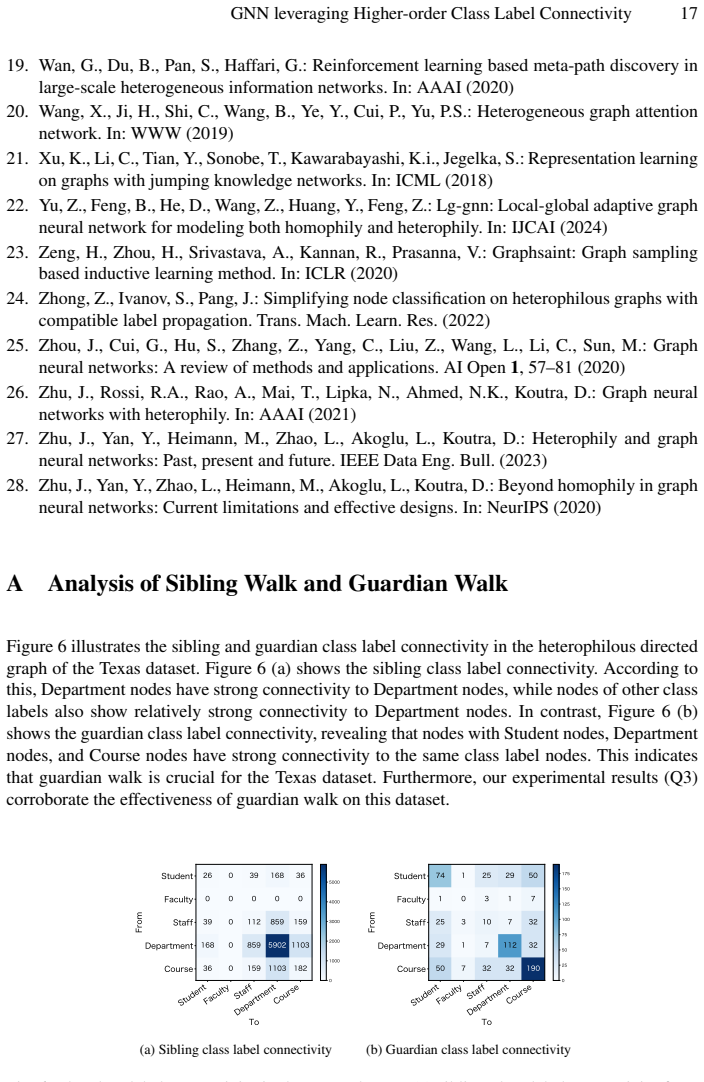
Zhu, J., Y an, Y ., Zhao, L., Heimann, M., Akoglu, L., Koutra, D.: Beyond homophily in graph neural networks: Current limitations and effective designs. In: NeurIPS (2020) A Analysis of Sibling Walk and Guardian Walk Figure 6 illustrates the sibling and guardian class label connectivity in the heterophilous directed graph of the Texas dataset. Figure 6 (a...
2020
discussion (0)
Sign in with ORCID, Apple, or X to comment. Anyone can read and Pith papers without signing in.