REVIEW 3 major objections 6 minor 43 references
The paper claims that a per-question thinking checklist, residualized against the final-answer reward, turns hidden reasoning traces into an effective RL training signal.
Reviewed by Pith at T0; open to challenge. T0 means a machine referee read the full paper against a public rubric. the ladder, T0–T4 →
T0 review · deepseek-v4-flash
2026-08-01 11:34 UTC pith:2KN573JI
load-bearing objection TCR is a plausible, modest process-reward contribution, but the evidence is conditional: no human validation and overlapping CIs for two of five backbones make 'consistently improves' too strong. the 3 major comments →
Rewarding Better Thinking for LLM Preference Alignment
The pith
A machine-rendered reading of the paper's core claim, the machinery that carries it, and where it could break.
Core claim
On its own terms, the paper's discovery is that preference pairs can be converted into explicit, instance-specific criteria for what counts as good thinking, and that scoring the observable reasoning trace against those criteria provides a useful RL signal only when it is isolated from the outcome reward. The paper shows empirically that checklist scores correlate moderately (roughly 0.46–0.50) with final-response scores, so they track quality overall, yet vary substantially among responses that receive similar outcome scores. That combination – aligned but not redundant – is exploited by subtracting the outcome-predictable part of the checklist score, estimated by an exponential moving aver
What carries the argument
Thinking Checklist Reward (TCR) is a process-level reward term: a per-question checklist of 3–7 noun-phrase criteria inferred from a preferred/rejected response pair, scored against the model's reasoning trace on a five-level scale. The EMA residual formulation is the load-bearing mechanism: a global exponential moving average tracks the typical ratio of checklist reward to outcome reward, and the term actually added to training is the positive part of (checklist reward − EMA ratio × outcome reward), so the policy only receives a bonus for thinking quality that the final-answer reward cannot already explain.
Load-bearing premise
The load-bearing premise is that LLM judges used to infer checklists, score reasoning traces, and rank final answers are faithful proxies for what humans prefer; if they prize style or length over substance, the reported alignment gains may not transfer to human users.
What would settle it
Take the five trained checkpoints from the paper and run a human preference study on 200 samples from the same evaluation sets; if humans do not prefer the TCR-trained model over the baseline at a comparable rate to the LLM judge, the central claim is falsified.
If this is right
- If TCR is right, outcome-level RL can be upgraded without changing the optimizer or the preference data: the same pairwise data that feeds the outcome reward can also generate reasoning checklists, so trajectory-level supervision becomes available wherever preference pairs exist.
- The residualization principle should generalize: any process signal that correlates with an outcome signal can be added as a bonus only for its unpredictable component, reducing reward redundancy and reward hacking.
- Because final answer length stays roughly flat while length-controlled win rates improve, the method implies reasoning quality can be improved without encouraging verbosity – a concrete counter to length-driven reward gaming.
- The checklist analysis suggests that learned policies change their planning behavior (e.g., context grounding, trade-off awareness), so TCR can be seen as shaping the model's cognitive process, not just its output style.
Where Pith is reading between the lines
- Not in the paper: the residualization trick may transfer to other process signals—if a signal correlates with the outcome reward, its unpredictable component can be isolated and used as a bonus, so TCR is less a checklist-specific recipe than a general recipe for adding redundant-but-informative feedback.
- Not in the paper: because checklists are built by an LLM from preference pairs, the offline construction cost is separate from rollouts; a cheaper judge could make the method practical for larger training sets, with unknown effect on quality.
- Not in the paper: the authors' judge-consistency test scores the same reasoning traces with multiple LLM judges, but the last missing link is human agreement on what a 'good thinking trace' is; that is the natural next experiment.
- Not in the paper: generating checklists online during rollouts could remove the offline preference-pair dependency, but it would also risk the policy and judge co-adapting, which the offline construction avoids.
Editorial analysis
A structured set of objections, weighed in public.
Referee Report
Summary. The paper proposes Thinking Checklist Reward (TCR), a process-level reward for RL-based open-ended alignment. For each training prompt, GPT-4o infers a sample-specific thinking checklist from pairwise preference data; during DAPO/GRPO training, Qwen3-30B scores the generated reasoning trace against that checklist, the score is residualized using an EMA-based estimate of the outcome-reward relationship, and the residual is added to outcome and format rewards. Experiments on five models from three families report average pairwise win-rate gains over DAPO on Vicuna/Dolly/BPO-test and the best AlpacaEval 2.0 metrics across backbones, with ablations, a Gemini judge robustness check, and case studies.
Significance. If the empirical claim holds, TCR is a practical and reasonably economical way to inject trajectory-level preference information into RL post-training without step-level PRMs, and the multi-model, multi-benchmark evaluation is a genuine strength. The paper also ships detailed hyperparameters, prompts, and a reward computation algorithm, which supports reproducibility. However, the central claim is currently supported only through LLM-judge-mediated evaluation, and two of the five backbone-specific bootstrap intervals overlap zero; these limitations need to be addressed before the claimed consistency across models and benchmarks can be accepted.
major comments (3)
- [Experiments – Evaluation; Fig. 6] The paper's central claim concerns alignment with human preferences, but every training and evaluation signal is an LLM judge: GPT-4o constructs checklists, Qwen3-30B scores reasoning traces, GPT-4.1 performs the main pairwise evaluation, and Gemini 2.5 Pro is used only as a second LLM judge. No human evaluation or human-judge agreement is reported. The Gemini check only establishes agreement between two LLM judges, not faithfulness to human preferences. The reported gains may therefore reflect optimization toward the stylistic priors of GPT-family judges rather than toward human-valued quality. Please add human evaluation on at least a subset (e.g., Vicuna/Dolly) or report human-judge agreement, or explicitly reframe the claims as LLM-judge-relative.
- [Table 1 / Supplementary Table 4] The claim that TCR "consistently improves alignment performance" across all five backbones is not statistically supported for two of them. The bootstrap 95% CIs reported in the supplementary material for pooled ΔWR are [-0.63, 15.00] for Llama3.1-8B and [-1.46, 14.61] for DeepSeek-LLM-7B, both overlapping zero. The main tables report no confidence intervals. At minimum, report CIs for all comparisons and soften the "consistent" language, or add evaluation instances/runs to resolve the uncertainty.
- [Method – Eqs. (3)–(4); Algorithm 1 lines 12–13] The EMA residualization is described as isolating the part of checklist quality "not predictable from the outcome reward," but Eq. (3) updates α_m using the current response and Eq. (4) subtracts α_m r_out_i, which includes that same response. Algebraically, modulo ε, r_sur_i ≈ µ(γ_i − α_{m−1}) r_out_i, i.e., a temporal surprise bonus, not a residual against a contemporaneous outcome-based prediction. The authors should either use α_{m−1} in Eq. (4) to match the stated interpretation, or reinterpret and analyze the temporal-difference form. This matters because the EMA residual is a core contribution and the w/o EMA ablation is interpreted through this mechanism.
minor comments (6)
- [Table 1] The row labels "DAPO + TCR DPO" and "DAPO + TCR DAPO" are confusing; clarify in the caption what initialization or base algorithm each variant uses.
- [Eq. (3) / Algorithm 1] Eq. (3) does not include the ratio bound M shown in Algorithm 1 line 12; make the notation consistent between the main text and the algorithm.
- [Supplementary – Judge Consistency] The statement that checklist scores are "generally consistent across judges" is not supported by any reported numbers or table. Please provide agreement statistics (e.g., correlation, Cohen's κ, or score distributions).
- [Empirical Analysis – Fig. 2] Report sample sizes and confidence intervals for the Pearson correlations (0.459–0.503), and improve the readability of Figure 2's axes and panel labels.
- [Experimental Setup – Evaluation benchmarks] State explicitly that BPO-test Eval is disjoint from the BPO training data, since the training data is also BPO-based.
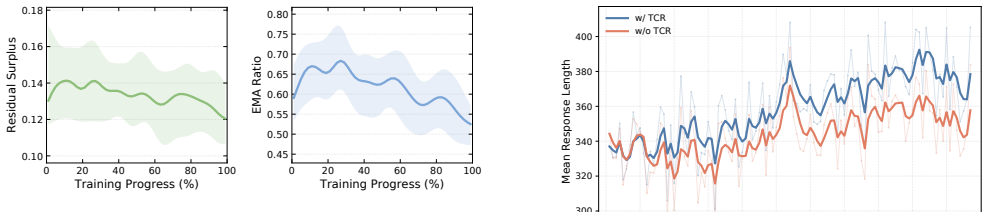
- [Additional Analysis – Figs. 5 and 7] Figure 5 reports the residual surplus and EMA ratio without units or error bars; clarify whether these are averaged over a single training run and what the y-axes represent. Figure 7's y-axis label says "Mean Response Length" but the caption could specify tokens versus words.
Circularity Check
No circular step found; the only self-citation is background and not load-bearing, so the score reflects that minor citation rather than any derivation-level circularity.
full rationale
The paper's derivation chain is constructive and empirical rather than inferential. The thinking checklists are generated offline from preference pairs (Table 9), the reward components are defined by Eqs. (1)-(6), and the EMA residual r_sur = [r_chk - alpha_m r_out]_+ is an online reward-shaping term updated from rollouts, not a parameter fitted to evaluation scores and later reported as a prediction. The claimed improvements are measured on held-out benchmarks with GPT-4.1 and Gemini-2.5-Pro (Tables 1-2, Fig. 6), so the evaluation is not equivalent to the training reward by construction. The only self-citation, Zhang et al. 2025b, appears in a related-work list and is not used to justify TCR's effectiveness; hence it does not create a load-bearing circular step. The dependence of both training and evaluation on LLM judges is a human-preference transfer validity concern, not circularity. Bootstrap CIs for Llama3.1-8B and DeepSeek-LLM-7B overlap zero, weakening the strength of the consistency claim for those backbones, but this is a statistical limitation rather than a circular derivation.
Axiom & Free-Parameter Ledger
free parameters (7)
- lambda_TCR =
0.05
- lambda_fmt =
0.1
- EMA decay mu =
0.99
- ratio bound M =
5.0
- numerical epsilon =
1e-6
- checklist score center =
6
- outcome reward clipping interval =
[-25, 70]
axioms (4)
- domain assumption GPT-4o checklist inference and Qwen3-30B judge scoring produce faithful process-level supervision from pairwise preferences.
- domain assumption GPT-4.1 (and Gemini-2.5-Pro in a robustness check) pairwise judgments are valid proxies for human preference in open-ended alignment.
- ad hoc to paper The relationship between checklist quality and outcome quality is approximately captured by a global multiplicative EMA ratio alpha, and the positive-part residual preserves useful complementary signal.
- domain assumption The visible reasoning trace inside <think> tags is a valid, extractable object for process supervision.
read the original abstract
LLM preference alignment aims to optimize models toward human preferences across diverse user instructions. Reinforcement learning has become a major post-training approach for this goal, but existing proxy rewards are often outcome-level, mainly evaluating the final response while providing limited guidance for the reasoning trajectory. This can make credit assignment coarse when multiple responses receive similar final scores, leaving trajectory-level preferences under-specified. To address this limitation, we propose Thinking Checklist Reward (TCR), a process-oriented reward for RL-based preference alignment. TCR converts preference pairs into sample-specific thinking checklists and uses them to evaluate whether the generated reasoning trace addresses the preference-implied considerations. To reduce overlap with outcome-level supervision, TCR further introduces an exponential moving average (EMA) residual formulation to isolate a complementary thinking surplus beyond what is predictable from the outcome reward. Experiments on five models from three model families show that TCR consistently improves alignment performance across diverse benchmarks, with ablations further validating the importance of EMA-based residual formulation and sample-specific checklist supervision.
Figures



Reference graph
Works this paper leans on
-
[1]
First identify concrete flaws, gaps, or weaknesses
-
[2]
Briefly explain how well the {subject_type.lower()} satisfies the criterion (1–2 sentences)
-
[3]
Choose ONE rating level
-
[4]
items": [ {
Output the corresponding numeric score. After all items: - Provide an overall summary (3–4 sentences). - Compute overall_score as the arithmetic mean of all numeric scores, rounded to one decimal. Output MUST be valid JSON only, exactly following this schema: { "items": [ { "criterion": "<text>", "explanation": "<1-2 sentences>", "rating_level": "<very po...
-
[5]
very poor
Whether it is logically consistent and helpful for producing a good final answer. Choose exactly ONE rating level: - "very poor" - "poor" - "adequate" - "good" - "excellent" Map the rating level to a numeric score: - very poor -> 2 - poor -> 4 - adequate -> 6 - good -> 8 - excellent -> 10 Output MUST be valid JSON only, exactly following this schema: { "e...
-
[6]
Consider important trade-offs, edge cases, or contextual factors when needed
-
[7]
Whether it correctly understands the user's intent
-
[8]
Whether it identifies relevant requirements, constraints, and context
-
[9]
Whether it develops a coherent and useful reasoning process
-
[10]
Whether it avoids unsupported assumptions, hallucinations, and irrelevant reasoning
-
[12]
Correctly understand the user's intent and the main task
-
[13]
Identify the key requirements, constraints, and conditions in the question
-
[14]
Develop a coherent and useful reasoning plan before answering
-
[15]
Use relevant information from the question and avoid irrelevant reasoning
-
[16]
Avoid unsupported assumptions, hallucinated facts, or overgeneralization
-
[18]
Table 13: Global thinking checklist used by the Global Checklist Reward baseline
Ensure the reasoning process is logically consistent and leads toward a helpful answer. Table 13: Global thinking checklist used by the Global Checklist Reward baseline. Case Study 1: Challenges in the Education Sector Question.What are the major challenges faced by the education sector today? Reasoning w/o TCR. To address the major challenges faced by th...
-
[19]
**Access to Education**: Despite progress, many regions still struggle with providing equitable access to education. [...]
-
[20]
**Quality of Education**: Ensuring that all students receive a high-quality education that prepares them for the future is a major challenge. [...],→
-
[21]
**Teacher Training and Support**: Teachers need continuous professional development [...]
-
[22]
**Curriculum Relevance**: The curriculum needs to evolve to reflect the changing needs of society and the workforce. [...]
-
[23]
**Integration of Technology**: While technology has the potential to enhance learning, its integration into education faces challenges [...],→
-
[24]
**Global Events and Societal Changes**: Events such as pandemics, economic downturns, and political instability can disrupt education systems [...],→ Reasoning w/ TCR. To address the major challenges faced by the education sector today, I need to consider several key areas that have been impacted by various factors such as technological advancements, soci...
-
[25]
Identify broad categories of challenges
-
[26]
Provide specific examples under each category
-
[27]
Consider the impact of these challenges on different stakeholders (students, educators, administrators)
-
[28]
Answer w/ TCR
Ensure the answer is comprehensive and covers the most significant issues. Answer w/ TCR. The education sector today faces several significant challenges that impact its effectiveness and accessibility. Here are some of the major challenges:,→
-
[29]
**Technological Integration and Accessibility**: - **Digital Divide**: Not all students have equal access to technology and the internet [...] - **Digital Literacy**: Educators and students need to develop skills to effectively use digital tools and platforms
-
[30]
**Curriculum Relevance and Adaptability**: - **Changing Job Market**: The rapid pace of technological change requires curricula to be updated frequently [...] - **Global Competitiveness**: Educational systems must adapt to compete globally [...]
-
[31]
**Educational Inequality**: - **Resource Allocation**: Schools in affluent areas often have better resources [...] - **Social and Economic Barriers**: Students from lower socio-economic backgrounds may face additional challenges [...]
-
[32]
**Teacher Quality and Professional Development**: - **Retention and Recruitment** [...] - **Professional Growth** [...]
-
[33]
**Assessment and Evaluation**: - **Standardized Testing** [...] - **Holistic Assessment** [...]
-
[34]
**Mental Health and Well-being**: - **Stress and Anxiety** [...] - **Support Services** [...]
-
[35]
**Global Events and Disruptions**: - **Pandemics and Natural Disasters** [...] - **Political and Economic Instability** [...] Observation.The model trained w/ TCR first plans how to organize the analysis, including category construction, examples, stakeholder impact, and coverage. This planning is reflected in the final answer, which covers more concrete ...
-
[36]
- Automation can increase efficiency and productivity [...] - However, rapid technological change can also lead to job displacement and income inequality
Technological progress: - Innovation drives economic growth and can lead to new industries and job opportunities. - Automation can increase efficiency and productivity [...] - However, rapid technological change can also lead to job displacement and income inequality
-
[37]
- Job creation can provide a sense of purpose and fulfillment [...] - However, simply creating jobs does not guarantee that they are sustainable or well-paying
Job creation: - Ensuring that people have employment can improve quality of life and reduce poverty. - Job creation can provide a sense of purpose and fulfillment [...] - However, simply creating jobs does not guarantee that they are sustainable or well-paying. The challenge is to balance these factors. Answer w/o TCR. In a world where automation is becom...
-
[38]
New technologies can create entirely new industries and job sectors [...],→
Economic Growth and Innovation: Technological progress often drives economic growth and innovation. New technologies can create entirely new industries and job sectors [...],→
-
[39]
Jobs that are repetitive or can be easily automated might become obsolete [...],→
Job Displacement: Automation can also lead to job displacement in certain sectors. Jobs that are repetitive or can be easily automated might become obsolete [...],→
-
[40]
This can exacerbate inequality and economic disparity.,→
Skill Mismatch: As technology advances, there is often a mismatch between the skills that are in demand and the skills that the workforce possesses. This can exacerbate inequality and economic disparity.,→
-
[41]
Long-term Benefits [...]
-
[42]
Policy and Education [...]
-
[43]
The Soundtrack of Our Lives,
Sustainability and Ethical Considerations [...] Given these considerations, it seems that both job creation and technological progress are important, but they are not mutually exclusive.,→ Answer w/ TCR. In a world where automation is becoming increasingly prevalent, it is crucial to strike a balance between prioritizing job creation and technological pro...
-
[2024]
five letters
as the outcome reward model and Qwen3-30B-A3B- Instruct-2507-FP8(Team2025)asthechecklistscoringmodel. The raw outcome reward is clipped to[−25,70] and linearly normalized to[0,1]. For checklist scoring, the judge model assigns each checklist item one of five scores,{2,4,6,8,10} , where 6 corresponds to the adequate level. The checklist reward is centered ...
2023
-
[2025]
arXiv preprint arXiv:2505.08827
RLSR: Reinforcement Learning from Self Reward. arXiv preprint arXiv:2505.08827. Su,Y.;Yu,D.;Song,L.;Li,J.;Mi,H.;Tu,Z.;Zhang,M.;and Yu, D. 2025. Crossing the reward bridge: Expanding rl with verifiable rewards across diverse domains.arXiv preprint arXiv:2503.23829. Team, Q. 2024. Qwen2.5: A Party of Foundation Models. Team, Q. 2025. Qwen3 Technical Report....
Pith/arXiv arXiv 2025
discussion (0)
Sign in with ORCID, Apple, or X to comment. Anyone can read and Pith papers without signing in.