REVIEW 4 major objections 5 minor 95 references
This paper argues that the Weyl group of sl_{n+1}, acting as electric-magnetic self-dualities on the A_n quiver family, moves solutions between all stability chambers while leaving the quiver Yangian and the DT generating function invariant
Reviewed by Pith at T0; open to challenge. T0 means a machine referee read the full paper against a public rubric. the ladder, T0–T4 →
T0 review · deepseek-v4-flash
2026-08-03 09:57 UTC pith:2KXNZ2JG
load-bearing objection Serious hypothesis-driven program for Weyl-group wall-crossing in quiver Yangians, but the central isomorphism is conditional on an approximate mutation rule. the 4 major comments →
Weyl Mutations in Quiver Yangians
The pith
A machine-rendered reading of the paper's core claim, the machinery that carries it, and where it could break.
Core claim
The central claim is that the phase-shifted quiver Yangian wY(sl_{n+1}) is isomorphic to the ordinary Yangian Y(sl_{n+1}), and more broadly that the quiver Yangian is a wall-crossing invariant. The paper constructs this by exhibiting Weyl mutations as electro-magnetic dualities on the framed A_n quiver Q_{n,u,h}: stability parameters transform by Weyl reflections, dimensions transform like fundamental weights with a framing correction, and the mutated maps are required to form a short exact sequence. Acting on fixed points, these mutations map the cyclic chamber (labelled by boxed plane partitions) onto every stability chamber. The DT generating function is shown to stay the same across all
What carries the argument
The central object is the Weyl mutation, a set of rules (4.1)–(4.6) on the framed A_n quiver. Its load-bearing part is the fourth rule: the mutated maps α and β must form a short exact sequence 0 → V̌_a → C^{hδ_{a,u}} ⊕ V_{a−1} ⊕ V_{a+1} → V_a → 0, with h copies of the framing space when the framed node is mutated. This exactness is what turns a mutated ansatz into a genuine solution of the quiver equations (3.3), and it is the step the paper itself flags as approximate. The mutations act on atomic-structure plots of fixed points, carrying boxed plane-partition labels from the cyclic chamber to every other chamber.
Load-bearing premise
The entire construction depends on the mutated maps α and β forming the short exact sequence (4.5); the paper itself calls this rule approximate and notes it does not work always exactly, so the bijection between chambers and the resulting algebra isomorphism stand or fall with this exactness.
What would settle it
Solve the quiver equations (3.3) directly in a non-cyclic chamber where rule 4 is approximate, for example phase 5 of Q_{3,2,2} with ζ = (ζ1+ζ2, −ζ2, ζ2+ζ3), and count the solutions; if the count does not reproduce the cyclic-chamber DT generating function (B.32), the claimed wall-crossing invariance and the isomorphism wY(sl4) ≅ Y(sl4) fail. A sharper test is the sl2 inverse mutation, where the naive α and β are both zero and no short exact sequence exists.
If this is right
- The DT generating function for Q_{n,u,h} is identical in every stability chamber, so the BPS state count does not change across marginal-stability walls.
- Every quiver-Yangian representation outside the cyclic chamber inherits a basis labelled by pre-image boxed plane partitions, so the representation theory developed in the cyclic chamber applies globally.
- The phase-valued algebra wY(sl_{n+1}) is isomorphic to Y(sl_{n+1}), meaning the Weyl group action on the Yangian is an automorphism rather than a deformation.
- For non-simply laced Dynkin diagrams B_n, C_n, F_4 and G_2, the paper proposes analogous mutation rules with Cartan-matrix-weighted copies in the exact sequence; there the cyclic-chamber fixed points are no longer plane partitions.
Where Pith is reading between the lines
- The authors' caveat on rule 4 implies that the chamber-to-chamber bijection may fail exactly where the short exact sequence degenerates; a natural test is whether the inverse mutation from the negative sl2 chamber, where α and β both vanish, can be repaired by a suitable choice of complex stability parameters.
- If Weyl mutations form a genuine group action, their composition on fixed-point sets should satisfy the braid relations at the level of solutions, not just on stability parameters; the sl4 fixed-point list in the appendix is a direct place to check s1s2s1 = s2s1s2.
- In the non-simply laced cases the cyclic chamber is no longer counted by plane partitions, so a new combinatorial label for fixed points is needed; computing the G2 DT generating function and matching it to the character of the (0,1) representation would be a direct test of the proposed generalization.
Editorial analysis
A structured set of objections, weighed in public.
Referee Report
Summary. The paper studies wall-crossing in quiver Yangians associated with A_n-type quivers. It proposes a set of 'Weyl mutation' rules (Sec. 4.1, Eqs. (4.1)–(4.6)) intended as Seiberg-like dualities, and claims that these mutations act on fixed points of the ADHM equations (3.3), preserve the DT generating function, and induce an isomorphism (Eq. (5.16)) between the quiver Yangian in any stability chamber and Y(sl_{n+1}). The construction is tested on explicit examples for sl_3, sl_4, so_5≃sp_4, and g_2 (Apps. B–C), with special focus on the sl_3 case. The paper also sketches generalizations to non-simply laced Dynkin diagrams.
Significance. If the central claim were established, the paper would provide a systematic solution-generating technique for ADHM-like equations, and would connect Weyl-group actions, Seiberg duality, and wall-crossing invariance of quiver Yangians. The manuscript contains valuable explicit material: complete lists of fixed points for sl_3 in all chambers, mutation computations for sl_4, and concrete proposals for B_2 and G_2 quivers. These examples are the paper's main strength. However, the claimed general A_n wall-crossing invariance and the isomorphism (5.16) are not proven in the text; the authors themselves call the mutation rules a 'hypothesis' (Sec. 4.1) and list the general sl_{n+1} check as an open problem (Conclusion). The most load-bearing rule, Rule 4, is acknowledged to be 'approximate' and to fail in the inverse direction (Sec. 4.1 Remark 5, App. B.1). Because the definition of the w-phase algebra in Eq. (5.15) relies on the inverse mutation map w^{-1}, the failure of exactness directly undermines the claimed isomorphism. The paper is therefore best viewed as a well-illustrated conjecture with strong low-rank evidence, not as a proof of the stated theorem.
major comments (4)
- [Sec. 4.1, Rule 4 and Remark 5; App. B.1] Rule 4 is the engine that turns a mutated ansatz into a genuine solution, via the short exact sequence (4.5). The authors state in Remark 5 that this rule is 'approximate' and 'does not work always exactly.' App. B.1 demonstrates the failure in the inverse direction: applying s_1^{-1} from Ph_- to Ph_+ for Q_{1,1,h} gives R=0, Š=0, α=β=0, which is not a short exact sequence. The suggested cure—choosing the Q theory to have ζ>0 and Q̌ to have ζ<0, or adding complex stability parameters—is not part of the rules and is not proven for general sequences. Since Eq. (5.15) defines the w-phase generators through the pre-image w^{-1}(v), the entire construction depends on a bijective inverse mutation map. The paper does not provide such a map. This is a load-bearing gap, not a cosmetic one.
- [Sec. 5.3, Eq. (5.16); Conclusion] The abstract and Sec. 7 state that the quiver Yangian is a wall-crossing invariant and is isomorphic to Y(sl_{n+1}), but Sec. 5.3 verifies this only for sl_3, and the Conclusion lists 'checking the validity of the proposed Weyl action in more general cases of Y(sl_{n+1})' as an open problem. Moreover, the sl_3 check is not exhaustive: Eq. (5.17) verifies a single equality of E- and F-matrix-element products in one phase, which is one instance of the hysteresis relations (5.9), not a derivation of all Yangian relations (5.2) or of the full algebra isomorphism. The ψ_a parameters also change from phase to phase (Eq. (5.18)), so the claim that the same abstract algebra survives across chambers needs a substantially more complete verification, or a clearly stated conjectural status.
- [Eq. (5.15) and Sec. 5.3] The definition of wY(sl_{n+1}) is made by pulling fixed points back to the cyclic chamber via w^{-1}. This makes the isomorphism (5.16) substantially built into the definition: the generators are labeled by cyclic-chamber Young diagrams, and matrix elements are computed from those pre-images. What still needs checking is whether the resulting operators satisfy the hysteresis relations (5.9) and the Yangian relations. The paper checks one such relation for sl_3. For general w, no proof is given that w^{-1} is well-defined, independent of the chosen decomposition of w, or indeed that every chamber is reached by a unique sequence of mutations. Given the failure of the inverse mutation in App. B.1, the canonical nature of w^{-1} cannot be assumed.
- [Sec. 3.3 and Sec. 4.1, Remark 6] The claim that every stability chamber is the orbit of the cyclic chamber under Weyl mutations, and that fixed points in any chamber are in bijection with cyclic-chamber fixed points, is asserted rather than proven. The examples cover sl_3 completely, but for sl_4 only a chain of chambers (Ph1→Ph3→Ph5) is traced in App. B.3, and for B_2 and G_2 only selected phases are shown (Apps. C.1–C.2). This is not sufficient to establish the general A_n statement or the claimed invariance of the DT generating function (3.7), which is made in Eq. (3.8) and Remark 6. The derivation 'dimension transformation rule (4.2) is such that vector weights remain invariant' assumes the bijection already exists. As it stands, the DT invariance is a conjecture supported by examples, not a theorem.
minor comments (5)
- [Eq. (5.2)] The Yangian relations as printed appear to be missing the mode shifts. For example, the standard relation is [h_i^{(k)}, e_j^{(m)}] = A_{ij} e_j^{(k+m)} and similarly for f; as written, the equations imply no dependence on k, which is inconsistent with the mode-shifting formula (5.3). Please correct these relations.
- [Sec. 3.1, table below Eq. (3.2)] The equivariant charge table is ambiguous: five fields (A_a, B_a, C_a, R, S) are listed but six charge entries appear. Presumably C_a has charge −ϵ_1−ϵ_2; please format the table accordingly.
- [Sec. 4.1, Eq. (4.2) and Remark 3] The dimension shift hδ_{a,u} is introduced with only a heuristic justification via a 'dummy stability parameter' at the framing node. Since this correction is essential for the weight-invariance argument in Remark 6, a more explicit derivation would help the reader.
- [App. B.3] The atomic structure plots in the mutation chains (B.33) are not visible in the manuscript text; several entries appear empty. If these are meant to be diagrams, they must be included. Without them the sl_4 mutation verification cannot be followed.
- [Abstract and Sec. 7] The abstract and conclusion state 'we showed' results that are later qualified as conjectural or open. This mismatch should be corrected in revision by either adding proofs or clearly labeling the general statements as conjectures supported by low-rank evidence.
Circularity Check
No significant circularity; the central isomorphism is tested on matrix elements rather than imposed, and the acknowledged mutation-rule failures are gaps in support, not self-referential reductions.
full rationale
The paper's derivation is not circular in the sense of the rubric. The cyclic-chamber construction of the quiver Yangian representation (Sec. 3.2-3.3 and Eqs. (5.6)-(5.9)) is an independent, previously established construction and is not derived from the mutation claims. The Weyl-mutation rules in Sec. 4.1 are explicitly proposed as a hypothesis: 'By considering various examples in App. B we propose a hypothesis that mutation s_a is subjected to the following rules.' The paper itself flags the main technical rule as approximate: 'the rule in item 4 is approximate... rule 4 does not work always exactly' (Remark 5, Sec. 4.1), and Appendix B.1 shows the inverse sl2 mutation gives R=0, Š=0, α=β=0, not a short exact sequence. These are acknowledged limitations on the well-definedness of the mutation map, not a circular identification. In Sec. 5.3, Eq. (5.15) does label the w-phase basis by cyclic-chamber pre-images w^{-1}(v), which gives the claimed isomorphism (5.16) a definitional flavor; however the paper explicitly states that 'matrix elements are calculated according to (5.10) for actual fixed points in the w-phase that are not Young diagrams', and it checks hysteresis relations for sl3 (Eq. (5.17)). Thus the isomorphism claim has independent content beyond the definition, although the check is only one example. The use of the authors' previous paper [1] for the approach is a self-citation, but it is not the sole load-bearing evidence because the present paper provides explicit checks. No fitted parameter is renamed as a prediction: the phase-dependent ψ values in (5.18) are reported as phase-dependent data, and DT invariance is a consequence of the rules plus the checked fixed-point counts, not a back-fit. Overall, the main issues are incompleteness and reliance on unproven bijections, which affect correctness risk, not circularity.
Axiom & Free-Parameter Ledger
free parameters (2)
- Mutation dimension correction h δ_{a,u} =
h δ_{a,u} (h = height of rectangular Young diagram; u = framing node)
- Rule-4 phase orientation convention =
Q is the ζ_a > 0 theory, ˇQ the ˇζ_a < 0 theory
axioms (6)
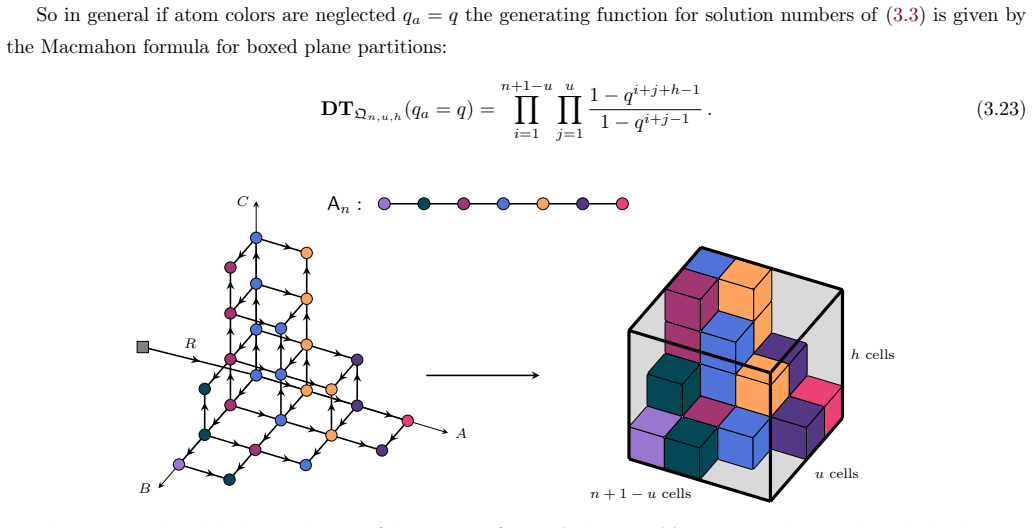
- domain assumption Fixed points of Q_{n,u,h} in the cyclic chamber are in 1-to-1 correspondence with boxed 3d Young diagrams in an (n+1−u)×u×h box
- domain assumption The BPS algebra of Q_{n,u,h} is Y(sl_{n+1}), and the cyclic-chamber fixed points form the irreducible representation Υ_{u,h} labeled by a rectangular Young diagram
- ad hoc to paper Weyl reflection rules (4.1)–(4.2) and the short exact sequence (4.5) define valid solution-to-solution mutations
- domain assumption Every stability chamber lies on the Weyl-mutation orbit of the cyclic chamber
- standard math Standard Lie theory: τ_i = e^{ad e_i} e^{−ad f_i} e^{ad e_i} implements Weyl reflections as algebra automorphisms
- ad hoc to paper Generators in a w-phase defined by (5.15), with amplitudes from (5.10), satisfy the hysteresis relations (5.9)
read the original abstract
The problem of solving non-linear equations would be considerably simplified by a possibility to convert known solutions into the new ones. This could seem an element of art, but in the context of ADHM-like equations describing quiver varieties there is a systematic approach. In this note we study moduli spaces and dualities of quiver gauge theories associated to effective dynamics of D-branes compactified on Calabi-Yau resolutions. We concentrate on a subfamily of quivers $\mathfrak{Q}_{\mathfrak{g}}$ covering Dynkin diagrams for simple Lie algebras $\mathfrak{g}$, where the respective BPS algebra is expected to be the Yangian algebra $Y(\mathfrak{g})$. For Yangians labeled by quivers their representations are described by solutions of ADHM-like equations. As quivers substitute Dynkin diagrams a generalization of the Weyl group $\mathcal{W}_{\mathfrak{g}}$ acts on the ADHM solutions. Here we work with the case $\mathfrak{g}=\mathfrak{sl}_{n+1}$ and treat this group as a group of electro-magnetic Seiberg-like dualities (we call them Weyl mutations) on the respective quiver gauge theories. We lift it to the case of higher representations associated to rectangular Young diagrams. An action of Weyl mutations on the BPS Yangian algebra is also discussed.
Figures


Reference graph
Works this paper leans on
-
[1]
Wall-crossing effects on quiver BPS algebras,
D. Galakhov, A. Morozov, and N. Tselousov, “Wall-crossing effects on quiver BPS algebras,”JHEP05(2024) 118,arXiv:2403.14600 [hep-th]
Pith/arXiv arXiv 2024
-
[2]
Wall-crossing from supersymmetric galaxies,
E. Andriyash, F. Denef, D. L. Jafferis, and G. W. Moore, “Wall-crossing from supersymmetric galaxies,”JHEP 01(2012) 115,arXiv:1008.0030 [hep-th]
Pith/arXiv arXiv 2012
-
[3]
BPS Wall Crossing and Topological Strings,
S. Cecotti and C. Vafa, “BPS Wall Crossing and Topological Strings,”arXiv:0910.2615 [hep-th]
-
[4]
M. Aganagic, H. Ooguri, C. Vafa, and M. Yamazaki, “Wall Crossing and M-theory,”Publ. Res. Inst. Math. Sci. Kyoto47(2011) 569,arXiv:0908.1194 [hep-th]
Pith/arXiv arXiv 2011
-
[5]
Stability structures, motivic Donaldson-Thomas invariants and cluster transformations,
M. Kontsevich and Y. Soibelman, “Stability structures, motivic Donaldson-Thomas invariants and cluster transformations,”arXiv:0811.2435 [math.AG]
-
[6]
Felix Klein Lectures: “Applications of the Six-dimensional (2,0) Theory to Physical Mathematics,
G. W. Moore, “Felix Klein Lectures: “Applications of the Six-dimensional (2,0) Theory to Physical Mathematics,” .” Available athttp://www.physics.rutgers.edu/~gmoore
-
[7]
Wall Crossing, Quivers and Crystals,
M. Aganagic and K. Schaeffer, “Wall Crossing, Quivers and Crystals,”JHEP10(2012) 153,arXiv:1006.2113 [hep-th]
Pith/arXiv arXiv 2012
-
[8]
Wall-crossing, free fermions and crystal melting,
P. Sulkowski, “Wall-crossing, free fermions and crystal melting,”Commun. Math. Phys.301(2011) 517–562, arXiv:0910.5485 [hep-th]
Pith/arXiv arXiv 2011
-
[9]
Wall Crossing from Boltzmann Black Hole Halos,
J. Manschot, B. Pioline, and A. Sen, “Wall Crossing from Boltzmann Black Hole Halos,”JHEP07(2011) 059, arXiv:1011.1258 [hep-th]. 44
Pith/arXiv arXiv 2011
-
[10]
Corfu lectures on wall-crossing, multi-centered black holes, and quiver invariants,
B. Pioline, “Corfu lectures on wall-crossing, multi-centered black holes, and quiver invariants,”PoSCorfu2012 (2013) 085,arXiv:1304.7159 [hep-th]
Pith/arXiv arXiv 2013
-
[11]
Wall-crossing structures in Donaldson-Thomas invariants, integrable systems and Mirror Symmetry,
M. Kontsevich and Y. Soibelman, “Wall-crossing structures in Donaldson-Thomas invariants, integrable systems and Mirror Symmetry,”Lect. Notes Union. Mat. Ital.15(2014) 197–308,arXiv:1303.3253 [math.AG]
Pith/arXiv arXiv 2014
-
[12]
Shifted quiver Yangians and representations from BPS crystals,
D. Galakhov, W. Li, and M. Yamazaki, “Shifted quiver Yangians and representations from BPS crystals,”JHEP 08(2021) 146,arXiv:2106.01230 [hep-th]
Pith/arXiv arXiv 2021
-
[13]
Shifted quiver quantum toroidal algebra and subcrystal representations,
G. Noshita and A. Watanabe, “Shifted quiver quantum toroidal algebra and subcrystal representations,”JHEP 05(2022) 122,arXiv:2109.02045 [hep-th]
Pith/arXiv arXiv 2022
-
[14]
Two-dimensional crystal melting and D4-D2-D0 on toric Calabi-Yau singularities,
T. Nishinaka, S. Yamaguchi, and Y. Yoshida, “Two-dimensional crystal melting and D4-D2-D0 on toric Calabi-Yau singularities,”JHEP05(2014) 139,arXiv:1304.6724 [hep-th]
Pith/arXiv arXiv 2014
-
[15]
Higher spinsl2R-matrix from equivariant (co)homology,
D. Bykov and P. Zinn-Justin, “Higher spinsl2R-matrix from equivariant (co)homology,”Lett. Math. Phys.110 no. 9, (2020) 2435–2470,arXiv:1904.11107 [math-ph]
Pith/arXiv arXiv 2020
-
[16]
Higher spin representations of the Yangian ofsl2 and R-matrices,
Y. Yang and P. Zinn-Justin, “Higher spin representations of the Yangian ofsl2 and R-matrices,” arXiv:2403.17433 [math.RT]
-
[17]
Lectures on Nakajima’s Quiver Varieties,
V. Ginzburg, “Lectures on Nakajima’s Quiver Varieties,”arXiv:0905.0686 [math.RT]
-
[18]
Crystal Melting and Wall Crossing Phenomena,
M. Yamazaki, “Crystal Melting and Wall Crossing Phenomena,”Int. J. Mod. Phys. A26(2011) 1097–1228, arXiv:1002.1709 [hep-th]
Pith/arXiv arXiv 2011
-
[19]
Quiver algebras and their representations for arbitrary quivers,
W. Li, “Quiver algebras and their representations for arbitrary quivers,”JHEP12(2024) 089, arXiv:2303.05521 [hep-th]
Pith/arXiv arXiv 2024
-
[20]
Quiver Yangians and crystal meltings: A concise summary,
M. Yamazaki, “Quiver Yangians and crystal meltings: A concise summary,”J. Math. Phys.64no. 1, (2023) 011101,arXiv:2203.14314 [hep-th]
Pith/arXiv arXiv 2023
-
[21]
The origin of Calabi-Yau crystals in BPS states counting,
J. Bao, R.-K. Seong, and M. Yamazaki, “The origin of Calabi-Yau crystals in BPS states counting,”JHEP03 (2024) 140,arXiv:2401.02792 [hep-th]
Pith/arXiv arXiv 2024
-
[22]
Quiver Yangian and Supersymmetric Quantum Mechanics,
D. Galakhov and M. Yamazaki, “Quiver Yangian and Supersymmetric Quantum Mechanics,”Commun. Math. Phys.396no. 2, (2022) 713–785,arXiv:2008.07006 [hep-th]
Pith/arXiv arXiv 2022
-
[23]
Quiver varieties and kac-moody algebras,
H. Nakajima, “Quiver varieties and kac-moody algebras,”Duke Mathematical Journal91(02, 1998) 515–560
1998
-
[24]
Cohomological Hall algebras, vertex algebras and instantons,
M. Rapcak, Y. Soibelman, Y. Yang, and G. Zhao, “Cohomological Hall algebras, vertex algebras and instantons,”Commun. Math. Phys.376no. 3, (2019) 1803–1873,arXiv:1810.10402 [math.QA]
Pith/arXiv arXiv 2019
-
[25]
Cohomological Hall algebras and perverse coherent sheaves on toric Calabi–Yau3-folds,
M. Rapcak, Y. Soibelman, Y. Yang, and G. Zhao, “Cohomological Hall algebras and perverse coherent sheaves on toric Calabi–Yau3-folds,”Commun. Num. Theor. Phys.17no. 4, (2023) 847–939,arXiv:2007.13365 [math.QA]
Pith/arXiv arXiv 2023
-
[26]
Tunnels under geometries (or instantons know their algebras),
D. Galakhov and A. Morozov, “Tunnels under geometries (or instantons know their algebras),”JHEP05(2025) 132,arXiv:2502.11294 [hep-th]. 45
Pith/arXiv arXiv 2025
-
[27]
A. Gavshin, “Quiver Yangian algebras associated to Dynkin diagrams of A-type and their rectangular representations,”arXiv:2510.02121 [math.RT]
-
[28]
BPS Hall Algebra of Scattering Hall States,
D. Galakhov, “BPS Hall Algebra of Scattering Hall States,”Nucl. Phys. B946(2019) 114693, arXiv:1812.05801 [hep-th]
Pith/arXiv arXiv 2019
-
[29]
Cohomological Hall algebra, exponential Hodge structures and motivic Donaldson-Thomas invariants,
M. Kontsevich and Y. Soibelman, “Cohomological Hall algebra, exponential Hodge structures and motivic Donaldson-Thomas invariants,”Commun. Num. Theor. Phys.5(2011) 231–352,arXiv:1006.2706 [math.AG]
Pith/arXiv arXiv 2011
-
[30]
Electric - magnetic duality in supersymmetric nonAbelian gauge theories,
N. Seiberg, “Electric - magnetic duality in supersymmetric nonAbelian gauge theories,”Nucl. Phys. B435 (1995) 129–146,arXiv:hep-th/9411149
Pith/arXiv arXiv 1995
-
[31]
Lectures on supersymmetric gauge theories and electric-magnetic duality,
K. A. Intriligator and N. Seiberg, “Lectures on supersymmetric gauge theories and electric-magnetic duality,” Nucl. Phys. B Proc. Suppl.45BC(1996) 1–28,arXiv:hep-th/9509066
Pith/arXiv arXiv 1996
-
[32]
A Comment on duality in N=1 supersymmetric nonAbelian gauge theories,
D. Kutasov, “A Comment on duality in N=1 supersymmetric nonAbelian gauge theories,”Phys. Lett. B351 (1995) 230–234,arXiv:hep-th/9503086
Pith/arXiv arXiv 1995
-
[33]
On duality in supersymmetric Yang-Mills theory,
D. Kutasov and A. Schwimmer, “On duality in supersymmetric Yang-Mills theory,”Phys. Lett. B354(1995) 315–321,arXiv:hep-th/9505004
Pith/arXiv arXiv 1995
-
[34]
Chiral rings, singularity theory and electric - magnetic duality,
D. Kutasov, A. Schwimmer, and N. Seiberg, “Chiral rings, singularity theory and electric - magnetic duality,” Nucl. Phys. B459(1996) 455–496,arXiv:hep-th/9510222
Pith/arXiv arXiv 1996
-
[35]
Seiberg duality for quiver gauge theories,
D. Berenstein and M. R. Douglas, “Seiberg duality for quiver gauge theories,”arXiv:hep-th/0207027
-
[36]
N= 2quantum field theories and their BPS quivers,
M. Alim, S. Cecotti, C. Cordova, S. Espahbodi, A. Rastogi, and C. Vafa, “N= 2quantum field theories and their BPS quivers,”Adv. Theor. Math. Phys.18no. 1, (2014) 27–127,arXiv:1112.3984 [hep-th]
Pith/arXiv arXiv 2014
-
[37]
Cluster Algebras from Dualities of 2dN= (2, 2) Quiver Gauge Theories,
F. Benini, D. S. Park, and P. Zhao, “Cluster Algebras from Dualities of 2dN= (2, 2) Quiver Gauge Theories,” Commun. Math. Phys.340(2015) 47–104,arXiv:1406.2699 [hep-th]
Pith/arXiv arXiv 2015
-
[38]
A new proof of a theorem of narasimhan and seshadri,
S. K. Donaldson, “A new proof of a theorem of narasimhan and seshadri,”Journal of Differential Geometry18 no. 2, (1983) 269–277
1983
-
[39]
Moduli of representations of finite dimensional algebras,
A. D. King, “Moduli of representations of finite dimensional algebras,”The Quarterly Journal of Mathematics 45no. 4, (1994) 515–530
1994
-
[40]
Fulton and J
W. Fulton and J. Harris,Representation theory: a first course, vol. 129. Springer Science & Business Media, 2013
2013
-
[41]
Standard automorphisms of semisimple Lie algebras and their relations,
D. Reynoso-Mercado, “Standard automorphisms of semisimple Lie algebras and their relations,” arXiv:2401.15256 [math.RA]
-
[42]
J. E. Humphreys,Introduction to Lie algebras and representation theory, vol. 9. Springer Science & Business Media, 2012
2012
-
[43]
Di Francesco, P
P. Di Francesco, P. Mathieu, and D. Senechal,Conformal Field Theory. Graduate Texts in Contemporary Physics. Springer-Verlag, New York, 1997. 46
1997
-
[44]
Braid Group Action on Affine Yangian,
R. Kodera, “Braid Group Action on Affine Yangian,”SIGMA15(Mar., 2019) 020,arXiv:1805.01621 [math.RT]
Pith/arXiv arXiv 2019
-
[45]
Yang-mills instantons on ale gravitational instantons,
P. B. Kronheimer and H. Nakajima, “Yang-mills instantons on ale gravitational instantons,”Mathematische Annalen288no. 1, (1990) 263–307
1990
-
[46]
Instantons on ale spaces, quiver varieties, and kac-moody algebras,
H. Nakajima, “Instantons on ale spaces, quiver varieties, and kac-moody algebras,”Duke Mathematical Journal 76no. 2, (1994) 365
1994
-
[47]
D-branes, quivers, and ALE instantons,
M. R. Douglas and G. W. Moore, “D-branes, quivers, and ALE instantons,”arXiv:hep-th/9603167
-
[48]
Vortices, instantons and branes,
A. Hanany and D. Tong, “Vortices, instantons and branes,”JHEP07(2003) 037,arXiv:hep-th/0306150
Pith/arXiv arXiv 2003
-
[49]
Instantons on noncommutative R**4 and (2,0) superconformal six-dimensional theory,
N. Nekrasov and A. S. Schwarz, “Instantons on noncommutative R**4 and (2,0) superconformal six-dimensional theory,”Commun. Math. Phys.198(1998) 689–703,arXiv:hep-th/9802068
Pith/arXiv arXiv 1998
-
[50]
Quantum field theory on noncommutative spaces,
R. J. Szabo, “Quantum field theory on noncommutative spaces,”Phys. Rept.378(2003) 207–299, arXiv:hep-th/0109162
Pith/arXiv arXiv 2003
-
[51]
ADHM Construction of Noncommutative Instantons,
M. Hamanaka and T. Nakatsu, “ADHM Construction of Noncommutative Instantons,” in20th International Colloquium on Integrable Systems and Quantum Symmetries. 11, 2013.arXiv:1311.5227 [hep-th]
Pith/arXiv arXiv 2013
-
[52]
The construction of ALE spaces as hyper-K¨ ahler quotients,
P. Kronheimer, “The construction of ALE spaces as hyper-K¨ ahler quotients,”Journal of differential geometry29 no. 3, (1989) 665–683
1989
-
[53]
Quiver varieties and weyl group actions,
G. Lusztig, “Quiver varieties and weyl group actions,” inAnnales de l’institut Fourier, vol. 50, pp. 461–489. 2000
2000
-
[54]
A remark on quiver varieties and weyl groups,
A. Maffei, “A remark on quiver varieties and weyl groups,”Pisa Cl. SciI(01, 2002) 649–686, arXiv:math/0003159 [math.AG]
Pith/arXiv arXiv 2002
-
[55]
Reflection functors for quiver varieties and weyl group actions,
H. Nakajima, “Reflection functors for quiver varieties and weyl group actions,”Mathematische Annalen327 no. 4, (2003) 671–721
2003
-
[56]
Affine Super Yangian and Weyl groupoid,
V. Stukopin and V. Volkov, “Affine Super Yangian and Weyl groupoid,”arXiv:2306.14598 [math.QA]
-
[57]
Coproducts for affine super-Yangian and Weyl groupoid action,
V. Volkov and V. Stukopin, “Coproducts for affine super-Yangian and Weyl groupoid action,” arXiv:2510.04221 [math.QA]
-
[58]
Braid actions on quantum toroidal superalgebras,
L. Bezerra and E. Mukhin, “Braid actions on quantum toroidal superalgebras,”Journal of algebra585(2021) 338–369,arXiv:1912.08729 [math.QA]
Pith/arXiv arXiv 2021
-
[59]
Algorithms for representations of quiver Yangian algebras,
D. Galakhov, A. Gavshin, A. Morozov, and N. Tselousov, “Algorithms for representations of quiver Yangian algebras,”JHEP08(2024) 209,arXiv:2406.20074 [hep-th]
Pith/arXiv arXiv 2024
-
[60]
More on affine Dynkin quiver Yangians,
J. Bao, “More on affine Dynkin quiver Yangians,”JHEP07(2023) 153,arXiv:2304.00767 [hep-th]
Pith/arXiv arXiv 2023
-
[61]
An Overview of Crystals and Double Quiver Yangians,
J. Bao, “An Overview of Crystals and Double Quiver Yangians,”arXiv:2509.16918 [hep-th]
-
[62]
Hopf algebras and the quantum Yang-Baxter equation,
V. G. Drinfel’d, “Hopf algebras and the quantum Yang-Baxter equation,” inSoviet Math. Dokl., vol. 32, pp. 254–258. 1985. 47
1985
-
[63]
Gauge/Bethe correspondence from quiver BPS algebras,
D. Galakhov, W. Li, and M. Yamazaki, “Gauge/Bethe correspondence from quiver BPS algebras,”JHEP11 (2022) 119,arXiv:2206.13340 [hep-th]
Pith/arXiv arXiv 2022
-
[64]
Gromov–Witten theory and Donaldson–Thomas theory, I,
D. Maulik, N. Nekrasov, A. Okounkov, and R. Pandharipande, “Gromov–Witten theory and Donaldson–Thomas theory, I,”Compositio Mathematica142no. 5, (2006) 1263–1285,arXiv:math/0312059 [math.AG]
Pith/arXiv arXiv 2006
-
[65]
Mckay correspondence and hilbert schemes in dimension three,
Y. Ito and H. Nakajima, “Mckay correspondence and hilbert schemes in dimension three,”Topology39no. 6, (2000) 1155–1191,arXiv:math/9803120 [math.AG]
Pith/arXiv arXiv 2000
-
[66]
A new realization of Yan-gians and quantized affine algebras,
V. G. Drinfel’d, “A new realization of Yan-gians and quantized affine algebras,” inSoviet Math. Dokl., vol. 32, pp. 212–216. 1988
1988
-
[67]
Coproduct for Yangians of affine Kac–Moody algebras,
N. Guay, H. Nakajima, and C. Wendlandt, “Coproduct for Yangians of affine Kac–Moody algebras,”Advances in Mathematics338(2018) 865–911,arXiv:1701.05288 [math.QA]
Pith/arXiv arXiv 2018
-
[68]
W-symmetry, topological vertex and affine Yangian,
T. Proch´ azka, “W-symmetry, topological vertex and affine Yangian,”JHEP10(2016) 077,arXiv:1512.07178 [hep-th]
Pith/arXiv arXiv 2016
-
[69]
Quiver Yangian from Crystal Melting,
W. Li and M. Yamazaki, “Quiver Yangian from Crystal Melting,”JHEP11(2020) 035,arXiv:2003.08909 [hep-th]
Pith/arXiv arXiv 2020
-
[70]
Geometric singularities and enhanced gauge symmetries,
M. Bershadsky, K. A. Intriligator, S. Kachru, D. R. Morrison, V. Sadov, and C. Vafa, “Geometric singularities and enhanced gauge symmetries,”Nucl. Phys. B481(1996) 215–252,arXiv:hep-th/9605200
Pith/arXiv arXiv 1996
-
[71]
4d N=2 Gauge Theories and Quivers: the Non-Simply Laced Case,
S. Cecotti and M. Del Zotto, “4d N=2 Gauge Theories and Quivers: the Non-Simply Laced Case,”JHEP10 (2012) 190,arXiv:1207.7205 [hep-th]
Pith/arXiv arXiv 2012
-
[72]
Crystals and double quiver algebras from Jeffrey-Kirwan residues,
J. Bao and M. Yamazaki, “Crystals and double quiver algebras from Jeffrey-Kirwan residues,”SciPost Phys.18 no. 4, (2025) 143,arXiv:2501.03365 [hep-th]
Pith/arXiv arXiv 2025
-
[73]
Quiver Yangians as Coulomb branch algebras,
T. Chen and W. Li, “Quiver Yangians as Coulomb branch algebras,”arXiv:2502.01323 [hep-th]
-
[74]
Slodowy,Simple Singularities and Simple Algebraic Groups
P. Slodowy,Simple Singularities and Simple Algebraic Groups. Lecture Notes in Mathematics. Springer Berlin Heidelberg, 2006.https://books.google.ru/books?id=-u96CwAAQBAJ
2006
-
[75]
Notes on Coxeter Transformations and the McKay correspondence,
R. Stekolshchik, “Notes on Coxeter Transformations and the McKay correspondence,”arXiv:math/0510216 [math.RT]
-
[76]
An analogue of B¨ acklund’s theorem in affine geometry,
S. Chern and C. Terng, “An analogue of B¨ acklund’s theorem in affine geometry,”Rocky Mountain J. Math.10 no. 4, (1980) 105–124
1980
-
[77]
Quantum difference equation for Nakajima varieties,
A. Okounkov and A. Smirnov, “Quantum difference equation for Nakajima varieties,”Invent. Math.229no. 3, (2022) 1203–1299,arXiv:1602.09007 [math-ph]
Pith/arXiv arXiv 2022
-
[78]
Commutative families in W∞, integrable many-body systems and hypergeometricτ-functions,
A. Mironov, V. Mishnyakov, A. Morozov, and A. Popolitov, “Commutative families in W∞, integrable many-body systems and hypergeometricτ-functions,”JHEP23(2020) 065,arXiv:2306.06623 [hep-th]
Pith/arXiv arXiv 2020
-
[79]
Commutative subalgebras from Serre relations,
A. Mironov, V. Mishnyakov, A. Morozov, and A. Popolitov, “Commutative subalgebras from Serre relations,” Phys. Lett. B845(2023) 138122,arXiv:2307.01048 [hep-th]. 48
Pith/arXiv arXiv 2023
-
[80]
Elliptic stable envelope for Hilbert scheme of points in the plane,
A. Smirnov, “Elliptic stable envelope for Hilbert scheme of points in the plane,”arXiv:1804.08779 [math.AG]
discussion (0)
Sign in with ORCID, Apple, or X to comment. Anyone can read and Pith papers without signing in.