REVIEW 2 major objections 6 minor 1 cited by
A phase-separating nucleator advected by the cytoskeletal network it creates arrests coarsening and locks in a stable wavelength; within a band of wavenumbers, the final pattern preserves its memory of initial conditions.
Reviewed by Pith at T0; open to challenge. T0 means a machine referee read the full paper against a public rubric. the ladder, T0–T4 →
Coupling a conserved phase-separating nucleator to a self-straining active network arrests coarsening and stabilizes a band of wavelengths, encoding memory of initial conditions.
T0 review reviewed 2026-08-04 challenge →
load-bearing objection A genuinely new mechanochemical route to pattern selection and memory, but the stable-band claim at its core is only verified at first-harmonic order — worth refereeing, with a request for higher-harmonic checks. the 2 major comments →
Arrested coarsening, oscillations, and memory from a conserved phase separating nucleator in a self-straining cytoskeletal network
The pith
A machine-rendered reading of the paper's core claim, the machinery that carries it, and where it could break.
The reading
Core claim
The central claim is that coarsening is arrested by active mechanics: the network density grows when the nucleator amplitude exceeds a wavenumber-dependent threshold, and the resulting advection changes the nucleator dynamics. The final state is a periodic pattern with a well-defined wavelength, reached via damped oscillations. A harmonic stability analysis identifies a band of stable steady states for wavenumbers between q_m/2 and q_rho; within this band the wavelength is preserved, so the system retains memory of its initial condition. The paper proposes this compound material as a paradigm for mechano-chemical scale selection and memory fixation in cells.
What carries the argument
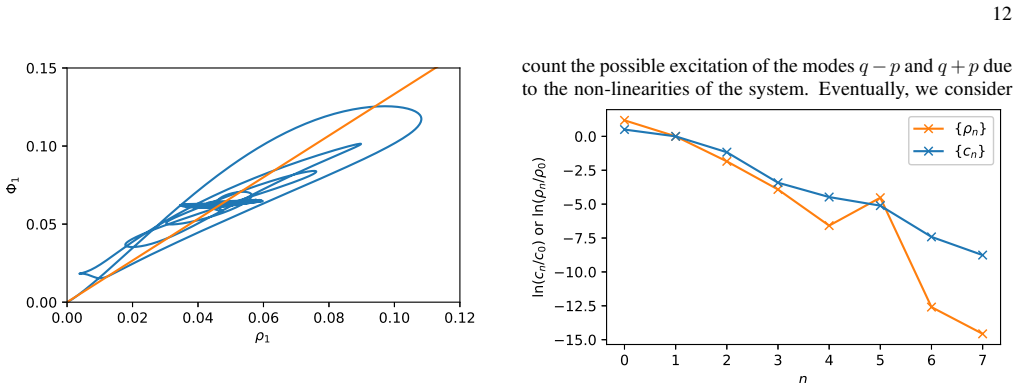
The central object is the coupled equations for a conserved Cahn-Hilliard nucleator density c advected by a self-straining cytoskeletal network with density rho and polarity P. The network grows by branching nucleation at rate alpha c and turns over with rate r, while filaments slide at speed V. The analysis uses a harmonic truncation: steady Cahn-Hilliard profiles are expressed via Jacobi elliptic functions, and higher harmonics are slaved to the first harmonic and wavenumber by an exponential-decay closure. This closure yields the threshold for network growth and, through a center-manifold reduction, the threshold for nucleator decay. A 9x9 linear stability matrix around first-harmonic ste
Load-bearing premise
The stability analysis keeps only the lowest Fourier harmonic, assuming higher harmonics decay exponentially; the paper notes this closure worsens during coarsening and fails for wavelengths below a certain wavenumber.
What would settle it
Initialize the full model with a steady-state wavelength below the stated wavenumber limit or with a large first-harmonic amplitude and follow the Fourier spectrum; if the wavenumber drifts or higher harmonics grow, the claimed stable band is not robust. In a reconstituted system, prepare two droplet patterns of different wavelengths inside the claimed stable band and check whether both persist; convergence to a single wavelength would falsify memory.
If this is right
- A phase-separating nucleator no longer coarsens to one large droplet; the steady pattern wavelength is set by the network growth and turnover kinetics.
- The approach to the patterned state is not monotonic: damped oscillations occur whose turning points are described by the analytic thresholds.
- Different initial conditions can land on different stable wavelengths within the band, so the final pattern stores information about the system's history.
- Reverse coarsening, or mesa splitting, occurs for wavenumbers below the band, while an oscillatory instability at large amplitude produces period-doubling oscillations.
Where Pith is reading between the lines
- If the memory band survives in two or three dimensions, similar compound materials could give organelles a general way to record past mechanical or chemical conditions.
- A direct experimental test is suggested: reconstitute a phase-separating nucleator with an actively crosslinked filament network, prepare initial patterns with two different wavelengths inside the band, and check that both persist instead of coarsening.
- Because the stability analysis is truncated at the first harmonic, the memory claim can be stress-tested by simulating the full equations with broadband noise in the regime where the paper states the harmonic closure breaks down.
Editorial analysis
A structured set of objections, weighed in public.
Referee Report
Summary. The paper studies a one-dimensional, mass-conserving Cahn–Hilliard (CH) field c that is advected by a cytoskeletal network of density ρ and polarity P, with ρ nucleated by c. The authors report three main results from spectral simulations: (i) coarsening of the CH field is arrested once the self-strained network grows; (ii) the system settles into a patterned steady state through damped oscillations; and (iii) a continuum of steady wavelengths is linearly stable, so the final pattern encodes information about the initial condition. The analytical work develops harmonic-amplitude closures for CH steady states, a threshold c1,th for network growth, an adiabatic/center-manifold reduction to a steady-state condition in terms of ρ0 and q, and a 9×9 linear stability analysis of sinusoidal base states. Analytic predictions are compared with simulations for the parameters of Fig. 1.
Significance. If the claims hold, the paper offers a genuinely new mechanochemical route to length-scale selection and memory in phase-separating systems, distinct from chemically active droplets and non-reciprocal CH models. The model is biologically motivated, and the analytic thresholds and stability boundaries are parameter-free in the sense that they are derived from the governing equations rather than fitted to simulation. The availability of code and input files is a concrete strength. The qualitative phenomena — arrested coarsening, damped oscillations, and initial-condition-dependent final wavelengths — are supported by direct simulation. The main risk is that the central 'memory' claim is stated as a continuum of stable steady states, but the analytical stability argument rests on a first-harmonic truncation in a regime where the paper itself acknowledges that the underlying harmonic closure degrades.
major comments (2)
- [§II.D/Appendix E (Eqs. E1–E3)] The memory band is derived from a stability matrix truncated at first harmonic with a sinusoidal base state. Near q_m/2≈0.293 for Fig. 1 parameters, Eq. (B16) gives K≈11.4; the true profile (Eq. B17) is a sharp-interface array with only geometrically decaying harmonics (Fig. 7). Appendix B states the closure becomes progressively worse and is unreliable for q̄≲0.25, so the lower band edge sits just above the paper's own breakdown region. The neglected couplings to p±nq harmonics drive reverse coarsening at smaller q. Thus the stable band [q_m/2,q_ρ] is not established.
- [§II.D/Fig. 3] The 'memory' statement relies on a continuum of stable steady states in Fig. 3(a), but direct simulations show only two wavenumbers inside the band, both near the middle. The lower edge, closest to the closure breakdown, is untested. A numerical sweep of initial q across [q_m/2,q_ρ], or a Floquet stability analysis on the full anharmonic profiles, is needed to support the broad-band claim.
minor comments (6)
- [Title/Abstract] The word 'conse rved' should be 'conserved'.
- [§II.A] 'input fies' should be 'input files'; 'The Code' should be lowercase 'code'.
- [§II.B] 'the physical picture that emerges form this analysis' should be 'from this analysis'.
- [References] Reference [37] is listed as 'To be published (2025)'; this is not a citable reference and should be updated or removed.
- [Appendix E] The typeset 9×9 matrix is very difficult to read in the manuscript; please ensure the notation (v, cq, Φq, etc.) is clear and unambiguous.
- [Notation] The symbols q̄ and q are used interchangeably; define the dimensionless wavenumber explicitly and use one notation consistently.
Circularity Check
No significant circularity: analytic thresholds and stability regions are derived from the stated model equations without fitting; the harmonic-closure caveat is a truncation risk, not circularity.
full rationale
The paper's central claims are analytic consequences of the model (Eqs. 1-2). The network equations, although citing prior same-author work, are re-derived in Appendix A from a stated crosslink force balance (Eq. A1) and continuity arguments. The Cahn-Hilliard stationary profiles (Eq. B17) follow the external method of Argentina et al. and are rederived in Appendix B. The harmonic closure (cn ~ epsilon^n) is based on the analytic profiles themselves (Fig. 7), not on fitting simulation data; the paper explicitly notes the closure becomes progressively worse during coarsening, so this is a controlled-approximation caveat. The center-manifold reduction is motivated by numerical observation of the same simulations, but it does not introduce fitted parameters; the resulting thresholds are compared a posteriori with independent simulations. The linear stability analysis is truncated at first harmonic (Appendix E), and the paper admits the approximations break down for q-bar <~ 0.25; near the lower edge qm/2 this is a genuine truncation/correctness risk, but it does not make the prediction equal to its input by construction. No step reduces to a self-citation chain or a fitted parameter renamed as a prediction. Hence only a low score reflecting the self-citation in building the model and the numerics-informed closure is warranted.
Axiom & Free-Parameter Ledger
free parameters (8)
- Mobility ratio Λ̄ = Λ/(kV∥) =
1.6
- ā = a/k² =
10/3
- b =
1
- κ̄ = κ/k² =
1.75
- c̄0 = c0 k =
0.3
- c̄c = cc k =
0.5
- ᾱ = α/V∥ =
0.9
- ρ̄init = ρinit k =
10^{-5}
axioms (6)
- ad hoc to paper Harmonic hierarchy closure: |c_n| ~ ε^n, truncating at a fixed order in ε
- ad hoc to paper Adiabatic elimination of polarity: Φ ≈ V∥/r ∂x ρ (Eq. D1)
- ad hoc to paper Center-manifold reduction: ρ profiles near threshold lie along the σ=0 eigenvector, so ρ0 and q suffice
- domain assumption Self-straining network equations (1) taken from prior work [35,36]
- standard math Infinite-wavelength approximation for CH profiles (δ² << 2b/a) in Eq. (B15)
- domain assumption One-dimensional geometry captures the mechanism
Cite this review
Pith. "Pith review of Arrested coarsening, oscillations, and memory from a conserved phase separating nucleator in a self-straining cytoskeletal network." pith.science (2026). https://pith.science/paper/2MI5V4DB
@misc{pith2026250907181,
  author       = {Pith},
  title        = {Pith review of: Arrested coarsening, oscillations, and memory from a conserved phase separating nucleator in a self-straining cytoskeletal network},
  year         = {2026},
  howpublished = {\url{https://pith.science/paper/2MI5V4DB}},
  note         = {Machine review of arXiv:2509.07181}
}
read the original abstract
How do phase separated cellular structures set their size? To elucidate this, we study the dynamics and steady states of a phase separating nucleator that is advected by the self-straining cytoskeletal network which it nucleates. We find (i) that the interplay between transport and the tendency of nucleators to phase separate arrests coarsening; (ii) that the system undergoes damped oscillations towards a patterned steady state with a well defined length scale; (iii) that the system supports a spectrum of patterned states of different steady length scales, enabling the retention of a mechano-chemical memory of the initial conditions. Together, our findings establish a physiologically plausible compound material made of the phase separating nucleator and the self-straining network as a paradigm for mechano-chemical scale selection and memory fixation in cells.
Figures





Forward citations
Cited by 1 Pith paper
-
Active Transport as a Mechanism of Microphase Selection in Biomolecular Condensates
Active transport via motor-protein binding generates long-range repulsion that selects finite sizes for biomolecular condensates in a minimal diffusion-transport model.
Reference graph
Works this paper leans on
-
[1]
Crosslink-mediated forces between cytoskeletal filamen ts FIG. 4. Sketch of crosslink-mediated filament interactions Consider a system made of a large number of cytoskeletal filaments with center of mass positions xi, orientations pi, and lengths Li. In 1D the unit vector pi = ±ˆex. Here, i is a particle index and ˆex is the unit vector pointing in the posit...
-
[2]
This is trivially fulfilled when vi = −V||pi + v0 for all filaments, since then fij = 0 for all i, j
Force balance and filament motion In the overdamped limit, the equation of motion for fila- ment i is simply Fi = 0 . This is trivially fulfilled when vi = −V||pi + v0 for all filaments, since then fij = 0 for all i, j. The constant velocity v0 is fixed by requiring that the center of mass of the system be at rest. In our case v0 = 0 , since we consider a syst...
-
[3]
Continuous fields and fluxes To relate the above force balance and equations of motion to the continuous equations of motion in the main text, we define the continuous density ρ, polarity P and velocity v as ρ(x) = ∑ i δ(xi − x), (A4a) P (x) = 1 ρ ∑ i piδ(xi − x), (A4b) v(x) = 1 ρ ∑ i viδ(xi − x), (A4c) respectively. Using Eq. (A3) in Eq. (A4c) immediately g...
-
[4]
S. Boeynaems, S. Alberti, N. L. Fawzi, T. Mittag, M. Poly- menidou, F. Rousseau, J. Schymkowitz, J. Shorter, B. Wolozi n, L. V an Den Bosch,et al., Protein phase separation: a new phase in cell biology, Trends in cell biology 28, 420 (2018)
work page 2018
-
[5]
(B1) Our approach closely follows the method of Argentina et al
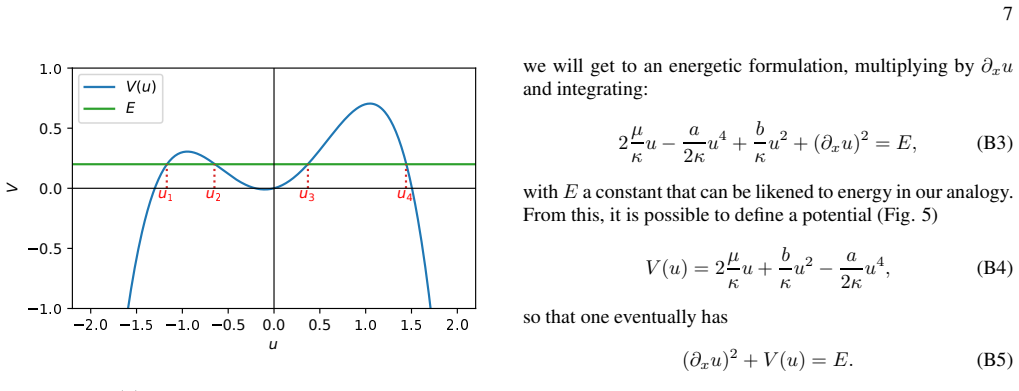
Profile derivation using the chemical potential In this section, we derive stationary profiles of the Cahn- Hilliard equation ∂tc = Λ∂2 x ( a(c − cc)3 − b(c − cc) − κ∂2 xc) ) . (B1) Our approach closely follows the method of Argentina et al. [43]. Accordingly, we will use u = c−cc, and fall in line with the notations of [43]. In this notation the chemical p...
- [6]
-
[7]
(B11) 8 This way, our problem now only depends on κ/a and two among b/a, δ and u1. In the following, we will get back to q-periodic profiles of average c0, and thus replace δ (and the redundant u1) by q and c0. Considering that the period is infinite (i.e. u1 = u2) also implies that the Jacobi elliptic function sn has converged to a hyperbolic tangent (its ...
-
[8]
A. M. Turing, The chemical basis of morphogenesis, Philo soph- ical Transactions of the Royal Society of London. Series B, B i- ological Sciences 237, 37 (1952)
work page 1952
-
[9]
Harmonic amplitude equations In this section, we use the Fourier decomposition of the c profile to compute the stationary Fourier coefficients (i.e. the Fourier coefficients of Eq. (B17)). We define the Fourier co- efficients by c(x) = c0 + 2 ∑ n≥1 cn cos(nqx), (B18) where all cn are real, since we chose the coordinate system such that the profile is even. Thus...
-
[10]
Adiabatic approximation In order to simplify the expressions, and to reduce the di- mension of the space of profiles we consider, we will perform an adiabatic approximation to link ρ and Φ. On the onset of the growth/decay of ρ, Φ evolves with a much faster rate than ρ, hence the following approximation: Φ = V|| r ∂xρ. (D1) This approximation is justified o...
-
[11]
However, now, ρ and Φ are no longer null, and add a new term in Eq
Harmonic development of c Let us reuse the harmonic amplitude equations of Appendix B 2. However, now, ρ and Φ are no longer null, and add a new term in Eq. (B19) and Eq. (B20). In Eq. (B19), this supplemental term reads −kV||n2q2∑ i∈Z∗ ρicn−i. (D2) In order to compare this term with the previous ones, and to perform a similar truncation as in Eq. (B22), ...
-
[12]
J. B. Haldane, On being the right size, Harper’s magazine 152, 424 (1926)
work page 1926
-
[13]
M. B. Ginzberg, R. Kafri, and M. Kirschner, On being the ri ght (cell) size, Science 348, 1245075 (2015)
work page 2015
-
[14]
D. S. Banerjee and S. Banerjee, Design principles and fee dback mechanisms in organelle size control, Current Opinion in Ce ll Biology 95, 102533 (2025)
work page 2025
-
[15]
J. W. Cahn, Phase separation by spinodal decomposition in isotropic systems, The Journal of chemical physics 42, 93 (1965)
work page 1965
-
[16]
D. M. Mitrea and R. W. Kriwacki, Phase separation in biolo gy; functional organization of a higher order, Cell Communicat ion and Signaling 14, 1 (2016)
work page 2016
-
[17]
D. Zwicker, O. W. Paulin, and C. ter Burg, Physics of dropl et regulation in biological cells, arXiv preprint arXiv:2501 .13639 (2025)
work page 2025
-
[18]
C. A. Weber, D. Zwicker, F. J¨ ulicher, and C. F. Lee, Physi cs of active emulsions, Reports on Progress in Physics 82, 064601 (2019)
work page 2019
- [19]
-
[20]
S. Kondo and T. Miura, Reaction-diffusion model as a fram e- work for understanding biological pattern formation, scie nce 329, 1616 (2010)
work page 2010
- [21]
- [22]
-
[23]
F. Bergmann, L. Rapp, and W. Zimmermann, Active phase se p- aration: A universal approach, Physical Review E 98, 020603 (2018)
work page 2018
-
[24]
J. F. Robinson, T. Machon, and T. Speck, Universal limit ing behavior of reaction-diffusion systems with conservation laws, Physical Review E 111, 065417 (2025)
work page 2025
-
[25]
J. W. Cahn and J. E. Hilliard, Free energy of a nonuniform sys- tem. i. interfacial free energy, The Journal of chemical phy sics 28, 258 (1958)
work page 1958
-
[26]
T. Frohoff-H¨ ulsmann, J. Wrembel, and U. Thiele, Suppr ession 14 of coarsening and emergence of oscillatory behavior in a cah n- hilliard model with nonvariational coupling, Physical Review E 103, 042602 (2021)
work page 2021
-
[27]
A. Novick-Cohen, The nonlinear cahn-hilliard equatio n: transi- tion from spinodal decomposition to nucleation behavior, J our- nal of statistical physics 38, 707 (1985)
work page 1985
-
[28]
A. Bray, Coarsening dynamics of phase-separating syst ems, Philosophical Transactions of the Royal Society of London. Se- ries A: Mathematical, Physical and Engineering Sciences 361, 781 (2003)
work page 2003
-
[29]
Ostwald, Lehrbuch der allgemeinen Chemie, V ol
W. Ostwald, Lehrbuch der allgemeinen Chemie, V ol. 1 (W. En- gelmann, 1903)
work page 1903
-
[30]
B. Alberts, J. Wilson, and T. Hunt, Molecular biology of the cell (garland science, new york) (2008)
work page 2008
- [31]
-
[32]
G. Gonnella, D. Marenduzzo, A. Suma, and A. Tiribocchi, Motility-induced phase separation and coarsening in activ e matter, Comptes Rendus. Physique 16, 316 (2015)
work page 2015
-
[33]
D. Zwicker, A. A. Hyman, and F. J¨ ulicher, Suppression o f ostwald ripening in active emulsions, Physical Review E 92, 012317 (2015)
work page 2015
-
[34]
D. Zwicker, The intertwined physics of active chemical reac- tions and phase separation, Current Opinion in Colloid & Int er- face Science 61, 101606 (2022)
work page 2022
-
[35]
H. Garcke, On cahn—hilliard systems with elasticity, P roceed- ings of the Royal Society of Edinburgh Section A: Mathematics 133, 307 (2003)
work page 2003
-
[36]
Finally Ω encodes for the domain over which s crosslinker can connect two filaments
for generalizations. Finally Ω encodes for the domain over which s crosslinker can connect two filaments
-
[37]
N. B. Padhan, K. V . Kiran, and R. Pandit, Novel turbulenc e and coarsening arrest in active-scalar fluids, Soft Matter 20, 3620 (2024)
work page 2024
-
[38]
T. Frohoff-H¨ ulsmann, U. Thiele, and L. M. Pismen, Non- reciprocity induces resonances in a two-field cahn–hilliar d model, Philosophical Transactions of the Royal Society A 381, 20220087 (2023)
work page 2023
-
[39]
L. Mao, H. Lou, Y . Lou, N. Wang, and F. Jin, Behaviour of cyto- plasmic organelles and cytoskeleton during oocyte maturat ion, Reproductive biomedicine online 28, 284 (2014)
work page 2014
-
[40]
P . Chen and D. L. Levy, Regulation of organelle size and o r- ganization during development, in Seminars in cell & develop- mental biology, V ol. 133 (Elsevier, 2023) pp. 53–64
work page 2023
-
[41]
J. S. Langer, Theory of spinodal decomposition in alloy s, An- nals of Physics 65, 53 (1971)
work page 1971
-
[42]
D. J. Needleman, A. Groen, R. Ohi, T. Maresca, L. Mirny, a nd T. Mitchison, Fast microtubule dynamics in meiotic spindle s measured by single molecule imaging: evidence that the spindle environment does not stabilize microtubules, Molecular biology of the cell 21, 323 (2010)
work page 2010
-
[43]
to obtain Eq. (B13). In the following, we use this result to perform integrals, and get back to a periodic profile, rath er than a single bubble. Indeed it is clear, as we supposed an infinite period, that the spatial average of c is no longer c0. Enforcing this condition will enable us to know where to cut the infinite u = u1 tails of this profile, in order ...
-
[44]
M. Fritzsche, A. Lewalle, T. Duke, K. Kruse, and G. Charr as, Analysis of turnover dynamics of the submembranous actin cor- tex, Molecular biology of the cell 24, 757 (2013)
work page 2013
- [45]
-
[46]
B. Kaye, O. Stiehl, P . J. Foster, M. J. Shelley, D. J. Need leman, and S. F¨ urthauer, Measuring and modeling polymer concentra- tion profiles near spindle boundaries argues that spindle mi cro- tubules regulate their own nucleation, New Journal of Physi cs 20, 055012 (2018)
work page 2018
-
[47]
S. F¨ urthauer, B. Lemma, P . J. Foster, S. C. Ems-McClung , C.- H. Y u, C. E. Walczak, Z. Dogic, D. J. Needleman, and M. J. Shelley, Self-straining of actively crosslinked microtub ule net- works, Nature physics 15, 1295 (2019)
work page 2019
-
[48]
S. F¨ urthauer, D. J. Needleman, and M. J. Shelley, A desi gn framework for actively crosslinked filament networks, New Journal of Physics 23, 013012 (2021)
work page 2021
- [49]
-
[50]
V . Ginzburg and L. Landau, Theory of superconductivity , Zh. Eksp. Teor. Fiz.;(USSR) 20 (1950)
work page 1950
-
[51]
K. J. Burns, G. M. V asil, J. S. Oishi, D. Lecoanet, and B. P . Brown, Dedalus: A flexible framework for numerical simu- lations with spectral methods, Physical Review Research 2, 023068 (2020)
work page 2020
-
[52]
Q. Bodini-Lefranc, J. Schindelwig, D. Weidinger, L. En - gleder, and S. F¨ urthauer, Arrested coarsening code, https://gitlab.tuwien.ac.at/sebastian.fuerthauer/arres (2025)
work page 2025
-
[53]
A. Novick-Cohen and L. A. Segel, Nonlinear aspects of th e cahn-hilliard equation, Physica D: Nonlinear Phenomena 10, 277 (1984)
work page 1984
-
[54]
M. Argentina, M. Clerc, R. Rojas, and E. Tirapegui, Coar sening dynamics of the one-dimensional cahn-hilliard model, Phys ical Review E—Statistical, Nonlinear, and Soft Matter Physics 71, 046210 (2005)
work page 2005
-
[55]
M. R. King and S. Petry, Phase separation of tpx2 enhance s and spatially coordinates microtubule nucleation, Nature com muni- cations 11, 270 (2020)
work page 2020
-
[56]
V . T. Yan, A. Narayanan, T. Wiegand, F. J¨ ulicher, and S. W. Grill, A condensate dynamic instability orchestrates acto - myosin cortex activation, Nature 609, 597 (2022)
work page 2022
-
[57]
S. Saha, J. Agudo-Canalejo, and R. Golestanian, Scalar active mixtures: The nonreciprocal cahn-hilliard model, Physica l Re- view X 10, 041009 (2020)
work page 2020
-
[58]
Introduction to Elliptic Functions. By F. Bowman. Pp. 1 15. 12s. 6d. 1953. (English Universities Press)
work page 1953
This paper was first reviewed by deepseek-v4-flash on August 4, 2026.
discussion (0)
Sign in with ORCID, Apple, or X to comment. Anyone can read and Pith papers without signing in.