REVIEW 3 major objections 6 minor 33 references
V-Mem: Modality-Routed Retrieval for Long-Term Multimodal Agentic Memory
T0 review · 3 major / 6 minor · reviewed 2026-08-06 · deepseek-v4-flash
Pith's one-line read V-Mem claims that multimodal agent memory retrieval should be routed by the (query, target) modality pair, relying on conversation rounds and LLM-generated anchors rather than cross-modal similarity, and that this closes the two gaps that b
desk verdict V-Mem is a solid, genuinely novel routing-and-anchor memory system with credible visual gains, but the LoCoMo win rests on an unvalidated judge that its own lexical metrics contradict. read the letter →
The pith
A machine-rendered reading of the paper's core claim, the machinery that carries it, and where it could break.
The reading
What carries the argument
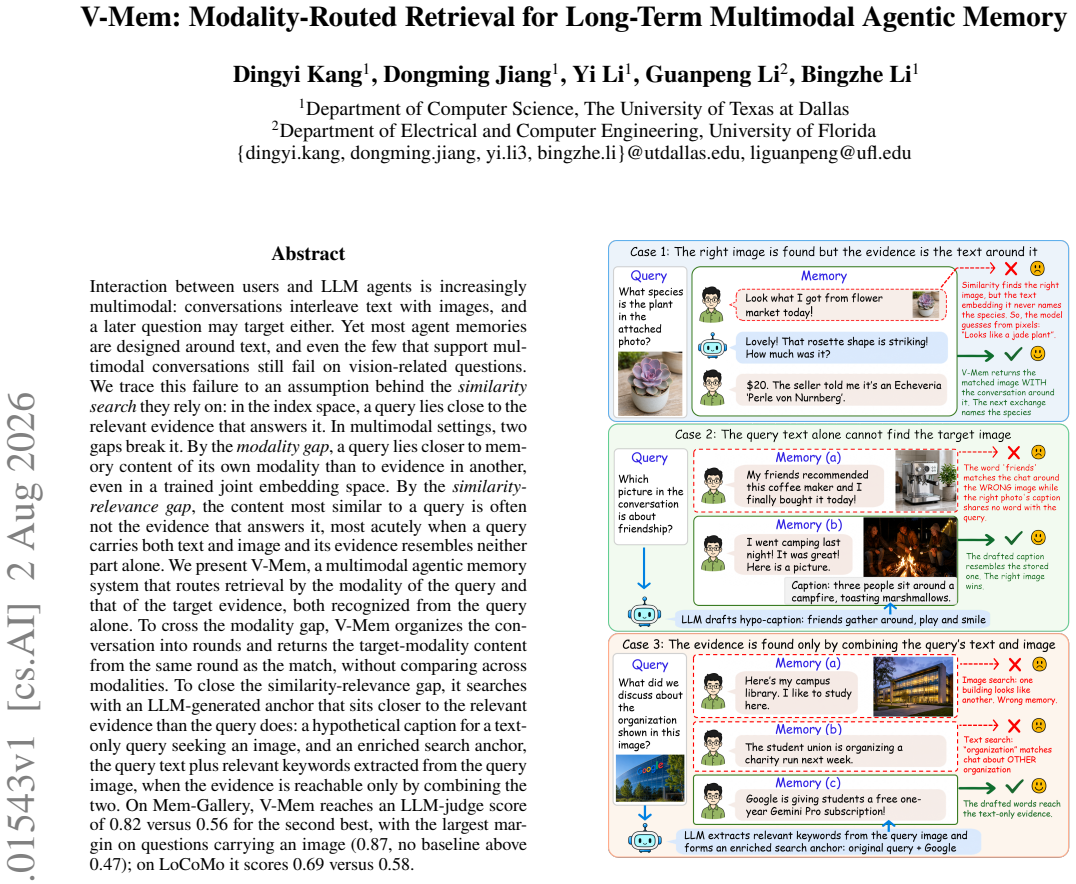
Routed retrieval over four (query, target) modality cases, with two mechanisms: matching through shared rounds (each round is one user-assistant exchange; a same-modality match's round supplies the other-modality evidence, so no cross-modal comparison is needed) and searching with LLM-generated anchors (a hypothetical caption replacing the query for text-to-image, and an enriched anchor—query text plus keywords extracted from the query image—for image-plus-text-to-text). Separate lanes per modality, rank-based fusion by reciprocal rank, and returning each top round with its ±1 neighbors complete the design.
What would settle it
Take a Mem-Gallery dialogue and shuffle memory units across rounds while preserving their embeddings and text, then measure V-Mem's judge score; if accuracy does not drop, round-level binding is not the mechanism. Alternatively, isolate multi-topic rounds (one exchange containing an image about A and text discussion about B) and check whether image+text→text retrieval returns B's text when the query image matches A's image; returning B's text would show the shared-round premise failing.
Extended reading notes
Core claim
The paper claims that the failure of multimodal agent memory is not a missing encoder but an unexamined retrieval assumption: that in the index space a query lies close to the evidence that answers it. In multimodal conversations this fails twice—across modalities (the modality gap) and within or between content types (the similarity-relevance gap). V-Mem replaces uniform similarity search with modality-routed retrieval: it recognizes from the query alone whether the target evidence is text or image, activates only the matching lane, and crosses the modality gap by matching within the query's own modality and returning the target-modality units from the same conversation round as the match.
Load-bearing premise
The load-bearing premise is that units in the same user-assistant round are about the same topic, so returning the target-modality content from the round of a same-modality match reliably recovers the true evidence; if turns are multi-topic, the recovered content can be the wrong thing.
Editorial extensions
If this is right
- Multimodal agent memories can be built with zero LLM tokens: storing every span and image as-is, with the retrieval design doing the work, matches or beats systems that spend millions of tokens on extraction.
- Cross-modal retrieval no longer requires a learned shared embedding space; round co-occurrence binds an image to the text discussed with it.
- A query that carries both text and an image can be answered by enriching the text with keywords visible in the image, reaching evidence that resembles neither part alone.
- Routing by (query, target) modality avoids the distraction of irrelevant lanes, which is why no single uniform fusion of lanes wins across cases.
- The same retrieval stack wins on a text-only benchmark, so multimodal support does not come at the cost of text-centric retrieval.
Reading between the lines
- The paper leaves untested whether the round-binding mechanism extends to audio and video if those modalities are transcribed or captioned into text units; the same co-occurrence premise would seem to carry over.
- If a conversation round mixes unrelated topics, the shared-round premise weakens; an experiment that shuffles or splits units across rounds would isolate exactly how much V-Mem depends on topic-pure rounds.
- The zero-token build makes V-Mem attractive for on-device agents, but answer-time anchor generation still needs a vision LLM; precomputing anchors at build time would trade away the zero-build property for cheaper answers.
- The LLM-judge metric could be complemented by human evaluation, since lexical metrics favor verbose baselines and the judge prefers V-Mem's terse answers, leaving format effects entangled with correctness.
Editorial analysis
A structured set of objections, weighed in public.
Referee Report
Summary. V-Mem addresses long-term multimodal agentic memory. The paper argues that similarity search fails in multimodal settings for two reasons: a modality gap (queries lie closer to same-modality memory content than to cross-modality evidence) and a similarity-relevance gap (the most similar content is not necessarily the evidence that answers the query). The proposed system routes retrieval by the inferred (query, target) modality pair, organizes the conversation into rounds, stores text and images in separate lanes, matches within one modality and returns target-modality content from the same round, and uses LLM-generated anchors (a hypothetical caption for text-to-image, an enriched text anchor with image-derived keywords for image-plus-text to text). Memory construction is extraction-free and uses local encoders. Experiments are run on Mem-Gallery and LoCoMo, with gpt-4o-mini as the judge, lexical metrics in the appendix, budget-fixed ablations, paired bootstrap/permutation tests, cost analysis, and an honest limitations section. The headline reported results are Mem-Gallery 0.825 vs. 0.561 for the best baseline and LoCoMo 0.690 vs. 0.583.
Significance. If the results stand, the paper makes a useful design contribution: it shows that cross-modal gaps in agent memory can be addressed without a learned cross-modal alignment, by round-level binding and generated anchors, and that this can be done with a zero-LLM-token memory build. The experimental work is careful in several respects: the ablation keeps return budgets fixed; the comparisons share backbones, encoders, and judge; significance is tested with paired bootstrap and permutation tests; the paper openly reports that two of the three ablation rungs are not individually significant and that a 7B backbone reverses the ordering. The main Mem-Gallery result is reinforced by lexical metrics, which V-Mem also wins. However, the LoCoMo claim rests entirely on a single unvalidated LLM judge, and the lexical metrics on LoCoMo contradict that judge. The significance is therefore real but conditional: the multimodal contribution is better supported than the text-domain superiority claim.
major comments (3)
- [§4.1/§4.2, Table 10, Appendix G] The LoCoMo superiority claim (0.690 vs. 0.583) rests solely on the gpt-4o-mini judge. Table 10 shows the opposite direction on every lexical metric: V-Mem's LoCoMo F1 is 0.210 vs. Omni's 0.427, BLEU 0.051 vs. 0.147, and EM 0.006 vs. 0.183. The paper's explanation that Omni emits 'longer, gold-style answers' is stated but not independently supported. No human-judged sample, alternative judge, or correlation with human judgments is provided. In the gpt-4o-mini backbone block the same model generates the answers and judges them, which raises a concrete style/length/self-preference risk. This is load-bearing because the claim that V-Mem 'does not give up ground on text-only' is used to argue generality. Please validate the judge on a sampled subset (e.g., 200 questions per benchmark) with human annotations, or report an independent judge, and show agreement between the judge and human correc
- [§3.2–§3.3, Table 3, Appendix I] The largest single ablation gain, +0.129 overall for 'matching through shared rounds' (Table 3, significant at p<10^-4 in Appendix I), depends on the premise stated in §3.2: units co-occurring in one user-assistant exchange 'are likely relevant to one another.' The paper does not provide direct evidence for this premise on the benchmarks, nor a diagnostic for how often rounds are multi-topic. If a round contains unrelated user and assistant statements, the cross-modal return will retrieve the wrong content. Please add a direct test: e.g., human-annotate or automatically measure whether the target-modality content in the same round actually answers the query, or compare against a baseline that groups by fixed temporal windows or embedding-similarity clusters rather than by round. This would also make the mechanism's applicability outside these two benchmarks more convincing.
- [Appendix B, Table 5] The routing design is central, but the exact routing keyword patterns and aggregation trigger terms are deferred to 'released with the code.' This makes it hard to assess whether the result is a general architecture or a set of manually tuned heuristics, especially because the aggregation branch is used only on LoCoMo. Please include the full rule inventory in the appendix and, if feasible, a robustness check by varying or ablating the rules. This is important for reproducibility of the 'no per-dataset tuning' claim.
minor comments (6)
- [Appendix G, Table 9] The provenance note says V-Mem's lexical scores come from the run preceding the enriched anchor, whose overall judge score is 0.820 rather than the 0.825 in Table 1. This inconsistency across tables is confusing and should be reconciled, or the note should be moved closer to Table 9.
- [§4.1, Appendix D] The text says all systems share the same text and image encoders, while Appendix D says encoders are shared 'where a system uses them.' Please clarify for Omni and A-Mem whether they use the same encoders as V-Mem, since this affects the isolation claim.
- [Appendix C] The judge prompt for LoCoMo is cited to prior work and not reproduced. Since the LoCoMo result is contested by the lexical metrics, please reproduce the exact prompt in the appendix rather than only citing it.
- [Algorithm 1] A compact table mapping each of the four routing cases to the active lanes, candidate sets, and anchors would make the procedure easier to verify. The prose and Algorithm 1 are consistent, but a table would reduce the risk of misreading the branches.
- [Appendix H, Table 14] The DINOv2/SigLIP comparison is measured on the pre-enriched-anchor configuration, so the SigLIP column reads 0.820 rather than 0.825. The comparison is internally valid, but it would be cleaner to state the confound explicitly in the table caption.
- [Limitations] The 7B-backbone reversal is disclosed in the limitations section, which is commendable. Consider also stating explicitly in the abstract or introduction that the reported gains assume a sufficiently capable backbone, since this is a strong boundary condition on the headline result.
Circularity Check
No circularity: V-Mem's retrieval decisions are generated from the query and compared on a blind shared judge; the only self-referential element is an evaluation prompt, which is not load-bearing.
full rationale
The paper's derivation chain is not circular. Routed retrieval (Eq. 3) generalizes similarity search (Eq. 2) by choosing lanes, anchors, and return units from the query and from LLM-generated anchors; the anchor prompts (Appendix C) take only the query and attached image, not the memory or the gold answer, so no prediction is fitted to its target. The round-co-occurrence heuristic is an explicit empirical assumption ('units of a round co-occur in one exchange, so they are likely relevant to one another'), not a definition of relevance, and the LLM judge scores against gold references independently of the retrieval mechanism. The only self-referential element is the LoCoMo judge prompt taken from the authors' prior work (Jiang et al. 2026a); this is a minor evaluation self-citation, and the same gpt-4o-mini model serves as both backbone and judge, which is a validity concern. The paper transparently reports that lexical metrics on LoCoMo contradict the judge (Appendix G) and that a weaker backbone reverses the ordering (Appendix E), but these are empirical limitations rather than cases where a result reduces by construction to its inputs. No equation or reported score is defined in terms of V-Mem's own output, so there is no circular step.
Assumptions & free parameters
free parameters (6)
- neighbor window W =
±1
- rank fusion constant κ =
60
- returned rounds k =
12 (30 for LoCoMo aggregation)
- per-signal candidate pool =
20
- image keywords per query =
at most 8
- routing keyword rules =
hand-written patterns
assumptions (5)
- domain assumption Units co-occurring in the same user-assistant round are likely relevant to one another
- domain assumption A keyword rule can reliably infer the target modality from query wording alone
- domain assumption An LLM-generated hypothetical caption lies closer to the target image's caption than the raw text query does
- domain assumption LLM-extracted keywords from the attached image, appended to query text, lie closer to the target evidence than either part alone
- standard math BM25, cosine, and reciprocal rank fusion provide adequate scoring of text and image units
Cite this review
Pith. "Pith review of V-Mem: Modality-Routed Retrieval for Long-Term Multimodal Agentic Memory." pith.science (2026). https://pith.science/paper/2MUDLHAU
@misc{pith2026260801543,
  author       = {Pith},
  title        = {Pith review of: V-Mem: Modality-Routed Retrieval for Long-Term Multimodal Agentic Memory},
  year         = {2026},
  howpublished = {\url{https://pith.science/paper/2MUDLHAU}},
  note         = {Machine review of arXiv:2608.01543}
}
read the original abstract
Interaction between users and LLM agents is increasingly multimodal: conversations interleave text with images, and a later question may target either. Yet most agent memories are designed around text, and even the few that support multimodal conversations still fail on vision-related questions. We trace this failure to an assumption behind the similarity search they rely on: in the index space, a query lies close to the relevant evidence that answers it. In multimodal settings, two gaps break it. By the modality gap, a query lies closer to memory content of its own modality than to evidence in another, even in a trained joint embedding space. By the similarity-relevance gap, the content most similar to a query is often not the evidence that answers it, most acutely when a query carries both text and image and its evidence resembles neither part alone. We present V-Mem, a multimodal agentic memory system that routes retrieval by the modality of the query and that of the target evidence, both recognized from the query alone. To cross the modality gap, V-Mem organizes the conversation into rounds and returns the target-modality content from the same round as the match, without comparing across modalities. To close the similarity-relevance gap, it searches with an LLM-generated anchor that sits closer to the relevant evidence than the query does: a hypothetical caption for a text-only query seeking an image, and an enriched search anchor, the query text plus relevant keywords extracted from the query image, when the evidence is reachable only by combining the two. On Mem-Gallery, V-Mem reaches an LLM-judge score of 0.82 versus 0.56 for the second best, with the largest margin on questions carrying an image (0.87, no baseline above 0.47); on LoCoMo it scores 0.69 versus 0.58.
Figures

Reference graph
Works this paper leans on
-
[1]
and Stoica, Ion and Gonzalez, Joseph E
Packer, Charles and Wooders, Sarah and Lin, Kevin and Fang, Vivian and Patil, Shishir G. and Stoica, Ion and Gonzalez, Joseph E. , howpublished=
-
[2]
Li, Junnan and Li, Dongxu and Xiong, Caiming and Hoi, Steven , booktitle=
-
[3]
Chen, Wenhu and Hu, Hexiang and Chen, Xi and Verga, Pat and Cohen, William W. , booktitle=
-
[4]
Zero-shot Multimodal Document Retrieval via Cross-modal Question Generation , author=
-
[5]
Liu, Jiaqi and Su, Yaofeng and Xia, Peng and Han, Siwei and Zheng, Zeyu and Xie, Cihang and Ding, Mingyu and Yao, Huaxiu , journal=
-
[6]
Jiang, Dongming and Li, Yi and Li, Guanpeng and Li, Bingzhe , journal=
-
[7]
Wang, Yu and Gao, Yifan and Chen, Xiusi and Jiang, Haoming and Li, Shiyang and Yang, Jingfeng and Yin, Qingyu and Li, Zheng and Li, Xian and Yin, Bing and Shang, Jingbo and McAuley, Julian , booktitle=
-
[8]
ACM Transactions on Information Systems , volume=
A Survey on the Memory Mechanism of Large Language Model-based Agents , author=. ACM Transactions on Information Systems , volume=
Show all 33 references
-
[9]
Chen, Baian and Shu, Chang and Shareghi, Ehsan and Collier, Nigel and Narasimhan, Karthik and Yao, Shunyu , howpublished=
-
[10]
Yin, Da and Brahman, Faeze and Ravichander, Abhilasha and Chandu, Khyathi and Chang, Kai-Wei and Choi, Yejin and Lin, Bill Yuchen , booktitle=. Agent
-
[11]
Proceedings of the 62nd Annual Meeting of the Association for Computational Linguistics (ACL) , pages=
Same Task, More Tokens: the Impact of Input Length on the Reasoning Performance of Large Language Models , author=. Proceedings of the 62nd Annual Meeting of the Association for Computational Linguistics (ACL) , pages=
-
[12]
Li, Zhiyu and Song, Shichao and Wang, Hanyu and Niu, Simin and Chen, Ding and Yang, Jiawei and Xi, Chenyang and Lai, Huayi and Zhao, Jihao and Wang, Yezhaohui and others , journal=
-
[13]
Yu, Hongli and Chen, Tinghong and Feng, Jiangtao and Chen, Jiangjie and Dai, Weinan and Yu, Qiying and Zhang, Ya-Qin and Ma, Wei-Ying and Liu, Jingjing and Wang, Mingxuan and Zhou, Hao , journal=
-
[14]
Zhang, Guibin and Fu, Muxin and Yan, Shuicheng , journal=
-
[15]
Advances in Neural Information Processing Systems (NeurIPS) , year=
Mind the Gap: Understanding the Modality Gap in Multi-modal Contrastive Representation Learning , author=. Advances in Neural Information Processing Systems (NeurIPS) , year=
-
[16]
Proceedings of the 61st Annual Meeting of the Association for Computational Linguistics (ACL) , year=
Precise Zero-Shot Dense Retrieval without Relevance Labels , author=. Proceedings of the 61st Annual Meeting of the Association for Computational Linguistics (ACL) , year=
-
[17]
Communications of the ACM , volume=
The Vocabulary Problem in Human-System Communication , author=. Communications of the ACM , volume=
-
[18]
Liu, Jiaqi and Ling, Zipeng and Qiu, Shi and Liu, Yanqing and Han, Siwei and Xia, Peng and Tu, Haoqin and Zheng, Zeyu and Xie, Cihang and Fleming, Charles and Ding, Mingyu and Yao, Huaxiu , journal=
-
[19]
Feng, Junyu and Xu, Binxiao and Chen, Jiayi and Dai, Mengyu and Wu, Cenyang and Li, Haodong and Zeng, Bohan and Xie, Yunliu and Liang, Hao and Lu, Ming and Zhang, Wentao , journal=
-
[20]
Liu, Junming and Sun, Yifei and Cheng, Weihua and Lei, Haodong and Chen, Yirong and Wen, Licheng and Yang, Xuemeng and Fu, Daocheng and Cai, Pinlong and Deng, Nianchen and Yu, Yi and Hu, Shuyue and Shi, Botian and Wang, Ding , journal=
-
[21]
arXiv preprint arXiv:2502.12110 , year=
A-Mem: Agentic Memory for LLM Agents , author=. arXiv preprint arXiv:2502.12110 , year=
-
[22]
Proceedings of the 62nd Annual Meeting of the Association for Computational Linguistics (ACL) , year=
Evaluating Very Long-Term Conversational Memory of LLM Agents , author=. Proceedings of the 62nd Annual Meeting of the Association for Computational Linguistics (ACL) , year=
-
[23]
Proceedings of the IEEE/CVF International Conference on Computer Vision (ICCV) , year=
Sigmoid Loss for Language Image Pre-Training , author=. Proceedings of the IEEE/CVF International Conference on Computer Vision (ICCV) , year=
-
[24]
Proceedings of the 2019 Conference on Empirical Methods in Natural Language Processing (EMNLP) , year=
Sentence-BERT: Sentence Embeddings using Siamese BERT-Networks , author=. Proceedings of the 2019 Conference on Empirical Methods in Natural Language Processing (EMNLP) , year=
2019
-
[25]
Foundations and Trends in Information Retrieval , volume=
The Probabilistic Relevance Framework: BM25 and Beyond , author=. Foundations and Trends in Information Retrieval , volume=
-
[26]
Proceedings of the 32nd International ACM SIGIR Conference , year=
Reciprocal Rank Fusion Outperforms Condorcet and Individual Rank Learning Methods , author=. Proceedings of the 32nd International ACM SIGIR Conference , year=
-
[27]
Proceedings of the 38th International Conference on Machine Learning (ICML) , year=
Learning Transferable Visual Models from Natural Language Supervision , author=. Proceedings of the 38th International Conference on Machine Learning (ICML) , year=
-
[28]
Bei, Yuanchen and Wei, Tianxin and Ning, Xuying and Zhao, Yanjun and Liu, Zhining and Lin, Xiao and Zhu, Yada and Hamann, Hendrik and He, Jingrui and Tong, Hanghang , journal=
-
[29]
Yao, Shunyu and Zhao, Jeffrey and Yu, Dian and Du, Nan and Shafran, Izhak and Narasimhan, Karthik and Cao, Yuan , booktitle=
-
[30]
Achiam, Josh and others , howpublished=
-
[31]
Transactions of the Association for Computational Linguistics , volume=
Lost in the Middle: How Language Models Use Long Contexts , author=. Transactions of the Association for Computational Linguistics , volume=
-
[32]
Jiang, Dongming and Li, Yi and Li, Guanpeng and Li, Qiannan and Li, Bingzhe , journal=
-
[33]
arXiv preprint arXiv:2602.19320 , year=
Anatomy of Agentic Memory: Taxonomy and Empirical Analysis of Evaluation and System Limitations , author=. arXiv preprint arXiv:2602.19320 , year=
Reviewed August 6, 2026 · model on record in the stance chip above.
Discussion (0). Sign in to comment.