REVIEW 3 major objections 5 minor 5 cited by
Unbinned machine-learning inference beats binned histograms when four LHC diboson channels are combined to constrain six SMEFT Wilson coefficients.
Reviewed by Pith at T0; open to challenge. T0 means a machine referee read the full paper against a public rubric. the ladder, T0–T4 →
T0 review · deepseek-v4-flash
2026-08-05 05:23 UTC pith:2NBDQERD
load-bearing objection Competent first global SBI-vs-histogram SMEFT comparison; the factor-of-two headline is conditional on a deliberately coarse baseline, so the direction likely survives but the magnitude is the open question. the 3 major comments →
Unbinning global LHC analyses
The pith
A machine-rendered reading of the paper's core claim, the machinery that carries it, and where it could break.
Core claim
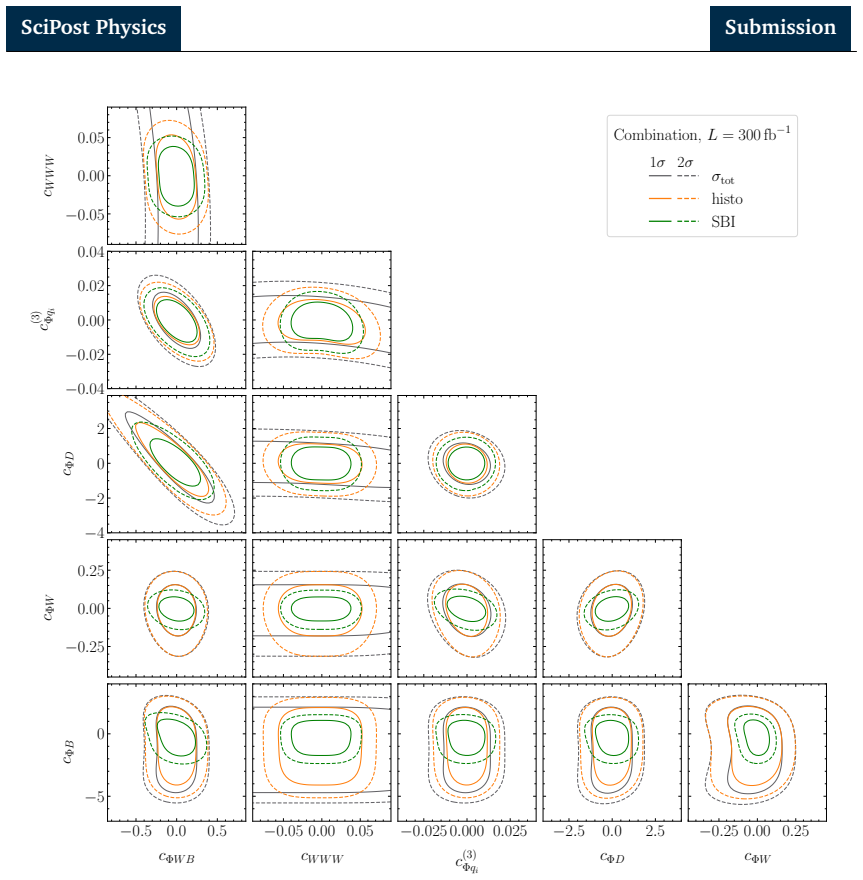
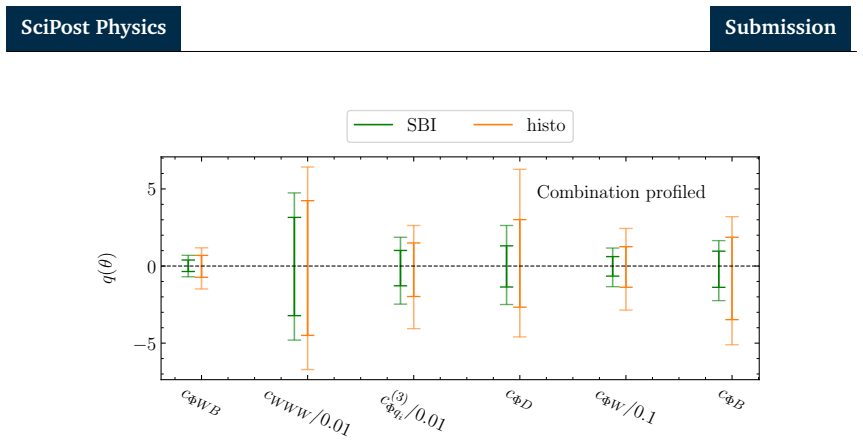
Working at 13.6 TeV with a simplified detector simulation, the paper derives expected exclusion limits on six Wilson coefficients from four diboson processes. It finds that SBI consistently outperforms histograms built from standard experimental observables and binnings: in profiled one-dimensional combined limits, the SBI constraints are roughly a factor of two stronger for coefficients to which the chosen histograms are only indirectly sensitive, and about 30% stronger even for coefficients that the histogram observables directly probe. The advantage is traced to SBI's use of the full phase space, in particular its sensitivity to Z-boson polarization, which breaks degeneracies that the tra
What carries the argument
The central mechanism is 'derivative learning': because the SMEFT squared matrix element is a quadratic polynomial in the Wilson coefficients, the likelihood ratio can be expanded as a second-order polynomial whose coefficient functions R_i and R_ij depend only on event kinematics. Neural networks are trained to regress these coefficient functions from parton-level ratios, yielding an unbinned estimate of the reconstruction-level likelihood ratio. Backgrounds are incorporated through a signal–background classifier, and the per-process log-likelihood-ratio test statistics are then summed to form a combined test statistic for the global fit.
Load-bearing premise
The comparison assumes that the binnings taken from existing experiments and the neglect of systematic uncertainties are representative of real LHC analyses; if better binnings or realistic systematics are used, the reported factor-of-two gain may shrink.
What would settle it
Repeat the same four-channel, six-operator combination with histogram observables optimized per operator, such as polarization-sensitive angular variables, and with correlated systematic uncertainties folded in. If the SBI limits are no longer roughly twice as strong as the histogram limits, the paper's central quantitative claim fails. A quicker check is whether the SBI advantage persists when the background classifier is replaced by a different background-modeling treatment.
If this is right
- A global SMEFT fit built on SBI would set stronger limits on electroweak and Higgs–gauge operators than the same fit built on rate or binned differential measurements.
- Operators that are degenerate in low-dimensional histograms—especially those distinguished by gauge-boson polarization—become individually constrainable once full event information is used.
- The expected gain corresponds to roughly a factor of four in integrated luminosity for the most degenerate coefficients, so unbinned inference can substitute for additional data in a histogram-based analysis.
- Combining channels does not erase the SBI advantage; the improvement persists after profiling over all other Wilson coefficients.
- The gain is not limited to one high-profile process: the method transfers to a multi-process, multi-parameter global analysis.
- The reported quantitative gains assume no systematic uncertainties and use unoptimized binnings, so they represent the kinematic-information gain under idealized conditions.
Where Pith is reading between the lines
- Because the paper deliberately used standard, unoptimized binnings, a fair next test would compare SBI against histograms built from polarization-sensitive observables or per-operator optimized binnings; such a test would reveal how much of the factor-of-two gap is intrinsic to unbinned inference versus an artifact of binning choice.
- If realistic correlated systematic uncertainties were included, the ranking could shift: rate systematics affect both methods equally, but shape systematics and limited Monte Carlo statistics may degrade histograms more, potentially enlarging the SBI advantage—or, conversely, shrinking it if the learned likelihoods inherit simulation inaccuracies.
- The same derivative-learning combination strategy should extend to more processes, such as vector-boson fusion or gluon-fusion Higgs production, and to the full SMEFT operator set, where degeneracies are even more severe; the paper's architecture appears ready for that scaling.
- A concrete cross-check would be to reproduce the combined SBI limits with an independent unbinned method, such as the matrix-element method or a different likelihood-ratio estimator, to confirm that the reported limits are not sensitive to the specific neural-network training choices.
Editorial analysis
A structured set of objections, weighed in public.
Referee Report
Summary. The paper compares simulation-based inference (SBI), implemented via the derivative-learning likelihood-ratio method, with traditional histogram-based inference for SMEFT constraints in a combined analysis of WW, WZ, WH, and ZH production at the LHC. Six dimension-six Wilson coefficients are considered. Expected limits at 300 fb^-1 are derived using parton-level reference limits, total-rate limits, one-dimensional histograms based on standard experimental/STXS binnings, and unbinned SBI. The central result is that SBI yields significantly stronger expected limits than the histogram approach, with factor-of-two improvements in several profiled directions (Fig. 11), corresponding to a claimed factor of roughly four in effective luminosity. The paper includes coverage checks of the learned likelihoods, uses fractional smearing to control high-weight events, and includes backgrounds for the Higgs-associated channels.
Significance. If the quantitative claim holds, the paper is a useful step toward global SMEFT interpretations with unbinned inference, and it demonstrates an interesting multi-process combination rather than a single-channel proof of principle. The strength is that the SBI likelihood ratios are derived from theory matrix elements and checked against parton-level ratios and coverage curves, so the comparison is not circular. The method is technically credible. However, the headline comparison is made against deliberately coarse histogram baselines and neglects systematic uncertainties and several backgrounds. These are acknowledged limitations, but they directly affect the magnitude of the claimed SBI advantage, so the significance as stated is somewhat narrower than the abstract/conclusion suggests.
major comments (3)
- [Sec. 3.2 (Histogram observables) and Sec. 4.2 (Fig. 11)] The central quantitative claim—SBI limits a factor ~2 stronger, equivalent to ~4x more luminosity—is measured against a deliberately unoptimized histogram baseline. The authors state that 'the choice of observables and binnings can be improved... we deliberately adopt the standard STXS binning.' The histograms are one-dimensional (pT^l1, mT^WZ, pT^V), while real diboson analyses use multiple observables, control regions, and optimized discriminants. Since the abstract and conclusion claim that 'SBI clearly outperforms histogram-based methods,' the factor-of-two statement is not established for a competitive histogram baseline. The paper should either benchmark against an optimized histogram approach (e.g., 2D binnings or a binned classifier discriminant) or qualify the claim to comparison with existing standard experimental binnings.
- [Sec. 3.2 (Event generation)] Systematic uncertainties are neglected, with the expectation that 'systematics to degrade the histogram limits more than the SBI limits,' but no demonstration is provided. All expected limits in Figs. 1–11 are pure-statistical. In realistic LHC diboson analyses, normalization and shape systematics are often comparable to statistical power, and they can reduce the advantage of unbinned methods, especially for operators where sensitivity is dominated by rate information. A stylized systematic model, or an explicit restriction of the conclusions to statistical-only limits, is needed to support the quantitative improvement claim.
- [Sec. 3.2 (Pre-selection cuts and backgrounds)] For WW and WZ, the dominant backgrounds (di-top for WW; Z+jets, Zgamma, ttbar for WZ, ~20–35% of the signal region) are omitted, with the justification that the two methods should be affected similarly. This is a plausibility argument rather than a demonstrated equivalence. Backgrounds enter both the Poisson rate term and the signal–background classifier, so omitting them could change the relative performance of SBI and histograms, particularly for rate-sensitive operators. Including these backgrounds or showing numerically that the ranking is unchanged would remove this uncertainty.
minor comments (5)
- [Title/Abstract] The term 'global LHC analyses' overstates the scope: the analysis combines four diboson processes and a subset of six operators, with no systematic uncertainties. Consider 'multi-process' or 'a global analysis of the electroweak/Higgs diboson sector' for precision.
- [Fig. 10 caption and Sec. 4.1] The caption states that parton-level limits are compared in the combined result, but Sec. 4.1 explicitly says parton-level bounds are not shown for WH (and none are shown for ZH). Clarify how the combined parton-level curve is obtained, or remove it from Fig. 10 to avoid an apparent inconsistency.
- [Fig. 7 caption] The phrase 'small central ellipsis' is confusing; 'ellipsis' should be 'ellipse.' Also clarify that the expected SM point is included in the 1-sigma region and what exactly the small ellipse represents.
- [Appendix B] Typos: 'emperical' should be 'empirical' and 'slighlty' should be 'slightly'.
- [Sec. 3.2 (Histogram observables)] For WW and WZ the histogram limits are shown without backgrounds, consistent with the SBI setup, but this should be stated in the table/caption so that the comparison is not misinterpreted as including full experimental backgrounds in either method.
Circularity Check
No significant circularity: SBI limits are derived from matrix-element-based likelihood ratios and compared against independent histograms; the few self-citations are method provenance, not load-bearing.
full rationale
The central derivation chain is self-contained. The likelihood ratio r(x|theta,theta0) is defined from the differential cross-section (Eqs. 1-7), and the network regresses the parton-level derivatives R_i and R_ij (Eq. 9) which are computed from SMEFT matrix elements, not from the reported limits. The expected limits in Sec. 4 are obtained by plugging these learned ratios into a full Poisson + kinematic likelihood (Eqs. 20-23) and a Wilks-based test statistic; no parameter is fitted to the quantity being predicted. The comparison in Fig. 11 uses the same simulated events and the same rate information for SBI and histograms, with histograms defined in Tab. 4. The paper's self-citations (Refs. [14] and [16]) supply the derivative-learning algorithm and fractional-smearing stabilization, but the physics conclusion ('SBI clearly outperforms histogram-based methods') is not inferred from those citations; it emerges from the independent limit-setting calculation, and the learned likelihoods are cross-checked with coverage curves (App. B) and parton-level references. The acknowledged choice of standard, non-optimized STXS binnings ('We deliberately adopt the standard STXS binning...') could make the histogram baseline weaker than a fully optimized one, but this is a baseline-choice/correctness concern, not circularity: the SBI result is not defined in terms of that histogram or vice versa. No step reduces by construction to its own input.
Axiom & Free-Parameter Ledger
axioms (6)
- domain assumption SMEFT Lagrangian truncated at dimension six, neglecting CP and flavor violation
- domain assumption Interference between signal and background is negligible (different initial/final states or small Higgs width)
- domain assumption Backgrounds for WW and WZ are omitted because they are expected to affect SBI and histograms similarly
- domain assumption Systematic uncertainties are neglected
- domain assumption NLO corrections are approximated by flat K-factors
- domain assumption The four processes are treated as uncorrelated in the combined likelihood
Cite this review
Pith. "Pith review of Unbinning global LHC analyses." pith.science (2026). https://pith.science/paper/2NBDQERD
@misc{pith2026250905409,
  author       = {Pith},
  title        = {Pith review of: Unbinning global LHC analyses},
  year         = {2026},
  howpublished = {\url{https://pith.science/paper/2NBDQERD}},
  note         = {Machine review of arXiv:2509.05409}
}
read the original abstract
Simulation-based inference has been shown to outperform traditional, histogram-based inference in numerous phenomenological and experimental studies. So far, these analyses have focused on individual high-profile processes. We study the combination of four different di-boson processes in terms of the Standard Model Effective Field Theory. Our results demonstrate how simulation-based inference also wins over traditional methods for global LHC analyses.
Figures




Forward citations
Cited by 5 Pith papers
-
Neural Control Variates at LO and NLO
Signed neural control variates from normalizing flows, combined with neural importance sampling, reduce weight ranges and negative weights for LO and NLO phase-space integration and event generation.
-
One Generator, Any Process: LLM-Conditioning for the LHC
LLM embeddings condition generative networks for LHC events, yielding faster convergence, higher quality, and generalization to unseen processes.
-
Agentic Re-Casting using Agentic Re-Simulations
An agentic AI system with a physicist in the loop re-casts an ATLAS ttZ measurement into a global top-quark SMEFT fit and recovers injected coloron Wilson coefficients in a repeatable benchmark.
-
One Generator, Any Process: LLM-Conditioning for the LHC
LLM embeddings condition a generative transformer to enable faster convergence, better performance, and generalization to unseen LHC processes using a single model.
-
Matrix element method at NLO: A fine proof of concept in POWHEG
Proof-of-concept for NLO matrix element method via POWHEG projections applied to fully leptonic WW production in SMEFT, demonstrating near-optimal classification of BSM versus SM events using lepton correlations.
Reference graph
Works this paper leans on
-
[1]
S. Badger et al. , Machine learning and LHC event generation , http://dx.doi.org/10.21468/SciPostPhys.14.4.079 SciPost Phys. 14 (2023) 4, 079 , http://arxiv.org/abs/2203.07460 arXiv:2203.07460 [hep-ph]
Pith/arXiv arXiv 2023
-
[2]
T. Plehn, A. Butter, B. Dillon, T. Heimel, C. Krause, and R. Winterhalder, Modern Machine Learning for LHC Physicists , http://arxiv.org/abs/2211.01421 arXiv:2211.01421 [hep-ph]
-
[3]
K. Cranmer, J. Brehmer, and G. Louppe, The frontier of simulation-based inference , http://dx.doi.org/10.1073/pnas.1912789117 Proc. Nat. Acad. Sci. 117 (2020) 48, 30055 , http://arxiv.org/abs/1911.01429 arXiv:1911.01429 [stat.ML]
Pith/arXiv arXiv 2020
-
[4]
A. Butter, T. Heimel, T. Martini, S. Peitzsch, and T. Plehn, Two invertible networks for the matrix element method , http://dx.doi.org/10.21468/SciPostPhys.15.3.094 SciPost Phys. 15 (2023) 3, 094 , http://arxiv.org/abs/2210.00019 arXiv:2210.00019 [hep-ph]
Pith/arXiv arXiv 2023
-
[5]
T. Heimel, N. Huetsch, R. Winterhalder, T. Plehn, and A. Butter, Precision-Machine Learning for the Matrix Element Method , http://arxiv.org/abs/2310.07752 arXiv:2310.07752 [hep-ph]
-
[6]
J. Brehmer, K. Cranmer, G. Louppe, and J. Pavez, A Guide to Constraining Effective Field Theories with Machine Learning , http://dx.doi.org/10.1103/PhysRevD.98.052004 Phys. Rev. D 98 (2018) 5, 052004 , http://arxiv.org/abs/1805.00020 arXiv:1805.00020 [hep-ph]
Pith/arXiv arXiv 2018
-
[7]
J. Brehmer, K. Cranmer, G. Louppe, and J. Pavez, Constraining Effective Field Theories with Machine Learning , http://dx.doi.org/10.1103/PhysRevLett.121.111801 Phys. Rev. Lett. 121 (2018) 11, 111801 , http://arxiv.org/abs/1805.00013 arXiv:1805.00013 [hep-ph]
Pith/arXiv arXiv 2018
-
[8]
J. Brehmer, G. Louppe, J. Pavez, and K. Cranmer, Mining gold from implicit models to improve likelihood-free inference , http://dx.doi.org/10.1073/pnas.1915980117 Proc. Nat. Acad. Sci. 117 (2020) 10, 5242 , http://arxiv.org/abs/1805.12244 arXiv:1805.12244 [stat.ML]
Pith/arXiv arXiv 2020
-
[9]
J. Brehmer, F. Kling, I. Espejo, and K. Cranmer, MadMiner: Machine learning-based inference for particle physics , http://dx.doi.org/10.1007/s41781-020-0035-2 Comput. Softw. Big Sci. 4 (2020) 1, 3 , http://arxiv.org/abs/1907.10621 arXiv:1907.10621 [hep-ph]
Pith/arXiv arXiv 2020
-
[10]
S. Chatterjee, N. Frohner, L. Lechner, R. Sch \"o fbeck, and D. Schwarz, Tree boosting for learning EFT parameters , http://dx.doi.org/10.1016/j.cpc.2022.108385 Comput. Phys. Commun. 277 (2022) 108385 , http://arxiv.org/abs/2107.10859 arXiv:2107.10859 [hep-ph]
-
[11]
S. Chatterjee, S. Rohshap, R. Sch \"o fbeck, and D. Schwarz, Learning the EFT likelihood with tree boosting , http://arxiv.org/abs/2205.12976 arXiv:2205.12976 [hep-ph]
-
[12]
K. Kong, K. T. Matchev, S. Mrenna, and P. Shyamsundar, New Machine Learning Techniques for Simulation-Based Inference: InferoStatic Nets, Kernel Score Estimation, and Kernel Likelihood Ratio Estimation , http://arxiv.org/abs/2210.01680 arXiv:2210.01680 [stat.ML]
work page internal anchor Pith review Pith/arXiv arXiv
-
[13]
R. Sch \"o fbeck, Refinable modeling for unbinned SMEFT analyses , http://dx.doi.org/10.1088/2632-2153/ad9fd1 Mach. Learn. Sci. Tech. 6 (2025) 1, 015007 , http://arxiv.org/abs/2406.19076 arXiv:2406.19076 [hep-ph]
Pith/arXiv arXiv 2025
-
[14]
H. Bahl, V. Bres\'o, G. De Crescenzo, and T. Plehn, Advancing Tools for Simulation-Based Inference , http://arxiv.org/abs/2410.07315 arXiv:2410.07315 [hep-ph]
- [15]
-
[16]
Benchmarking simplified template cross sections in $WH$ production
J. Brehmer, S. Dawson, S. Homiller, F. Kling, and T. Plehn, Benchmarking simplified template cross sections in WH production , http://dx.doi.org/10.1007/JHEP11(2019)034 JHEP 11 (2019) 034 , http://arxiv.org/abs/1908.06980 arXiv:1908.06980 [hep-ph]
work page internal anchor Pith review Pith/arXiv arXiv 2019
-
[17]
R. K. Barman, D. Gon c alves, and F. Kling, Machine learning the Higgs boson-top quark CP phase , http://dx.doi.org/10.1103/PhysRevD.105.035023 Phys. Rev. D 105 (2022) 3, 035023 , http://arxiv.org/abs/2110.07635 arXiv:2110.07635 [hep-ph]
Pith/arXiv arXiv 2022
-
[18]
H. Bahl and S. Brass, Constraining CP -violation in the Higgs-top-quark interaction using machine-learning-based inference , http://dx.doi.org/10.1007/JHEP03(2022)017 JHEP 03 (2022) 017 , http://arxiv.org/abs/2110.10177 arXiv:2110.10177 [hep-ph]
Pith/arXiv arXiv 2022
-
[19]
R. Gomez Ambrosio, J. ter Hoeve, M. Madigan, J. Rojo, and V. Sanz, Unbinned multivariate observables for global SMEFT analyses from machine learning , http://dx.doi.org/10.1007/JHEP03(2023)033 JHEP 03 (2023) 033 , http://arxiv.org/abs/2211.02058 arXiv:2211.02058 [hep-ph]
Pith/arXiv arXiv 2023
-
[20]
R. Barru \'e , P. Conde-Mu \' \ n o, V. Dao, and R. Santos, Simulation-based inference in the search for CP violation in leptonic WH production , http://dx.doi.org/10.1007/JHEP04(2024)014 JHEP 04 (2024) 014 , http://arxiv.org/abs/2308.02882 arXiv:2308.02882 [hep-ph]
Pith/arXiv arXiv 2024
-
[21]
R. Mastandrea, B. Nachman, and T. Plehn, Constraining the Higgs potential with neural simulation-based inference for di-Higgs production , http://dx.doi.org/10.1103/PhysRevD.110.056004 Phys. Rev. D 110 (2024) 5, 056004 , http://arxiv.org/abs/2405.15847 arXiv:2405.15847 [hep-ph]
Pith/arXiv arXiv 2024
-
[22]
A. Ghosh, M. Griese, U. Haisch, and T. H. Park, Neural simulation-based inference of the Higgs trilinear self-coupling via off-shell Higgs production , http://arxiv.org/abs/2507.02032 arXiv:2507.02032 [hep-ph]
- [23]
-
[24]
ATLAS, G. Aad et al. , Measurement of off-shell Higgs boson production in the H^* ZZ 4 decay channel using a neural simulation-based inference technique in 13 \, TeV pp collisions with the ATLAS detector , http://dx.doi.org/10.1088/1361-6633/adcd9a Rept. Prog. Phys. 88 (2025) 5, 057803 , http://arxiv.org/abs/2412.01548 arXiv:2412.01548 [hep-ex]
Pith/arXiv arXiv 2025
-
[25]
C. Degrande, N. Greiner, W. Kilian, O. Mattelaer, H. Mebane, T. Stelzer, S. Willenbrock, and C. Zhang, Effective Field Theory: A Modern Approach to Anomalous Couplings , http://dx.doi.org/10.1016/j.aop.2013.04.016 Annals Phys. 335 (2013) 21 , http://arxiv.org/abs/1205.4231 arXiv:1205.4231 [hep-ph]
Pith/arXiv arXiv 2013
-
[26]
I. Brivio and M. Trott, The Standard Model as an Effective Field Theory , http://dx.doi.org/10.1016/j.physrep.2018.11.002 Phys. Rept. 793 (2019) 1 , http://arxiv.org/abs/1706.08945 arXiv:1706.08945 [hep-ph]
Pith/arXiv arXiv 2018
-
[27]
A. Butter, O. J. P. \'Eboli, J. Gonzalez-Fraile, M. C. Gonzalez-Garcia, T. Plehn, and M. Rauch, The Gauge-Higgs Legacy of the LHC Run I , http://dx.doi.org/10.1007/JHEP07(2016)152 JHEP 07 (2016) 152 , http://arxiv.org/abs/1604.03105 arXiv:1604.03105 [hep-ph]
Pith/arXiv arXiv 2016
-
[28]
E. da Silva Almeida, A. Alves, N. Rosa Agostinho, O. J. P. \'E boli, and M. C. Gonzalez-Garcia, Electroweak Sector Under Scrutiny: A Combined Analysis of LHC and Electroweak Precision Data , http://dx.doi.org/10.1103/PhysRevD.99.033001 Phys. Rev. D 99 (2019) 3, 033001 , http://arxiv.org/abs/1812.01009 arXiv:1812.01009 [hep-ph]
Pith/arXiv arXiv 2019
-
[29]
A. Biek\"otter, T. Corbett, and T. Plehn, The Gauge-Higgs Legacy of the LHC Run II , http://dx.doi.org/10.21468/SciPostPhys.6.6.064 SciPost Phys. 6 (2019) 6, 064 , http://arxiv.org/abs/1812.07587 arXiv:1812.07587 [hep-ph]
Pith/arXiv arXiv 2019
-
[30]
J. Ellis, C. W. Murphy, V. Sanz, and T. You, Updated Global SMEFT Fit to Higgs, Diboson and Electroweak Data , http://dx.doi.org/10.1007/JHEP06(2018)146 JHEP 06 (2018) 146 , http://arxiv.org/abs/1803.03252 arXiv:1803.03252 [hep-ph]
Pith/arXiv arXiv 2018
-
[31]
E. d. S. Almeida, A. Alves, O. J. P. \'E boli, and M. C. Gonzalez-Garcia, Electroweak legacy of the LHC run II , http://dx.doi.org/10.1103/PhysRevD.105.013006 Phys. Rev. D 105 (2022) 1, 013006 , http://arxiv.org/abs/2108.04828 arXiv:2108.04828 [hep-ph]
Pith/arXiv arXiv 2022
-
[32]
T. Giani, G. Magni, and J. Rojo, SMEFiT: a flexible toolbox for global interpretations of particle physics data with effective field theories , http://dx.doi.org/10.1140/epjc/s10052-023-11534-7 Eur. Phys. J. C 83 (2023) 5, 393 , http://arxiv.org/abs/2302.06660 arXiv:2302.06660 [hep-ph]
Pith/arXiv arXiv 2023
-
[33]
N. Elmer, M. Madigan, T. Plehn, and N. Schmal, Staying on Top of SMEFT-Likelihood Analyses , http://dx.doi.org/10.21468/SciPostPhys.18.3.108 SciPost Phys. 18 (2025) 108 , http://arxiv.org/abs/2312.12502 arXiv:2312.12502 [hep-ph]
Pith/arXiv arXiv 2025
-
[34]
Profile Likelihoods on ML-Steroids
T. Heimel, T. Plehn, and N. Schmal, Profile Likelihoods on ML-Steroids , http://arxiv.org/abs/2411.00942 arXiv:2411.00942 [hep-ph]
work page internal anchor Pith review Pith/arXiv arXiv
-
[35]
J. de Blas, A. Goncalves, V. Miralles, L. Reina, L. Silvestrini, and M. Valli, Constraining new physics effective interactions via a global fit of electroweak, Drell-Yan, Higgs, top, and flavour observables , http://arxiv.org/abs/2507.06191 arXiv:2507.06191 [hep-ph]
-
[36]
I. Brivio, S. Bruggisser, N. Elmer, E. Geoffray, M. Luchmann, and T. Plehn, To profile or to marginalize - A SMEFT case study , http://dx.doi.org/10.21468/SciPostPhys.16.1.035 SciPost Phys. 16 (2024) 1, 035 , http://arxiv.org/abs/2208.08454 arXiv:2208.08454 [hep-ph]
Pith/arXiv arXiv 2024
-
[37]
K. Cranmer, J. Pavez, and G. Louppe, Approximating Likelihood Ratios with Calibrated Discriminative Classifiers , http://arxiv.org/abs/1506.02169 arXiv:1506.02169 [stat.AP]
-
[38]
M. Arratia et al. , Publishing unbinned differential cross section results , http://dx.doi.org/10.1088/1748-0221/17/01/P01024 JINST 17 (2022) 01, P01024 , http://arxiv.org/abs/2109.13243 arXiv:2109.13243 [hep-ph]
Pith/arXiv arXiv 2022
-
[39]
ATLAS, M. Aaboud et al. , Measurement of fiducial and differential W^+W^- production cross-sections at s =13 TeV with the ATLAS detector , http://dx.doi.org/10.1140/epjc/s10052-019-7371-6 Eur. Phys. J. C 79 (2019) 10, 884 , http://arxiv.org/abs/1905.04242 arXiv:1905.04242 [hep-ex]
Pith/arXiv arXiv 2019
-
[40]
ATLAS, M. Aaboud et al. , Measurement of W^ Z production cross sections and gauge boson polarisation in pp collisions at s = 13 TeV with the ATLAS detector , http://dx.doi.org/10.1140/epjc/s10052-019-7027-6 Eur. Phys. J. C 79 (2019) 6, 535 , http://arxiv.org/abs/1902.05759 arXiv:1902.05759 [hep-ex]
Pith/arXiv arXiv 2019
- [41]
-
[42]
ATLAS, G. Aad et al. , Measurements of Higgs boson production by gluon-gluon fusion and vector-boson fusion using H W W^* e decays in pp collisions at s =13 TeV with the ATLAS detector , http://dx.doi.org/10.1103/PhysRevD.108.032005 Phys. Rev. D 108 (2023) 032005 , http://arxiv.org/abs/2207.00338 arXiv:2207.00338 [hep-ex]
Pith/arXiv arXiv 2023
-
[43]
CMS, A. M. Sirunyan et al. , Search for a heavy vector resonance decaying to a Z _ ^ boson and a Higgs boson in proton-proton collisions at s = 13\, Te V , http://dx.doi.org/10.1140/epjc/s10052-021-09348-6 Eur. Phys. J. C 81 (2021) 8, 688 , http://arxiv.org/abs/2102.08198 arXiv:2102.08198 [hep-ex]
work page internal anchor Pith review Pith/arXiv arXiv 2021
-
[44]
LHC Higgs Cross Section Working Group, D. de Florian et al. , Handbook of LHC Higgs Cross Sections: 4. Deciphering the Nature of the Higgs Sector , http://arxiv.org/abs/1610.07922 arXiv:1610.07922 [hep-ph]
-
[45]
J. R. Andersen et al. , Les Houches 2015: Physics at TeV Colliders Standard Model Working Group Report , in 9th Les Houches Workshop on Physics at TeV Colliders . 5, 2016. http://arxiv.org/abs/1605.04692 arXiv:1605.04692 [hep-ph]
Pith/arXiv arXiv 2015
-
[46]
N. Berger et al. , Simplified Template Cross Sections -- Stage 1.1 and 1.2 , http://arxiv.org/abs/1906.02754 arXiv:1906.02754 [hep-ph]
arXiv 1906
-
[47]
S. Amoroso et al. , Les Houches 2019: Physics at TeV Colliders: Standard Model Working Group Report , in 11th Les Houches Workshop on Physics at TeV Colliders : PhysTeV Les Houches . 3, 2020. http://arxiv.org/abs/2003.01700 arXiv:2003.01700 [hep-ph]
Pith/arXiv arXiv 2019
-
[48]
J. Alwall, M. Herquet, F. Maltoni, O. Mattelaer, and T. Stelzer, MadGraph 5 : Going Beyond , http://dx.doi.org/10.1007/JHEP06(2011)128 JHEP 06 (2011) 128 , http://arxiv.org/abs/1106.0522 arXiv:1106.0522 [hep-ph]
Pith/arXiv arXiv 2011
-
[49]
C. Degrande, G. Durieux, F. Maltoni, K. Mimasu, E. Vryonidou, and C. Zhang, Automated one-loop computations in the standard model effective field theory , http://dx.doi.org/10.1103/PhysRevD.103.096024 Phys. Rev. D 103 (2021) 9, 096024 , http://arxiv.org/abs/2008.11743 arXiv:2008.11743 [hep-ph]
Pith/arXiv arXiv 2021
-
[50]
W- and Z-boson production with a massive bottom-quark pair at the Large Hadron Collider
F. Febres Cordero, L. Reina, and D. Wackeroth, W- and Z-boson production with a massive bottom-quark pair at the Large Hadron Collider , http://dx.doi.org/10.1103/PhysRevD.80.034015 Phys. Rev. D 80 (2009) 034015 , http://arxiv.org/abs/0906.1923 arXiv:0906.1923 [hep-ph]
work page internal anchor Pith review Pith/arXiv arXiv 2009
-
[51]
M. Czakon and A. Mitov, Top++: A Program for the Calculation of the Top-Pair Cross-Section at Hadron Colliders , http://dx.doi.org/10.1016/j.cpc.2014.06.021 Comput. Phys. Commun. 185 (2014) 2930 , http://arxiv.org/abs/1112.5675 arXiv:1112.5675 [hep-ph]
Pith/arXiv arXiv 2014
-
[52]
T. Gehrmann, M. Grazzini, S. Kallweit, P. Maierh \"o fer, A. von Manteuffel, S. Pozzorini, D. Rathlev, and L. Tancredi, W^+W^- Production at Hadron Colliders in Next to Next to Leading Order QCD , http://dx.doi.org/10.1103/PhysRevLett.113.212001 Phys. Rev. Lett. 113 (2014) 21, 212001 , http://arxiv.org/abs/1408.5243 arXiv:1408.5243 [hep-ph]
Pith/arXiv arXiv 2014
-
[53]
A. Denner and G. Pelliccioli, NLO QCD predictions for doubly-polarized WZ production at the LHC , http://dx.doi.org/10.1016/j.physletb.2021.136107 Phys. Lett. B 814 (2021) 136107 , http://arxiv.org/abs/2010.07149 arXiv:2010.07149 [hep-ph]
-
[54]
L. Buonocore, S. Devoto, S. Kallweit, J. Mazzitelli, L. Rottoli, and C. Savoini, Associated production of a W boson and massive bottom quarks at next-to-next-to-leading order in QCD , http://dx.doi.org/10.1103/PhysRevD.107.074032 Phys. Rev. D 107 (2023) 7, 074032 , http://arxiv.org/abs/2212.04954 arXiv:2212.04954 [hep-ph]
Pith/arXiv arXiv 2023
-
[55]
P. Artoisenet, R. Frederix, O. Mattelaer, and R. Rietkerk, Automatic spin-entangled decays of heavy resonances in Monte Carlo simulations , http://dx.doi.org/10.1007/JHEP03(2013)015 JHEP 03 (2013) 015 , http://arxiv.org/abs/1212.3460 arXiv:1212.3460 [hep-ph]
Pith/arXiv arXiv 2013
-
[56]
T. Sj \"o strand, S. Ask, J. R. Christiansen, R. Corke, N. Desai, P. Ilten, S. Mrenna, S. Prestel, C. O. Rasmussen, and P. Z. Skands, An introduction to PYTHIA 8.2 , http://dx.doi.org/10.1016/j.cpc.2015.01.024 Comput. Phys. Commun. 191 (2015) 159 , http://arxiv.org/abs/1410.3012 arXiv:1410.3012 [hep-ph]
Pith/arXiv arXiv 2015
-
[57]
DELPHES 3, J. de Favereau, C. Delaere, P. Demin, A. Giammanco, V. Lema \^ tre, A. Mertens, and M. Selvaggi, DELPHES 3, A modular framework for fast simulation of a generic collider experiment , http://dx.doi.org/10.1007/JHEP02(2014)057 JHEP 02 (2014) 057 , http://arxiv.org/abs/1307.6346 arXiv:1307.6346 [hep-ex]
Pith/arXiv arXiv 2014
-
[58]
M. Cacciari, G. P. Salam, and G. Soyez, FastJet User Manual , http://dx.doi.org/10.1140/epjc/s10052-012-1896-2 Eur. Phys. J. C 72 (2012) 1896 , http://arxiv.org/abs/1111.6097 arXiv:1111.6097 [hep-ph]
Pith/arXiv arXiv 2012
-
[59]
J. Butterworth et al. , PDF4LHC recommendations for LHC Run II , http://dx.doi.org/10.1088/0954-3899/43/2/023001 J. Phys. G 43 (2016) 023001 , http://arxiv.org/abs/1510.03865 arXiv:1510.03865 [hep-ph]
Pith/arXiv arXiv 2016
-
[60]
A. Buckley, J. Ferrando, S. Lloyd, K. Nordstr \"o m, B. Page, M. R \"u fenacht, M. Sch \"o nherr, and G. Watt, LHAPDF6: parton density access in the LHC precision era , http://dx.doi.org/10.1140/epjc/s10052-015-3318-8 Eur. Phys. J. C 75 (2015) 132 , http://arxiv.org/abs/1412.7420 arXiv:1412.7420 [hep-ph]
Pith/arXiv arXiv 2015
-
[61]
A. Dedes, W. Materkowska, M. Paraskevas, J. Rosiek, and K. Suxho, Feynman rules for the Standard Model Effective Field Theory in R _ -gauges , http://dx.doi.org/10.1007/JHEP06(2017)143 JHEP 06 (2017) 143 , http://arxiv.org/abs/1704.03888 arXiv:1704.03888 [hep-ph]
Pith/arXiv arXiv 2017
discussion (0)
Sign in with ORCID, Apple, or X to comment. Anyone can read and Pith papers without signing in.