REVIEW 2 major objections 2 minor 1 cited by
Optimizing cross-attention maps during early denoising enables faithful rendering of fine-grained attributes in visual storytelling with diffusion models.
Reviewed by Pith at T0; open to challenge. T0 means a machine referee read the full paper against a public rubric. the ladder, T0–T4 →
T0 review · grok-4.3
2026-05-21 05:43 UTC pith:2NGEI3XF
load-bearing objection The paper adds a small benchmark of 200 attribute-specified stories and an early-denoising attention alignment loss, but provides almost no quantitative evidence that the loss actually delivers better final images. the 2 major comments →
AttriStory: Fine-grained Attribute Realization for Visual Storytelling with Diffusion Models
The pith
A machine-rendered reading of the paper's core claim, the machinery that carries it, and where it could break.
Core claim
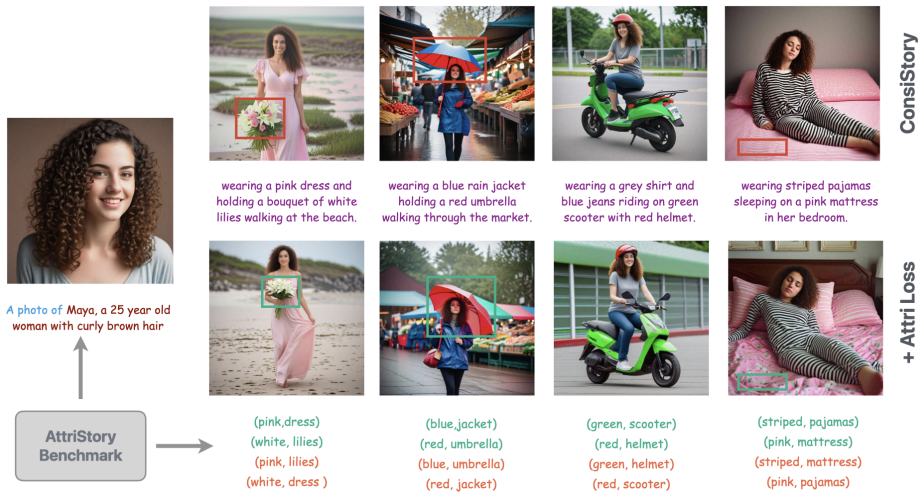
AttriStory provides a benchmark enabling attribute realization in visual storytelling. The AttriLoss objective maximizes alignment between the cross-attention maps for desired attribute-object pairs while suppressing spurious associations, guiding models to localize attributes correctly when applied during early denoising steps. The approach operates orthogonally to existing consistency mechanisms and integrates seamlessly with current story generation pipelines without architectural modifications.
What carries the argument
AttriLoss objective that maximizes alignment between cross-attention maps for desired attribute-object pairs while suppressing spurious associations to localize attributes correctly.
Load-bearing premise
Optimizing cross-attention maps only during early denoising steps produces faithful attribute rendering in the final image without introducing new artifacts or degrading overall story coherence.
What would settle it
Side-by-side evaluation on the AttriStory benchmark showing no measurable increase in correct attribute depiction when using AttriLoss versus standard generation, as judged by attribute-specific accuracy metrics or human raters.
If this is right
- Consistent improvements appear when incorporating AttriLoss across all tested baselines.
- Attribute realization emerges as a distinct and complementary dimension of visual storytelling alongside character consistency.
- The method advances the field toward fine-grained attribute-controlled story generation.
- No architectural modifications are required to integrate with existing pipelines.
Where Pith is reading between the lines
- The attention-alignment idea could extend to controlling object relationships or background elements in generated scenes.
- Applying the same optimization at later denoising stages might further refine details without harming early structure.
- Interactive tools could let users adjust specific attributes mid-generation by modifying the loss targets.
Editorial analysis
A structured set of objections, weighed in public.
Referee Report
Summary. The paper introduces AttriStory, a benchmark of 200 multi-scene stories across 10 artistic styles curated via LLMs, each equipped with detailed attribute specifications for clothing, accessories, colors, and textures. It proposes a plug-and-play latent optimization module that applies an AttriLoss objective during early denoising steps to maximize cross-attention alignment for desired attribute-object pairs while suppressing spurious associations, thereby guiding correct attribute localization in diffusion-based visual storytelling. The method is presented as orthogonal to existing consistency mechanisms and is reported to yield consistent improvements across baselines.
Significance. If substantiated, the work usefully separates attribute realization from character consistency as a distinct control axis in story generation. The benchmark could support future controlled experiments, and the plug-and-play formulation avoids architectural changes. However, the absence of quantitative results, measurement protocols, or ablations in the abstract limits evaluation of practical impact and leaves the core proxy assumption (early attention alignment implies final pixel-level fidelity) untested.
major comments (2)
- [Abstract] Abstract: the claim of 'consistent improvements on incorporating AttriLoss across all baselines' is unsupported by any quantitative results, error bars, or description of how attribute success (e.g., color/texture fidelity) was measured. This information is load-bearing for the central empirical claim.
- [Abstract] Abstract (AttriLoss description): the method optimizes cross-attention maps only in early denoising steps under the assumption that this suffices for faithful final-image attribute rendering. For fine-grained attributes such as clothing textures or accessory colors, attention maps can be diffuse and later denoising steps can still alter appearance; no ablation on loss timing or direct evidence linking early alignment to final pixel output is provided.
minor comments (2)
- The manuscript would benefit from explicit statements on reproducibility (hyperparameters of the latent optimization, exact weighting of AttriLoss, and whether code or prompts will be released).
- Notation for cross-attention maps and the precise formulation of the suppression term in AttriLoss should be clarified with an equation reference to avoid ambiguity in implementation.
Simulated Author's Rebuttal
We thank the referee for the constructive comments that help clarify the presentation of our empirical claims and methodological choices. We address each major comment below and describe the corresponding revisions.
read point-by-point responses
-
Referee: [Abstract] Abstract: the claim of 'consistent improvements on incorporating AttriLoss across all baselines' is unsupported by any quantitative results, error bars, or description of how attribute success (e.g., color/texture fidelity) was measured. This information is load-bearing for the central empirical claim.
Authors: We agree that the abstract lacks sufficient detail on the evaluation protocol and results. The full manuscript reports quantitative metrics for attribute fidelity (color and texture accuracy via automated matching and human evaluation) with standard deviations across runs, showing consistent gains over baselines. We will revise the abstract to briefly describe the measurement approach and key quantitative outcomes while referencing the experiments section. revision: yes
-
Referee: [Abstract] Abstract (AttriLoss description): the method optimizes cross-attention maps only in early denoising steps under the assumption that this suffices for faithful final-image attribute rendering. For fine-grained attributes such as clothing textures or accessory colors, attention maps can be diffuse and later denoising steps can still alter appearance; no ablation on loss timing or direct evidence linking early alignment to final pixel output is provided.
Authors: The focus on early steps follows from the established role of initial denoising in determining semantic structure and layout. The manuscript includes attention-map visualizations that link improved early alignment to correct final attributes. We acknowledge the benefit of explicit timing ablations and will add experiments comparing AttriLoss application across early, middle, and late stages, plus quantitative analysis correlating attention alignment with pixel-level attribute accuracy. revision: yes
Circularity Check
No significant circularity; derivation is self-contained
full rationale
The paper introduces a new benchmark (AttriStory with 200 stories) and a plug-and-play latent optimization module using the AttriLoss on cross-attention maps during early denoising steps. The central claim—that this loss maximizes alignment for attribute-object pairs and thereby improves fine-grained attribute realization—is presented as an empirical outcome from integrating the module with baselines, without any equations or steps that reduce the reported improvement to a fitted parameter, self-defined metric, or self-citation chain. The text explicitly positions the method as orthogonal to consistency mechanisms and requiring no architectural changes, indicating the derivation chain adds independent content rather than renaming or reconstructing its inputs.
Axiom & Free-Parameter Ledger
axioms (1)
- domain assumption Cross-attention maps in diffusion models can be directly optimized to control attribute localization without side effects on image quality.
invented entities (2)
-
AttriLoss
no independent evidence
-
AttriStory benchmark
no independent evidence
read the original abstract
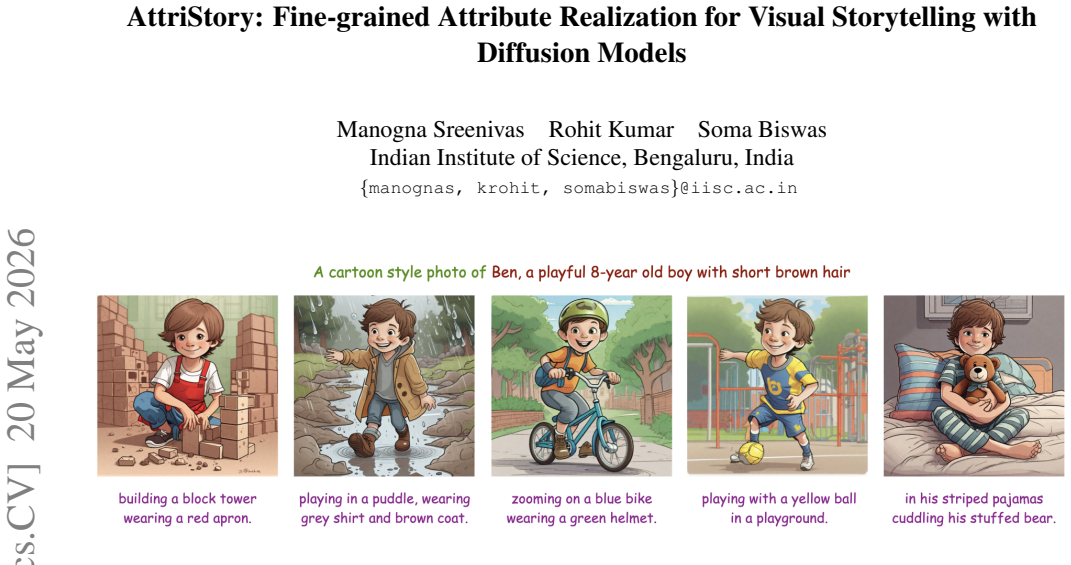
Visual storytelling with diffusion models has made impressive strides in maintaining character consistency across narrative scenes. However, a critical gap remains: while these methods ensure a character remains consistent across scenes, they provide no systematic method to ensure if fine-grained attributes such as color and textures of clothing, accessories are faithfully rendered in the generated images. Towards this goal, we introduce AttriStory, a benchmark enabling attribute realization in visual storytelling. We curate 200 multi-scene stories across 10 distinct artistic styles using Large Language Model. Each scene is constructed with detailed attribute specifications to enable rich visual narratives. Further, to address attribute realization, we propose a plug-and-play latent optimization module that operates during early denoising steps, when the model establishes structural and semantic content. We achieve this through AttriLoss objective designed to maximize alignment between the cross-attention maps for desired attribute-object pairs while suppressing spurious associations, guiding models to localize attributes correctly. This approach operates orthogonally to existing consistency mechanisms, integrating seamlessly with current story generation pipelines without requiring architectural modifications. Our experiments demonstrate consistent improvements on incorporating AttriLoss across all baselines. This work positions attribute realization as a distinct, complementary dimension of visual storytelling, alongside character consistency, advancing the field toward fine-grained attribute-controlled story generation. Project-page:https://manogna-s.github.io/attristory/
Figures




Forward citations
Cited by 1 Pith paper
-
KathaTrace: Diagnosing Semantic Trajectory Collapse in Generated Visual Narratives
Introduces KathaTrace protocol and KathaBench-25K benchmark to quantify Semantic Trajectory Gap (STG) as the loss of transition meaning in visualized narratives, reporting STG of 23.5 +/- 1.3 across generators.
Reference graph
Works this paper leans on
-
[1]
Kiymet Akdemir and Pinar Yanardag. Oracle: Leveraging mutual information for consistent character generation with loras in diffusion models.arXiv preprint arXiv:2406.02820,
-
[2]
Break-a-scene: Extracting multi- ple concepts from a single image
Omri Avrahami, Kfir Aberman, Ohad Fried, Daniel Cohen- Or, and Dani Lischinski. Break-a-scene: Extracting multi- ple concepts from a single image. InSIGGRAPH Asia 2023 Conference Papers, pages 1–12, 2023. 2
work page 2023
-
[3]
The chosen one: Consistent characters in text- to-image diffusion models
Omri Avrahami, Amir Hertz, Yael Vinker, Moab Arar, Shlomi Fruchter, Ohad Fried, Daniel Cohen-Or, and Dani Lischinski. The chosen one: Consistent characters in text- to-image diffusion models. InACM SIGGRAPH 2024 con- ference papers, pages 1–12, 2024. 3
work page 2024
-
[4]
Masactrl: Tuning-free mu- tual self-attention control for consistent image synthesis and editing
Mingdeng Cao, Xintao Wang, Zhongang Qi, Ying Shan, Xi- aohu Qie, and Yinqiang Zheng. Masactrl: Tuning-free mu- tual self-attention control for consistent image synthesis and editing. InProceedings of the IEEE/CVF international con- ference on computer vision, pages 22560–22570, 2023. 2
work page 2023
-
[5]
DreamSim: Learning New Dimensions of Human Visual Similarity using Synthetic Data
Stephanie Fu, Netanel Tamir, Shobhita Sundaram, Lucy Chai, Richard Zhang, Tali Dekel, and Phillip Isola. Dream- sim: Learning new dimensions of human visual similar- ity using synthetic data.arXiv preprint arXiv:2306.09344,
work page internal anchor Pith review arXiv
-
[6]
An Image is Worth One Word: Personalizing Text-to-Image Generation using Textual Inversion
Rinon Gal, Yuval Alaluf, Yuval Atzmon, Or Patash- nik, Amit H Bermano, Gal Chechik, and Daniel Cohen- Or. An image is worth one word: Personalizing text-to- image generation using textual inversion.arXiv preprint arXiv:2208.01618, 2022. 2
work page internal anchor Pith review Pith/arXiv arXiv 2022
-
[7]
Interactive story visualiza- tion with multiple characters
Yuan Gong, Youxin Pang, Xiaodong Cun, Menghan Xia, Yingqing He, Haoxin Chen, Longyue Wang, Yong Zhang, Xintao Wang, Ying Shan, et al. Interactive story visualiza- tion with multiple characters. InSIGGRAPH Asia 2023 Con- ference Papers, pages 1–10, 2023. 1
work page 2023
-
[8]
Prompt-to-Prompt Image Editing with Cross Attention Control
Amir Hertz, Ron Mokady, Jay Tenenbaum, Kfir Aberman, Yael Pritch, and Daniel Cohen-Or. Prompt-to-prompt im- age editing with cross attention control.arXiv preprint arXiv:2208.01626, 2022. 2, 6
work page internal anchor Pith review Pith/arXiv arXiv 2022
-
[9]
Clipscore: A reference-free evaluation met- ric for image captioning
Jack Hessel, Ari Holtzman, Maxwell Forbes, Ronan Le Bras, and Yejin Choi. Clipscore: A reference-free evaluation met- ric for image captioning. InProceedings of the 2021 confer- ence on empirical methods in natural language processing, pages 7514–7528, 2021. 7
work page 2021
-
[10]
Jonathan Ho, Ajay Jain, and Pieter Abbeel. Denoising dif- fusion probabilistic models.Advances in neural information processing systems, 33:6840–6851, 2020. 2
work page 2020
-
[11]
Animate anyone: Consistent and controllable image- to-video synthesis for character animation
Li Hu. Animate anyone: Consistent and controllable image- to-video synthesis for character animation. InProceedings of the IEEE/CVF Conference on Computer Vision and Pattern Recognition, pages 8153–8163, 2024. 2
work page 2024
-
[12]
Multi-concept customization of text-to-image diffusion
Nupur Kumari, Bingliang Zhang, Richard Zhang, Eli Shechtman, and Jun-Yan Zhu. Multi-concept customization of text-to-image diffusion. InProceedings of the IEEE/CVF conference on computer vision and pattern recognition, pages 1931–1941, 2023. 2
work page 1931
-
[13]
Flux.https://github.com/ black-forest-labs/flux, 2024
Black Forest Labs. Flux.https://github.com/ black-forest-labs/flux, 2024. 2
work page 2024
-
[14]
Photomaker: Customizing re- alistic human photos via stacked id embedding
Zhen Li, Mingdeng Cao, Xintao Wang, Zhongang Qi, Ming- Ming Cheng, and Ying Shan. Photomaker: Customizing re- alistic human photos via stacked id embedding. InProceed- ings of the IEEE/CVF conference on computer vision and pattern recognition, pages 8640–8650, 2024. 3
work page 2024
-
[15]
Evaluating text-to-visual generation with image-to-text gen- eration
Zhiqiu Lin, Deepak Pathak, Baiqi Li, Jiayao Li, Xide Xia, Graham Neubig, Pengchuan Zhang, and Deva Ramanan. Evaluating text-to-visual generation with image-to-text gen- eration. InEuropean Conference on Computer Vision, pages 366–384. Springer, 2024. 7
work page 2024
-
[16]
Towards understanding cross and self-attention in stable diffusion for text-guided image editing
Bingyan Liu, Chengyu Wang, Tingfeng Cao, Kui Jia, and Jun Huang. Towards understanding cross and self-attention in stable diffusion for text-guided image editing. InProceed- ings of the IEEE/CVF conference on computer vision and pattern recognition, pages 7817–7826, 2024. 2
work page 2024
-
[17]
Intelligent grimm - open-ended visual storytelling via latent diffusion models
Chang Liu, Haoning Wu, Yujie Zhong, Xiaoyun Zhang, Yan- feng Wang, and Weidi Xie. Intelligent grimm - open-ended visual storytelling via latent diffusion models. InProceed- ings of the IEEE/CVF Conference on Computer Vision and Pattern Recognition (CVPR), pages 6190–6200, 2024. 1
work page 2024
-
[18]
One-prompt-one-story: Free-lunch consistent text-to-image generation using a single prompt
Tao Liu, Kai Wang, Senmao Li, Joost van de Weijer, Fa- had Shahbaz Khan, Shiqi Yang, Yaxing Wang, Jian Yang, and Ming-Ming Cheng. One-prompt-one-story: Free-lunch consistent text-to-image generation using a single prompt. arXiv preprint arXiv:2501.13554, 2025. 1, 2, 3, 6, 7
-
[19]
Storydall-e: Adapting pretrained text-to-image transformers for story continuation
Adyasha Maharana, Darryl Hannan, and Mohit Bansal. Storydall-e: Adapting pretrained text-to-image transformers for story continuation. InEuropean conference on computer vision, pages 70–87. Springer, 2022. 1
work page 2022
-
[20]
Chong Mou, Xintao Wang, Jiechong Song, Ying Shan, and Jian Zhang. Dragondiffusion: Enabling drag-style manipula- tion on diffusion models.arXiv preprint arXiv:2307.02421,
-
[21]
Chatgpt.https://chatgpt.com/, 2025
OpenAI. Chatgpt.https://chatgpt.com/, 2025. Large language model. 4, 6
work page 2025
-
[22]
Synthesizing coherent story with auto-regressive la- tent diffusion models
Xichen Pan, Pengda Qin, Yuhong Li, Hui Xue, and Wenhu Chen. Synthesizing coherent story with auto-regressive la- tent diffusion models. InProceedings of the IEEE/CVF Win- ter Conference on Applications of Computer Vision, pages 2920–2930, 2024. 1
work page 2024
-
[23]
Scalable diffusion models with transformers
William Peebles and Saining Xie. Scalable diffusion models with transformers. InProceedings of the IEEE/CVF inter- national conference on computer vision, pages 4195–4205,
-
[24]
SDXL: Improving Latent Diffusion Models for High-Resolution Image Synthesis
Dustin Podell, Zion English, Kyle Lacey, Andreas Blattmann, Tim Dockhorn, Jonas M ¨uller, Joe Penna, and Robin Rombach. Sdxl: Improving latent diffusion mod- els for high-resolution image synthesis.arXiv preprint arXiv:2307.01952, 2023. 2, 6, 7
work page internal anchor Pith review Pith/arXiv arXiv 2023
-
[25]
Learning transferable visual models from natural language supervi- sion
Alec Radford, Jong Wook Kim, Chris Hallacy, Aditya Ramesh, Gabriel Goh, Sandhini Agarwal, Girish Sastry, Amanda Askell, Pamela Mishkin, Jack Clark, et al. Learning transferable visual models from natural language supervi- sion. InInternational conference on machine learning, pages 8748–8763. PmLR, 2021. 2
work page 2021
-
[26]
Hierarchical Text-Conditional Image Generation with CLIP Latents
Aditya Ramesh, Prafulla Dhariwal, Alex Nichol, Casey Chu, and Mark Chen. Hierarchical text-conditional image gener- ation with clip latents.arXiv preprint arXiv:2204.06125, 1 (2):3, 2022. 2
work page internal anchor Pith review Pith/arXiv arXiv 2022
-
[27]
High-resolution image synthesis with latent diffusion models
Robin Rombach, Andreas Blattmann, Dominik Lorenz, Patrick Esser, and Bj ¨orn Ommer. High-resolution image synthesis with latent diffusion models. InProceedings of the IEEE/CVF conference on computer vision and pattern recognition, pages 10684–10695, 2022. 2
work page 2022
-
[28]
Dreambooth: Fine tuning text-to-image diffusion models for subject-driven generation
Nataniel Ruiz, Yuanzhen Li, Varun Jampani, Yael Pritch, Michael Rubinstein, and Kfir Aberman. Dreambooth: Fine tuning text-to-image diffusion models for subject-driven generation. InProceedings of the IEEE/CVF conference on computer vision and pattern recognition, pages 22500– 22510, 2023. 2
work page 2023
-
[29]
Hyperdreambooth: Hypernetworks for fast personalization of text-to-image models
Nataniel Ruiz, Yuanzhen Li, Varun Jampani, Wei Wei, Tingbo Hou, Yael Pritch, Neal Wadhwa, Michael Rubinstein, and Kfir Aberman. Hyperdreambooth: Hypernetworks for fast personalization of text-to-image models. InProceedings of the IEEE/CVF conference on computer vision and pattern recognition, pages 6527–6536, 2024. 2
work page 2024
-
[30]
Chitwan Saharia, William Chan, Saurabh Saxena, Lala Li, Jay Whang, Emily L Denton, Kamyar Ghasemipour, Raphael Gontijo Lopes, Burcu Karagol Ayan, Tim Salimans, et al. Photorealistic text-to-image diffusion models with deep language understanding.Advances in neural information processing systems, 35:36479–36494, 2022. 2
work page 2022
-
[31]
Denoising Diffusion Implicit Models
Jiaming Song, Chenlin Meng, and Stefano Ermon. Denoising diffusion implicit models.arXiv preprint arXiv:2010.02502, 2020. 2
work page internal anchor Pith review Pith/arXiv arXiv 2010
-
[32]
Yoad Tewel, Omri Kaduri, Rinon Gal, Yoni Kasten, Lior Wolf, Gal Chechik, and Yuval Atzmon. Training-free consis- tent text-to-image generation.ACM Transactions on Graph- ics (TOG), 43(4):1–18, 2024. 1, 2, 3, 6, 7
work page 2024
-
[33]
Characonsist: Fine- grained consistent character generation
Mengyu Wang, Henghui Ding, Jianing Peng, Yao Zhao, Yunpeng Chen, and Yunchao Wei. Characonsist: Fine- grained consistent character generation. InProceedings of the IEEE/CVF International Conference on Computer Vi- sion, pages 16058–16067, 2025. 1
work page 2025
-
[34]
InstantID: Zero-shot Identity-Preserving Generation in Seconds
Qixun Wang, Xu Bai, Haofan Wang, Zekui Qin, Anthony Chen, Huaxia Li, Xu Tang, and Yao Hu. Instantid: Zero-shot identity-preserving generation in seconds.arXiv preprint arXiv:2401.07519, 2024. 2
work page internal anchor Pith review Pith/arXiv arXiv 2024
-
[35]
Qinghe Wang, Baolu Li, Xiaomin Li, Bing Cao, Liqian Ma, Huchuan Lu, and Xu Jia. Characterfactory: Sampling consis- tent characters with gans for diffusion models.IEEE Trans- actions on Image Processing, 2025. 2
work page 2025
-
[36]
Elite: Encoding visual concepts into textual embeddings for customized text-to-image generation,
Yuxiang Wei, Yabo Zhang, Zhilong Ji, Jinfeng Bai, Lei Zhang, and Wangmeng Zuo. Elite: Encoding visual con- cepts into textual embeddings for customized text-to-image generation.arXiv preprint arXiv:2302.13848, 2023. 2
-
[37]
Chenfei Wu, Jiahao Li, Jingren Zhou, Junyang Lin, Kaiyuan Gao, Kun Yan, Sheng-ming Yin, Shuai Bai, Xiao Xu, Yilei Chen, et al. Qwen-image technical report.arXiv preprint arXiv:2508.02324, 2025. 2
work page internal anchor Pith review Pith/arXiv arXiv 2025
-
[38]
Seed-story: Multi- modal long story generation with large language model
Shuai Yang, Yuying Ge, Yang Li, Yukang Chen, Yixiao Ge, Ying Shan, and Ying-Cong Chen. Seed-story: Multi- modal long story generation with large language model. In Proceedings of the IEEE/CVF International Conference on Computer Vision, pages 1850–1860, 2025. 1
work page 2025
-
[39]
IP-Adapter: Text Compatible Image Prompt Adapter for Text-to-Image Diffusion Models
Hu Ye, Jun Zhang, Sibo Liu, Xiao Han, and Wei Yang. Ip- adapter: Text compatible image prompt adapter for text-to- image diffusion models.arXiv preprint arXiv:2308.06721,
work page internal anchor Pith review Pith/arXiv arXiv
-
[40]
Yupeng Zhou, Daquan Zhou, Ming-Ming Cheng, Jiashi Feng, and Qibin Hou. Storydiffusion: Consistent self- attention for long-range image and video generation.Ad- vances in Neural Information Processing Systems, 37: 110315–110340, 2024. 1, 2, 3, 6, 7
work page 2024
-
[41]
Zhengguang Zhou, Jing Li, Huaxia Li, Nemo Chen, and Xu Tang. Storymaker: Towards holistic consistent characters in text-to-image generation.arXiv preprint arXiv:2409.12576,
discussion (0)
Sign in with ORCID, Apple, or X to comment. Anyone can read and Pith papers without signing in.