REVIEW 2 major objections 7 minor 89 references
GLProtein: Global-and-Local Structure Aware Protein Representation Learning
T0 review · 2 major / 7 minor · reviewed 2026-08-15 · deepseek-v4-flash
Pith's one-line read GLProtein claims that pre-training on global structure similarity plus local amino-acid geometry improves protein contact and interaction prediction.
desk verdict A promising integration of global structural similarity and local substructure signals into a protein LM, but the triplet loss as written is undefined for variable-length proteins and needs a pooling specification plus corrected objectives before the empirical claims can be trusted. read the letter →
The pith
A machine-rendered reading of the paper's core claim, the machinery that carries it, and where it could break.
The reading
What carries the argument
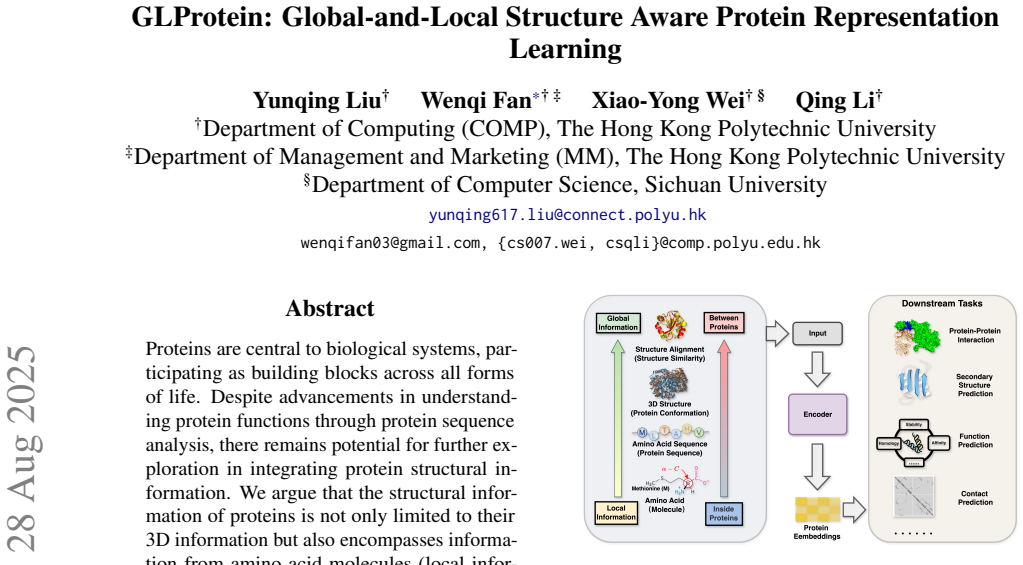
The load-bearing mechanism is the joint objective $L = L_{MLM} + \alpha L_{PTL}$, coupling three components: masked protein language modelling, global triplet structure modelling, and local decoder injection. The triplet loss $L_{PTL}$ is the carrier of global information: positives and negatives are chosen by TM-Vec using TM-score, a standard measure of whole-structure similarity, and the loss aligns representations of structurally similar proteins while repelling dissimilar ones. Local information enters through the decoder, where Gaussian-basis 3D distance encoding $\Phi^{distance}$ biases attention and mol2vec-generated amino acid substructure embeddings $E_a$ act as keys and values. Ablations in the paper show that removing either the triplet component, the distance encoding, or the molecule embeddings lowers contact and interaction performance, which identifies these three pieces as the machinery carrying the claimed gains.
What would settle it
Compute the triplet loss exactly as written in Eq. (3) for a protein pair of different lengths, e.g. 100 and 200 residues, and observe that the subtraction is undefined; then re-run pre-training with a specified pooling (mean pooling, a learned pooler, or a CLS token) and check whether the reported contact and PPI gains persist. If the gains disappear for some pooling choices, the claimed advantage depends on the hidden alignment rather than on structure similarity.
Extended reading notes
Core claim
The central claim is that protein structure information should be encoded at both global and local scales during pre-training, and that a model trained this way transfers better to downstream prediction than sequence-only or single-scale structure models. Globally, the framework samples a triplet $(P, P^{pos}, P^{neg})$ using TM-Vec's predicted structure similarity, then optimizes a triplet loss $$L_{PTL}(P,$P^{{pos}}$,$P^{{neg}}$) = \max\big(\|E_p - $E_p^{{pos}}$\|_2 - \|E_p - $E_p^{{neg}}$\|_2 + \epsilon,\,0\big)$$ so that a protein's representation approaches its structural neighbors and moves away from decoys with TM-score below $0.2$. Locally, the decoder computes Gaussian-basis 3D distance encoding $\Phi^{distance}$ from $\alpha$-carbon coordinates and uses it as attention bias, while mol2vec substructure embeddings $E_a$ serve as keys and values, so masked amino-acid reconstruction is conditioned on atomic and geometric detail. The full objective is $L = L_{MLM} + \alpha L_{PTL}$, and on contact prediction and protein-protein interaction benchmarks the paper reports the best results among the compared baselines.
Load-bearing premise
The contrastive loss subtracts the representation of one whole protein from another as though they were equal-sized vectors, but protein sequences differ in length and the paper never states how they are pooled to a common size; the global structural signal therefore rests on an unspecified length-reduction step.
Editorial extensions
If this is right
- Pre-training on global structure similarity should let sequence-only fine-tuning inherit functional relationships that sequence identity misses, such as the similar beta-helical fold of FfIBP and CaTrailin_4.
- Contact prediction and protein-protein interaction models initialized from GLProtein can be fine-tuned without structural input and still beat structure-aware baselines on the reported benchmarks.
- The ablations imply that each of the three components — triplet similarity, 3D distance encoding, and amino-acid substructure encoding — contributes an independent performance gain, so strengthening any one of them should yield further improvement.
- The same representation also transfers to stability prediction, where GLProtein reports the highest Spearman correlation among compared models on the TAPE benchmark, pointing to use in protein engineering.
Reading between the lines
- Our inference: if the global triplet signal drives the gains, scaling the structure database used for sampling should improve remote-homology and fold-classification performance even with the encoder held fixed; this is directly testable.
- Our inference: because the triplet loss as written subtracts whole-sequence representations of different lengths, the empirical implementation must rely on an unstated pooling or alignment; making that choice explicit and varying it would reveal how much of the gain comes from structural similarity versus the length reduction itself.
- Our inference: the same global-plus-local recipe could transfer to RNA structures, protein-ligand complexes, or protein-nucleic acid interfaces, where whole-molecule similarity and local chemical detail play analogous roles.
- Our inference: the paper's own limitation on binding-affinity prediction suggests that mutation or MSA-style variation, not additional geometric structure, is the missing signal for that task.
Signed reviews
Editorial analysis
A structured set of objections, weighed in public.
Referee Report
Summary. The paper proposes GLProtein, a protein representation learning framework that combines a ProtBert-style masked language model with two structure-aware modules. Global structure information is injected through a triplet loss on protein representations, with positive and negative proteins selected by TM-Vec based on TM-score structure similarity; local structure information is injected through AlphaFoldDB-derived 3D distance encodings and mol2vec substructure encodings in the decoder. The model is pre-trained on Swiss-Prot and evaluated on contact prediction, PPI, TAPE, function prediction, binding affinity and stability, reporting strong results on contact and PPI and mixed results on other tasks, which the limitations section acknowledges.
Significance. If the objective definitions are corrected, the paper's contribution is a plausible and potentially useful integration of global structural similarity and local molecular detail into a single protein pre-training pipeline. The evaluation is broad, includes ablations and parameter sensitivity studies, and the authors are transparent about tasks where GLProtein does not improve over baselines. The use of TM-Vec as an external structural similarity oracle is a legitimate design choice and not circular. However, the two mathematical errors in the objectives are load-bearing and currently prevent the method from being executed or reproduced as written.
major comments (2)
- [Section 3.1, Eq. (1)] The masked language modeling loss is written as L_MLM = -log sum_{i in M} P(x_i | x_sim i; theta_E, theta_D). Standard masked LM uses the sum of per-token cross-entropy terms, i.e., -sum_i log P(...), because each masked position has its own softmax distribution; the negative log of the sum of these probabilities has no probabilistic interpretation and would lead to a different and incorrect training signal. Since this term is half of the joint objective in Eq. (5), the training objective as written is mathematically incorrect and must be corrected.
- [Section 3.2, Eq. (3)] The triplet loss compares E_p, E_pos_p and E_neg_p, each stated to be in R^{L_p x D}. Positive and negative proteins are sampled independently in Section 3.2, so their lengths generally differ from the anchor length L_p; the matrix differences in Eq. (3) are therefore undefined unless a length-alignment step such as pooling, padding with masking, or residue-level alignment is applied. No such step is described in Section 3.2, in the implementation details, or in the appendix, and the complexity analysis in Section A.9 implicitly assumes a single length L by reporting O(3Ld). This is not a cosmetic issue, because L_PTL is the only global-structure term in Eq. (5) and its gradient is the mechanism that injects global structural similarity into the representation. The authors should specify the exact pooling/alignment procedure and revise the complexity analysis accordingly.
minor comments (7)
- [References] The citation for ESM-2 points to Beal (2015), which is a paper about experience sampling methods in organizational research, not the protein language model ESM-2; this reference must be corrected.
- [Section 5] The conclusion contains the typo 'GLProtien' and should read 'GLProtein'.
- [Table 2 caption] 'Breath-First Search' should be 'Breadth-First Search'.
- [Abstract and Introduction] The claim that GLProtein is 'the first framework' to incorporate global structural similarity and local amino acid details is too strong without a more complete comparison against prior structure-aware methods; the paper's own Table 3 and Table 4 show ties and losses on several tasks, so the outperformance claim should be qualified.
- [Section 3.4 / Appendix A.7] Appendix A.7 says it studies 'the number of protein samples in the protein local structure information modelling component', but the sampled positives and negatives are used by the global triplet loss, so the wording should be corrected.
- [Eq. (4)] The Gaussian basis kernel is written with a negative prefactor -1/(sqrt(2 pi) |sigma_k|), which is unusual for a radial basis function; if this sign is intentional, the authors should explain it, and the role of |sigma_k| as a learnable scaling factor should be clarified.
- [Section 3.2] The global structure component is described as leveraging 'self-supervised signals', but the triplet labels are produced by TM-Vec, a separately trained model, and the structures come from AlphaFoldDB; the authors should describe this as external supervision or knowledge-based sampling rather than self-supervision.
Circularity Check
No significant circularity: GLProtein's training signal comes from external TM-Vec labels, AlphaFoldDB coordinates, and mol2vec embeddings, while the in-text self-citations are not load-bearing.
full rationale
The claimed derivation chain is not circular. The global triplet objective L_PTL (Eq. 3) is supervised by positive and negative samples generated by TM-Vec (Hamamsy et al., 2023), an external model computing TM-scores; the model does not generate its own training labels. The local structure terms use AlphaFoldDB coordinates through 3D distance encoding and mol2vec for substructure-based amino acid embeddings, both external. The masked language modeling component is a standard BERT-style objective initialized from ProtBert. None of the downstream predictions are equivalent by construction to a fitted parameter or to the model's own inputs. The paper contains several self-citations (e.g., Fan et al., 2025; Liu et al., 2023; Li et al., 2024a-c, 2025), but these appear only as general related-work pointers and are not used to justify the core method, to establish a uniqueness claim, or to forbid alternative approaches; there is no imported uniqueness theorem. Section 6 honestly reports weaker performance on binding affinity and fluorescence tasks, and the ablations in Appendix A.6 are evaluated on external benchmarks, so these limitations do not create circularity. The main internal defect is that Eq. (3) writes E_p, E_pos_p, and E_neg_p all in R^{L_p x D}, with L_p described as the sequence length, whereas the anchor, positive, and negative proteins in a triplet will generally have different lengths; no pooling, padding, masking, or length-restricted sampling is specified, and Appendix A.9's O(3Ld) complexity analysis implicitly assumes a single length. This makes the global objective as written undefined for variable-length triplets, but that is a correctness/reproducibility problem rather than a circular reduction of a claimed result to its inputs.
Assumptions & free parameters
free parameters (4)
- alpha (contrastive loss weight) =
1
- Number of positive/negative samples per protein =
4
- Triplet margin epsilon =
not specified
- Gaussian kernel count K =
not specified
assumptions (5)
- domain assumption TM-Vec provides reliable TM-scores for selecting structurally similar proteins.
- domain assumption AlphaFoldDB predicted structures are treated as true 3D coordinates.
- domain assumption Pretraining on Swiss-Prot and AlphaFoldDB does not leak into downstream test sets.
- domain assumption ProtBert is a valid initialization for continued pretraining.
- standard math Standard machine learning operations (attention, layer norm, GELU) behave as widely assumed.
Cite this review
Pith. "Pith review of GLProtein: Global-and-Local Structure Aware Protein Representation Learning." pith.science (2026). https://pith.science/paper/2OJZN7T3
@misc{pith2026250606294,
  author       = {Pith},
  title        = {Pith review of: GLProtein: Global-and-Local Structure Aware Protein Representation Learning},
  year         = {2026},
  howpublished = {\url{https://pith.science/paper/2OJZN7T3}},
  note         = {Machine review of arXiv:2506.06294}
}
read the original abstract
Proteins are central to biological systems, participating as building blocks across all forms of life. Despite advancements in understanding protein functions through protein sequence analysis, there remains potential for further exploration in integrating protein structural information. We argue that the structural information of proteins is not only limited to their 3D information but also encompasses information from amino acid molecules (local information) to protein-protein structure similarity (global information). To address this, we propose \textbf{GLProtein}, the first framework in protein pre-training that incorporates both global structural similarity and local amino acid details to enhance prediction accuracy and functional insights. GLProtein innovatively combines protein-masked modelling with triplet structure similarity scoring, protein 3D distance encoding and substructure-based amino acid molecule encoding. Experimental results demonstrate that GLProtein outperforms previous methods in several bioinformatics tasks, including predicting protein-protein interaction, contact prediction, and so on.
Figures


Figures from the paper (6 more)


Reference graph
Works this paper leans on
-
[1]
Is protein blast a thing of the past? nature communications , 14(1):8195, 2023
Ali Al-Fatlawi, Martin Menzel, and Michael Schroeder. Is protein blast a thing of the past? nature communications , 14(1):8195, 2023
2023
-
[2]
Proteinnet: a standardized data set for machine learning of protein structure
Mohammed AlQuraishi. Proteinnet: a standardized data set for machine learning of protein structure. BMC bioinformatics , 20:1--10, 2019
2019
-
[3]
Machine learning in protein structure prediction
Mohammed AlQuraishi. Machine learning in protein structure prediction. Current opinion in chemical biology , 65:1--8, 2021
2021
-
[4]
Jimmy Lei Ba, Jamie Ryan Kiros, and Geoffrey E Hinton. Layer normalization. arXiv preprint arXiv:1607.06450 , 2016
arXiv 2016
-
[5]
Esm 2.0: State of the art and future potential of experience sampling methods in organizational research
Daniel J Beal. Esm 2.0: State of the art and future potential of experience sampling methods in organizational research. Annu. Rev. Organ. Psychol. Organ. Behav. , 2(1):383--407, 2015
2015
-
[6]
Scope: classification of large macromolecular structures in the structural classification of proteins—extended database
John-Marc Chandonia, Naomi K Fox, and Steven E Brenner. Scope: classification of large macromolecular structures in the structural classification of proteins—extended database. Nucleic acids research , 47(D1):D475--D481, 2019
2019
-
[7]
Endowing protein language models with structural knowledge
Dexiong Chen, Philip Hartout, Paolo Pellizzoni, Carlos Oliver, and Karsten Borgwardt. Endowing protein language models with structural knowledge. arXiv preprint arXiv:2401.14819 , 2024
arXiv 2024
-
[8]
Multifaceted protein--protein interaction prediction based on siamese residual rcnn
Muhao Chen, Chelsea J-T Ju, Guangyu Zhou, Xuelu Chen, Tianran Zhang, Kai-Wei Chang, Carlo Zaniolo, and Wei Wang. Multifaceted protein--protein interaction prediction based on siamese residual rcnn. Bioinformatics , 35(14):i305--i314, 2019
2019
Show all 89 references
-
[9]
Machine learning methods for protein structure prediction
Jianlin Cheng, Allison N Tegge, and Pierre Baldi. Machine learning methods for protein structure prediction. IEEE reviews in biomedical engineering , 1:41--49, 2008
2008
-
[10]
Single-sequence protein structure prediction using a language model and deep learning
Ratul Chowdhury, Nazim Bouatta, Surojit Biswas, Christina Floristean, Anant Kharkar, Koushik Roy, Charlotte Rochereau, Gustaf Ahdritz, Joanna Zhang, George M Church, et al. Single-sequence protein structure prediction using a language model and deep learning. Nature Biotechnol...
2022
-
[11]
Protein stability prediction by fine-tuning a protein language model on a mega-scale dataset
Simon KS Chu, Kush Narang, and Justin B Siegel. Protein stability prediction by fine-tuning a protein language model on a mega-scale dataset. PLOS Computational Biology , 20(7):e1012248, 2024
2024
-
[12]
Evaluation and improvement of multiple sequence methods for protein secondary structure prediction
James A Cuff and Geoffrey J Barton. Evaluation and improvement of multiple sequence methods for protein secondary structure prediction. Proteins: Structure, Function, and Bioinformatics , 34(4):508--519, 1999
1999
-
[13]
Food without agriculture
Steven J Davis, Kathleen Alexander, Juan Moreno-Cruz, Chaopeng Hong, Matthew Shaner, Ken Caldeira, and Ian McKay. Food without agriculture. Nature Sustainability , 7(1):90--95, 2024
2024
-
[14]
Bert: Pre-training of deep bidirectional transformers for language understanding
Jacob Devlin, Ming-Wei Chang, Kenton Lee, and Kristina Toutanova. Bert: Pre-training of deep bidirectional transformers for language understanding. arXiv preprint arXiv:1810.04805 , 2018
2018 arXiv
-
[15]
Selective photoredox trifluoromethylation of tryptophan-containing peptides
Bo Ding, Yue Weng, Yunqing Liu, Chunlan Song, Le Yin, Jiafan Yuan, Yanrui Ren, Aiwen Lei, and Chien-Wei Chiang. Selective photoredox trifluoromethylation of tryptophan-containing peptides. European Journal of Organic Chemistry , 2019(46):7596--7605, 2019
2019
-
[16]
Prottrans: Toward understanding the language of life through self-supervised learning
Ahmed Elnaggar, Michael Heinzinger, Christian Dallago, Ghalia Rehawi, Yu Wang, Llion Jones, Tom Gibbs, Tamas Feher, Christoph Angerer, Martin Steinegger, et al. Prottrans: Toward understanding the language of life through self-supervised learning. IEEE transactions on pattern ...
2021
-
[17]
Computational protein science in the era of large language models (llms)
Wenqi Fan, Yi Zhou, Shijie Wang, Yuyao Yan, Hui Liu, Qian Zhao, Le Song, and Qing Li. Computational protein science in the era of large language models (llms). arXiv preprint arXiv:2501.10282 , 2025
2025 arXiv
-
[18]
Protgpt2 is a deep unsupervised language model for protein design
Noelia Ferruz, Steffen Schmidt, and Birte H \"o cker. Protgpt2 is a deep unsupervised language model for protein design. Nature communications , 13(1):4348, 2022
2022
-
[19]
Drugclip: Contrasive protein-molecule representation learning for virtual screening
Bowen Gao, Bo Qiang, Haichuan Tan, Yinjun Jia, Minsi Ren, Minsi Lu, Jingjing Liu, Wei-Ying Ma, and Yanyan Lan. Drugclip: Contrasive protein-molecule representation learning for virtual screening. Advances in Neural Information Processing Systems , 36, 2024
2024
-
[20]
What do molecular biologists mean when they say'structure determines function'? 2018
Gregor P Greslehner. What do molecular biologists mean when they say'structure determines function'? 2018
2018
-
[21]
Roles of tau protein in health and disease
Tong Guo, Wendy Noble, and Diane P Hanger. Roles of tau protein in health and disease. Acta neuropathologica , 133:665--704, 2017
2017
-
[22]
Tm-vec: template modeling vectors for fast homology detection and alignment
Tymor Hamamsy, James T Morton, Daniel Berenberg, Nicholas Carriero, Vladimir Gligorijevic, Robert Blackwell, Charlie EM Strauss, Julia Koehler Leman, Kyunghyun Cho, and Richard Bonneau. Tm-vec: template modeling vectors for fast homology detection and alignment. bioRxiv , page...
2022
-
[23]
Protein remote homology detection and structural alignment using deep learning
Tymor Hamamsy, James T Morton, Robert Blackwell, Daniel Berenberg, Nicholas Carriero, Vladimir Gligorijevic, Charlie EM Strauss, Julia Koehler Leman, Kyunghyun Cho, and Richard Bonneau. Protein remote homology detection and structural alignment using deep learning. Nature biot...
2023
-
[24]
Predicting protein--protein interactions through sequence-based deep learning
Somaye Hashemifar, Behnam Neyshabur, Aly A Khan, and Jinbo Xu. Predicting protein--protein interactions through sequence-based deep learning. Bioinformatics , 34(17):i802--i810, 2018
2018
-
[25]
Deep residual learning for image recognition
Kaiming He, Xiangyu Zhang, Shaoqing Ren, and Jian Sun. Deep residual learning for image recognition. In Proceedings of the IEEE conference on computer vision and pattern recognition , pages 770--778, 2016
2016
-
[26]
Contrastive representation learning for 3d protein structures
Pedro Hermosilla and Timo Ropinski. Contrastive representation learning for 3d protein structures. arXiv preprint arXiv:2205.15675 , 2022
2022 arXiv
-
[27]
A high-level programming language for generative protein design
Brian Hie, Salvatore Candido, Zeming Lin, Ori Kabeli, Roshan Rao, Nikita Smetanin, Tom Sercu, and Alexander Rives. A high-level programming language for generative protein design. bioRxiv , pages 2022--12, 2022
2022
-
[28]
Long short-term memory
Sepp Hochreiter and J \"u rgen Schmidhuber. Long short-term memory. Neural computation , 9(8):1735--1780, 1997
1997
-
[29]
Deepsf: deep convolutional neural network for mapping protein sequences to folds
Jie Hou, Badri Adhikari, and Jianlin Cheng. Deepsf: deep convolutional neural network for mapping protein sequences to folds. Bioinformatics , 34(8):1295--1303, 2018
2018
-
[30]
Improving user controlled table-to-text generation robustness
Hanxu Hu, Yunqing Liu, Zhongyi Yu, and Laura Perez-Beltrachini. Improving user controlled table-to-text generation robustness. arXiv preprint arXiv:2302.09820 , 2023
2023 arXiv
-
[31]
Protein 3d graph structure learning for robust structure-based protein property prediction
Yufei Huang, Siyuan Li, Lirong Wu, Jin Su, Haitao Lin, Odin Zhang, Zihan Liu, Zhangyang Gao, Jiangbin Zheng, and Stan Z Li. Protein 3d graph structure learning for robust structure-based protein property prediction. In Proceedings of the AAAI Conference on Artificial Intellige...
2024
-
[32]
Mol2vec: unsupervised machine learning approach with chemical intuition
Sabrina Jaeger, Simone Fulle, and Samo Turk. Mol2vec: unsupervised machine learning approach with chemical intuition. Journal of chemical information and modeling , 58(1):27--35, 2018
2018
-
[33]
Prediction of protein--protein interaction using graph neural networks
Kanchan Jha, Sriparna Saha, and Hiteshi Singh. Prediction of protein--protein interaction using graph neural networks. Scientific Reports , 12(1):8360, 2022
2022
-
[34]
Highly accurate protein structure prediction with alphafold
John Jumper, Richard Evans, Alexander Pritzel, Tim Green, Michael Figurnov, Olaf Ronneberger, Kathryn Tunyasuvunakool, Russ Bates, Augustin Z \' dek, Anna Potapenko, et al. Highly accurate protein structure prediction with alphafold. nature , 596(7873):583--589, 2021
2021
-
[35]
plm-blast: distant homology detection based on direct comparison of sequence representations from protein language models
Kamil Kaminski, Jan Ludwiczak, Kamil Pawlicki, Vikram Alva, and Stanislaw Dunin-Horkawicz. plm-blast: distant homology detection based on direct comparison of sequence representations from protein language models. Bioinformatics , 39(10):btad579, 2023
2023
-
[36]
Sequence-structure-function relationships in the microbial protein universe
Julia Koehler Leman, Pawel Szczerbiak, P Douglas Renfrew, Vladimir Gligorijevic, Daniel Berenberg, Tommi Vatanen, Bryn C Taylor, Chris Chandler, Stefan Janssen, Andras Pataki, et al. Sequence-structure-function relationships in the microbial protein universe. Nature communicat...
2023
-
[37]
Deep neural network based predictions of protein interactions using primary sequences
Hang Li, Xiu-Jun Gong, Hua Yu, and Chang Zhou. Deep neural network based predictions of protein interactions using primary sequences. Molecules , 23(8):1923, 2018
1923
-
[38]
Tomg-bench: Evaluating llms on text-based open molecule generation
Jiatong Li, Junxian Li, Yunqing Liu, Dongzhan Zhou, and Qing Li. Tomg-bench: Evaluating llms on text-based open molecule generation. arXiv preprint arXiv:2412.14642 , 2024
2024 arXiv
-
[39]
Empowering molecule discovery for molecule-caption translation with large language models: A chatgpt perspective
Jiatong Li, Yunqing Liu, Wenqi Fan, Xiao-Yong Wei, Hui Liu, Jiliang Tang, and Qing Li. Empowering molecule discovery for molecule-caption translation with large language models: A chatgpt perspective. IEEE transactions on knowledge and data engineering , 2024
2024
-
[40]
Molreflect: Towards in-context fine-grained alignments between molecules and texts
Jiatong Li, Yunqing Liu, Wei Liu, Jingdi Le, Di Zhang, Wenqi Fan, Dongzhan Zhou, Yuqiang Li, and Qing Li. Molreflect: Towards in-context fine-grained alignments between molecules and texts. arXiv preprint arXiv:2411.14721 , 2024
2024 arXiv
-
[41]
Dietary protein sources, mediating biomarkers, and incidence of type 2 diabetes: findings from the women’s health initiative and the uk biobank
Jie Li, Andrea J Glenn, Qingling Yang, Ding Ding, Lingling Zheng, Wei Bao, Jeannette Beasley, Erin LeBlanc, Kenneth Lo, JoAnn E Manson, et al. Dietary protein sources, mediating biomarkers, and incidence of type 2 diabetes: findings from the women’s health initiative and the u...
2022
-
[42]
Amino acids in cancer
Elizabeth L Lieu, Tu Nguyen, Shawn Rhyne, and Jiyeon Kim. Amino acids in cancer. Experimental & molecular medicine , 52(1):15--30, 2020
2020
-
[43]
Rapid and sensitive protein similarity searches
David J Lipman and William R Pearson. Rapid and sensitive protein similarity searches. Science , 227(4693):1435--1441, 1985
1985
-
[44]
Generative diffusion models on graphs: methods and applications
Chengyi Liu, Wenqi Fan, Yunqing Liu, Jiatong Li, Hang Li, Hui Liu, Jiliang Tang, and Qing Li. Generative diffusion models on graphs: methods and applications. In Proceedings of the Thirty-Second International Joint Conference on Artificial Intelligence , pages 6702--6711, 2023
2023
-
[45]
Generating 3d molecules for target protein binding
Meng Liu, Youzhi Luo, Kanji Uchino, Koji Maruhashi, and Shuiwang Ji. Generating 3d molecules for target protein binding. arXiv preprint arXiv:2204.09410 , 2022
2022 arXiv
-
[46]
Biochemistry, essential amino acids
Michael J Lopez and Shamim S Mohiuddin. Biochemistry, essential amino acids. In StatPearls [Internet] . StatPearls Publishing, 2024
2024
-
[47]
Learning unknown from correlations: Graph neural network for inter-novel-protein interaction prediction
Guofeng Lv, Zhiqiang Hu, Yanguang Bi, and Shaoting Zhang. Learning unknown from correlations: Graph neural network for inter-novel-protein interaction prediction. arXiv preprint arXiv:2105.06709 , 2021
2021 arXiv
-
[48]
Progen: Language modeling for protein generation
Ali Madani, Bryan McCann, Nikhil Naik, Nitish Shirish Keskar, Namrata Anand, Raphael R Eguchi, Po-Ssu Huang, and Richard Socher. Progen: Language modeling for protein generation. arXiv preprint arXiv:2004.03497 , 2020
2004 arXiv
-
[49]
Colabfold: making protein folding accessible to all
Milot Mirdita, Konstantin Sch \"u tze, Yoshitaka Moriwaki, Lim Heo, Sergey Ovchinnikov, and Martin Steinegger. Colabfold: making protein folding accessible to all. Nature methods , 19(6):679--682, 2022
2022
-
[50]
Skempi: a structural kinetic and energetic database of mutant protein interactions and its use in empirical models
Iain H Moal and Juan Fern \'a ndez-Recio. Skempi: a structural kinetic and energetic database of mutant protein interactions and its use in empirical models. Bioinformatics , 28(20):2600--2607, 2012
2012
-
[51]
The language of proteins: Nlp, machine learning & protein sequences
Dan Ofer, Nadav Brandes, and Michal Linial. The language of proteins: Nlp, machine learning & protein sequences. Computational and Structural Biotechnology Journal , 19:1750--1758, 2021
2021
-
[52]
Pocket2mol: Efficient molecular sampling based on 3d protein pockets
Xingang Peng, Shitong Luo, Jiaqi Guan, Qi Xie, Jian Peng, and Jianzhu Ma. Pocket2mol: Efficient molecular sampling based on 3d protein pockets. In International Conference on Machine Learning , pages 17644--17655. PMLR, 2022
2022
-
[53]
Protein nanofibrils for next generation sustainable water purification
Mohammad Peydayesh and Raffaele Mezzenga. Protein nanofibrils for next generation sustainable water purification. Nature communications , 12(1):3248, 2021
2021
-
[54]
Evaluating protein transfer learning with tape
Roshan Rao, Nicholas Bhattacharya, Neil Thomas, Yan Duan, Peter Chen, John Canny, Pieter Abbeel, and Yun Song. Evaluating protein transfer learning with tape. Advances in neural information processing systems , 32, 2019
2019
-
[55]
Deeprank-gnn: a graph neural network framework to learn patterns in protein--protein interfaces
Manon R \'e au, Nicolas Renaud, Li C Xue, and Alexandre MJJ Bonvin. Deeprank-gnn: a graph neural network framework to learn patterns in protein--protein interfaces. Bioinformatics , 39(1):btac759, 2023
2023
-
[56]
Deeprank: a deep learning framework for data mining 3d protein-protein interfaces
Nicolas Renaud, Cunliang Geng, Sonja Georgievska, Francesco Ambrosetti, Lars Ridder, Dario F Marzella, Manon F R \'e au, Alexandre MJJ Bonvin, and Li C Xue. Deeprank: a deep learning framework for data mining 3d protein-protein interfaces. Nature communications , 12(1):7068, 2021
2021
-
[57]
Cellular agriculture—industrial biotechnology for food and materials
Heiko Rischer, G \'e za R Szilvay, and Kirsi-Marja Oksman-Caldentey. Cellular agriculture—industrial biotechnology for food and materials. Current opinion in biotechnology , 61:128--134, 2020
2020
-
[58]
Biological structure and function emerge from scaling unsupervised learning to 250 million protein sequences
Alexander Rives, Joshua Meier, Tom Sercu, Siddharth Goyal, Zeming Lin, Jason Liu, Demi Guo, Myle Ott, C Lawrence Zitnick, Jerry Ma, et al. Biological structure and function emerge from scaling unsupervised learning to 250 million protein sequences. Proceedings of the National ...
2021
-
[59]
Global analysis of protein folding using massively parallel design, synthesis, and testing
Gabriel J Rocklin, Tamuka M Chidyausiku, Inna Goreshnik, Alex Ford, Scott Houliston, Alexander Lemak, Lauren Carter, Rashmi Ravichandran, Vikram K Mulligan, Aaron Chevalier, et al. Global analysis of protein folding using massively parallel design, synthesis, and testing. Scie...
2017
-
[60]
Comparing support vector machines with gaussian kernels to radial basis function classifiers
Bernhard Scholkopf, Kah-Kay Sung, Christopher JC Burges, Federico Girosi, Partha Niyogi, Tomaso Poggio, and Vladimir Vapnik. Comparing support vector machines with gaussian kernels to radial basis function classifiers. IEEE transactions on Signal Processing , 45(11):2758--2765, 1997
1997
-
[61]
Spot-contact-lm: improving single-sequence-based prediction of protein contact map using a transformer language model
Jaspreet Singh, Thomas Litfin, Jaswinder Singh, Kuldip Paliwal, and Yaoqi Zhou. Spot-contact-lm: improving single-sequence-based prediction of protein contact map using a transformer language model. Bioinformatics , 38(7):1888--1894, 2022
2022
-
[62]
Computational methods in drug discovery
Gregory Sliwoski, Sandeepkumar Kothiwale, Jens Meiler, and Edward W Lowe. Computational methods in drug discovery. Pharmacological reviews , 66(1):334--395, 2014
2014
-
[63]
Advanced microbial protein technologies are promising for supporting global food-feed supply chains with positive environmental impacts
Mostafa Sobhi, Eman Zakaria, Feifei Zhu, Wei Liu, Dominic Aboagye, Xinjuan Hu, Yi Cui, and Shuhao Huo. Advanced microbial protein technologies are promising for supporting global food-feed supply chains with positive environmental impacts. Science of the Total Environment , 89...
2023
-
[64]
Multi-scale representation learning on proteins
Vignesh Ram Somnath, Charlotte Bunne, and Andreas Krause. Multi-scale representation learning on proteins. Advances in Neural Information Processing Systems , 34:25244--25255, 2021
2021
-
[65]
Saprot: Protein language modeling with structure-aware vocabulary
Jin Su, Chenchen Han, Yuyang Zhou, Junjie Shan, Xibin Zhou, and Fajie Yuan. Saprot: Protein language modeling with structure-aware vocabulary. biorxiv. 2023
2023
-
[66]
Uniref: comprehensive and non-redundant uniprot reference clusters
Baris E Suzek, Hongzhan Huang, Peter McGarvey, Raja Mazumder, and Cathy H Wu. Uniref: comprehensive and non-redundant uniprot reference clusters. Bioinformatics , 23(10):1282--1288, 2007
2007
-
[67]
Uniref clusters: a comprehensive and scalable alternative for improving sequence similarity searches
Baris E Suzek, Yuqi Wang, Hongzhan Huang, Peter B McGarvey, Cathy H Wu, and UniProt Consortium. Uniref clusters: a comprehensive and scalable alternative for improving sequence similarity searches. Bioinformatics , 31(6):926--932, 2015
2015
-
[68]
Deep learning methods in protein structure prediction
Mirko Torrisi, Gianluca Pollastri, and Quan Le. Deep learning methods in protein structure prediction. Computational and Structural Biotechnology Journal , 18:1301--1310, 2020
2020
-
[69]
Harnessing protein folding neural networks for peptide--protein docking
Tomer Tsaban, Julia K Varga, Orly Avraham, Ziv Ben-Aharon, Alisa Khramushin, and Ora Schueler-Furman. Harnessing protein folding neural networks for peptide--protein docking. Nature communications , 13(1):176, 2022
2022
-
[70]
Learning functional properties of proteins with language models
Serbulent Unsal, Heval Atas, Muammer Albayrak, Kemal Turhan, Aybar C Acar, and Tunca Do g an. Learning functional properties of proteins with language models. Nature Machine Intelligence , 4(3):227--245, 2022
2022
-
[71]
Attention is all you need
Ashish Vaswani, Noam Shazeer, Niki Parmar, Jakob Uszkoreit, Llion Jones, Aidan N Gomez, ukasz Kaiser, and Illia Polosukhin. Attention is all you need. Advances in neural information processing systems , 30, 2017
2017
-
[72]
Language models generalize beyond natural proteins
Robert Verkuil, Ori Kabeli, Yilun Du, Basile IM Wicky, Lukas F Milles, Justas Dauparas, David Baker, Sergey Ovchinnikov, Tom Sercu, and Alexander Rives. Language models generalize beyond natural proteins. BioRxiv , pages 2022--12, 2022
2022
-
[73]
A high efficient biological language model for predicting protein--protein interactions
Yanbin Wang, Zhu-Hong You, Shan Yang, Xiao Li, Tong-Hai Jiang, and Xi Zhou. A high efficient biological language model for predicting protein--protein interactions. Cells , 8(2):122, 2019
2019
-
[74]
Lm-gvp: an extensible sequence and structure informed deep learning framework for protein property prediction
Zichen Wang, Steven A Combs, Ryan Brand, Miguel Romero Calvo, Panpan Xu, George Price, Nataliya Golovach, Emmanuel O Salawu, Colby J Wise, Sri Priya Ponnapalli, et al. Lm-gvp: an extensible sequence and structure informed deep learning framework for protein property prediction...
2022
-
[75]
Late-stage photoredox c--h amidation of n-unprotected indole derivatives: Access to n-(indol-2-yl) amides
Yue Weng, Bo Ding, Yunqing Liu, Chunlan Song, Lo-Ying Chan, and Chien-Wei Chiang. Late-stage photoredox c--h amidation of n-unprotected indole derivatives: Access to n-(indol-2-yl) amides. Organic Letters , 23(7):2710--2714, 2021
2021
-
[76]
Environmental dimensions of the protein corona
Korin E Wheeler, Andrew J Chetwynd, Kira M Fahy, Brian S Hong, Jose A Tochihuitl, Lilah A Foster, and Iseult Lynch. Environmental dimensions of the protein corona. Nature Nanotechnology , 16(6):617--629, 2021
2021
-
[77]
Plasma protein patterns as comprehensive indicators of health
Stephen A Williams, Mika Kivimaki, Claudia Langenberg, Aroon D Hingorani, Juan P Casas, Claude Bouchard, Christian Jonasson, Mark A Sarzynski, Martin J Shipley, Leigh Alexander, et al. Plasma protein patterns as comprehensive indicators of health. Nature medicine , 25(12):1851...
2019
-
[78]
Modeling protein using large-scale pretrain language model
Yijia Xiao, Jiezhong Qiu, Ziang Li, Chang-Yu Hsieh, and Jie Tang. Modeling protein using large-scale pretrain language model. arXiv preprint arXiv:2108.07435 , 2021
2021 arXiv
-
[79]
How significant is a protein structure similarity with tm-score= 0.5? Bioinformatics , 26(7):889--895, 2010
Jinrui Xu and Yang Zhang. How significant is a protein structure similarity with tm-score= 0.5? Bioinformatics , 26(7):889--895, 2010
2010
-
[80]
Deeprank-gnn-esm: a graph neural network for scoring protein--protein models using protein language model
Xiaotong Xu and Alexandre MJJ Bonvin. Deeprank-gnn-esm: a graph neural network for scoring protein--protein models using protein language model. Bioinformatics advances , 4(1):vbad191, 2024
2024
-
[81]
Do transformers really perform badly for graph representation? Advances in neural information processing systems , 34:28877--28888, 2021
Chengxuan Ying, Tianle Cai, Shengjie Luo, Shuxin Zheng, Guolin Ke, Di He, Yanming Shen, and Tie-Yan Liu. Do transformers really perform badly for graph representation? Advances in neural information processing systems , 34:28877--28888, 2021
2021
-
[82]
Diatom adhesive trail proteins acquired by horizontal gene transfer from bacteria serve as primers for marine biofilm formation
Jirina Zackova Suchanova, Gust Bilcke, Beata Romanowska, Ali Fatlawi, Martin Pippel, Alastair Skeffington, Michael Schroeder, Wim Vyverman, Klaas Vandepoele, Nils Kr \"o ger, et al. Diatom adhesive trail proteins acquired by horizontal gene transfer from bacteria serve as prim...
2023
-
[83]
Ontoprotein: Protein pretraining with gene ontology embedding
Ningyu Zhang, Zhen Bi, Xiaozhuan Liang, Siyuan Cheng, Haosen Hong, Shumin Deng, Qiang Zhang, Jiazhang Lian, and Huajun Chen. Ontoprotein: Protein pretraining with gene ontology embedding. In International Conference on Learning Representations
-
[84]
Scoring function for automated assessment of protein structure template quality
Yang Zhang and Jeffrey Skolnick. Scoring function for automated assessment of protein structure template quality. Proteins: Structure, Function, and Bioinformatics , 57(4):702--710, 2004
2004
-
[85]
Protein representation learning by geometric structure pretraining
Zuobai Zhang, Minghao Xu, Arian Jamasb, Vijil Chenthamarakshan, Aurelie Lozano, Payel Das, and Jian Tang. Protein representation learning by geometric structure pretraining. arXiv preprint arXiv:2203.06125 , 2022
2022 arXiv
-
[86]
Holistic food system innovation strategies can close up to 80\ Nature Food , pages 1--11, 2024
Hao Zhao, Xiangwen Fan, Zhaohai Bai, Lin Ma, Chao Wang, Petr Havl \' k, Zhenling Cui, Juraj Balkovic, Mario Herrero, Zhou Shi, et al. Holistic food system innovation strategies can close up to 80\ Nature Food , pages 1--11, 2024
2024
-
[87]
Exploring the computational methods for protein-ligand binding site prediction
Jingtian Zhao, Yang Cao, and Le Zhang. Exploring the computational methods for protein-ligand binding site prediction. Computational and structural biotechnology journal , 18:417--426, 2020
2020
-
[88]
Recommender systems in the era of large language models (llms)
Zihuai Zhao, Wenqi Fan, Jiatong Li, Yunqing Liu, Xiaowei Mei, Yiqi Wang, Zhen Wen, Fei Wang, Xiangyu Zhao, Jiliang Tang, et al. Recommender systems in the era of large language models (llms). IEEE Transactions on Knowledge and Data Engineering , 2024
2024
-
[89]
Protein representation learning via knowledge enhanced primary structure reasoning
Hong-Yu Zhou, Yunxiang Fu, Zhicheng Zhang, Bian Cheng, and Yizhou Yu. Protein representation learning via knowledge enhanced primary structure reasoning. In The Eleventh International Conference on Learning Representations , 2023
2023
Reviewed August 15, 2026 · model on record in the stance chip above.
Discussion (0). Continue with ORCID to comment.