REVIEW 4 major objections 7 minor 1 cited by
Causal Foundation Models: Disentangling Physics from Instrument Properties
T0 review · 4 major / 7 minor · reviewed 2026-08-06 · deepseek-v4-flash
Pith's one-line read A causal dual-encoder model for time series separates the physics of a star from the distortions of the instrument that observes it, and the stellar latent predicts astrophysical parameters far better than a single shared latent in…
desk verdict Plausible method demonstration on simulated data, but the few-shot claim needs a fairer baseline and a quantitative disentanglement metric. read the letter →
The pith
A machine-rendered reading of the paper's core claim, the machinery that carries it, and where it could break.
The reading
What carries the argument
The load-bearing mechanism is triplet-based contrastive learning on naturally available observational metadata: for each anchor light curve, a same-star/different-instrument observation is a positive for the stellar loss, and a same-instrument/different-star observation is a positive for the instrument loss. Two InfoNCE losses (Eq. 7) push the stellar latent to be invariant to instrument and the instrument latent to be invariant to star, while a decoder combines the two latents with an element-wise multiplicative interaction to reconstruct the observation. This structured contrastive objective, not the encoder architecture, is what the paper identifies as the source of disentanglement.
What would settle it
On a synthetic dataset where the instrument distortion for a fixed ID depends on an unobserved continuous context variable (e.g., pointing drift or sector), measure the correlation between $\theta_{s,0}$ and $z_{\rm instr}$ and the $R^2$ of $z_{\rm star}$ for $\theta_{s,0}$; if the correlation grows or the stellar $R^2$ collapses toward the single-latent baseline, the claimed disentanglement is an artifact of the simplified instrument model.
Extended reading notes
Core claim
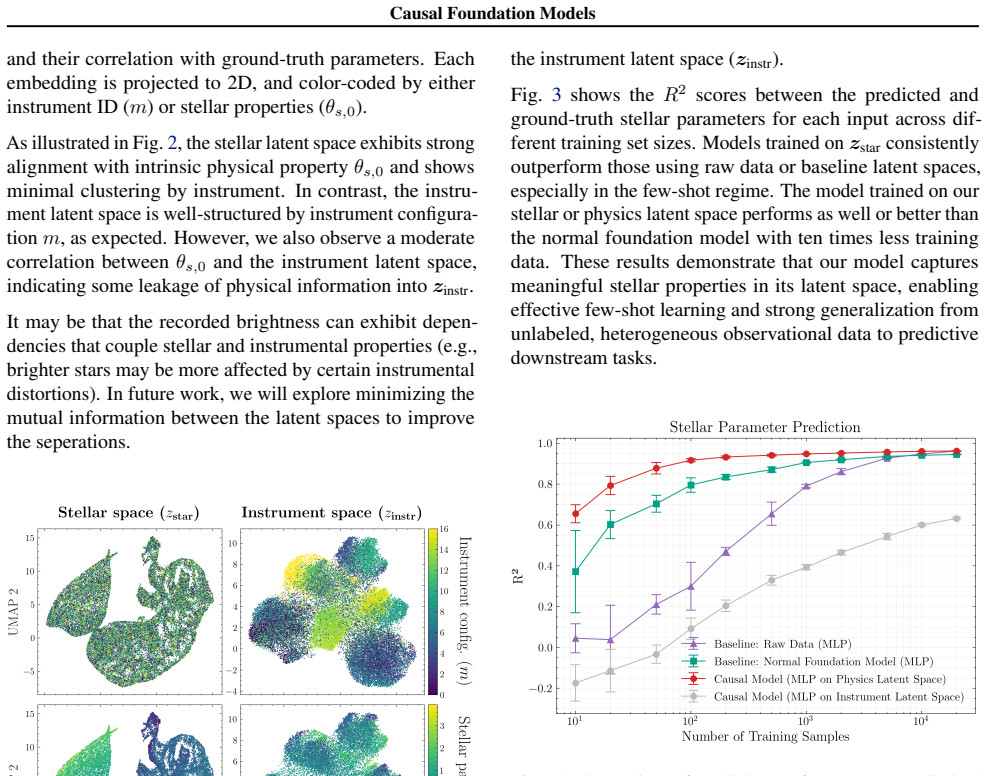
The central claim is that a dual-encoder architecture trained with star/instrument triplet contrastive learning can produce a stellar latent $z_{\rm star}$ that is nearly free of instrument effects and an instrument latent $z_{\rm instr}$ that captures systematic distortions, on synthetic light curves generated from Fourier stellar signals modulated by instrument-specific scale and offset. On a downstream regression of the stellar parameter $\theta_{s,0}$, the stellar-latent representation decisively beats both raw data and a matched single-latent foundation model, particularly with very small labeled training sets. The paper also notes a moderate correlation between $\theta_{s,0}$ and $z_{\rm instr}$, so the disentanglement is partial rather than complete.
Load-bearing premise
The load-bearing premise is that every observation cleanly belongs to one star ID and one instrument ID, and that instrument effects are smooth per-instrument functions; if real instruments behave as many context-dependent distortions, the instrument latent will absorb part of the physics.
Editorial extensions
If this is right
- A stellar latent trained this way can be reused as a frozen feature space for downstream physics, cutting labeled-data requirements by about an order of magnitude.
- Because the objective uses only metadata, unlabeled multi-instrument surveys can supply the triplets for pretraining without any physical labels.
- The instrument latent itself becomes a compact descriptor of systematic distortions, which could support calibration, anomaly detection, or transfer between surveys.
- The disentanglement effect persists with simpler MLP encoders, so the result should transfer to other structured time-series domains.
Reading between the lines
- A direct extension is to replace the discrete instrument-ID labels with continuous context embeddings (pointing, cadence, attitude) and test whether the observed leakage of $\theta_{s,0}$ into $z_{\rm instr}$ drops.
- The same triplet structure appears wherever one object is measured by multiple sensors — medical imaging, remote sensing, genomics batch effects — so the method should transfer to those domains with the labels replaced by battery, plate, or visit identifiers.
- If the leakage is intrinsic to the generative model (brightness couples to instrument distortion), then the current architecture may need a mutual-information penalty, which the paper flags as future work, before real survey data will show clean disentanglement.
Editorial analysis
A structured set of objections, weighed in public.
Referee Report
Summary. The paper proposes a dual-encoder foundation model for astronomical light curves in which one latent space is trained to encode stellar physics and another to encode instrument effects, using two InfoNCE losses built from same-star and same-instrument contrastive pairs plus a reconstruction loss. The method is evaluated on a simulated dataset of 40,000 light curves generated from 2,000 stars and 17 instrument configurations. The central claim, stated in the abstract and Section 4.2, is that the stellar latent representation outperforms a single-latent baseline on few-shot prediction of the primary stellar parameter θs,0, achieving comparable R² with roughly ten times less training data. The manuscript also reports UMAP visualizations and an acknowledged moderate leakage of θs,0 into the instrument latent space. The empirical evaluation is closed-loop within the paper's own generative model; there is no derivational circularity, since the downstream target is an input to the simulator and the model is learned rather than fitted to a known equation.
Significance. If the few-shot advantage survives a fair comparison and transfer to real survey data, the paper would provide a useful demonstration that structured, causality-motivated contrastive objectives can yield sample-efficient and interpretable latent spaces for time-series foundation models. The central contribution is clearly specified: a concrete architecture, an explicit triplet construction, and a falsifiable claim about data efficiency. The paper is also honest about the observed leakage into the instrument latent space, which is a strength relative to papers that report only qualitative UMAP separation. However, the significance is currently limited by the simulated-only evaluation, the asymmetric baseline, and the absence of quantitative disentanglement metrics. The method is plausible and the claims are testable, but the evidence presented does not yet establish that the benefit comes from causal disentanglement rather than from the additional supervision signal provided by instrument metadata.
major comments (4)
- [Section 4.2, Fig. 3] The comparison against the single-latent baseline is not a fair test of disentanglement. The baseline is described in one sentence as 'identical architecture but a single shared latent space, trained with contrastive learning over same-star pairs only,' meaning it receives only same-star positives and has no instrument-identity objective. The proposed model receives both same-star and same-instrument positives, so it has strictly more supervision about which factors of variation are shared. The headline 'ten times less training data' claim in Fig. 3 could therefore reflect the extra contrastive signal rather than the dual-latent disentanglement. Please add a single-latent baseline that also consumes the instrument metadata (for example, a single latent trained with both same-star and same-instrument contrastive pairs) and an ablation that removes L_instr from the proposed model, and report whether the few-shot gain persists.
- [Section 4.1 and Eq. 5] The paper acknowledges a 'moderate correlation between θs,0 and the instrument latent space' but never quantifies it. Since Section 4.2 explicitly evaluates an MLP on z_instr and Fig. 3 includes the instrument latent curve, the R² values for z_instr must be reported. If z_instr achieves non-negligible R² for θs,0, then z_star is not the only carrier of physical information, and the apparent few-shot benefit may arise from a more linearly accessible geometry rather than from actual separation of physical and instrumental factors. Please report quantitative disentanglement metrics on held-out data, such as R² of θs,0 from z_instr, instrument classification accuracy from z_star, and an estimate of mutual information between the two latents.
- [Section 2, Eqs. 3–4] The instrument model is a discrete, deterministic function of the instrument index m: each instrument m has one fixed scale S_m(t) and offset O_m(t), so instrument identity exactly determines the distortion. In the simulator, the contrastive positives built from the label m are therefore exact. Real survey systematics are continuous and context-dependent (cadence, pointing, pixel masks, spacecraft attitude), and the same detector can produce many distinct distortion signatures. The paper's broad generalization claims in the abstract and Section 5 require either a clear scope statement that the method targets settings where discrete instrument identity is a good proxy for distortion class, or additional simulations with observation-dependent instrument coefficients (e.g., β_{m,j}+δ_{n,j} with per-observation draws) to show that the method degrades gracefully when the identity partition is approximate.
- [Section 4.2, Fig. 3] The quantitative support for the 'ten times less training data' claim is incomplete. The figure shows mean and standard deviation across five runs, but the text does not report the actual R² values or the standard deviations at the crossover point, nor does it state how 'as well or better' is defined (e.g., R² within 0.01, or a statistical test). Please report per-training-set-size R² with confidence intervals, the number of downstream seeds, and a significance test for the difference between z_star and the baseline at each label budget. Without these numbers, a reader cannot assess whether the reported advantage is robust or within run-to-run noise.
minor comments (7)
- [Eq. (1)] The clipping is applied before adding the noise ε, so the final observation is not actually bounded to [-1,1] as stated in the text; if bounded data are intended, the clip should be applied to the sum including ε.
- [Section 2, Eq. (2)] The parameter values used in the experiments are under-specified: the text gives K=13, M=17, and T=100, but the reduction factor λ, the spectral decay exponent α, the distribution of the stellar parameters θs,k, and the exact values of the loss weights are not fully stated in the main text.
- [Appendix B] The encoder is credited to 'Gregory et al., in prep.', but no corresponding reference appears in the reference list; please add the full citation or remove the author-year attribution.
- [Section 4.1] There is a typo: 'seperations' should be 'separations'.
- [Fig. 3] The figure caption says data points indicate mean and standard deviation across five runs, but the figure itself is not reproduced in the text; in the final version, please ensure error bars or shaded regions are visible and that axis labels and units are included.
- [Section 5] The sentence 'Our preliminary experiments on NASA TESS light curves demonstrate the method's potential for real-world application' is not supported by any result in this paper; either include the experiment or refrain from claiming it.
- [Abstract] The phrase 'significantly outperforms traditional single-latent space foundation models' overstates the evidence, which is based on a single baseline in one simulated setting; consider replacing 'traditional' with 'a single-latent baseline'.
Circularity Check
No significant circularity: the learned latents are not fitted to the downstream target and the evaluation is empirical, though closed-loop.
full rationale
The paper's derivation chain is self-contained and non-circular. The generative model in Eqs. 1-4 produces observed light curves from stellar parameters θ_{s,k} and instrument parameters β,γ; the dual encoders are trained with reconstruction and contrastive losses (Eqs. 7-11), none of which uses the downstream target θ_{s,0} as supervision. The downstream evaluation in Section 4.2 fits an MLP on held-out latent embeddings and compares R² across four input representations. Because θ_{s,0} enters the simulator as ground truth and is not an input to the contrastive objective, the high correlation of z_star with θ_{s,0} is an empirical consequence of the generative structure, not a fitted identity. The baseline comparison may be unfair (the single-latent baseline is trained with same-star positives only and lacks any instrument-invariance objective), and Section 4.1 explicitly reports physical leakage into z_instr ('moderate correlation between θs,0 and the instrument latent space'), but these are validity concerns, not circularity. The one self-citation (Gregory et al., in prep.) supports the encoder architecture and is not load-bearing for the disentanglement claim. No step in the derivation reduces by construction to its own inputs.
Assumptions & free parameters
free parameters (7)
- period reduction factor λ =
not reported
- spectral decay exponent α =
not reported
- Gaussian noise scale ε =
0.03
- instrument distortion amplitude and coefficients =
0.05 with β, γ ~ N(0, 1)
- simulation geometry =
40,000 light curves, 2,000 stars, 17 instruments, T=100, K=13
- loss weights λ_recon, λ_star, λ_instr =
1.0, 1.0, 1.0
- InfoNCE temperature τ =
not reported
assumptions (5)
- domain assumption Observational data contain natural triplets: the same target under varying instruments and distinct targets under a shared instrument.
- domain assumption The observed signal factorizes as a multiplicative scale plus additive offset of the true stellar signal (Eq. 1).
- ad hoc to paper Training with identity-based contrastive losses is enough to obtain separate physical and instrumental latent spaces.
- domain assumption The simulated Fourier-series light curves adequately capture the complexity of real TESS variable-star observations.
- domain assumption The single-latent baseline is a fair and sufficiently strong comparator.
Cite this review
Pith. "Pith review of Causal Foundation Models: Disentangling Physics from Instrument Properties." pith.science (2026). https://pith.science/paper/2PHNA2DG
@misc{pith2026250705333,
  author       = {Pith},
  title        = {Pith review of: Causal Foundation Models: Disentangling Physics from Instrument Properties},
  year         = {2026},
  howpublished = {\url{https://pith.science/paper/2PHNA2DG}},
  note         = {Machine review of arXiv:2507.05333}
}
read the original abstract
Foundation models for structured time series data must contend with a fundamental challenge: observations often conflate the true underlying physical phenomena with systematic distortions introduced by measurement instruments. This entanglement limits model generalization, especially in heterogeneous or multi-instrument settings. We present a causally-motivated foundation model that explicitly disentangles physical and instrumental factors using a dual-encoder architecture trained with structured contrastive learning. Leveraging naturally occurring observational triplets (i.e., where the same target is measured under varying conditions, and distinct targets are measured under shared conditions) our model learns separate latent representations for the underlying physical signal and instrument effects. Evaluated on simulated astronomical time series designed to resemble the complexity of variable stars observed by missions like NASA's Transiting Exoplanet Survey Satellite (TESS), our method significantly outperforms traditional single-latent space foundation models on downstream prediction tasks, particularly in low-data regimes. These results demonstrate that our model supports key capabilities of foundation models, including few-shot generalization and efficient adaptation, and highlight the importance of encoding causal structure into representation learning for structured data.
Figures


Figures from the paper (1 more)

Forward citations
Cited by 1 Pith paper
-
Learning What's Real: Disentangling Signal and Measurement Artifacts in Multi-Sensor Data, with Applications to Astrophysics
Overlapping multi-instrument galaxy images plus dual encoders and flow-matching counterfactual generation yield physics latents unconfounded by sensor artifacts.
Reference graph
Works this paper leans on
-
[4]
URL https: //arxiv.org/abs/2402.03885. Gulati, A., Qin, J., Chiu, C.-C., Parmar, N., Zhang, Y ., Yu, J., Han, W., Wang, S., Zhang, Z., Wu, Y ., and Pang, R. Conformer: Convolution-augmented trans- former for speech recognition,
-
[5]
McInnes, L., Healy, J., and Melville, J
URL https: //arxiv.org/abs/2005.08100. McInnes, L., Healy, J., and Melville, J. UMAP: Uniform Manifold Approximation and Projection for Dimension Reduction.ArXiv e-prints, February
arXiv 2005
-
[6]
doi: 10.1093/mnras/stae068. Parker, L., Lanusse, F., Golkar, S., Sarra, L., Cranmer, M., Bietti, A., Eickenberg, M., Krawezik, G., McCabe, M., Morel, R., Ohana, R., Pettee, M., R´egaldo-Saint Blancard, B., Cho, K., Ho, S., and Polymathic AI Collaboration. AstroCLIP: a cross-modal foundation model for galaxies. Monthly Notices of the Royal Astronomical Soc...
-
[7]
doi: 10.1093/mnras/stae1450. Ricker, G. R., Winn, J. N., Vanderspek, R., Latham, D. W., Bakos, G. ´A., Bean, J. L., Berta-Thompson, Z. K., Brown, T. M., Buchhave, L., Butler, N. R., Butler, R. P., Chap- lin, W. J., Charbonneau, D., Christensen-Dalsgaard, J., Clampin, M., Deming, D., Doty, J., De Lee, N., Dressing, C., Dunham, E. W., Endl, M., Fressin, F.,...
-
[9]
doi: 10.48550/arXiv. 2411.08842. Sch¨olkopf, B., Hogg, D. W., Wang, D., Foreman- Mackey, D., Janzing, D., Simon-Gabriel, C.-J., and Pe- ters, J. Modeling confounding by half-sibling regres- sion.Proceedings of the National Academy of Sci- ences, 113(27):7391–7398,
-
[12]
Zhang, G., Helfer, T., Gagliano, A
URL https://arxiv.org/ abs/2412.02527. Zhang, G., Helfer, T., Gagliano, A. T., Mishra-Sharma, S., and Ashley Villar, V . Maven: a multimodal foundation model for supernova science.Machine Learning: Science and Technology, 5(4):045069, December
-
[13]
for astronomical data from Pan et al. (2024). Implementation Details:Each encoder (as illustrated in Fig
work page 2024
- [2015]
Show all 13 references
-
[2016]
1511656113
doi: 10.1073/pnas. 1511656113. URL https://www.pnas.org/doi/ abs/10.1073/pnas.1511656113. Sch¨olkopf, B., Locatello, F., Bauer, S., Ke, N. R., Kalch- brenner, N., Goyal, A., and Bengio, Y . Toward causal representation learning.Proceedings of the IEEE, 109(5): 612–634,
- [2020]
-
[2021]
The Multimodal Universe Collaboration, Angeloudi, E., Audenaert, J., Bowles, M., Boyd, B
doi: 10.1109/JPROC.2021.3058954. The Multimodal Universe Collaboration, Angeloudi, E., Audenaert, J., Bowles, M., Boyd, B. M., Chemaly, D., Cherinka, B., Ciuca, I., Cranmer, M., Do, A., Grayling, M., et al. The multimodal universe: Enabling large- scale machine learning with 1...
2021
-
[2024]
URL https://arxiv.org/abs/2310. 10688. Euclid Collaboration, Siudek, M., Huertas-Company, M., Smith, M., Martinez-Solaeche, G., Lanusse, F., Ho, S., Angeloudi, E., Cunha, P. A. C., Dom´ınguez S´anchez, H., Dunn, M., Fu, Y ., Iglesias-Navarro, P., Junais, J., Knapen, J. H., Lal...
-
[2025]
Goswami, M., Szafer, K., Choudhry, A., Cai, Y ., Li, S., 5 Causal Foundation Models and Dubrawski, A
doi: 10.48550/arXiv.2503.15312. Goswami, M., Szafer, K., Choudhry, A., Cai, Y ., Li, S., 5 Causal Foundation Models and Dubrawski, A. Moment: A family of open time- series foundation models. InForty-first International Conference on Machine Learning International Con- ference ...
Reviewed August 6, 2026 · model on record in the stance chip above.
Discussion (0). Sign in to comment.