REVIEW 1 major objections 3 minor 67 references
A periodic drive cannot push the zero-frequency current noise in the hottest contact beyond a weighted sum of Floquet-band currents; in the large-temperature-bias limit that weighted sum is the dissipated power.
Reviewed by Pith at T0; open to challenge. T0 means a machine referee read the full paper against a public rubric. the ladder, T0–T4 →
T0 review · deepseek-v4-flash
2026-08-04 21:55 UTC pith:2QIUNOOD
load-bearing objection A solid, clearly scoped extension of the static FDB to Floquet-driven conductors; the main bound is correct within its stated hottest-contact restriction. the 1 major comments →
Fluctuation-dissipation bounds for time-dependently driven conductors
The pith
A machine-rendered reading of the paper's core claim, the machinery that carries it, and where it could break.
Core claim
The central claim is that for any multi-terminal, multi-channel coherent conductor described by a Floquet scattering matrix, the excess noise obeys S_αα - 2k_B T_α Σ_{β≠α} G_αβ ≤ q Σ_{β,k} (1 - 2f_α(ε_βk)) I_αβ,k, where the noise is measured in the hottest contact α. The left side compares the full nonequilibrium zero-frequency noise S_αα with the thermal noise set by the linear conductances G_αβ computed in the presence of driving. The right side is a sum over contacts β and Floquet index k of contact-resolved current components I_αβ,k, multiplied by the factor 1 - 2f_α evaluated at the energy ε_βk where the shifted Fermi function of contact β crosses the Fermi function of the hot measureme
What carries the argument
The Floquet scattering matrix, which assigns to each incoming energy from one contact the amplitude for an excitation to leave another contact after exchanging an integer number of drive quanta, is the object through which all currents, conductances, and noise are expressed. The load-bearing step is the crossing-energy argument: for T_α > T_β, the difference f_β(E_k) - f_α(E) changes sign at a unique energy ε_βk, and because 1 - 2f_α(E) is monotone in energy, that factor can be pulled out of the energy integral with the correct sign. A second mechanism is the effective distribution f⋆_α(E), a transmission-weighted average of the incoming Fermi functions of the other contacts; its odd number
Load-bearing premise
The measurement contact has to be the hottest one; if the noise is measured in a contact colder than some other contact, the sign argument at the Fermi-function crossings stops working and the stated bound is not proven.
What would settle it
Take the two-terminal ac-driven setup of Sec. IV but reverse the temperature ordering so the noise is measured in the colder contact, then evaluate both sides of Eq. (15) from the Floquet scattering matrix over a range of driving amplitudes, bias voltages, and transmission functions. A single parameter set in which S_αα - 2k_B T_α Σ_{β≠α} G_αβ exceeds q Σ_{β,k} (1 - 2f_α(ε_βk)) I_αβ,k would show that the hot-contact assumption is load-bearing. For the hot-contact case, a violation for any unitary scattering matrix would disprove the claim.
If this is right
- The static fluctuation-dissipation bound is recovered when the periodic driving is switched off, so the new inequality is a strict extension rather than a competing result.
- Noise constraints now apply to arbitrary periodic driving, including gate modulations of the central conductor, ac bias voltages, and time-dependent temperatures, with screening potentials included at mean-field level.
- In the large-temperature-bias regime the bound can be evaluated from time-averaged dissipated powers alone, without resolving the individual Floquet components of the current.
- The intersection bound constrains excess noise from the crossing structure of effective nonthermal distributions, and the paper anticipates its use for generic nonthermal reservoirs beyond time-dependent driving.
Where Pith is reading between the lines
- Beyond the paper: the same crossing argument might yield a bound for contacts that are not the hottest by replacing the reference distribution with one that dominates the effective distribution at both energy extremes, which would broaden the bound's practical range.
- Beyond the paper: in driven heat engines, the large-temperature-bias form suggests a measurable figure of merit—excess noise divided by dissipated power—bounded by q^2/(k_B ΔT), testable without Floquet-resolved measurements.
- Beyond the paper: saturation of the intersection bound could serve as a diagnostic for nonthermal states, allowing one to infer the crossing energies of the effective distribution from noise measurements alone.
Editorial analysis
A structured set of objections, weighed in public.
Referee Report
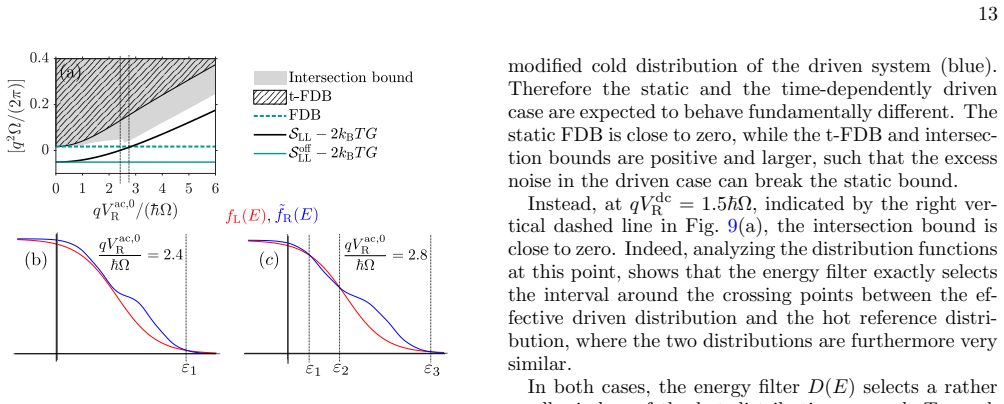
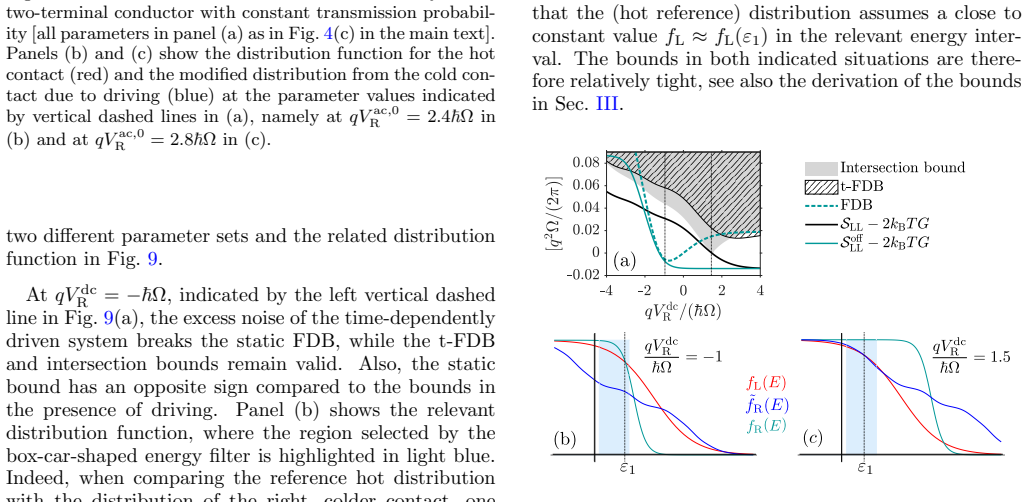
Summary. This paper derives upper bounds on the zero-frequency charge-current noise of multi-terminal, multi-channel coherent conductors subject to arbitrary periodic time-dependent driving and to static voltage and temperature biases. The central result is Eq. (15), the time-dependent fluctuation-dissipation bound (t-FDB), which bounds the excess noise S_alpha-alpha - 2 k_B T_alpha sum_{beta neq alpha} G_alpha_beta by a weighted sum of Floquet-resolved current components I_alpha_beta,k, under the condition that the noise is measured in the hottest contact. In the large-temperature-bias limit the bound is recast in terms of dissipated powers due to static bias and driving, Eq. (21). A complementary 'intersection bound', Eq. (23), based on crossings between effective driven distributions and the hot reference distribution, is also derived and is often tighter. The bounds are illustrated on a two-terminal ac-biased conductor for cosine, Lorentzian, and square drives, with constant and energy-filtered transmissions.
Significance. If the proof is corrected, this is a substantial extension of the static fluctuation-dissipation bound of Ref. [34] to arbitrary time-dependent driving, with no weak-coupling or close-to-equilibrium assumptions. The large-temperature-bias power interpretation and the explicit two-terminal examples with different driving shapes and energy filters make the results concrete and experimentally relevant. The derivation is self-contained and parameter-free, and the paper gives a clear physical picture of when the static FDB fails under driving. The main caveats are the proof error in Appendix C identified below and the explicitly stated but easily overlooked restriction to measurement in the hottest contact.
major comments (1)
- [Appendix C, Eqs. (C2) and (C3)] As printed, the Cauchy-Schwarz step has the channel number N_alpha in the numerator instead of the denominator. The correct projection bound is S^(4,2)_alpha_alpha <= -(q^2/(h N_alpha)) integral dE |Tr{tilde t_alpha_beta(E,E_k) tilde t^dagger_alpha_beta(E,E_k)} f_beta(E_k)|^2, with implicit sums over beta,k. A concrete static counterexample to the printed inequality is a two-terminal, two-channel conductor with P_L = diag(1,0), P_R = diag(0,1), f_L = 0.5, f_R = 0.9 at the relevant energy. Then S^(4,2)_LL = -(q^2/h)(0.25+0.81) = -1.06 q^2/h, while the printed right-hand side is -(q^2/h) N_L (0.5+0.9)^2 = -3.92 q^2/h, so the inequality fails. Replacing N_alpha by 1/N_alpha gives -0.98 q^2/h, which is consistent with the Cauchy-Schwarz lower bound. This error appears again in the quadratic term of Eq. (C3). Because that term is dropped in the subsequent step, the final bound (13) survives t
minor comments (3)
- [Abstract and Sec. V] The t-FDB (15) is derived only when the measurement contact alpha is the hottest one, T_alpha > T_beta for all beta neq alpha. This condition is stated in Sec. II B and used in Sec. III A, but the abstract and conclusions present the result without it. Please add the qualifier prominently, since the bound is not proven for colder or intermediate measurement contacts.
- [Sec. I and Abstract] Minor typos: 'how the the power and current fluctuations' in the Introduction and 'afluctuation-dissipation bound' in the abstract.
- [Sec. III C] The derivation of the intersection bound (23) is quite compressed. A short appendix showing the interval-wise replacement of 1-2f_alpha(E) by its value at the crossing points would improve verifiability, especially since the number and ordering of crossings is central to the statement.
Circularity Check
No significant circularity: the t-FDB is derived from the scattering-theory noise expression via Cauchy-Schwarz and Fermi-function crossing arguments, with no fitted parameter or self-citation serving as the load-bearing step.
full rationale
The central bound Eq. (15) is obtained by starting from the exact Floquet scattering expression for the zero-frequency noise Eq. (10), splitting S^(4) and applying the Cauchy-Schwarz inequality in Appendix C (Eqs. C1-C5) to obtain Eq. (13). The replacement of 1-2f_alpha(E) by its value at the crossing energy epsilon_beta k is justified by the monotonicity of 1-2f_alpha and the single-crossing property of f_beta(E_k)-f_alpha(E) under the explicit assumption T_alpha > T_beta (Eq. 14 and Fig. 2a). No parameter is fitted, and the bound is expressed in terms of independently defined Floquet current components I_alpha beta,k (Eq. 16). The reduction to the static FDB of Ref. [34] in the absence of driving is presented as a consistency check, not used as an input; the power identities (19)-(20) are derived in Appendix B from Floquet unitarity and time-reversal properties. The only notable limitation is the stated hottest-contact assumption for measuring contact alpha; this is a scope restriction acknowledged in the text, and outside that scope the proof of Eq. (15) does not go through, but this is not a circularity. The self-citation of Ref. [34] is not load-bearing because the present derivation does not assume its result.
Axiom & Free-Parameter Ledger
axioms (5)
- domain assumption Floquet scattering matrix is unitary: Σ_{β,p} t̃†_{αβ}(E_ℓ, E_p) t̃_{αβ}(E_k, E_p) = δ_{kℓ} 1_α (Appendix A, Eq. A4).
- domain assumption Contacts are ideal reservoirs with Fermi functions f_α(E) characterized by T_α = T̄ + ΔT_α and μ_α = μ̄ + q V_α^dc (Sec. II A).
- domain assumption The driving is periodic with period T = 2π/Ω, so that the scattering matrix has a Floquet decomposition and the potential can be expanded as X(t) = Σ_n e^{-inΩt} X_n (Sec. II A).
- domain assumption Interactions between quasiparticles are neglected beyond mean field; the noise autocorrelation factorizes into products of scattering amplitudes and Fermi functions (Eqs. 2, 10).
- domain assumption Noise is measured in the hottest contact, T_α > T_β for all β≠α, and the hot and cold Fermi functions cross at a single energy ε_βk for each Floquet band k (Sec. III A).
Cite this review
Pith. "Pith review of Fluctuation-dissipation bounds for time-dependently driven conductors." pith.science (2026). https://pith.science/paper/2QIUNOOD
@misc{pith2026250907583,
  author       = {Pith},
  title        = {Pith review of: Fluctuation-dissipation bounds for time-dependently driven conductors},
  year         = {2026},
  howpublished = {\url{https://pith.science/paper/2QIUNOOD}},
  note         = {Machine review of arXiv:2509.07583}
}
read the original abstract
We analyze the noise in a multi-terminal multi-channel conductor under arbitrary time-dependent driving and subject to -- possibly large -- static potential and temperature biases. We show that the full out-of-equilibrium zero-frequency noise is constrained by a fluctuation-dissipation bound. It consists of an upper bound expressed in terms of weighted current components of the separate Floquet bands arising from the time-dependent driving. In the limit of large static temperature bias, it has an intuitive interpretation in terms of the dissipated powers due to the static potential bias and due to the time-dependent driving. Furthermore, we show the existence of a second bound that relies on the specific shape of the electron distribution resulting from the driving, which is often even tighter than the fluctuation-dissipation bound. We show the implications of our bounds at the simple, but experimentally relevant example of a two-terminal conductor in the presence of an ac bias.
Figures


Reference graph
Works this paper leans on
-
[1]
To show them, we start from the definitions in Eqs
Floquet coefficients The Floquet coefficients fulfill some important prop- erties. To show them, we start from the definitions in Eqs. (4). First, we demonstrate the sum rule X k c∗ α(k+p)cα(k+ℓ) = = Z T 0 dt T Z T 0 dt′ T X k eiϕα(t′)e−i(k+p)Ωt′ e−iϕα(t)ei(k+ℓ)Ωt = Z T 0 dt T e−i(p−ℓ)Ωt =δ pℓ (A1) Furthermore, we demonstrate a relation needed to ex- pres...
-
[2]
Unitarity of Floquet scattering matrix The Floquet scattering matrix fulfills the unitarity con- dition X β,p ˜t† αβ(Eℓ, Ep)˜tαβ(Ek, Ep) =δ kℓ1α (A4) here written for the submatrices ˜tαβ with [ ˜tαβ]nm = ˜sαn,βm, with1 α the unit matrix of dimensionN α. Appendix B: Power due to driving and static biases We need the expressions for the power in order to i...
-
[3]
Sharp features in intersection bound In Figs. 4 and 5, the intersection bound displays dis- continuities as function of different externally tunable parameters. This can be explained by examining how crossings between the hot reference distribution and the effective distribution of the driven contact appear and disappear as function of those parameters. I...
-
[4]
Crossing points and energy-dependent transmission How tight the different bounds are and in which hierar- chy they occur depends strongly on the energy-filtering properties of the transmission functions, as can be ob- served when comparing Fig. 4 with 5. We show this for 13 Figure 8. Excess noise and bounds for a harmonically driven two-terminal conductor...
-
[5]
Fundamental aspects of steady- state conversion of heat to work at the nanoscale,
Giuliano Benenti, Giulio Casati, Keiji Saito, and Robert S. Whitney, “Fundamental aspects of steady- state conversion of heat to work at the nanoscale,” Phys. Rep.694, 1–124 (2017)
work page 2017
-
[6]
Quantum thermodynamics of nanoscale thermoelectrics and electronic devices
Robert S. Whitney, Rafael S´ anchez, and Janine Splettstoesser, “Quantum thermodynamics of nanoscale thermoelectrics and electronic devices,” arXiv (2018), 1805.04297
work page internal anchor Pith review Pith/arXiv arXiv 2018
-
[7]
Quantum engines and refrigerators,
Loris Maria Cangemi, Chitrak Bhadra, and Amikam Levy, “Quantum engines and refrigerators,” Phys. Rep. 1087, 1–71 (2024)
work page 2024
-
[8]
Quantum thermocouples: nonlocal conversion and control of heat in nanostructures
Jos´ e Balduque and Rafael S´ anchez, “Quantum ther- mocouples: nonlocal conversion and control of heat in semiconductor nanostructures,” arXiv (2025), 10.48550/arXiv.2504.09121, 2504.09121
work page internal anchor Pith review Pith/arXiv arXiv doi:10.48550/arxiv.2504.09121 2025
-
[9]
Opportu- nities for mesoscopics in thermometry and refrigeration: 14 Physics and applications,
Francesco Giazotto, Tero T. Heikkil¨ a, Arttu Luukanen, Alexander M. Savin, and Jukka P. Pekola, “Opportu- nities for mesoscopics in thermometry and refrigeration: 14 Physics and applications,” Rev. Mod. Phys.78, 217–274 (2006)
work page 2006
-
[10]
Single-electron current sources: To- ward a refined definition of the ampere,
Jukka P. Pekola, Olli-Pentti Saira, Ville F. Maisi, Antti Kemppinen, Mikko M¨ ott¨ onen, Yuri A. Pashkin, and Dmitri V. Averin, “Single-electron current sources: To- ward a refined definition of the ampere,” Rev. Mod. Phys. 85, 1421–1472 (2013)
work page 2013
-
[11]
Hermann Edlbauer, Junliang Wang, Thierry Crozes, Pierre Perrier, Seddik Ouacel, Cl´ ement Geffroy, Gior- gos Georgiou, Eleni Chatzikyriakou, Antonio Lacerda- Santos, Xavier Waintal, D. Christian Glattli, Pre- den Roulleau, Jayshankar Nath, Masaya Kataoka, Janine Splettstoesser, Matteo Acciai, Maria Cecilia da Silva Figueira, Kemal ¨Oztas, Alex Trellakis, ...
work page 2022
-
[12]
Shot noise in meso- scopic conductors,
Ya. M. Blanter and M. B¨ uttiker, “Shot noise in meso- scopic conductors,” Phys. Rep.336, 1–166 (2000)
2000
-
[13]
Shot Noise in Mesoscopic Systems: From Single Particles to Quantum Liquids,
Kensuke Kobayashi and Masayuki Hashisaka, “Shot Noise in Mesoscopic Systems: From Single Particles to Quantum Liquids,” J. Phys. Soc. Jpn.90, 102001 (2021)
work page 2021
-
[14]
Irreversibil- ity and Generalized Noise,
Herbert B. Callen and Theodore A. Welton, “Irreversibil- ity and Generalized Noise,” Phys. Rev.83, 34–40 (1951)
work page 1951
-
[15]
Melville S. Green, “Markoff Random Processes and the Statistical Mechanics of Time-Dependent Phenomena. II. Irreversible Processes in Fluids,” J. Chem. Phys.22, 398– 413 (1954)
work page 1954
-
[16]
Ryogo Kubo, “Statistical-Mechanical Theory of Irre- versible Processes. I. General Theory and Simple Appli- cations to Magnetic and Conduction Problems,” J. Phys. Soc. Jpn.12, 570–586 (1957)
work page 1957
-
[17]
Nonequilibrium fluctuations, fluctuation the- orems, and counting statistics in quantum systems,
Massimiliano Esposito, Upendra Harbola, and Shaul Mukamel, “Nonequilibrium fluctuations, fluctuation the- orems, and counting statistics in quantum systems,” Rev. Mod. Phys.81, 1665–1702 (2009)
2009
-
[18]
Fluctuation phenomena in tunnel junctions,
D. Rogovin and D. J. Scalapino, “Fluctuation phenomena in tunnel junctions,” Ann. Phys.86, 1–90 (1974)
work page 1974
-
[19]
Counting statistics of tunneling current,
L. S. Levitov and M. Reznikov, “Counting statistics of tunneling current,” Phys. Rev. B70, 115305 (2004)
work page 2004
-
[20]
Fluctuation theo- rem for transport in mesoscopic systems,
David Andrieux and Pierre Gaspard, “Fluctuation theo- rem for transport in mesoscopic systems,” J. Stat. Mech.: Theory Exp.2006, P01011 (2006)
work page 2006
-
[21]
Time-dependent Transport in arbitrary extended driven tunnel junctions
Ines Safi, “Time-dependent Transport in arbitrary extended driven tunnel junctions,” arXiv (2014), 10.48550/arXiv.1401.5950, 1401.5950
work page internal anchor Pith review Pith/arXiv arXiv doi:10.48550/arxiv.1401.5950 2014
-
[22]
Trans- port fluctuation relations in interacting quantum pumps,
Roman-Pascal Riwar and Janine Splettstoesser, “Trans- port fluctuation relations in interacting quantum pumps,” New J. Phys.23, 013010 (2021)
work page 2021
-
[23]
Fluctuation-Dissipation Relations Far from Equilibrium,
Bernhard Altaner, Matteo Polettini, and Massimiliano Esposito, “Fluctuation-Dissipation Relations Far from Equilibrium,” Phys. Rev. Lett.117, 180601 (2016)
2016
-
[24]
Naoto Shiraishi, “Time-Symmetric Current and Its Fluctuation Response Relation around Nonequilibrium Stalling Stationary State,” Phys. Rev. Lett.129, 020602 (2022)
work page 2022
-
[25]
J. Tobiska and Yu. V. Nazarov, “Inelastic interaction cor- rections and universal relations for full counting statistics in a quantum contact,” Phys. Rev. B72, 235328 (2005)
work page 2005
-
[26]
Fluctuation Relations Without Microreversibility in Nonlinear Transport,
H. F¨ orster and M. B¨ uttiker, “Fluctuation Relations Without Microreversibility in Nonlinear Transport,” Phys. Rev. Lett.101, 136805 (2008)
work page 2008
-
[27]
Bidirectional single-electron counting and the fluctuation theorem,
Y. Utsumi, D. S. Golubev, M. Marthaler, K. Saito, T. Fu- jisawa, and Gerd Sch¨ on, “Bidirectional single-electron counting and the fluctuation theorem,” Phys. Rev. B81, 125331 (2010)
work page 2010
-
[28]
Current Fluctuations in Open Quantum Systems: Bridging the Gap Between Quantum Continuous Measurements and Full Counting Statistics,
Gabriel T. Landi, Michael J. Kewming, Mark T. Mitchi- son, and Patrick P. Potts, “Current Fluctuations in Open Quantum Systems: Bridging the Gap Between Quantum Continuous Measurements and Full Counting Statistics,” PRX Quantum5, 020201 (2024)
2024
-
[29]
Thermodynamic Un- certainty Relation for Biomolecular Processes,
Andre C. Barato and Udo Seifert, “Thermodynamic Un- certainty Relation for Biomolecular Processes,” Phys. Rev. Lett.114, 158101 (2015)
2015
-
[30]
Dissipation Bounds All Steady-State Current Fluctuations,
Todd R. Gingrich, Jordan M. Horowitz, Nikolay Pe- runov, and Jeremy L. England, “Dissipation Bounds All Steady-State Current Fluctuations,” Phys. Rev. Lett. 116, 120601 (2016)
2016
-
[31]
Kinetic uncertainty relation,
Ivan Di Terlizzi and Marco Baiesi, “Kinetic uncertainty relation,” J. Phys. A: Math. Theor.52, 02LT03 (2018)
2018
-
[32]
Ther- modynamic Bounds on Precision in Ballistic Multitermi- nal Transport,
Kay Brandner, Taro Hanazato, and Keiji Saito, “Ther- modynamic Bounds on Precision in Ballistic Multitermi- nal Transport,” Phys. Rev. Lett.120, 090601 (2018)
2018
-
[33]
Kinetic uncertainty rela- tions for quantum transport,
Didrik Palmqvist, Ludovico Tesser, and Ja- nine Splettstoesser, “Kinetic uncertainty rela- tions for quantum transport,” arXiv (2024), 10.48550/arXiv.2410.10793, 2410.10793
-
[34]
Combining kinetic and thermodynamic uncertainty relations in quantum transport,
Didrik Palmqvist, Ludovico Tesser, and Janine Splettstoesser, “Combining kinetic and thermodynamic uncertainty relations in quantum transport,” Quantum Sci. Technol.10, 035059 (2025)
2025
-
[35]
Thermodynamic Uncer- tainty Relations for Coherent Transport,
Kay Brandner and Keiji Saito, “Thermodynamic Uncer- tainty Relations for Coherent Transport,” arXiv (2025), 10.48550/arXiv.2502.07917, 2502.07917
-
[36]
Quantum thermoelectric transmission functions with minimal current fluctuations,
Andr´ e M. Timpanaro, Giacomo Guarnieri, and Gabriel T. Landi, “Quantum thermoelectric transmission functions with minimal current fluctuations,” Phys. Rev. B111, 014301 (2025)
work page 2025
-
[37]
Thermodynamic bound on current fluctuations in coherent conductors,
Kay Brandner and Keiji Saito, “Thermodynamic bound on current fluctuations in coherent conductors,” arXiv (2025), 10.48550/arXiv.2507.01214, 2507.01214
-
[38]
Out-of- Equilibrium Fluctuation-Dissipation Bounds,
Ludovico Tesser and Janine Splettstoesser, “Out-of- Equilibrium Fluctuation-Dissipation Bounds,” Phys. Rev. Lett.132, 186304 (2024)
work page 2024
-
[39]
Thermodynamic bounds on coher- ent transport in periodically driven conductors,
Elina Potanina, Christian Flindt, Michael Moskalets, and Kay Brandner, “Thermodynamic bounds on coher- ent transport in periodically driven conductors,” Phys. Rev. X11, 021013 (2021)
work page 2021
-
[40]
Geometric thermodynamic un- certainty relation in a periodically driven thermoelectric heat engine,
Jincheng Lu, Zi Wang, Jiebin Peng, Chen Wang, Jian- Hua Jiang, and Jie Ren, “Geometric thermodynamic un- certainty relation in a periodically driven thermoelectric heat engine,” Phys. Rev. B105, 115428 (2022)
work page 2022
-
[41]
Thermodynamic and energetic constraints on transition probabilities of small-scale quantum systems,
Ludovico Tesser, Matteo Acciai, Christian Sp ˚ ansl¨ att, In` es Safi, and Janine Splettstoesser, “Thermodynamic and energetic constraints on transition probabilities of small-scale quantum systems,” Phys. Rev. Res.7, 023084 (2025)
work page 2025
-
[42]
Heat Pulses in Electron Quantum Optics,
Pedro Portugal, Fredrik Brange, and Christian Flindt, “Heat Pulses in Electron Quantum Optics,” Phys. Rev. Lett.132, 256301 (2024)
work page 2024
-
[43]
Theory of Thermal Transport Coeffi- cients,
J. M. Luttinger, “Theory of Thermal Transport Coeffi- cients,” Phys. Rev.135, A1505–A1514 (1964)
work page 1964
-
[44]
Gauge-invariant nonlinear electric transport in mesoscopic conductors,
T. Christen and M. B¨ uttiker, “Gauge-invariant nonlinear electric transport in mesoscopic conductors,” Europhys. Lett.35, 523 (1996)
work page 1996
-
[45]
Scattering Theory of 15 Nonlinear Thermoelectric Transport,
David S´ anchez and Rosa L´ opez, “Scattering Theory of 15 Nonlinear Thermoelectric Transport,” Phys. Rev. Lett. 110, 026804 (2013)
work page 2013
-
[46]
Scattering the- ory of nonlinear thermoelectricity in quantum coher- ent conductors,
Jonathan Meair and Philippe Jacquod, “Scattering the- ory of nonlinear thermoelectricity in quantum coher- ent conductors,” J. Phys.: Condens. Matter25, 082201 (2013)
work page 2013
-
[47]
Christophe Texier and Johannes Mitscherling, “Nonlin- ear conductance in weakly disordered mesoscopic wires: Interaction and magnetic field asymmetry,” Phys. Rev. B97, 075306 (2018)
work page 2018
-
[48]
Readout of Quantum Screening Effects Using a Time-Dependent Probe,
Nastaran Dashti, Matteo Acciai, Sara Kheradsoud, Maciej Misiorny, Peter Samuelsson, and Janine Splettstoesser, “Readout of Quantum Screening Effects Using a Time-Dependent Probe,” Phys. Rev. Lett.127, 246802 (2021)
work page 2021
-
[49]
Moskalets,Scattering Matrix Approach to Non-Stationary Quantum Transport(World Scientific Publishing Company, London, England, UK, 2011)
Michael V. Moskalets,Scattering Matrix Approach to Non-Stationary Quantum Transport(World Scientific Publishing Company, London, England, UK, 2011)
2011
-
[50]
P. K. Tien and J. P. Gordon, “Multiphoton Process Ob- served in the Interaction of Microwave Fields with the Tunneling between Superconductor Films,” Phys. Rev. 129, 647–651 (1963)
work page 1963
-
[51]
Solution of the Schr¨ odinger Equation with a Hamiltonian Periodic in Time,
Jon H. Shirley, “Solution of the Schr¨ odinger Equation with a Hamiltonian Periodic in Time,” Phys. Rev.138, B979–B987 (1965)
work page 1965
-
[52]
Thermal and electrical transport formal- ism for electronic microstructures with many terminals,
P. N. Butcher, “Thermal and electrical transport formal- ism for electronic microstructures with many terminals,” J. Phys.: Condens. Matter2, 4869 (1990)
work page 1990
-
[53]
General theory for thermal and nonthermal quantum linear engines,
Milton Aguilar and Juan Pablo Paz, “General theory for thermal and nonthermal quantum linear engines,” Phys. Rev. A105, 042219 (2022)
work page 2022
-
[54]
Correlated quantum ma- chines beyond the standard second law,
Milton Aguilar and Eric Lutz, “Correlated quantum ma- chines beyond the standard second law,” arXiv (2024), 10.48550/arXiv.2409.07899, 2409.07899
-
[55]
Nonequilibrium System as a Demon,
Rafael S´ anchez, Janine Splettstoesser, and Robert S. Whitney, “Nonequilibrium System as a Demon,” Phys. Rev. Lett.123, 216801 (2019)
work page 2019
-
[56]
Entropy current and efficiency of quantum machines driven by nonequilibrium incoherent reservoirs,
Sebastian E. Deghi and Ra´ ul A. Bustos-Mar´ un, “Entropy current and efficiency of quantum machines driven by nonequilibrium incoherent reservoirs,” Phys. Rev. B102, 045415 (2020)
work page 2020
-
[57]
Thermodynamic Performance of Hot- Carrier Solar Cells: A Quantum Transport Model,
Ludovico Tesser, Robert S. Whitney, and Janine Splettstoesser, “Thermodynamic Performance of Hot- Carrier Solar Cells: A Quantum Transport Model,” Phys. Rev. Appl.19, 044038 (2023)
work page 2023
-
[58]
Coherent states of alternating current,
D. A. Ivanov, H. W. Lee, and L. S. Levitov, “Coherent states of alternating current,” Phys. Rev. B56, 6839– 6850 (1997)
work page 1997
-
[59]
Minimal Ex- citation States of Electrons in One-Dimensional Wires,
J. Keeling, I. Klich, and L. S. Levitov, “Minimal Ex- citation States of Electrons in One-Dimensional Wires,” Phys. Rev. Lett.97, 116403 (2006)
work page 2006
-
[60]
Minimal-excitation states for electron quantum optics using levitons,
J. Dubois, T. Jullien, F. Portier, P. Roche, A. Cavanna, Y. Jin, W. Wegscheider, P. Roulleau, and D. C. Glattli, “Minimal-excitation states for electron quantum optics using levitons,” Nature502, 659–663 (2013)
work page 2013
-
[61]
Bruno Bertin-Johannet, J´ erˆ ome Rech, Thibaut Jonck- heere, Beno ˆ ıt Gr´ emaud, Laurent Raymond, and Thierry Martin, “Microscopic theory of photoassisted electronic transport in normal-metal/BCS-superconductor junc- tions,” Phys. Rev. B105, 115112 (2022)
work page 2022
-
[62]
Optimizing energy conversion with non- thermal resources in steady-state quantum devices,
Elsa Danielsson, Henning Kirchberg, and Janine Splettstoesser, “Optimizing energy conversion with non- thermal resources in steady-state quantum devices,” arXiv (2025), 10.48550/arXiv.2508.15578, 2508.15578
-
[63]
Dynamics of Quantum Noise in a Tunnel Junction under ac Excitation,
J. Gabelli and B. Reulet, “Dynamics of Quantum Noise in a Tunnel Junction under ac Excitation,” Phys. Rev. Lett.100, 026601 (2008)
work page 2008
-
[64]
Levitons for electron quantum optics,
D. Christian Glattli and Preden S. Roulleau, “Levitons for electron quantum optics,” Phys. Status Solidi B254, 1600650 (2017)
work page 2017
-
[65]
Quantum Heat En- gines and Refrigerators: Continuous Devices,
Ronnie Kosloff and Amikam Levy, “Quantum Heat En- gines and Refrigerators: Continuous Devices,” Annu. Rev. Phys. Chem. , 365–393 (2014)
work page 2014
-
[66]
Magnetic-field symme- try of pump currents of adiabatically driven mesoscopic structures,
M. Moskalets and M. B¨ uttiker, “Magnetic-field symme- try of pump currents of adiabatically driven mesoscopic structures,” Phys. Rev. B72, 035324 (2005)
work page 2005
-
[67]
Energy and power fluctuations in ac- driven coherent conductors,
Francesca Battista, Federica Haupt, and Janine Splettstoesser, “Energy and power fluctuations in ac- driven coherent conductors,” Phys. Rev. B90, 085418 (2014)
work page 2014
discussion (0)
Sign in with ORCID, Apple, or X to comment. Anyone can read and Pith papers without signing in.