REVIEW 4 major objections 5 minor 35 references
Feature-Based Instance Neighbor Discovery: Advanced Stable Test-Time Adaptation in Dynamic World
T0 review · 4 major / 5 minor · reviewed 2026-08-07 · deepseek-v4-flash
Pith's one-line read FIND keeps test-time adaptation working when a batch mixes several distributions: it partitions each layer's features into similar groups, normalizes each with blended statistics, and reports 30% accuracy gains over prior methods.
desk verdict Plausible normalization method and useful dynamic scenarios; the 30% claim overreaches and cluster purity is untested. read the letter →
The pith
A machine-rendered reading of the paper's core claim, the machinery that carries it, and where it could break.
The reading
What carries the argument
Three mechanisms carry the argument. LFD (Layer-wise Feature Disentanglement): at a BN layer each sample is represented by its instance-level channel-mean vector mu_I in R^C (Eq. 1); cosine similarity between these vectors (Eq. 2) picks each sample's first neighbor, and the adjacency rule that connects samples sharing a first neighbor (Eq. 3) groups the batch into connected components, a parameter-free clustering taken from FINCH. FABN (Feature Aware Batch Normalization): per-group statistics mu_F, sigma_F (Eq. 4) are blended with source statistics through $\alpha$-weighting (Eqs. 5-6) before group-wise normalization (Eq. 7). S-FABN (Selective FABN): a per-layer sensitivity score combines the mean and standard deviation of channel-wise KL divergence between target and source (Eqs. 8-9); layers below a threshold gamma skip partitioning and fall back to whole-batch test statistics.
What would settle it
Run FIND in the CrossMix scenario with ground-truth corruption labels available and measure, layer by layer, how often an LFD cluster contains samples from only one corruption type (purity or adjusted Rand index against the domain labels). If the layers that carry most of the reported accuracy gain produce clusters no purer than random partitions of the same size while accuracy is maintained, the claimed mechanism of distribution-coherent grouping is not what causes the gain; a control experiment that replaces cosine-similarity grouping with random splits of identical cluster sizes would settle this.
Extended reading notes
Core claim
FIND's central claim is that the failure of test-time batch normalization in dynamic scenarios comes from computing statistics globally over a mixture of distributions, and that the mixture structure can be recovered, label-free, from the features themselves. At each BN layer, per-sample channel-mean vectors form distinct clusters with different means and variances, so LFD groups samples through first-neighbor relations in cosine-similarity space, producing subsets whose test-feature-specific statistics describe one distribution rather than a blend. FABN then mixes each subset's statistics with the source batch-normalization statistics at a fixed weight (alpha = 0.8), which the paper argues compensates for the generic information that small subsets lose. S-FABN derives a per-layer sensitivity score from the mean and spread of the KL divergence between target and source statistics, and switches partitioning off for insensitive layers, so the selective variant FIND* runs faster at nearly equal accuracy. Across CIFAR10-C, CIFAR100-C and ImageNet-C under three dynamic protocols, the paper reports accuracy gains of roughly 30% over prior state-of-the-art, plus the first strong result for a BN-based test-time normalization method on a transformer backbone.
Load-bearing premise
The method stands on the assumption that grouping a batch's samples by how similar their per-channel average features are at each layer yields groups that each come from a single distribution; if a group mixes several distributions, its normalization statistics are biased and the source-statistics blend is only a rough correction.
Editorial extensions
If this is right
- Test-time normalization can be made robust to batches that mix many distributions at once: the paper reports accuracy gains of about 30% over the best prior methods across the CrossMix, Random, and Shuffle scenarios.
- Because FIND only adjusts normalization statistics and never backpropagates, it stays cheap, with around 0.21 s latency and 1.44 GB memory on ImageNet-C with ResNet-50, tens of times faster than some fine-tuning baselines.
- The selective variant FIND* shows that many layers do not need partitioning at all; turning it off cuts runtime further (0.15 s) with negligible accuracy loss, which helps when streams are long.
- Accuracy stays roughly constant as batch size shrinks from 64 down to 1, a regime where earlier normalization baselines degrade, which matters for small-batch and on-device deployment.
- The same normalization scheme transfers to a transformer-style backbone with BN layers (EfficientViT), supporting the paper's claim of being the first BN-based test-time adaptation method that works well on such models.
Reading between the lines
- If LFD's grouping is really the source of the gain, the same instance-level channel-mean descriptor could be used to harden fine-tuning-based test-time adaptation against mixed batches, for example by restricting gradient updates to samples from one detected group at a time.
- The fixed blend weight alpha = 0.8 and the threshold gamma are the method's free parameters; the paper's own per-layer sensitivity score suggests a natural extension in which alpha is set per layer, which the authors themselves list as future work.
- The three dynamic protocols (CrossMix, Random, Shuffle) form a reusable stress test: any test-time adaptation method could be evaluated on mixed-distribution batches with abrupt shifts before deployment, since the paper shows prior methods lose over 15% accuracy on average in this setting.
- A direct check of the mechanism would be measuring the domain purity of LFD's clusters against ground-truth corruption labels; the paper's own Figure 12 indicates clusters track domains in middle layers and classes in deep layers, implying the benefit of partitioning is concentrated in the middle layers.
Editorial analysis
A structured set of objections, weighed in public.
Referee Report
Summary. The manuscript proposes FIND, a test-time normalization method for dynamic scenarios in which test batches contain samples from multiple distributions. The method has three components: Layer-wise Feature Disentanglement (LFD), which partitions per-layer feature maps by first-neighbor relationships among instance-level channel means; Feature Aware Batch Normalization (FABN), which blends per-cluster test statistics with source batch-normalization statistics; and Selective FABN (S-FABN), which disables partitioning on layers judged insensitive by a KL-divergence-based score. The authors evaluate FIND on CIFAR10-C, CIFAR100-C, and ImageNet-C under CrossMix, Random, and Shuffle scenarios with ResNet-50 and EfficientViT backbones, and report accuracy and efficiency comparisons against TENT, EATA, NOTE, SAR, RoTTA, ViDA, DeYO, TBN, alpha-BN, and IABN. The central claim is that FIND achieves a 30% accuracy improvement in dynamic scenarios, attributed to the divide-and-conquer normalization strategy.
Significance. If the reported gains are robust, the paper addresses a real and under-explored problem: test-time normalization when batches contain multiple simultaneous distributions. The experimental breadth is a genuine strength: three corrupted benchmark datasets, three dynamic scenario definitions, two backbones, a long-horizon replication study, and an efficiency analysis. The method is also backward-free, which is attractive for deployment. However, the paper currently does not provide the evidence needed to support its central mechanism: LFD's cluster purity is never measured, the headline 30% figure is not supported by the aggregate tables, and key hyperparameters are tuned on the evaluation datasets. These issues are fixable in principle, but they are load-bearing for the paper's claims.
major comments (4)
- [Abstract and Section 3.2, Table 1] The abstract's claim of a 30% accuracy improvement in dynamic scenarios is not supported by Table 1. In the Avg-All column, FIND reaches 47.87% and FIND* 48.50%, while the strongest baseline alpha-BN reaches 43.98% and DeYO reaches 43.48%. The gain over these baselines is about 4-5 percentage points, i.e., roughly 9-11% relative, not 30%. The largest single-cell gain in Table 1 is on ImageNet-C under CrossMix (FIND 29.21% vs DeYO 19.13%), but this is one favorable cell, not an aggregate result. The authors should either correct the claim or specify precisely which comparison yields 30%.
- [Sections 2.3-2.4 and Appendix H] The load-bearing premise of the method is that LFD partitions each batch into distributionally coherent clusters, so that the per-cluster TFN statistics in Eq. (4) are single-distribution estimates. This premise is not demonstrated. Appendix H/Fig. 12 only reports the number of clusters per layer and observes that the count matches the number of domains in middle layers; a match of counts does not establish purity, since heavily mixed clusters can produce the same count. No ARI, NMI, or per-cluster domain-composition statistics are reported. The scale issue compounds this: in CrossMix with batch size 64 and 15 domains, an average cluster contains about 4 samples, so even a pure cluster yields noisy mean and variance estimates in Eq. (4). The authors should report direct cluster-purity metrics and, ideally, compare FABN with an oracle domain-partition baseline.
- [Section 3.1 and Appendices E-G] Key hyperparameters appear to be selected using the evaluation datasets. The aggregation weight alpha is set to 0.8, the S-FABN threshold gamma is set to 0.1, and the cold-start duration is set to 10 batches based on sensitivity analyses on CIFAR10-C, CIFAR100-C, and ImageNet-C (Section 3.1, Figures 6 and 11, Appendix F). No held-out validation set or cross-validation procedure is described. Because these choices are tuned on the test domains, the reported numbers include fitted hyperparameters. The authors should either use fixed values justified by a separate validation split or report results over a range of hyperparameter choices in a way that does not require access to the test distribution.
- [Section 3.5, Table 3] The clustering ablation in Table 3 does not isolate the contribution of LFD's specific grouping mechanism. It compares LFD against HDBSCAN, Agglomerative, Birch, RccCluster, DSets-DBSCAN, DBSCAN, and K-means, but it does not include a size-matched random partition or a global (non-partitioned) baseline using the same number of clusters. Without such a control, the improvement could come from the mere act of splitting the batch into small groups rather than from the distributional coherence of LFD's first-neighbor groups. A random-partition or global-partition ablation is needed to support the divide-and-conquer attribution.
minor comments (5)
- [Section 2.4] In the text after Eq. (3), the set F is written as {F^1, F^2, ..., F^2, ..., F^r}, which contains a duplicated F^2; this should be {F^1, F^2, ..., F^r}.
- [Section 3.1] EfficientViT is described as a vision transformer, but it is a hybrid architecture with both convolution and attention components; the claim of being 'the first BN-based method tested on ViT' should be stated more precisely or softened.
- [Appendix C] The baseline descriptions contain formatting artifacts such as 'TEST-T IME FINE -T UNE' and inconsistent bullet indentation; these should be cleaned up.
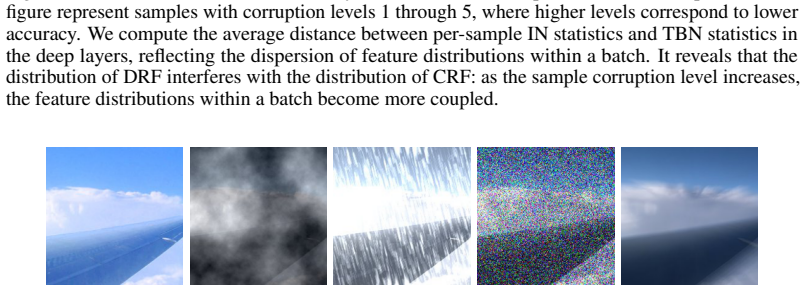
- [Appendix K] The description of Figure 13 says the analysis computes distance between 'instance-normalized and TBN statistics,' but the text is unclear about whether the comparison is between per-instance statistics and batch statistics or between two normalization outputs; please clarify the exact quantity plotted.
- [Section 5 and Appendix P] The conclusion and Appendix P contain duplicated sentences ('Our approach demonstrates robust performance across diverse distribution shifts...' appears twice in Section 5), and the text should be edited for conciseness.
Circularity Check
No significant circularity found: the method is an empirical proposal validated on external benchmarks, not a derivation that reduces to its inputs.
full rationale
The paper proposes an algorithmic method (LFD clustering plus FABN statistics blending) and evaluates it on external benchmarks (CIFAR10-C, CIFAR100-C, ImageNet-C under the TTAB protocol). I looked for self-definitional reductions: Eq. (4)-(7) compute per-subset normalization statistics and blend them with source statistics via alpha; although the subsets are formed from per-instance channel means in Eqs. (1)-(3), the FABN output is not equal to those inputs by construction, because it depends on the full spatial feature maps, subset statistics, and affine parameters. There is no fitted parameter that is renamed as a prediction: alpha=0.8 and gamma=0.1 are hyperparameters chosen through sensitivity experiments, and the reported accuracies are measured results under those settings rather than predictions forced by the equations. The paper cites external building blocks (FINCH, TTAB, Neyshabur et al., Lee et al.) rather than invoking the authors' own prior results as a uniqueness theorem. The empirical weakness that cluster purity is not directly measured in Appendix H is a validity concern, not a circularity: a cluster count matching the domain count does not prove domain-coherent subsets, but this is a missing measurement, not a demonstration that the derivation reduces to its inputs. No load-bearing self-citation or definitional equivalence was found.
Assumptions & free parameters
free parameters (3)
- alpha (FABN blending weight) =
0.8
- gamma (S-FABN threshold) =
0.1
- cold-start duration =
10 batches
assumptions (4)
- domain assumption Feature distributions of different domains in a test batch form distinct clusters at each BN layer, and per-instance channel means are sufficient statistics to separate them.
- domain assumption The first-neighbor graph partitioning (FINCH-style, from [23]) yields useful clusters without a predefined cluster count.
- domain assumption Source BN statistics (SBN) remain valid under distribution shift and improve stability of cluster-level normalization (FABN, Eq. 5-6).
- domain assumption Layer-wise KL scores (Eq. 8-9) correctly rank layer sensitivity to distribution shift, so disabling partitioning for low-scoring layers does not hurt accuracy.
Cite this review
Pith. "Pith review of Feature-Based Instance Neighbor Discovery: Advanced Stable Test-Time Adaptation in Dynamic World." pith.science (2026). https://pith.science/paper/2UWUSCH2
@misc{pith2026250606782,
  author       = {Pith},
  title        = {Pith review of: Feature-Based Instance Neighbor Discovery: Advanced Stable Test-Time Adaptation in Dynamic World},
  year         = {2026},
  howpublished = {\url{https://pith.science/paper/2UWUSCH2}},
  note         = {Machine review of arXiv:2506.06782}
}
read the original abstract
Despite progress, deep neural networks still suffer performance declines under distribution shifts between training and test domains, leading to a substantial decrease in Quality of Experience (QoE) for applications. Existing test-time adaptation (TTA) methods are challenged by dynamic, multiple test distributions within batches. We observe that feature distributions across different domains inherently cluster into distinct groups with varying means and variances. This divergence reveals a critical limitation of previous global normalization strategies in TTA, which inevitably distort the original data characteristics. Based on this insight, we propose Feature-based Instance Neighbor Discovery (FIND), which comprises three key components: Layer-wise Feature Disentanglement (LFD), Feature Aware Batch Normalization (FABN) and Selective FABN (S-FABN). LFD stably captures features with similar distributions at each layer by constructing graph structures. While FABN optimally combines source statistics with test-time distribution specific statistics for robust feature representation. Finally, S-FABN determines which layers require feature partitioning and which can remain unified, thereby enhancing inference efficiency. Extensive experiments demonstrate that FIND significantly outperforms existing methods, achieving a 30\% accuracy improvement in dynamic scenarios while maintaining computational efficiency.
Figures


Figures from the paper (12 more)



Reference graph
Works this paper leans on
-
[1]
The k-means algorithm: A comprehensive survey and performance evaluation
Mohiuddin Ahmed, Raihan Seraj, and Syed Mohammed Shamsul Islam. The k-means algorithm: A comprehensive survey and performance evaluation. Electronics, 9(8):1295, 2020
work page 2020
-
[2]
Tasknorm: Rethinking batch normalization for meta-learning
John Bronskill, Jonathan Gordon, James Requeima, Sebastian Nowozin, and Richard Turner. Tasknorm: Rethinking batch normalization for meta-learning. In International Conference on Machine Learning, pages 1153–1164. PMLR, 2020
work page 2020
-
[3]
Contrastive Test-Time Adapta- tion, April 2022
Dian Chen, Dequan Wang, Trevor Darrell, and Sayna Ebrahimi. Contrastive Test-Time Adapta- tion, April 2022. arXiv:2204.10377 [cs]
arXiv 2022
-
[4]
Sungha Choi, Sanghun Jung, Huiwon Yun, Joanne T Kim, Seungryong Kim, and Jaegul Choo. Robustnet: Improving domain generalization in urban-scene segmentation via instance selective whitening. In Proceedings of the IEEE/CVF Conference on Computer Vision and Pattern Recognition, pages 11580–11590, 2021
work page 2021
-
[5]
Back to the Source: Diffusion-Driven Test-Time Adaptation, June 2023
Jin Gao, Jialing Zhang, Xihui Liu, Trevor Darrell, Evan Shelhamer, and Dequan Wang. Back to the Source: Diffusion-Driven Test-Time Adaptation, June 2023. arXiv:2207.03442 [cs]
arXiv 2023
-
[6]
NOTE: Robust Continual Test-time Adaptation Against Temporal Correlation, 2023
Taesik Gong, Jongheon Jeong, Taewon Kim, Yewon Kim, Jinwoo Shin, and Sung-Ju Lee. NOTE: Robust Continual Test-time Adaptation Against Temporal Correlation, 2023
work page 2023
-
[7]
Deep Residual Learning for Image Recognition, 2015
Kaiming He, Xiangyu Zhang, Shaoqing Ren, and Jian Sun. Deep Residual Learning for Image Recognition, 2015
2015
-
[8]
Benchmarking neural network robustness to common corruptions and perturbations, 2019
Dan Hendrycks and Thomas Dietterich. Benchmarking neural network robustness to common corruptions and perturbations, 2019
2019
Show all 35 references
-
[9]
Dsets-dbscan: A parameter-free clustering algorithm
Jian Hou, Huijun Gao, and Xuelong Li. Dsets-dbscan: A parameter-free clustering algorithm. IEEE Transactions on Image Processing, 25(7):3182–3193, 2016
2016
-
[10]
Batch Normalization: Accelerating Deep Network Training by Reducing Internal Covariate Shift, 2015
Sergey Ioffe and Christian Szegedy. Batch Normalization: Accelerating Deep Network Training by Reducing Internal Covariate Shift, 2015
2015
-
[11]
Entropy is not enough for test-time adaptation: From the perspective of disentangled factors, 2024
Jonghyun Lee, Dahuin Jung, Saehyung Lee, Junsung Park, Juhyeon Shin, Uiwon Hwang, and Sungroh Yoon. Entropy is not enough for test-time adaptation: From the perspective of disentangled factors, 2024
2024
-
[12]
TTN: A Domain-Shift Aware Batch Normalization in Test-Time Adaptation, 2023
Hyesu Lim, Byeonggeun Kim, Jaegul Choo, and Sungha Choi. TTN: A Domain-Shift Aware Batch Normalization in Test-Time Adaptation, 2023
2023
-
[13]
Vida: Homeostatic visual domain adapter for continual test time adaptation, 2024
Jiaming Liu, Senqiao Yang, Peidong Jia, Renrui Zhang, Ming Lu, Yandong Guo, Wei Xue, and Shanghang Zhang. Vida: Homeostatic visual domain adapter for continual test time adaptation, 2024
2024
-
[14]
Efficientvit: Memory efficient vision transformer with cascaded group attention, 2023
Xinyu Liu, Houwen Peng, Ningxin Zheng, Yuqing Yang, Han Hu, and Yixuan Yuan. Efficientvit: Memory efficient vision transformer with cascaded group attention, 2023
2023
-
[15]
hdbscan: Hierarchical density based clustering
Leland McInnes, John Healy, Steve Astels, et al. hdbscan: Hierarchical density based clustering. J. Open Source Softw., 2(11):205, 2017
2017
-
[16]
The norm must go on: Dynamic unsupervised domain adaptation by normalization
M Jehanzeb Mirza, Jakub Micorek, Horst Possegger, and Horst Bischof. The norm must go on: Dynamic unsupervised domain adaptation by normalization. In Proceedings of the IEEE/CVF conference on computer vision and pattern recognition, pages 14765–14775, 2022
2022
-
[17]
Ward’s hierarchical agglomerative clustering method: which algorithms implement ward’s criterion? Journal of classification, 31:274–295, 2014
Fionn Murtagh and Pierre Legendre. Ward’s hierarchical agglomerative clustering method: which algorithms implement ward’s criterion? Journal of classification, 31:274–295, 2014
2014
-
[18]
What is being transferred in transfer learning? Advances in neural information processing systems, 33:512–523, 2020
Behnam Neyshabur, Hanie Sedghi, and Chiyuan Zhang. What is being transferred in transfer learning? Advances in neural information processing systems, 33:512–523, 2020
2020
-
[19]
Efficient test-time model adaptation without forgetting, 2022
Shuaicheng Niu, Jiaxiang Wu, Yifan Zhang, Yaofo Chen, Shijian Zheng, Peilin Zhao, and Mingkui Tan. Efficient test-time model adaptation without forgetting, 2022
2022
-
[20]
Towards stable test-time adaptation in dynamic wild world, 2023
Shuaicheng Niu, Jiaxiang Wu, Yifan Zhang, Zhiquan Wen, Yaofo Chen, Peilin Zhao, and Mingkui Tan. Towards stable test-time adaptation in dynamic wild world, 2023
2023
-
[21]
Dataset shift in machine learning
Joaquin Quiñonero-Candela, Masashi Sugiyama, Anton Schwaighofer, and Neil D Lawrence. Dataset shift in machine learning. Mit Press, 2022
2022
-
[22]
Density-based clustering in spatial databases: The algorithm gdbscan and its applications
Jörg Sander, Martin Ester, Hans-Peter Kriegel, and Xiaowei Xu. Density-based clustering in spatial databases: The algorithm gdbscan and its applications. Data mining and knowledge discovery, 2:169–194, 1998. 11
1998
-
[23]
Efficient parameter-free clustering using first neighbor relations
Saquib Sarfraz, Vivek Sharma, and Rainer Stiefelhagen. Efficient parameter-free clustering using first neighbor relations. In Proceedings of the IEEE/CVF conference on computer vision and pattern recognition, pages 8934–8943, 2019
2019
-
[24]
Improving robustness against common corruptions by covariate shift adaptation
Steffen Schneider, Evgenia Rusak, Luisa Eck, Oliver Bringmann, Wieland Brendel, and Matthias Bethge. Improving robustness against common corruptions by covariate shift adaptation. Advances in neural information processing systems, 33:11539–11551, 2020
2020
-
[25]
Recursive consensus clustering for novel subtype discovery from transcriptome data
Pranali Sonpatki and Nameeta Shah. Recursive consensus clustering for novel subtype discovery from transcriptome data. Scientific reports, 10(1):11005, 2020
2020
-
[26]
Tent: Fully Test-time Adaptation by Entropy Minimization, 2021
Dequan Wang, Evan Shelhamer, Shaoteng Liu, Bruno Olshausen, and Trevor Darrell. Tent: Fully Test-time Adaptation by Entropy Minimization, 2021
2021
-
[27]
Decoupled Prototype Learning for Reliable Test-Time Adaptation, January 2024
Guowei Wang, Changxing Ding, Wentao Tan, and Mingkui Tan. Decoupled Prototype Learning for Reliable Test-Time Adaptation, January 2024. arXiv:2401.08703 [cs]
2024 arXiv
-
[28]
Continual Test-Time Domain Adapta- tion, 2022
Qin Wang, Olga Fink, Luc Van Gool, and Dengxin Dai. Continual Test-Time Domain Adapta- tion, 2022
2022
-
[29]
Dynamically instance-guided adaptation: A backward-free approach for test-time domain adaptive semantic segmentation
Wei Wang, Zhun Zhong, Weijie Wang, Xi Chen, Charles Ling, Boyu Wang, and Nicu Sebe. Dynamically instance-guided adaptation: A backward-free approach for test-time domain adaptive semantic segmentation. In Proceedings of the IEEE/CVF Conference on Computer Vision and Pattern Re...
2023
-
[30]
Test-time batch statistics calibration for covariate shift
Fuming You, Jingjing Li, and Zhou Zhao. Test-time batch statistics calibration for covariate shift. arXiv preprint arXiv:2110.04065, 2021
2021 arXiv
-
[31]
Robust Test-Time Adaptation in Dynamic Scenarios, 2023
Longhui Yuan, Binhui Xie, and Shuang Li. Robust Test-Time Adaptation in Dynamic Scenarios, 2023
2023
-
[32]
Memo: Test time robustness via adaptation and augmentation
Marvin Zhang, Sergey Levine, and Chelsea Finn. Memo: Test time robustness via adaptation and augmentation. Advances in neural information processing systems, 35:38629–38642, 2022
2022
-
[33]
Birch: an efficient data clustering method for very large databases
Tian Zhang, Raghu Ramakrishnan, and Miron Livny. Birch: an efficient data clustering method for very large databases. ACM sigmod record, 25(2):103–114, 1996
1996
-
[34]
On pitfalls of test-time adaptation
Hao Zhao, Yuejiang Liu, Alexandre Alahi, and Tao Lin. On pitfalls of test-time adaptation. In International Conference on Machine Learning (ICML), 2023
2023
-
[35]
Xingzhi Zhou, Zhiliang Tian, Ka Chun Cheung, Simon See, and Nevin L. Zhang. Resilient Practical Test-Time Adaptation: Soft Batch Normalization Alignment and Entropy-driven Memory Bank, January 2024. arXiv:2401.14619 [cs]. 12 Contents of Appendix A The Layer-Wise Feature Disent...
2024 arXiv
Reviewed August 7, 2026 · model on record in the stance chip above.
Discussion (0). Sign in to comment.