REVIEW 3 major objections 5 minor 34 references
Evaluating Vision Transformer Models for Visual Quality Control in Industrial Manufacturing
T0 review · 3 major / 5 minor · reviewed 2026-08-12 · deepseek-v4-flash
Pith's one-line read The paper claims that swapping ResNet-50 for vision transformer backbones can improve anomaly detection and localization in industrial visual quality control while shrinking model size, with the compact hierarchical EsViT offering a…
desk verdict The paper's central transformer-over-ResNet claim is not established because the ResNet baselines get smaller anomaly-detection heads (50 versus 100 Gaussians, 8 versus 20 flow steps); the authors even concede this in Section 4.3. read the letter →
The pith
A machine-rendered reading of the paper's core claim, the machinery that carries it, and where it could break.
The reading
What carries the argument
The load-bearing object is the two-part anomaly-detection pipeline: a frozen ImageNet-pretrained visual backbone that converts an image into a grid of patch embeddings, and a trainable head that models the distribution of normal embedded patches. The paper compares two heads. The first is a Gaussian mixture model whose means, standard deviations, and mixture weights are predicted by small MLPs, trained by minimizing the negative log-likelihood and scored by the normalized log-likelihood of each patch. The second is a normalizing-flow head made of alternating 3x3 and 1x1 convolutional layers in invertible flow steps, which computes exact likelihoods via the log-determinant of the Jacobian and uses those likelihoods as anomaly maps. The same frozen backbones—DeiT (monolithic), EsViT and EfficientFormer (hierarchical), and ResNet-50 (CNN baseline)—feed both heads, so any performance differences can be attributed to the backbone-head combination rather than to pre-training procedure.
What would settle it
Re-run the backbone comparison with per-class hyperparameter search and select checkpoints by the final evaluation metric (AUROC/PRO) instead of by validation likelihood; if the relative ordering of DeiT, EsViT, and ResNet-50 changes on the same five classes, the reported rankings are an artifact of the tuning protocol rather than a property of the architectures.
Extended reading notes
Core claim
The paper's central claim is that for industrial visual quality control, transformer-based vision backbones—including the lightweight hierarchical ones—are a better starting point than the standard ResNet-50, because they can raise anomaly-detection and localization performance while reducing total model size. The evidence is a systematic grid of four frozen pre-trained backbones and two trainable detection heads: with a normalizing-flow head, DeiT reaches a mean image-level AUROC of 96.20 on five selected MVTecAD classes, ahead of EsViT (86.80) and ResNet-50 (85.40), and with a GMM head, EsViT reaches 90.60, well ahead of DeiT (77.40) and ResNet (71.80). Across all experiments, one or another transformer backbone outperforms ResNet in detection, and the flow head is more stable across classes. The paper concludes that using transformers can improve anomaly-detection performance and reduce model size compared with ResNet, and that hierarchical transformers are worth evaluating for production scenarios with limited computational capacity.
Load-bearing premise
The comparisons assume that hyperparameters tuned on a single class (hazelnut from MVTecAD) and checkpoints selected by validation likelihood transfer to every other class, even though the paper's own ablation shows no direct relation between that likelihood and the reported localization score (PRO).
Editorial extensions
If this is right
- A practitioner with tight compute budgets should evaluate a hierarchical transformer such as EsViT with a normalizing-flow head rather than defaulting to ResNet-50, since it improves detection and shrinks the head from 115M to 31M parameters in the paper's configurations.
- A practitioner with ample compute should prefer a monolithic transformer such as DeiT, which gives the best detection AUROC and the best flow-head localization among the tested models.
- Normalizing-flow heads are more robust across object classes than GMM heads (standard deviation 4.00 versus 15.49 in detection AUROC), making them the safer default for production classes that are not in the benchmark.
- Comparisons against reported values from VT-ADL and FastFlow indicate that a frozen pre-trained transformer can beat training a transformer from scratch on small industrial datasets.
- Choosing which encoder block feeds the head is a cheap and actionable tuning lever, since intermediate features localize anomalies more precisely while final features detect them more confidently.
Reading between the lines
- A natural extension is to repeat the comparison with backbones pre-trained on unlabeled industrial images rather than ImageNet-1k, since transformers' global attention may show a different accuracy gap on domain-specific textures and defects.
- The paper's own ablation shows that validation likelihood does not predict the reported PRO score, so an inexpensive improvement for this benchmark family would be to select checkpoints by the final evaluation metric (AUROC or PRO) directly, or to report several checkpoints.
- The NF i7 versus NF i11 comparison hints that a multi-scale flow head fed by several encoder stages, analogous to the multi-block ResNet averaging already used here, could combine fine localization with accurate detection; the paper leaves this combination unexplored.
Editorial analysis
A structured set of objections, weighed in public.
Referee Report
Summary. The paper evaluates combinations of four visual backbones (ResNet-50, DeiT-B, EsViT-Swin-T, EfficientFormer-L3) with two anomaly detection heads (GMM and normalizing flow) for unsupervised industrial visual quality control on the MVTecAD and BTAD datasets. It reports image-level AUROC/PRAUC and pixel-level PRO scores, comparing against VT-ADL and FastFlow, and derives practical guidelines for choosing backbones under computational constraints. The central claim is that transformer backbones, especially hierarchical ones such as EsViT, can improve anomaly detection performance while reducing model size compared to ResNet.
Significance. If the central comparative claim were fully supported, the paper would provide a useful practitioner-oriented benchmark, and the public release of the evaluation code (GitHub link in Section 1) is a reproducible contribution. The paper also offers a broad overview of transformer backbones and AD heads that is genuinely helpful for applied engineers. However, the headline conclusion that 'transformer models improve anomaly detection and reduce size compared to ResNet' rests on comparisons that do not control for head capacity, use a potentially biased class subset, and select checkpoints by a loss that the paper itself shows is unrelated to the reported localization metric. These issues prevent the current version from establishing its main empirical claim, though they appear addressable with additional experiments or appropriately weakened conclusions.
major comments (3)
- [3.2, Table 2, Tables 5-6] The backbone comparison in Tables 5 and 6 does not hold the anomaly-detection head capacity fixed. According to Table 2, ResNet-50 uses only 50 Gaussians in the GMM and 8 flow steps in the NF, while all transformer backbones use 100 Gaussians and 20 flow steps. Since Section 4.3 itself attributes the poor ResNet performance to 'the usage of only 50 Gaussians and two output layers', the reported transformer advantage could be an artifact of giving transformer models a larger, more expressive head rather than reflecting backbone quality. This directly undermines the conclusion that 'transformer models can improve the performance of anomaly detection models and reduce the overall size compared to ResNet'. To support that claim, the authors should rerun ResNet with the same head capacity (or transformers with the reduced head), or explicitly scope the conclusion to the tested unequal-resource configuration.
- [3.6, Tables 5-6] The backbone comparison is performed on only five MVTecAD classes per AD head, and the classes were selected based on the authors' own previous DeiT results, deliberately including classes with 'high, medium and low performance' from those experiments. This selection is informed by the outcome variable and is therefore subject to selection bias: the relative ranking of backbones on the chosen five classes need not generalize to the full dataset, and the small sample size further weakens the claim. The authors should either report all 15 classes or use a pre-specified, outcome-independent selection criterion (for example, random selection or a fixed subset used across all backbones) and discuss the implications of the class choice.
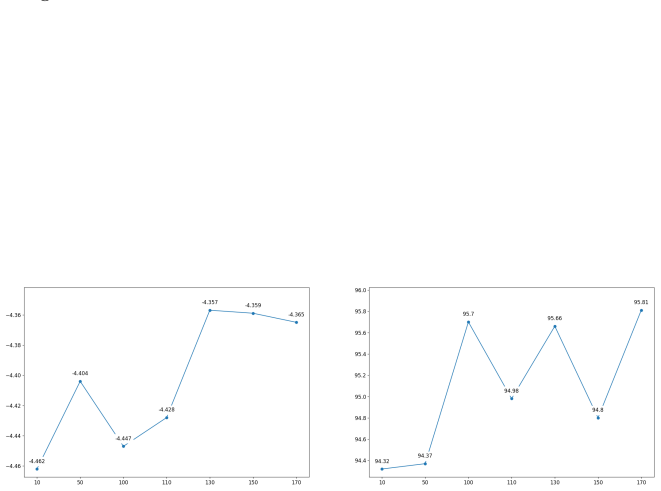
- [3.4, Appendix C] Model selection relies entirely on the validation likelihood loss, yet Appendix C (Figure 10) shows that there is 'no direct relation between PRO score and likelihood loss'. Since PRO score is the localization metric reported in Tables 4-6, the checkpoints selected by validation loss may not be the ones achieving the best localization performance for each model. This could affect the head-to-head comparisons across backbones, particularly the AD vs AL discrepancies. The authors should either select checkpoints by the actual evaluation metric (or a proxy that correlates with it) or demonstrate that the relative performance of the backbones is insensitive to the checkpoint-selection criterion.
minor comments (5)
- [Table 4, Section 4.1] The comparison with FastFlow is not like-for-like: the authors use 224x224 images instead of 384x384 and 80% of the training data instead of 100%. These differences are acknowledged in the text, but the table does not state them; adding a note to the table would prevent readers from misinterpreting the gap as a pure implementation failure.
- [Table 4 header] The last column is labeled 'al (auroc)' and the caption says 'FastFlow reported pixel AUROC'; make clear whether the reported value is pixel-level AUROC or PRO to avoid inconsistency with the other 'al' columns that report PRO.
- [Section 2.1] In the description of HaloNet, the reference cited is [26] (Vaswani et al.), but the bibliography entry [26] is the 'Scaling local self-attention' paper; please verify that the intended HaloNet reference is listed and numbered correctly.
- [Tables 5 and 6] The column headers 'auroc ad' and 'pro score' are inconsistent with Table 4's headers ('image' and 'pixel' or 'auroc' and 'pro'); please use consistent terminology across tables, e.g., 'AD AUROC' and 'PRO'.
- [Acknowledgments] The acknowledgment section contains the sentence 'This preprint has not undergone peer review or any post-submission improvements or corrections.' For a published version of record this statement is misleading; remove it or adjust to reflect the paper's publication status.
Circularity Check
No significant circularity: the paper is an empirical benchmark whose conclusions are measured outcomes, not derivations from their own inputs.
full rationale
The paper makes no equivocation between inputs and outputs: it measures AUROC/PRO of four frozen ImageNet-pretrained backbones (ResNet-50, DeiT-B, EsViT-T, EfficientFormer-L3) combined with two anomaly-detection heads (GMM and NF) on MVTecAD and BTAD. The central claim that transformer models improve anomaly-detection performance and reduce model size is an empirical generalization from Tables 5 and 6, not a quantity that is defined in terms of itself or a fitted parameter renamed as a prediction. Hyperparameters are tuned once on the hazelnut class and transferred to other classes (Section 3.4), and Appendix C explicitly shows that the validation likelihood used for checkpoint selection is not directly related to the reported PRO metric; this is a metric-alignment and selection-risk concern, not circularity. The skeptical concern that ResNet is handicapped by fewer Gaussians (50 vs 100) and fewer flow steps (8 vs 20) is a fairness/confound issue for the comparative claim, but it does not make the evaluation circular. There are no load-bearing self-citations, no uniqueness theorems imported from the authors' prior work, and no known result renamed as a new one. The work is self-contained against external benchmarks and external baselines, so the appropriate circularity score is 0.
Assumptions & free parameters
free parameters (10)
- GMM number of Gaussians =
50 (ResNet-50), 100 (others)
- Flow steps =
8 (ResNet-50), 20 (others)
- Hidden ratio h =
0.16
- Learning rates =
1e-4 (GMM all; NF ResNet and EsViT), 1e-3 (NF other)
- Weight decay =
1e-4 (GMM), 1e-5 (NF)
- Batch sizes =
4 to 32 depending on model
- Image resolution =
224x224
- Training and validation split =
80/20
- NF feature block choice (i7 vs i11) =
7th or 11th DeiT block
- Anomaly threshold =
empirically determined on validation set
assumptions (6)
- domain assumption MVTecAD and BTAD are representative of industrial quality control scenarios.
- domain assumption ImageNet-pretrained frozen backbones provide useful features for these anomaly detection tasks.
- domain assumption AUROC, PRO, and PRAUC are appropriate evaluation metrics for the stated quality-control goals.
- ad hoc to paper Hyperparameters tuned on the hazelnut class transfer to all other classes.
- ad hoc to paper Validation likelihood loss is a valid model-selection criterion.
- domain assumption Previously published FastFlow and VT-ADL numbers are comparable despite differences in image resolution and training data fraction.
Cite this review
Pith. "Pith review of Evaluating Vision Transformer Models for Visual Quality Control in Industrial Manufacturing." pith.science (2026). https://pith.science/paper/2X2NO4D4
@misc{pith2026241114953,
  author       = {Pith},
  title        = {Pith review of: Evaluating Vision Transformer Models for Visual Quality Control in Industrial Manufacturing},
  year         = {2026},
  howpublished = {\url{https://pith.science/paper/2X2NO4D4}},
  note         = {Machine review of arXiv:2411.14953}
}
read the original abstract
One of the most promising use-cases for machine learning in industrial manufacturing is the early detection of defective products using a quality control system. Such a system can save costs and reduces human errors due to the monotonous nature of visual inspections. Today, a rich body of research exists which employs machine learning methods to identify rare defective products in unbalanced visual quality control datasets. These methods typically rely on two components: A visual backbone to capture the features of the input image and an anomaly detection algorithm that decides if these features are within an expected distribution. With the rise of transformer architecture as visual backbones of choice, there exists now a great variety of different combinations of these two components, ranging all along the trade-off between detection quality and inference time. Facing this variety, practitioners in the field often have to spend a considerable amount of time on researching the right combination for their use-case at hand. Our contribution is to help practitioners with this choice by reviewing and evaluating current vision transformer models together with anomaly detection methods. For this, we chose SotA models of both disciplines, combined them and evaluated them towards the goal of having small, fast and efficient anomaly detection models suitable for industrial manufacturing. We evaluated the results of our experiments on the well-known MVTecAD and BTAD datasets. Moreover, we give guidelines for choosing a suitable model architecture for a quality control system in practice, considering given use-case and hardware constraints.
Figures


Figures from the paper (8 more)



Reference graph
Works this paper leans on
-
[1]
Ardizzone, L., Bungert, T., Draxler, F., Köthe, U., Kruse, J., Schmier, R., Sor- renson, P.: Framework for Easily Invertible Architectures (FrEIA) (2022),https: //github.com/vislearn/FrEIA
work page 2022
-
[2]
Bae, J., Lee, J.H., Kim, S.: Image anomaly detection and localization with position and neighborhood information,https://arxiv.org/pdf/2211.12634v2.pdf
-
[3]
International Journal of Computer Vision129(4), 1038–1059 (2021)
Bergmann, P., Batzner, K., Fauser, M., Sattlegger, D., Steger, C.: The mvtec anomaly detection dataset: A comprehensive real-world dataset for unsupervised anomaly detection. International Journal of Computer Vision129(4), 1038–1059 (2021). https://doi.org/10.1007/s11263-020-01400-4
-
[4]
In: 2020 IEEE/CVF Conference on Computer Vision and Pattern Recognition (CVPR)
Bergmann, P., Fauser, M., Sattlegger, D., Steger, C.: Uninformed students: Student-teacher anomaly detection with discriminative latent embeddings. In: 2020 IEEE/CVF Conference on Computer Vision and Pattern Recognition (CVPR). pp. 4182–4191 (2020). https://doi.org/10.1109/CVPR42600.2020.00424
arXiv 2020
-
[5]
Workingpaper, Aston University (1994)
Bishop, C.: Mixture density networks. Workingpaper, Aston University (1994)
1994
-
[6]
Electronics 11(15), 2306 (2022)
Choi, B., Jeong, J.: Viv-ano: Anomaly detection and localization combining vision transformer and variational autoencoder in the manufacturing process. Electronics 11(15), 2306 (2022). https://doi.org/10.3390/electronics11152306
-
[7]
In: 2009 IEEE conference on computer vision and pattern recognition
Deng, J., Dong, W., Socher, R., Li, L.J., Li, K., Fei-Fei, L.: Imagenet: A large- scale hierarchical image database. In: 2009 IEEE conference on computer vision and pattern recognition. pp. 248–255. Ieee (2009)
2009
-
[8]
Dinh, L., Sohl-Dickstein, J., Bengio, S.: Density estimation using real nvp,https: //arxiv.org/pdf/1605.08803
Show all 34 references
-
[9]
Dosovitskiy, A., Beyer, L., Kolesnikov, A., Weissenborn, D., Zhai, X., Unterthiner, T., Dehghani, M., Minderer, M., Heigold, G., Gelly, S., Uszkoreit, J., Houlsby, N.: An image is worth 16x16 words: Transformers for image recognition at scale, https://arxiv.org/pdf/2010.11929
2010 arXiv
-
[10]
Computer Vision and Image Understanding 195 (2020)
Fan, Y., Wen, G., Li, D., Qiu, S., Levine, M.D., Xiao, F.: Video anomaly detection and localization via gaussian mixture fully convolutional variational autoencoder. Computer Vision and Image Understanding 195 (2020). https://doi.org/10. 1016/j.cviu.2020.102920
2020
-
[11]
Gudovskiy,D.,Ishizaka,S.,Kozuka,K.:Cflow-ad:Real-timeunsupervisedanomaly detection with localization via conditional normalizing flows,https://arxiv.org/ pdf/2107.12571
-
[12]
Alber et al
He, K., Zhang, X., Ren, S., Sun, J.: Deep residual learning for image recognition, https://arxiv.org/pdf/1512.03385 16 M. Alber et al
-
[13]
Hyun, J., Kim, S., Jeon, G., Kim, S.H., Bae, K., Kang, B.J.: Reconpatch : Con- trastive patch representation learning for industrial anomaly detection, http: //arxiv.org/pdf/2305.16713
-
[14]
Kim, Y., Jang, H., Lee, D., Choi, H.J.: Altub: Alternating training method to update base distribution of normalizing flow for anomaly detection, https: //arxiv.org/pdf/2210.14913v1.pdf
-
[15]
Lei, J., Hu, X., Wang, Y., Liu, D.: Pyramidflow: High-resolution defect con- trastive localization using pyramid normalizing flow, https://arxiv.org/pdf/ 2303.02595v1.pdf
-
[16]
Li, C., Yang, J., Zhang, P., Gao, M., Xiao, B., Dai, X., Yuan, L., Gao, J.: Efficient self-supervised vision transformers for representation learning, https: //arxiv.org/pdf/2106.09785.pdf
-
[17]
Li, H., Wu, J., Chen, H., Wang, M., Shen, C.: Efficient anomaly detection with budgetannotationusingsemi-supervisedresidualtransformer, http://arxiv.org/ pdf/2306.03492
-
[18]
arXiv preprint arXiv:2206.01191 (2022)
Li, Y., Yuan, G., Wen, Y., Hu, J., Evangelidis, G., Tulyakov, S., Wang, Y., Ren, J.: Efficientformer: Vision transformers at mobilenet speed. arXiv preprint arXiv:2206.01191 (2022)
2022 arXiv
-
[19]
org/pdf/2103.14030
Liu, Z., Lin, Y., Cao, Y., Hu, H., Wei, Y., Zhang, Z., Lin, S., Guo, B.: Swin trans- former: Hierarchical vision transformer using shifted windows, https://arxiv. org/pdf/2103.14030
-
[20]
Mathian, E., Liu, H., Fernandez-Cuesta, L., Samaras, D., Foll, M., Chen, L.: Haloae: An halonet based local transformer auto-encoder for anomaly detection and localization, https://arxiv.org/pdf/2208.03486.pdf
-
[21]
In: 30th IEEE/IES International Symposium on Industrial Electronics (ISIE) (June 2021)
Mishra, P., Verk, R., Fornasier, D., Piciarelli, C., Foresti, G.L.: VT-ADL: A vi- sion transformer network for image anomaly detection and localization. In: 30th IEEE/IES International Symposium on Industrial Electronics (ISIE) (June 2021)
2021
-
[22]
Roth, K., Pemula, L., Zepeda, J., Schölkopf, B., Brox, T., Gehler, P.: Towards to- talrecallinindustrialanomalydetection, https://arxiv.org/pdf/2106.08265v2. pdf
-
[23]
The IEEE Conference on Computer Vision and Pattern Recognition (CVPR) (2019),https://arxiv.org/pdf/1801.04381
Sandler, M., Howard, A., Zhu, M., Zhmoginov, A., Chen, L.C.: Mobilenetv2: In- verted residuals and linear bottlenecks. The IEEE Conference on Computer Vision and Pattern Recognition (CVPR) (2019),https://arxiv.org/pdf/1801.04381
2019 arXiv
-
[24]
IEEE Transactions on Instrumentation and Measurement 71, 1–21 (2022)
Tao, X., Gong, X., Zhang, X., Yan, S., Adak, C.: Deep learning for unsuper- vised anomaly localization in industrial images: A survey. IEEE Transactions on Instrumentation and Measurement 71, 1–21 (2022). https://doi.org/10.1109/ TIM.2022.3196436
2022
-
[25]
org/pdf/2012.12877
Touvron, H., Cord, M., Douze, M., Massa, F., Sablayrolles, A., Jégou, H.: Training data-efficient image transformers & distillation through attention,https://arxiv. org/pdf/2012.12877
2012 arXiv
-
[26]
Vaswani, A., Ramachandran, P., Srinivas, A., Parmar, N., Hechtman, B., Shlens, J.: Scaling local self-attention for parameter efficient visual backbones, https: //arxiv.org/pdf/2103.12731
-
[27]
The Interna- tional Journal of Advanced Manufacturing Technology94(9-12), 3465–3471 (2018)
Wang, T., Chen, Y., Qiao, M., Snoussi, H.: A fast and robust convolutional neu- ral network-based defect detection model in product quality control. The Interna- tional Journal of Advanced Manufacturing Technology94(9-12), 3465–3471 (2018). https://doi.org/10.1007/s00170-017-0882-0
2018 doi
-
[28]
Wang, W., Xie, E., Li, X., Fan, D.P., Song, K., Liang, D., Lu, T., Luo, P., Shao, L.: Pvtv2:Improvedbaselineswithpyramidvisiontransformer.ComputationalVisual Media 8(3), 415–424 (2022).https://doi.org/10.1007/s41095-022-0274-8 ViT Models for Industrial Visual Quality Control 17
2022 doi
-
[29]
Xie, E., Wang, W., Yu, Z., Anandkumar, A., Alvarez, J.M., Luo, P.: Segformer: Simple and efficient design for semantic segmentation with transformers,http: //arxiv.org/pdf/2105.15203.pdf
-
[30]
01816.pdf
You, Z., Yang, K., Luo, W., Cui, L., Le Xinyi, Zheng, Y.: Adtr: Anomaly de- tection transformer with feature reconstruction, https://arxiv.org/pdf/2209. 01816.pdf
-
[31]
Yu, J., Zheng, Y., Wang, X., Li, W., Wu, Y., Zhao, R., Wu, L.: Fastflow: Un- supervised anomaly detection and localization via 2d normalizing flows,https: //arxiv.org/pdf/2111.07677
-
[32]
Pattern Recognition Letters 153, 144–150 (2022)
Zhang, K., Wang, B., Kuo, C.C.J.: Pedenet: Image anomaly localization via patch embedding and density estimation. Pattern Recognition Letters 153, 144–150 (2022). https://doi.org/10.1016/j.patrec.2021.11.030
2022 doi
-
[33]
Zhang,Z.,Zhang,H.,Zhao,L.,Chen,T.,Arik,S.O.,Pfister,T.:Nestedhierarchical transformer: Towards accurate, data-efficient and interpretable visual understand- ing, https://arxiv.org/pdf/2105.12723.pdf
-
[34]
In: International Conference on Learning Representations (2018), https: //openreview.net/forum?id=BJJLHbb0- A Generated anomaly maps from different model configurations 18 M
Zong, B., Song, Q., Min, M.R., Cheng, W., Lumezanu, C., Cho, D., Chen, H.: Deep autoencoding gaussian mixture model for unsupervised anomaly detec- tion. In: International Conference on Learning Representations (2018), https: //openreview.net/forum?id=BJJLHbb0- A Generated ano...
2018
Reviewed August 12, 2026 · model on record in the stance chip above.
Discussion (0). Continue with ORCID to comment.