REVIEW 3 major objections 5 minor 17 references
Agentic LLMs can implement many local API behaviors, but still fail to produce complete deployable backend services on most contract-defined tasks.
Reviewed by Pith at T0; open to challenge. T0 means a machine referee read the full paper against a public rubric. the ladder, T0–T4 →
Agentic LLMs can implement many local backend API behaviors, but under a hardened HTTP oracle the best model fully solves only 28.6% of 56 deployable service tasks.
T0 review reviewed 2026-07-14 challenge →
load-bearing objection Solid agentic-coding benchmark with a real empirical gap (55%→29% all-pass); the co-evolved oracle is the contribution and the soft spot, not a reason to ignore the work. the 3 major comments →
BackendForge: Benchmarking Agentic End-to-End Code Generation with Backend Services
The pith
A machine-rendered reading of the paper's core claim, the machinery that carries it, and where it could break.
The reading
Core claim
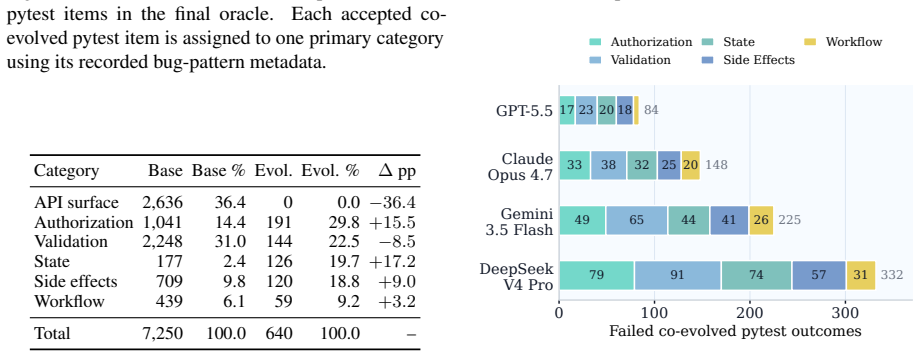
Current agentic LLMs implement many local API behaviors but rarely construct fully correct deployable backend services. Across 56 contract-defined tasks, the strongest model fully passes the final HTTP oracle on only 16 tasks (28.6%), down from 55.4% under the base oracle. The remaining failures are not mainly syntax errors or missing endpoints; they are failures of authorization isolation, validation, state consistency, side-effect propagation, and multi-step workflows.
What carries the argument
Multi-agent oracle co-evolution: a test agent proposes black-box HTTP tests from the visible specification and OpenAPI contract; only candidates that fail the current reference are reviewed; a review agent admits a candidate only if it is uniquely supported by that contract; a code agent then repairs the reference until full regression passes. This process adds 640 admitted items (about 8.8% more tests) that sharply reduce all-pass success without introducing hidden requirements.
Load-bearing premise
The hardened oracle only adds requirements uniquely required by the visible specification and OpenAPI contract, which depends on the review agent correctly rejecting unsupported candidates.
What would settle it
Have independent auditors re-label a large sample of the 640 admitted co-evolved tests against the released specs: if many enforce behavior not uniquely required by those materials, or if stronger models close most of the base-to-final success gap without those tests being wrong, the claim that models fail at complete services (rather than at an over-specified oracle) would not hold.
If this is right
- Endpoint-level progress can look strong while a single failed invariant still blocks full service success.
- A modest number of contract-grounded, co-evolved HTTP tests can expose large correctness gaps that base endpoint suites miss.
- Sparse hidden self-verification can recover some tasks but does not make the benchmark collapse: most tasks still fail.
- Deterministic black-box HTTP scoring against OpenAPI contracts is a workable way to evaluate end-to-end service generation without GUI entanglement.
- Deployable backend generation under explicit contracts remains a hard target for agentic coding workflows.
Where Pith is reading between the lines
- If review filtering is imperfect, part of the base-to-final drop may reflect oracle construction choices rather than pure model inability—so independent re-audit of admitted items would tighten the claim.
- Failure concentration on ownership, isolation, and cascades suggests agent scaffolding that models resource graphs and side-effect rules may help more than raw longer context alone.
- Python-only Dockerized scoring may understate difficulty or transfer for multi-language production backends with real external dependencies.
- The same co-evolution pattern could harden oracles for other contract-rich surfaces (gRPC, database schemas, event buses) without inventing requirements.
Editorial analysis
A structured set of objections, weighed in public.
Referee Report
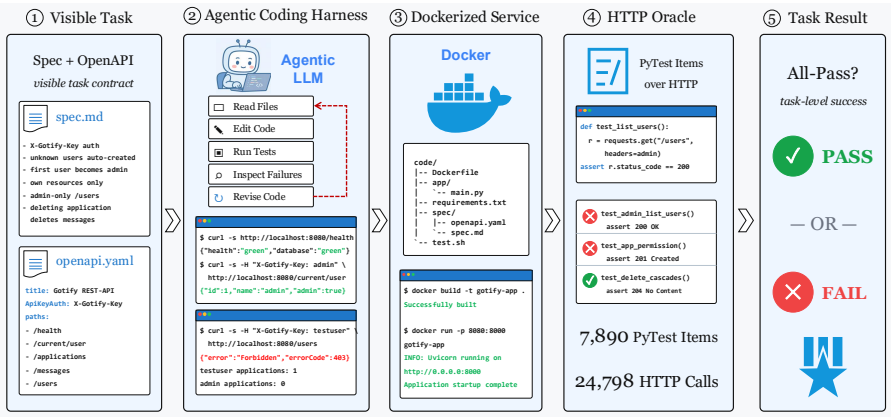
Summary. BackendForge introduces a 56-task benchmark for agentic end-to-end backend service generation. Each task supplies a visible natural-language specification and OpenAPI contract; models must produce a Dockerized Python service that is scored only via black-box HTTP tests after build and deploy. The authors construct a base oracle (7,250 pytest items) and then strengthen it via multi-agent co-evolution (test, review, and code agents), admitting 640 additional items only when they fail the current reference, pass contract-grounding review, and survive full regression after reference repair. Under the base oracle the best model (GPT-5.5) fully solves 55.4% of tasks; under the final oracle success falls to 28.6% (16/56). Failures concentrate on authorization, validation, state consistency, side effects, and multi-step workflows rather than missing endpoints. A limited self-verification protocol recovers some tasks but leaves most unsolved. The paper positions BackendForge as combining rigorous deterministic evaluation, agentic development, and end-to-end deployable output.
Significance. If the construction and evaluation hold, this is a timely and useful contribution to agentic code evaluation. Prior benchmarks emphasize functions, repository patches, or full-stack apps with entangled GUI signals; BackendForge isolates contract realization for deployable services with deterministic HTTP oracles, which is a clean and realistic substrate. Strengths include: a fixed 56-task denominator with substantial API surface (2,345 operations; 24,798 HTTP calls); staged oracles that make the base-to-final attrition explicit (Table 2); explicit review filters against hidden requirements; and failure-mode breakdowns (Table 3, Figs. 3–5) that go beyond pass/fail. The co-evolution methodology is a concrete attempt to harden oracles without silent over-specification. These results would give the community a harder, more service-level signal than unit-test or patch benchmarks alone.
major comments (3)
- [§3.4 Multi-Agent Oracle Co-Evolution; §5.2] §3.4 and §5.2: The central causal claim—that the Base→Final SR drop (e.g., GPT-5.5 55.4%→28.6%) measures model inability to realize the visible contract—depends on admitted co-evolved items being uniquely entailed by spec.md/OpenAPI and free of construction bias. The paper reports that the review agent filtered 113 candidates and describes KEEP/FILTER criteria, but provides no independent human audit of a sample of KEEP and FILTER decisions, no inter-rater agreement, and no hold-out comparison against a human-written oracle. Because the same agent stack proposes tests, judges grounding, and repairs the reference, residual over-admission of strict-but-plausible behaviors (or under-admission of true gaps) remains a load-bearing threat. A modest audited sample (e.g., 50–100 KEEP/FILTER cases with human labels and disagreement analysis) or a human-oracle subset would substantially strengthen
- [§4.1 Experimental Setup; Table 2] §4.1–§4.2 and Table 2: Agentic coding runs are known to be high-variance (tool use, exploration order, early stopping). The main results appear to report a single trajectory per model–task pair, with no seed/run variance, confidence intervals, or pass@k-style aggregation. Given that task-level success is all-or-nothing over thousands of pytest items, a single unlucky trajectory can flip a near-pass into a fail and inflate model ranking differences (e.g., GPT-5.5 16/56 vs. Claude Opus 4.7 10/56). At minimum, the paper should state the number of runs explicitly and, where cost allows, report multi-run stability for the top models or a stratified task subset; otherwise the comparative claims should be qualified as single-run point estimates.
- [§3.1 Task Selection and Controlled Rewriting] §3.1–§3.2 and Tables 4–7: Tasks are rewritten from real open-source backends to reduce recoverability, which is appropriate, but the manuscript does not quantify residual contamination risk (name/domain leakage, structural similarity to popular repos, or whether models emit framework idioms that match common public implementations). A short contamination check—e.g., n-gram/API-path overlap with upstream sources, or a closed-book probe of whether models can name the source project from the rewritten contract—would better support the claim that success reflects contract realization rather than partial memorization of public backends.
minor comments (5)
- [Table 1] Table 1: “Rigorous Eval.” / “Agentic” / “End-to-End” are binary checkmarks that compress nuanced differences (e.g., BaxBench vs. BackendForge). A short footnote clarifying the criteria used for each check would reduce ambiguity.
- [Figure 1] Figure 1 caption and pipeline text: “7,890 PyTest Items / 24,798 HTTP Calls” are aggregate oracle statistics; stating that these are oracle-side totals (not per-submission agent self-tests) would avoid reader confusion.
- [§5.3 Hidden Self-Verification] §5.3 / Figure 7: The self-verification protocol is valuable but only reported for DeepSeek V4 Pro. A sentence on why other models were not included (cost, API limits) would help interpret generalizability of the +5 recovery result.
- [Appendix A; §4.1] Appendix A prompts are useful; ensuring that any released artifact includes the exact harness configuration (timeouts, max turns, tool set) would improve reproducibility of the agentic results in Table 2.
- [Limitations; §3.2] Limitations correctly note Python-only scope; consider also noting that five tasks use mock external services, so integration difficulty is only partially represented.
Circularity Check
No derivation circularity: BackendForge is an empirical benchmark whose success rates are measured against a fixed oracle, not predictions forced by construction or self-citation.
full rationale
BackendForge does not present a first-principles derivation, uniqueness theorem, or fitted-parameter prediction chain. Its load-bearing claim is empirical: under a fixed black-box HTTP oracle, agentic LLMs pass fewer tasks on the final co-evolved suite (e.g., GPT-5.5 55.4% base → 28.6% final) than on the base suite, with failures concentrated in authorization, validation, state, side effects, and workflows. The multi-agent co-evolution loop (test agent proposes items that fail the current reference; review agent filters against visible spec.md/OpenAPI; code agent repairs only the reference under full regression) is a benchmark-construction procedure, not a circular reduction of a scientific prediction to its inputs. Once admitted, oracle items are held fixed and applied to independent model runs; model success is not defined as matching the construction agents’ own outputs. Related-work self-citations (e.g., AppForge) are comparative, not load-bearing uniqueness imports. Residual concerns about review-agent KEEP/FILTER bias or over-strict co-evolved items affect causal attribution of the Base→Final gap (methodological validity), not circularity of a claimed derivation. Score 0 with empty steps is therefore the correct circularity finding.
Axiom & Free-Parameter Ledger
free parameters (3)
- task set size and selection (56 rewritten backends)
- co-evolved item admission threshold / review policy
- agentic harness and thinking-effort settings
axioms (5)
- domain assumption A visible natural-language specification plus OpenAPI contract is a sufficient and exclusive source of truth for required backend behavior.
- domain assumption Black-box HTTP interactions against a deployed Dockerized service are an adequate proxy for end-to-end behavioral correctness of backend services.
- ad hoc to paper Restricting candidate implementations to Python backends with a Dockerfile does not invalidate comparative claims about agentic backend generation ability.
- ad hoc to paper LLM test/review/code agents, under regression and contract review, can strengthen oracles without systematically introducing unsupported requirements.
- domain assumption Task-level all-pass success rate over the same 56 tasks is the primary measure of deployable backend generation competence.
invented entities (2)
-
BackendForge benchmark (56 rewritten contract-defined backend tasks + final HTTP oracle)
no independent evidence
-
Multi-agent oracle co-evolution loop (test agent + review agent + code agent)
no independent evidence
Cite this review
Pith. "Pith review of BackendForge: Benchmarking Agentic End-to-End Code Generation with Backend Services." pith.science (2026). https://pith.science/paper/2XNFYL4C
@misc{pith2026260711042,
  author       = {Pith},
  title        = {Pith review of: BackendForge: Benchmarking Agentic End-to-End Code Generation with Backend Services},
  year         = {2026},
  howpublished = {\url{https://pith.science/paper/2XNFYL4C}},
  note         = {Machine review of arXiv:2607.11042}
}
read the original abstract
Large language models (LLMs) are increasingly used in agentic coding settings, where they can inspect files, execute commands, run tests, observe failures, and iteratively revise code. This shift raises a central evaluation question: can an agentic LLM generate an end-to-end software artifact that is both deployable and behaviorally correct under execution? Backend services provide a controlled but realistic substrate for this evaluation. Their APIs expose application-level executable semantics, and deployed behavior can be checked deterministically against an OpenAPI contract through black-box HTTP interactions. We introduce BackendForge, a benchmark of 56 contract-defined backend generation tasks rewritten from real open-source applications. Given a visible specification and an OpenAPI contract, an LLM must generate a Dockerized service that is built, deployed, and evaluated only through HTTP tests. To strengthen evaluation without introducing hidden requirements, BackendForge uses a test agent and a code agent to co-evolve the test oracle and reference service, where the test agent proposes specification-grounded backend tests and the code agent repairs the reference implementation. Although the best-performing model, GPT-5.5, succeeds on 55.4\% of tasks under the base oracle, it succeeds on only 28.6\% under the final oracle. This gap suggests that current LLMs can implement many local API behaviors, but still struggle to produce complete backend services.
Figures



Reference graph
Works this paper leans on
-
[1]
CodeT: Code generation with generated tests. Preprint, arXiv:2207.10397. Jinyang Chen, Binyuan Chen, Haoran Zhang, Xiaoyu Yang, Yilun Deng, Hongwei Jiang, Seung-won Lee, Xuan Zhang, Minjoon Kim, Hwanjun Yu, Jian Pei, Fei Wang, Chi Wang, and Ahmed Hassan Awadallah
-
[2]
TaskWeaver: A code-first agent framework. Preprint, arXiv:2311.17541. Mark Chen, Jerry Tworek, Heewoo Jun, Qiming Yuan, Henrique Ponde de Oliveira Pinto, Jared Kaplan, Harri Edwards, Yuri Burda, Nicholas Joseph, Greg Brockman, Alex Ray, Raul Puri, Gretchen Krueger, Michael Petrov, Heidy Khlaaf, Girish Sastry, Pamela Mishkin, Brooke Chan, Scott Gray, and 39 others
-
[3]
Evaluating large language models trained on code.Preprint, arXiv:2107.03374. DeepSeek-AI. 2026. DeepSeek-V4: Towards highly efficient million-token context intelli- gence. https://huggingface.co/deepseek-ai/ DeepSeek-V4-Pro/blob/main/DeepSeek_V4. pdf. Xiang Deng, Yu Gu, Boyuan Zheng, Shijie Chen, Sam Stevens, Boshi Wang, Huan Sun, and Yu Su. 2023. Mind2We...
Pith/arXiv arXiv 2026
-
[4]
AppForge: From assistant to independent de- veloper – are GPTs ready for software development? Preprint, arXiv:2510.07740. Timo Schick, Jane Dwivedi-Yu, Roberto Dessì, Roberta Raileanu, Maria Lomeli, Eric Hambro, Luke Zettle- moyer, Nicola Cancedda, and Thomas Scialom. 2023. Toolformer: Language models can teach themselves to use tools. InAdvances in Neur...
arXiv 2023
-
[5]
InConference on Language Modeling
AutoGen: Enabling next-gen LLM applica- tions via multi-agent conversations. InConference on Language Modeling. Tianbao Xie, Danyang Zhang, Jixuan Chen, Xiaochuan Li, Siheng Zhao, Ruisheng Cao, Toh Jing Hua, Zhou- jun Cheng, Dongchan Shin, Fangyu Lei, Yitao Liu, Yiheng Xu, Shuyan Zhou, Silvio Savarese, Caiming Xiong, Victor Zhong, and Tao Yu. 2024. OSWorl...
arXiv 2024
-
[6]
field naming or response-shape mismatch
-
[7]
missing nested relation data
-
[8]
declared filters, sorting, or pagination not implemented
-
[9]
incorrect HTTP status codes
-
[10]
empty or fake business logic
-
[11]
authorization or data-isolation failure
-
[12]
cascade, side-effect, or preservation failure
-
[13]
candidates
uniqueness, ordering, idempotency, or state- machine failure Inputs: - Task name: {{ task_name }} - spec.md: {{ spec_md }} - openapi.yaml: {{ openapi_yaml }} - Existing base tests: {{ existing_tests_summary }} - Previously accepted co-evolved tests: {{ accepted_tests_summary }} - Previously rejected candidate tests: {{ rejected_tests_summary }} - Referenc...
-
[14]
original base oracle tests
-
[15]
previously accepted co-evolved tests
-
[16]
current candidate tests in the repair batch
-
[17]
task": "{{ task_name }}
fresh-container regression checks Output: - files changed - claims or failures addressed - behavior implemented - regression commands run - any candidate that should be reclassified as SPEC_GAP or TESTCASE_BUG A.3 Review Agent The review agent protects the benchmark from hid- den requirements. It reviews the behavioral claim of each candidate test rather ...
This paper was first reviewed by grok-4.5 on July 14, 2026.
discussion (0)
Sign in with ORCID, Apple, or X to comment. Anyone can read and Pith papers without signing in.