REVIEW 2 major objections 5 minor 45 references
RSPO trains multi-turn LLM agents on true outcome rewards while using dense-process trajectories only for exploration, raising success rates up to 12 percent.
Reviewed by Pith at T0; open to challenge. T0 means a machine referee read the full paper against a public rubric. the ladder, T0–T4 →
T0 review · grok-4.5
2026-07-11 14:42 UTC pith:33D64AP7
load-bearing objection Practical reward-swap loop that uses dense rewards only for exploration then re-labels for outcome-only updates; clean gains on GRPO/PPO/GiGPO, solid ablations, modest novelty. the 2 major comments →
RSPO: Reward-Swap Policy Optimization for Multi-Turn LLM Agents
The pith
A machine-rendered reading of the paper's core claim, the machinery that carries it, and where it could break.
Core claim
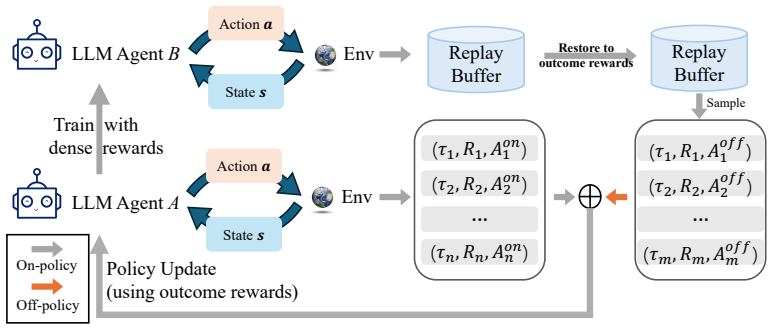
A cyclic reward-swap procedure lets dense process rewards expand the set of trajectories that an outcome-reward policy can learn from, without ever making the final optimization objective depend on those dense rewards. The resulting policy therefore inherits the exploration breadth of process supervision while remaining consistent with the true sparse task reward, producing higher success rates than either pure outcome or pure dense training.
What carries the argument
The reward-swap loop: Agent A is trained for k steps on dense rewards to become Agent B; B rolls out trajectories that are stored in a replay buffer after their rewards are restored to true outcome values; A is then updated off-policy on a mixture of its own on-policy data and high-reward samples drawn from that buffer (α = 1/8), using a generalized clipping center that accounts for the behavior policy of B.
Load-bearing premise
A fixed small fraction of off-policy data plus a simple clip-center shift is enough to keep the distribution of those samples close enough to the current policy that proximal updates stay stable.
What would settle it
Run the identical ALFWorld or WebShop protocol with α increased to 1/2 or higher (or with k large enough that Agent B overfits the dense reward) and check whether success rate falls back to or below the pure-outcome baseline; if it does not, the stability claim fails.
Editorial analysis
A structured set of objections, weighed in public.
Referee Report
Summary. The paper proposes Reward-Swap Policy Optimization (RSPO), a cyclic training framework for multi-turn LLM agents under sparse outcome rewards. An agent is first trained for k steps on dense process rewards (Agent B), which then explores and deposits trajectories into a replay buffer; those trajectories are re-labeled with ground-truth outcome rewards and mixed (at fixed ratio α) into off-policy updates of the original agent (Agent A) under a proximal objective (GRPO/PPO/GiGPO) that uses generalized clipping. The final optimization target therefore remains the true sparse reward while the dense-trained explorer expands the set of successful trajectories that can be learned. Experiments on ALFWorld and WebShop with Qwen2.5-1.5B/7B show consistent absolute gains (up to +12 % for 1.5B PPO) over the three baselines, with ablations isolating reward-based sampling, dense-versus-outcome buffer content, dense-reward noise, and the hyperparameters α and k.
Significance. If the reported gains hold under broader evaluation, RSPO supplies a simple, plug-and-play way to exploit imperfect process rewards without permanently biasing the policy toward them—an important practical contribution for long-horizon agent RL where pure outcome rewards are sparse and pure process rewards are misaligned. Strengths include multi-baseline, multi-seed tables, explicit reward-hacking demonstration (Fig. 3), noise-injection and hyper-parameter sensitivity studies (Appendix C–D), and a clear algorithmic description with pseudocode. The method is purely algorithmic and does not rely on circular definitions; the dense reward model is trained once offline and never used for the final objective.
major comments (2)
- Section 4.2 and Appendix C: the central stability claim rests on a fixed off-policy fraction α = 1/8 together with generalized clipping (Eq. 2). While the α-sweep correctly shows degradation at 1/4 and 1/2, the paper never measures the actual distribution shift (e.g., KL or TV distance between π_B and π_ heta) nor tests whether the same α remains safe when Agent B is allowed to train longer or when the dense reward model is substantially weaker. A short diagnostic of policy divergence inside each loop would make the load-bearing assumption falsifiable rather than merely empirically tuned.
- Table 1 and Section 5.2: absolute gains shrink markedly from 1.5B to 7B (average ~5–6 % → ~2–4 %). The authors attribute this to stronger base exploration, yet supply no quantitative evidence (state-visit diversity, success-trajectory coverage) that the 7B model already saturates the behavioral space that dense rewards open for the 1.5B model. Without such evidence the claim that RSPO “elevates the performance ceiling” remains only partially supported for stronger base models.
minor comments (5)
- Figure 1 caption and surrounding text: the phrase “behavioral space guided by outcome rewards” is never formalized; a one-sentence operational definition (e.g., support of the state-action occupancy under pure outcome training) would help readers interpret the schematic.
- Section 4.2.3 / Eq. (5)–(7): the dense-reward model is trained with MSE on trajectory sums; it is unclear whether step-level labels are obtained by simple division or by a learned attribution. Clarifying this (or citing the exact SPA-RL procedure) would improve reproducibility.
- Table 1: SPEAR reproductions under the authors’ smaller data/epoch budget are markedly worse than the original SPEAR paper; a brief note that the comparison is therefore not apples-to-apples would prevent misinterpretation.
- Appendix E reports identical-state counts as a diversity proxy; reporting the complementary metric (unique states visited) would make the exploration claim more transparent.
- Minor typos: “GiGPOw/ std” formatting, occasional missing spaces after periods, and inconsistent capitalization of “Agent A/B”.
Circularity Check
No significant circularity; RSPO is a self-contained algorithmic framework with empirical validation on external benchmarks.
full rationale
The paper presents an algorithmic training loop (dense-reward exploration by Agent B, reward-swap into an outcome-reward replay buffer, mixed on-/off-policy proximal updates of Agent A) whose objective is explicitly the ground-truth sparse outcome reward (Eqs. 1, 3–4). The dense process reward model is trained once offline via MSE on final returns (Eqs. 5–7) and is used only for trajectory generation, never as the final optimization target; Section 5.4 and Figure 3 explicitly demonstrate reward hacking when dense rewards are used alone, confirming the swap is not definitional. No quantity is fitted to data and then re-presented as a prediction, no uniqueness theorem is imported from the authors, and self-citations are limited to standard baselines (GRPO, PPO, GiGPO) and external dense-reward constructions (SPA-RL). Performance claims rest on independent ALFWorld/WebShop evaluations with multiple seeds and ablations (Tables 1–2, Appendix C–E). The derivation chain therefore contains no reduction of a claimed result to its own inputs by construction.
Axiom & Free-Parameter Ledger
free parameters (3)
- off-policy data ratio α =
1/8
- loop steps k =
3
- train data size split (14 on-policy + 2 off-policy) =
14+2
axioms (3)
- domain assumption Multi-turn agent–environment interaction is an MDP with sparse terminal reward.
- domain assumption Proximal policy gradient methods (PPO/GRPO) remain stable under a modest amount of off-policy data when generalized clipping is used.
- domain assumption A dense process reward model trained by MSE on trajectory returns can serve as a useful (if imperfect) exploration guide.
invented entities (1)
-
Reward-swap cycle (Agent A ↔ Agent B with outcome re-labeling)
no independent evidence
read the original abstract
Reinforcement learning holds significant potential for training large language models (LLMs) to handle multi-turn interactive tasks. However, in long-horizon, multi-turn tasks characterized by sparse outcome rewards, directly training with outcome rewards often results in slow convergence due to the sparsity of signals and the lack of fine-grained feedback. Furthermore, the model may fail to learn successful trajectories that are not sampled during training, thereby limiting its performance. Conversely, while employing customized dense process rewards provides richer signals and accelerates convergence, these surrogate rewards may exhibit potential misalignment with the ground-truth outcome rewards. This inconsistency can bias the training direction and ultimately degrade the model's final performance. In this work, we propose Reward-Swap Policy Optimization (RSPO), a method designed to leverage the rich information from dense process rewards to facilitate training with outcome rewards. By utilizing a reward-swap mechanism, RSPO ensures the diversity of sampled trajectories while guaranteeing consistency between the optimization objective and the true outcome rewards, thereby elevating the performance ceiling of the model. We conduct extensive experiments on two challenging agent benchmarks, WebShop and ALFWorld. By applying our method to various reinforcement learning algorithms, including GRPO, PPO, and GiGPO, we demonstrate that RSPO achieves consistent performance improvements across different baselines and benchmarks.
Figures


Reference graph
Works this paper leans on
-
[1]
Chain-of-thought prompting elicits reasoning in large language models
Jason Wei, Xuezhi Wang, Dale Schuurmans, Maarten Bosma, Fei Xia, Ed Chi, Quoc V Le, Denny Zhou, et al. Chain-of-thought prompting elicits reasoning in large language models. Advances in Neural Information Processing Systems, 35:24824–24837, 2022
2022
-
[2]
Gpt-4 technical report.arXiv preprint arXiv:2303.08774, 2023
Josh Achiam, Steven Adler, Sandhini Agarwal, Lama Ahmad, Ilge Akkaya, Florencia Leoni Aleman, Diogo Almeida, Janko Altenschmidt, Sam Altman, Shyamal Anadkat, et al. Gpt-4 technical report.arXiv preprint arXiv:2303.08774, 2023
Pith/arXiv arXiv 2023
-
[3]
Large language models encode clinical knowledge.Nature, 620(7972):172–180, 2023
Karan Singhal, Shekoofeh Azizi, Tao Tu, S Sara Mahdavi, Jason Wei, Hyung Won Chung, Nathan Scales, Ajay Tanwani, Heather Cole-Lewis, Stephen Pfohl, et al. Large language models encode clinical knowledge.Nature, 620(7972):172–180, 2023
2023
-
[4]
Bloomberggpt: A large language model for finance.arXiv preprint arXiv:2303.17564, 2023
Shijie Wu, Ozan Irsoy, Steven Lu, Vadim Dabravolski, Mark Dredze, Sebastian Gehrmann, Prabhanjan Kambadur, David Rosenberg, and Gideon Mann. Bloomberggpt: A large language model for finance.arXiv preprint arXiv:2303.17564, 2023
Pith/arXiv arXiv 2023
-
[5]
Training language models to follow instructions with human feedback.Advances in Neural Information Processing Systems, 35:27730–27744, 2022
Long Ouyang, Jeffrey Wu, Xu Jiang, Diogo Almeida, Carroll Wainwright, Pamela Mishkin, Chong Zhang, Sandhini Agarwal, Katarina Slama, Alex Ray, et al. Training language models to follow instructions with human feedback.Advances in Neural Information Processing Systems, 35:27730–27744, 2022
2022
-
[6]
Constitutional ai: Harmlessness from ai feedback.arXiv preprint arXiv:2212.08073, 2022
Yuntao Bai, Saurav Kadavath, Sandipan Kundu, Amanda Askell, Jackson Kernion, Andy Jones, Anna Chen, Anna Goldie, Azalia Mirhoseini, Cameron McKinnon, et al. Constitutional ai: Harmlessness from ai feedback.arXiv preprint arXiv:2212.08073, 2022
Pith/arXiv arXiv 2022
-
[7]
Qiying Yu, Zheng Zhang, Ruofei Zhu, Yufeng Yuan, Xiaochen Zuo, Yu Yue, Weinan Dai, Tiantian Fan, Gaohong Liu, Lingjun Liu, et al. Dapo: An open-source llm reinforcement learning system at scale.arXiv preprint arXiv:2503.14476, 2025
Pith/arXiv arXiv 2025
-
[8]
Understanding r1-zero-like training: A critical perspective.arXiv preprint arXiv:2503.20783, 2025
Zichen Liu, Changyu Chen, Wenjun Li, Penghui Qi, Tianyu Pang, Chao Du, Wee Sun Lee, and Min Lin. Understanding r1-zero-like training: A critical perspective.arXiv preprint arXiv:2503.20783, 2025
Pith/arXiv arXiv 2025
-
[9]
Mohit Shridhar, Xingdi Yuan, Marc-Alexandre Côté, Yonatan Bisk, Adam Trischler, and Matthew Hausknecht. Alfworld: Aligning text and embodied environments for interactive learning.arXiv preprint arXiv:2010.03768, 2020
Pith/arXiv arXiv 2010
-
[10]
Zhihong Shao, Peiyi Wang, Qihao Zhu, Runxin Xu, Junxiao Song, Xiao Bi, Haowei Zhang, Mingchuan Zhang, YK Li, Yang Wu, et al. Deepseekmath: Pushing the limits of mathematical reasoning in open language models.arXiv preprint arXiv:2402.03300, 2024
Pith/arXiv arXiv 2024
-
[11]
Hanlin Wang, Chak Tou Leong, Jiashuo Wang, Jian Wang, and Wenjie Li. Spa-rl: Reinforcing llm agents via stepwise progress attribution.arXiv preprint arXiv:2505.20732, 2025
Pith/arXiv arXiv 2025
-
[12]
Zijing Zhang, Ziyang Chen, Mingxiao Li, Zhaopeng Tu, and Xiaolong Li. Rlvmr: Reinforce- ment learning with verifiable meta-reasoning rewards for robust long-horizon agents.arXiv preprint arXiv:2507.22844, 2025
Pith/arXiv arXiv 2025
-
[13]
Group-in-group policy optimization for llm agent training.arXiv preprint arXiv:2505.10978, 2025
Lang Feng, Zhenghai Xue, Tingcong Liu, and Bo An. Group-in-group policy optimization for llm agent training.arXiv preprint arXiv:2505.10978, 2025
Pith/arXiv arXiv 2025
-
[14]
Proximal policy optimization algorithms.arXiv preprint arXiv:1707.06347, 2017
John Schulman, Filip Wolski, Prafulla Dhariwal, Alec Radford, and Oleg Klimov. Proximal policy optimization algorithms.arXiv preprint arXiv:1707.06347, 2017
Pith/arXiv arXiv 2017
-
[15]
Qwen2.5 technical report.arXiv preprint arXiv:2412.15115, 2024
An Yang, Baosong Yang, Beichen Zhang, Binyuan Hui, Bo Zheng, Bowen Yu, Chengyuan Li, Dayiheng Liu, Fei Huang, Haoran Wei, Huan Lin, Jian Yang, Jianhong Tu, Jianwei Zhang, Jianxin Yang, Jiaxi Yang, Jingren Zhou, Junyang Lin, Kai Dang, Keming Lu, Keqin Bao, Kexin Yang, Le Yu, Mei Li, Mingfeng Xue, Pei Zhang, Qin Zhu, Rui Men, Runji Lin, Tianhao Li, Tingyu X...
Pith/arXiv arXiv 2024
-
[16]
Let’s verify step by step
Hunter Lightman, Vineet Kosaraju, Yuri Burda, Harrison Edwards, Bowen Baker, Teddy Lee, Jan Leike, John Schulman, Ilya Sutskever, and Karl Cobbe. Let’s verify step by step. InThe twelfth International Conference on Learning Representations, 2023
2023
-
[17]
Daya Guo, Dejian Yang, Haowei Zhang, Junxiao Song, Ruoyu Zhang, Runxin Xu, Qihao Zhu, Shirong Ma, Peiyi Wang, Xiao Bi, et al. Deepseek-r1: Incentivizing reasoning capability in llms via reinforcement learning.arXiv preprint arXiv:2501.12948, 2025
Pith/arXiv arXiv 2025
-
[18]
Back to basics: Revisiting reinforce-style optimization for learning from human feedback in llms
Arash Ahmadian, Chris Cremer, Matthias Gallé, Marzieh Fadaee, Julia Kreutzer, Olivier Pietquin, Ahmet Üstün, and Sara Hooker. Back to basics: Revisiting reinforce-style optimization for learning from human feedback in llms. InProceedings of the 62nd Annual Meeting of the Association for Computational Linguistics (V olume 1: Long Papers), pages 12248–12267, 2024
2024
-
[19]
Jian Hu, Jason Klein Liu, Haotian Xu, and Wei Shen. Reinforce++: An efficient rlhf algorithm with robustness to both prompt and reward models.arXiv preprint arXiv:2501.03262, 1(3):5, 2025
Pith/arXiv arXiv 2025
-
[20]
Ziniu Li, Tian Xu, Yushun Zhang, Zhihang Lin, Yang Yu, Ruoyu Sun, and Zhi-Quan Luo. Remax: A simple, effective, and efficient reinforcement learning method for aligning large language models.arXiv preprint arXiv:2310.10505, 2023
Pith/arXiv arXiv 2023
-
[21]
Group sequence policy optimization.arXiv preprint arXiv:2507.18071, 2025
Chujie Zheng, Shixuan Liu, Mingze Li, Xiong-Hui Chen, Bowen Yu, Chang Gao, Kai Dang, Yuqiong Liu, Rui Men, An Yang, et al. Group sequence policy optimization.arXiv preprint arXiv:2507.18071, 2025
Pith/arXiv arXiv 2025
-
[22]
Learning to reason under off-policy guidance.arXiv preprint arXiv:2504.14945, 2025
Jianhao Yan, Yafu Li, Zican Hu, Zhi Wang, Ganqu Cui, Xiaoye Qu, Yu Cheng, and Yue Zhang. Learning to reason under off-policy guidance.arXiv preprint arXiv:2504.14945, 2025
Pith/arXiv arXiv 2025
-
[23]
Repo: Replay-enhanced policy optimization.arXiv preprint arXiv:2506.09340, 2025
Siheng Li, Zhanhui Zhou, Wai Lam, Chao Yang, and Chaochao Lu. Repo: Replay-enhanced policy optimization.arXiv preprint arXiv:2506.09340, 2025
Pith/arXiv arXiv 2025
-
[24]
Jing Liang, Hongyao Tang, Yi Ma, Jinyi Liu, Yan Zheng, Shuyue Hu, Lei Bai, and Jianye Hao. Squeeze the soaked sponge: Efficient off-policy reinforcement finetuning for large language model.arXiv preprint arXiv:2507.06892, 2025
Pith/arXiv arXiv 2025
-
[25]
Retool: Reinforcement learning for strategic tool use in llms.arXiv preprint arXiv:2504.11536, 2025
Jiazhan Feng, Shijue Huang, Xingwei Qu, Ge Zhang, Yujia Qin, Baoquan Zhong, Chengquan Jiang, Jinxin Chi, and Wanjun Zhong. Retool: Reinforcement learning for strategic tool use in llms.arXiv preprint arXiv:2504.11536, 2025
Pith/arXiv arXiv 2025
-
[26]
Torl: Scaling tool-integrated rl.arXiv preprint arXiv:2503.23383, 2025
Xuefeng Li, Haoyang Zou, and Pengfei Liu. Torl: Scaling tool-integrated rl.arXiv preprint arXiv:2503.23383, 2025
Pith/arXiv arXiv 2025
-
[27]
Bowen Jin, Hansi Zeng, Zhenrui Yue, Jinsung Yoon, Sercan Arik, Dong Wang, Hamed Za- mani, and Jiawei Han. Search-r1: Training llms to reason and leverage search engines with reinforcement learning.arXiv preprint arXiv:2503.09516, 2025
Pith/arXiv arXiv 2025
-
[28]
Zihan Wang, Kangrui Wang, Qineng Wang, Pingyue Zhang, Linjie Li, Zhengyuan Yang, Xing Jin, Kefan Yu, Minh Nhat Nguyen, Licheng Liu, et al. Ragen: Understanding self-evolution in llm agents via multi-turn reinforcement learning.arXiv preprint arXiv:2504.20073, 2025
Pith/arXiv arXiv 2025
-
[29]
Quan Wei, Siliang Zeng, Chenliang Li, William Brown, Oana Frunza, Wei Deng, Anderson Schneider, Yuriy Nevmyvaka, Yang Katie Zhao, Alfredo Garcia, and Mingyi Hong. Reinforcing multi-turn reasoning in llm agents via turn-level reward design.arXiv preprint arXiv:2505.11821, 2025
arXiv 2025
-
[30]
Agentic reinforced policy optimization
Guanting Dong, Hangyu Mao, Kai Ma, Licheng Bao, Yifei Chen, Zhongyuan Wang, Zhongxia Chen, Jiazhen Du, Huiyang Wang, Fuzheng Zhang, et al. Agentic reinforced policy optimization. arXiv preprint arXiv:2507.19849, 2025
Pith/arXiv arXiv 2025
-
[31]
Agentic entropy-balanced policy optimization.arXiv preprint arXiv:2510.14545, 2025
Guanting Dong, Licheng Bao, Zhongyuan Wang, Kangzhi Zhao, Xiaoxi Li, Jiajie Jin, Jing- han Yang, Hangyu Mao, Fuzheng Zhang, Kun Gai, et al. Agentic entropy-balanced policy optimization.arXiv preprint arXiv:2510.14545, 2025. 11
arXiv 2025
-
[32]
Yulei Qin, Xiaoyu Tan, Zhengbao He, Gang Li, Haojia Lin, Zongyi Li, Zihan Xu, Yuchen Shi, Siqi Cai, Renting Rui, et al. Learn the ropes, then trust the wins: Self-imitation with progressive exploration for agentic reinforcement learning.arXiv preprint arXiv:2509.22601, 2025
arXiv 2025
-
[33]
Self-imitation learning
Junhyuk Oh, Yijie Guo, Satinder Singh, and Honglak Lee. Self-imitation learning. InInterna- tional Conference on Machine Learning, pages 3878–3887. PMLR, 2018
2018
-
[34]
Agent learning via early experience.arXiv preprint arXiv:2510.08558, 2025
Kai Zhang, Xiangchao Chen, Bo Liu, Tianci Xue, Zeyi Liao, Zhihan Liu, Xiyao Wang, Yuting Ning, Zhaorun Chen, Xiaohan Fu, et al. Agent learning via early experience.arXiv preprint arXiv:2510.08558, 2025
Pith/arXiv arXiv 2025
-
[35]
Guoqing Wang, Sunhao Dai, Guangze Ye, Zeyu Gan, Wei Yao, Yong Deng, Xiaofeng Wu, and Zhenzhe Ying. Information gain-based policy optimization: A simple and effective approach for multi-turn llm agents.arXiv preprint arXiv:2510.14967, 2025
arXiv 2025
-
[36]
Zhirui Deng, Zhicheng Dou, Yutao Zhu, Ji-Rong Wen, Ruibin Xiong, Mang Wang, and Weipeng Chen. From novice to expert: Llm agent policy optimization via step-wise reinforcement learning.arXiv preprint arXiv:2411.03817, 2024
Pith/arXiv arXiv 2024
-
[37]
Process reinforcement through implicit rewards
Ganqu Cui, Lifan Yuan, Zefan Wang, Hanbin Wang, Yuchen Zhang, Jiacheng Chen, Wendi Li, Bingxiang He, Yuchen Fan, Tianyu Yu, et al. Process reinforcement through implicit rewards. arXiv preprint arXiv:2502.01456, 2025
Pith/arXiv arXiv 2025
-
[38]
Wenlin Zhang, Xiangyang Li, Kuicai Dong, Yichao Wang, Pengyue Jia, Xiaopeng Li, Yingyi Zhang, Derong Xu, Zhaocheng Du, Huifeng Guo, et al. Process vs. outcome reward: Which is better for agentic rag reinforcement learning.arXiv preprint arXiv:2505.14069, 2025
arXiv 2025
-
[39]
ReAct: Synergizing reasoning and acting in language models
Shunyu Yao, Jeffrey Zhao, Dian Yu, Nan Du, Izhak Shafran, Karthik Narasimhan, and Yuan Cao. ReAct: Synergizing reasoning and acting in language models. InInternational Conference on Learning Representations, 2023
2023
-
[40]
MIT press Cambridge, 1998
Richard S Sutton, Andrew G Barto, et al.Reinforcement learning: An introduction, volume 1. MIT press Cambridge, 1998
1998
-
[41]
Generalized proximal policy optimization with sample reuse.Advances in Neural Information Processing Systems, 34: 11909–11919, 2021
James Queeney, Yannis Paschalidis, and Christos G Cassandras. Generalized proximal policy optimization with sample reuse.Advances in Neural Information Processing Systems, 34: 11909–11919, 2021
2021
-
[42]
John Schulman, Philipp Moritz, Sergey Levine, Michael Jordan, and Pieter Abbeel. High- dimensional continuous control using generalized advantage estimation.arXiv preprint arXiv:1506.02438, 2015
Pith/arXiv arXiv 2015
-
[43]
Webshop: Towards scalable real-world web interaction with grounded language agents.Advances in Neural Information Processing Systems, 35:20744–20757, 2022
Shunyu Yao, Howard Chen, John Yang, and Karthik Narasimhan. Webshop: Towards scalable real-world web interaction with grounded language agents.Advances in Neural Information Processing Systems, 35:20744–20757, 2022
2022
-
[44]
Soft adaptive policy optimization.arXiv preprint arXiv:2511.20347, 2025
Chang Gao, Chujie Zheng, Xiong-Hui Chen, Kai Dang, Shixuan Liu, Bowen Yu, An Yang, Shuai Bai, Jingren Zhou, and Junyang Lin. Soft adaptive policy optimization.arXiv preprint arXiv:2511.20347, 2025
Pith/arXiv arXiv 2025
-
[45]
Dario Amodei, Chris Olah, Jacob Steinhardt, Paul Christiano, John Schulman, and Dan Mané. Concrete problems in ai safety.arXiv preprint arXiv:1606.06565, 2016. 12 A Implementation Details All our experiments are implemented based on VeRL-Agent. [13]. Throughout our experiments, we strictly adhered to the licensing terms for academic use associated with LL...
Pith/arXiv arXiv 2016
discussion (0)
Sign in with ORCID, Apple, or X to comment. Anyone can read and Pith papers without signing in.