REVIEW 4 major objections 6 minor 93 references
The 6D phase-space distribution of 5,000 halo tracers carries 2.5-9.9 times more information about the Milky Way-LMC masses and halo shape than standard all-sky velocity moments, and a joint 19-dimensional summary of basis-function coeffici
Reviewed by Pith at T0; open to challenge. T0 means a machine referee read the full paper against a public rubric. the ladder, T0–T4 →
T0 review · deepseek-v4-flash
2026-08-01 11:03 UTC pith:34VHYLSQ
load-bearing objection First real benchmark of information content in MW–LMC 6D phase space, with solid validation and an honest anisotropy stress test; headline ratios are approximate until CFM calibration is pinned down. the 4 major comments →
LMC-induced Perturbations in the Milky Way Halo II: Bridging Field-level Inference and Summary-level Simulation-Based Inference
The pith
A machine-rendered reading of the paper's core claim, the machinery that carries it, and where it could break.
Core claim
The paper trains a conditional flow matching model on 90% of an N-body simulation suite to evaluate the exact likelihood of a 5,000-particle 6D phase-space catalogue at a held-out parameter point, and uses it as a field-level benchmark. Against this benchmark, the 15-component all-sky velocity-moment summary is 2.5-9.9 times less constraining for the four parameters (MW mass, LMC mass, concentration, flattening). A four-dimensional MOPED compression of a 10-channel basis-function expansion (density plus three momentum and six dispersion fields) sits between the benchmarks, and a 19-dimensional vector combining these summaries with velocity moments reaches within a factor of 1.3-2.9 of the fi
What carries the argument
Three objects carry the argument. A conditional flow matching (CFM) generative model, trained on 90% of the simulation suite, provides a tractable likelihood for individual 6D phase-space particles and therefore a field-level information benchmark. A biorthogonal basis function expansion (BFE) projects the density field and the first and second velocity-moment fields onto spherical-harmonic and radial eigenfunctions, separating the reflex dipole, the wake, and the halo-shape quadrupole into interpretable channels. The MOPED algorithm then compresses the 10,800 active BFE coefficients into four linear summary statistics, one per model parameter, preserving the Fisher information of the origin
Load-bearing premise
The neural likelihood model, trained on 90% of the simulation suite and checked at a single held-out parameter point, is accurate enough to serve as the reference for how much information the raw phase-space data contains; if it is miscalibrated at other points, the quoted information ratios and the MOPED summary directions derived from its gradients shift.
What would settle it
Compute the neural-likelihood posterior for, say, five additional held-out simulations spread across the parameter box and check marginal and joint coverage; if the coverage deviates from nominal at any of these points, the field-level benchmark and the 2.5-9.9x information ratios used to rank summaries are not trustworthy. Alternatively, at one off-fiducial point, replace the neural-derived score gradients with explicit N-body finite differences and see whether the MOPED compression and the joint-summary gains survive.
If this is right
- If the field-level benchmark holds, any summary-based analysis that uses only all-sky velocity moments is leaving a factor of 2.5-9.9 in parameter constraining power unused.
- A joint 19-dimensional summary of BFE+MOPED and velocity moments provides most of the practical gain while remaining interpretable, reaching within a factor of 1.3-2.9 of the information limit.
- The mutual-information result implies that angular multipole information and radial-bin moments are complementary; combining them is always worthwhile, not a matter of taste.
- Because the MW-mass and concentration channels are driven by velocity-dispersion monopoles, inference from real, radially biased tracer populations will require careful treatment of anisotropy, or the mass and concentration estimates will shift.
- The BFE channel decomposition gives a diagnostic route: if a posterior shift is driven by a specific physical channel (e.g., second-moment velocities), that channel can be censored or modelled better.
Where Pith is reading between the lines
- The single-fiducial calibration leaves open the possibility that the field-level benchmark is optimistic elsewhere; a straightforward extension would test coverage at several additional held-out simulation points before trusting the 2.5-9.9x ratios in survey analyses.
- If this information hierarchy persists at other parameter points, the practical implication is that future halo surveys should consider collecting enough tracers to reach the joint-summary limit before investing in full field-level inference.
- The strong anisotropy sensitivity of the MW-mass and concentration channels suggests that adding a tracer-anisotropy nuisance parameter to the summary emulator may be more impactful than refining the density or velocity expansion.
Editorial analysis
A structured set of objections, weighed in public.
Referee Report
Summary. The paper presents a field-level likelihood benchmark for the constraining power of 6D phase-space tracer data on the MW-LMC parameter set (M_MW, M_LMC, c, q), based on a Conditional Flow Matching (CFM) generative model trained on the HaloDance N-body suite. Against this benchmark, the authors compare all-sky velocity-moment summaries and a BFE+MOPED linear compression, and then combine the two summary sets into a 19-dimensional vector. The headline claims are: (i) the CFM field-level posterior is tighter than a velocity-moment Fisher forecast by factors of 2.5-9.9 (Table 1); (ii) the joint 19D summary vector comes within a factor of 1.3-2.9 of the field-level benchmark (Table 2); and (iii) the BFE+MOPED summaries are physically interpretable and complementary to moments. The summary-level pipeline is validated extensively on 185 held-out parameter grids with P-P, TARP, and anisotropy stress tests.
Significance. If the quantitative claims survive scrutiny, the paper makes a useful contribution: it supplies an information bound for the MW-LMC problem and demonstrates that a modest number of interpretable summaries can retain much of the field-level information. The methodological structure—field-level benchmark plus summary-level SBI—is timely and the validation effort is above the norm for this literature. The anisotropy stress test is a particularly honest and valuable systematic check. The central numerical claims, however, rest on the CFM likelihood being a well-calibrated conditional density, and the same CFM is also used to build the MOPED summaries. Because no simulation-based calibration of the CFM is reported, the quantitative ratios in Tables 1-2 are not yet fully supported.
major comments (4)
- [Section 2.3, Table 1] The field-level benchmark is validated only at a single held-out fiducial point (Fig. 3). No P-P, TARP, or equivalent coverage test is reported for the CFM likelihood itself; Appendix D calibrates only the summary-level MDN emulator. Since the CFM marginal widths are the denominator of the headline 2.5-9.9 ratios and the reference for the 1.3-2.9 gap, an overconfident or biased CFM would directly inflate or shift these numbers. Please calibrate the CFM posterior on a set of held-out simulations (the 10% isotropic hold-out set provides roughly 185 such points) and report coverage diagnostics. If the CFM is miscalibrated, the benchmark should be re-derived or the ratios quoted as upper limits.
- [Appendix B, Eq. (B2)] The MOPED score derivatives are obtained by averaging CFM-generated realizations at off-grid parameter points. The same CFM defines the field-level benchmark, so the comparison is partly self-referential: a bias in the CFM's localised, high-order channels can simultaneously bias the benchmark widths and the MOPED projection directions in a way that makes the summary pipeline look closer to (or farther from) the field-level limit than it really is. Please demonstrate robustness, for example by recomputing the MOPED directions using simulation-based derivatives at the nearest LHS grid points, or by quantifying how much the Table 2 ratios change under plausible CFM mis-calibration.
- [Section 2.3, grid resolution] The 11-point-per-parameter grid spacing is comparable to the reported marginal widths: for q, Δq=0.006 versus σ_q=0.0084; for M_MW, Δ≈0.005×10^12 versus σ≈0.0066×10^12; for M_LMC, Δ≈0.024×10^11 versus σ≈0.036×10^11. The posterior marginals are also smoothed with a one-bin Gaussian kernel. At 1.3-2 grid spacings, the quoted widths may be significantly affected by the discretisation and smoothing rather than by the likelihood itself. Please recompute the CFM posterior on a finer local grid (or use a continuous interpolation/emulator) and verify that the Table 1 ratios and the subsequent comparisons are stable.
- [Section 2.2, Appendix A] The CFM likelihood is repeatedly described as 'exact', but the implemented log-likelihood uses the Hutchinson trace estimator with n_H=8 probe vectors and a fixed-step RK4 solver with 128 steps (Eq. A5-A6). These are controlled approximations, not exact evaluations. Please either soften the terminology or provide convergence checks in N_H and solver steps for the specific benchmark widths reported in Table 1.
minor comments (6)
- [Abstract and Section 3.2] The claim that MOPED 'preserves their Fisher information' is stated without the caveat that the implemented version uses a diagonal covariance approximation and finite-sample estimates. The caveat appears later in Appendix B and is handled honestly; please state it in the main text when MOPED is introduced.
- [Table 2] Please state explicitly in the table caption that the CFM column comes from a smoothed discrete grid posterior with one-bin Gaussian smoothing, and add the grid spacings so readers can assess the resolution issue directly.
- [Section 4.1] The mutual information estimates in Table 4 are reported without uncertainties. Since the complementarity conclusion (and hence the construction of the joint 19D vector) is based on these numbers, a simple bootstrap over validation points or a sensitivity check across training seeds would be useful.
- [Appendix D] The q parameter has a marginal P-P KS p-value of 3.1×10^-9, which is flagged and explained as weak leverage in parts of the prior. This is acceptable, but the explanation could be strengthened by showing that the q bias does not affect the parameter-ordering claims (the joint vector still beats moments and approaches CFM).
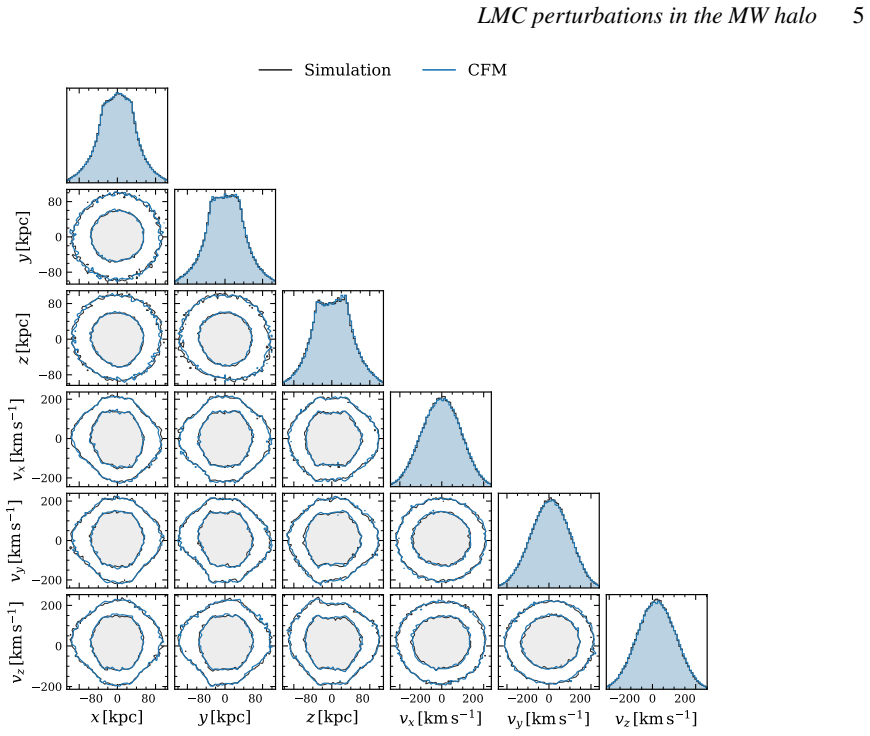
- [Figures 2 and 3] The qualitative overlap in Fig. 2 is convincing but could be quantified with a two-sample test on the 1D marginals or a lightweight distance metric. In Fig. 3, the CFM contours are smoothed grid posteriors while the Fisher forecasts are analytic ellipses; this asymmetry is fine but should be noted in the caption.
- [Section 6.3] The anisotropy stress test is a strong feature of the paper. Please also report the posterior widths in the anisotropic case explicitly (the text reports shifts but not the width comparison); this would help readers judge whether the failure is mainly a bias or also a width miscalibration.
Circularity Check
No significant circularity: the CFM benchmark is a held-out predictive test, the summary comparisons are measured quantities, and the shared CFM/MOPED score derivatives are a calibration caveat rather than a definitional reduction.
full rationale
Walking the derivation chain, I find no step in which a claimed prediction is identical by construction to a fitted input. The field-level benchmark is produced by a Conditional Flow Matching model trained on a 90% split of the HaloDance simulations with the fiducial simulation held out (Sec. 2.2, Figs. 2–3); the truth lying inside the 68% contour is a genuine out-of-sample test, not a re-statement of training data. The velocity-moment Fisher forecast is computed from the phase-space data and its covariance (Eqs. 1–3), independent of the CFM posterior. The BFE+MOPED summaries are built from the BFE coefficients of the same HaloDance particles, and the MOPED score derivatives are indeed drawn from the trained CFM (Appendix B), so the benchmark and the MOPED directions share a fitted model. This is a real shared-model systematic: if the CFM likelihood is miscalibrated, both the benchmark widths and the MOPED directions could be biased in correlated ways, affecting the quantitative 1.3–2.9 gap. However, the MOPED Fisher constraints are measured quantities (Sec. 3.3) rather than the CFM posterior itself, and MOPED's information-preservation property is a design identity, not a predicted discovery. The 185-grid summary-level validation and the anisotropy stress test provide independent checks of the qualitative ordering. Self-citations to the HaloDance suite are normal provenance and do not carry the argument through an unverified uniqueness claim. The limitations noted in the paper—single-fiducial CFM check, coarse 11-point grid, and the q P-P deviation—are calibration and precision concerns, not circularity.
Axiom & Free-Parameter Ledger
free parameters (4)
- CFM neural network weights =
~8.5e6 parameters
- BFE+MOPED radial truncation n_max =
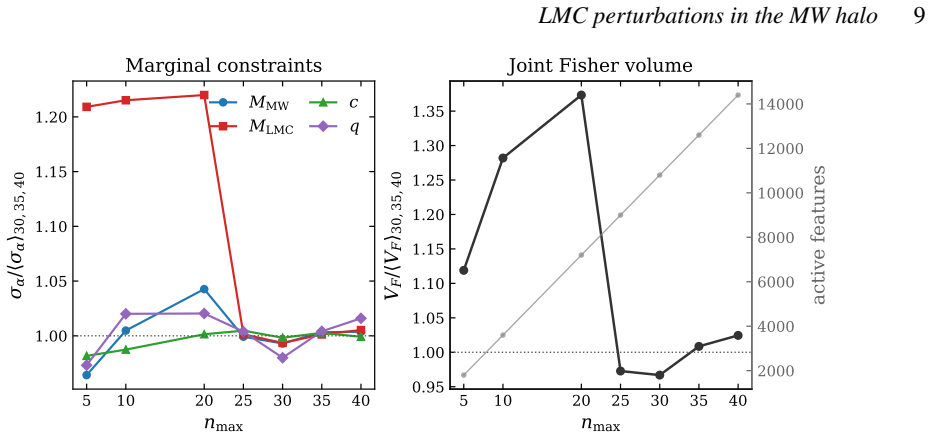
30
- CFM curriculum weighting w_i =
unspecified schedule
- CFM posterior grid smoothing kernel =
1 bin Gaussian
axioms (7)
- domain assumption CFM likelihood is a faithful approximation to the HaloDance phase-space distribution at the held-out fiducial and across parameter space.
- domain assumption Gaussian likelihood for the 15 velocity moments and the 19D joint summaries.
- domain assumption Biorthogonal BFE with NFW r_s=16 kpc, l_max=5, n_max=40 spans the halo fields in 30-120 kpc.
- ad hoc to paper MOPED with diagonal covariance preserves Fisher information.
- domain assumption Dark matter particles as equal-mass tracers with no selection function; beta=0 fiducial.
- domain assumption Uniform prior over the HaloDance parameter box.
- standard math Fisher/Cramer-Rao bound applies to the summary forecasts.
read the original abstract
The gravitational interaction between the Milky Way (MW) and the Large Magellanic Cloud (LMC) drives the outer halo into dynamical disequilibrium, imprinting the masses and structural parameters of both galaxies onto the 6D phase-space distribution of halo tracers. This signal has been characterised with summary statistics ranging from low-order velocity moments to basis function expansions, yet how much information these summaries discard, and whether they are complementary, remains unclear. We address these questions by comparing a field-level likelihood benchmark with physically interpretable summaries for constraining $(M_{\mathrm{MW}}, M_{\mathrm{LMC}}, c, q)$, where $c$ and $q$ are the MW halo concentration and flattening. A Conditional Flow Matching (CFM) model trained on the HaloDance $N$-body suite provides an exact likelihood at a held-out fiducial point; for 5,000 tracers in $30$--$120$~kpc it tightens marginal constraints by factors of $2.5$--$9.9$ over an all-sky velocity-moment forecast. We then expand the halo density and velocity fields in a multipole basis-function expansion (BFE) and compress the coefficients with the Massive Optimised Parameter Estimation and Data compression (MOPED) algorithm into four parameter-sensitive summaries that preserve their Fisher information. A variational mutual-information analysis shows that the BFE+MOPED summaries and the velocity moments are complementary, so we combine them into a joint $19$-dimensional vector as our primary inference pipeline: it tightens the marginal constraints by up to $15$ per cent over BFE+MOPED alone and by $30$--$71$ per cent over velocity moments alone, reaching within a factor of $1.3$--$2.9$ of the field-level benchmark. We thus establish a physically interpretable summary-level route to MW--LMC inference alongside the field-level benchmark that bounds its information content.
Figures





Reference graph
Works this paper leans on
-
[1]
The LMC Corona Favors a First Passage
The LMC Corona Favors a First Passage. arXiv e-prints , keywords =. doi:10.48550/arXiv.2510.03395 , archivePrefix =. 2510.03395 , primaryClass =
work page internal anchor Pith review Pith/arXiv arXiv doi:10.48550/arxiv.2510.03395
-
[2]
The Galaxy in Context: Structural, Kinematic, and Integrated Properties. , keywords =. doi:10.1146/annurev-astro-081915-023441 , archivePrefix =. 1602.07702 , primaryClass =
-
[3]
Measuring the Mass of the Large Magellanic Cloud with Stellar Streams Observed by S ^ 5. , keywords =. doi:10.3847/1538-4357/ac2e93 , archivePrefix =. 2107.13004 , primaryClass =
-
[4]
A determination of the Large Magellanic Cloud dark matter subhalo mass using the Milky Way halo stars in its gravitational wake. , keywords =. doi:10.1051/0004-6361/202347450 , archivePrefix =. 2309.12989 , primaryClass =
-
[5]
Third-epoch Magellanic Cloud Proper Motions. II. The Large Magellanic Cloud Rotation Field in Three Dimensions. , keywords =. doi:10.1088/0004-637X/781/2/121 , archivePrefix =. 1305.4641 , primaryClass =
-
[6]
The Mass of the Large Magellanic Cloud from the Three-dimensional Kinematics of Its Globular Clusters. , keywords =. doi:10.3847/1538-4357/ad1f58 , archivePrefix =. 2401.14458 , primaryClass =
-
[7]
The total mass of the Large Magellanic Cloud from its perturbation on the Orphan stream. , keywords =. doi:10.1093/mnras/stz1371 , archivePrefix =. 1812.08192 , primaryClass =
-
[8]
Tango for three: Sagittarius, LMC, and the Milky Way. , keywords =. doi:10.1093/mnras/staa3673 , archivePrefix =. 2009.10726 , primaryClass =
Pith/arXiv arXiv 2009
-
[9]
S ^ 5 : Probing the Milky Way and Magellanic Clouds potentials with the 6D map of the Orphan-Chenab stream. , keywords =. doi:10.1093/mnras/stad551 , archivePrefix =. 2211.04495 , primaryClass =
-
[10]
Implications of the Milky Way Travel Velocity for Dynamical Mass Estimates of the Local Group. , keywords =. doi:10.3847/1538-4357/aca01f , archivePrefix =. 2204.07173 , primaryClass =
-
[11]
The Distant Milky Way Halo from the Southern Hemisphere: Characterization of the LMC-induced Dynamical Friction Wake. , keywords =. doi:10.3847/1538-4357/adbf08 , archivePrefix =. 2410.00114 , primaryClass =
-
[12]
And Yet it Moves: The Dangers of Artificially Fixing the Milky Way Center of Mass in the Presence of a Massive Large Magellanic Cloud. , keywords =. doi:10.1088/0004-637X/802/2/128 , archivePrefix =. 1408.4128 , primaryClass =
-
[13]
The influence of Sagittarius and the Large Magellanic Cloud on the stellar disc of the Milky Way Galaxy. , keywords =. doi:10.1093/mnras/sty1574 , archivePrefix =. 1710.02538 , primaryClass =
-
[14]
Response of the Milky Way's disc to the Large Magellanic Cloud in a first infall scenario. , keywords =. doi:10.1093/mnras/stx2146 , archivePrefix =. 1608.04743 , primaryClass =
-
[15]
Hunting for the Dark Matter Wake Induced by the Large Magellanic Cloud. , keywords =. doi:10.3847/1538-4357/ab32eb , archivePrefix =. 1902.05089 , primaryClass =
Pith/arXiv arXiv 1902
-
[16]
Reflex motion in the Milky Way stellar halo resulting from the Large Magellanic Cloud infall. , keywords =. doi:10.1093/mnrasl/slaa029 , archivePrefix =. 2001.09142 , primaryClass =
Pith/arXiv arXiv 2001
-
[17]
Detection of the LMC-induced sloshing of the Galactic halo. , keywords =. doi:10.1093/mnras/stab1828 , archivePrefix =. 2010.13789 , primaryClass =
Pith/arXiv arXiv 2010
-
[18]
The Effect of the LMC on the Milky Way System. Galaxies , keywords =. doi:10.3390/galaxies11020059 , archivePrefix =. 2304.09136 , primaryClass =
-
[19]
The Open Journal of Astrophysics , keywords =
Effect of the Large Magellanic Cloud on the kinematics of Milky Way satellites and virial mass estimate. The Open Journal of Astrophysics , keywords =. doi:10.33232/001c.120316 , archivePrefix =. 2405.06017 , primaryClass =
-
[20]
Uncovering the first-infall history of the LMC through its dynamical impact in the Milky Way halo. , keywords =. doi:10.1093/mnras/stae2259 , archivePrefix =. 2404.08975 , primaryClass =
-
[21]
HaloDance simulation suite and observational forecasts
LMC-induced perturbations in the Milky Way halo ─ I. HaloDance simulation suite and observational forecasts. , keywords =. doi:10.1093/mnras/staf1780 , archivePrefix =. 2507.03663 , primaryClass =
-
[22]
The Milky Way - Large Magellanic Cloud Interaction with Simulation Based Inference
The Milky Way - Large Magellanic Cloud Interaction with Simulation Based Inference. arXiv e-prints , keywords =. doi:10.48550/arXiv.2510.04735 , archivePrefix =. 2510.04735 , primaryClass =
work page internal anchor Pith review Pith/arXiv arXiv doi:10.48550/arxiv.2510.04735
-
[23]
A simulation-based inference approach to the dynamics of the MW─LMC system - validation. , keywords =. doi:10.1093/mnras/staf2111 , archivePrefix =. 2507.10667 , primaryClass =
-
[24]
Quantifying the Milky Way, LMC and their interaction using all-sky kinematics of outer halo stars. , keywords =. doi:10.1093/mnras/stag926 , archivePrefix =. 2603.08788 , primaryClass =
-
[25]
Shaping the Milky Way. II. The dark matter halo's response to the LMC's passage in a cosmological context. arXiv e-prints , keywords =. doi:10.48550/arXiv.2511.02031 , archivePrefix =. 2511.02031 , primaryClass =
-
[26]
The effect of dynamical friction on the orbit of the Magellanic Clouds. , keywords =. doi:10.1086/154049 , adsurl =
-
[27]
The Magellanic Stream and the Galaxy with a Massive Halo. , keywords =. doi:10.1093/pasj/32.4.581 , adsurl =
-
[28]
On the proper motion of the Magellanic Clouds and the halo mass of our galaxy. , keywords =. doi:10.1093/mnras/198.3.707 , adsurl =
-
[29]
The Proper Motion of the Large Magellanic Cloud Using HST. , keywords =. doi:10.1086/498972 , archivePrefix =. astro-ph/0508457 , primaryClass =
-
[30]
Third-epoch Magellanic Cloud Proper Motions. I. Hubble Space Telescope/WFC3 Data and Orbit Implications. , keywords =. doi:10.1088/0004-637X/764/2/161 , archivePrefix =. 1301.0832 , primaryClass =
-
[31]
Are the Magellanic Clouds on Their First Passage about the Milky Way?. , keywords =. doi:10.1086/521385 , archivePrefix =. astro-ph/0703196 , primaryClass =
-
[32]
The frequency of dwarf galaxy multiples at low redshift in SDSS versus cosmological expectations. , keywords =. doi:10.1093/mnras/sty2041 , archivePrefix =. 1807.06673 , primaryClass =
-
[33]
Dear Magellanic Clouds, welcome back!. , keywords =. doi:10.1093/mnras/stad2612 , archivePrefix =. 2306.04837 , primaryClass =
-
[34]
The Milky Way Tomography with Subaru Hyper Suprime-Cam: Implications for the past orbit of the Large Magellanic Cloud. arXiv e-prints , keywords =. doi:10.48550/arXiv.2604.10281 , archivePrefix =. 2604.10281 , primaryClass =
work page internal anchor Pith review Pith/arXiv arXiv doi:10.48550/arxiv.2604.10281
-
[35]
Detection of the Milky Way reflex motion due to the Large Magellanic Cloud infall. Nature Astronomy , keywords =. doi:10.1038/s41550-020-01254-3 , archivePrefix =. 2011.10581 , primaryClass =
Pith/arXiv arXiv 2011
-
[36]
Dynamical Friction. II. The Rate of Escape of Stars from Clusters and the Evidence for the Operation of Dynamical Friction. , year = 1943, month = mar, volume =. doi:10.1086/144518 , adsurl =
doi:10.1086/144518 1943
-
[37]
Revisiting Dynamical Friction: The Role of Global Modes and Local Wakes. , keywords =. doi:10.3847/1538-4357/ac0627 , archivePrefix =. 2007.13763 , primaryClass =
Pith/arXiv arXiv 2007
-
[38]
Structure, Kinematics, and Observability of the Large Magellanic Cloud's Dynamical Friction Wake in Cold versus Fuzzy Dark Matter. , keywords =. doi:10.3847/1538-4357/ace533 , archivePrefix =. 2307.00053 , primaryClass =
-
[39]
All-sky dynamical response of the Galactic halo to the Large Magellanic Cloud. , keywords =. doi:10.1038/s41586-021-03385-7 , archivePrefix =. 2104.09515 , primaryClass =
-
[40]
The radial variation of the LMC-induced reflex motion of the Milky Way disc observed in the stellar halo. , keywords =. doi:10.1093/mnras/stae1363 , archivePrefix =. 2402.10841 , primaryClass =
-
[41]
All-sky Kinematics of the Distant Halo: The Reflex Response to the LMC. , keywords =. doi:10.3847/1538-4357/addab6 , archivePrefix =. 2406.01676 , primaryClass =
-
[42]
Exploring the interaction between the MW and LMC with a large sample of blue horizontal branch stars from the DESI survey. , keywords =. doi:10.1093/mnras/staf1219 , archivePrefix =. 2410.09149 , primaryClass =
-
[43]
The velocity field of our Milky Way outer stellar halo based on DESI DR2. arXiv e-prints , keywords =. doi:10.48550/arXiv.2604.01628 , archivePrefix =. 2604.01628 , primaryClass =
-
[44]
The M31─M33 Interaction: Impact on M31's Center-of-mass Motion and Satellite Orbits. , keywords =. doi:10.3847/1538-4357/adc992 , archivePrefix =. 2504.02805 , primaryClass =
-
[45]
The Pisces Plume and the Magellanic wake. , keywords =. doi:10.1093/mnrasl/slz101 , archivePrefix =. 1904.07909 , primaryClass =
Pith/arXiv arXiv 1904
-
[46]
Quantifying the Impact of the Large Magellanic Cloud on the Structure of the Milky Way's Dark Matter Halo Using Basis Function Expansions. , keywords =. doi:10.3847/1538-4357/ac0b44 , archivePrefix =. 2010.00816 , primaryClass =
Pith/arXiv arXiv 2010
-
[47]
Modeling the recent interactions between the Magellanic Clouds and Milky Way. arXiv e-prints , keywords =. doi:10.48550/arXiv.2602.05021 , archivePrefix =. 2602.05021 , primaryClass =
-
[48]
The effect of the deforming dark matter haloes of the Milky Way and the Large Magellanic Cloud on the Orphan-Chenab stream. , keywords =. doi:10.1093/mnras/stac3108 , archivePrefix =. 2205.01688 , primaryClass =
-
[49]
Mapping the Distorted Dark Matter Distribution of the LMC─SMC System Prior to Milky Way Infall with Basis Function Expansions. , keywords =. doi:10.3847/1538-4357/ae4a9d , archivePrefix =. 2601.00946 , primaryClass =
-
[50]
Constraining the Milky Way Halo Kinematics via Its Linear Response to the Large Magellanic Cloud. , keywords =. doi:10.3847/1538-4357/ac7139 , archivePrefix =. 2201.05589 , primaryClass =
-
[51]
Quantifying the Stellar Halo's Response to the LMC's Infall with Spherical Harmonics. , keywords =. doi:10.3847/1538-4357/ab9b88 , archivePrefix =. 2006.08621 , primaryClass =
Pith/arXiv arXiv 2006
-
[52]
Euclid preparation. I. The Euclid Wide Survey. , keywords =. doi:10.1051/0004-6361/202141938 , archivePrefix =. 2108.01201 , primaryClass =
-
[53]
Journal of Astronomical Telescopes, Instruments, and Systems , keywords =
Astrometry with the Wide-Field Infrared Space Telescope. Journal of Astronomical Telescopes, Instruments, and Systems , keywords =. doi:10.1117/1.JATIS.5.4.044005 , archivePrefix =. 1712.05420 , primaryClass =
-
[54]
Science China Physics, Mechanics, and Astronomy , keywords =
Introduction to the Chinese Space Station Survey Telescope (CSST). Science China Physics, Mechanics, and Astronomy , keywords =. doi:10.1007/s11433-025-2809-0 , archivePrefix =. 2507.04618 , primaryClass =
-
[55]
The DESI Experiment Part I: Science,Targeting, and Survey Design. arXiv e-prints , keywords =. doi:10.48550/arXiv.1611.00036 , archivePrefix =. 1611.00036 , primaryClass =
-
[56]
Research in Astronomy and Astrophysics , year = 2012, month = sep, volume =
The Large Sky Area Multi-Object Fiber Spectroscopic Telescope (LAMOST). Research in Astronomy and Astrophysics , year = 2012, month = sep, volume =. doi:10.1088/1674-4527/12/9/003 , adsurl =
-
[57]
4MOST: Project overview and information for the First Call for Proposals. The Messenger , keywords =. doi:10.18727/0722-6691/5117 , archivePrefix =. 1903.02464 , primaryClass =
Pith/arXiv arXiv 1903
-
[58]
The wide-field, multiplexed, spectroscopic facility WEAVE: Survey design, overview, and simulated implementation. , keywords =. doi:10.1093/mnras/stad557 , archivePrefix =. 2212.03981 , primaryClass =
-
[59]
Mapping the Stellar Halo with the H3 Spectroscopic Survey. , keywords =. doi:10.3847/1538-4357/ab38b8 , archivePrefix =. 1907.07684 , primaryClass =
Pith/arXiv arXiv 1907
-
[60]
Ground-based and Airborne Instrumentation for Astronomy VI , year = 2016, editor =
Prime Focus Spectrograph (PFS) for the Subaru telescope: overview, recent progress, and future perspectives. Ground-based and Airborne Instrumentation for Astronomy VI , year = 2016, editor =. doi:10.1117/12.2232103 , archivePrefix =. 1608.01075 , primaryClass =
Pith/arXiv arXiv 2016
-
[61]
Deep Learning in Astrophysics. arXiv e-prints , keywords =. doi:10.48550/arXiv.2510.10713 , archivePrefix =. 2510.10713 , primaryClass =
-
[62]
Flow Matching for Generative Modeling. arXiv e-prints , keywords =. doi:10.48550/arXiv.2210.02747 , archivePrefix =. 2210.02747 , primaryClass =
-
[63]
Flow Matching Guide and Code. arXiv e-prints , keywords =. doi:10.48550/arXiv.2412.06264 , archivePrefix =. 2412.06264 , primaryClass =
-
[64]
The Gravitational Field of Flat Galaxies. , keywords =. doi:10.1007/BF00643095 , adsurl =
-
[65]
An Adaptive Algorithm for N-Body Field Expansions. , keywords =. doi:10.1086/300669 , archivePrefix =. astro-ph/9805357 , primaryClass =
-
[66]
The Journal of Open Source Software , keywords =
EXP: a Python/C++ package for basis function expansion methods in galactic dynamics. The Journal of Open Source Software , keywords =. doi:10.21105/joss.07302 , archivePrefix =. 2505.06403 , primaryClass =
-
[67]
Massive lossless data compression and multiple parameter estimation from galaxy spectra. , keywords =. doi:10.1046/j.1365-8711.2000.03692.x , archivePrefix =. astro-ph/9911102 , primaryClass =
arXiv 2000
-
[68]
A Universal Density Profile from Hierarchical Clustering. , keywords =. doi:10.1086/304888 , archivePrefix =. astro-ph/9611107 , primaryClass =
-
[69]
Three-Dimensional Models for the Distribution of Mass in Galaxies. , keywords =. doi:10.1093/pasj/27.4.533 , adsurl =
-
[70]
An Analytical Model for Spherical Galaxies and Bulges. , keywords =. doi:10.1086/168845 , adsurl =
-
[71]
An iterative method for the construction of N-body galaxy models in collisionless equilibrium. , keywords =. doi:10.1093/mnras/stu1421 , archivePrefix =. 1402.1623 , primaryClass =
-
[72]
Simulating cosmic structure formation with the GADGET-4 code. , keywords =. doi:10.1093/mnras/stab1855 , archivePrefix =. 2010.03567 , primaryClass =
Pith/arXiv arXiv 2010
-
[73]
Building Normalizing Flows with Stochastic Interpolants. arXiv e-prints , keywords =. doi:10.48550/arXiv.2209.15571 , archivePrefix =. 2209.15571 , primaryClass =
-
[74]
KRATOS: A large suite of N-body simulations to interpret the stellar kinematics of LMC-like discs. , keywords =. doi:10.1051/0004-6361/202349058 , archivePrefix =. 2404.04061 , primaryClass =
-
[75]
Milky Way-est: Cosmological Zoom-in Simulations with Large Magellanic Cloud and Gaia─Sausage─Enceladus Analogs. , keywords =. doi:10.3847/1538-4357/ad554c , archivePrefix =. 2404.08043 , primaryClass =
-
[76]
Variational Inference with Normalizing Flows. arXiv e-prints , keywords =. doi:10.48550/arXiv.1505.05770 , archivePrefix =. 1505.05770 , primaryClass =
-
[77]
Neural Spline Flows. arXiv e-prints , keywords =. doi:10.48550/arXiv.1906.04032 , archivePrefix =. 1906.04032 , primaryClass =
-
[78]
Deep Unsupervised Learning using Nonequilibrium Thermodynamics. arXiv e-prints , keywords =. doi:10.48550/arXiv.1503.03585 , archivePrefix =. 1503.03585 , primaryClass =
-
[79]
Denoising Diffusion Probabilistic Models. arXiv e-prints , keywords =. doi:10.48550/arXiv.2006.11239 , archivePrefix =. 2006.11239 , primaryClass =
-
[80]
Score-Based Generative Modeling through Stochastic Differential Equations. arXiv e-prints , keywords =. doi:10.48550/arXiv.2011.13456 , archivePrefix =. 2011.13456 , primaryClass =
discussion (0)
Sign in with ORCID, Apple, or X to comment. Anyone can read and Pith papers without signing in.