REVIEW 2 major objections 5 minor 73 references
The paper claims that the directional Fisher information of a pulsar timing array can be recast into analytic, direction-resolved sensitivity curves that reduce any anisotropic sky to a single effective spectrum, recovering the isotropic li
Reviewed by Pith at T0; open to challenge. T0 means a machine referee read the full paper against a public rubric. the ladder, T0–T4 →
T0 review · deepseek-v4-flash
2026-08-04 00:54 UTC pith:35AFJYSN
load-bearing objection Useful, honest methods/software paper that recasts the known directional Fisher matrix as per-frequency sensitivity curves; the full-Fisher absolute scale is SVD-threshold-dependent as the authors admit, but the radiometer and sky-weighted curves and the code make it worth refereeing. the 2 major comments →
Directional Anisotropic Sensitivity Curves for Pulsar Timing Arrays
The pith
A machine-rendered reading of the paper's core claim, the machinery that carries it, and where it could break.
Core claim
On the paper's own terms, the central discovery is that the directional Fisher matrix M(Ω, Ω′; f), assembled from pairs of pulsars weighted by their duty cycle and by the inverse product of the two pulsars' noise spectra, contains the full directional sensitivity of the array. Inverting its diagonal element gives the radiometer sensitivity (the uncertainty on one sky direction assuming all others are empty); inverting the whole matrix and taking the diagonal gives the full-Fisher sensitivity (the uncertainty on that direction when all other directions are left free); contracting the matrix against the sky power P(Ω) on both sides gives a sky-weighted curve that reduces the anisotropic sky to
What carries the argument
The load-bearing object is the directional Fisher information matrix M(Ω, Ω′; f), a kernel on the sky built from per-pulsar-pair responses R_IJ(Ω) weighted by T_IJ/(T_obs S_I(f)S_J(f)). It carries both how much information the array has about each sky direction (its diagonal) and how strongly the quadrupolar antenna pattern couples different directions (its off-diagonal). All three sensitivity curves are algebraic functions of this matrix—diagonal, inverse-diagonal, or a double sky integral—so once M is built from the noise models, every sensitivity map follows in closed form. The eigenmodes of M define the principal-map basis, the one basis in which the two estimators coincide.
Load-bearing premise
The absolute scale of the marginalized (full-Fisher) sensitivity curves rests on a chosen numerical threshold for inverting a nearly singular matrix—the paper's own appendix shows the curves shift by orders of magnitude with that threshold—so if the goal is an array-only absolute sensitivity map, that convention, not the array, is carrying the scale.
What would settle it
Take a simulated array with P(Ω)=1 everywhere and compute the sky-weighted S_eff at every frequency: if it does not numerically coincide with the standard isotropic sensitivity curve (beyond roundoff), the claimed reduction fails. For the full-Fisher branch, fix two different inversion thresholds and compare the median S_full_eff; the paper predicts a large shift, so a threshold-independent result would directly falsify its characterization of the inversion.
If this is right
- Any pulsar timing array can now produce a per-direction, per-frequency sensitivity map directly from its pulsar noise models, without Monte Carlo calibration.
- The sky-weighted curve turns an arbitrary anisotropic angular power distribution into a single effective strain-noise spectrum, and the isotropic limit reproduces the standard sensitivity curve exactly, so the new tool contains the old one.
- The radiometer and full-Fisher curves bracket the isotropic curve direction by direction; the size of the gap is a geometric property of the array (it is independent of observing time) that quantifies how mixed the array's directional information is.
- For detection statistics, applying the Fisher matrix forward (no inversion) yields a full-Fisher SNR that recovers the standard isotropic detection statistic in the P=1 limit, while the radiometer total falls far short for diffuse skies; the gap between the two is a direct measure of coherence lost by diagonal estimation.
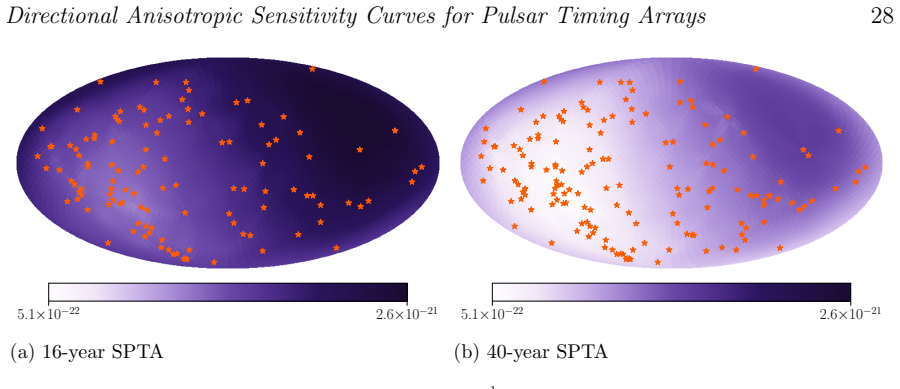
- Forecasting a larger, longer-baseline array with this framework shows sensitivity improving across the whole sky, with the largest gains at low frequencies, and the shape of the directional gap changing little as the array grows.
Where Pith is reading between the lines
- Editorial extension: Because the absolute full-Fisher sensitivity scale shifts by over two orders of magnitude with the chosen matrix-inversion threshold (the paper's own appendix shows this), a fair comparison of absolute S_full_eff values between different arrays will require a community-standard truncation convention; the angular pattern of the gap, by contrast, is robust.
- Editorial extension: The framework's separation of astrophysical from instrumental anisotropy suggests a concrete planning use: an array could rank candidate new pulsars by how much they reduce S_eff in the least-sensitive sky regions, effectively designing the angular response rather than just measuring it.
- Editorial extension: Since the paper's implementation already admits frequency-dependent angular power P(f, Ω), applying the curves to a real dataset with the expected f^{11/3} growth of anisotropy would give a direct, model-based test of whether hotspots brighten at high frequency before they are individually resolvable.
- Editorial extension: The radiometer/full-Fisher gap could serve as a diagnostic for estimator choice: in directions where the gap is large, clean-map uncertainties will dominate and a Bayesian or principal-map treatment may be preferable.
Editorial analysis
A structured set of objections, weighed in public.
Referee Report
Summary. The paper develops an analytic framework for directional effective sensitivity curves in pulsar timing arrays, extending the isotropic hasasia formalism to arbitrary anisotropic skies. Starting from the cross-correlation estimator and the Ali-Haïmoud/Smith/Mingarelli and Pol/Taylor/Romano Fisher formalism, it defines a radiometer sensitivity S_rad_eff = 1/sqrt(M_ΩΩ), a full-Fisher sensitivity S_full_eff = sqrt([M^{-1}]_ΩΩ), and a sky-weighted S_eff = (∫∫ P M P)^{-1/2}. The sky-weighted curve is shown to reduce to the Hazboun/Romano/Smith isotropic sensitivity when P=1. The framework is implemented in an extension of hasasia with five sky-decomposition bases (pixel, spherical harmonic, square-root spherical harmonic, radiometer, principal-map), and demonstrated on a simulated IPTA-like array: angular response maps, Fisher-matrix structure, injected von Mises-Fisher hotspots, and 16-year to 40-year sensitivity forecasts.
Significance. If the central claim holds, the paper provides a useful and much-needed extension of PTA sensitivity-curve tools to the anisotropic case, with a public code release. The closed-form definition of the sky-weighted S_eff and its exact reduction to the isotropic limit are clean and valuable. The radiometer branch is well-defined and independent of regularization. The paper is also unusually transparent in Appendix A about the conditioning problem of the full-Fisher inversion. However, the full-Fisher branch, which is a headline object in the title and abstract, has an absolute scale set by an ad hoc SVD threshold rather than by the array alone, so the claim that these curves are derived directly from per-pulsar noise models is only partially true. The paper is a methods/forecasting contribution rather than a measurement, which mitigates the circularity concern: the derivations are largely definitions, but they are useful definitions with explicit consistency checks.
major comments (2)
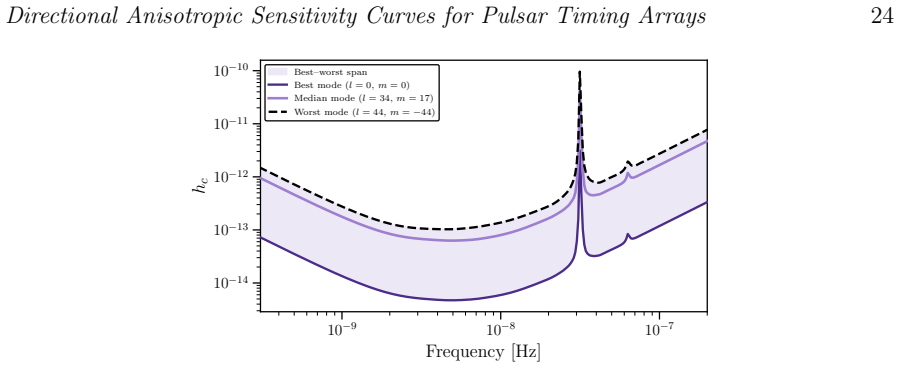
- [§2.5, Eq. (21); Appendix A, Fig. A1] The full-Fisher sensitivity S_full_eff = sqrt([M^{-1}]_ΩΩ) is presented as an array-only directional sensitivity. Appendix A shows that the inverse is a truncated-SVD pseudo-inverse with rcond=10^{-10}, and that sweeping rcond from 10^{-6} to 10^{-12} changes the median S_full_eff/S_rad_eff by more than two orders of magnitude. Thus the absolute scale of S_full_eff and h_c^full is not a property of the array alone. The paper acknowledges this and says the absolute values are not figures of merit, but Figures 10 and 17 display full-Fisher envelopes as sensitivity curves without a prominent caveat, and the abstract/title feature the full-Fisher estimator. Please reframe the full-Fisher branch as a regularized estimator variance with explicit regularization dependence, or restrict the central claim to the radiometer and sky-weighted curves.
- [§2.6, Eq. (26) and §4.1, Eqs. (33)-(34)] There is an apparent double-counting of the pixel normalization. The paper defines R_IJ,k = R_IJ(Ω_k)/Npix (Eq. 33), which makes the discrete Fisher matrix M_kk = Σ_IJ (T_IJ/T_obs) R_IJ,k^2/(S_I S_J) = M_continuous(Ω_k,Ω_k)/Npix^2. Yet Eq. 34 writes M_kk'(f)=M(Ω_k,Ω_k';f) without the 1/Npix^2 factor, and Eq. 26 divides M(Ω_k,Ω_k;f) by Npix^2 again. If M(Ω_k,Ω_k) in Eq. 26 is the discrete matrix, the per-pixel SNRs in Figures 5, 11, 12 and Table 2 are off by Npix^2; if it is the continuous kernel, Eq. 34 should say so explicitly. Please state clearly which object is used and verify the radiometer totals against an independent normalization check.
minor comments (5)
- [Eq. (30)] σ(Ω;f) = sqrt(M^{-1}(Ω,Ω)/T_obs) equals S_full_eff / sqrt(T_obs), not S_full_eff * sqrt(T_obs). Please correct the displayed equality and the accompanying sentence.
- [Figures 10 and 17] Add a note in the captions that the absolute scale of the full-Fisher envelope depends on the SVD threshold rcond used for the inversion (see Appendix A), so that the figure is not read as an array-only sensitivity.
- [§5.4] The language 'recovery of injected hotspots' describes expected-SNR skymaps computed by applying the same Fisher matrix forward, not an end-to-end recovery from simulated noise realizations. Consider using 'expected SNR for an injected hotspot' to avoid overstating the demonstration.
- [§4.6] Typo: 'hasasiasupports' should be 'hasasia supports'.
- [§2.5 and §4.5] The statement that the principal-map basis is unique in making S_rad_eff = S_full_eff is essentially tautological, since any basis that diagonalizes M would have this property. The usefulness of the principal-map basis is the mode ordering and SNR sum; consider rephrasing the uniqueness claim.
Circularity Check
No material circularity: the S_eff quantities are definitional extensions of the Fisher formalism, the isotropic-limit recovery is a consistency check, and the self-citations are supporting rather than load-bearing; the Appendix A regularization issue is a robustness caveat, not a circular step.
full rationale
Equations 20-22 define S_eff directly in terms of the Fisher matrix M (radiometer: 1/sqrt(M_ΩΩ); full-Fisher: sqrt([M^-1]_ΩΩ); sky-weighted: [∫∫ P M P]^-1/2). These are definitions of an effective strain-noise from the Fisher information, not derivations that hide an input as an output. The Cauchy-Schwarz ordering of Sec. 2.5 and the principal-map collapse (Eq. 49) are mathematical identities following from those definitions, so they are not circular predictions. The isotropic-limit recovery (Eq. 23) is explicitly a consistency check against Hazboun, Romano & Smith (2019), and the self-citations to [33]-[35] supply the noise-model and isotropic-curve inputs rather than being invoked to forbid alternatives. The paper reports no empirical predictions: the injection-recovery results in Sec. 5.4 apply the forward Fisher operator to a known injected sky and read off SNRs. Appendix A does assert a real limitation: the absolute full-Fisher sensitivity scale is set by the chosen SVD truncation, not by the array alone ('the absolute scale of the full-Fisher quantities is set by the truncation and not by the array alone'). That is a convention-dependence/robustness caveat for one branch, not a circular reduction; no fitted quantity is relabeled as a prediction, and the radiometer, sky-weighted, and total-SNR results are regularization-independent. Under the hard-rule definitions, no load-bearing step reduces to its own inputs, so the circularity score is 0.
Axiom & Free-Parameter Ledger
free parameters (3)
- SVD truncation threshold rcond =
10^-10 fiducial (swept 10^-6 to 10^-12)
- Pixel-basis resolution Nside =
16
- SPTA white-noise rescaling =
tuned to 16-yr GWB SNR ~7
axioms (6)
- domain assumption Spectral and angular dependence separate: P(f,Omega) -> P(Omega)
- domain assumption Earth-term only, weak-signal limit; pulsar term neglected
- domain assumption Covariance between distinct pulsar pairs is neglected; only per-pair variances are used
- standard math Stationary noise with Toeplitz covariance diagonalized by a Fourier basis
- ad hoc to paper The near-singular Fisher matrix can be replaced by a regularized pseudo-inverse whose spectrum encodes meaningful modes
- ad hoc to paper Pixel-basis normalization: R_IJ,k = R_IJ(Omega_k)/Npix and isotropic P_k=1 with sum P_k=Npix
read the original abstract
After two decades of observations, pulsar timing array collaborations have reported strong evidence for a stochastic gravitational wave background, most likely sourced by an inspiraling population of supermassive black hole binaries. Because that population is finite, anisotropy in the background is inevitable, producing hotspots on the sky that track the loudest binaries. Building on the Fisher formalism for anisotropic backgrounds, we recast the directional Fisher information as effective sensitivity curves on the sky, distinguishing the radiometer and full-Fisher estimators, along with a sky-weighted curve that reduces the anisotropic sky to a single spectrum and recovers the standard isotropic curve in the isotropic limit. We implement five sky-decomposition bases: pixel, spherical harmonic, square-root spherical harmonic, radiometer, and principal-map. We demonstrate the framework on an IPTA-like pulsar timing array: characterizing the angular response, analyzing the Fisher structure, recovering injected anisotropic hotspots, and forecasting future-array sensitivity. The framework is released as an extension to the sensitivity software package hasasia.
Figures






Reference graph
Works this paper leans on
-
[1]
Sazhin M V 1978Soviet Astronomy2236–38 ISSN 0038-5301 aDS Bibcode: 1978SvA....22...36S URLhttps://ui.adsabs.harvard.edu/abs/1978SvA....22...36S
-
[2]
Detweiler S 1979ApJ2341100 ISSN 0004-637X, 1538-4357 URLhttp://adsabs.harvard.edu/ doi/10.1086/157593
-
[3]
We briefly review the specifications of the simulated PTA here
SPTA: An IPTA-like simulated PTA In this work, we use the same simulated dataset that was created in [35] to be realistic in its noise heterogeneity and similar in scale and sensitivity to the International Pulsar Timing Array (IPTA) [55]. We briefly review the specifications of the simulated PTA here. The distribution of pulsars in the simulated PTA is d...
-
[4]
The choice of basis is important as each provides a different parameterization of the angular power distribution and no single basis is uniformly the best
Anisotropy Bases The Fisher objectM( ˆΩ, ˆΩ′;f) is basis-agnostic, but in practice the sky powerP( ˆΩ) has to be parameterized by a finite set of coefficients{a µ}with a chosen basis{B µ( ˆΩ)}. The choice of basis is important as each provides a different parameterization of the angular power distribution and no single basis is uniformly the best. We impl...
2026
-
[5]
These maps describe the array’s angular response to different regions of the sky, set by the pulsar locations
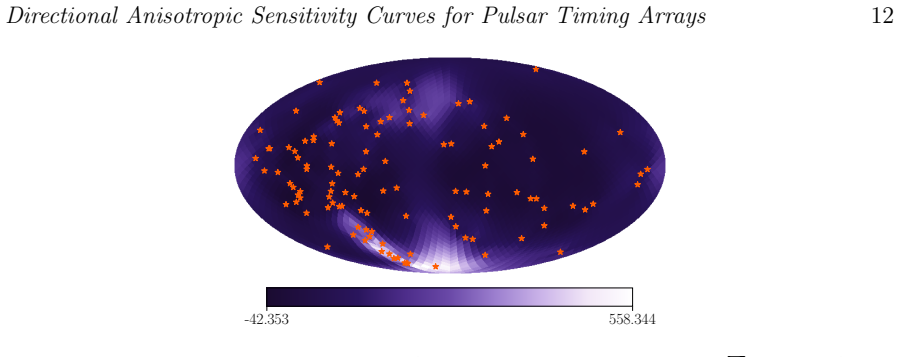
Results Throughout this section, we setP k = 1 to denote a sky-isotropic background, so that the results characterize the intrinsic angular sensitivity of the SPTA itself, before any astrophysical injection is layered on top. These maps describe the array’s angular response to different regions of the sky, set by the pulsar locations. The SPTA serves as a...
2026
-
[6]
Conclusion We have developed an analytical framework for directional anisotropic sensitivity curves in pulsar timing arrays, implemented inhasasia. Starting from the cross-correlation estimator, we recast the directional Fisher information as effective sensitivity curves on the sky,S eff(f, ˆΩ) andh c(f, ˆΩ), and carried two estimators throughout: the rad...
2020
-
[7]
harvard.edu/doi/10.1086/169195
Foster R S and Backer D C 1990ApJ361300 ISSN 0004-637X, 1538-4357 URLhttp://adsabs. harvard.edu/doi/10.1086/169195
-
[8]
Hellings R W and Downs G S 1983ApJ265L39 ISSN 0004-637X, 1538-4357 URLhttp: //adsabs.harvard.edu/doi/10.1086/183954
-
[9]
Agazie G, Anumarlapudi A, Archibald A M, Arzoumanian Z, Baker P T, B´ ecsy B, Blecha L, Brazier A, Brook P R, Burke-Spolaor S, Burnette R, Case R, Charisi M, Chatterjee S, Chatziioannou K, Cheeseboro B D, Chen S, Cohen T, Cordes J M, Cornish N J, Crawford F, Cromartie H T, Crowter K, Cutler C J, DeCesar M E, DeGan D, Demorest P B, Deng H, Dolch T, Drachle...
2041
-
[10]
EPTA Collaboration and InPTA Collaboration:, Antoniadis J, Arumugam P, Arumugam S, Babak S, Bagchi M, Bak Nielsen A S, Bassa C G, Bathula A, Berthereau A, Bonetti M, Bortolas E, Brook P R, Burgay M, Caballero R N, Chalumeau A, Champion D J, Chanlaridis S, Chen S, Cognard I, Dandapat S, Deb D, Desai S, Desvignes G, Dhanda-Batra N, Dwivedi C, Falxa M, Ferdm...
-
[11]
Reardon D J, Zic A, Shannon R M, Hobbs G B, Bailes M, Di Marco V, Kapur A, Rogers A F, Thrane E, Askew J, Bhat N D R, Cameron A, Cury lo M, Coles W A, Dai S, Goncharov B, Kerr M, Kulkarni A, Levin Y, Lower M E, Manchester R N, Mandow R, Miles M T, Nathan R S, Os lowski S, Russell C J, Spiewak R, Zhang S and Zhu X J 2023ApJL951L6 ISSN 2041-8205, 2041-8213 ...
-
[12]
Xu H, Chen S, Guo Y, Jiang J, Wang B, Xu J, Xue Z, Nicolas Caballero R, Yuan J, Xu Y, Wang J, Hao L, Luo J, Lee K, Han J, Jiang P, Shen Z, Wang M, Wang N, Xu R, Wu X, Manchester R, Qian L, Guan X, Huang M, Sun C and Zhu Y 2023Res. Astron. Astrophys.23075024 ISSN 1674- 4527, 2397-6209 URLhttps://iopscience.iop.org/article/10.1088/1674-4527/acdfa5
-
[13]
Phinney E S 2001 A Practical Theorem on Gravitational Wave Backgrounds arXiv:astro- ph/0108028 URLhttp://arxiv.org/abs/astro-ph/0108028 Directional Anisotropic Sensitivity Curves for Pulsar Timing Arrays36
arXiv 2001
-
[14]
Sesana A, Vecchio A and Colacino C N 2008Monthly Notices of the Royal Astronomical Society390 192–209 ISSN 00358711, 13652966 URLhttps://academic.oup.com/mnras/article-lookup/ doi/10.1111/j.1365-2966.2008.13682.x
arXiv 2008
-
[15]
Sesana A 2013Monthly Notices of the Royal Astronomical Society: Letters433L1–L5 ISSN 1745- 3933, 1745-3925 URLhttps://academic.oup.com/mnrasl/article/433/1/L1/954113
-
[16]
Romano J D and Cornish N J 2017Living Rev Relativ202 ISSN 2367-3613, 1433-8351 URL http://link.springer.com/10.1007/s41114-017-0004-1
-
[17]
Arzoumanian Z, Baker P T, Blumer H, B´ ecsy B, Brazier A, Brook P R, Burke-Spolaor S, Chatterjee S, Chen S, Cordes J M, Cornish N J, Crawford F, Cromartie H T, DeCesar M E, Demorest P B, Dolch T, Ellis J A, Ferrara E C, Fiore W, Fonseca E, Garver-Daniels N, Gentile P A, Good D C, Hazboun J S, Holgado A M, Islo K, Jennings R J, Jones M L, Kaiser A R, Kapla...
2041
-
[18]
Begelman M C, Blandford R D and Rees M J 1980Nature287307–309 ISSN 0028-0836, 1476-4687 URLhttps://www.nature.com/articles/287307a0
-
[19]
Rajagopal M and Romani R W 1995ApJ446543 ISSN 0004-637X, 1538-4357 arXiv:astro- ph/9412038 URLhttp://arxiv.org/abs/astro-ph/9412038
-
[20]
Jaffe A H and Backer D C 2003ApJ583616–631 ISSN 0004-637X, 1538-4357 URLhttps: //iopscience.iop.org/article/10.1086/345443
-
[21]
Kormendy J and Richstone D 1995Annu. Rev. Astron. Astrophys.33581–624 ISSN 0066-4146, 1545-4282 URLhttps://www.annualreviews.org/doi/10.1146/annurev.aa.33. 090195.003053
-
[22]
Ferrarese L and Merritt D 2000The Astrophysical Journal539L9–L12 ISSN 0004637X URL https://iopscience.iop.org/article/10.1086/312838
-
[23]
Gebhardt K, Bender R, Bower G, Dressler A, Faber S M, Filippenko A V, Green R, Grillmair C, Ho L C, Kormendy J, Lauer T R, Magorrian J, Pinkney J, Richstone D and Tremaine S 2000 The Astrophysical Journal539L13–L16 ISSN 0004637X URLhttps://iopscience.iop.org/ article/10.1086/312840
doi:10.1086/312840 2000
-
[24]
McConnell N J and Ma C P 2013ApJ764184 ISSN 0004-637X, 1538-4357 URLhttps: //iopscience.iop.org/article/10.1088/0004-637X/764/2/184
-
[25]
Kormendy J and Ho L C 2013Annu. Rev. Astron. Astrophys.51511–653 ISSN 0066-4146, 1545- 4282 URLhttps://www.annualreviews.org/doi/10.1146/annurev-astro-082708-101811
-
[26]
Burke-Spolaor S, Taylor S R, Charisi M, Dolch T, Hazboun J S, Holgado A M, Kelley L Z, Lazio T J W, Madison D R, McMann N, Mingarelli C M F, Rasskazov A, Siemens X, Simon J J and Smith T L 2019Astron Astrophys Rev275 ISSN 0935-4956, 1432-0754 URL http://link.springer.com/10.1007/s00159-019-0115-7
-
[27]
Mingarelli C M F, Sidery T, Mandel I and Vecchio A 2013Phys. Rev. D88062005 ISSN 1550-7998, 1550-2368 URLhttps://link.aps.org/doi/10.1103/PhysRevD.88.062005
-
[28]
Mingarelli C M F, Lazio T J W, Sesana A, Greene J E, Ellis J A, Ma C P, Croft S, Burke-Spolaor S and Taylor S R 2017Nat Astron1886–892 ISSN 2397-3366 arXiv:1708.03491 [astro-ph] URL http://arxiv.org/abs/1708.03491
-
[29]
Sato-Polito G and Kamionkowski M 2024Phys. Rev. D109123544 ISSN 2470-0010, 2470-0029 URLhttps://link.aps.org/doi/10.1103/PhysRevD.109.123544
-
[30]
Lin M X, Lidz A and Ma C P 2026 Analytical Estimates of Gravitational Wave Background Anisotropies from Shot Noise and Large-Scale Structure in Pulsar Timing Arrays arXiv:2602.16808 [astro-ph] URLhttp://arxiv.org/abs/2602.16808
arXiv 2026
-
[31]
Raidal J, Urrutia J, Vaskonen V and Veerm¨ ae H 2026A&A706A159 (Preprint2411.19692) Directional Anisotropic Sensitivity Curves for Pulsar Timing Arrays37
-
[32]
Lemke A M, Mitridate A and Gersbach K A 2024 Detecting Gravitational Wave Anisotropies from Supermassive Black Hole Binaries arXiv:2407.08705 [astro-ph] URLhttp://arxiv.org/ abs/2407.08705
Pith/arXiv arXiv 2024
-
[33]
Taylor S, Mingarelli C, Gair J, Sesana A, Theureau G, Babak S, Bassa C, Brem P, Burgay M, Caballero R, Champion D, Cognard I, Desvignes G, Guillemot L, Hessels J, Janssen G, Karuppusamy R, Kramer M, Lassus A, Lazarus P, Lentati L, Liu K, Os lowski S, Perrodin D, Petiteau A, Possenti A, Purver M, Rosado P, Sanidas S, Smits R, Stappers B, Tiburzi C, Van Haa...
-
[34]
Agazie G, Anumarlapudi A, Archibald A M, Arzoumanian Z, Baker P T, B´ ecsy B, Blecha L, Brazier A, Brook P R, Burke-Spolaor S, Casey-Clyde J A, Charisi M, Chatterjee S, Cohen T, Cordes J M, Cornish N J, Crawford F, Cromartie H T, Crowter K, DeCesar M E, Demorest P B, Dolch T, Drachler B, Ferrara E C, Fiore W, Fonseca E, Freedman G E, Gardiner E, Garver- D...
Pith/arXiv arXiv 2023
-
[35]
Grunthal K, Champion D J, Thrane E, Nathan R S, Kramer M and Miles M T 2026A&A706A352 ISSN 0004-6361, 1432-0746 URLhttps://www.aanda.org/10.1051/0004-6361/202557896
-
[36]
Chen Y, Zhao S Y, Peng Z Z, Zhu X, Bhat N R, Chen Z C, Cury lo M, Di Marco V, Hobbs G, Kapur A, Ling W, Mandow R, Mishra S, Reardon D J, Russell C J, Shannon R M, Tremblay J C, Wang J, Zhang L and Zic A 2026Phys. Rev. D113043042 ISSN 2470-0010, 2470-0029 URLhttps://link.aps.org/doi/10.1103/czxp-zrd6
-
[37]
Hazboun J S, Romano J D and Smith T L 2019Phys. Rev. D100104028 ISSN 2470-0010, 2470-0029 URLhttps://link.aps.org/doi/10.1103/PhysRevD.100.104028
-
[38]
Hazboun J, Romano J and Smith T 2019Journal of Open Source Software41775 ISSN 2475-9066 URLhttps://joss.theoj.org/papers/10.21105/joss.01775
-
[39]
Baier J G, Hazboun J S and Romano J D 2025Class. Quantum Grav.42075008 ISSN 0264-9381, 1361-6382 URLhttps://iopscience.iop.org/article/10.1088/1361-6382/adbbab
-
[40]
Thrane E, Ballmer S, Romano J D, Mitra S, Talukder D, Bose S and Mandic V 2009Phys. Rev. D80122002 ISSN 1550-7998, 1550-2368 arXiv:0910.0858 [astro-ph] URLhttp://arxiv.org/ abs/0910.0858
-
[41]
Moore C J, Cole R H and Berry C P L 2015Class. Quantum Grav.32015014 ISSN 0264-9381, 1361-6382 URLhttps://iopscience.iop.org/article/10.1088/0264-9381/32/1/015014
-
[42]
3847/2041-8205/819/1/L6
Taylor S R, Vallisneri M, Ellis J A, Mingarelli C M F, Lazio T J W and Haasteren R V 2016 ApJL819L6 ISSN 2041-8205, 2041-8213 URLhttps://iopscience.iop.org/article/10. 3847/2041-8205/819/1/L6
2016
-
[43]
Ali-Ha ¨ ımoud Y, Smith T L and Mingarelli C M 2020Phys. Rev. D102122005 ISSN 2470-0010, 2470-0029 URLhttps://link.aps.org/doi/10.1103/PhysRevD.102.122005
-
[44]
Ali-Ha ¨ ımoud Y, Smith T L and Mingarelli C M F 2021Phys. Rev. D103042009 ISSN 2470-0010, 2470-0029 URLhttps://link.aps.org/doi/10.1103/PhysRevD.103.042009
-
[45]
Pol N, Taylor S R and Romano J D 2022ApJ940173 ISSN 0004-637X, 1538-4357 URL https://iopscience.iop.org/article/10.3847/1538-4357/ac9836 Directional Anisotropic Sensitivity Curves for Pulsar Timing Arrays38
-
[46]
Babak S, Falxa M, Franciolini G and Pieroni M 2024Phys. Rev. D110063022 ISSN 2470-0010, 2470-0029 URLhttps://link.aps.org/doi/10.1103/PhysRevD.110.063022
-
[47]
Depta P F, Domcke V, Franciolini G and Pieroni M 2025Phys. Rev. D111083039 ISSN 2470-0010, 2470-0029 URLhttps://link.aps.org/doi/10.1103/PhysRevD.111.083039
-
[48]
J.Submitted
Moursy T T, Pol N S, Agazie Get al.2026Astrophys. J.Submitted
-
[49]
Taylor S R and Gair J R 2013Phys. Rev. D88084001 ISSN 1550-7998, 1550-2368 URL https://link.aps.org/doi/10.1103/PhysRevD.88.084001
-
[50]
Gair J, Romano J D, Taylor S and Mingarelli C M 2014Phys. Rev. D90082001 ISSN 1550-7998, 1550-2368 URLhttps://link.aps.org/doi/10.1103/PhysRevD.90.082001
-
[51]
Gersbach K A, Taylor S R, B´ ecsy B, Lemke A M, Mitridate A and Pol N 2026 Mapping the gravitational-wave background across the spectrum with a next-generation anisotropic per- frequency optimal statistic URLhttps://link.aps.org/doi/10.1103/d55k-75p9
-
[52]
Allen B and Romano J D 1999Phys. Rev. D59102001 ISSN 0556-2821, 1089-4918 URL https://link.aps.org/doi/10.1103/PhysRevD.59.102001
-
[53]
Anholm M, Ballmer S, Creighton J D E, Price L R and Siemens X 2009Phys. Rev. D79084030 ISSN 1550-7998, 1550-2368 URLhttps://link.aps.org/doi/10.1103/PhysRevD.79.084030
-
[54]
Chamberlin S J, Creighton J D, Siemens X, Demorest P, Ellis J, Price L R and Romano J D 2015Phys. Rev. D91044048 ISSN 1550-7998, 1550-2368 URLhttps://link.aps.org/doi/ 10.1103/PhysRevD.91.044048
-
[55]
Crisostomi M, van Haasteren R, Meyers P M and Vallisneri M 2025arXiv e-prints ArXiv:2506.13866 (Preprint2506.13866)
-
[56]
Vallisneri M 2008Phys. Rev. D77042001 ISSN 1550-7998, 1550-2368 URLhttps://link.aps. org/doi/10.1103/PhysRevD.77.042001
-
[57]
Semenzato F, Bellomo N, Raccanelli A and Mingarelli C M F 2025 Bias from small-scale leakage in Pulsar Timing Array maps arXiv:2510.24857 [astro-ph] URLhttp://arxiv.org/abs/2510. 24857
Pith/arXiv arXiv 2025
-
[58]
Mitra S, Dhurandhar S, Souradeep T, Lazzarini A, Mandic V, Bose S and Ballmer S 2008Phys. Rev. D77042002 ISSN 1550-7998, 1550-2368 URLhttps://link.aps.org/doi/10.1103/ PhysRevD.77.042002
-
[59]
Verbiest J P W, Lentati L, Hobbs G, van Haasteren R, Demorest P B, Janssen G H, Wang J B, Desvignes G, Caballero R N, Keith M J, Champion D J, Arzoumanian Z, Babak S, Bassa C G, Bhat N D R, Brazier A, Brem P, Burgay M, Burke-Spolaor S, Chamberlin S J, Chatterjee S, Christy B, Cognard I, Cordes J M, Dai S, Dolch T, Ellis J A, Ferdman R D, Fonseca E, Gair J...
-
[60]
Agazie G, Alam M F, Anumarlapudi A, Archibald A M, Arzoumanian Z, Baker P T, Blecha L, Bonidie V, Brazier A, Brook P R, Burke-Spolaor S, B´ ecsy B, Chapman C, Charisi M, Chatterjee S, Cohen T, Cordes J M, Cornish N J, Crawford F, Cromartie H T, Crowter K, Decesar M E, Demorest P B, Dolch T, Drachler B, Ferrara E C, Fiore W, Fonseca E, Freedman G E, Garver...
-
[61]
Agazie G, Anumarlapudi A, Archibald A M, Arzoumanian Z, Baker P T, B´ ecsy B, Blecha L, Brazier A, Brook P R, Burke-Spolaor S, Charisi M, Chatterjee S, Cohen T, Cordes J M, Cornish N J, Crawford F, Cromartie H T, Crowter K, Decesar M E, Demorest P B, Dolch T, Drachler B, Ferrara E C, Fiore W, Fonseca E, Freedman G E, Garver-Daniels N, Gentile P A, Glaser ...
-
[62]
Agazie G, Antoniadis J, Anumarlapudi A, Archibald A M, Arumugam P, Arumugam S, Arzoumanian Z, Askew J, Babak S, Bagchi M, Bailes M, Bak Nielsen A S, Baker P T, Bassa C G, Bathula A, B´ ecsy B, Berthereau A, Bhat N D R, Blecha L, Bonetti M, Bortolas E, Brazier A, Brook P R, Burgay M, Burke-Spolaor S, Burnette R, Caballero R N, Cameron A, Case R, Chalumeau ...
-
[63]
Gorski K M, Hivon E, Banday A J, Wandelt B D, Hansen F K, Reinecke M and Bartelmann M 2005ApJ622759–771 ISSN 0004-637X, 1538-4357 URLhttps://iopscience.iop.org/ article/10.1086/427976 Directional Anisotropic Sensitivity Curves for Pulsar Timing Arrays40
-
[64]
Agarwal D, Romano J D, Ali-Ha ¨ ımoud Y and Smith T L 2026 Addressing leakage and mode suppression in angular power spectrum estimation for gravitational-wave backgrounds using pulsar timing arrays arXiv:2602.20075 [gr-qc] URLhttp://arxiv.org/abs/2602.20075
arXiv 2026
-
[65]
Taylor S R, Van Haasteren R and Sesana A 2020Phys. Rev. D102084039 ISSN 2470-0010, 2470-0029 URLhttps://link.aps.org/doi/10.1103/PhysRevD.102.084039
-
[66]
Konstandin T, Lemke A M, Mitridate A and Perboni E 2026J. Cosmol. Astropart. Phys.2026084 ISSN 1475-7516 URLhttps://iopscience.iop.org/article/10.1088/1475-7516/2026/02/ 084
-
[67]
Fisher R 1953Proceedings of the Royal Society A: Mathematical, Physical and Engineering Sciences 217295–305 ISSN 1364-5021, 1471-2946 URLhttp://rspa.royalsocietypublishing.org/ cgi/doi/10.1098/rspa.1953.0064
arXiv 1953
-
[68]
Wiley) ISBN 978-0-471-95333-3 978-0-470-31781-5 978-0-470-31697-9
Mardia K V and Jupp P E (eds) 2010Directional statisticsWiley series in probability and statistics (Chichester New York: J. Wiley) ISBN 978-0-471-95333-3 978-0-470-31781-5 978-0-470-31697-9
-
[69]
Siemens X, Ellis J, Jenet F and Romano J D 2013Class. Quantum Grav.30224015 ISSN 0264-9381, 1361-6382 URLhttps://iopscience.iop.org/article/10.1088/0264-9381/30/ 22/224015
-
[70]
Virtanen P, Gommers R, Oliphant T E, Haberland M, Reddy T, Cournapeau D, Burovski E, Peterson P, Weckesser W, Bright J, van der Walt S J, Brett M, Wilson J, Millman K J, Mayorov N, Nelson A R J, Jones E, Kern R, Larson E, Carey C J, Polat˙I, Feng Y, Moore E W, VanderPlas J, Laxalde D, Perktold J, Cimrman R, Henriksen I, Quintero E A, Harris C R, Archibald...
-
[71]
Harris C R, Millman K J, van der Walt S J, Gommers R, Virtanen P, Cournapeau D, Wieser E, Taylor J, Berg S, Smith N J, Kern R, Picus M, Hoyer S, van Kerkwijk M H, Brett M, Haldane A, del R ´ ıo J F, Wiebe M, Peterson P, G´ erard-Marchant P, Sheppard K, Reddy T, Weckesser W, Abbasi H, Gohlke C and Oliphant T E 2020Nature585357–362 URL https://doi.org/10.10...
-
[72]
Hunter J D 2007Computing in Science & Engineering990–95
-
[73]
Zonca A, Singer L P, Lenz D, Reinecke M, Rosset C, Hivon E and Gorski K M 2019Journal of Open Source Software41298 URLhttps://doi.org/10.21105/joss.01298
discussion (0)
Sign in with ORCID, Apple, or X to comment. Anyone can read and Pith papers without signing in.